ISSN 2234-3806 • eISSN 2234-3814
https://doi.org/10.3343/alm.2020.40.2.131
Urinary Biomarkers may Complement the Cleveland Score for Prediction of Adverse Kidney Events After Cardiac Surgery: A Pilot Study
Christian Albert , M.D.1,2, Michael Haase , M.D.1,2, Annemarie Albert , M.D.2,3, Siegfried Kropf , Ph.D.4,
Rinaldo Bellomo , M.D.5, Sabine Westphal , M.D.6, Mark Westerman, Ph.D.7ϯ, Rüdiger Christian Braun-Dullaeus , M.D.8, and Anja Haase-Fielitz , Pharm.D.9,10
1Faculty of Medicine, Otto-von-Guericke University Magdeburg, Magdeburg, Germany; 2Diaverum Renal Services, MVZ Potsdam, Potsdam, Germany;
3Department of Nephrology and Endocrinology, Klinikum Ernst von Bergmann, Potsdam, Germany; 4Institute for Biometrics and Medical Informatics, Otto- von-Guericke University Magdeburg, Magdeburg, Germany; 5School of Medicine, University of Melbourne, Melbourne, Australia; 6Institute of Laboratory Medicine, Hospital Dessau, Dessau, Germany; 7Intrinsic LifeSciences, La Jolla, CA, USA; 8Department of Internal Medicine, University Clinic for Cardiology and Angiology, Otto-von-Guericke University Magdeburg, Magdeburg, Germany; 9Department of Cardiology, Immanuel Diakonie Bernau, Heart Center Brandenburg, Brandenburg Medical School Theodor Fontane (MHB), Germany; 10Institute of Social Medicine and Health Economics, Otto-von-Guericke University Magdeburg, Magdeburg, Germany
Background: The ability of urinary biomarkers to complement established clinical risk pre- diction models for postoperative adverse kidney events is unclear. We assessed the effect of urinary biomarkers linked to suspected pathogenesis of cardiac surgery-induced acute kidney injury (AKI) on the performance of the Cleveland Score, a risk assessment model for postoperative adverse kidney events.
Methods: This pilot study included 100 patients who underwent open-heart surgery. We determined improvements to the Cleveland Score when adding urinary biomarkers mea- sured using clinical laboratory platforms (neutrophil gelatinase-associated lipocalin [NGAL], interleukin-6) and those in the preclinical stage (hepcidin-25, midkine, alpha-1 microglobulin), all sampled immediately post-surgery. The primary endpoint was major adverse kidney events (MAKE), and the secondary endpoint was AKI. We performed ROC curve analysis, assessed baseline model performance (odds ratios [OR], 95% CI), and carried out statistical reclassification analyses to assess model improvement.
Results: NGAL (OR [95% CI] per 20 concentration-units wherever applicable): (1.07 [1.01–1.14]), Interleukin-6 (1.51 [1.01–2.26]), midkine (1.01 [1.00–1.02]), 1-hepci- din-25 (1.08 [1.00–1.17]), and NGAL/hepcidin-ratio (2.91 [1.30–6.49]) were indepen- dent predictors of MAKE and AKI (1.38 [1.03–1.85], 1.08 [1.01–1.15], 1.01 [1.00–1.02], 1.09 [1.01–1.18], and 3.45 [1.54–7.72]). Category-free net reclassification improvement identified interleukin-6 as a model-improving biomarker for MAKE and NGAL for AKI.
However, only NGAL/hepcidin-25 improved model performance for event- and event-free patients for MAKE and AKI.
Conclusions: NGAL and interleukin-6 measured immediately post cardiac surgery may complement the Cleveland Score. The combination of biomarkers with hepcidin-25 may further improve diagnostic discrimination.
Key Words: Acute kidney injury, Cleveland Score, Major adverse kidney events, Cardiac surgery, Hepcidin, Interleukin-6, Midkine, Neutrophil gelatinase-associated lipocalin, Re- classification analysis
Received: June 8, 2019 Revision received: July 9, 2019 Accepted: October 8, 2019 Corresponding author:
Anja Haase-Fielitz, Pharm.D.
Institute of Social Medicine and Health Economics, Otto-von-Guericke University Magdeburg, Leipziger Straße 44, Magdeburg 39120, Germany Tel: +49-391-6724324 Fax: +49-391-6724310
E-mail: [email protected] Co-corresponding author:
Christian Albert, M.D.
Faculty of Medicine, Otto-von-Guericke University Magdeburg, Diaverum Renal Services, MVZ Potsdam, Germany Am Neuen Garten 11, Potsdam 14469, Germany
Tel: +49-331-280690 Fax: +49-331-2806932
E-mail: [email protected]
ϯdeceased
© Korean Society for Laboratory Medicine This is an Open Access article distributed under the terms of the Creative Commons Attribution Non-Commercial License (http://creativecom- mons.org/licenses/by-nc/4.0) which permits unrestricted non-commercial use, distribution, and reproduction in any medium, provided the original work is properly cited.
2017-03-16 https://crossmark-cdn.crossref.org/widget/v2.0/logos/CROSSMARK_Color_square.svg
INTRODUCTION
Acute kidney injury (AKI) is a common and serious complica- tion of cardiac surgery with incremental, stage-dependent wors- ening of prognosis [1]. The most recent clinical practice guide- lines for AKI highlight the importance of earliest possible detec- tion of AKI and adjustment of treatment accordingly [2]. In pa- tients undergoing cardiac surgery, treating physicians may con- sult clinical variable-based risk assessment models to predict postoperative adverse kidney events, especially the widely ad- opted Cleveland Score [3, 4]. However, additional pathophysio- logical information derived from kidney biomarker analysis and clinical information are needed, as risk assessment based solely on preoperative information may not be sufficiently accurate.
Additionally, an established clinical risk model combining pre- operative and intraoperative information on kidney risk/response is not yet available.
Recently, kidney injury biomarkers have been included in AKI definition and risk assessment to complement established renal functional criteria [5]. However, a candidate biomarker should be able to improve a reference model in order to be of diagnos- tic or prognostic benefit [6]. Oxido-inflammatory stress and iron metabolism are involved in the pathogenesis of cardiac surgery- associated AKI [1, 7]. Given that, in a single patient, several pathomechanisms may be simultaneously active to cause AKI, it may be reasonable to analyze biomarkers in the urine linked to oxido-inflammatory stress and iron metabolism, such as in- terleukin-6, neutrophil gelatinase-associated lipocalin (NGAL), hepcidin-25, and alpha-1 microglobulin.
Interleukin-6 is a proinflammatory acute phase response cy- tokine that was recently found to be elevated in the urine of pa- tients with acute tubular injury [8, 9]. Both NGAL [10] and hep- cidin-25 are regulators of tubular iron metabolism [7, 11]. Al- pha-1 microglobulin is another member of the lipocalin super- family involved in heme degradation, and, when found in- creased in urine may indicate proximal tubular injury [12]. Mid- kine cannot be filtered through the glomerular basement mem- branes, pointing to generation through tubular injury induced by ischemia and hypoxia when found in urine [13, 14]. Postopera- tively, increased urinary concentrations of hepcidin-25 were found in non-AKI patients suggesting renal-protective capability [15, 16].
Finally, data regarding prediction of MAKE or AKI in conjunc- tion with the Cleveland Score is unavailable. Therefore, we aimed to identify the urinary kidney injury biomarkers or bio- marker combination with the best possible additive predictive
ability for adverse kidney-related events post-cardiac surgery.
We hypothesized that the predictive ability of above-mentioned urinary biomarkers could improve the predictive performance of the Cleveland Score.
METHODS
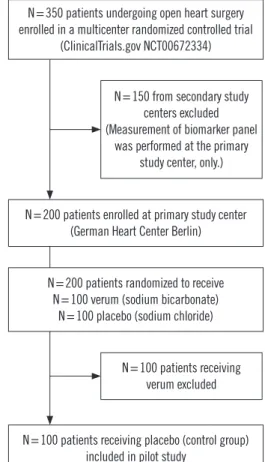
Patients and settingThis exploratory ancillary study of the BIC-Multicenter Study used a cohort of 100 patients who underwent elective open- heart surgery with the use of cardio-pulmonary bypass (CPB), enrolled as a control group at the German Heart Center, Berlin, Germany (NCT00672334) from January 2009 through June 2010 (Fig. 1). Full study details have been described previously [17]. This study was approved by the Institutional Review Board of Charité University Medicine Ethics Committee, Berlin, Ger- many (approval no.: ZS EK 11 654/07), and written informed consent was obtained from each patient. We excluded patients undergoing emergency operations (time between hospital ad- mission to operation <24 hours) or off-pump surgery, patients presenting with advanced chronic kidney disease (serum creati-
Fig. 1. Patient flow diagram.
N=200 patients enrolled at primary study center (German Heart Center Berlin)
N=200 patients randomized to receive N=100 verum (sodium bicarbonate)
N=100 placebo (sodium chloride)
N=100 patients receiving placebo (control group) included in pilot study
N=350 patients undergoing open heart surgery enrolled in a multicenter randomized controlled trial
(ClinicalTrials.gov NCT00672334)
N=150 from secondary study centers excluded (Measurement of biomarker panel
was performed at the primary study center, only.)
N=100 patients receiving verum excluded
nine >300 µmol/L) or kidney transplant, patients <18 years, patients on immunosuppression medication, and those enrolled in a conflicting research study. Decisions regarding all diagnos- tic and therapeutic interventions were performed by the inten- sive care physicians, independent of this investigation.
Study endpoints
The primary endpoint was the development of MAKE, including alternatively occurring events of RIFLE-AKI stages Injury or Fail- ure (Risk, Injury, Failure, End-stage renal disease classification [18]), persistent AKI >48 hours, acute renal replacement ther- apy (RRT) initiation, and in-hospital mortality. The secondary endpoint was AKI, defined and classified by severity according to the RIFLE criteria based on increases in postoperative serum creatinine concentration compared with the preoperative base- line concentration, as well as urine output criteria [18]. We chose the RIFLE criteria because they tend to have a higher discriminative value in predicting hospital mortality in cardiac surgery patients than the Acute Kidney Injury Network or Kidney Disease Improving Global Outcome criteria [19, 20].
Biomarker sampling and measurement
We obtained urine at 6 hours (referred to as ‘intensive care unit [ICU] admission’) after commencement of CPB. Sampling was performed as previously described [17]. NGAL concentration (ng/mL) was measured using an ARCHITECT Analyzer (Abbott Diagnostics, Abbott Park, IL, USA). Interleukin-6 (pg/mL) and alpha-1 microglobulin (ng/mL) concentrations were determined using the Cobas e/c411 Immunoassay Analyzer Platform (Roche Diagnostics, Mannheim, Germany). ELISA kits were used to measure midkine (pg/mL; PeproTech, Hamburg, Ger- many) and hepcidin-25 (ng/mL, C-ELISA, Intrinsic Lifesciences, LLC, La Jolla, CA, USA), according to the manufacturer’s in- structions [21].
Serum creatinine was measured using the enzymatic method standardized by isotope dilution mass spectroscopy (Cobas 8000 modular analyzer, Roche Diagnostics). Laboratory investi- gators were blinded to the sample sources and clinical outcome.
Statistical analysis
We assessed the discriminative ability and performance of can- didate biomarkers to predict study endpoints in a stepwise ap- proach: First, the area under the ROC curve (AUC) based on biomarker concentrations and biomarker/hepcidin-25-ratios measured at ICU admission in conjunction with clinical study endpoints was calculated separately for each marker or ratio (for
hepcidin-25, a marker for absence of MAKE and AKI, with re- versed orientation indicated as 1-hepcidin-25).
The following variables from the Cleveland kidney risk assess- ment model were included into the reference logistic regression model [3]: gender, congestive heart failure defined as NYHA (New York Hearth Association classification) class 3 or 4 or left ventricular ejection fraction (LVEF) <35%, chronic kidney dis- ease defined as preoperative creatinine >120 µmol/L, insulin- dependent diabetes mellitus, chronic obstructive pulmonary disease, history of previous cardiac surgery, and type of surgery (defined as coronary artery bypass graft [CABG], valve proce- dure or concomitant procedure). We did not include the vari- ables “emergency surgery” and “use of intra-aortic balloon pump (IABP)” from the original model as all patients underwent elective open-heart surgery and no patient required IABP [3].
The predictive performance of the risk assessment models is reported as AUC for the derived multivariate scores with a 95%
confidence interval (CI).
Thereafter, we sequentially included each biomarker sepa- rately into the reference model to exclude interaction. The model odds ratio (Exp [B]) was calculated to assess the ability of a biomarker to independently predict the study endpoints.
The goodness of fit of each logistic regression was assessed us- ing the Hosmer-Lemeshow test.
Reclassification statistics offer additional information not avail- able from the AUC for the quantification of incremental im- provements in multivariate model performance following the ad- dition of a candidate biomarker to a reference model [6]. There- fore, improvements in the performance of the reference model following the addition of a urinary biomarker were evaluated by net reclassification improvement (NRI) (reported as category- free NRI [cfNRI] to overcome the shortcomings of NRI), and the integrated discrimination improvement (IDI) illustrated as risk assessment plots [22].
To better quantify how accurately the reference and reclassifi- cation model would perform with independent data, we adopted a leave-one-out cross-validation. Logarithmic transformations were applied when necessary. SPSS, version 25.0 (IBM Corp., Armonk, NY, USA) and SAS, version 9.4 (SAS Institute Inc., Cary, NC, USA) were used for statistical analysis. P <0.05 (two- sided) was considered statistically significant.
RESULTS
Patient characteristics
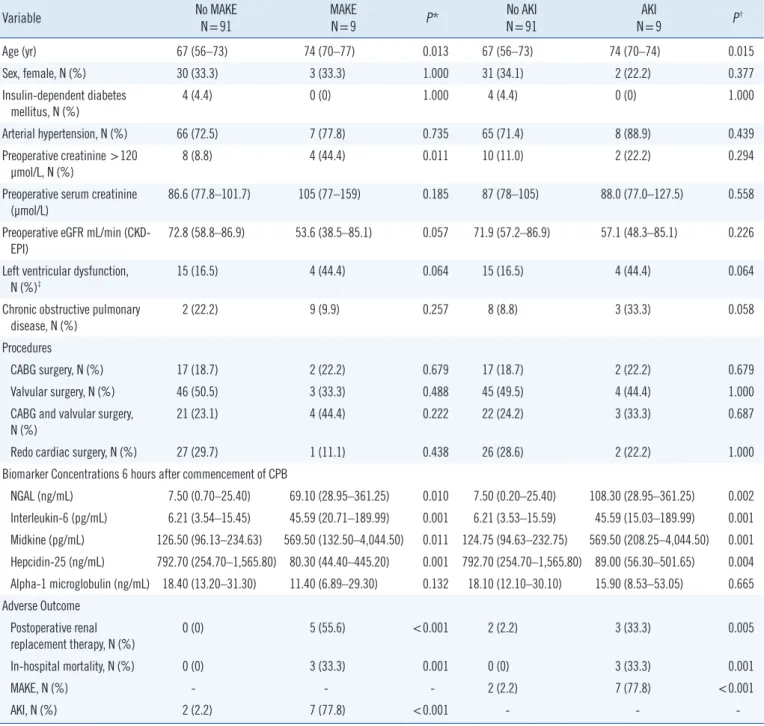
Patient baseline characteristics are shown in Table 1. Patients
with postoperative MAKE or AKI were older and more likely to have left ventricular dysfunction than patients without MAKE or AKI. Patients with MAKE more frequently had lower baseline es- timated glomerular filtration rate (eGFR) than those without
MAKE. Type of surgery and gender were similar in patients with and without MAKE or AKI. AKI was associated with increased risk of acute RRT initiation (P =0.005) and in-hospital mortality (P =0.001).
Table 1. Perioperative patient characteristics
Variable No MAKE
N=91 MAKE
N=9 P* No AKI
N=91 AKI
N=9 P†
Age (yr) 67 (56–73) 74 (70–77) 0.013 67 (56–73) 74 (70–74) 0.015
Sex, female, N (%) 30 (33.3) 3 (33.3) 1.000 31 (34.1) 2 (22.2) 0.377
Insulin-dependent diabetes mellitus, N (%)
4 (4.4) 0 (0) 1.000 4 (4.4) 0 (0) 1.000
Arterial hypertension, N (%) 66 (72.5) 7 (77.8) 0.735 65 (71.4) 8 (88.9) 0.439
Preoperative creatinine >120
µmol/L, N (%) 8 (8.8) 4 (44.4) 0.011 10 (11.0) 2 (22.2) 0.294
Preoperative serum creatinine (µmol/L)
86.6 (77.8–101.7) 105 (77–159) 0.185 87 (78–105) 88.0 (77.0–127.5) 0.558
Preoperative eGFR mL/min (CKD-
EPI) 72.8 (58.8–86.9) 53.6 (38.5–85.1) 0.057 71.9 (57.2–86.9) 57.1 (48.3–85.1) 0.226
Left ventricular dysfunction, N (%)‡
15 (16.5) 4 (44.4) 0.064 15 (16.5) 4 (44.4) 0.064
Chronic obstructive pulmonary
disease, N (%) 2 (22.2) 9 (9.9) 0.257 8 (8.8) 3 (33.3) 0.058
Procedures
CABG surgery, N (%) 17 (18.7) 2 (22.2) 0.679 17 (18.7) 2 (22.2) 0.679
Valvular surgery, N (%) 46 (50.5) 3 (33.3) 0.488 45 (49.5) 4 (44.4) 1.000
CABG and valvular surgery, N (%)
21 (23.1) 4 (44.4) 0.222 22 (24.2) 3 (33.3) 0.687
Redo cardiac surgery, N (%) 27 (29.7) 1 (11.1) 0.438 26 (28.6) 2 (22.2) 1.000
Biomarker Concentrations 6 hours after commencement of CPB
NGAL (ng/mL) 7.50 (0.70–25.40) 69.10 (28.95–361.25) 0.010 7.50 (0.20–25.40) 108.30 (28.95–361.25) 0.002 Interleukin-6 (pg/mL) 6.21 (3.54–15.45) 45.59 (20.71–189.99) 0.001 6.21 (3.53–15.59) 45.59 (15.03–189.99) 0.001 Midkine (pg/mL) 126.50 (96.13–234.63) 569.50 (132.50–4,044.50) 0.011 124.75 (94.63–232.75) 569.50 (208.25–4,044.50) 0.001 Hepcidin-25 (ng/mL) 792.70 (254.70–1,565.80) 80.30 (44.40–445.20) 0.001 792.70 (254.70–1,565.80) 89.00 (56.30–501.65) 0.004 Alpha-1 microglobulin (ng/mL) 18.40 (13.20–31.30) 11.40 (6.89–29.30) 0.132 18.10 (12.10–30.10) 15.90 (8.53–53.05) 0.665 Adverse Outcome
Postoperative renal
replacement therapy, N (%) 0 (0) 5 (55.6) <0.001 2 (2.2) 3 (33.3) 0.005
In-hospital mortality, N (%) 0 (0) 3 (33.3) 0.001 0 (0) 3 (33.3) 0.001
MAKE, N (%) - - - 2 (2.2) 7 (77.8) <0.001
AKI, N (%) 2 (2.2) 7 (77.8) <0.001 - - -
Numbers denote median (25th–75th percentile) or N (%) where appropriate.
*P for MAKE vs. No-MAKE; †P refers to comparison between AKI and No AKI patients; ‡Congestive heart failure defined as NYHA class 3 or 4 or LVEF
<35%.
Abbreviations: AKI, acute kidney injury; CABG, coronary artery bypass graft; CKD-EPI, Chronic Kidney Disease Epidemiology Collaboration equation for esti- mation of glomerular filtration rate; CPB, cardio-pulmonary bypass; eGFR, estimated glomerular filtration rate; MAKE, major adverse kidney events; NGAL, urine neutrophil gelatinase associated lipocalin; RIFLE, risk injury failure end-stage renal disease classification [18]; NYHA, New York Hearth Association classification; LVEF, left ventricular ejection fraction.
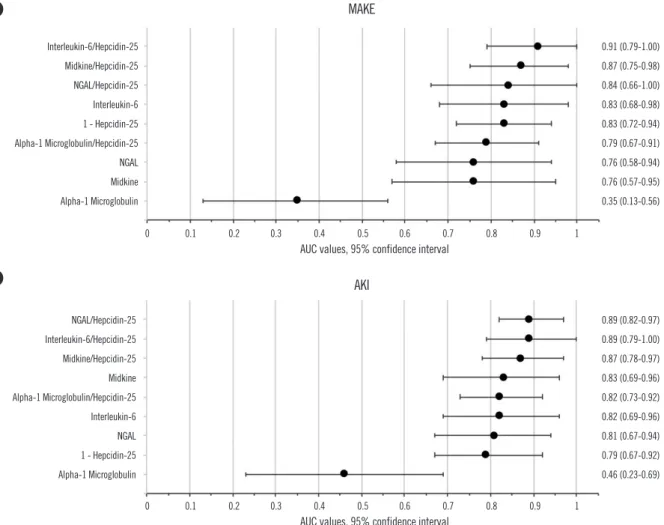
Fig. 2. Ranking of assessed urinary biomarker performance according to the univariate AUC (with 95% confidence interval bars) at ICU admission for predicting (A) MAKE and (B) AKI.
Abbreviations: NGAL, neutrophil gelatinase-associated lipocalin; ICU, intensive care unit; AUC, area under the ROC curve; MAKE, major adverse kidney events; AKI, acute kidney injury.
B A
Discriminative performance of urinary biomarkers
For MAKE, interleukin-6 and 1-hepcidin-25 had an AUC of 0.83 (0.68–0.98) and 0.83 (0.72–0.94), respectively. For AKI, NGAL had an AUC of 0.81 (0.67–0.94), interleukin-6 0.82 (0.69–
0.96), and midkine 0.83 (0.69–0.96). Alpha-1 microglobulin was not predictive for either MAKE or AKI (AUC <0.5). The AUC findings for all biomarkers were higher when the biomarker combinations were expressed as 1/hepcidin-25 ratios. NGAL/
hepcidin-25 ratio was the best performing biomarker for AKI (AUC 0.89 [0.82–0.97]), while interleukin-6/hepcidin-25 dem- onstrated the highest discriminative performance for MAKE, with an AUC of 0.91 (0.79–1.00). The univariate AUC values are shown in Fig. 2.
Urinary biomarkers as independent predictors of MAKE or AKI We found that NGAL, interleukin-6, midkine, hepcidin-25, and
NGAL/hepcidin-25 were independent predictors of MAKE, while NGAL, interleukin-6, midkine, their hepcidin-25 ratios and hep- cidin-25 were independent predictors of AKI using multivariate logistic regression based on the Cleveland Score (Table 2 and Supplemental Data Table S1). Alpha-1 microglobulin and al- pha-1 microglobulin/hepcidin-25 were not independently asso- ciated with MAKE or AKI.
Estimation of improvement of the Cleveland Score with added urinary biomarker data
The cross-validated baseline performance characterized by AUC for the Cleveland reference models was 0.84 (0.73–0.96) for MAKE and 0.79 (0.66–0.91) for AKI. The goodness of fit in- dicated good calibration of the reference kidney risk assessment model for both endpoints (MAKE: Hosmer-Lemeshow, P = 0.864; -2 Log likelihood, 51.33; AKI: Hosmer-Lemeshow, P =
Interleukin-6/Hepcidin-25 Midkine/Hepcidin-25 NGAL/Hepcidin-25 Interleukin-6 1 - Hepcidin-25 Alpha-1 Microglobulin/Hepcidin-25 NGAL Midkine Alpha-1 Microglobulin
NGAL/Hepcidin-25 Interleukin-6/Hepcidin-25 Midkine/Hepcidin-25 Midkine Alpha-1 Microglobulin/Hepcidin-25 Interleukin-6 NGAL 1 - Hepcidin-25 Alpha-1 Microglobulin
0.91 (0.79-1.00) 0.87 (0.75-0.98) 0.84 (0.66-1.00) 0.83 (0.68-0.98) 0.83 (0.72-0.94) 0.79 (0.67-0.91) 0.76 (0.58-0.94) 0.76 (0.57-0.95) 0.35 (0.13-0.56)
0.89 (0.82-0.97) 0.89 (0.79-1.00) 0.87 (0.78-0.97) 0.83 (0.69-0.96) 0.82 (0.73-0.92) 0.82 (0.69-0.96) 0.81 (0.67-0.94) 0.79 (0.67-0.92) 0.46 (0.23-0.69)
MAKE
AKI
0 0.1 0.2 0.3 0.4 0.5 0.6 0.7 0.8 0.9 1
0 0.1 0.2 0.3 0.4 0.5 0.6 0.7 0.8 0.9 1 AUC values, 95% confidence interval
AUC values, 95% confidence interval
0.968; -2 Log likelihood, 45.28).
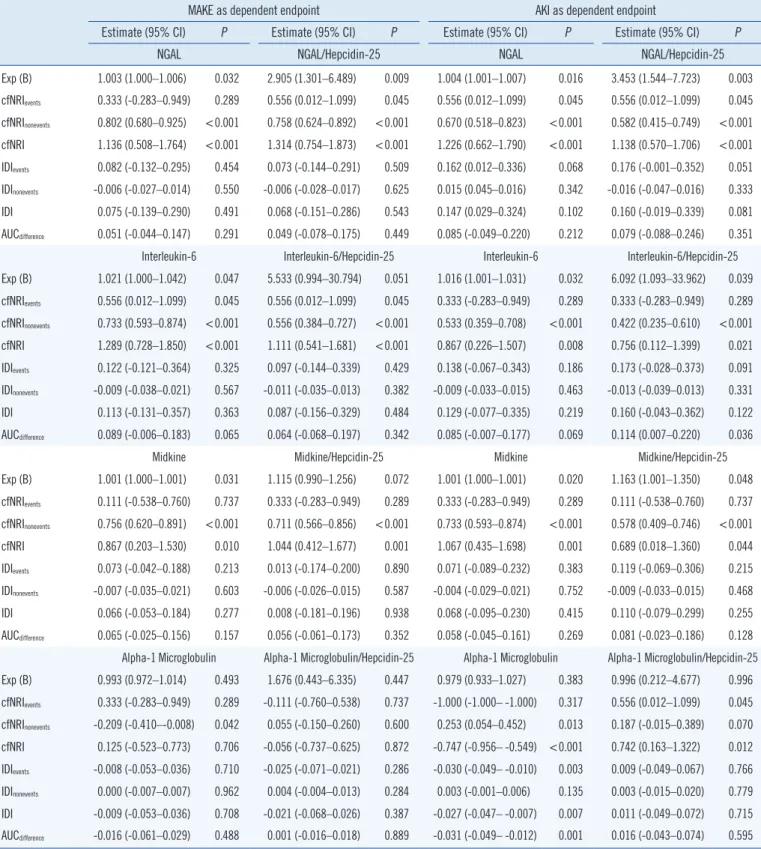
The AUC performance of the new model compared with the reference model with 95% CI (orange) is illustrated in Fig. 3.
Generally, the addition of urinary biomarkers NGAL, interleukin-6, and midkine, as well as corresponding 1/hepcidin-25 ratios im- proved the reference model for MAKE and AKI, while alpha-1 microglobulin did not improve model performance (Table 2).
Risk assessment plots illustrating the performance of the ref- erence kidney risk model and the new model are shown in Fig.
4 and Supplemental Data Fig. S1 and S2. Interleukin-6 im- proved MAKE prediction for events and non-events; however, for AKI this was only true for non-events. In contrast, NGAL im- proved cfNRI-based AKI prediction of the Cleveland Score for
events and non-events; however, for MAKE this was only true for non-events. Only the addition of the NGAL/hepcidin-25 ratio im- proved the reference model for both MAKE and AKI events and non-events. Midkine and the midkine/hepcidin-25 ratio im- proved the cfNRI-based prediction of the reference model only for non-events of MAKE and AKI. Finally, IDI, which takes into account the magnitude of changes in predicted risk, showed no improvement for all biomarkers for both endpoints.
DISCUSSION
This pilot study used established reclassification metrics to as- sess the incremental value of various urinary biomarkers added
Fig. 3. Ranking of kidney risk prediction model performance to predict (A) MAKE and (B) AKI according to the area under the ROC curve (AUC with 95% confidence interval [CI] bars) with added urinary kidney injury biomarker at ICU admission (new model) and without (refer- ence model [3], 95% CI highlighted orange).
Abbreviations: MAKE, major adverse kidney events; AKI, acute kidney injury; NGAL, neutrophil gelatinase-associated lipocalin; AUC, area under the ROC curve.
B A
Interleukin-6 Midkine Interleukin-6/Hepcidin-25 Midkine/Hepcidin-25 NGAL/Hepcidin-25 NGAL Hepcidin-25 Alpha-1 Microglobulin/Hepcidin-25 Reference Model Alpha-1 Microglobulin
Interleukin-6/Hepcidin-25 Midkine/Hepcidin-25 NGAL Interleukin-6 NGAL/Hepcidin-25 Midkine Hepcidin-25 Alpha-1 Microglobulin/Hepcidin-25 Reference Model Alpha-1 Microglobulin
0.93 (0.88-0.98) 0.91 (0.84-0.98) 0.91 (0.82-0.99) 0.90 (0.83-0.97) 0.89 (0.81-0.98) 0.89 (0.81-0.98) 0.86 (0.76-0.95) 0.84 (0.74-0.95) 0.84 (0.73-0.96) 0.83 (0.71-0.94)
0.90 (0.83-0.97) 0.87 (0.79-0.95) 0.87 (0.78-0.97) 0.87 (0.78-0.96) 0.87 (0.74-0.99) 0.84 (0.76-0.93) 0.81 (0.71-0.91) 0.80 (0.69-0.91) 0.79 (0.66-0.91) 0.76 (0.63-0.89)
MAKE
AKI
0.5 0.6 0.7 0.8 0.9 1
0.5 0.6 0.7 0.8 0.9 1 AUC values, 95% confidence interval
AUC values, 95% confidence interval
Table 2. Category-free net reclassification improvement (cfNRI) and integrated discrimination improvement (IDI) of selected urinary bio- markers measured at ICU admission
MAKE as dependent endpoint AKI as dependent endpoint
Estimate (95% CI) P Estimate (95% CI) P Estimate (95% CI) P Estimate (95% CI) P
NGAL NGAL/Hepcidin-25 NGAL NGAL/Hepcidin-25
Exp (B) 1.003 (1.000–1.006) 0.032 2.905 (1.301–6.489) 0.009 1.004 (1.001–1.007) 0.016 3.453 (1.544–7.723) 0.003 cfNRIevents 0.333 (-0.283–0.949) 0.289 0.556 (0.012–1.099) 0.045 0.556 (0.012–1.099) 0.045 0.556 (0.012–1.099) 0.045 cfNRInonevents 0.802 (0.680–0.925) <0.001 0.758 (0.624–0.892) <0.001 0.670 (0.518–0.823) <0.001 0.582 (0.415–0.749) <0.001 cfNRI 1.136 (0.508–1.764) <0.001 1.314 (0.754–1.873) <0.001 1.226 (0.662–1.790) <0.001 1.138 (0.570–1.706) <0.001
IDIevents 0.082 (-0.132–0.295) 0.454 0.073 (-0.144–0.291) 0.509 0.162 (0.012–0.336) 0.068 0.176 (-0.001–0.352) 0.051
IDInonevents -0.006 (-0.027–0.014) 0.550 -0.006 (-0.028–0.017) 0.625 0.015 (0.045–0.016) 0.342 -0.016 (-0.047–0.016) 0.333
IDI 0.075 (-0.139–0.290) 0.491 0.068 (-0.151–0.286) 0.543 0.147 (0.029–0.324) 0.102 0.160 (-0.019–0.339) 0.081
AUCdifference 0.051 (-0.044–0.147) 0.291 0.049 (-0.078–0.175) 0.449 0.085 (-0.049–0.220) 0.212 0.079 (-0.088–0.246) 0.351
Interleukin-6 Interleukin-6/Hepcidin-25 Interleukin-6 Interleukin-6/Hepcidin-25 Exp (B) 1.021 (1.000–1.042) 0.047 5.533 (0.994–30.794) 0.051 1.016 (1.001–1.031) 0.032 6.092 (1.093–33.962) 0.039 cfNRIevents 0.556 (0.012–1.099) 0.045 0.556 (0.012–1.099) 0.045 0.333 (-0.283–0.949) 0.289 0.333 (-0.283–0.949) 0.289 cfNRInonevents 0.733 (0.593–0.874) <0.001 0.556 (0.384–0.727) <0.001 0.533 (0.359–0.708) <0.001 0.422 (0.235–0.610) <0.001 cfNRI 1.289 (0.728–1.850) <0.001 1.111 (0.541–1.681) <0.001 0.867 (0.226–1.507) 0.008 0.756 (0.112–1.399) 0.021
IDIevents 0.122 (-0.121–0.364) 0.325 0.097 (-0.144–0.339) 0.429 0.138 (-0.067–0.343) 0.186 0.173 (-0.028–0.373) 0.091
IDInonevents -0.009 (-0.038–0.021) 0.567 -0.011 (-0.035–0.013) 0.382 -0.009 (-0.033–0.015) 0.463 -0.013 (-0.039–0.013) 0.331
IDI 0.113 (-0.131–0.357) 0.363 0.087 (-0.156–0.329) 0.484 0.129 (-0.077–0.335) 0.219 0.160 (-0.043–0.362) 0.122
AUCdifference 0.089 (-0.006–0.183) 0.065 0.064 (-0.068–0.197) 0.342 0.085 (-0.007–0.177) 0.069 0.114 (0.007–0.220) 0.036
Midkine Midkine/Hepcidin-25 Midkine Midkine/Hepcidin-25
Exp (B) 1.001 (1.000–1.001) 0.031 1.115 (0.990–1.256) 0.072 1.001 (1.000–1.001) 0.020 1.163 (1.001–1.350) 0.048 cfNRIevents 0.111 (-0.538–0.760) 0.737 0.333 (-0.283–0.949) 0.289 0.333 (-0.283–0.949) 0.289 0.111 (-0.538–0.760) 0.737 cfNRInonevents 0.756 (0.620–0.891) <0.001 0.711 (0.566–0.856) <0.001 0.733 (0.593–0.874) <0.001 0.578 (0.409–0.746) <0.001 cfNRI 0.867 (0.203–1.530) 0.010 1.044 (0.412–1.677) 0.001 1.067 (0.435–1.698) 0.001 0.689 (0.018–1.360) 0.044
IDIevents 0.073 (-0.042–0.188) 0.213 0.013 (-0.174–0.200) 0.890 0.071 (-0.089–0.232) 0.383 0.119 (-0.069–0.306) 0.215
IDInonevents -0.007 (-0.035–0.021) 0.603 -0.006 (-0.026–0.015) 0.587 -0.004 (-0.029–0.021) 0.752 -0.009 (-0.033–0.015) 0.468
IDI 0.066 (-0.053–0.184) 0.277 0.008 (-0.181–0.196) 0.938 0.068 (-0.095–0.230) 0.415 0.110 (-0.079–0.299) 0.255
AUCdifference 0.065 (-0.025–0.156) 0.157 0.056 (-0.061–0.173) 0.352 0.058 (-0.045–0.161) 0.269 0.081 (-0.023–0.186) 0.128
Alpha-1 Microglobulin Alpha-1 Microglobulin/Hepcidin-25 Alpha-1 Microglobulin Alpha-1 Microglobulin/Hepcidin-25 Exp (B) 0.993 (0.972–1.014) 0.493 1.676 (0.443–6.335) 0.447 0.979 (0.933–1.027) 0.383 0.996 (0.212–4.677) 0.996 cfNRIevents 0.333 (-0.283–0.949) 0.289 -0.111 (-0.760–0.538) 0.737 -1.000 (-1.000– -1.000) 0.317 0.556 (0.012–1.099) 0.045 cfNRInonevents -0.209 (-0.410–-0.008) 0.042 0.055 (-0.150–0.260) 0.600 0.253 (0.054–0.452) 0.013 0.187 (-0.015–0.389) 0.070 cfNRI 0.125 (-0.523–0.773) 0.706 -0.056 (-0.737–0.625) 0.872 -0.747 (-0.956– -0.549) <0.001 0.742 (0.163–1.322) 0.012
IDIevents -0.008 (-0.053–0.036) 0.710 -0.025 (-0.071–0.021) 0.286 -0.030 (-0.049– -0.010) 0.003 0.009 (-0.049–0.067) 0.766
IDInonevents 0.000 (-0.007–0.007) 0.962 0.004 (-0.004–0.013) 0.284 0.003 (-0.001–0.006) 0.135 0.003 (-0.015–0.020) 0.779
IDI -0.009 (-0.053–0.036) 0.708 -0.021 (-0.068–0.026) 0.387 -0.027 (-0.047– -0.007) 0.007 0.011 (-0.049–0.072) 0.715
AUCdifference -0.016 (-0.061–0.029) 0.488 0.001 (-0.016–0.018) 0.889 -0.031 (-0.049– -0.012) 0.001 0.016 (-0.043–0.074) 0.595
Goodness of fit for reference models: MAKE: Hosmer-Lemeshow P =0.864, -2 Log likelihood 51.33, Nagelkerke R2 0.195, AUC 0.84; AKI: Hosmer-Leme- show P =0.968, -2 Log likelihood 45.28, Nagelkerke R2 0.311, AUC 0.79.
Abbreviations: AKI, acute kidney injury; MAKE, major adverse kidney events; AUC, area under the curve; CI, confidence interval; cfNRI, category-free net re- classification improvement; Exp(B), Logit coefficient expressed as odds ratio for one performance unit; NGAL, neutrophil gelatinase-associated lipocalin; IDI, integrated discrimination improvement.
to the Cleveland Score to predict MAKE and AKI after cardiac surgery [3]. We found that urinary NGAL, interleukin-6, and their 1/hepcidin-25-ratios are independent predictors that im- prove cfNRI-based MAKE- and AKI-prediction when added to the Cleveland Score. Notably, biomarker-related improvement was particularly dependent on correctly reclassifying patients without the event of interest.
Several statistical proposals have been made to assess the ad- ditional benefit of predictive biomarkers. Comparative metrics (AUC, cfNRI, IDI) are differently sensitive to detecting small im- provements. Specifically, we found that high cfNRInonevent values indicate the ability of a biomarker to correctly decrease risk esti- mates for non-events. Thus, they are useful for ruling out adverse kidney events [23]. In contrast, IDI and cfNRIevent are presumably confounded by low event numbers for MAKE and AKI [24].
As no single kidney biomarker will meet every requirement re- garding the underlying pathophysiological mechanisms of AKI, we assessed the predictive performance of several urinary bio- markers representing different direct or indirect components of
tubular stress or damage [13, 25] or potential renal protective mechanisms [15, 16]. We found increased postoperative uri- nary hepcidin-25 concentrations in non-AKI patients, whereas the concentrations remained low in patients with subsequent AKI, in line with previous studies [15, 16, 26]. We hypothesize that the improved predictive ability of NGAL and interleukin-6 expressed as 1/hepcidin-25 ratio vs NGAL and interleukin-6 alone may be explained by the role of hepcidin-25 in the me- tabolism of labile-iron compounds in the presence and absence of AKI [15, 26-28]. During cardiac surgery, unbound labile iron- related injury maintained by oxido-inflammatory stress may be of specific pathophysiological importance [7]. The involvement and contribution of interleukin-6 to inflammatory response- pathways have also been implicated in the pathogenesis of ischemic AKI [29]. We believe that interleukin-6, a pro-inflam- matory cytokine detected in urine, in particular, may serve as an indicator of tubular oxido-inflammation in cardiac surgery asso- ciated kidney injury. We were also able to extend previous find- ings on midkine as a potentially valuable predictor of MAKE and Fig. 4. Risk assessment plots showing the changes in model performance. Compared with AUC graphs, risk assessment plots illustrate infor- mation for events and non-events separately, representing the preferences and drawbacks of the reclassified risk models (●nonevents, ■events, sol- id lines) calculated by the addition of urinary biomarker concentrations (NGAL, interleukin-6, NGAL/hepcidin-25, interleukin-6/hepcidin-25) to the reference model (○nonevents, □events, dashed lines). □■ represent model sensitivity (Y-axis) versus the calculated risk (X-axis) for those with the event. ○● represent 1-specificity (Y-axis) versus the calculated risk (X-axis) for those without an event (endpoints MAKE, AKI).
Abbreviations: AUC, area under the ROC curve; MAKE, major adverse kidney events; AKI, acute kidney injury; NGAL, neutrophil gelatinase-associated lipo- calin; IL-6, interleukin-6.
1.0 0.8 0.6 0.4 0.2
0 1.0 0.8 0.6 0.4 0.2
0
0 0.2 0.4 0.6 0.8 1.0 0 0.2 0.4 0.6 0.8 1.0 0 0.2 0.4 0.6 0.8 1.0 0 0.2 0.4 0.6 0.8 1.0 Calculated risk
○ Reference (non-event) ● New (non-event) □ Reference (event) ■ New (event)
NGAL IL-6 NGAL/Hepcidin IL-6/Hepcidin
Sensitivity (squares)/1-Specificity (circles) MAKEAKI
AKI [14]. Finally, the weak discriminatory ability of alpha-1 mi- croglobulin for MAKE and AKI after cardiac surgery may be re- lated to other predominant pathogenic tubular stress factors be- ing effective in cardiac surgery compared with critically ill pa- tients for whom alpha-1 microglobulin was previously found to be of value [12].
Perioperative risk assessment provides an opportunity for early diagnosis of adverse kidney events and early implementa- tion of interventional strategies [30, 31]. Our finding regarding improved biomarker risk assessment after cardiac surgery car- ries the potential of timely implementation of AKI care bundles, triggering diagnostic and therapeutic modifications [32], which are associated with favorable outcomes [30]. Importantly, given the pronounced improvement in non-event prediction, our find- ings may facilitate withholding unnecessary diagnostic or thera- peutic measures. Considering the performance and immediate availability of the assessed biomarkers in clinical practice, NGAL and interleukin-6, both measurable using clinical laboratory platforms, appear to be the most promising candidates for im- plementation in kidney risk assessment at the bedside. Finally, our findings on alpha-1 microglobulin are in line with previous findings and do not support further investigation of this bio- marker in the cardiac surgery setting [33].
Our study has several strengths and limitations. We investi- gated typical patients at risk of adverse outcome in a relatively homogenous and well-defined patient cohort after cardiac sur- gery. Well-calibrated statistical and clinical risk assessment models enabled us to identify specific predictive patterns such as biomarkers improving prediction of non-events. In patient cohorts with only a few MAKE or AKI events, large sample sizes are necessary to derive reliable performance estimates, particu- larly for the estimation of classification errors. Thus, the limited sample size of this study is clearly a limitation. However, the ap- parent improvement in the accuracy of prediction models with small sample sizes may be potentially confounded by model overfitting. Hence, we utilized cross-validated estimates. As ex- pected, model accuracy (AUC) was decreased, and the cross- validated measures were more conservative in detecting model improvement [34]. Weaker performance in reclassifying
“events” may also reflect the limitations of the markers them- selves or may be, at least partly, explained by “imperfect” clini- cal endpoints, which commonly depend on changes in serum creatinine, a poor reference standard [35]. Finally, the present study does not preclude the conclusion that no other kidney biomarkers may improve AKI risk prediction, as previously shown [36].
Early recognition of AKI or subclinical AKI using NGAL or in- terleukin-6 analysis at the bedside may help guide early risk- stratified interventions, such as implementation of the Kidney Disease Improving Global Outcomes (KDIGO) care bundles, and may also prevent unnecessary care for event-free patients [24, 30]. Future studies should clarify whether such clinical kidney risk assessment and interventions guided by readily available biomarkers can improve outcomes.
In summary, biomarkers from multiple, biologically linked pathways related to iron metabolism and/or inflammation are associated with the risk of adverse kidney related outcomes [37, 38]. In this pilot study, we found urinary NGAL and interleukin-6 to be the most promising candidates for further clinical imple- mentation research. The combination of biomarkers with hepci- din-25 may further improve diagnostic discrimination. Further research into the reno-protective abilities of hepcidin-25 should be conducted.
Acknowledgements
We thank Argid and Raimund Rutenberg for their excellent re- search assistance.
Author Contributions
CA, MH, AA, SK, RB, RBD, AHF made substantial contributions to conception, design and analysis of the study. MH and AHF performed acquisition of patient data. MW, SW performed labo- ratory testing. SK, CA performed statistical analysis. All authors participated in drafting and/or revising the paper and provided important intellectual contributions. All authors accepted their responsibility for the entire content of the manuscript, gave final approval of the submitted version and any revised versions sub- mitted prior to acceptance.
Conflicts of Interest
CA has received honoraria speaking for Siemens Healthineers.
MH has received honoraria speaking for Abbott Diagnostics, Alere, Biosite Inc., and Siemens Healthineers, AA has received honoraria speaking for Abbott Diagnostics. All companies are involved in the development and marketing of renal biomarkers.
Research Funding
This study was supported by grants from the German Heart
Foundation (Deutsche Stiftung für Herzforschung) and from the Else Kröner-Fresenius-Stiftung, Germany.
ORCID
Christian Albert https://orcid.org/0000-0002-6956-9962 Michael Haase https://orcid.org/0000-0001-8212-7416 Annemarie Albert https://orcid.org/0000-0002-5611-1506 Siegfried Kropf https://orcid.org/0000-0002-5197-3481 Rinaldo Bellomo https://orcid.org/0000-0002-1650-8939 Sabine Westphal https://orcid.org/0000-0002-5846-3345 Rüdiger Christian Braun-Dullaeus https://orcid.org/0000-0003-
3888-6532
Anja Haase-Fielitz https://orcid.org/0000-0001-6881-2249
ϯMark Westerman, deceased, no ORCID available.
REFERENCES
1. Haase-Fielitz A, Haase M, Bellomo R, Calzavacca P, Spura A, Baraki H, et al. Perioperative hemodynamic instability and fluid overload are asso- ciated with increasing acute kidney injury severity and worse outcome after cardiac surgery. Blood Purif 2017;43:298-308.
2. Kellum JA, Lameire N, Aspelin P, Barsoum RS, Burdmann EA, Gold- stein SL, et al. Kidney disease: improving global outcomes (KDIGO) acute kidney injury work group. KDIGO clinical practice guideline for acute kidney injury. Kidney Int Suppl 2012;2:1-138.
3. Thakar CV, Arrigain S, Worley S, Yared JP, Paganini EP. A clinical score to predict acute renal failure after cardiac surgery. J Am Soc Nephrol 2005;16:162-8.
4. Vives M, Monedero P, Perez-Valdivieso JR, Garcia-Fernandez N, Lavilla J, Herreros J, et al. External validation and comparison of three scores to predict renal replacement therapy after cardiac surgery: a multi- center cohort. Int Artif Organs 2011;34:329-38.
5. McCullough PA, Shaw AD, Haase M, Bouchard J, Waikar SS, Siew ED, et al. Diagnosis of acute kidney injury using functional and injury bio- markers: workgroup statements from the tenth Acute Dialysis Quality Initiative Consensus Conference. Contrib Nephrol 2013;182:13-29.
6. Pencina MJ, D’Agostino RB Sr, D’Agostino RB Jr, Vasan RS. Evaluating the added predictive ability of a new marker: from area under the ROC curve to reclassification and beyond. Stat Med 2008;27:157-72.
7. Haase M, Bellomo R, Haase-Fielitz A. Novel biomarkers, oxidative stress, and the role of labile iron toxicity in cardiopulmonary bypass-as- sociated acute kidney injury. J Am Coll Cardiol 2010;55:2024-33.
8. Renhua L, Miaolin C, Junlin W, Qingwei W, Xiaoping X, Huili D, et al.
The level of the biomarkers at the time of nephrology consultation might predict the prognosis of acute kidney injury in hospitalized patients.
Blood Purif 2014;38:89-95.
9. Gueret G, Lion F, Guriec N, Arvieux J, Dovergne A, Guennegan C, et al.
Acute renal dysfunction after cardiac surgery with cardiopulmonary by- pass is associated with plasmatic IL6 increase. Cytokine 2009;45:92-8.
10. Haase M, Bellomo R, Devarajan P, Schlattmann P, Haase-Fielitz A, the NGAL Meta-analysis Investigator Group. Accuracy of neutrophil gelatin- ase-associated lipocalin (NGAL) in diagnosis and prognosis in acute kidney injury: a systemic review and meta-analysis. Am J Kidney Dis
2009;54:1012-24.
11. Nemeth E and Ganz T. The role of hepcidin in iron metabolism. Acta Haematol 2009;122:78-86.
12. Herget-Rosenthal S, Poppen D, Hüsing J, Marggraf G, Pietruck F, Ja- kob HG, et al. Prognostic value of tubular proteinuria and enzymuria in nonoliguric acute tubular necrosis. Clin Chem 2004;50:552-8.
13. Sato W, Kadomatsu K, Yuzawa Y, Muramatsu H, Hotta N, Matsuo S, et al. Midkine is involved in neutrophil infiltration into the tubulointersti- tium in ischemic renal injury. J Immunol 2001;167:3463-9.
14. Hayashi H, Sato W, Kosugi T, Nishimura K, Sugiyama D, Asano N, et al.
Efficacy of urinary midkine as a biomarker in patients with acute kidney injury. Clin Exp Nephrol 2017;21:597-607.
15. Ho J, Reslerova M, Gali B, Gao A, Bestland J, Rush DN, et al. Urinary hepcidin-25 and risk of acute kidney injury following cardiopulmonary bypass. Clin J Am Soc Nephrol 2011;6:2340-6.
16. Mårtensson J, Glassford NJ, Jones S, Eastwood GM, Young H, Peck L, et al. Urinary neutrophil gelatinase-associated lipocalin to hepcidin ratio as a biomarker of acute kidney injury in intensive care unit patients. Mi- nerva Anestesiol 2015;81:1192-200.
17. Haase M, Haase-Fielitz A, Plass M, Kuppe H, Hetzer R, Hannon C, et al. Prophylactic perioperative sodium bicarbonate to prevent acute kid- ney injury following open heart surgery: a multicenter double-blinded randomized controlled trial. PLoS Med 2013;10:e1001426.
18. Bellomo R, Ronco C, Kellum JA, Mehta RL, Palevsky P; Acute Dialysis Quality Initiative workgroup. Acute renal failure–definition, outcome measures, animal models, fluid therapy and information technology needs: the Second International Consensus Conference of the Acute Dialysis Quality Initiative (ADQI) Group. Crit Care 2004;8:R204-12.
19. Englberger L, Suri RM, Li Z, Casey ET, Daly RC, Dearani JA, et al. Clini- cal accuracy of RIFLE and Acute Kidney Injury Network (AKIN) criteria for acute kidney injury in patients undergoing cardiac surgery. Crit Care 2011;15:R16.
20. Xiong J, Tang X, Hu Z, Nie L, Wang Y, Zhao J. The RIFLE versus AKIN classification for incidence and mortality of acute kidney injury in critical ill patients: a meta-analysis. Sci Rep 2015;5:1791717917.
21. Ganz T, Olbina G, Girelli D, Nemeth E, Westerman M. Immunoassay for human serum hepcidin. Blood 2008;112:4292-7.
22. Pencina MJ, D’Agostino RB Sr, Steyerberg EW. Extensions of net reclas- sification improvement calculations to measure usefulness of new bio- markers. Stat Med 2011;30:11-21.
23. Leening MJG, Vedder MM, Witteman JC, Pencina MJ, Steyerberg EW.
Net reclassification improvement: computation, interpretation, and con- troversies: a literature review and clinician’s guide. Ann Intern Med 2014;160:122-31.
24. Albert C, Albert A, Bellomo R, Kropf S, Devarajan P, Westphal S, et al.
Urinary neutrophil gelatinase-associated lipocalin-guided risk assess- ment for major adverse kidney events after open-heart surgery. Biomark Med 2018;12:975-85.
25. Kim SY, Jeong TD, Lee W, Chun S, Sunwoo S, Kim SB, et al. Plasma neutrophil gelatinase-associated lipocalin as a marker of tubular dam- age in diabetic nephropathy. Ann Lab Med 2018;38:524-9.
26. Prowle JR, Ostland V, Calzavacca P, Licari E, Ligabo EV, Echeverri JE, et al. Greater increase in urinary hepcidin predicts protection from acute kidney injury after cardiopulmonary bypass. Nephrol Dial Transplant 2012;27:595-602.
27. Mori K, Lee HT, Rapoport D, Drexler IR, Foster K, Yang J, et al. Endo- cytic delivery of lipocalin-siderophore-iron complex rescues the kidney from ischemia-reperfusion injury. J Clin Invest 2005;115:610-21.
28. van Swelm RPL, Wetzels JF, Verweij VG, Laarakkers CM, Pertijs JC, van der Wijst J, et al. Renal handling of circulating and renal-synthesized
hepcidin and its protective effects against hemoglobin-mediated kidney injury. J Am Soc Nephrol 2016;27:2720-32.
29. Burne-Taney MJ, Kofler J, Yokota N, Weisfeldt M, Traystman RJ, Rabb H.
Acute renal failure after whole body ischemia is characterized by in- flammation and T cell-mediated injury. Am J Physiol Renal Physiol 2003;285:F87-94.
30. Meersch M, Schmidt C, Hoffmeier A, Van Aken H, Wempe C, Gerss J, et al. Prevention of cardiac surgery-associated AKI by implementing the KDIGO guidelines in high risk patients identified by biomarkers: the PrevAKI randomized controlled trial. Intensive Care Med 2017;43:
1551-61.
31. de Geus HR, Ronco C, Haase M, Jacob L, Lewington A, Vincent JL.
The cardiac surgery-associated neutrophil gelatinase-associated lipo- calin (CSA-NGAL) score: a potential tool to monitor acute tubular dam- age. J Thorac Cardiovasc Surg 2016;151:1476-81.
32. Haase M, Kribben A, Zidek W, Floege J, Albert C, Isermann B, et al.
Electronic alerts for acute kidney injury. Dtsch Arztebl Int 2017;114:1- 8.
33. Ho J, Lucy M, Krokhin O, Hayglass K, Pascoe E, Darroch G, et al. Mass spectrometry-based proteomic analysis of urine in acute kidney injury
following cardiopulmonary bypass: a nested case-control study. Am J Kidney Dis 2009;53:584–95.
34. Airola A, Pahikkala T, Waegeman W, De Baets B, Salakoski T. An exper- imental comparison of cross-validation techniques for estimating the area under the ROC curve. Comput Stat Data Anal 2011;55:1828-44.
35. Waikar SS, Betensky RA, Emerson SC, Bonventre JV. Imperfect gold standards for kidney injury biomarker evaluation. J Am Soc Nephrol 2012;23:13-21.
36. Kim H, Hur M, Lee S, Marino R, Magrini L, Cardelli P, et al. Proenkeph- alin, neutrophil gelatinase-associated lipocalin, and estimated glomeru- lar filtration rates in patients with sepsis. Ann Lab Med 2017;37:388- 9797.
37. Haase M, Devarajan P, Haase-Fielitz A, Bellomo R, Cruz DN, Wagener G, et al. The outcome of neutrophil gelatinase-associated lipocalin-positive subclinical acute kidney injury: a multicenter pooled analysis of pro- spective studies. J Am Coll Cardiol 2011;57:1752-61.
38. Albert C, Albert A, Kube J, Bellomo R, Wettersten N, Kuppe H, et al.
Urinary biomarkers may provide prognostic information for subclinical acute kidney injury after cardiac surgery. J Thorac Cardiovasc Surg 2018;155:2441-2452.e13.
![Fig. 3. Ranking of kidney risk prediction model performance to predict (A) MAKE and (B) AKI according to the area under the ROC curve (AUC with 95% confidence interval [CI] bars) with added urinary kidney injury biomarker at ICU admission (new model) and](https://thumb-ap.123doks.com/thumbv2/123dokinfo/5187555.113204/6.892.105.764.434.1002/ranking-prediction-performance-according-confidence-interval-biomarker-admission.webp)