http://dx.doi.org/10.4047/jap.2011.3.3.132
132
ORIGINAL ARTICLE J Adv Prosthodont 2011;3:132-5
INTRODUCTION
Dental occlusion has been an essential part for all dental works in restorative dentistry. Dental treatment has the ability to basi- cally alter static and dynamic occlusal relationships, while try- ing to accomplish as near “ideal”occlusion as possible. For dynamic occlusal relationships, there are three main con- cepts regarding tooth contact during the lateral excursion of mandibular movement: 1) balanced occlusion, which was developed from the work of Bonwill,12) canine guidance, described by D’Amico,2and 3) group function, as discussed by Beyron.3
Tooth loading in canine guidance and group-function occlu- sions is considered to be different.4According to Glossary of Prosthodontic Terms (8thedition),5group function is defined as multiple contact relations between the maxillary and mandibular teeth in lateral movements on the working side. The simultaneous contact of numerous teeth acts as a group to dis- tribute occlusal forces. Whereas canine protected articulation is defined by the glossary as a form of mutually protected artic- ulation in which the vertical and horizontal overlap of the canine
teeth disengages the posterior teeth in the excursive movements of the mandible.
Both canine guidance and group-function guidance occlusions are considered normal. The latter occlusal scheme occurs naturally as a result of occlusal wear.6When an entire occlu- sion to be restored, either occlusal scheme will serve effectively.
However, when only a part of the occlusion is to be restored, the restoration must be consistent with the existing occlusal scheme. Despite which occlusal scheme is used, the dentist must preserve that scheme during routine postoperative appointments.7-11
For the field of restorative dentistry especially during the process of oral rehabilitation, the rationale to choose occlusal scheme could be based on epidemiological data in combination with study on physiology of the masticatory system. For this rea- son, the purpose of this study was to obtain the epidemiological data on the distribution of 2 major occlusal schemes (group func- tion and canine protected occlusion) as well as associated sta- tic occlusal relationship such as vertical and horizontal over- lap and its relationship with the occlusal scheme among Thais.
Occlusal scheme in a group of Thais
Nattaya Asawaworarit*, DDS, Somsak Mitrirattanakul, DDS, PhD
Department of Masticatory Science, Faculty of Dentistry, Mahidol University, Bangkok, Thailand
PURPOSE. To study the distribution of various occlusal schemes as well as associated static occlusal relationship among Thais. MATERIALS AND METHODS. The subjects’occlusal schemes on the left and right sides were classified as canine protected occlusion, group function, or unclassified according to the definition from Glossary of Prosthodontic Terms (8thedition). In addition, the presence of occlusal interferences during mandibular excursions were recorded. The measurement of the horizontal overlap and vertical overlap was also performed.
Chi-square, One-way ANAVA and Mann-Whitney U statistical tests were used with level of significance set at P=.05. RESULTS. Total of 104 subjects were included in this study. The ratio for male to female was 1.8 to 1. Average age of the population was 25.01±6.87 years old. The mean vertical overlap and horizontal overlap were 1.94±1.20 and 2.41±1.32 mm respectively. The majority of the populations (68.3%) possessed group function occlusal scheme. For the remaining, 17.3% possess canine protected occlusion and 12.5% possess combination of both occlusal schemes. We also found that occlusal interference was presented in 20.2% of the population. The most common was protrusive interference (57.14%), the second was balancing interference (38.1%) and the third was working interference (4.1%). CONCLUSION.
Among Thais, the most common occlusal scheme was group function, however there were no significant occlusal factors related to any particular occlusal scheme. [J Adv Prosthodont 2011;3:132-5]
KEY WORDS: Dynamic occlusion; Group function; Canine protected occlusion; Occlusion type
Corresponding author: Nattaya Asawaworarit
Department of Masticatory Science, Faculty of Dentistry, Mahidol University 6 Yothe Rd.Rajthevee, Bangkok 10400, Thailand
Tel. 66 2203 6540: e-mail, [email protected]
Received May 6, 2011 / Last Revison June 13, 2011 / Accepted June 27, 2011
ⓒ 2011 The Korean Academy of Prosthodontics
This is an Open Access article distributed under the terms of the Creative Commons Attribution Non-Commercial License (http://creativecommons.org/licenses/by- nc/3.0) which permits unrestricted non-commercial use, distribution, and reproduction in any medium, provided the original work is properly cited.
*This research is partially supported by Faculty of Dentistry Mahidol University.
133
Occlusal scheme in a group of Thais
J Adv Prosthodont 2011;3:132-5
Asawaworarit N et al.
MATERIALS AND METHODS
The population for this study consisted of 104 subjects attending clinic at Faculty of Dentistry, Mahidol University (67 males and 37 females). The age of subjects ranged from 18 - 50 years, with a mean age of 25.01±6.87 years. The study was approved by Mahidol University Institutional Review Board.
(MU IRB# 2009/093.1905) Subjects who met the follow- ing criteria were selected:
�No previous or current orthodontic treatment.
�The presence of completed permanent dentition except for the third molars
�No previous occlusal adjustments
�No large restorations involving the incisal edge or a cusp tip
�No crowns or fixed partial dentures
�No apparent pathologic periodontal problems
�Upper and lower canines in the line of the arch
�No tooth showing attrition into the dentine
The static occlusion of each subject was assessed by intra- oral examination on a dental chair under direct vision. The incisor relationship were recorded according to the classification of the British Standard Institute.12Dynamic occlusion was deter- mined with the aid of shimstock with 8 mm width, 8 μm thickness (Almore shimstock, Hanel, Langenau, Germany) to confirm tooth contact.
The examination was carried out with subjects seated in an upright position in a dental chair with the Frankfort plane par- allel to the floor. All recordings were made by the same operator in the same period of the day (morning hours) to avoid possible diurnal variation.13For the lateral excursion, occlusal contacts were recorded on the working and the nonworking sides.
Subjects were asked to perform the movements with the aid of a handheld mirror. The shimstock was placed on the occlusal surfaces of teeth from the canine backward; the subject was then asked to close his/her mandible into maximum intercuspation. Gliding movement was performed to the right or the left while the examiner maintained a constant pulling force on the shimstock. On reaching the 0.5 mm position, the teeth holding the shimstock were recorded as working side contacts.
The subject was asked to repeat the movement with the shimstock placed on the opposite side to record the non- working side contact. Occlusal contacts at the protrusive excursion of mandibular movement were recorded at the edge-to edge position. The shimstock was placed on the incisal edges of the anterior teeth. The subject was asked to close into maximum intercuspation and then slide to the edge-to-edge protrusive position while the examiner maintained a con- stant pulling pressure. Once the teeth were at the edge-to-edge position, teeth holding the shimstock were considered to be in contact and were recorded. The shimstock was then placed on the occlusal surfaces of posterior teeth, and the subject was asked
to repeat the same movement to check for the presence of pos- terior tooth contact.
Chi-square test was used to examine the relationship between types of occlusal scheme and gender as well as the relationship with the presence of interferences. For the comparison of vertical and horizontal overlap distances among types of occlusal scheme, the oneway analysis of variance (ANO- VA) was employed. Lastly, the Mann-Whitney U test was used to compare the vertical and horizontal overlap in relation to the presence of protrusive interference. The level of significance for all statistical analysis was set at P=.05.
RESULTS
Total of 104 subjects were included in this study. The ratio for Male to Female was 1.8:1. The mean vertical overlap and horizontal overlap found in this population were 1.94±
1.20 and 2.41±1.32 mm respectively.
The majority of the populations (68.3%) possessed group function occlusal scheme. For the remaining, 17.3% of the pop- ulations possessed canine protected occlusion, 12.5% possessed combination of both occlusal schemes. There were 2 subjects (1.9%) with their occlusal schemes unclassifiable as there was only one pair of the opposing posterior teeth in contact during lateral excursions.
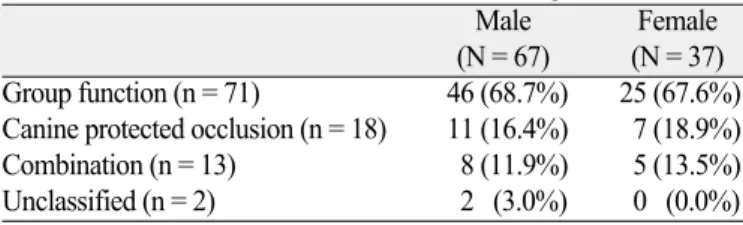
The study also found that majority of the populations (79.8%) did not have any occlusal interference. For the pop- ulation with occlusal interference (20.2%), we found that the most common interference was protrusive interference (57.14%), the second was balancing interference (38.1%) and the third was working interference (4.1%). Next we examined the distribution of occlusal scheme within each gender as well as the distribution of gender within each occlusal scheme and discovered that there was no statistical dif- ferences (Chi-square test; P=.743) for either distributions. There was almost equal distribution of group function, canine pro- tected occlusion and combination occlusal scheme for each gen- der (Table 1).
For the incisal relationship, the distance of both horizontal overlap and vertical overlap were not statistically different among both occlusal schemes and the combination group. On the oth- er hand, there was a tendency of less vertical overlap in group function when compared to canine protected occlusion
Table 1. Occlusal scheme distribution within each gender Male Female (N = 67) (N = 37) Group function (n = 71) 46 (68.7%) 25 (67.6%) Canine protected occlusion (n = 18) 11 (16.4%) 7 (18.9%) Combination (n = 13) 8 (11.9%) 5 (13.5%) Unclassified (n = 2) 2 (3.0%) 0 (0.0%)
134
Occlusal scheme in a group of Thais
J Adv Prosthodont 2011;3:132-5 Asawaworarit N et al.
occlusal scheme. However, there was no statistical significant difference for this observation (Table 2).
Our study revealed that the majority in each occlusal scheme does not process occlusal interferences ranging from approx- imately 89% in canine protected occlusion to 79% in group func- tion (Table 3). However, there was no significant relationship between the presence of interferences and occlusal scheme (Chi- square test; P=.743).
Lastly, we examined the difference in distance of horizon- tal overlap and vertical overlap in population with or without protrusive interferences (Table 4). We found that for vertical overlap, there was less distance for the population with pro- trusive interference (1.33±0.62 mm) than the distance for the population without the protrusive interference (2.02±1.24 mm).
DISCUSSION
Our findings of the majority of studied population processed group function occlusal scheme. This is similar to the earlier epidemiological data such as study by Beyron3showed fair- ly overwhelmingly that adult Australian aborigines had group function occlusion. Weinberg14found that 81% of his studied population possessed group function occlusal scheme, where- as only 5% had canine guided occlusal scheme. By contrast,
Scaife and Holt15 examined 1200 individuals, and discov- ered that the majority had either unilateral or bilateral canine protected occlusion. The discrepancy among studies may be due to the difference in examined population, culture and regular food intakes as well as influence of the materials used to register the contacts. As Tarazi et al.16demonstrated that the number of recorded tooth contacts varies with the mater- ial used to record registrations.
For the occlusal interference, Posselt17described this term as a cuspal contact forcing the mandible to deviate from a nor- mal pattern of movement. The eighth edition of the glos- sary of prosthodontic terms5states an occlusal interference as any tooth contact that inhibits the remaining occluding surfaces from attaining stable and harmonious contacts. Ash and Ramfjord18 described the term occlusal interference as an occlusal contact relationship that interferes in a meaningful way with function or parafunction. Even though there were slight differences of definition of this term, it has been long a sub- ject of interest, study and debate in dental field. Our study found that majority of the population does not process occlusal interferences. The type of occlusal interferences that has the highest percentage is protrusive interference followed by balancing side interference. This is surprising that our finding was less occlusal interferences which the most common was balancing or non-working interference.
The result of the incisal relation found from this study was similar with previous study18in the Thai population. They found the average of vertical overlap (2.28±1.13 mm) was greater than horizontal overlap (2.68±1.1 mm). They also found that the common range of vertical overlap was 1 - 3 mm. and the horizontal overlap was 2 - 4 mm. This finding was simi- lar to our finding. Interestingly, we found that the shorter dis- tance of vertical overlap was found in the population with pro- trusive interference. However, there was no difference for the horizontal overlap between the population with or without pro- trusive interference.
A number of limitations can be noted in the above mentioned studies. No reference was made to the location of the canine in terms of its relationship to the line of the arch nor to the degree of attrition of the canine, which is of particular importance in examining the assumption that attrition could lead from one type of contact during lateral movement to another.19In this study, subjects with marked attrition were excluded based on the assumption made by McAdam4and Woda et al.19that canine
Table 4. Comparison of vertical overlap and horizontal overlap regarding the presence of protrusive interference
N Mean (m.m) P value*
Vertical overlap no protrusive interference 92 2.02 ± 1.24 .037
protrusive interference 12 1.33 ± 0.62
Horizontal overlap no protrusive interference 92 2.45 ± 1.36 .424
protrusive interference 12 2.17 ± 0.91
Table 2. Measurement of incisal relationship (horizontal overlap and ver- tical overlap) for each type of occlusal scheme
Horizontal Vertical overlap (mm) overlap (mm) Group function (n = 71) 2.38±1.23 1.81±1.09 Canine protected occlusion (n = 18) 2.58±1.29 2.39±1.40 Combination (n = 13) 2.58±1.81 2.08±1.47
P value .781 .178
Table 3. Presence of occlusal interferences for each type of occlusal scheme Presence of interferences
Yes No
Group function (n = 71) 15 (21.1%) 56 (78.9%) Canine protected occlusion (n = 18) 2 (11.1%) 16 (88.9%) Combination (n = 13) 2 (15.4%) 11 (84.6%)
Unclassify (n = 2) 2 (100.0%) 0 (0.0%)
135
Occlusal scheme in a group of Thais
J Adv Prosthodont 2011;3:132-5
Asawaworarit N et al.
guidance and group function appear to correspond to two successive states of the evolving dentition under the effect of attrition.
The inclusion criteria for this study were set to assure the pres- ence of a natural dentition as well as the absence of noticeable periodontal problems. These criteria were set because the neuromuscular control of occlusal stability as well as masti- catory muscles can be influenced by the periodontal input.20,21 Moreover, the position at which the occlusal contact pattern was recorded (cusp to cusp) may not be representative of the functional range of the lateral excursion of mandibular move- ment. Chewing kinematics can vary based on several factors such as age, dental static occlusion, facial morphology, and so on.22,23
Another fact for consideration is that changes occurring during the development of occlusion could influence the occlusal contact pattern. Heikinheimo et al.24 reported an increase in occlusal interferences between the ages of 12 and 15 years. Other studies showed a decreasing prevalence with increasing age.19,25,26The fact that the sample was composed of subjects aged from 18 to 50 years, could be the explanation for the slight differences in the result from other studies as the changes occurring during occlusal development could influ- ence the occlusal contact pattern.
CONCLUSION
This study demonstrated that among Thais, the most com- mon occlusal scheme is group function, but there was no demographic or occlusal factors that strongly related to any par- ticular occlusal scheme. However, we did not focus our study on the exact association between other static occlusal relationship parameters such as Angle’s classification with the other dynamic occlusal relationship parameter other than occlusal scheme. This should be conducted in the future study.
REFERENCES
1. Bonwill WGA. Geometric and mechanical laws of articulation:
anatomical articulation. Transactions of the Odontological Society of Pennsylvania; 1885. p. 119.
2. D’Amico A. Functional occlusion of the natural teeth of man.
J Prosthet Dent 1961;11:899-915.
3. Beyron H. Occlusal relations and mastication in Australian aborigines. Acta Odontol Scand 1964;22:597-678.
4. McAdam DB. Tooth loading and cuspal guidance in canine and group-function occlusions. J Prosthet Dent 1976;35:283-90.
5. American academy of Prosthodontics. The glossary of prostho- dontic terms. J Prosthet Dent 2005;94:10-92.
6. Abdullah A, Sherfudhin H, Omar R, Johansson A. Prevalence
of occlusal tooth wear and its relationship to lateral and protrusive contact schemes in a young adult Indian population. Acta Odontol Scand 1994;52:191-7.
7. Wiskott HW, Belser UC. A rationale for a simplified occlusal design in restorative dentistry: historical review and clinical guide- lines. J Prosthet Dent 1995;73:169-83.
8. Hagag G, Yoshida K, Miura H. Occlusion, prosthodontic treat- ment, and temporomandibular disorders: a review. J Med Dent Sci 2000;47:61-6.
9. McIntyre FM, Jureyda O. Occlusal function. Beyond centric re- lation. Dent Clin North Am 2001;45:173-80.
10. Nikolopoulou F, Ktena-Agapitou P. Rationale for choices of oc- clusal schemes for complete dentures supported by implants. J Oral Implantol 2006;32:200-3.
11. Al-Nimri KS, Bataineh AB, Abo-Farha S. Functional occlusal patterns and their relationship to static occlusion. Angle Orthod 2010;80:65-71.
12. Houston WJB, Stephens CD, Tulley WJ. A Textbook of orthodontics. 2nded. Wright Publications; 1992.
13. Berry DC, Singh BP. Daily variations in occlusal contacts. J Prosthet Dent 1983;50:386-91.
14. Weinberg LA. A cinematic study of centric and eccentric oc- clusions. J Prosthet Dent 1964;14:290-3.
15. Scaife RR Jr. Holt JE. Natural occurrence of cuspid guidance.
J Prosthet Dent 1969;22:225-9.
16. Tarazi E, Ticotsky-Zadok N. Occlusal schemes of complete den- tures-a review of the literature. Refuat Hapeh Vehashinayim 2007;24:56-64, 85-6.
17. Posselt U. Physiology of Occlusion and Rehabilitation. Oxford;
Blackwell Scientific Publications; 1968.
18. Ash MM, Ramfjord S. Occlusion. Philadelphia; WB Saunders Co; 1996.
19. Asawaworarit N, Suchatlampong C, Asawaworarit W. Average incisal relationships. J Dent Assoc Thai 1992;42:171-5.
20. Woda A, Vigneron P, Kay D. Nonfunctional and functional oc- clusal contacts: a review of the literature. J Prosthet Dent 1979;42:335-41.
21. Manns A, Chan C, Miralles R. Influence of group function and canine guidance on electromyographic activity of elevator muscles. J Prosthet Dent 1987;57:494-501.
22. Ferrario VF, Tartaglia GM, Galletta A, Grassi GP, Sforza C. The influence of occlusion on jaw and neck muscle activity: a sur- face EMG study in healthy young adults. J Oral Rehabil 2006;
33:341-8.
23. Gerstner GE, Marchi F, Haerian H. Relationship between an- teroposterior maxillomandibular morphology and masticatory jaw movement patterns. Am J Orthod Dentofacial Orthop 1999;115:258-66.
24. Ahlgren J. Pattern of chewing and malocclusion of teeth. A clin- ical study. Acta Odontol Scand 1967;25:3-13.
25. Heikinheimo K, Salmi K, Mylla¨rniemi S, Kirveskari P. A lon- gitudinal study of occlusal interferences and signs of cran- iomandibular disorder at the ages of 12 and 15 years. Eur J Orthod 1990;12:190-7.
26. Pahkala R, Laine T. Variation in function of the masticatory sys- tem in 1008 rural children. J Clin Pediatr Dent 1991;16:25-30.
27. Egermark-Eriksson I, Carlsson GE, Ingervall B. Prevalence of mandibular dysfunction and orofacial parafunction in 7-, 11- and 15-year-old Swedish children. Eur J Orthod 1981;3:163-72.