Original Article
대퇴감각이상증의 임상 및 전기생리학적 특징
아주대학교 의과대학 신경과학교실
최문희․박하늘․엄영인․주인수
Clinical and Electrophysiological Characteristics of Meralgia Paresthetica
Mun Hee Choi, Hanul Park, Young In Eom, In Soo Joo
Department of Neurology, Ajou University School of Medicine, Suwon, Korea
Background: Meralgia paresthetica (MP) is a mononeuropathy affecting the lateral femoral cutaneous nerve. The disease is often diagnosed clinically, but electrophysiological tests play an important role. The aim of this study is to clarify clinical characteristics of MP as well as the role of sensory nerve conduction study (NCS) in the diagnosis of MP.
Methods: Sixty-five consecutive patients with clinical diagnosis of MP between March 2001 and June 2012 were retro- spectively reviewed at a single tertiary center. General demographics, clinical characteristics and sensory NCS findings were investigated. Measurements of sensory NCS included the baseline-to-peak amplitude, side-to-side amplitude ratio and the conduction velocity. To compare between the normal and abnormal NCS groups, independent t-tests and chi- square test were performed. Results: Sixty-five patients had male predominance (56.9%) with mean age of 48.4±13.4 years (range: 16-75). Seven patients (13.5%) had undergone operation or procedure before the symptom onset. The sensory nerve action potentials were obtainable in 52 (80%) of 65 clinically diagnosed MP patients. Sensory NCS revealed abnormalities in 38 patients (73.1%), and others (n=14, 26.9%) showed normal findings. Between the normal and abnormal NCS groups, there is no statistically significant difference on demographics or clinical features.
Conclusions: We clarify the clinical features and sensory NCS findings of MP patients. Due to several limitations of sensory NCS, the diagnosis of MP could be accomplished both clinically and electrophysiologically.
Key Words: Meralgia paresthetica, Lateral femoral cutaneous nerve, Nerve conduction study
Received 6 May 2013; received in revised form 9 August 2013; accepted 5 December 2013.
Address for correspondence;
In Soo Joo
Department of Neurology, Ajou University School of Medicine, 164 Worldcup-ro, Yeongtong-gu, Suwon 443-380, Korea
Tel: +82-31-219-5175 Fax: +82-31-219-5178 E-mail: [email protected]
Introduction
Meralgia paresthetica (MP) is a focal compressive neuropathy
involving the lateral femoral cutaneous nerve (LFCN).1-3 It is known to be the second most frequent entrapment neuropathy of the lower extremity.4,5 MP literally means thigh pain, and its clin- ical features are abnormal or decreased sensation and pain on the anterolateral side of the thigh. The incidence of MP was estimated as 4.3 per 10,000 person-years.6 MP has been reported to be asso- ciated with mechanical factors such as pregnancy, obesity, wear- ing of tight clothes and iatrogenic causes.1,6-8 Diagnosis is often achieved by symptoms and neurological examination in primary care settings, but electrophysiological tests including sensory
nerve conduction study (NCS) and somatosensory evoked poten- tials (SSEP) play an important role.5,9-12 The studies on corre- lation of electrophysiological findings with clinical features is very limited in number. The aim of this study was to clarify clin- ical characteristics of MP as well as the role of sensory NCS in the diagnosis of MP.
Methods
We retrospectively reviewed 65 consecutive patients diag- nosed with MP between March 2001 and June 2012 in a single tertiary referral center. The diagnosis of MP is based only on the presence of the following symptoms and signs: (a) unpleasant paresthesia, numbness, burning sensation, dysesthesia or pain over the anterolateral aspect of the thigh and (b) exacerbation of symptoms on walking, standing or extending the hips.13 History taking and neurologic examination were done in all patients by an experienced neurologist. Demographic features and precipitating conditions such as pregnancy, diabetes, trauma, procedure or op- eration were investigated. Clinical symptoms were categorized into negative sensory symptoms (numbness, hypesthesia) and positive sensory symptoms (paresthesia, pain). Clinical character- istics including symptom duration at diagnosis, affected side, se- verity were studied. Severity was assessed depending on the ne- cessity of medical management. Sensory NCS of the bilateral LFCN were performed in all patients. In patients suspected with other diseases mimicking MP, needle electromyography, spinal imaging, and laboratory test were done. These investigations were conducted to rule out other diseases, such as lumbosacral root dis- orders, polyneuropathy or metabolic diseases.
Sensory NCS of the LFCN were performed using Lagueny’s method using surface electrodes instead of needle.9 Patients were placed in the supine position. Skin temperature was kept above 32℃. The LFCN was antidromically stimulated at 1.5 cm medial and distal to the anterior superior iliac spine (ASIS) with the anode 3 cm proximal to the cathode. The active recording elec- trode was located 12 cm distal to the ASIS with the reference elec- trode 3 cm below it. The ground electrode was placed between the stimulating and recording points. All tests were conducted bilaterally. Measurements included the baseline-to-peak ampli- tude, peak latency and the conduction velocity. The base- line-to-peak amplitude reflected the number of axons associated with neural depolarization more accurately. Abnormal results
were defined as absent potentials, slowed conduction velocity less than 45.8 m/s, sensory nerve action potential (SNAP) amplitude less than 3.0 μV (our reference value from 20 normal control, 2SD) or side-to-side amplitude ratio of less than 45%.9 Electro- physiological studies were performed with a Medelec Synergy® (Oxford Instruments Medical, New York, USA).
To clarify the reliability of sensory NCS for diagnosis of MP, we divided the patients into the normal and abnormal NCS groups. We compared clinical and electrophysiological data be- tween 2 groups. In subgroup analyses, we compared between short (less than 3 months) and long symptom duration groups, mild and severe groups (according to the necessity of medical management), and with diabetes versus without diabetes groups.
Data analysis was conducted using independent t-test, Fisher’s exact test, and chi-square test. In subgroup analyses, independent t-test, chi-square test, and Mann-Whitney test were used. P-value less than 0.05 was used as a level of significance. Statistical analy- ses were performed by using a commercially available software package SPSS 12.0 for Windows (SPSS, Inc., Chicago, Illinois).
Results
Clinical Data
Sixty-five patients consisted of 37 (56.9%) men and 28 (43.1%) women. Mean age was 48.4±13.4 years (range: 16-75).
Only 3 patients among 35 BMI-measured patients (8.6%) were obese (BMI above 30.0 kg/m2). Mean BMI was 24.23±3.63 kg/m2 (range: 16.14-35.56). Only 5 patients (7.7%) had diabetes. Five patients (7.7%) had trauma histories and 7 (10.8%) had under- gone operation or procedure before the symptom onset. These in- cluded transfemoral coronary angiography, abscess drainage at inguinal area, liposuction, surgery for arteriovenous fistula, colo- noscopic biopsy or laparoscopic surgery (Table 1).
The right thigh was involved in 35 patients (53.8%) and the left in 27 patients (41.5%). Three patients had bilateral symptom.
Twenty-six patients (50.0%) had negative sensory symptoms such as numbness or hypesthesia. Twelve patients (23.1%) had positive sensory symptoms and the rest (n=14, 26.9%) had both negative and positive symptoms. Mean symptom duration was about 30 months (range: 0.2-300.0); duration was 3 months or less in 27 patients (41.5%), 3-6 months in 8 (12.3%), 6-12 months in 13 (20.0%), 12 months to 5 years in 8 (12.3%), and more than 5 years in 9 (13.8%). In 20 patients (30.8%), medications were
Table 1. Demographic and clinical features of 65 clinically diagnosed patients with meralgia paresthetica
Demographics Age (years) 48.4±13.4 (16.4-74.6)
Sex (male:female) 37 (56.9%):28 (43.1%)
Obesity* 3/35 (8.6%)
Diabetes 5 (7.7%)
Trauma 5 (7.7%)
Operation or procedure 7 (10.8%)
Clinical Symptom duration(months) 31.9±71.1 (0.2-300.0)
Characteristics Bilaterality 3 (4.6%)
Symptom side (R:L) 35 (53.8%):27 (41.5%)
Clinical symptoms
Positive sensory symptoms 17 (26.2%)
Negative sensory symptoms 32 (49.2%)
Both (positive and negative) 16 (24.6%)
Severe (need medications) 20 (30.8%)
*Obesity means BMI above 30 kg/m2. BMI measurements were available in 35 patients.
needed to control ones’ symptoms (Table 1). There was no patient requiring surgical treatment. The mean follow up duration was 9.9 months (range: 0.3-144).
Electrophysiological Data
In 65 patients, SNAPs were obtainable in 52 (80%). Ten pa- tients with undetected SNAP of the bilateral LFCNs and 3 pa- tients with bilateral symptom were excluded in data analyses.
Sensory NCS revealed abnormalities in 38 patients (73.1%), and others (n=14, 26.9%) showed normal findings. In abnormal NCS group, SNAP of the symptomatic LFCN was not detected in 20 patients. Eighteen SNAP-detected patients revealed low ampli- tude (<3 uV) in 2, slowed NCV (<45.8 m/s) in 13 and both in 3.
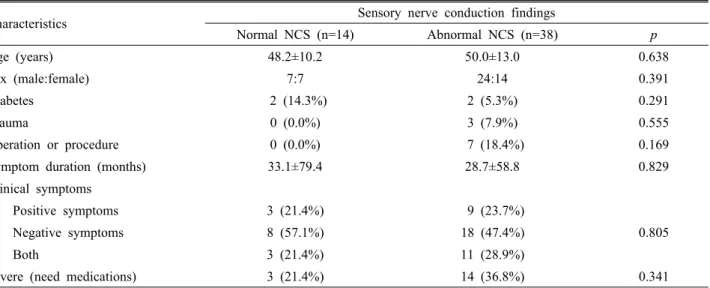
Between the normal and abnormal NCS groups, there was no stat- istically significant difference on demographics or clinical fea- tures (Table 2).
To elucidate useful parameter of NCS in the diagnosis of MP, comparison of sensory nerve conduction study parameters be- tween the affected and unaffected sides was conducted except for 23 patients in whom SNAP was not evoked. The SNAP amplitude was significantly different between two sides (8.151±4.234 μV vs. 9.868±4.887 μV, p=0.003). But the sensory NCV showed no statistically significant difference.
Discussion
MP is a frequently encountered condition in primary care settings. Numerous studies have included patients with MP diagnosed by electrophysiological methods.4,12 However, using electrophysiological tests to diagnose MP is limited. Our study results, which included patients clinically diagnosed with MP, provide useful information for primary care physicians and neurologists.
We compared the clinical features of 65 patients with clinical MP with data from the literature. Male predominance (56.9%), mean age at onset, and duration of symptoms were consistent with the literature.6,12,14 However, obesity and diabetes, known to be risk factors for MP,15 were less frequent than previously reported (8.6% for obesity, 7.7% for diabetes). This may have resulted from racial differences in the study populations because the majority of previous studies have targeted Caucasian patients.
The lower BMI of Korean patients with diabetes is well known.16 The lower BMI of Koreans, both in diabetic and non-diabetic patients, is most likely responsible for the lower proportions of obese and diabetic patients with MP observed in this study, because mechanical pressure over the LFCN would be less in patients with lower-BMI. In a previous report, the most common symptom was numbness (68.7%) and one-third of all patients experience burning pain.17 Another study reported that pain occurred in almost all patients.4 In our study, the most frequent
Table 2. Comparison between the normal and abnormal NCS groups
Characteristics Sensory nerve conduction findings
Normal NCS (n=14) Abnormal NCS (n=38) p
Age (years) 48.2±10.2 50.0±13.0 0.638
Sex (male:female) 7:7 24:14 0.391
Diabetes 2 (14.3%) 2 (5.3%) 0.291
Trauma 0 (0.0%) 3 (7.9%) 0.555
Operation or procedure 0 (0.0%) 7 (18.4%) 0.169
Symptom duration (months) 33.1±79.4 28.7±58.8 0.829
Clinical symptoms
Positive symptoms 3 (21.4%) 9 (23.7%)
0.805
Negative symptoms 8 (57.1%) 18 (47.4%)
Both 3 (21.4%) 11 (28.9%)
Severe (need medications) 3 (21.4%) 14 (36.8%) 0.341
NCS; nerve conduction study.
symptoms was negative, such as hypesthesia (73.8%), whereas half of all patients experienced positive symptoms. A well-de- signed prospective clinical study would be needed in order to clarify this issue.
Some patients develop symptoms after a procedure or an oper- ation, as described in previous case series. Transfemoral coronary angiography,18 inguinal surgery such as that performed to treat hernia,19 and laparoscopic surgery20 are unusual causes of MP. In one patient, symptoms occurred after liposuction, which has not been reported previously. The patient received liposuction at mul- tiple locations on both thighs. The LFCN could be injured by a procedure involving the thigh or inguinal area.
Electrodiagnostic tests are important for the diagnosis of MP but there are several limitations.1 Although sensory NCS and so- matosensory-evoked potentials (SSEP) are mainly used, a stand- ard protocol for NCSs of LFCNs has not yet been determined.9,17 Several factors such as BMI, age, and anatomical variation may also influence the findings of sensory NCSs.21,22 In addition, the clinical significance of SSEP is still controversial.11,23
The electrophysiological characteristics of MP observed in this study can be summarized as follows. First, a significant portion of patients with MP had normal NCSs (n = 14, 26.9%). In recent studies, diagnoses of MP were made using electrophysiological methods. However, because we have included all patients pre- senting with typical symptoms of MP, patients were divided into two groups: one with abnormal NCS and the other with normal NCS. And between the 2 groups, no significant differences were
observed in the demographics or clinical feature. This suggests that the diagnosis of MP could be made on clinical grounds re- gardless of the results of the electrophysiological studies. This is probably because electrophysiological changes be observed only after a progression of nerve entrapment until pathologic change such as degeneration of myelin sheaths or axonal damage develops.24 Thus, although entrapment of the LFCN leads to clin- ical symptoms of MP, NCS findings could be normal if entrap- ment is transient or mild.
Secondly, we assumed that the SNAP baseline-to-peak ampli- tude was the most useful parameter for diagnosing of MP. In the abnormal NCS group, 31 of 38 patients (81.6%) showed abnor- mal amplitudes. When we compared SNAP parameters between the affected side vs. unaffected side, the amplitude was the only parameter had showed a statistical significance (8.151± 4.234 μV vs. 9.868 ± 4.887 μV, P = 0.003). Moreover, even when the SNAP was within the normal range, the amplitude difference between both sides was also important.
Finally, the abnormal NCS findings were different between patients. Twenty patients (38.5%) did not show a SNAP response due to severe axonal damage. Sixteen (30.8%) showed NCV slowing reflecting demyelination, and five (9.6%) had a low am- plitude suggesting axonal change. No difference in clinical fea- tures was observed between slowed NCV and low amplitude pa- tients (data not shown).
This study has several limitations. It was a retrospective and cross-sectional study, and electrophysiological or clinical evalua-
tion was not serially conducted. As also shown in our study, it is generally agreed that NCS of the LFCN has relatively low sensi- tivity in detecting MP. In previous report on sensory NCSs,9 al- most one-third of patients showed normal NCS results. In addi- tion, there is no consensus on which NCS methodology is better in the diagnosis of MP as yet.
In conclusion, we have clarified the clinical and electro- diagnostic characteristics of patients with MP, and compared to the data published in previous literatures. A diagnosis of MP based on NCS findings might be insufficient because the LFCN is often not detected due to technical factors, and NCS findings can be normal even if clinical features are compatible with MP. Due to the lack of a standard NCS protocol for LFCN, various methods are currently used for eletrodiagnosis of MP. Therefore, clinical features are as important as electrophysiological tests for diagnos- ing MP. Studies to develop more sensitive and specific diagnostic test for MP would be needed in the future.
REFERENCES
1. Harney D, Patijn J. Meralgia paresthetica: diagnosis and man- agement strategies. Pain Med 2007;8:669-677.
2. Wartenberg R. Meralgia paresthetica. Neurology 1956;6:560-562.
3. Grossman MG, Ducey SA, Nadler SS, Levy AS. Meralgia par- esthetica: diagnosis and treatment. J Am Acad Orthop Surg 2001;9:336-344.
4. Seror P, Seror R. Meralgia paresthetica: clinical and electro- physiological diagnosis in 120 cases. Muscle Nerve 2006;33:
650-654.
5. Butler ET, Johnson EW, Kaye ZA. Normal conduction velocity in the lateral femoral cutaneous nerve. Arch Phys Med Rehabil 1974;55:31-32.
6. van Slobbe AM, Bohnen AM, Bernsen RM, Koes BW, Bierma-Zeinstra SM. Incidence rates and determinants in mer- algia paresthetica in general practice. J Neurol 2004;251:294-297.
7. Mondelli M, Rossi S, Romano C. Body mass index in mer- algia paresthetica: a case-control study. Acta Neurol Scand 2007;
116:118-123.
8. Williams PH, Trzil KP. Management of meralgia paresthetica.
J Neurosurg 1991;74:76-80.
9. Lagueny A, Deliac MM, Deliac P, Durandeau A. Diagnostic and prognostic value of electrophysiologic tests in meralgia
paresthetica. Muscle Nerve 1991;14:51-56.
10. Laroy V, Knoops P, Semoulin P. The lateral femoral cutaneous nerve: nerve conduction technique. J Clin Neurophysiol 1999;
16:161-163.
11. Seror P. Lateral femoral cutaneous nerve conduction v somato- sensory evoked potentials for electrodiagnosis of meralgia paresthetica. Am J Phys Med Rehabil 1999;78:313-316.
12. Seror P. Somatosensory evoked potentials for the electro- diagnosis of meralgia paresthetica. Muscle Nerve 2004;29:
309-312.
13. Dureja GP, Gulaya V, Jayalakshmi TS, Mandal P. Management of meralgia paresthetica: a multimodality regimen. Anesth Analg 1995;80:1060-1061.
14. Kitchen C, Simpson J. Meralgia paresthetica. A review of 67 patients. Acta Neurol Scand 1972;48:547-555.
15. Parisi TJ, Mandrekar J, Dyck PJ, Klein CJ. Meralgia paresthe- tica: relation to obesity, advanced age, and diabetes mellitus.
Neurology 2011;77:1538-1542.
16. Moon OR, Kim NS, Jang SM, Yoon TH, Kim SO. The rela- tionship between body mass index and the prevalence of obe- sity-related diseases based on the 1995 National Health Inter- view Survey in Korea. Obes Rev 2002;3:191-196.
17. El-Tantawi GA. Reliability of sensory nerve-conduction and somatosensory evoked potentials for diagnosis of meralgia paraesthetica. Clin Neurophysiol 2009;120:1346-1351.
18. Ziael SJ. Meralgia paresthetica syndrom after transfemoral cor- onary angiography. J Res Med Sci 2001;6:[abstract].
19. Rao T, Kim H, Mathrubhutham M, Lee KN. Meralgia pares- thetica. Unsusual complication of inguinal herniorrhaphy. JAMA 1977;237:2525.
20. Yamout B, Tayyim A, Farhat W. Meralgia paresthetica as a complication of laparoscopic cholecystectomy. Clin Neurol Neurosurg 1994;96:143-144.
21. Kim HY, Han YS, Koh SH, Kim JH, Kim SH. Lateral femoral cutaneous nerve: variety in conduction (seror’s method) ac- cording to body mass index and age. Korean J Clin Neurophysiol 2006;8:152-157.
22. Shin YB, Park JH, Kwon DR, Park BK. Variability in con- duction of the lateral femoral cutaneous nerve. Muscle Nerve 2006;33:645-649.
23. Po HL, Mei SN. Meralgia paresthetica: the diagnostic value of somatosensory evoked potentials. Arch Phys Med Rehabil 1992;73:70-72.
24. Jefferson D, Eames RA. Subclinical entrapment of the lateral femoral cutaneous nerve: an autopsy study. Muscle Nerve 1979;
2:145-154.