Determinants of Inpatients Satisfaction and Intent to Revisit Oriental Medical Hospitals
Hyun-Suk Park, Young-Joon Seo
Dept. of Health Service Management, Daejeon Univ., Dept. of Health Administration, Yonsei Univ.
Original Article
⋅Received:9 December 2014 ⋅Revised:29 December 2014 ⋅Accepted:29 December 2014
⋅Correspondence to:Young-Joon Seo Dept. of Health Administration, Yonsei Univ.
Yonsei Univ. Wonju Campus, Maeji-ri, Heungeop-myeon, Wonju-si, Gangwon-do, 220-710 Tel:+82-33-760-2415, Fax:+82-33-760-2519, E-mail:[email protected]
Objectives: This study aimed to investigate the determinants of inpatients satisfaction and intent to revisit oriental medical hospitals.
Methods: The independent variables of the study contain the level of satisfaction with doctors, nurses, staffs, medical fee, environment, facilities and hospital life. Each variable was measured by three to eight items about the level of satisfaction with various aspects of hospital ward life. The level of overall patient satisfaction was used as an intervening variable and the level of intent to revisit was used as a dependent variable. The sample used in this study consisted of 268 inpatients from 3 oriental medical hospitals located in Chungnam Province. Data were collected with a structured and self-administrated questionnaire and analysed using path analysis.
Results: The major findings of the study were as follows : First, it was found that the 3 variables of hospital life satisfaction, ancillary staffs satisfaction, and metropolitan residents has significant positive effect on the level of overall patient satisfaction. Second, the overall satisfaction and the satisfactory level of facilities, medical fee, and quality of ward life were found to have significant effects on the level of intent to revisit of respondents.
Conclusions: The results of the study indicate that oriental medical hospitals should make an effort to improve the overall satisfaction of inpatients, especially focusing on the facilities convenience, medical price, and hospital ward life which will lead to high level of intent to revisit of inpatients.
Key Words : Inpatients Satisfaction, Intent to Revisit, Oriental Medical Hospitals
Introduction
Since oriental medical insurance was enforced all over the country, the demand for oriental medical fields has greatly increased. However, oriental medical institutions have poor marketing strategies to induce patients to reuse oriental medical service by actively attracting and satisfying them while properly coping with such a consumers’ demand
1,2). All the endeavors of hospitals for improving patients’
satisfaction have a multi-dimensional concept, and its main purpose is to increase patients’ loyalty by
giving them a good impression about hospitals and improving their quality of life through high-quality medical services. Besides, all the endeavors are based on a positive-function cycle, such as sustaining hospitals by securing profitability through satisfying patients’ needs and by motivating hospital staff through better compensation for providing patients with better medical services
3).
Various researches have been conducted on the
relationship between patients’ satisfaction and revisit
intention in Korea and oversea
3). Fisk et al.,
4)argued
that the more satisfied patients are with medical
services provided, the higher intention they have to revisit the same medical institution, and Binter
5), Bolton and Drew
6,5)clarified that there was a significant correlation between patients’ satisfaction with medical services and their revisit intention.
Swan
7)proposed a model explaining that the quality of medical services has an effect on patients’
satisfaction, which leads to their revisit intention.
Steiber
8)and Woodside et al.,
9)also reported that there is a high correlation between the quality of medical services and patients’ revisit intention and between their satisfaction and revisit intention. Many researches conducted in Korea clarified that medical services in various fields have effect on consumers’
satisfaction, which also has significant effect on their intention to revisit the same medical institution
10-17). Seo et al.,
2)reported that medical expenses, the level of satisfaction with kindness of oriental doctors and medical staff, oriental doctors’ professionalism, credibility, medical facilities and equipment, and the reputation of a hospital or a doctor have significant effects on patients’ intention to revisit oriental medical institutions and their satisfaction through systematically analyzing 33 articles in Korea.
However, most of the previous studies on patient satisfaction and revisit intention in oriental medical services were conducted with small-size sample from one or two institutions, and the number of the variables included in the study were very limited, especially focused on clinical skills. Thus, this study aims to investigate inpatients’ satisfaction with and their intention to revisit through estimating the wholistic model of the patients’revisit intention to oriental medicine hospitals. The specific objectives of this study are as below.
Firstly, this study aims to compare the level of inpatients’ general satisfaction and intention to revisit oriental medicine hospitals in terms of socio-demographic characteristics of the respondents.
Secondly, this study will find out the factors affecting inpatients’ general satisfaction with oriental
medical services.
Thirdly, this study aims to find out factors affecting inpatients’ intention to revisit oriental medicine hospitals.
Research Methods
1. Data Collection
Data of the study were collected from inpatients of 2 oriental medicine hospitals in D City and 1 university-affiliated oriental medicine hospital in C City located in Choongnam Province, Korea.
Self-administered questionnaires were distributed to a total of 100 inpatients randomly selected from each hospital considering the proportion of the patient population in terms of their socio-demographic characteristics. A total of 268 out of 300 questionnaires were returned from October to December 2012.
2. Measurement
This study established a single path model that
patients’ satisfaction with 7 independent factors has
direct and indirect effect on their overall satisfaction
with hospital services and revisit intention. Seven
independent factors used in the study were human
factors, such as patients’ satisfaction with doctors,
satisfaction with nurses, and satisfaction with staff,
and material factors, such as satisfaction with
medical fee, satisfaction with amenities, satisfaction
with hospital facilities, and satisfaction with their
ward lives. All the variables used for this study were
measured by Likert 5-point scale ranging from
1-point for ‘very unsatisfactory’ to 5-point for ‘very
satisfactory’. Seven factors were composed of 3 to
8 questions about detailed characteristics of each
factor, except medical expenses. Socio-demographic
variables of the study included their gender, age,
marital status, educational background, religion,
monthly income, dwelling area, route to oriental
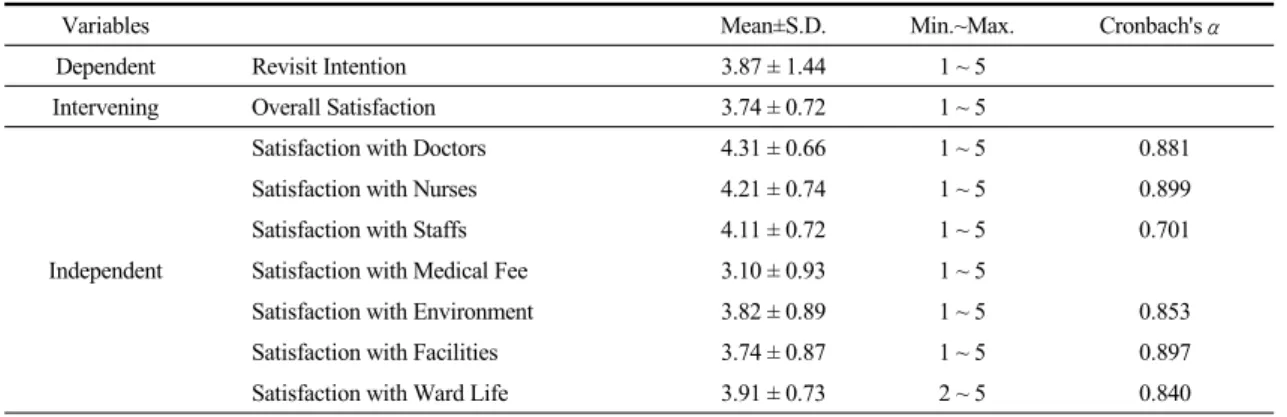
Variables Mean±S.D. Min.~Max. Cronbach's α
Dependent Revisit Intention 3.87 ± 1.44 1 ~ 5
Intervening Overall Satisfaction 3.74 ± 0.72 1 ~ 5
Independent
Satisfaction with Doctors 4.31 ± 0.66 1 ~ 5 0.881
Satisfaction with Nurses 4.21 ± 0.74 1 ~ 5 0.899
Satisfaction with Staffs 4.11 ± 0.72 1 ~ 5 0.701
Satisfaction with Medical Fee 3.10 ± 0.93 1 ~ 5
Satisfaction with Environment 3.82 ± 0.89 1 ~ 5 0.853
Satisfaction with Facilities 3.74 ± 0.87 1 ~ 5 0.897
Satisfaction with Ward Life 3.91 ± 0.73 2 ~ 5 0.840
Table 1. Descriptive Statistics and Reliability of Study Variables
medical services, medical department, length of admission, health status when being hospitalized, and treatment results.
3. Statistical Analysis
Collected data were analyzed with PASW 18.0.
The reliability of responses to each factor was verified using the value of Cronbach's α and all of the value showed over 0.70 which was regarded as an acceptable level(Table 1). The difference of patients’ overall satisfaction and revisit intention were compared in terms of socio-demographic characteristics of respondents through t-test, ANOVA and Scheffe test. To investigate patients’ satisfaction with each factor that has effect on their overall satisfaction, multiple regression analysis and a path analysis were conducted with AMOS 18.0.
Results
1. General Characteristics of the Respondents
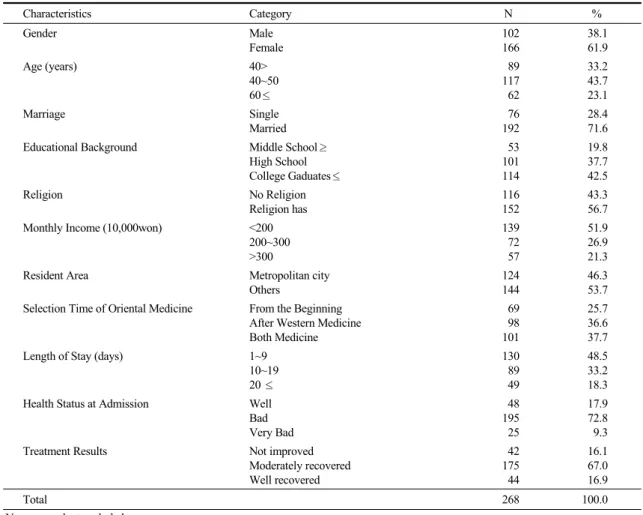
Table 2 shows the socio-demographic characteristics of respondents. The respondents were composed of 102 males (38.1%) and 166 females (61.9%), and their mean age was 46. One hundred ninety two persons(71.6%) were married and 114 persons (42.5%) were college graduates. A total of 152
persons (56.7%) responded that they have a religion, and 139 persons (51,9%) had a monthly income below 2 million won. One hundred twenty four persons (46.3%) lived in large cities, and 144 (53.7%) in small-sized city and rural areas. In the route of using oriental medical services, 101 persons (37.7%) used the western and oriental medicine together, 98 (36.6%) persons chose the oriental medicine after the western medicine, and 69 persons (25.7%) chose the oriental medicine from the beginning. A total of 130 persons (48.5%) were hospitalized from 1 to 9 days, 89 (33.2%) for 10 to 19 days, 49 (18.3%) over 20 days. In treatment results, 175 persons (67.0%) partially recovered, 44 (16.9%) fully recovered, and 42 (16.1%) remained in no recovery state.
2. Inpatients’Overall Satisfaction and Their Intent to Revisit Oriental Medical Hospitals
This study verified if there would be differences
between patients’ overall satisfaction and revisit
intention in terms of the socio-demographic
characteristics of respondents. The result showed
that there was a significant difference at the level of
patient satisfaction in terms of the characteristics of
marriage, dwelling areas and treatment results(table
3). As the patients were single, had a monthly
Characteristics Category N %
Gender Male
Female
102 166
38.1 61.9
Age (years) 40>
40~50 60≤
89 117 62
33.2 43.7 23.1
Marriage Single
Married
76 192
28.4 71.6
Educational Background Middle School≥
High School College Gaduates≤
53 101 114
19.8 37.7 42.5
Religion No Religion
Religion has
116 152
43.3 56.7 Monthly Income (10,000won) <200
200~300
>300
139 72 57
51.9 26.9 21.3
Resident Area Metropolitan city
Others
124 144
46.3 53.7 Selection Time of Oriental Medicine From the Beginning
After Western Medicine Both Medicine
69 98 101
25.7 36.6 37.7
Length of Stay (days) 1~9
10~19 20 ≤
130 89 49
48.5 33.2 18.3
Health Status at Admission Well
Bad Very Bad
48 195 25
17.9 72.8 9.3
Treatment Results Not improved
Moderately recovered Well recovered
42 175 44
16.1 67.0 16.9
Total 268 100.0
Non-respondent excluded
Table 2. Demographic Characteristics of Respondents
income over 3 million won, and better treatment results, they showed a higher level of overall satisfaction. Patients’ revisit intention were also found to be different by their monthly income and treatment results, which means that as the patients had a monthly income over 3 million won and better treatment results, they showed a higher degree of revisit intention.
3. Factors Affecting Inpatients’Overall Satisfaction
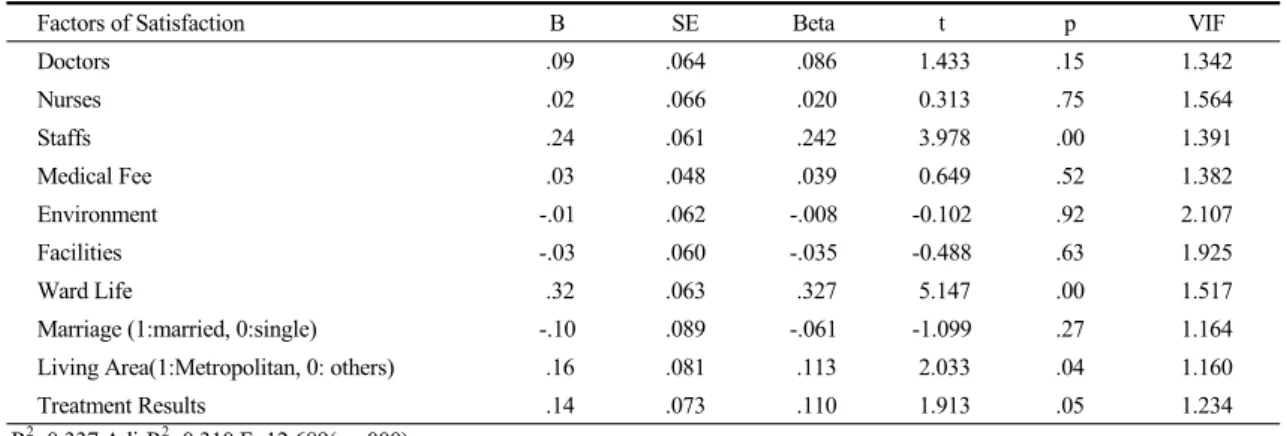
Tale 4 shows the results of multiple regression analysis. The regression equation was statistically
significant (F=12.689, p=.000), and there was no problem of multicollinearity since VIF of independent variables was 2.107 to the maximum.
The variation of patients’ overall satisfaction explained by independent variables was 33.7%. The results showed that as patients were more satisfied with ward life (.327), resided in larger cities (.113), and had better treatment results (.110), they were more likely to have a high level of overall satisfaction with the oriental medical services.
Characteristics Category Overall Satisfaction Intent to Revisit
Mean±S.D. t/F Mean±S.D. t/F
Gender Male
Female
3.74 ± 0.84 3.74 ± 0.64
0.058 3.65 ± 1.67 4.00 ± 1.28
1.831
Age (years) 40>
40~50 60≤
3.83 ± 0.79 3.72 ± 0.65 3.65 ± 0.75
1.301 3.99 ± 1.39 3.89 ± 1.38 3.65 ± 1.65
1.057
Marriage Single
Married
3.93 ± 0.77 3.66 ± 0.69
2.818** 4.05 ± 1.28 3.79 ± 1.50
1.426
Educational Background
Middle School≥
High School College Graduates≤
3.75 ± 0.73 3.78 ± 0.72 3.69 ± 0.73
0.421 3.64 ± 1.70 4.03 ± 1.40 3.82 ± 1.35
1.334
Religion No Religion
Religion has
3.73 ± 0.76 3.74 ± 0.70
0.119 3.95 ± 1.30 3.80 ± 1.55
0.835
Monthly Income (10,000won)
<200 200~300
>300
3.76 ± 0.75 3.60 ± 0.73 3.88 ± 0.63
2.486 3.78 ± 1.49a 3.64 ± 1.49a 4.37 ± 1.14b
4.712**
Living Area Metropolitan City Others
3.88 ± 0.69 3.62 ± 0.73
2.999** 4.02 ± 1.24 3.74 ± 1.60
1.164
Selection Time of Oriental Medicine
From the Beginning After Western Medicine Both Medicine
3.80 ± 0.76 3.72 ± 0.74 3.71 ± 0.68
0.307 3.84 ± 1.47 3.73 ± 1.53 4.01 ± 1.35
0.913
Medical Department
Internal Medicine Gynecology Pediatric
Ophthalmology·ENT Neurology Acupuncture Rehabilitation Emergency
3.79 ± 0.73 3.67 ± 0.50 4.00 ± 0.50 3.67 ± 0.89 3.68 ± 0.68 3.75 ± 0.80 3.73 ± 0.70 4.50 ± 0.71
0.452 3.76 ± 1.44 4.33 ± 1.00 5.00 ± 1.00 4.33 ± 0.98 3.44 ± 1.77 4.06 ± 1.41 3.94 ± 1.32 5.00 ± 0.00
1.418
Length of Stay (days)
1~9 10~19 20 ≤
3.78 ± 0.69 3.74 ± 0.75 3.61 ± 0.76
1.011 4.08 ± 1.25 3.65 ± 1.59 3.69 ± 1.61
2.739
Health Status at Admission
Well Bad Very Bad
3.96 ± 0.62 3.70 ± 0.73 3.60 ± 0.82
2.958 3.92 ± 1.60 3.87 ± 1.39 3.72 ± 1.62
0.157
Treatment Results Not Improved Improved Recovered
3.57 ± 0.80b 3.66 ± 0.71b 4.20 ± 0.55a
11.957*** 3.14 ± 1.68c 3.87 ± 1.41b 4.55 ± 0.85a
11.039***
Total 3.74 ± 0.72 3.87 ± 1.44
Non-respondent excluded / Post-hoc Scheffe test / * p<.05 ** p<.01 *** p<.001
Table 3. Inpatients Satisfaction and Intent to Revisit Oriental Medical Hospitals
4. Factors Affecting Inpatients' Intent to Revisit Oriental Medical Hospitals
Table 5 shows the results of a path analysis including the overall patients’ satisfaction as an intervening variable. Variables with coefficient estimate 0.1 and over in the value of total effect were hospital facilities (.180), medial fees (.111) and
ward life (.108).
Discussion
As a result of the study, several significant
variables were found to have significant effects on
patients’ overall satisfaction and revisit intention on
Factors of Satisfaction B SE Beta t p VIF
Doctors .09 .064 .086 1.433 .15 1.342
Nurses .02 .066 .020 0.313 .75 1.564
Staffs .24 .061 .242 3.978 .00 1.391
Medical Fee .03 .048 .039 0.649 .52 1.382
Environment -.01 .062 -.008 -0.102 .92 2.107
Facilities -.03 .060 -.035 -0.488 .63 1.925
Ward Life .32 .063 .327 5.147 .00 1.517
Marriage (1:married, 0:single) -.10 .089 -.061 -1.099 .27 1.164
Living Area(1:Metropolitan, 0: others) .16 .081 .113 2.033 .04 1.160
Treatment Results .14 .073 .110 1.913 .05 1.234
R2=0.337 Adj-R2=0.310 F=12.689(p=.000)
Table 5. Factors that Influence the Intent to Revisit of Respondents (Path Analysis)
Variables Direct Effect Indirect Effect Total Effect
Intermediate Overall Satisfaction .207 .207
Independent
Satisfaction with Doctors -.020 .017 .003
Satisfaction with Nurses .084 .003 .088
Satisfaction with Staffs -.017 .051 .034
Satisfaction with Medical Fee .100 .010 .111
Satisfaction with Environment .097 -.002 .095
Satisfaction with Facilities .186 -.006 .180
Satisfaction with Ward Life .041 .068 .108
Monthly Income .067 -.001 .067
Treatment Results .063 .031 .094
Table 4. Factors that Influence the Overall Satisfaction of Respondents