1)
태충 유침 및 전침이 병태모델 흰쥐의 장운동에 미치는 영향
임성철․이현
대전대학교 한의과대학 침구학교실
Effect of Acupuncture and Electro-acupuncture at LR 3 on Intestinal Motility in Rats
Lim Sung-chul and Lee Hyun
Dept. of Acupuncture and Moxibustion, College of Oriental Medicine, Daejeon University
Objectives : The purpose of this study was to observe the effects of acupuncture and electro- acupuncture at LR
3on intestinal motility in rat.
Methods : We made over-activated state of intestinal motility with carbachol and suppressed state of intestinal motility with loperamide in rat and carried out needle retention acupuncture and high frequency electro-acupuncture at LR
3in rat devided into pre-treatment group and post-treatment group. The charcoal travel rate was measured to evaluate the intestinal motility.
Results :
1. High frequency electro-acupuncture at LR
3have significant influences on intestinal motility of rat in normal state.
2. Pre-treatment of needle retention acupuncture, high frequency electro-acupuncture significantly decreased intestinal motility in rat which over-activated with carbachol.
3. Post-treatment of high frequency electro-acupuncture significantly increased intestinal motility in rat which suppressed with loperamide.
Conclusions : These results suggest that acupuncture and electro-acupuncture at LR
3are effective on intestinal motility in rat.
Key Words : acupuncture, high frequency electro-acupuncture, LR
3, carbachol, loperamide, intestinal motility
․접수 : 2008. 7. 22. ․수정 : 2008. 7. 23. ․채택 : 2008. 7. 24.
․교신저자 : 이현, 대전광역시 동구 용운동 96-3 대전대학교 한의과대학 침구학교실 Tel. 042-280-2647 E-mail : [email protected]
Abstract
원 저
Ⅰ. 서 론
자침의 원리는 ≪黃帝內經․靈樞․官能篇≫1)에
“工之用鍼也, 知氣之所在 而守其門戶 明于調氣”, “用 鍼之要, 無忘其神”이라 지적한 바와 같이 경락을 통 한 조기, 치신의 상보상성에 의해 자침이 이루어지는 데, 즉 혈위의 자극을 통한 경락, 장부에 발생된 유여 혹은 부족을 조정하고 저체된 기혈의 운행을 소통시 킨다고 하였다2,3).
≪黃帝內經․靈樞․九鍼十二原≫1)에서 “刺之而氣 不至 無問其數 刺之而氣至 乃去之 勿復鍼” “刺之要 氣至而有效”라 하였고, 氣至가 速하면 效果도 速하 고 氣至가 遲하면 效果도 遲하다2,4)고 하여 氣至의 자극을 강조하였으며, 고대로부터 氣至를 얻기 위한 다양한 수기법들이 있었는데 현대에는 기계적 자극 과 전기적 자극을 결합시킨 전침요법이 임상에 많이 사용되고 있다5-10). 전침요법은 전류의 자극을 이용 하여 자침부위에 자극을 강화하는 치료법으로, 자침 치료의 적응증이라면 전침요법을 광범위하게 응용 할 수 있다2).
자침치료가 예로부터 위장관 질환에 많이 사용되 어 왔는데, 태충은 疏泄下焦濕熱, 舒肝理氣하여 溏泄, 腸炎, 腹脹, 消化不良 등에 효과가 있으며 합곡과 배 합하여 消化不良, 霍亂, 關格, 氣塞에 特效穴로 사용 되고 있다2). 또한 ≪黃帝內經․素問․陰陽離合論≫11) 의 三陰三陽 開闔樞에 근거한 장부상통관계에서 간 은 대장과 상통관계를 이루므로12,13) 족궐음간경의 原 穴인 태충은 장운동에 유의한 영향을 미칠 것으로 생각되었다.
그동안 장운동에 관한 침이나 전침 연구는 족삼
리14-17)를 위주로 천추 및 상거허18), 사관19) 등에 대한
연구가 있었으나 대부분 정상상태에서 각 경혈에 대 한 자침이나 전침이 장운동에 미치는 영향을 보고하 였고, 병적인 상태의 영향에 대한 연구는 아직까지 접 하지 못하였다.
이에 저자는 흰쥐의 정상상태와 병적으로 유도된 장운동 항진 및 저하상태에서 자극 시점을 전처치와 후처치로 구분하고 태충에 유침 및 고주파 전침 자극 을 각각 시행하여 장운동 상태를 측정, 관찰 비교하여 유의한 결과를 얻었기에 보고하는 바이다.
Ⅱ. 실 험
1. 재료
1) 동물
동물은 6주령의 수컷 체중 180±20g의 Sprague- Dawley rat(샘타코바이오코리아, 한국)으로 실험당일 까지 고형사료(抗生劑 無添加, 삼양사료, 한국)와 물 을 충분히 공급하고, 실온 22±2℃를 유지하여 1주일 간 실험실 환경에 적응시킨 후 실험에 사용하였다.
2) 시약 및 기기
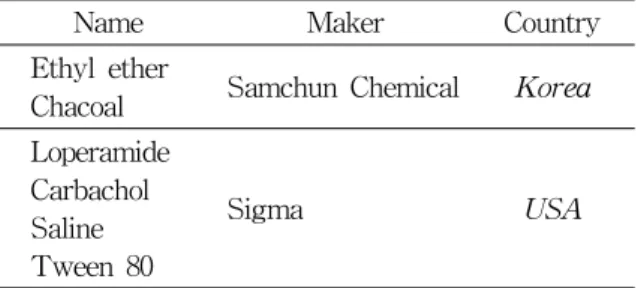
본 실험에 사용된 시약과 기기는 Table 1, 2와 같다.
Name Maker Country
Ethyl ether
Chacoal Samchun Chemical
KoreaLoperamide
Carbachol Saline Tween 80
Sigma
USATable 1. Reagents
Name Maker Country
Scale Needle
Munhaw Dong Bang Acupuncture Co
Korea
Electric
stimulator(PG-6) Ito Co
JapanTable 2. Instruments
2. 방법
1) 실험군 분류 및 처치
실험군은 모두 34군으로 분류하였으며, 각 군은 6 마리씩으로 하였다(Table 3). 실험동물은 본 실험에 들어가기 2일전부터 금식을 시켰다.
정상군(normal)은 아무런 처치도 하지 않고 charcoal 을 경구투여 하였고, 구속대조군(holder)은 홀더에 15 분간 구속한 후 charcoal을 경구투여 하였다. 정상 유 침(needle retention; NR) 및 전침(electro-acupuncture;
EA)군은 carbachol이나 loperamide를 처치하지 않고
Group Treatment(→: immediate, ⇨: 15 min, ⇒: 25 min) 1 Normal Charcoal ⇒ intestinal extirpate
2 Holder Holder restriction → charcoal ⇒ intestinal extirpate 3 N-Sham-NR NR at sham point → charcoal ⇒ intestinal extirpate 4 N-Sham-EA(H) EA(H) at sham point → charcoal ⇒ intestinal extirpate 5 N-LR
3-NR NR at LR
3→ charcoal ⇒ intestinal extirpate
6 N-LR
3-EA(H) EA(H) at LR
3→ charcoal ⇒ intestinal extirpate 7 C-Control Carbachol ⇨ charcoal ⇒ intestinal extirpate
8 C-Sham-NR Carbachol → NR at sham point → charcoal ⇒ intestinal extirpate 9 C-Sham-EA(H) Carbachol → EA(H) at sham point → charcoal ⇒ intestinal extirpate 10 C-LR
3-NR Carbachol → NR at LR
3→ charcoal ⇒ intestinal extirpate
11 C-LR
3-EA(H) Carbachol → EA(H) at LR
3→ charcoal ⇒ intestinal extirpat 12 Sham-NR-C NR at sham point → carbachol ⇨ charcoal ⇒ intestinal extirpate 13 Sham-EA(H)-C EA(H) at sham point → Carbachol ⇨ charcoal ⇒ intestinal extirpate 14 LR
3-NR-C NR at LR
3→ Carbachol ⇨ charcoal ⇒ intestinal extirpate
15 LR
3-EA(H)-C EA(H) at LR
3→ Carbachol ⇨ charcoal ⇒ intestinal extirpate 16 L-Control Loperamide ⇨ charcoal ⇒ intestinal extirpate
17 L-Sham-NR Loperamide → NR at sham point → charcoal ⇒ intestinal extirpate 18 L-Sham-EA(H) Loperamide → EA(H) at sham point → charcoal ⇒ intestinal extirpate 19 L-LR
3-NR Loperamide → NR at LR
3→ charcoal ⇒ intestinal extirpate
20 L-LR
3-EA(H) Loperamide → EA(H) at LR
3→ charcoal ⇒ intestinal extirpat 21 Sham-NR-L NR at sham point → Loperamide ⇨ charcoal ⇒ intestinal extirpate 22 Sham-EA(H)-L EA(H) at sham point → Loperamide ⇨ charcoal ⇒ intestinal extirpate 23 LR
3-NR-L NR at LR
3→ Loperamide ⇨ charcoal ⇒ intestinal extirpate
24 LR
3-EA(H)-L EA(H) at LR
3→ Loperamide ⇨ charcoal ⇒ intestinal extirpate
Table 3. Classification of Experimental Groups태충(LR3) 또는 임의혈(sham point)에 유침 또는 전침 자극을 15분간 가한 후 charcoal을 경구투여 하였다.
C-control군 및 L-Control군은 carbachol 또는 loperamide를 처치하고 15분 후에 charcoal을 경구투 여 하였다.
전처치군은 먼저 태충(LR3) 또는 비혈위(sham point)에 자침 후 유침(needle retention; NR) 및 고주 파 전침{high frequency electro-acupuncture; EA(H)}
을 15분간 실시하고, 발침 후 즉시 carbachol 혹은 loperamide를 처치하였으며, 15분 후에 charcoal을 경 구투여 하였다(Scheme 1).
후처치군은 먼저 carbachol 혹은 loperamide를 처 치하고, 태충(LR3) 또는 비혈위(sham point)에 자침 후 유침 및 고주파 전침을 15분간 실시하였으며, 발침 후 즉시 charcoal을 경구투여 하였다(Scheme 2).
Scheme 1. Pre-treatment of NR or EA at sham or LR3
Scheme 2. Post-treatment of NR or EA at sham or LR3
Intestinal extirpate
Intestinal extirpate Carbachol
Loperamide
Travel rate (%) = travel length of charcoal
× 100 total length of intestine
모든 실험동물은 charcoal을 투여하고 나서 25분 후에 개복하여 charcoal의 이동률을 확인하였다(Scheme 1, Scheme 2).
2) 취혈 및 전침 처치
자침 및 전침을 시행할 실험을 위하여 길이 20㎝, 지름 5㎝의 원통형 아크릴 홀더를 제작하여 4개의 구 멍을 뚫어 실험동물의 사지를 노출하여 멸균된 stainless steel 호침으로 골도분촌법에 준하여 인체의 태충 (LR3)에 상응하는 부위를 실험동물의 좌측 후지에서 취하여 약 2-3㎜ 깊이로 자침하였다. 비혈위는 실험 동물의 좌측 둔부에서 취하였다. 유침군은 좌측 태충 또는 비혈위에 침을 자입한 후, 전침 자극을 가하지 않고 15분간 유침하였다. 고주파 전침자극은 100㎐에 서, 근육의 수축이 육안으로 확인되는 정도로 전압을 조절하여 15분간 자극을 가하였다. 전침자극을 가하 기 위하여 0.5×1㎠의 패드를 실험동물의 좌측 해계 (ST41) 상응 부위에 부착한 후, 전침 치료기의 한쪽 극을 태충(LR3)에 자입된 침의 끝에 연결하고 다른 한쪽 극을 해계(ST41)에 부착된 패드에 연결하였다.
3) 약물 처치
Carbachol은 생리 식염수를 이용하여 1㎎/㎖로 녹 였다. 이 1㎎/㎖으로 희석된 carbachol 용액 100㎕를 다시 생리 식염수 900㎕에 섞어서 실험동물에게 1㎖
씩 경구투여 하였다.
Loperamide는 0.05% tween 80이 첨가된 생리식염 수를 이용하여 1㎎/㎖로 녹였다. 이 loperamide 용액 100㎕를 생리 식염수 400㎕에 섞어서 실험동물에게 0.5㎖씩 복강주사 하였다.
Charcoal의 투여는, 생리식염수 100㎖에 charcoal 5
㎎을 섞어 5% charcoal을 만들어 0.5㎖씩 경구투여 하였다.
4) 장운동 평가
5% charcoal을 0.5㎖씩 투여하고, 25분 후에 ether 를 이용하여 실험동물을 마취하고 개복하여 장을 적 출하였다. 위의 유문부 하단부터 대장의 하단부인 항 문부까지를 총 장길이(total length of intestine)로 하 고, charcoal이 유문부로부터 이동한 길이(travel length of charcoal)를 확인하여 백분율로 나타내었다.
5) 통계처리
본 실험에서 얻은 결과는 평균±표준편차로 나타내 었다. SPSS 통계프로그램(ver 14.0 KO)의 일원배치 분산분석(one way ANOVA)을 사용하여 유의성을 검 증하였으며 사후검정은 Scheffe를 이용하였다. 각 실 험군을 비교하여 신뢰도 95% 이상(p≤0.05)일 때 유 의성이 있는 것으로 판정하였다. Fig. 1과 Fig. 2를 제 외한 모든 도표에서 정상군(normal)과 다른 실험군과 의 비교에 대한 유의성 표시는 무의미하여 생략하였 으며, Fig. 5 이후의 모든 도표에서 구속대조군 (holder)과 다른 실험군과의 비교에 대한 유의성 표시 도 무의미하여 생략하였다.
Ⅲ. 성 적
1. Carbachol 투여가 흰쥐의 장운동에 미치는 영향
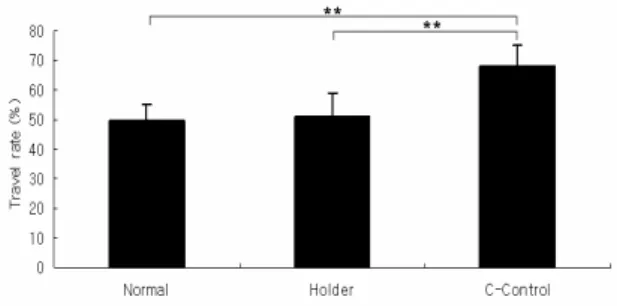
정상군(normal)과 구속대조군(holder)의 장내 charcoal 이동률에는 유의한 차이가 나타나지 않았다. Carbachol 을 경구 투여한 C-대조군(C-control)의 장내 charcoal 이동률은 정상군(normal) 및 구속대조군(holder)에 비 하여 유의하게 증가하였다(Fig. 1, Table 4).
Fig. 1. Effect of carbachol on intestinal motility of rat
SD rats were orally administered with carbachol (0.5㎎/㎏) 15 min before charcoal meal administration.
The animals were sacrificed 25 min after the charcoal meal administration, and the intestinal motility was determined by calculating the percentage of passage distance of charcoal to the whole length of intestine.
Data were expressed as mean±SD(n=6).
Normal: normal SD rat.
Holder: SD rat restrained in the holder.
C-Control: SD rat orally administered with carbachol (0.5㎎/㎏).
**: P≤0.01 by one-way ANOVA.
Group Travel rate(%)
Normal 49.48±5.513
Holder 50.934±8.084
C-Control 67.786±7.119
Table 4. Effect of Carbachol on Intestinal Motility of Rat
2. Loperamide 투여가 흰쥐의 장운동에 미치는 영향
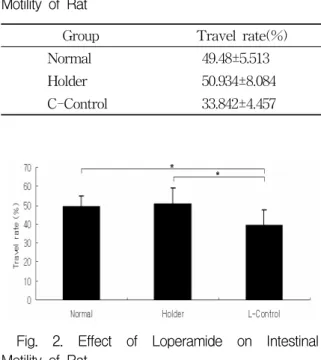
정상군(normal)과 구속대조군(holder)의 장내 charcoal 이동률에는 유의한 차이가 나타나지 않았다. Loperamide 를 복강 투여한 L-대조군(L-control)의 장내 charcoal 이동률은 정상군(normal) 및 구속대조군(holder)에 비 하여 유의하게 감소하였다(Table 5, Fig. 2).
Group Travel rate(%)
Normal 49.48±5.513
Holder 50.934±8.084
C-Control 33.842±4.457
Table 5. Effect of Loperamide on Intestinal Motility of Rat
Fig. 2. Effect of Loperamide on Intestinal Motility of Rat
SD rats were intraperitoneally injected with loperamide (0.5㎎/㎏) 15min before charcoal meal administration. The animals were sacrificed 25 min after the charcoal meal administration, and the intestinal motility was determined by calculating the percentage of passage distance of charcoal to the whole length of intestine. Data were expressed as mean±SD(n=6).
Normal: normal SD rat.
Holder: SD rat restrained in the holder.
L-Control: SD rat intraperitoneally injected with loperamide(0.5㎎/㎏).
*: P≤0.05 by one-way ANOVA.
3. 태충 유침 및 고주파 전침이 흰쥐 의 장운동에 미치는 영향
1) 정상 흰쥐의 장운동에 미치는 영향 정상 흰쥐의 태충 및 비혈위에 유침 및 고주파 전 침자극을 가한 후 장내 charcoal의 이동률을 측정하였 다(Table 6).
Group Travel rate(%)
Normal 49.48±5.513
Holder 50.934±8.084
N-Sham-NR 55.22±2.334
N-LR
3-NR 55.198±3.202
N-Sham-EA(H) 39.905±5.683
N-LR
3-EA(H) 63.554±3.497
Table 6. Effects of Needle Retention(NR) and High Frequency Electro-acupuncture(EA(H)) at LR3on Intestinal Motility of Rat in Normal State
⑴ 유침
정상 흰쥐의 태충 및 비혈위에 유침자극 후 장내 charcoal의 이동률을 측정하였다. 태충 유침군(N-LR3- NR)에서 구속대조군(holder) 및 비혈위 유침군(N- Sham-NR)에 비하여 장내 charcoal 이동률에 유의한 변화가 없었다(Fig. 3).
0 10 20 30 40 50 60 70
Normal Holder N-Sham-NR N-LR3-NR
Travel rate (%)
Fig. 3. Effect of NR at LR3 on intestinal motility of rat in normal state
SD rats were acupunctured at left LR3 or sham point and the needles were retained for 15 min. After the withdrawal of the needles, charcoal meal was administered.
25 min later, the animals were sacrificed and the intestinal motility was determined by calculating the percentage of passage distance of charcoal to the whole length of intestine. Data were expressed as mean±SD(n=6).
Normal: normal SD rat.
Holder: SD rat restrained in the holder.
N-Sham-NR: SD rat treated with NR at sham point for 15 min.
N-LR3-NR: SD rat treated with NR at left LR3 for 15 min.
⑵ 고주파 전침
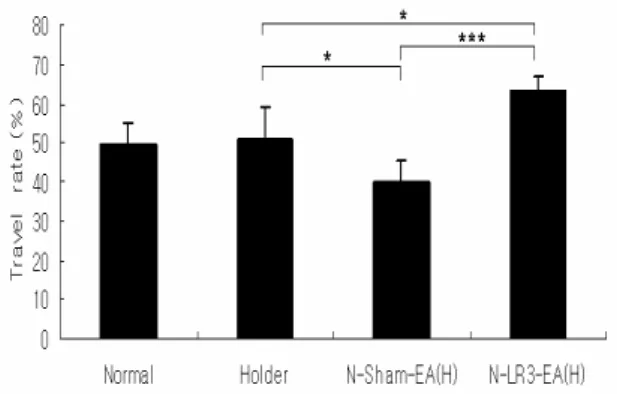
정상 흰쥐의 태충 및 비혈위에 고주파 전침자극을 가한 후 장내 charcoal의 이동률을 측정하였다. 태충 고주파 전침군{N-LR3-EL(H)}에서는 구속대조군(holder) 및 비혈위 고주파 전침군{N-Sham-EA(H)}에 비하여 장내 charcoal의 이동률이 유의하게 증가하였으며 비 혈위 고주파 전침군{N-Sham-EA(H)}은 구속대조군 (holder)에 비하여 유의하게 감소하였다(Fig. 4).
Fig. 4. Effect of EA(H) at LR3 on intestinal motility of rat in normal state
SD rats were acupunctured at left LR3 or sham point and electrically stimulated at 100Hz for 15 min. Charcoal meal was administered after EA stimulation. The animals were sacrificed 25 min after the charcoal meal administration, and the intestinal motility was determined by calculating the percentage of passage distance of charcoal to the whole length of intestine. Data were expressed as mean±SD(n=6).
Normal: normal SD rat.
Holder: SD rat restrained in the holder.
N-Sham-EA(H): SD rat treated with EA at 100Hz at sham point for 15 min.
N-LR3-EA(H): SD rat treated with EA at 100Hz at left LR3 for 15 min.
***: P≤0.001, *: P≤0.05 by one-way ANOVA.
⑶ 유침 및 고주파 전침 비교
정상 흰쥐의 태충에 유침 및 고주파 전침자극을 가 한 후 장내 charcoal의 이동률을 비교하였다. 태충 고 주파 전침군{N-LR3-EL(H)}이 구속대조군(holder)에 비하여 유의하게 증가하였다. 그러나 태충 유침군 (N-LR3-NR)과 태충 고주파 전침군{N-LR3-EL(H)}의 사이에서는 유의한 차이가 나타나지 않았다(Fig. 5).
0 10 20 30 40 50 60 70 80
Normal Holder N-LR3-NR N-LR3-EA (H)
Travel rate (%)
*
Fig. 5. Effect of NR and EA(H) at LR3 on intestinal motility of rat in normal state.
SD rats were treated with NR, 2Hz EA and 100Hz EA at left LR3 for 15 min, and the charcoal meal was administered. 25 min later, the animals were sacrificed and the intestinal motility was determined by calculating the percentage of passage distance of charcoal to the whole length of intestine
Data were expressed as mean±SD(n=6).
Normal: normal SD rat.
Holder: SD rat restrained in the holder.
N-LR3-NR: SD rat treated with NR at left LR3 for 15 min.
N-LR3-EA(H): SD rat treated with EA at 100Hz at left LR3 for 15 min.
*: P≤0.05 by one-way ANOVA.
2) Carbachol에 의해 항진된 장운동에 미치는 영향
Carbachol을 이용하여 흰쥐의 장운동을 항진시키 고, carbachol 투여 전 또는 후에 태충 및 비혈위에 유침 및 고주파 전침자극을 가한 후 장내 charcoal의 이동률을 측정하였다(Table 7).
Group Travel rate(%)
Normal 49.48±5.513
Holder 50.934±8.084
C-Control 67.786±7.119
Sham-NR-C 59.747±9.958
LR
3-NR-C 48.258±8.177
C-Sham-NR 75.725±8.282
C-LR
3-NR 68.631±4.374
Sham-EA(H)-C 47.582±11.593
LR
3-EA(H)-C 42.923±8.244
C-Sham-EA(H) 73.247±8.085
C-LR
3-EA(H) 64.435±8.444
Table 7. Effects of Pre-treatment or Post- treatment of NR(Needle Retention) and High Fequency Eectro-acupuncture{EA(H)} at LR3 on Intestinal Motility Over-activated with Carbachol in Rat*
⑴ 유침 전처치
태충 및 비혈위에 유침자극을 가한 후 carbachol을 투여한 흰쥐의 장내 charcoal 이동률을 관찰하였다.
태충 유침 전처치군(LR3-NR-C)이 C-대조군(C-control) 에 비교하여 유의하게 감소하였다(Fig. 6).
Fig. 6. Effect of pre-treatment of NR at LR3 on intestinal motility over-activated with carbachol in rat
SD rats were acupunctured at left LR3 or sham point and the needles were retained for 15 min. After the withdrawal of the needles, carbachol(0.5㎎/㎏) was orally administered. And 15 min later, charcoal meal was administered. The animals were sacrificed 25 min after the charcoal meal administration, and the intestinal motility was determined by calculating the percentage of passage distance of charcoal to the whole length of intestine.
Data were expressed as mean±SD(n=6).
Normal: normal SD rat.
Holder: SD rat restrained in the holder.
C-Control: SD rat orally administered with carbachol (0.5㎎/㎏).
Sham-NR-C: SD rat treated with NR at sham point and carbachol(0.5㎎/㎏).
LR3-NR-C: SD rat treated with NR at left LR3 and carbachol(0.5㎎/㎏).
**: P≤0.01 by one-way ANOVA.
⑵ 유침 후처치
Carbachol을 투여한 흰쥐의 태충 및 비혈위에 유 침자극을 가한 후 장내 charcoal 이동률을 측정하였 다. 태충 유침 후처치군(C-LR3-NR)에서 C-대조군 (C-control) 및 비혈위 유침 후처치군(C-Sham-NR) 에 비하여 장내 charcoal 이동률에 유의한 차이가 나 타나지 않았다(Fig. 7).
Fig. 7. Effect of post-treatment of NR at LR3 on intestinal motility over-activated with carbachol in rat
SD rats were orally administered with carbachol(0.5㎎/
㎏) and immediately after, they were acupunctured at left LR3 or sham point. The needles were retained for 15 min before removal, and the charcoal meal was administered.
The animals were sacrificed 25 min after the charcoal meal administration, and the intestinal motility was determined by calculating the percentage of passage distance of charcoal to the whole length of intestine.
Data were expressed as mean±SD(n=6).
Normal: normal SD rat.
Holder: SD rat restrained in the holder.
C-Control: SD rat orally administered with carbachol(0.5㎎/㎏).
C-Sham-NR: SD rat treated with carbachol(0.5㎎/㎏) and NR at sham point.
C-LR3-NR: SD rat treated with carbachol(0.5㎎/㎏) and NR at left LR3.
⑶ 유침 전처치 및 후처치 비교
태충 유침자극을 전처치한 군(LR3-NR-C)과 후처 치한 군(C-LR3-NR)의 장내 charcoal 이동률을 비교 하였다. C-대조군(C-control)에 비해 태충 유침 전처 치군(LR3-NR-C)에서 유의한 감소가 있었으며, 태충 유침 전처치군(LR3-NR-C)이 태충 유침 후처치군 (C-LR3-NR)에 비하여 유의하게 낮았다(Fig. 8).
Fig. 8. Effect of pre-treatment and post- treatment of NR at LR3 on intestinal motility over- activated with carbachol in rat
SD rats were treated with NR at left LR3 before or after carbachol(0.5㎎/㎏) administration. Charcoal meal was administered 15 min after the carbachol administration, and 25 min later, the animals were sacrificed, The intestinal motility was determined by calculating the percentage of passage distance of charcoal to the whole length of intestine.
Data were expressed as mean±SD(n=6).
Normal: normal SD rat.
Holder: SD rat restrained in the holder.
C-Control: SD rat orally administered with carbachol(0.5㎎/㎏) LR3-NR-C: SD rat treated with NR at left LR3 and carbachol(0.5㎎/㎏).
C-LR3-NR: SD rat treated with carbachol(0.5㎎/㎏) and NR at left LR3.
***: P<0.001, **: P<0.01 by one-way ANOVA.
⑷ 고주파 전침 전처치
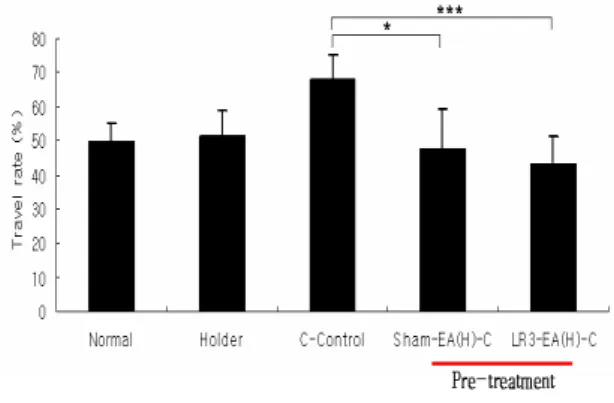
태충 및 비혈위에 고주파 전침 자극을 가한 후 carbachol을 투여한 흰쥐의 장내 charcoal 이동률을 비교 관찰하였다. 태충 고주파 전침 전처치군{LR3- EA(H)-C}과 비혈위 고주파 전침 전처치군{Sham- EA(H)-C}에서 C-대조군(C-control)에 비하여 장내 charcoal 이동률이 유의하게 감소하였다(Fig. 9).
Fig. 9. Effect of pre-treatment of EA(H) at LR3
on intestinal motility over-activated with carbachol in rat
SD rats were acupunctured at left LR3 or sham point and electrically stimulated at 100Hz for 15 min. After EA stimulation, carbachol(0.5㎎/㎏) was orally administered.
And, 15 min later, charcoal meal was administered. The animals were sacrificed 25 min after the charcoal meal administration, and the intestinal motility was determined by calculating the percentage of passage distance of charcoal to the whole length of intestine.
Data were expressed as mean±SD(n=6).
Normal: normal SD rat.
Holder: SD rat restrained in the holder.
C-Control: SD rat orally administered with carbachol (0.5㎎/㎏).
Sham-EA(H)-C: SD rat treated with 100Hz EA at sham point and carbachol(0.5㎎/㎏).
LR3-EA(H)-C: SD rat treated with 100Hz EA at left LR3 and carbachol(0.5㎎/㎏).
***: P≤0.001, *: P≤0.05 by one way ANOVA.
⑸ 고주파 전침 후처치
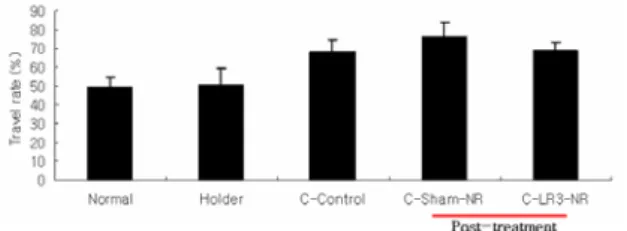
Carbachol을 투여한 흰쥐의 태충 및 비혈위에 고 주파 전침 자극을 가한 후 장내 charcoal 이동률을 측 정하였다. 태충 고주파 전침 후처치군{C-LR3-EA(H)}
에서 C-대조군(C-control) 및 비혈위 고주파 전침 후 처치군{C-Sham-EA(H)}에 비하여 장내 charcoal 이동률 에 유의한 변화가 없었다(Fig. 10).
Fig. 10. Effect of pre-treatment of EA(H) at LR3
on intestinal motility over-activated with carbachol in rat
SD rats were orally administered with carbachol(0.5㎎/
㎏) and immediately after, they were acupunctured at left LR3 or sham point and electrically stimulated at 100Hz for 15 min. After EA stimulation, charcoal meal was administered. The animals were sacrificed 25 min after the charcoal meal administration, and the intestinal motility was determined by calculating the percentage of passage distance of charcoal to the whole length of intestine.
Data were expressed as mean±SD(n=6).
Normal: normal SD rat.
Holder: SD rat restrained in the holder.
C-Control: SD rat orally administered with carbachol (0.5㎎/㎏).
C-Sham-EA(H): SD rat treated with carbachol(0.5㎎/
㎏) and 100Hz EA at sham point.
C-LR3-EA(H): SD rat treated with carbachol(0.5㎎/㎏) and 100Hz EA at left LR3.
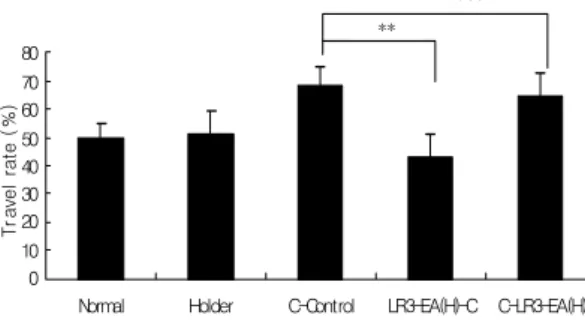
Fig. 11. Effect of pre-treatment and post- treatment of EA(H) at LR3 on intestinal motility over-activated with carbachol in rat
SD rats were treated with EA at 100Hz at left LR3
before or after carbachol(0.5㎎/㎏) administration. Charcoal meal was administered 15 min after the carbachol administration, and 25 min later, the animals were sacrificed, The intestinal motility was determined by calculating the percentage of passage distance of charcoal to the whole length of intestine.
Data were expressed as mean±SD(n=6).
Normal: normal SD rat.
Holder: SD rat restrained in the holder.
C-Control: SD rat orally administered with carbachol (0.5㎎/㎏).
LR3-EA(H)-C: SD rat treated with 100Hz EA at left LR3 and carbachol(0.5㎎/㎏).
C-LR3-EA(H): SD rat treated with carbachol(0.5㎎/㎏) and 100Hz EA at left LR3.
***: P≤0.001 by one way ANOVA.
0 10 20 30 40 50 60 70 80
Normal Holder C-Control LR3-EA(H)-C C-LR3-EA(H)
Travel rate (%)
** ***
Fig. 12. Effect of pre-treatment of NR and EA(H) at LR3 on intestinal motility over-activated with carbachol in rat
SD rats were treated with NR, 2Hz EA and 100Hz EA at left LR3 for 15 min. and carbachol(0.5㎎/㎏) was orally administered. 15 min after the carbachol administration, charcoal meal was administered. The animals were sacrificed 25 min after the charcoal meal administration, and the intestinal motility was determined by calculating the percentage of passage distance of charcoal to the whole length of intestine.
Data were expressed as mean±SD(n=6).
Normal: normal SD rat.
Holder: SD rat restrained in the holder.
C-Control: SD rat orally administered with carbachol (0.5㎎/㎏).
LR3-NR-C: SD rat treated with NR at left LR3 and carbachol(0.5㎎/㎏).
LR3-EA(H)-C: SD rat treated with 100Hz EA at left LR3 and carbachol(0.5㎎/㎏).
***: P≤0.001, **: P≤0.01 by one way ANOVA.
⑹ 고주파 전침 전처치 및 후처치 비교
태충 고주파 전침 자극을 전처치한 군{LR3- EA(H)-C}과 후처치한 군{C-LR3-EA(H)}의 장내 charcoal 이동률을 비교하였다. C-대조군(C-control) 에 비해 태충 고주파 전침 전처치군{LR3-EA(H)-C}
에서 유의한 감소가 있었으며 태충 고주파 전침 전처치 군{LR3-EA(H)-C}이 태충 고주파 전침 후처치군{C- LR3-EA(H)}의 비해서는 유의하게 낮았다(Fig. 11).
⑺ 유침 및 고주파 전침 전처치 비교
태충에 유침 및 고주파 전침 자극을 가한 후 carbachol을 투여한 흰쥐의 장내 charcoal 이동률을 비교하였다. C-대조군(C-control)에 비해 태충 유침 전처치군(LR3-NR-C)과 태충 고주파 전침 전처치군 {LR3-EA(H)-C}에서 유의하게 낮았으나, 태충 유침 전처치군(LR3-NR-C) 및 태충 고주파 전침 전처치군 {LR3-EA(H)-C}의 비교에서는 유의한 차이는 없었다 (Fig. 12).
⑻ 유침 및 고주파 전침 후처치 비교
Carbachol을 투여한 흰쥐의 태충에 유침 및 고주 파 전침 자극을 가한 후 장내 charcoal 이동률을 비교 하였다. 태충 유침 후처치군(C-LR3-NR) 및 태충 고 주파 전침 후처치군{C-LR3-EA(H)}의 장내 charcoal 이동률에는 유의한 차이가 없었다(Fig. 13).
0 10 20 30 40 50 60 70 80
Normal Holder C-Control C-LR3-NR C-LR3-EA(H)
Travel rate (%)
Fig. 13. Effect of post-treatment of NR and EA(H) at LR3 on intestinal motility over-activated with carbachol in rat
SD rats were orally administered with carbachol(0.5㎎/
㎏) and immediately after, they were treated with NR, 2Hz EA and 100Hz EA at left LR3 for 15 min. And the animals were administered with charcoal meal and sacrificed 25 min after the charcoal meal administration. The intestinal motility was determined by calculating the percentage of passage distance of charcoal to the whole length of intestine.
Data were expressed as mean±SD(n=6).
Normal: normal SD rat.
Holder: SD rat restrained in the holder.
C-Control: SD rat orally administered with carbachol (0.5㎎/㎏).
C-LR3-NR: SD rat treated with carbachol(0.5㎎/㎏) and NR at left LR3.
C-LR3-EA(H): SD rat treated with carbachol(0.5㎎/㎏) and 100Hz EA at left LR3.
3) Loperamide에 의해 저하된 장운동 에 미치는 영향
Loperamide를 이용하여 흰쥐의 장운동을 억제시키 고, loperamide 투여 전 또는 후에 태충 및 비혈위에 유침 및 고주파 전침자극을 가한 후 장내 charcoal의 이동률을 측정하였다(Table 8).
⑴ 유침 전처치
태충 및 비혈위에 유침자극을 가한 후 loperamide 를 투여한 흰쥐의 장내 charcoal 이동률을 관찰하였 다. 태충 유침 전처치군(LR3-NR-L)에서 비혈위 유침 전처치군(Sham-NR-L)에 비하여 장내 charcoal 이동 률이 약간 높게 나타났으나 통계적 유의성은 없었다 (Fig. 14).
***
**
Group Travel rate(%)
Normal 49.48±5.513
Holder 50.934±8.084
L-Control 33.842±4.457
Sham-NR-L 28.71±7.26
LR
3-NR-L 40.126±10.132
L-Sham-NR 34.911±12.798
L-LR
3-NR 40.095±13.299
Sham-EA(H)-L 23.541±8.653
LR
3-EA(H)-L 46.684±11.316
L-Sham-EA(H) 18.692±2.341
L-LR
3-EA(H) 62.572±8.248
Table 8. Effects of Pre-treatment or Post- treatment of NR(Needle Retention) and High Frequency Electro-acupuncture{EA(H)} at LR3 on Intestinal Motility Suppressed with Loperamide in RatFig. 14. Effect of pre-treatment of NR at LR3 on intestinal motility suppressed with loperamide in rat
SD rats were acupunctured at left LR3 or sham point and the needles were retained for 15 min. After the withdrawal of the needles, loperamide(0.5㎎/㎏) were intraperitoneally injected. And 15 min later, charcoal meal was administered. The animals were sacrificed 25 min after the charcoal meal administration, and the intestinal motility was determined by calculating the percentage of passage distance of charcoal to the whole length of intestine.
Data were expressed as mean±SD(n=6).
Normal: normal SD rat.
Holder: SD rat restrained in the holder.
L-Control: SD rat intraperitoneally injected with loperamide(0.5㎎/㎏).
Sham-NR-L: SD rat treated with NR at sham point and loperamide(0.5㎎/㎏).
LR3-NR-L: SD rat treated with NR at left LR3 and loperamide(0.5㎎/㎏).
⑵ 유침 후처치
Loperamide를 투여한 흰쥐의 태충 및 비혈위에 유침 자극을 가한 후 장내 charcoal 이동률을 측정하였다. 태 충 유침 후처치군(L-LR3-NR)에서 L-대조군(L- control)
및 비혈위 유침 후처치군(L-Sham-NR)에 비하여 장내 charcoal 이동률에 유의한 차이가 없었다(Fig. 15).
Fig. 15. Effect of post-treatment of NR at LR3 on intestinal motility suppressed with loperamide in rat
SD rats were intraperitoneally injected with loperamide (0.5㎎/㎏) and immediately after, they were acupunctured at left LR3 or sham point. The needles were retained for 15 min before removal, and the charcoal meal was administered. The animals were sacrificed 25 min after the charcoal meal administration, and the intestinal motility was determined by calculating the percentage of passage distance of charcoal to the whole length of intestine.
Data were expressed as mean±SD(n=6).
Normal: normal SD rat.
Holder: SD rat restrained in the holder
L-Control: SD rat intraperitoneally injected with loperamide(0.5㎎/㎏).
L-Sham-NR: SD rat treated with loperamide(0.5㎎/㎏) and NR at sham point.
L-LR3-NR: SD rat treated with loperamide(0.5㎎/㎏) and NR at left LR3.
0 20 40 60 80
Normal Holder L-Control LR3-NR-L L-LR3-NR
Travel rate (%)
Fig. 16. Effect of pre-treatment and post- treatment of NR at LR3 on intestinal motility suppressed with loperamide in rat
SD rats were treated with NR at left LR3 before or after loperamide(0.5㎎/㎏) administration. Charcoal meal was administered 15 min after the loperamide injection, and 25 min later, the animals were sacrificed, The intestinal motility was determined by calculating the percentage of passage distance of charcoal to the whole length of intestine.
Data were expressed as mean±SD(n=6).
Normal: normal SD rat.
Holder: SD rat restrained in the holder.
L-Control: SD rat intraperitoneally injected with loperamide(0.5㎎/㎏).
LR3-NR-L: SD rat treated with NR at left LR3 and loperamide(0.5㎎/㎏).
L-LR3-NR: SD rat treated with loperamide(0.5㎎/㎏) and NR at left LR3.
⑶ 유침 전처치 및 후처치 비교
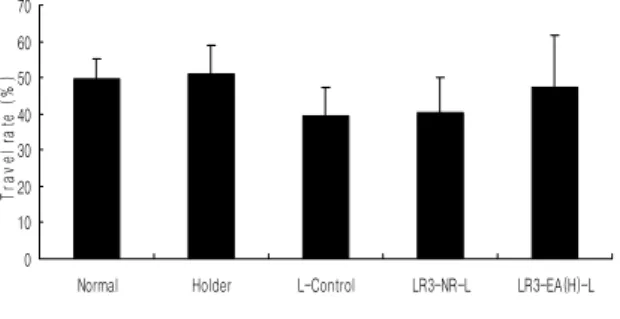
태충 유침자극을 전처치한 군(LR3-NR-L)과 후처 치한 군(L-LR3-NR)의 장내 charcoal 이동률을 비교 하였다. 태충 유침 전처치군(LR3-NR-L)과 태충 유침 후처치군(L-LR3-NR)의 장내 charcoal 이동률에는 유 의한 차이가 나타나지 않았다(Fig. 16).
⑷ 고주파 전침 전처치
태충 및 비혈위에 고주파 전침 자극을 가한 후 loperamide를 투여한 흰쥐의 장내 charcoal 이동률을 비교 관찰하였다. 태충 고주파 전침 전처치군{LR3-EA(H)-L}
에서는 비혈위 고주파 전침 전처치군{Sham-EA(H)-L}
에 비하여 장내 charcoal 이동률이 유의하게 높았으나 L-대조군(L-control)에 비해서는 유의한 변화가 없었 다(Fig. 17).
Fig. 17. Effect of pre-treatment of EA(H) at LR3 on intestinal motility suppressed with loperamide in rat
SD rats were acupunctured at left LR3 or sham point and electrically stimulated at 100Hz for 15 min. After EA stimulation, loperamide(0.5㎎/㎏) was intraperitoneally injected. And, 15 min later, charcoal meal was administered.
The animals were sacrificed 25 min after the charcoal meal administration, and the intestinal motility was determined by calculating the percentage of passage distance of charcoal to the whole length of intestine.
Data were expressed as mean±SD(n=6).
Normal: normal SD rat.
Holder: SD rat restrained in the holder.
L-Control: SD rat intraperitoneally injected with loperamide(0.5㎎/㎏).
Sham-EA(H)-L: SD rat treated with 100Hz EA at sham point and loperamide(0.5㎎/㎏).
LR3-EA(H)-L: SD rat treated with 100Hz EA at left LR3 and loperamide(0.5㎎/㎏).
*: P≤0.05 by one way ANOVA.
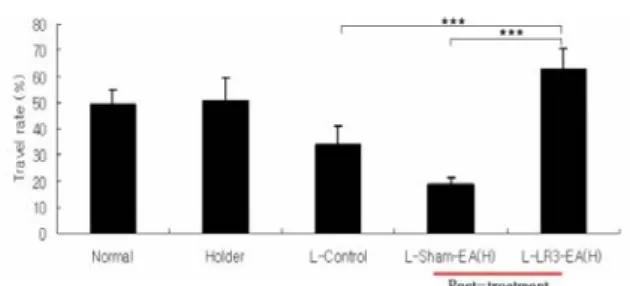
⑸ 고주파 전침 후처치
Loperamide를 투여한 흰쥐의 태충 및 비혈위에 고 주파 전침 자극을 가한 후 장내 charcoal 이동률을 측 정하였다. 태충 고주파 전침 후처치군{L-LR3-EA(H)}
에서 L-대조군(L-control) 및 비혈위 고주파 전침 후 처치군{L-Sham-EA(H)}에 비하여 장내 charcoal 이
동률이 유의하게 증가하였다(Fig. 18).
Fig. 18. Effect of post-treatment of EA(H) at LR3 on intestinal motility suppressed with loperamide in rat
SD rats were intraperitoneally injected with loperamide (0.5㎎/㎏) and immediately after, they were acupunctured at left LR3 or sham point and electrically stimulated at 100Hz for 15 min. After EA stimulation, charcoal meal was administered. The animals were sacrificed 25 min after the charcoal meal administration, and the intestinal motility was determined by calculating the percentage of passage distance of charcoal to the whole length of intestine.
Data were expressed as mean±SD(n=6).
Normal: normal SD rat.
Holder: SD rat restrained in the holder.
L-Control: SD rat intraperitoneally injected with loperamide(0.5㎎/㎏).
L-Sham-EA(H): SD rat treated with loperamide(0.5㎎/
㎏) and 100Hz EA at sham point.
L-LR3-EA(H): SD rat treated with loperamide(0.5㎎/㎏) and 100Hz EA at left LR3.
***: P≤0.001 by one way ANOVA.
Fig. 19. Effect of pre-treatment and post- treatment of EA(H) at LR3 on intestinal motility suppressed with loperamide in rat
SD rats were treated with EA at 100Hz at left LR3
before or after loperamide(0.5㎎/㎏) administration.
Charcoal meal was administered 15 min after the loperamide injection, and 25 min later, the animals were sacrificed, The intestinal motility was determined by calculating the percentage of passage distance of charcoal to the whole length of intestine.
Data were expressed as mean±SD(n=6).
Normal: normal SD rat.
Holder: SD rat restrained in the holder.
L-Control: SD rat intraperitoneally injected with loperamide(0.5㎎/㎏).
LR3-EA(H)-L: SD rat treated with 100Hz EA at left LR3 and loperamide(0.5㎎/㎏).
L-LR3-EA(H): SD rat treated with loperamide(0.5㎎/㎏) and 100Hz EA at left LR3.
**: P≤0.01 by one way ANOVA.
0 10 20 30 40 50 60 70 80
Normal Holder L-Control L-LR3-NR L-LR3-EA(H)
Travel rate (%)
** *
Fig. 21. Effect of post-treatment of NR and EA(H) at LR3 on intestinal motility suppressed with loperamide in rat
SD rats were intraperitoneally injected with loperamide (0.5㎎/㎏) and immediately after, they were treated with NR, 2Hz EA and 100Hz EA at left LR3 for 15 min. And the animals were administered with charcoal meal and sacrificed 25 min after the charcoal meal administration.
The intestinal motility was determined by calculating the percentage of passage distance of charcoal to the whole length of intestine.
Data were expressed as mean±SD(n=6).
Normal: normal SD rat.
Holder: SD rat restrained in the holder.
L-Control: SD rat intraperitoneally injected with loperamide(0.5㎎/㎏).
L-LR3-NR: SD rat treated with loperamide(0.5㎎/㎏) and NR at left LR3.
L-LR3-EA(H): SD rat treated with loperamide(0.5㎎/㎏) and 100Hz EA at left LR3.
**: P≤0.01, *: P≤0.05 by one way ANOVA.
⑹ 고주파 전침 전처치 및 후처치 비교 태충 고주파 전침 자극을 전처치한 군{LR3-EA (H)-L}과 후처치한 군{L-LR3-EA(H)}의 장내 charcoal 이동률을 비교하였다. L-대조군(L-control)에 비해 태 충 고주파 전침 후처치군{L-LR3-EA(H)}에서 유의한 증가가 나타났으며, 태충 고주파 전침 전처치군{LR3- EA(H)-L}과 태충 고주파 전침 후처치군{L-LR3- EA(H)}의 비교에서는 유의한 차이가 나타나지 않았 다(Fig. 19).
⑺ 유침 및 고주파 전침 전처치 비교
태충에 유침 및 고주파 전침 자극을 가한 후 loperamide를 투여한 흰쥐의 장내 charcoal 이동률을 비교하였다. 태충 유침 전처치군(LR3-NR-L) 및 태충 고주파 전침 전처치군{LR3-EA(H)-L}의 장내 charcoal 이동률에는 유의한 차이가 나타나지 않았다(Fig. 20).
0 10 20 30 40 50 60 70
Normal Holder L-Control LR3-NR-L LR3-EA(H)-L
Travel rate (%)
Fig. 20. Effect of pre-treatment of NR and EA(H) at LR3 on intestinal motility suppressed with loperamide in rat
SD rats were treated with NR, 2Hz EA and 100Hz EA at left LR3 for 15 min. and loperamide(0.5㎎/㎏) was intraperitoneally injected. 15 min after the loperamide injection, charcoal meal was administered. The animals were sacrificed 25 min after the charcoal meal administration, and the intestinal motility was determined by calculating the percentage of passage distance of charcoal to the whole length of intestine.
Data were expressed as mean±SD(n=6).
Normal: normal SD rat.
Holder: SD rat restrained in the holder.
L-Control: SD rat intraperitoneally injected with loperamide(0.5㎎/㎏).
LR3-NR-L: SD rat treated with NR at left LR3 and loperamide(0.5㎎/㎏).
LR3-EA(H)-L: SD rat treated with 100Hz EA at left LR3 and loperamide(0.5㎎/㎏).
⑻ 유침 및 고주파 전침 후처치 비교
Loperamide를 투여한 흰쥐의 태충에 유침 및 고주 파 전침 자극을 가한 후 장내 charcoal 이동률을 비교 하였다. 태충 고주파 전침 후처치군{L-LR3-EA(H)}에
서 L-대조군(L-control), 태충 유침 후처치군(L- LR3-NR) 에 비하여 장내 charcoal 이동률이 유의하 게 높았다(Fig. 21).
Ⅳ. 고 찰
한의학에서 경락은 경맥과 낙맥으로 구성되어 전 신에 분포된 인체 기혈의 통로라고 정의된다. 그러나 경락은 단순히 기혈의 통로로만 인식되는 것이 아니 고 인체 내부의 생리적, 병리적 상태를 외부로 드러내 고 인체 외부 자극을 수용함으로써 인체 내부 상태를 반영하고 또한 조절할 수 있는 기능이 있어 인체의 내부와 외부를 연결하는 연락조직이 결합되어 질병의 반응점과 치료의 자극점이 되는 독특한 자체 기능성 네트워크로 인식되어 진다2,20,21).
침치료에 있어서 用鍼은 그 氣가 至하여 調氣할 수 있도록 하기 위함인데 ≪黃帝內經․靈樞․九鍼十 二原≫11)에서 “刺之而氣不至 無問其數 刺之而氣至 乃 去之 勿復鍼” “刺之要 氣至而有效”라하여 침의 작용 에 氣至가 강조되었다.
경락은 안으로 외부 자극을 수용하고21), 밖으로 피
부를 통하여 각 혈위에 전도작용을 나타내는데, 이 전 도작용에 의하여 음과 양이 작용하는 전기현상을 이 용한 것이 전기요법이다. 효과적인 치료를 위해서는 전기 자극 조건이 있는데 자극 강도가 일정치 이상이 어야 하며, 자극이 충분히 빠른 속도로 도달하여야 하 며, 자극으로 유효하려면 자극이 일정한 시간 이상 지 속되어야 하는데20), 이것은 자침에 있어서 氣至의 필 요성과 유사한 점이라고 할 수 있으며, 전침요법이 임 상에 많이 사용되고 있는 이유라 생각된다.
전침요법은 한의학의 침요법과 현대과학기술의 결 합에 의하여 발전된 침구치료방법 중 하나로 경혈에 자침하고 침병에 전류를 통하여 기계적 자극과 전기 적 자극을 결합시켜 지속적인 운침이 가능하고 자극 방법을 쉽게 조절할 수 있으며 비교적 객관적이라는 장점이 있어 동통질환, 마비질환 등 일반적인 자침요 법의 적응증에 광범위하게 응용하고 있다2).
임상에서는 자극의 주파수, 파형, 자극 시간에 따라 다른 치료 효과를 나타내는데22), Holmgren 등23)은 주 파수가 높은 경우 진통 효과의 감소와 근 긴장이 저 하되며 주파수가 낮은 경우 진통 효과와 근 긴장이 증가된다고 하였고, Han 등24)은 저빈도 전침 자극 (2Hz)은 중추 신경계에서 nalnoxone에 의해 억제되는 δ 수용체와 µ수용체에 반응하는 endomorphins, enkephalin, ß-endorphin을 분비하고, 고빈도 전침 자극(100Hz)은 척수에서 k수용체에 반응하는 dynorphin을 분비한다 고 하였다.
≪黃帝內經․素問․靈蘭秘典論篇≫11)에서 “大腸者 傳道之官 變化出焉, 小腸者 受盛之官 化物出焉”이라 하였고 ≪東醫寶鑑≫25)에서는 “小腸傳受 凡胃中腐熟 水穀 其滓穢自胃之下口 傳入於小腸上口 自小腸下口 泌別淸濁 水液入膀胱上口 滓穢入大腸上口 大腸後附脊 以受小腸滓穢 當臍右廻 疊積上下辟大 大腸下口 連於 肛門”이라 하여, 소장은 위의 초보적 소화를 거친 음 식물을 가일층 소화시키며 脾에 의해서 그 중의 水穀 精微와 대부분의 수액이 흡수되어 전신에 輸布된다.
그리고 糟粕은 소장에서 대장으로 전송되어 糞便을 형성하고 항문에서 배출된다26). 또한 飢飽의 不均衡이 나 過寒過熱, 情志太過, 外感淫邪 등에 의하여 이러한 생리기능이 파괴될 경우 습열이 대장에 蘊結하면 장 관의 기혈이 손상을 받으므로 下利膿血하게 되며, 濕 邪에 의하여 대장의 전도작용이 제대로 발휘하지 못 하여 水樣便을 泄하며 腸鳴하게 된다고 하였다27).
장운동에 관한 자침 및 전침 연구를 살펴보면 이 등14)은 족삼리 자침이 소장운동을 증가시킨다고 하였
고, 허 등15)은 족삼리 자침이 대장운동을 증가시킨다 고 하였으며, 김 등18)은 천추, 상거허에 단순 유침 후 별 효과가 없었으나 전침 자극 후 좌측 대장 통과시 간을 단축시키는 효과가 있다고 하였다. 차 등17)은 족 삼리 전침이 자극 시간과 경혈의 좌, 우측 혈위의 차 이를 비교하면 자극시간은 20분 이상일 때, 혈위는 우 측 및 양측보다는 좌측일 때 더 유의하게 소장운동이 증가하였다고 하였으며, 김 등16)은 족삼리 전침 자극 이 2Hz, 100Hz 주파수에서 유의성이 있었고, 100Hz 자극보다는 2Hz에서 소장 운동이 더 유의하게 증가 하였으며, 자침 시간의 비교에서는 10분에서는 유의 성이 없었으나 20분, 30분, 40분, 50분, 60분에서 모두 유의하게 증가하였다고 보고하였다.
본 실험에서는 병적인 장운동 항진상태와 저하상 태를 유도하기 위해 carbachol과 loperamide를 사용하 였는데, carbachol은 니코틴성 작용으로 평활근, 특히 위장관 및 방광 평활근에 대한 작용이 강하며28), 세포 막을 탈분극시키고 Ca++ 투과성을 증가시키며 경축 을 유발시켜 장운동을 항진시키는 작용을 나타나게 된다29,30).
loperamide은 뇌혈관 장벽을 잘 통과하지 못하는 pethidine유도체로서31) 위장관의 연동운동을 감소시키 기 위해 위장관 근육에 직접적으로 작용을 하여 장운 동을 억제하는 지사효과를 나타내며, 아편제와 유사 한 작용이 있고 지사 작용 시간도 긴 편이며32,33) 박 등34)은 loperamide로 변비에 미치는 영향에 대한 관 찰 보고가 있었다.
태충은 족궐음간경의 원혈로서 ≪醫學入門≫35)에
“溏泄 大便難 腰引小腹痛”, ≪鍼灸大成≫36)에 “溏泄 大便難 便血 小便淋 小腸疝氣痛 㿉疝”의 효능이 있으 며 疏泄下焦濕熱, 通絡活血, 舒肝理氣의 穴性으로 溏 泄, 腸炎, 腹脹, 消化不良 등의 위장관 질환에 대한 치 료 효과가 있으며2), 합곡과 配穴하여 四關이라하여 消 化不良, 霍亂, 關格, 氣塞에 特效穴로 사용되고 있다2).
또한 장부상통관계로 살펴보면 ≪素問․陰陽離合 論≫11)에서 “是故三陽之離合也 太陽爲開 陽明爲闔 少 陽爲樞” “是故三陽之離合也 太陰爲開 厥陰爲闔 少陰 爲樞”라 하였으니 三陰三陽을 開闔樞에 따라 배속시 켜 人體 내부 六氣의 平衡을 調節하여 相通關係를 이 루는 장부가 生理的, 病理的으로 긴밀하게 연결되어
있는데12,13), 족궐음간경은 이러한 장부의 相通관계로
수양명대장경과 상통이 되므로 태충이 장운동에 유의 한 영향을 미칠 것으로 생각되었다.
이에 태충이 정상상태 및 병적인 상태의 장운동에