IntroductIon
Bone is a favorable site of metastasis and is invaded com-mon primary tumors such as prostate, breast, and lung. Due to the progressive pain and mortality of the bone metastasis, effort has been focused on the detection of bone metastasis in the field of nuclear medicine(Mitterhauser et al. 2007; Mirzaei et al. 2015). Traditional detection method was bone scanning using 99mTc-radiolabeled polyphosphonates, and there are some commonly used polyphosphonates such as methylene diphosphonate(MDP), dicarboxypropane dipho-sphonate(DPD), hydroxymethylene diphosphonate(HDP), and ethylene diamine tetramethylene phosphonate (EDT-MP)(Mitterhauser et al. 2007). Recently, the use of PET imaging using 18F-fluoride has been increased because of the higher sensitivity and spatial resolution compared with SPECT imaging using 99mTc-polyphosphonates(Cook and
Fogelman 2001). 18F-fluoride is however, prone to have a risk of high false-positive findings in minimal degenerative changes and represent blood flow rather than bone remodel-ing(Billinghurst 1982; Langsteger et al. 2006). Thus, other ligand-based bone seekers have been investigated for PET imaging(Simon et al. 2012; Mirzaei et al. 2015).
68Ga is produced from a cost-effective generator and its half-life is 67.6min. In addition, Because 68Ga provides sufficient radioactivity for high quality PET images, and therefore examination time and radiation toxicity to the pa-tient can be minimized. Notably, 68Ga might allow for the theranostic development because most therapeutic radionu-clides such as 177Lu is also metals(Velikyan 2013).
In designing suitable imaging agents for bone metastasis, multidentate polyaminophosphonate are regarded as the most promising candidates as carrier ligands owing to their high bone affinity, selective localization in skeletal lesions and ability to form metal chelates with high in-vivo stability (Chakraborty et al. 2008). Since EDTMP showed high bone affinity(Das et al. 2002), the macrocyclic analog of EDTMP,
Development of Freeze-Dried DOTMP Kits for Labeling with
68Ga
Jae Cheong Lim1,*, Sang Mu Choi1, Eun Ha Cho1, So Young Lee1, So Hee Dho1
and Soo Yong Kim1
Radioisotope Research Division, Department of Research Reactor Utilization, Korea Atomic Energy Research Institute, Daejeon 305-353, Korea
Abstract - Lyophilized dotMP kits were prepared using dotMP, ammonium acetate, and ascorbic acid. the 68Ga-dotMP was prepared by incubating the kit dissolved in 0.5ml of concentrated 68Ga using nacl method and 0.5ml of ddW, at 100°c for 7min. the labeling yield was evaluated by two solvent systems of tLc. 1MBq of concentrated 68Ga was labeled with 0.8 μg of DOTMP by high radiolabeling yield(>98%), which was determined by two tLc methods. the composition of the prepared freeze-dried vial is 400μg of DOTMP, 19.27mg of ammonium acetate and 17.62mg of ascorbic acid. ~555MBq of 68Ga-dotMP was prepared with excellent radiochemical purity(>98%) and it was stable for 4 hr at room temperature. In conclusion, Freeze-dried dotMP kits for the convenient preparation of 68Ga-dotMP have been developed. Availability of this kit is expected to stimulate the widespread use of 68Ga-DOTMP in the fields of nuclear medicine.
Key words : Freeze-dried dotMP kit, PEt, Gallium-68(68Ga), Bone metastasis
─ 63 ─
* Corresponding author: Jae Cheong Lim, Tel. +82-42-868-8344, Fax. +82-42-868-8448, E-mail. [email protected]
1,4,7,10-tetraazacyclododecane-1,4,7,10-tetramethylene phosphonic acid(DOTMP) was labeled with 153Sm, 166Ho and 177Lu, and used to treat bone metastasis(Liu and Ed-wards 2001; Chakraborty et al. 2008, Jaime et al. 2012).
Lanthanides including 166Ho, 177Lu and 68Ga form more stable and inert complexes with macrocyclic chelators than their acyclic analogs. Because the dissociation of the radio- metal from the chelate could result in the accumulation of radioactivity in nontarget organs, thermodynamic stability as well as kinetic inertness of the radio-peptide are very sig-nificant(Archana et al. 2014). It is pertinent to note that 166Ho-DOTMP has shown excellent pharmacokinetic pro-perties as well as clinical efficacy in the treatment of pa-tients suffering from multiple myeloma(Breitz et al. 2006). Thus, DOTMP that is the macrocyclic analog of EDTMP is useful for the diagnosis and treatment of bone metastasis.
To introduce the theranostic approach, the development of molecular based imaging technology is needed. Howev-er, to our knowledge, PET imaging study of DOTMP using 68Ga has not reported yet. In addition, the preparation of 68Ga-labeled imaging agent requires delicate and rapid han-dling because of its short half-life and possible radiolysis (Garnuszek et al. 2003). To solve these problems, develop-ment of a straightforward freeze-dried kit formulation stra-tegy is required to promote its widespread use(Archana et al. 2014).
Here, we report the methodologies of formulation of the freeze-dried DOTMP kit for labeling with 68Ga.
MAtErIALs And MEthods
1. MaterialsAll chemicals were of analytical grade and thus used with-out further purification(Anaspec, California, USA). For all experiments, a 68Ga was produced from a 68Ge/68Ga gener-ator(ITG, Germany). The radioactivity was determined with a Wallac 1470 automated gamma counter(PerkinElmer Life Science, Massachusetts, USA) and an ionizing chamber (Atomlab 200, Bio-dex, New York, USA). The radiolabel-ing yield and radiochemical purity(RCP) were determined using a Tracemaster 20 automated TLC-linear analyzer (Berthold, Germany).
2. Radiolabeling of DOTMP with 68Ga
The 68Ge produced by 68Ge/68Ga generator was eluted
with a total 4ml of 0.05M HCl according to the manufac-turer’s guidance., and concentrated using a NaCl-based 68Ga eluate concentration method as described by Mueller et al. (Mueller et al. 2012). Briefly, the 68Ga generator eluate was collected by a SCX cation exchange cartridge and eluted from the cartridge with 0.5ml of a 5M NaCl solution con-taining a 12.5μl of 5.5M HCl. This eluate(~555MBq) was slowly added to a 500μl of reaction buffer containing DOTMP(OXCHEM, CA, USA), pH 4.5 ammonium acetate buffer(final 0.25M) and ascorbic acid(final 0.1M). The mixture was reacted at 100°C for 7min for the radiolabeling. Various concentration of DOTMP(10~400μg) was labeled with 111MBq of 68Ga to evaluate the mass of DOTMP required for a high radiolabeling yield(>98%), and the re-sults were converted by 1MBq of 68Ga.
3. Quality control of 68Ga-dotMP
The radiolabeling yield was determined by TLC method, using 0.5M sodium citrate buffer(pH 4.5) as the eluting solvent. In brief, 2~4μl of the reaction mixture was spotted on the silica-gel(SG) TLC paper. The strip was developed using 0.5M sodium citrate buffer(pH 4.5), dried, and ana-lyzed using TLC-linear analyzer. To confirm its radiochem-ical purity, TLC using cellulose TLC plates developed with 2:1 mixture of B1:B2(B1: 9mL Millipore water; 0.6mL HCl(conc. 37%); 88mL acetone/B2: 2,4-pentadione) was evaluated(Fellner et al. 2012).
4. Formulation of freeze-dried dotMP kits
Freeze-dried DOTMP kits(ten numbers in each batch) were prepared following the protocol mentioned below. 4 mg of DOTMP was dissolved in 2.5ml of 1M ammonium acetate buffer(pH 4.5), and 2.5ml of 0.4M Ascorbic acid was added under aseptic conditions. The resultant solution was thoroughly mixed and subsequently passed through Millipore®(0.2μm) filter paper. Then, it was aliquoted into ten sterile glass vials, each vial containing 0.5ml of the solution. All these preparative steps were carried out under aseptic conditions. The vials were incubated for a period of 24h at -20°C. Finally, the vials were freeze-dried in a lyo-philizer and stored at -20°C.
5. Preparation of 68Ga-dotMP using freeze-dried dotMP kits
temperature before the radiolabeling. The lyophilized DOT-MP powder was dissolved by 0.5ml of DDW, and 0.5ml of concentrated 68Ga eluate(~555MBq) was slowly added to the vial. The vial was heated at 100°C for 7min for the radiolabeling, and the radiolabeling yield was evaluated by TLC method as described in 2.3. The stability of the 68Ga- DOTMP that was prepared using freeze-dried kit, and was studied by incubating the reacted solution at room temper-ature. A small drop of the solution was taken at selected times, and analyzed by TLC method as described above.
rEsuLts And dIscussIon
The multifarious advantages of PET using 68Ga in terms of sensitivity, specificity, accuracy, detection rate,
acquisi-tion and examinaacquisi-tion time stimulate its usage in the field of nuclear medicine(Archana et al. 2014). DOTMP is well-known bone seeker, and the present study was aimed to de-velop 68Ga-labeled DOTMP by using a freeze-dried kit for an easy and simple labeling.
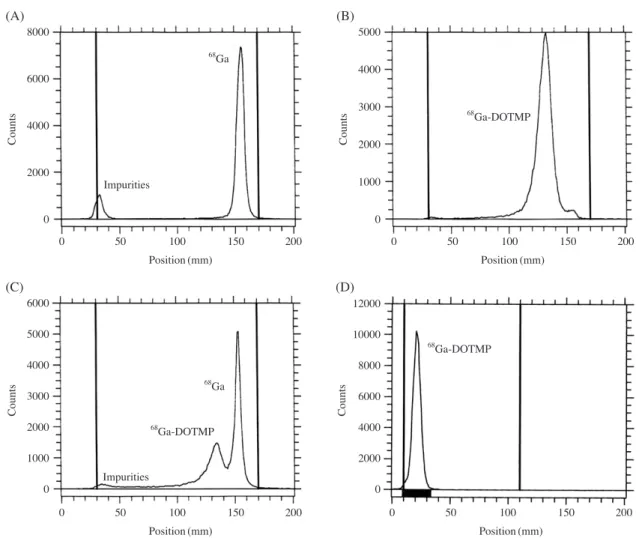
68Ga3+ was eluted from the 68Ge/68Ga generator and was concentration using NaCl method within less than five min-utes. As shown in Fig. 1(A), the eluted 68Ga solution con-tained 5~10% of impurities. Impurities(possibly colloidal 68Ga) were detected at the origin, and 68Ga was dragged to the solvent front by 0.5M sodium citrate buffer(pH 4.5). NaCl method not only removed impurities, but also concen-trated the 4ml of the eluted 68Ga solution to 0.5ml.
Impurities such as 68Ga-colloids are hardly labeled with DOTA-chelators. Because unlabeled radioactivity might result in toxicities to the non-targeted organ, purification of
Fig. 1. Typical iTLC profiles of eluted 68Ga(A), 68Ga-labeled DOTMP(B), and mixture of eluted 68Ga and 68Ga-labeled DOTMP(C). Mobile
phase was pH 4.5 0.5M sodium citrate buffer. Impurities(Rf: 0.03±0.01) was removed, and 68Ga(Rf: 0.99±0.01) was radiolabeled
with DOTMP that the Rf was 0.82±0.01. The radiochemical purity of 68Ga-DOTMP at origin was confirmed by TLC using cellulose
TLC plates(D). 8000 6000 4000 2000 0 6000 5000 4000 3000 2000 1000 0 5000 4000 3000 2000 1000 0 12000 10000 8000 6000 4000 2000 0 0 50 100 150 200 Position(mm) (A) (B) (C) (D) 0 50 100 150 200 Position(mm) 0 50 100 150 200 Position(mm) 0 50 100 150 200 Position(mm) Counts Counts Counts Counts 68Ga Impurities 68Ga 68Ga-DOTMP Impurities 68Ga-DOTMP 68Ga-DOTMP
68Ga solution is important. Several purification and concen-tration methods of 68Ga solution have been reported using cation and anion exchanger. In particular, we applied a rapid and convenient NaCl method to label chelators with 68Ga due to relatively few reagents and a minimal procedural with no subsequent purification steps(Mueller et al. 2012). 5~10% of impurities were detected by TLC analysis, and fast purification and concentration of the solution could be performed by the NaCl method.
The concentrated 68Ga was labeled with DOTMP by heat-ing at temperatures of 100℃ for 7min, and the 68Ga-labeled DOTMP was found in the middle of the plate(Rf=0.8). Fig. 1(C) showed the typical TLC profiles of the three compo-nents. To confirm the radiochemical purity of 68Ga-DOTMP, another cellulose-TLC was simultaneously performed(Fig. 1(D)). In this condition, 68Ga-DOTMP was remained at the origin and the unlabeled 68Ga was dragged by the solvent
(Fellner et al. 2012).
The concentrated 68Ga was labeled with DOTMP by high radiochemical purity(>98%), and further purification was not required. As a result of Fig. 2, 0.8μg of DOTMP was routinely required per 1MBq of the concentrated 68Ga solu-tion to obtain the radiochemical purity over 98%.
The presence of high levels of unlabeled peptide might be causes of side effects such as cardiac abnormalities. Thus, a particular labeling condition of metal to ligand is recom-mended(Tapas et al. 2014). In the previous studies about a freeze-dried kit for bone-seeking radiotracers reported that 120~189μg of EDTMP was labeled with 1MBq of 68Ga (Mitterhauser et al. 2007; Stefan et al. 2008). Compared with the reports, 0.8μg of DOTMP was successfully labeled with 1MBq of 68Ga by high radiochemical purity(>98%). This result is comparable to the other DOTA derivatives such as DOTA-TOC which is used for diagnosis of
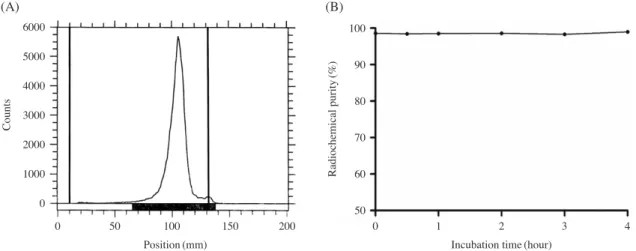
neu-Fig. 4. Preparation of 555MBq of 68Ga-DOTMP(A) using freeze-dried DOTMP kit, and the stability at room temperature(B). The 68Ga-DOTMP was prepared with high radioactivity over 98%, and the radiochemical purity was maintained for 4 hours.
6000 5000 4000 3000 2000 1000 0 100 90 80 70 60 50 0 50 100 150 200 Position(mm) 0 1 2 3 4 Incubation time(hour)
(A) (B)
Counts
Radiochemical purity
(%)
Fig. 2. Radiolabeling yields on the various concentration of
DOT-MP per 1MBq of concentrated 68Ga.
100 80 60 40 20 0 0.0 0.2 0.4 0.6 0.8 1.0 Concentration of DOTMP(μg) Radiolabeling yields (%)
roendocrine tumors(Archana et al. 2014). The optimized labeling condition is useful to avoid possible side effects caused by the high levels of unlabeled peptide.
A prepared freeze-dried kit vial was shown in Fig. 3. The composition of the kit was 400μg of DOTMP, 19.27mg of ammonium acetate and 17.62mg of ascorbic acid. The off-white, zonary lyophilized composition could be seen in the bottom of the freeze-dried vials.
Fig. 4 shows that the radiochemical yield of the freeze-dried DOTMP kit with 68Ga(~555MBq) was >98%, and the radiochemical purity was maintained for 4hr after label-ing which was a considerable amount of time for imaglabel-ing using the 68-min short half-life of 68Ga. The total prepara-tion time of 68Ga-DOTMP using freeze-dried kits was less than twenty minutes from the 68Ga elution to the evaluation of labeling yield.
Although the loss of ammonia during lyophilization was concerned(Archana et al. 2014), the kit was successfully applied for the preparation of up to 555MBq(15mCi) of 68Ga-DOTMP with >98% radiochemical purity. PET/CT imaging of bone metastases with 462MBq of 68Ga-BPAMD showed intense accumulation in multiple osteoblastic le-sions in the central skeleton, ribs, and proximal extremities (Kazuma and Hideo 2011). The freeze-dried DOTMP kit in this study was evaluated to be labeled with ~555MBq 68Ga, and it would be enough to prepare a patient dose of 68Ga-DOTMP. Because of the structural similarity between DOTMP and BPAMD which are the DOTA derivatives, the formulation of the freeze-dried DOTMP kit could be applied to prepare 68Ga-BPAMD.
As the fast and simple labeling procedure is important for a clinical application, the fast analysis of labeling yields is also significant(Fellner et al. 2012). Although another anal-ysis methods such as HPLC usually takes 10~15min, the TLC methods can be performed in less than 10min. For this reason, the labeling yield was evaluated by TLC methods in this study, and two TLC systems increased the accuracy. From the elution of 68Ga to evaluate the radio-labeling yield, the preparation of 68Ga-DOTMP(RCP>98%) was perform-ed within twenty minutes which is of great advantage in the clinical application.
A suitable freeze-dried kit is useful to prepare the desired patient doses of 68Ga-DOTMP through a simple step proce-dure in hospital radio-pharmacies. In addition, the use of the kit enable to prepare 68Ga-DOTMP immediately before administration, which would reduce the possibility of
radi-olysis during transportation and storage(Tapas et al. 2014). The availability of the kit will increase the use of 68Ga- DOTMP in the fields of nuclear medicine.
concLusIon
In this study, we described the development of the ready to use DOTMP kit for labeling with 68Ga to be used in hos-pital radiopharmacy along with 68Ge/68Ga generator. The kit consists of DOTMP in ammonium acetate and ascorbic acid, and could be labeled with 68Ga, in consistently high labeling yield(>98%) within twenty minutes. The easy and efficient labeling of this kit with 68Ga make them suitable for preparing 68Ga-DOTMP for imaging of bone metastasis.
AcKnoWLEdGEMEnts
This study was supported by the KAERI Major Project, Development of Radioisotope Production and Application Technology(525140-15).
rEFErEncEs
Archana M, Aruna K, Haladhar DS and Grace S. 2014. Single vial formulation for theranostic radiopharmaceutical prepa-ration. J. Radioanal. Nucl. Chem. 302:889-894.
Archana M, Usha P, Rubel C, Haladhar DS and Ashutosh D. 2014. Single vial kit formulation for preparation of PET ra-diopharmaceutical: 68Ga-DOTA-TOC. J. Radioanal. Nucl.
Chem. 302:1253-1258.
Billinghurst MW. 1982. Radioion exchange in bone. In: Bill-inghurst MW, Colombetti LG, editors. Studies of cellular function using radiotracers. Boca Raton(Fla)7 CRC Press Inc:93-114.
Breitz HB, Wendt RE, Stabin MS, Shen S, Erwin WD, Rajen-dran JG, Eary JF, Durack L, Delpassand E, Martin W and Meredith RF. 2006. 166Ho-DOTMP radiation-absorbed dose estimation for skeletal targeted radiotherapy. J. Nucl.
Med. 47:534-542.
Chakraborty S, Das T, Sarma HD, Venkatesh M and Banerjee S. 2008. Comparative studies of 177Lu-EDTMP and 177Lu- DOTMP as potential agents for palliative radiotherapy of bone metastasis. Appl. Radiat. Isot. 66(9):1196-1205. Cook GJ and Fogelman I. 2001. The role of positron emission
50-61.
Das T, Chakraborty S, Unni PR, Banerjee S, Samuel G, Sarma HD, Venkatesh M and Pillai MR. 2002. 177Lu-labeled cy-clic polyaminophosphonates as potential agents for bone pain palliation. Appl. Radiat. Isot. 57(2):177-184.
Fellner M, Biesalski B, Bausbacher N, Kubícek V, Hermann P, Rösch F and Thews O. 2012. 68Ga-BPAMD: PET-imaging of bone metastases with a generator based positron emitter.
Nuclear Medicine and Biology 39:993-999.
Garnuszek P, Pawlak D, Licinska I and Kaminska A. 2003. Evaluation of a freeze-dried kit for EDTMP-based bone- seeking radiopharmaceuticals. Appl. Radiat. Isot. 58(4): 481-488.
Jaime SKF, Druce K, William D, Naoto T and Richard E. 2012. A preclinical investigation of the saturation and dosimetry of 153Sm-DOTMP as a bone-seeking radiopharmaceutical.
Nuclear Medicine and Biology 39:770-776.
Kazuma O and Hideo S. 2011. Advances in Drug Design of Radiometal-Based Imaging Agents for Bone Disorders.
International Journal of Molecular Imaging 2011:7.
Langsteger W, Heinisch M and Fogelman I. 2006. The role of fluorodeoxyglucose, 18F-dihydroxyphenylalanine, 18 F-cho-line, and 18F-fluoride in bone imaging with emphasis on prostate and breast. Semin. Nucl. Med. 36(1):73-92. Liu S and Edwards DS. 2001. Bifunctional chelators for
thera-peutic lanthanide radiopharmaceuticals. Bioconjug. Chem.
12(1):7-34.
Mirzaei A, Jalilian AR, Badbarin A, Mazidi M, Mirshojaei F, Geramifar P and Beiki D. 2015. Optimized production and quality control of Ga-EDTMP for small clinical trials. Ann.
Nucl. Med. 29(6):506-511.
Mitterhauser M, Toegel S, Wadsak W, Lanzenberger RR, Mien LK, Kuntner C, Wanek T, Eidherr H, Ettlinger DE, Viern-stein H, Kluger R, Dudczak R and Kletter K. 2007. Pre vivo, ex vivo and in vivo evaluations of [68Ga]-EDTMP.
Nucl. Med. Biol. 34(4):391-397.
Mueller D, Klette I, Baum RP, Gottschaldt M, Schultz MK and Breeman WA. 2012. Simplified NaCl based 68Ga concen-tration and labeling procedure for rapid synthesis of 68Ga radiopharmaceuticals in high radiochemical purity.
Biocon-jug. Chem. 23(8):1712-1717.
Simon J, Frank RK, Crump DK, Erwin WD, Ueno NT and Wendt RE. 2012. A preclinical investigation of the satu-ration and dosimetry of 153Sm-DOTMP as a bone-seeking radiopharmaceutical. Nucl. Med. Biol. 39(6):770-776. Stefan T, Wolfgang W, Leonhard KM, Helmut V, Rainer K,
Harald E, Daniela H, Kurt K, Robert D and Markus M. 2008. Preparation and pre-vivo evaluation of no-carrier- added, carrier-added and cross-complexed [68Ga]-EDTMP formulations. Eur. J. Pharm. Biopharm. 68:406-412. Tapas D, Haladhar DS, Ajint S, Koramadai KK and Sharmila B.
2014. Formulation, preclinical evaluation, and preliminary clinical investigation of an in-house freeze-dried EDTMP kit suitable for the preparation of 177Lu-EDTMP. Cancer
Biother Radiopharm 29(10):412-421.
Velikyan I. 2013. Prospective of 68Ga-radiopharmaceutical de-velopment. Theranostics 4(1):47-80.
Received: 14 May 2015 Revised: 21 May 2015 Revision accepted: 21 May 2015