The Impact of Mechanical Ventilation
Duration on the Readmission to Intensive
Care Unit: A Population-Based Observational
Study
Hyun Woo Lee, M.D.
1and Young-Jae Cho, M.D., M.P.H., Ph.D.
21Division of Pulmonary and Critical Care Medicine, Department of Internal Medicine, Seoul Metropolitan Government-Seoul National University Boramae Medical Center, Government-Seoul, 2Division of Pulmonary and Critical Care Medicine, Department of Internal Medicine, Seoul National University Bundang Hospital, Seoul National University College of Medicine, Seongnam, Korea
Background: If the duration of mechanical ventilation (MV) is related with the intensive care unit (ICU) readmission must be clarified. The purpose of this study was to elucidate if prolonged MV duration increases ICU readmission rate.
Methods: The present observational cohort study analyzed national healthcare claims data from 2006 to 2015. Critically ill patients who received MV in the ICU were classified into five groups according to the MV duration: MV for <7 days, 7–13 days, 14–20 days, 21–27 days, and ≥28 days. The rate and risk of the ICU readmission were estimated according to the MV duration using the unadjusted and adjusted analyses.
Results: We found that 12,929 patients had at least one episode of MV in the ICU. There was a significant linear relationship between the MV duration and the ICU readmission (R2=0.85, p=0.025). The total readmission rate was
significantly higher as the MV duration is prolonged (MV for <7 days, 13.9%; for 7–13 days, 16.7%; for 14–20 days, 19.4%; for 21–27 days, 20.4%; for ≥28 days, 35.7%; p<0.001). The analyses adjusted by covariables and weighted with the multinomial propensity scores showed similar results. In the adjusted regression analysis with a Cox proportional hazards model, the MV duration was significantly related to the ICU readmission (hazard ratio, 1.058 [95% confidence interval, 1.047–1.069], p<0.001).
Conclusion: The rate of readmission to the ICU was significantly higher in patients who received longer durations of the MV in the ICU. In the clinical setting, closer observation of patients discharged from the ICU after prolonged periods of MV is required.
Keywords: Critical Illness; Mechanical Ventilation; Intensive Care Units; Patient Readmission; Mortality
Address for correspondence: Young-Jae Cho, M.D., M.P.H., Ph.D.
Division of Pulmonary and Critical Care Medicine, Department of Internal Medicine, Seoul National University Bundang Hospital, Seoul National University College of Medicine, 82 Gumi-ro 173 Beon-gil, Bundang-gu, Seongnam 13620, Korea
Phone: 82-31-787-7058, Fax: 82-31-787-4050, E-mail: [email protected]
Received: Mar. 14, 2020, Revised: Apr. 28, 2020, Accepted: Aug. 20, 2020, Published online: Aug. 21, 2020
cc It is identical to the Creative Commons Attribution Non-Commercial License (http://creativecommons.org/licenses/by-nc/4.0/).
Copyright © 2020
Introduction
The prognosis of critically ill patients is poor when they are readmitted to the intensive care unit (ICU) after being discharged from the ICU. ICU readmission is related to lon-ger hospital stays, higher hospital mortality rates, and higher medical costs1-4. It is possible that the readmission rate could be lowered if the risk factors for readmission were identified and addressed. Therefore, elaborate efforts have been made to determine the risk factors for readmission to the ICU2,3 and to identify the patients at a higher risk of readmission in advance5,6. Most of the risk factors for ICU readmission are as-sociated with impaired consciousness, severity of disease, and impaired cardiopulmonary function at discharge4,5,7. However, an accurate predictive model for ICU readmission has not yet been developed because of the complicated medical condi-tions of ICU patients5,6,8. Therefore, modifiable factors related to ICU readmission need further investigation.
Several studies have reported a relationship between prolonged mechanical ventilation (PMV) and poor post-dis-charge clinical outcomes. A PMV of ≥21 days has been report-edly associated with a greater post-discharge mortality rate9. Even if patients with PMV survive in the ICU, the weaning rate is only about 50% and the probability of discharge to home is only about 20%10. Low quality of life has been reported in sur-viving patients after PMV11. Although, the patients who stay in the ICU for a longer period are more likely to be readmitted to the ICU5,7, limited data exists to clarify whether the duration of mechanical ventilation (MV) is independently related to ICU readmission. Considering that the duration of MV can be reduced through better practice of the clinicians12,13, the relationship between duration of MV and ICU readmission rate needs to be identified. The purpose of this study was to analyze whether there is a difference in ICU readmission rates according to the duration of MV.
Materials and Methods
1. Study design, setting, and data sources
We followed the STROBE (Strengthening the Reporting of Observational Studies in Epidemiology) guidelines for designing the present study14. This historic cohort study was conducted using the National Sample Cohort (NSC) data-base (version 2.0) developed by the National Health Insur-ance Sharing Service. The NSC database selected 1,025,340 patients who claimed hospital charges from 2002 to 2015 by systematic stratified random sampling with proportional allocation and includes socio-demographic, clinical, and procedural information15. We analyzed 997,173 patients who were followed up from 2006 to 2015 with the informative data on readmission to ICU and post-discharge mortality. An MV
event was identified by specific KCD-7 (7th revision of Korean Standard Classification of Diseases) codes in the claim data-base, which were considered highly accurate and exclusive (Supplementary Table S1)16.
2. Patients
The eligibility criteria were as follows: (1) critically illness, (2) age ≥18 years, and (3) at least one MV code claim in ICU, regardless of the duration of MV. To exclude patients who re-quired MV without critical illnesses, we only included patients who stayed for 3 or more days or those who expired in the ICU16. The patients were classified into five categories based on the duration of MV: MV for <7 days, 7–13 days, 14–20 days, 21–27 days, and ≥28 days.
3. Variables
We evaluated the socio-demographic characteristics in-cluding age, sex, residence in urban or rural areas, decile of income, admission to tertiary referral hospital, comorbidities, and Charlson comorbidity index (CCI). Patients were divided into three groups based on CCI (0–1, 2–3, and ≥4). To evalu-ate the clinical features, we analyzed main diagnosis at the initiation of MV, number of days spent in the hospital and ICU, number of days of MV, bedside therapeutic exercise, and reha-bilitative breathing therapy.
We assessed clinical outcomes including the result of ICU management, the number of ICU readmission, total deaths during follow-up, time to ICU readmission, the rate of ICU re-admission, and the source of ICU readmission. ICU readmis-sion was defined as the second episode of ICU readmisreadmis-sion after the first episode of ICU admission in a patient who had more than two admissions to ICUs during 10 years of obser-vation period. All the patients were observed for at least 1 year. Cases of intra- or inter-hospital transfer between ICUs were considered one episode of ICU admission. Time to readmis-sion was classified into five categories: within 2 days, 3 days, 7 days, 28 days, and total. The source of ICU readmission was classified into the ICU readmission after hospital discharge and the ICU readmission from a general ward before hospital discharge. Multinomial propensity scores were estimated with variables including age, sex, area of residence, income, admis-sion to tertiary referral hospital, comorbidities, CCI, and main diagnosis at the initiation of MV13.
4. Statistical methods
Descriptive analyses were conducted to present the charac-teristics of the patients. Categorical variables were described as percentages and continuous variables were described as mean and standard deviation. The linear association between categorical variables and MV duration was evaluated using
the linear-by-linear test for categorical variables and Spear-man’s correlation analysis for continuous variables. Pearson’s correlation coefficient was estimated to reveal the association between MV duration and ICU readmission rate. A Poisson regression analysis was performed to estimate the unadjusted and adjusted incidence rate of ICU readmission in each group. A Kaplan-Meier curve with a log-rank test was used to assess differences in cumulative rates of ICU readmission. A multi-nomial propensity score-weighted logistic regression analysis was conducted to adjust for the putative risk of bias due to different baseline characteristics17. After the proportional haz-ards assumption were tested, univariable and multivariable analyses with a Cox proportional hazards model were con-ducted to reveal the adjusted impact of MV duration on ICU readmission.
The risk of ICU readmission was evaluated based on the group with an MV <7 days. Multicollinearity was measured with a variance inflation factor, and a cut-off value of 4 was regarded as high. Statistical significance was considered when p<0.05. All the analyses were conducted using R for Statistical Computing software, version 3.4.3 (R Core Team [2017], Vi-enna, Austria).
5. Ethical statement
The Institutional Review Board Committee of Bundang Seoul National University Hospital examined and approved the protocol of this study, and the need for informed consent was waived given that we only accessed electronic medical re-cords (Institutional Review Board number: X-1906-544-902).
Results
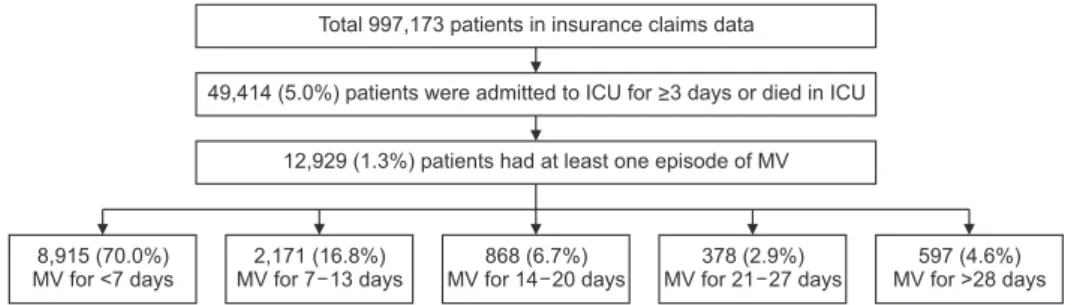
Among the 997,173 patients in the NSC database, 49,414 (5.0%) had at least one episode of ICU stay for ≥3 days or died in ICU and 12,929 (1.3%) had at least one episode of MV in 837 ICUs (Figure 1). The median MV duration was 3 days (interquartile range [IQR], 1–8 days). Based on MV duration, patients were classified into five groups: 8,915 (70.0%) patients with MV for <7 days, 2,171 (16.8%) patients with MV for 7–13 days, 868 (6.7%) patients with MV for 14–20 days, 378 (2.9%) patients with MV for 21–27 days, and 597 (4.6%) patients with
MV for ≥28 days.
1. Socio-demographic characteristics of the study population
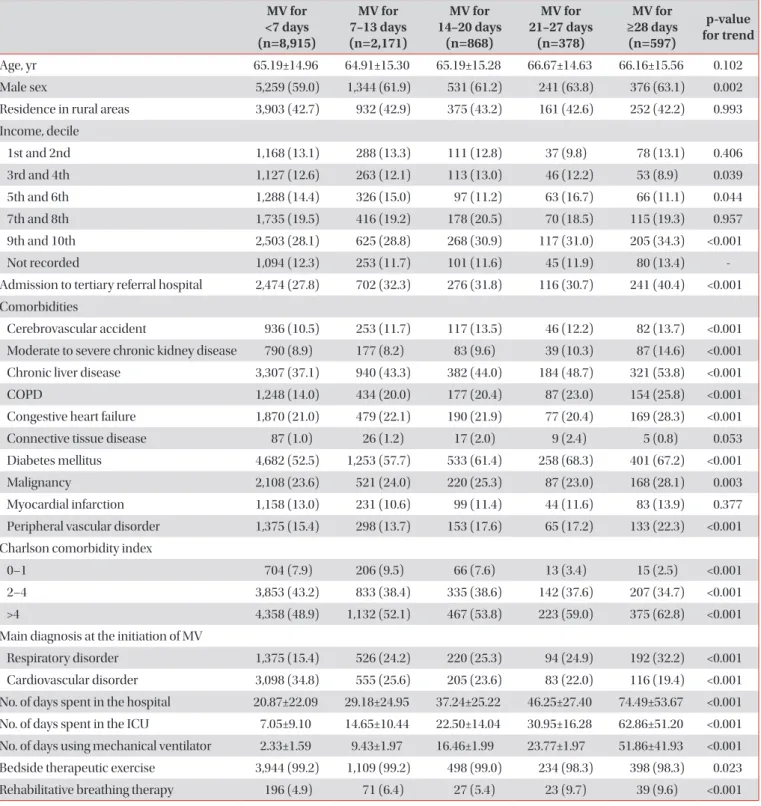
In the 12,929 patients with MV, a larger proportion of male and high income patients was found as MV duration in-creased (Table 1). The patients with longer MV duration were more found at tertiary referral hospitals. There were signifi-cant correlations between MV duration and several comor-bidities. The patients with longer MV duration had a higher CCI score and were more likely to have a respiratory disorder at the initiation of MV. Rehabilitative breathing therapy was only conducted in about 6% of the included subjects and was performed more often in patients with longer periods of MV.
2. Comparison of clinical outcomes
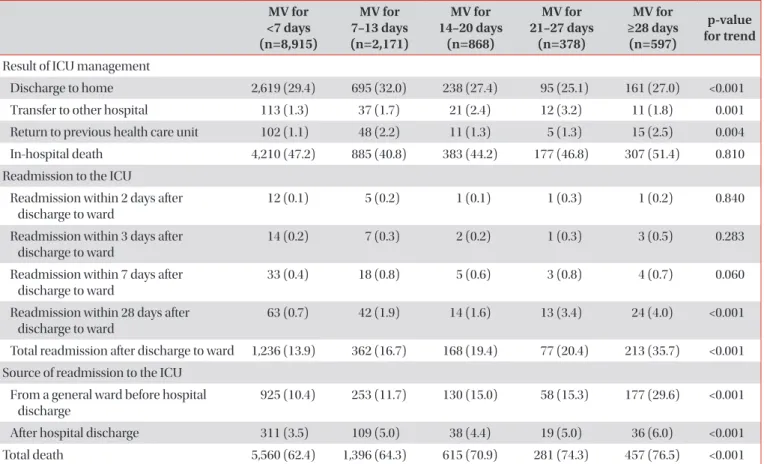
The patients with longer MV duration were less likely to be discharged to home (Table 2). More patients were died in hos-pital as MV duration was prolonged in the subpopulation with MV ≥7 days (p<0.001). Among the survived 6,967 patients, 2,056 (29.5%) were eventually readmitted to ICU for 10 years. The median time to readmission was 48 days (IQR, 23–822 days). Total ICU readmission rate and ICU readmission rate within 28 days was higher in the groups with longer MV dura-tion (p<0.001). We did not find a significant reladura-tionship be-tween MV duration and readmission to ICU until 7 days after discharge to the ward. In both sources of ICU readmission (from a general ward before hospital discharge and after hos-pital discharge), longer MV duration was significantly related with a higher ICU readmission rate. In addition, mortality (including in- and out-of-hospital death) was found to have a significant positive correlation with MV duration (p<0.001).
In the analysis of patients who survived in ICU and were discharged to the ward, ICU readmission rates increased ac-cording to MV duration (R2=0.85, p=0.025) (Figure 2A). In particular, patients with MV for ≥28 days showed a more than 3-fold higher readmission rate than those with MV for <7 days and a 2-fold higher readmission rate than those with MV for 14–20 days. The mortality rate increased according to MV du-ration, and more than half of the patients with MV for ≥21 days died during the observation period (Figure 2B).
Figure 1. Flow chart of the patient in-clusion according to the operational definition. ICU: intensive care unit; MV: mechanical ventilation. 597 (4.6%) MV for >28 days 378 (2.9%) MV for 21 27 days 868 (6.7%) MV for 14 20 days 2,171 (16.8%) MV for 7 13 days 8,915 (70.0%) MV for <7 days
49,414 (5.0%) patients were admitted to ICU for >3 days or died in ICU Total 997,173 patients in insurance claims data
3. Rate of ICU readmission
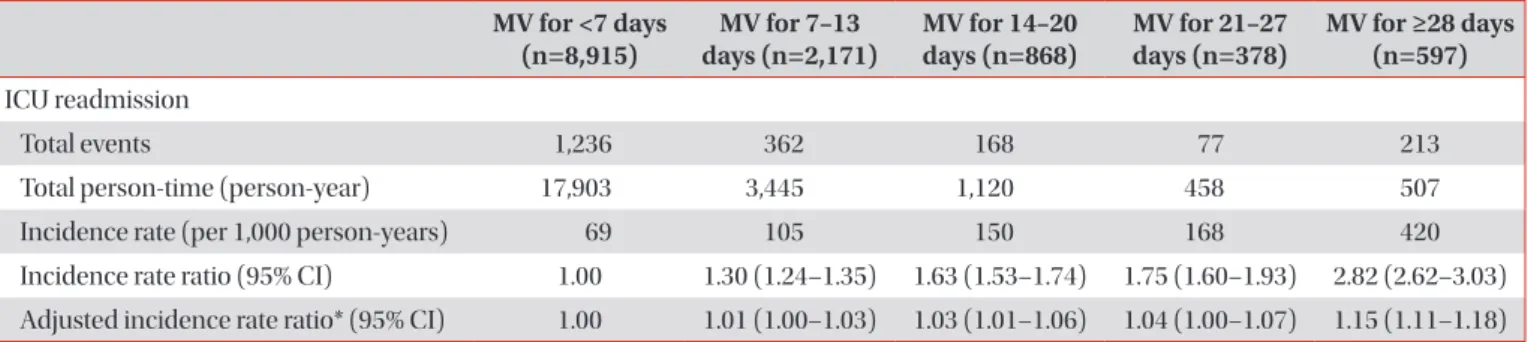
The rate of ICU readmission increased as MV duration in-creased (Table 3). Compared to patients with MV for <7 days,
the unadjusted incidence rate ratio (IRR) was higher in the patients with longer MV duration (patients with MV for 7–13 days, 1.30 [95% confidence interval (CI), 1.24–1.35]; patients with MV for 14–20 days, 1.63 [95% CI, 1.53–1.74]; patients with
Table 1. Socio-demographic and clinical characteristics according to MV duration in the ICU
MV for <7 days (n=8,915) MV for 7–13 days (n=2,171) MV for 14–20 days (n=868) MV for 21–27 days (n=378) MV for ≥28 days (n=597) p-value for trend Age, yr 65.19±14.96 64.91±15.30 65.19±15.28 66.67±14.63 66.16±15.56 0.102 Male sex 5,259 (59.0) 1,344 (61.9) 531 (61.2) 241 (63.8) 376 (63.1) 0.002
Residence in rural areas 3,903 (42.7) 932 (42.9) 375 (43.2) 161 (42.6) 252 (42.2) 0.993
Income, decile 1st and 2nd 1,168 (13.1) 288 (13.3) 111 (12.8) 37 (9.8) 78 (13.1) 0.406 3rd and 4th 1,127 (12.6) 263 (12.1) 113 (13.0) 46 (12.2) 53 (8.9) 0.039 5th and 6th 1,288 (14.4) 326 (15.0) 97 (11.2) 63 (16.7) 66 (11.1) 0.044 7th and 8th 1,735 (19.5) 416 (19.2) 178 (20.5) 70 (18.5) 115 (19.3) 0.957 9th and 10th 2,503 (28.1) 625 (28.8) 268 (30.9) 117 (31.0) 205 (34.3) <0.001 Not recorded 1,094 (12.3) 253 (11.7) 101 (11.6) 45 (11.9) 80 (13.4)
-Admission to tertiary referral hospital 2,474 (27.8) 702 (32.3) 276 (31.8) 116 (30.7) 241 (40.4) <0.001 Comorbidities
Cerebrovascular accident 936 (10.5) 253 (11.7) 117 (13.5) 46 (12.2) 82 (13.7) <0.001 Moderate to severe chronic kidney disease 790 (8.9) 177 (8.2) 83 (9.6) 39 (10.3) 87 (14.6) <0.001 Chronic liver disease 3,307 (37.1) 940 (43.3) 382 (44.0) 184 (48.7) 321 (53.8) <0.001
COPD 1,248 (14.0) 434 (20.0) 177 (20.4) 87 (23.0) 154 (25.8) <0.001
Congestive heart failure 1,870 (21.0) 479 (22.1) 190 (21.9) 77 (20.4) 169 (28.3) <0.001
Connective tissue disease 87 (1.0) 26 (1.2) 17 (2.0) 9 (2.4) 5 (0.8) 0.053
Diabetes mellitus 4,682 (52.5) 1,253 (57.7) 533 (61.4) 258 (68.3) 401 (67.2) <0.001
Malignancy 2,108 (23.6) 521 (24.0) 220 (25.3) 87 (23.0) 168 (28.1) 0.003
Myocardial infarction 1,158 (13.0) 231 (10.6) 99 (11.4) 44 (11.6) 83 (13.9) 0.377
Peripheral vascular disorder 1,375 (15.4) 298 (13.7) 153 (17.6) 65 (17.2) 133 (22.3) <0.001 Charlson comorbidity index
0–1 704 (7.9) 206 (9.5) 66 (7.6) 13 (3.4) 15 (2.5) <0.001
2–4 3,853 (43.2) 833 (38.4) 335 (38.6) 142 (37.6) 207 (34.7) <0.001
>4 4,358 (48.9) 1,132 (52.1) 467 (53.8) 223 (59.0) 375 (62.8) <0.001
Main diagnosis at the initiation of MV
Respiratory disorder 1,375 (15.4) 526 (24.2) 220 (25.3) 94 (24.9) 192 (32.2) <0.001
Cardiovascular disorder 3,098 (34.8) 555 (25.6) 205 (23.6) 83 (22.0) 116 (19.4) <0.001 No. of days spent in the hospital 20.87±22.09 29.18±24.95 37.24±25.22 46.25±27.40 74.49±53.67 <0.001 No. of days spent in the ICU 7.05±9.10 14.65±10.44 22.50±14.04 30.95±16.28 62.86±51.20 <0.001 No. of days using mechanical ventilator 2.33±1.59 9.43±1.97 16.46±1.99 23.77±1.97 51.86±41.93 <0.001 Bedside therapeutic exercise 3,944 (99.2) 1,109 (99.2) 498 (99.0) 234 (98.3) 398 (98.3) 0.023
Rehabilitative breathing therapy 196 (4.9) 71 (6.4) 27 (5.4) 23 (9.7) 39 (9.6) <0.001
Values are presented as mean±standard deviation or as number of patients (%).
MV for 21–27 days, 1.75 [95% CI, 1.60–1.93]; patients with MV for ≥28 days, 2.82 [95% CI, 2.62–3.03]). Although attenuated, the adjusted IRR in patients with longer MV was significantly
higher in patients with longer MV duration (patients with MV for 7–13 days, 1.01 [95% CI, 1.00–1.03]; patients with MV for 14–20 days, 1.03 [95% CI 1.01–1.06]; patients with MV for
Table 2. Clinical outcomes of ICU management according to the MV duration
MV for <7 days (n=8,915) MV for 7–13 days (n=2,171) MV for 14–20 days (n=868) MV for 21–27 days (n=378) MV for ≥28 days (n=597) p-value for trend
Result of ICU management
Discharge to home 2,619 (29.4) 695 (32.0) 238 (27.4) 95 (25.1) 161 (27.0) <0.001
Transfer to other hospital 113 (1.3) 37 (1.7) 21 (2.4) 12 (3.2) 11 (1.8) 0.001
Return to previous health care unit 102 (1.1) 48 (2.2) 11 (1.3) 5 (1.3) 15 (2.5) 0.004
In-hospital death 4,210 (47.2) 885 (40.8) 383 (44.2) 177 (46.8) 307 (51.4) 0.810
Readmission to the ICU
Readmission within 2 days after discharge to ward
12 (0.1) 5 (0.2) 1 (0.1) 1 (0.3) 1 (0.2) 0.840
Readmission within 3 days after discharge to ward
14 (0.2) 7 (0.3) 2 (0.2) 1 (0.3) 3 (0.5) 0.283
Readmission within 7 days after discharge to ward
33 (0.4) 18 (0.8) 5 (0.6) 3 (0.8) 4 (0.7) 0.060
Readmission within 28 days after discharge to ward
63 (0.7) 42 (1.9) 14 (1.6) 13 (3.4) 24 (4.0) <0.001
Total readmission after discharge to ward 1,236 (13.9) 362 (16.7) 168 (19.4) 77 (20.4) 213 (35.7) <0.001 Source of readmission to the ICU
From a general ward before hospital discharge
925 (10.4) 253 (11.7) 130 (15.0) 58 (15.3) 177 (29.6) <0.001
After hospital discharge 311 (3.5) 109 (5.0) 38 (4.4) 19 (5.0) 36 (6.0) <0.001
Total death 5,560 (62.4) 1,396 (64.3) 615 (70.9) 281 (74.3) 457 (76.5) <0.001
Values are presented as number (%).
ICU: intensive care unit; MV: mechanical ventilation.
Figure 2. The intensive care unit (ICU) readmission and total death after discharge to the ward in surviving ICU patients. (A) The ICU read-mission rate increases according to the mechanical ventilation (MV) duration, especially in patients with the MV for ≥28 days. (B) The mor-tality rate after the ICU discharge increases according to the MV duration, with more than half of patients with the MV for ≥21 days dying after discharge to the ward even though they survived in the ICU.
<7 7 13 14 20 21 27 >28 30 20 10 ICU readmission rate (%) 0 MV duration (day) <7 7 13 14 20 21 27 >28 50 40 30 20 10 Mortality rate (%) 0 MV duration (day) A B
21–27 days, 1.04 [95% CI 1.00–1.07]; patients with MV for ≥28 days, 1.15 [95% CI 1.11–1.18]).
In the Kaplan-Meier curves, the length of time to ICU re-admission was significantly longer in patients with MV for <7 days and shorter in those with MV for ≥28 days (Figure 3).
There was no significant difference between patients with MV for 7–13 days, 14–20 days, and 21–27 days. The results of the log-rank test are described in the footnote of Figure 3.
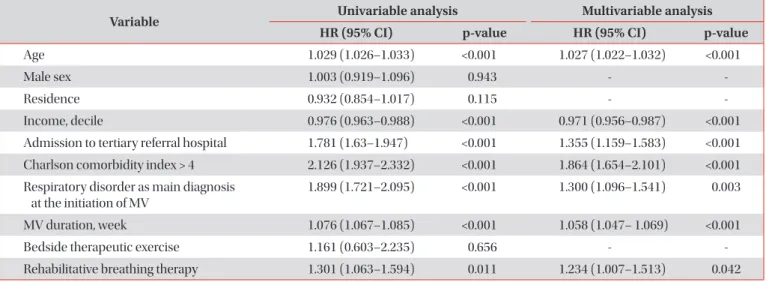
In the analysis weighted with multinomial propensity scores, ICU readmission was significantly associated with MV for 7–13 days (odds ratio [OR], 1.02 [95% CI, 1.01–1.02]; p<0.001), MV for 14–20 days (OR, 1.03 [95% CI, 1.02–1.05]; p<0.001), and MV for >27 days (OR, 1.19 [95% CI, 1.13–1.26]; p<0.001), but not MV for 21–27 days (OR, 1.04 [95% CI, 0.99– 1.09]; p=0.122). In the unadjusted regression analysis with a Cox proportional hazards model, we found that age, income, admission to tertiary hospital, CCI >4, respiratory disorder as main diagnosis at the initiation of MV, MV duration, and rehabilitative breathing therapy were significantly related to ICU readmission (Table 4). Similar results were found in the multivariable analysis (MV duration: hazard ratio, 1.058 [95% CI, 1.047–1.069]; p<0.001).
Discussion
We found that the ICU readmission rate was significantly related to MV duration. About 30% of critically ill patients with MV who survived in ICU were eventually readmitted to ICU. There was a significant linear relationship between MV dura-tion and ICU readmission. The IRR of ICU readmission was higher in patients with longer MV and similar results were found in the survival analysis and the analyses adjusted by multinomial propensity scores. The regression analysis with a Cox proportional hazards model showed a higher risk of ICU readmission in patients with PMV. Considering that the event of MV definitely preceded the event of ICU readmission, a causal relationship can be established, and prolonged MV du-ration should be regarded as one of the preceding risk factors for ICU readmission.
The reason why PMV increases ICU readmission has not been well discussed before. Cohort study has been rarely
Table 3. Comparison of the unadjusted and adjusted incidence rates of the ICU readmission according to the MV duration
MV for <7 days
(n=8,915) days (n=2,171)MV for 7–13 days (n=868)MV for 14–20 MV for 21–27 days (n=378) MV for ≥28 days (n=597)
ICU readmission
Total events 1,236 362 168 77 213
Total person-time (person-year) 17,903 3,445 1,120 458 507
Incidence rate (per 1,000 person-years) 69 105 150 168 420
Incidence rate ratio (95% CI) 1.00 1.30 (1.24–1.35) 1.63 (1.53–1.74) 1.75 (1.60–1.93) 2.82 (2.62–3.03) Adjusted incidence rate ratio* (95% CI) 1.00 1.01 (1.00–1.03) 1.03 (1.01–1.06) 1.04 (1.00–1.07) 1.15 (1.11–1.18) Incidence rate ratio was estimated based on the incidence rate of the patients with MV for <7 days.
*Poisson regression analysis was conducted with variables, including age, sex, income, admission to tertiary referral hospital, Charlson co-morbidity index, main diagnosis at the initiation of the MV, and the follow-up duration.
ICU: intensive care unit; MV: mechanical ventilation; CI: confidence interval.
Figure 3. The Kaplan-Meier curve to evaluate the time to readmis-sion according to mechanical ventilation duration. Red line, MV for <7 days; orange line, MV for 7–13 days; yellow line, MV for 14–20 days; green line, MV for 21–27 days; blue line, MV for >27 days. Log-rank test in comparison with <7 days (red line) vs. 7–13 days (orange line): p=0.003. Log-rank test in comparison with <7 days (red line) vs. 7–13 days (yellow line): p<0.001. Log-rank test in comparison with <7 days (red line) vs. 7–13 days (green line): p<0.001. Log-rank test in comparison with <7 days (red line) vs. 7–13 days (blue line): p<0.001. Log-rank test in comparison with 7–13 days (orange line) vs. 14–20 days (yellow line): p=0.055. Log-rank test in comparison with 7–13 days (orange line) vs. 21–27 days (green line): p=0.083. Log-rank test in comparison with 7–13 days (orange line) vs. >27 days (blue line): p<0.001. Log-rank test in comparison with 14–20 days (yellow line) vs. 21–27 days (green line): p=0.811. Log-rank test in comparison with 14–20 days (yellow line) vs. >27 days (blue line): p<0.001. Log-rank test in comparison with 21–27 days (green line) vs. >27 days (blue line): p<0.001.
0 20 40 60 80 100 0.8 0.6 0.4 0.2 120 Readmission rate Months 0
carried out and only case-control studies showing PMV as a risk factor for ICU readmission has been reported9,18. PMV increased ICU length of stay (LOS)19 and a risk of infection, acute kidney injury, coagulopathy, respiratory failure, and shock20. Prolonged LOS in ICU was associated with a higher 1-year mortality rate21. We made hypotheses for the mecha-nism of relationship between PMV and prolonged ICU LOS. First, patients with PMV often have relatively lower respiratory muscle performance that cannot compensate for increased respiratory demand22,23. Second, diaphragm atrophy has been described as one of the reasons for the poor prognosis in PMV24. Third, systemic muscle weakness is more common in ICU patients with acute respiratory distress syndrome who needed to stay in bed for longer periods with MV25. PMV increased a risk of ICU-acquired weakness or critical illness myopathy that attributes sepsis, immobility, multi-organ fail-ure, and hyperglycemia26. Lastly, patients with long-term MV may experience a decline in cognitive function and require additional hospitalization27. Early-onset delirium is associated with PMV28. A lower rate of successful extubation and a higher rate of neurocognitive and psychological dysfunction have been found when MV duration was prolonged1,29-31. Therefore, the patients with PMV may be readmitted to the ICU because of their reduced physiologic reservoirs to fight against new respiratory problems.
The clinical severity of patient condition in ICU has a con-siderable influence on MV duration. In a previous study, MV duration and clinical severity on day 1 had an inverted U shape relationship32. A higher grade of initial clinical sever-ity does not necessarily mean that the MV duration will be prolonged, because shorter MV duration due to early death is usually observed in patients with severe respiratory failure33. Rather, the clinical condition over the course of MV has been
considered as a more important issue than the initial clinical severity34. In fact, when the intensivist predicts MV duration based on the clinical information within 48 hours of MV, the accuracy of prediction is not high35. In contrast, a small obser-vational study showed that clinical severity scores identified after 48 hours of MV better predicted which patients would have an MV duration >7 days36. MV duration is a factor that re-flects the overall clinical course rather than the clinical severity at a particular time, which would be one of the explanations why ICU readmission can be predicted by MV duration.
The first strength of the present study is its well-verified cohort with a large sample population and 10-year follow-up duration15. Because of cohort design, causality can be clarified. The second strength is the reliability of the socio-demographic data, which is difficult to obtain from individual research institutes7. We used the credible socio-demographic information which was collected by the Korean Health and Welfare Department. The thirst strength is that, even though patients were admitted to different hospitals, we were able to accurately verify ICU readmission, duration of MV, ICU stay, and hospitalization for all patients in the cohort.
There were some limitations to this study. First, clinical condition and severity were not addressed in our study. As mentioned before, it is important to understand the clinical severity at the time of discharge from ICU, which cannot be ascertained from claim data. Second, our study cohort could not provide the reasons for MV implementation or ICU read-mission. Although limited, we used the main diagnosis at the time of MV to determine the reason for MV. Third, we could not elucidate any specific treatments that can affect the MV duration. The specific methods for intensive care were not dis-tinguishable in this claim data.
In conclusion, the patients who are discharged from the ICU
Table 4. Results of the unadjusted and adjusted regression analysis with the Cox proportional hazards model to evaluate the risk of intensive care unit readmission
Variable Univariable analysis Multivariable analysis
HR (95% CI) p-value HR (95% CI) p-value
Age 1.029 (1.026–1.033) <0.001 1.027 (1.022–1.032) <0.001
Male sex 1.003 (0.919–1.096) 0.943 -
-Residence 0.932 (0.854–1.017) 0.115 -
-Income, decile 0.976 (0.963–0.988) <0.001 0.971 (0.956–0.987) <0.001
Admission to tertiary referral hospital 1.781 (1.63–1.947) <0.001 1.355 (1.159–1.583) <0.001 Charlson comorbidity index > 4 2.126 (1.937–2.332) <0.001 1.864 (1.654–2.101) <0.001 Respiratory disorder as main diagnosis
at the initiation of MV
1.899 (1.721–2.095) <0.001 1.300 (1.096–1.541) 0.003
MV duration, week 1.076 (1.067–1.085) <0.001 1.058 (1.047– 1.069) <0.001
Bedside therapeutic exercise 1.161 (0.603–2.235) 0.656 -
-Rehabilitative breathing therapy 1.301 (1.063–1.594) 0.011 1.234 (1.007–1.513) 0.042
following long periods of MV need closer monitoring. This finding is important when formulating an accurate model to predict ICU readmission and planning surveillance of patients discharged from the ICU. Our findings also provide a perspec-tive for future studies investigating the impact of alternaperspec-tive interventions to conventional MV.
Authors’ Contributions
Conceptualization: Lee HW. Formal analysis: Lee HW, Cho YJ. Investigation: Lee HW. Writing - original draft preparation: Lee HW. Writing - review and editing: Cho YJ. Approval of final manuscript: all authors.
Conflicts of Interest
No potential conflict of interest relevant to this article was reported.
Funding
This work was supported by the grant from Korea Health Technology R & D Project through the Korea Health Indus-try Development Institute (KHIDI), funded by the Minis-try of Health & Welfare, Republic of Korea (grant number: HI16C1787).
Supplementary Material
Supplementary material can be found in the journal homepage (http://www.e-trd.org).
Supplementary Table S1. Admission and treatment codes used to identify the patients who met the operational defini-tion used in this study.
References
1. Metnitz PG, Fieux F, Jordan B, Lang T, Moreno R, Le Gall JR. Critically ill patients readmitted to intensive care units: les-sons to learn? Intensive Care Med 2003;29:241-8.
2. Renton J, Pilcher DV, Santamaria JD, Stow P, Bailey M, Hart G, et al. Factors associated with increased risk of readmission to intensive care in Australia. Intensive Care Med 2011;37:1800-8.
3. Rosenberg AL, Hofer TP, Hayward RA, Strachan C, Watts CM. Who bounces back? Physiologic and other predictors of in-tensive care unit readmission. Crit Care Med 2001;29:511-8. 4. Rosenberg AL, Watts C. Patients readmitted to ICUs: a
sys-tematic review of risk factors and outcomes. Chest 2000;118: 492-502.
5. Gajic O, Malinchoc M, Comfere TB, Harris MR, Achouiti A, Yilmaz M, et al. The Stability and Workload Index for Transfer score predicts unplanned intensive care unit patient read-mission: initial development and validation. Crit Care Med 2008;36:676-82.
6. Ouanes I, Schwebel C, Francais A, Bruel C, Philippart F, Vesin A, et al. A model to predict short-term death or readmission after intensive care unit discharge. J Crit Care 2012;27:422. 7. Ponzoni CR, Correa TD, Filho RR, Serpa Neto A, Assuncao
MS, Pardini A, et al. Readmission to the intensive care unit: incidence, risk factors, resource use, and outcomes: a retro-spective cohort study. Ann Am Thorac Soc 2017;14:1312-9. 8. Campbell AJ, Cook JA, Adey G, Cuthbertson BH. Predicting
death and readmission after intensive care discharge. Br J An-aesth 2008;100:656-62.
9. Hill AD, Fowler RA, Burns KE, Rose L, Pinto RL, Scales DC. Long-term outcomes and health care utilization after pro-longed mechanical ventilation. Ann Am Thorac Soc 2017;14: 355-62.
10. Damuth E, Mitchell JA, Bartock JL, Roberts BW, Trzeciak S. Long-term survival of critically ill patients treated with pro-longed mechanical ventilation: a systematic review and meta-analysis. Lancet Respir Med 2015;3:544-53.
11. Oeyen SG, Vandijck DM, Benoit DD, Annemans L, Decruy-enaere JM. Quality of life after intensive care: a systematic review of the literature. Crit Care Med 2010;38:2386-400. 12. Kress JP, Pohlman AS, O’Connor MF, Hall JB. Daily
interrup-tion of sedative infusions in critically ill patients undergoing mechanical ventilation. N Engl J Med 2000;342:1471-7. 13. Brook AD, Ahrens TS, Schaiff R, Prentice D, Sherman G,
Shannon W, et al. Effect of a nursing-implemented sedation protocol on the duration of mechanical ventilation. Crit Care Med 1999;27:2609-15.
14. von Elm E, Altman DG, Egger M, Pocock SJ, Gotzsche PC, Vandenbroucke JP, et al. The Strengthening the Reporting of Observational Studies in Epidemiology (STROBE) statement: guidelines for reporting observational studies. Lancet 2007; 370:1453-7.
15. Lee J, Lee JS, Park SH, Shin SA, Kim K. Cohort Profile: The National Health Insurance Service-National Sample Cohort (NHIS-NSC), South Korea. Int J Epidemiol 2017;46:e15. 16. Lee HW, Ji E, Ahn S, Yang HJ, Yoon SY, Park TY, et al. A
popu-lation-based observational study of patients with pulmonary disorders in intensive care unit. Korean J Intern Med 2019 Nov 25 [Epub]. https://doi.org/10.3904/kjlm.2018.449. 17. Burgette L, Griffin BA, McCaffrey D; RAND Corporation.
Pro-pensity scores for multiple treatments: a tutorial for the mnps function in the twang package. Santa Monica: RAND Corpo-ration; 2017.
18. Brown SE, Ratcliffe SJ, Kahn JM, Halpern SD. The epidemiol-ogy of intensive care unit readmissions in the United States.
Am J Respir Crit Care Med 2012;185:955-64.
19. Lone NI, Walsh TS. Prolonged mechanical ventilation in criti-cally ill patients: epidemiology, outcomes and modelling the potential cost consequences of establishing a regional wean-ing unit. Crit Care 2011;15:R102.
20. Arabi Y, Venkatesh S, Haddad S, Al Shimemeri A, Al Malik S. A prospective study of prolonged stay in the intensive care unit: predictors and impact on resource utilization. Int J Qual Health Care 2002;14:403-10.
21. Moitra VK, Guerra C, Linde-Zwirble WT, Wunsch H. Relation-ship between ICU length of stay and long-term mortality for elderly ICU survivors. Crit Care Med 2016;44:655-62.
22. Jubran A, Tobin MJ. Pathophysiologic basis of acute respira-tory distress in patients who fail a trial of weaning from me-chanical ventilation. Am J Respir Crit Care Med 1997;155:906-15.
23. Appendini L, Purro A, Patessio A, Zanaboni S, Carone M, Spa-da E, et al. Partitioning of inspiratory muscle workload and pressure assistance in ventilator-dependent COPD patients. Am J Respir Crit Care Med 1996;154:1301-9.
24. Goligher EC, Dres M, Fan E, Rubenfeld GD, Scales DC, Her-ridge MS, et al. Mechanical ventilation-induced diaphragm atrophy strongly impacts clinical outcomes. Am J Respir Crit Care Med 2018;197:204-13.
25. Schweickert WD, Hall J. ICU-acquired weakness. Chest 2007;131:1541-9.
26. Griffiths RD, Hall JB. Intensive care unit-acquired weakness. Crit Care Med 2010;38:779-87.
27. Turon M, Fernandez-Gonzalo S, de Haro C, Magrans R, Lopez-Aguilar J, Blanch L. Mechanisms involved in brain dysfunction in mechanically ventilated critically ill patients: implications and therapeutics. Ann Transl Med 2018;6:30. 28. Lin SM, Huang CD, Liu CY, Lin HC, Wang CH, Huang PY, et al.
Risk factors for the development of early-onset delirium and the subsequent clinical outcome in mechanically ventilated patients. J Crit Care 2008;23:372-9.
29. Scheinhorn DJ, Hassenpflug MS, Votto JJ, Chao DC, Epstein SK, Doig GS, et al. Post-ICU mechanical ventilation at 23 long-term care hospitals: a multicenter outcomes study. Chest 2007;131:85-93.
30. O’Connor HH, Kirby KJ, Terrin N, Hill NS, White AC. Decan-nulation following tracheostomy for prolonged mechanical ventilation. J Intensive Care Med 2009;24:187-94.
31. Jubran A, Lawm G, Kelly J, Duffner LA, Gungor G, Collins EG, et al. Depressive disorders during weaning from prolonged mechanical ventilation. Intensive Care Med 2010;36:828-35. 32. Seneff MG, Zimmerman JE, Knaus WA, Wagner DP, Draper
EA. Predicting the duration of mechanical ventilation. The importance of disease and patient characteristics. Chest 1996;110:469-79.
33. Gadre SK, Duggal A, Mireles-Cabodevila E, Krishnan S, Wang XF, Zell K, et al. Acute respiratory failure requiring mechani-cal ventilation in severe chronic obstructive pulmonary dis-ease (COPD). Medicine (Baltimore) 2018;97:e0487.
34. Esteban A, Anzueto A, Frutos F, Alia I, Brochard L, Stewart TE, et al. Characteristics and outcomes in adult patients receiving mechanical ventilation: a 28-day international study. JAMA 2002;287:345-55.
35. Figueroa-Casas JB, Connery SM, Montoya R, Dwivedi AK, Lee S. Accuracy of early prediction of duration of mechanical ventilation by intensivists. Ann Am Thorac Soc 2014;11:182-5.
36. Hira HS, Mittal A. Evaluation of the predictors for duration of mechanical ventilation in respiratory intensive care unit. Lung India 2006;23:70-4.