P1-36 / C.-S. Park
IMID 2009 DIGEST •
Abstract
We demonstrated a solvent-assisted soft-lithographic patterning method for producing patterned structure and patterned ordering with lyotropic liquid crystalline polymer (LCP) film. Experimental results showed that the liquid crystalline ordering of lyotropic film could be controlled by shearing effects of the fluidic solvent though the patterned mold channels. In this work, two types of lyotropic LCPs were used to investigate the effects of the alkyl chain length of the lyotropic LCP on producing liquid crystalline ordering through the solvent-assisted fluidic patterning.
1. Introduction
Recently, several types of lyotropic liquid crystalline polymers (LCPs) have been newly developed for display applications such as polarizers with a high extinction ratio and retardation films for viewing angle compensation in liquid crystal displays (LCDs). In general, the liquid crystalline ordering of the lyotropic LCPs is made by mechanical shearing in a gel state. Thermal annealing treatment on an anisotropic surface, which is general process for thermotropic LC with a low molecular weight, is not proper for making well-ordered lyotropic LCP films. With the mechanical shearing method, the preparation of the lyotropic LCP film with a multi-directional ordering is very difficult, which is essential for fabrication of complex optical films requiring micro-patterned optic axis distributions.
In this work, we demonstrated a solvent-assisted soft-lithographic patterning method for producing
patterned ordering in lyotropic liquid crystalline polymer (LCP) film. The liquid crystalline ordering of lyotropic film could be controlled by shearing effects of the patterned solvent flow though the patterned mold channels. The patterned shearing effects were produced by using the Micromolding in Capillaries (MIMIC) method. To investigate the effects of the alkyl chain length of the lyotropic LCP on producing liquid crystalline ordering, two types of lyotropic LCPs were used for the solvent-assisted fluidic patterning.
2. Experimental
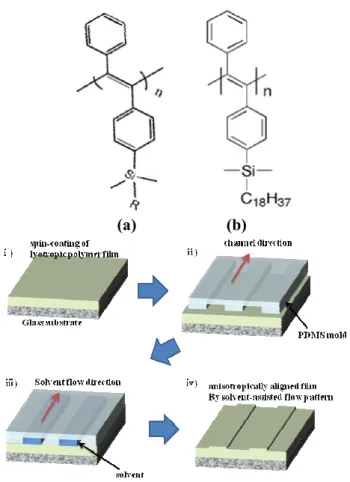
Figures 1 (a) and (b) show the chemical structures of lyotropic LCP used in our experiments. Figure 1(a) shows a lyotropic LCP(poly[1-trimethylsilyl)phenyl-2-phenylacetylene] (abbreviated PTMSDPA) and Fig. 1(b) shows a lyotropic LCP poly(1-phenyl-2-p-{dimethyl-noctadecylsilylphenyl}acetylene (abbrevia -ted C18-PDPA). In these structures, the lyotropic phase is driven by the intermolecular packing of side chains (the phenyl ring and the alkyl chain) through the steric interactions1,2. Two polymers have difference only in the length of the flexible long alkyl chain. Therefore, the liquid crystalline ordering is more easily obtained in the C18-PDPA than the PTMSDPA, which was observed in the previous shearing experiment.
Figure 1 (c) shows the schematic diagram of fabrication procedures for obtaining an aligned lyotropic LCP film through the solvent-assisted fluidic
Solvent-Assisted Soft-Lithographic Patterning of Lyotropic
Liquid Crystalline Polymer Film by Flow Control through
Patterned Channels
Chang-sub Park
1, Kyung-Woo Park
2, Shin-Won Kang
1,2, Giseop Kwak
3,
and Hak-Rin Kim
1,2,*1Department of Sensor and Display Engineering, Kyungpook National University,
1370 Sankyuk-dong, Bukgu, Daegu 702-701, Korea
2School of Electrical Engineering and Computer Science, Kyungpook National University,
1370 Sankyuk-dong, Bukgu, Daegu 702-701, Korea *Tel.:82-53-950-7211, E-mail: [email protected]
3Department of Polymer Science, Kyungpook National University, 1370 Sankyuk-dong,
Bukgu, Daegu 702-701, Korea
Keywords: Lyotropic Liquid Crystalline Polymer, Solvent-Assisted Soft-Lithography, Fluidic Channel, Shearing Effects
P1-36 / C.-S. Park
• IMID 2009 DIGEST
(a) (b)
(c)
Fig. 1. Chemical structures of (a) PTMSDPA (R=methyl) (b) C18-PDPA. (c) The schematic diagram of fabrication procedures showing the solvent-assisted flow patterning for preparing an aligned lyotropic liquid crystalline polymer film.
patterning. First, the isotropic lyotropic LCP film layer is uniformly spin-coated on a glass substrate (Fig. 1 (c-i)). On that surface, the fabricated elastomeric poly(dimethylsiloxane) (PDMS) mold structure with micro-channels is placed (Fig. 1 (c-ii)). As a solvent for capillary filling, aromatic solvent (toluene, xylene, etc.) was used by considering the solubility of both polymers. During filling the solvents through the channel, the LC polymers film in the isotropic state was changed to the gel state due to the solvent (Fig. 1 (c-iii)). In addition, the gel-state polymers are aligned to the solvent flow direction (Fig. 1 (c-iv)). The areas, which were in contact with the mold structure, were also changed from the solid film state to the gel state. The reason is that the solvent was penetrated to the film, while the solvent flew along the channel. As a result, the mold-contacted regions were
Fig. 2. The SEM image of the solvent-assisted soft-lithography pattern of the lyotropic LCP polymer.
morphologically changed due to the pressure of the mold.
Figure 2 shows the SEM image of the patterned polymer substrate. The heights of the mold-contacted regions were lower than those of the solvent-flowed regions. The reason is that the LCP surface was soften due to solvent penetration. From the SEM result, we can see that the etching effect in the patterning regions is negligible during the solvent flow.
We discussed the solvent effect on producing the patterned ordering in our patterning methods. When we used the polar solvents such as acetone, where our LCPs had no solubility, the liquid crystalline ordering could not be produced. This means that the solubility of the solvents plays an important role in producing patterned ordering in our method. To get a well-ordered film, the shearing force effects along the flow direction by the solvent flow as well as the film-softening effects by the solvent penetration along the depth direction should be involved in our patterning method3,4.
3. Results and discussion
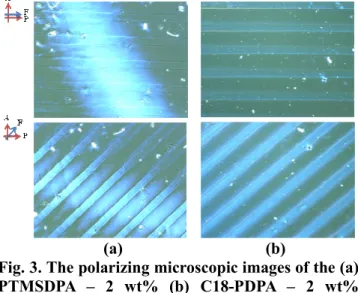
Figure 3 shows the polarizing microscopic images of the PTMSDPA and C18-PDPA patterns where the patterns were partially produced to compare the patterned regions and the non-patterned regions. In the results of the C18-PDPA (Fig. 3(b)), the solvent-assisted fluidic patterning produced very high liquid crystalline ordering due to the long alkyl side chains in the chemical structure. The ordering of the PTMSDPA was not good after patterning (Fig. 3(a)).
P1-36 / C.-S. Park
IMID 2009 DIGEST •
(a) (b)
Fig. 3. The polarizing microscopic images of the (a) PTMSDPA – 2 wt% (b) C18-PDPA – 2 wt% textures after patterning, where F indicates the flow direction of the solvent along the mold channel.
Fig. 4. The polarizing microscopic images of the patterned by using the MIMIC method, where F indicates the flow direction of the solution along the mold channel.
When we prepared the LCP film by mechanical shearing in a gel state, the liquid crystalline orderings were good in both films. This means that the length of the alkyl chain, thus the spacing between the backbone of polymer is important in obtaining highly ordered LCP in our fluidic patterning with weak shearing force.
We compared our method with the conventional micro-molding in capillary (MIMIC) method. Figure 4 shows the polarizing microscopic images of the patterned LCP polymer by using MIMIC method. After flow injection of the solution with the MIMIC patterning, the polarizing microscopic image showed
(a) (b)
Fig. 5. The schematic of the ordering effect of lyotropic liquid crystalline polymer by using the (a) solvent-assisted soft-lithographic method and (b) the MIMIC method, where blue arrow indicates flow direction of the solvent and red arrow indicates ordering direction of the lyotropic polymer.
no ordering effects. In both methods, the solvent flow is controlled by the patterned channel. However, the ordering effect of the lyotropic LCP film can be observed only after our patterning method as shown in Fig. 3 (b).
Figures 5(a) and (b) show the schematics of the patterning procedures by our solvent-assisted soft-lithographic method and the conventional MIMIC method during the solvent’s flow and after the solvent’s dry. The spin-coated lyotropic LCP of isotropic state is driven to the solvent as shown in Fig. 5(a). As previously mentioned, the polymer of the isotropic state was reacted to the solvent molecules and was changed to the ordered film in a gel state during the solvent flow along the mold channel. The ordering of the lyotropic LCP film by the solvent flow is not changed after the solvent evaporation.
However, in the MIMIC method, the LCP is geometrically patterned during the solvent’s flow in a solution state. In this case, the patterned lyotropic polymer had no liquid crystalline ordering because the concentration of the polymer is very critical in obtaining liquid crystalline ordering in our lyotropic LCPs. The melted lyotropic LCP is randomly ordered during the flow of the solution. During the drying process of the solvent through the mold after filling process, the solvent flow had no role in flow-assisted shearing effect. Thus, the final structure showed the randomly ordered structures. For this reason, the polarizing microscopic images with the two methods are differently appeared as shown in Figs. 3(b) and 4.
P1-36 / C.-S. Park
• IMID 2009 DIGEST
4. Summary
We demonstrated a solvent-assisted soft-lithographic patterning method for patterned ordering of lyotropic LCP film. Experimental results showed that the liquid crystalline ordering of lyotropic film could be controlled by shearing effects of the fluidic solvent though the patterned mold channels. In contrast to earlier approaches, the solvent-associated soft-lithographic method can produce the multi-directional ordering in lyotropic LCP film with a flow pattern. With the good ordering characteristic of the lyotropic polymer, our method is very usefully applied to fabrication of the compensation film with complex optic axis distribution.
Acknowledgement
This research was financially supported by the Ministry of Education, Science Technology (MEST) and Korea Institute for Advancement of Technology (KIAT) through the Human Resource Training Project for Regional Innovation and the Korea Science and Engineering Foundation (KOSEF) grant funded by the Korea government (2009-0063407).
5. References
1. G. Kwak, S. Fukao, M. Fujiki, T. Sakaguchi, and T. Masuda, Chem. Mater., 18, p.5537 (2006).
2. G. Kwak, M. Minakuchi, T. Sakaguchi, T. Masuda, and M. Fujiki, Chem. Mater., 19, p.3654 (2007). 3. P. J. Flory, Proc. R. Soc. London, A234, p. 73,
(1956).