The Effect of Cognitive Emotional Control on Happiness Levels
Jungae Kim
1,Milang Kim
2,Assistant Professor, Department of Nursing, Chodang University, Korea
1Assistant Professor, Department of International Studies, Chodang University, Korea
2,
[email protected]Abstract
This study was a cross-sectional descriptive research to analyze the effects of sub-factors of cognitive emotional control on happiness levels. The participants of the study were 201 men and women in their 20s, and data were collected online from January 1 to 15 collected data were, 2001 using structured cognitive control and happiness level questionnaires. The collected data were conducted Independent t-test, Pearson correlation analysis, simple regression analysis, multiple regression Analysis, hierarchical regression analysis using SPSS 18.0 statistic program. As a result, the study appeared that the level of happiness by gender does not differ, and cognitive emotional control affected 58.5%. The average of cognitive emotional control was higher for all men, but women were higher than men in criticized others. Also, acceptance was the sub-factor of emotional control that most affected the level of happiness (β=-.587, p<0.01). Based on the results of this study, it is suggested that a systematic program on subject of acceptance, a sub-factor of cognitive emotional control, should be developed to improve the level of happiness.
Keywords: Cognitive emotional control, Happiness level, People in their 20s
1. INTRODUCTION
Recently, Korea has become an economic powerhouse worldwide due to economic development, but Korea’s happiness index ranked 26th out of 34 OECD countries in 2011 and according to data published by Health Data, the average suicide rate in Korea was 28.4%, it reported that it ranks first among member countries [1]. These reports contrast the environment of Korea, which is making economic progress. The intellectuals who have felt the seriousness of this reality have been studying happiness for Koreans who feel unhappy. So far, the study on happiness has explained happiness through psychological meaning such as subjective quality of life, satisfaction of life, subjective well-being, ethical level of health, social culture, and other environmental factors. In other words, from the perspective of happiness as mental tranquility, happiness is received as a way to find happiness through the performance of the mind, and from the perspective of sensory pleasure, it seems to have been defined as the way to accumulation of money and wealth. Ultimately, it was a subjective division of mental wellbeing, and an objective view of happiness. It means that the level of happiness varies depending on the emotional perspective of recognizing happiness.
In one’s life, one experiences various and unpredictable events. Especially in situations where social and environmental stability is not stable, it is more likely to be regretted or placed in a negative position in society [2-3]. The problem of socially and environmentally difficult people can be interpreted as a more complex phenomenon because a new problem covers the problem without solving the existing problem.
IJACT 21-3-20
Manuscript received: January 31, 2021 / / revised: February 10, 2021 / accepted: February 22, 2021 Corresponding Author: [email protected]
Tel:+82-61-450-1926, Fax: +82-61-450-1599
Thus, if these complex environmental stresses do not improve and transition properly, human relationships will become more isolated. Isolation in human relationships leads to people living in their own world and not feeling other people’s emotions, and unhealthy emotions controllers can escalate into serious problems not only in themselves but throughout their structure, making everyone unhappy with their daily lives. This is likely to lead to more social problem such as suicide. Basically, people make various efforts to get out of that life. Nevertheless, it is reported that the reason is that in many cases when people are in crisis, proper instructions have not been made. As a result, people have lost their way of life and are living a hard life, which seems to have made them an extreme choice such as suicide. Even a small amount of support in a crisis can be of great help to them and lead to positive direction. The recent unexpected virus outbreak worldwide is causing more pain to the socially disadvantaged than those who are not, deepening inequality [4]. Depending on the environment that the socially disadvantaged are in, the same environmental stress can produce different results. Emotion played an important role in the crisis, and emotion influences other people’s relationship, communication, decision making, and behavior, thereby improving cognitive ability and ultimately affecting happiness [5]. emotional control is the process that one monitors one’s emotional response to social and cultural norms to achieve one’s goal and decides when and how to express one’s emotions in a particular situation [6]. Humans basically have a goal-oriented characteristic of trying to achieve what they want, so they respond emotionally with goals, whether positive or negative, to overcome the situation they are in [7]. It is a psychological expression of what people desire passionately, and it is also an important source of motivation in an individual’s life [8]. A life goal is a goal that a person ultimately aims to achieve in his or her life, which serves to guide the motivation and direction necessary to reach it as the final destination in a person’s life [9]. A life goal is a comprehensive concept that takes into account the entire life of an individual by integrating the past, present and future perspectives of a general goal and humans basically have a goal-oriented trait of trying to achieve what they want [7]. A person must present the cognitive aspects by actually acting in order to achieve his or her goals in life. Dealing with positive emotional responses from various events experienced in a person’s life is actually a necessary situation to make the direction of life happy [10].
Maslach and Jackson defined that people are exhausted when they experience a sense of emotional exhaustion, depersonalization, and feeling of reduced personal accomplishment [11], exhaustion is psychological and physical frustration caused by stress in psychology. Exhausted individuals are left with a negative assessment of themselves, unhappy with themselves, and letting go of the initiative in their lives. Therefore, in order to pursue a happy life, it is important to reduce negative emotions and foster positive emotions. Everyone has potential abilities and possibilities, a lot or a little. Identifying what emotional characteristics affect the direction of life for each individual helps to identify happiness and life goals in people’s lives. The methods of emotional control that people use are distinguished by cognitive and behavioral methods. It is distinguished according to the substrates of some aspect of justice [12-13]. Cognitive emotion control method is a technique to reduce negative emotions through changes in thought and belief in cognitive therapy as a way to bring about emotional changes through cognitive changes. Regarding cognitive emotional control, Garnefski explained the cognitive process of stable and consistent emotional control in the process of coping with stress, stressing that it is very important in the emotional control process because it helps us control ourselves without being overwhelmed by these emotions [12]. He classified emotional control as ‘emotional regulation’ that regulates internal emotional states and ‘behavior regulation’ that regulates behavioral responses. Cognitive emotion control is said to change the interpretation of events through cognitive assessment when negative emotions are received, and the strategy of cognitive emotion control is divided into 9 components, including self-criticism, other criticism, acceptance, plan rethinking, positive focus change, reflection, positive reevaluation, view expansion and destruction. Looking at the content, self-criticism is to blame yourself for what you have experienced, and blame others for what you have experienced. Acceptance is a concept of accepting what you have experienced, and plan rethinking means thinking about how to deal with negative events and what steps to take. A positive focus change is a kind of avoidance strategy in which people think of other pleasant things instead of thinking about real events, and rumination is to keep thinking about the feelings and thoughts associated with negative events. Positive reevaluation means an accident that gives positive meaning to the events that one experiences in
terms of personal growth, and expanding the view is an accident that lowers the severity of the incident by comparing the negative events experienced by the individual with other events. Destruction refers to accidents that often emphasize the frightening aspects of events experienced by individuals. Among them, acceptance, plan rethinking, positive focus change, positive reevaluation, and view expansion correspond to adaptive strategies, and self-criticism, blame others, rumination, and destruction are considered maladaptive strategies [12]. HY Yang [14] reports in her research that cognitive emotional control is acting as a mediating factor affecting happiness. Many people emphasize that happiness is not in matter, but it is seen as an attempt to materialize it at a time when it is not specifically known which factors are related to happiness. In her work, she cites self-distance as an execution method of cognitive emotional control, which is the opposite of the state of immersion in herself. In other words, taking a step back and looking at it in a more or less coordinated way when dealing with one's experiences, the degree of cognitive and emotional perception depends on how far you are from yourself, which affects the level of understanding and emotion [15].
As above, various emotional approaches have been studied as a way for people to pursue happiness in their lives. Especially recently, COVID-19 has changed the way people relate to each other while minimizing contact with people at the quarantine level, and as this rapidly changing situation is exposed to more stress than ever before, modern intellectuals are voicing the need to keep trying to find a way to live. Nevertheless, as Korea's overall low happiness index systematically established infrastructure projects for economic development, there is a lack of in-depth research by intellectuals on the level of happiness. Accordingly, the purpose of this study was to identify how the level of happiness people feel and the sub-factors of cognitively controllable emotions relate to and affect each other.
The specific objectives of this study are as follows: First, the correlation between the level of happiness and cognitive emotional control according to gender is identified. Second, check the correlation between happiness level and cognitive emotional control. Third, we analyze what are the sub-factors of cognitive emotional control that most affect the level of happiness.
2. METHODS
2.1 Research Design
The research is a cross-sectional survey of people in their 20s. This research collected data online using structured questionnaires and the data collection period was from January 1 to 15, 2021. Consent for participation in the study was indicated on the questionnaire and only those who understood the purpose of the study and voluntarily agreed to participate. Using SPSS 18.0 statistical programs, data analysis was performed using frequency analysis, t-test, Pearson correlation, Regression analysis, and Hierarchical regression analysis.
2.2 Research Tool
2.2.1. Cognitive Emotional Control
The research tool for measuring cognitive emotion regulation variables used in this study is a measure of JI Yoon [17] of SH Kim [16] translation of the Cognitive Emotion Regulation Questionnaire (CERQ) developed by Garnefski [12]. There are nine sub-factors: positive focus change, positive reevaluation, view expansion, plan rethinking, acceptance, rumination, self-criticism, others, and destruction; these are theoretically the first five more adaptive and the remaining four less adaptive. The nine sub-factors consist of 36 questions, each of which is four. For each question, a Likert five-point scale was used from one point of ‘almost not’ to five points of ‘almost always yes’, and the higher the score, the higher the level of corresponding cognitive emotional control. The reliability of cognitive emotional control was Chronbach alpha = 0.645.
2.2.2. Happiness Level
Happiness Measurements tool was developed by Fordyce [18] was translated by SR Yoo [19]. The happiness index scores 4.2 to 100, and averages the scores obtained from happiness test No. 1 (satisfaction with life), No. 2 (general happiness level), No. 3 (satisfaction with daily life), No. 4 (current life survey), and No. 5 (emotional meter). The happiness index calculation method is based on the number of points received in the happiness test No. 1 multiplied by 10 (10-100 points) and the number of points, the number of points received in happiness test No. 2 multiplied by 10 (0-100 points), the sum of the 10 scores from happiness test No. 3 (10-100 points), the final score of No. 4 happiness tests (0-100 points), to the final score of No. 5 happiness tests (1-100 points) then after adding all five (No. 1-5), divide the total by five.
3. RESULTS
3.1. General Characteristics
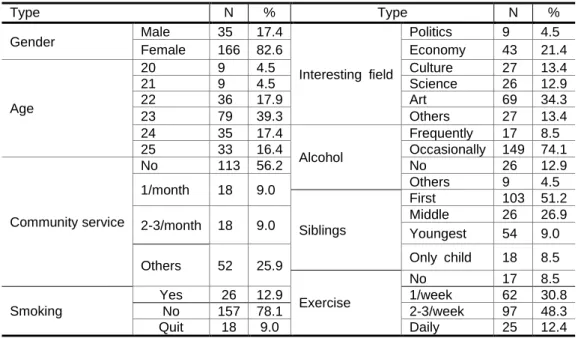
A frequency analysis was conducted to identify the general characteristics of the study participants (Table 1). A total of 201 people participated in the study, with 35 men (17.4 %) and 166 women (82.6 %). The age of the study was distributed between the ages of 20 and 25, with 79 people aged 23 years (39.3%), 36 people aged 22(17.9%), 35 people aged 24(17.4%), 33 people aged 25(16.4%), and 9 people aged 21(4.5%). The Protestant population was found to have 6 people (12.9%), 27 Catholic (13/4%), 18 Buddhism (9.0%), 27 Other (13.4%), and 103 None (51.2%). 113 people (56.2%) said they did not do community service at all, 18 people (9.0%) said they did it once a month, 18 people (9.0%) said they did it 2-3 times a month, and 52 others (25.9%). The areas of interest were 9 politics (4.5%), 43 economy (21.4%), 27 culture (13.4%), 26 science (12.9%), 69 art (34.3%), and 27 others (13.4%). Regarding the order of brothers and sisters, 103 respondents (51.2%) said they were the first, 26 (12.9%) said they were the middle, 54 (26.9%) said they were the youngest, and 18 (9.0%) said they were the only children. 17 people (8.5 percent) said they drink often, 149 (74.1 percent) said they drink occasionally, and 26 (12.9 percent) said they can't. Pets were found to be liked by 184 (91.5%) people, 17(8.5%) who thought it was normal, and no one disliked it. 26 people (12.9 percent) people smoked, 157 (78.1 %) were unable to smoke, and 18 (9.0 %) were found to have quit smoking. 62 people (30.8%) exercise once a week, 97 (48.3%) exercise twice a week, and 25 (12.4%) exercise every day.
Table 1. General Characteristics
N=201 Type N % Type N % Gender Male 35 17.4 Interesting field Politics 9 4.5 Female 166 82.6 Economy 43 21.4 Age 20 9 4.5 Culture 27 13.4 21 9 4.5 Science 26 12.9 22 36 17.9 Art 69 34.3 23 79 39.3 Others 27 13.4 24 35 17.4 Alcohol Frequently 17 8.5 25 33 16.4 Occasionally 149 74.1 Community service No 113 56.2 No 26 12.9 1/month 18 9.0 Others 9 4.5 Siblings First 103 51.2 2-3/month 18 9.0 Middle 26 26.9 Youngest 54 9.0
Others 52 25.9 Only child 18 8.5
Exercise No 17 8.5 Smoking Yes 26 12.9 1/week 62 30.8 No 157 78.1 2-3/week 97 48.3 Quit 18 9.0 Daily 25 12.4
3.2. Differences in the level of happiness and cognitive emotional control by gender
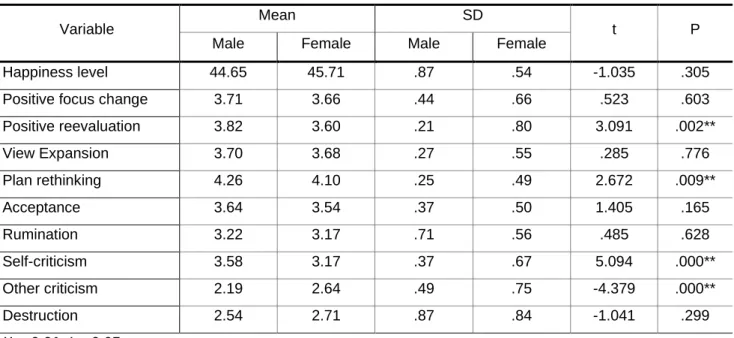
The independent variable t-test was conducted to identify the difference between the level of happiness and the ability to control cognitive emotions according to gender (Table 2). The analysis showed that happiness levels did not differ, but in cognitive emotional control, they differed under statistical significance levels in positive reevaluation, plan rethinking, self-criticism, and other criticism. Positive reevaluation showed that men(M=3.82, SD=.21) were higher than women(M=3.60, SD=.80), men(M=4.26), SD=.25) were higher than women in plan rethinking(M=4.10, SD=.49), men(M=3.58, SD=.37) were higher than women in self-criticism(M=3.58, SD=.37), and women(M=2.64, SD=.49) were higher than men(M=2.19, SD=.75) in other criticism.
Table 2. Differences in the level of happiness and Cognitive emotional Control by Gender
Variable Mean SD t P
Male Female Male Female
Happiness level 44.65 45.71 .87 .54 -1.035 .305
Positive focus change 3.71 3.66 .44 .66 .523 .603
Positive reevaluation 3.82 3.60 .21 .80 3.091 .002** View Expansion 3.70 3.68 .27 .55 .285 .776 Plan rethinking 4.26 4.10 .25 .49 2.672 .009** Acceptance 3.64 3.54 .37 .50 1.405 .165 Rumination 3.22 3.17 .71 .56 .485 .628 Self-criticism 3.58 3.17 .37 .67 5.094 .000** Other criticism 2.19 2.64 .49 .75 -4.379 .000** Destruction 2.54 2.71 .87 .84 -1.041 .299 **, <0.01, *, <0.05
3.3. Correlation between Cognitive Emotional Control and Happiness level
Pearson Correlation Analysis was conducted to analyze the correlation between cognitive emotional control and happiness level (Table 3). According to the analysis, the level of happiness under the statistical significance level is a positive focus change (R=.079, p<0.01), a positive reevaluation (R=.360, p<0.01), plan rethinking (R=.362, p<0.01), acceptance (R=-.306, p<0.01), rumination (R=-.235, p<0.01), other criticism (R=-.342, p<0.01), destruction (R=R=-.544, p<0.01) under the statistical significance level.
Table 3. Correlation between cognitive emotional control and life goals
Variable Mean SD Correlation
1 2 3 4 5 6 7 8 9 10 1.Happiness level 42.53 6.65 1 .079 ** .360 ** .117 .362 ** -.306 ** -.235 ** -.073 -.342 ** -.544 **
2.Positive focus changes 3.67 .63 1 .411 ** .395 ** .396 ** .350 ** .100 -.136 -.108 .035 3.Positive reevaluation 3.64 .74 1 .484 ** .604 ** .354 ** .268 ** .317 ** -.172 ** -.075 4. View expansion 3.69 .51 1 .385 ** .207 ** -.120 .025 -.228 ** -.220 ** 5. Plan rethinking 4.13 .46 1 .441 ** .319 ** .056 -.255 ** -.123 6. Acceptance 3.56 .48 1 .563 ** .555 ** -.042 .592* * 7. Rumination 3.18 .58 1 .453 ** .212 ** .715* * 8. Self-criticism 3.24 .65 1 -.101 .516* * 9.Other criticism 2.56 .73 1 .297* * 10. Destruction 2.58 .84 1 **, <0.01, *, <0.05
3.4. The Effect of Cognitive Emotional control on Happiness Level
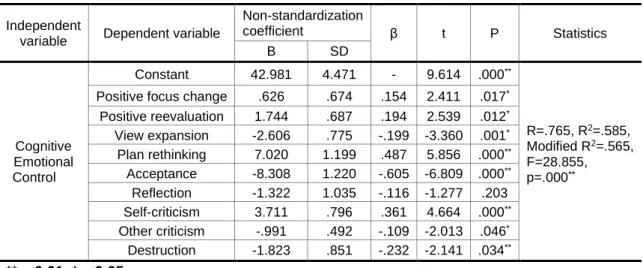
A simple regression analysis was conducted to analyze the effects of cognitive emotional control on the level of happiness (Table 4). According to the analysis, the sub-factors of human emotion control had a positive focus change (p<0.05), positive reevaluation (p<0.05), view expansion (p<0.05), plan rethinking (p<0.01), self-criticism (p<0.01), other-criticism (p<0.05), and destruction (p<0.05) had a 58.5% impact on happiness level. One of the sub-factors of cognitive emotional control was the rumination factor.
Table 4. The Effects of Cognitive Emotional Control on Happiness Level
Independent
variable Dependent variable
Non-standardization coefficient β t P Statistics B SD Cognitive Emotional Control Constant 42.981 4.471 - 9.614 .000** R=.765, R2=.585, Modified R2=.565, F=28.855, p=.000** Positive focus change .626 .674 .154 2.411 .017*
Positive reevaluation 1.744 .687 .194 2.539 .012* View expansion -2.606 .775 -.199 -3.360 .001* Plan rethinking 7.020 1.199 .487 5.856 .000** Acceptance -8.308 1.220 -.605 -6.809 .000** Reflection -1.322 1.035 -.116 -1.277 .203 Self-criticism 3.711 .796 .361 4.664 .000** Other criticism -.991 .492 -.109 -2.013 .046* Destruction -1.823 .851 -.232 -2.141 .034** **, <0.01, *, <0.05
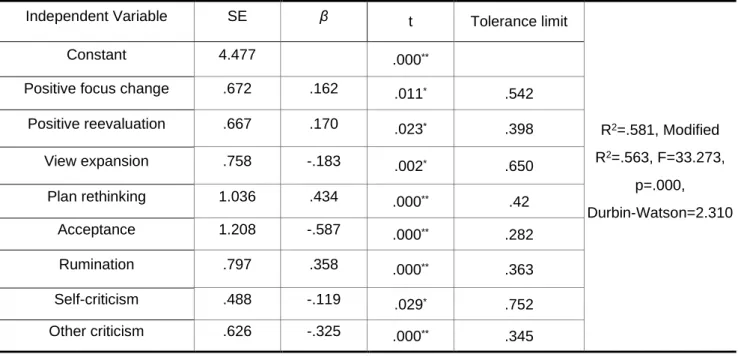
A hierarchical regression analysis was conducted to determine which of the sub-factors of cognitive emotional control affects the level of happiness the most (Table 5). According to the analysis, the sub-factor of cognitive emotion regulation that most affects the level of happiness is acceptance (β=-.587, p<0.01), followed by Plan rethinking (β=.434, p<0.01), followed by self-criticism (β=.358, p<0.01), followed by Destruction (β=-.325, p<0.01), positive reevaluation (β=.170, p<0.05), positive focus changes (β=.170, p<0.05), and other criticism (β=.-.119, p<0.05).
Table 5. Hierarchical Regression Analysis of Cognitive Emotional Control Affecting Happiness Level
Independent Variable SE β t Tolerance limit
R2=.581, Modified R2=.563, F=33.273,
p=.000, Durbin-Watson=2.310
Constant 4.477 .000**
Positive focus change .672 .162 .011* .542
Positive reevaluation .667 .170 .023* .398 View expansion .758 -.183 .002* .650 Plan rethinking 1.036 .434 .000** .42 Acceptance 1.208 -.587 .000** .282 Rumination .797 .358 .000** .363 Self-criticism .488 -.119 .029* .752 Other criticism .626 -.325 .000** .345 **, <0.01, *, <0.05
4. CONCLUSION
Compared to the past, people living in modern times certainly enjoy material affluence. However, despite the abundance, people are experiencing more confusion and conflict than ever before. People with various lifestyles and values ultimately all want to be happy and have a shared life goal of living to achieve it. Material affluence always has the property of wanting something bigger, so it is difficult to guarantee happiness as a life goal. Then, for people's ultimate happiness, they should look at it from a different perspective than from the hedonism of material abundance. Based on this interest, this study began to see how cognitive emotional control affects happiness. For this study, online surveys were randomly distributed and responses were received and analyzed to those who wanted to participate in the study voluntarily.
According to the analysis, correlations between cognitive emotional control and happiness levels showed that the level of happiness was related to positive focus change, positive reevaluation, plan rethinking, acceptance, reflection or rumination, criticism of others, and destruction. Based on this, cognitive emotional control is judged to affect the subjective level at which people feel happy. These results are similar to those of fMRI brain imaging [20] that positive emotions consistently relate to positive emotions such as 'joy', 'happiness' and 'comfort' in meta-analysis on local brain reaction. Based on this, the development of a program that utilizes cognitive emotional control as a way to improve the level of happiness is considered reasonable.
Although the level of happiness did not differ between men and women, men were high in positive reevaluation, plan rethinking, and self-criticism in cognitive emotional control, and women were high in others criticism. These results are very interesting, compared with studies analyzing the direction and coping mechanisms of criticism and the relationship with depression [21] that the higher the shame, the worse the degree of self-criticism, other people, and depression. Studies in [21] showed that both self- and other criticisms were higher for men, and depression was higher for women. However, [21]'s research is different from the participants in this study because it was based on the setting of social disparagement. If further research is carried out in the future, it will be more interesting to study human behavior if it becomes a deeper study. Among the sub-factors of cognitive emotional control, acceptance was the most influential factor, and the results of this study are consistent with the study of high school girls [22], which reveals that self-acceptance has a strong regulatory effect on happiness. When developing a program to raise the level of happiness in the future, it is believed that it will have a greater effect if it includes a lot of data on ‘acceptance’.
REFERENCES
[1] Health Data, OECD Health Data, 2011.
[2] Fenesy MC, The SE, Lee SS, Negative Parenting Moderates the Prospective Association of ADHD Symptoms and Youth Social Problems, J Abnorm Child Psychol, Vol. 47, No. 10, pp. 1583-1597, 2019. doi: 10.1007/s10802-019-00542-5.
[3] Luebbe AM, Bell DJ, Positive and negative family emotional climate differentially predict youth anxiety and depression via distinct affective pathways, Vol. 42, No. 6, pp. 897-911, 2014, doi: 10.1007/s10802-013-9838-5.
[4] 4Dubey S, Biswas P, Ghosh R, Chatterjee S, Dubey MJ, Chatterjee S, Lahiri D, Lavie CJ, Psychosocial impact od COVID-19, Diabetes Metab Syndr, Vol. 14, No. 5, pp. 779-788, 2020. doi: 10.1016.j.dsx.2020.05.035.
[5] KA Park, HS Back, JS Han, The effects of REBT Group Counseling on the job stress, Positive Affect, Negative Affect and Self-Esteem of Nurses, Korea Journal of Counseling, Vol. 8, No. 3, 2007.
[6] 6Gross. J. J, John O. P, Mapping the domain of expressivity: Multimethod evidence for a hierarchical model, Journal of Personality and Social Psychology, Vol. 74, No. 1, pp. 170-191, 1998, https://doi.org/10.1037/0022-3514.74.1.170.
[7] Locke. E. A,, Shaw. K. A., & Saati, L. M., & Latham, G. P., Goal setting and task performance: 1969-1980, Psychological Bulletin, Vol. 90, No. 1, pp. 125-152, 1981.
[8] MJ Kim, Effects of Parenting Attitudes on Juvenile Problem Behavior: focusing on target instability and mediating effects of life goals, Master's Degree unpublished thesis, Kyungpook National University, 2013.
[9] Schmuck, P., & Sheldon, K. M, Life goals and well-being, Hogrefe & Huber Publishers, 2001.
[10] Yang Y, Long and happy living: trends and patterns of happy life expectancy in the U,S., 1970-2000, Soc Sci Res, Vol. 37, No. 4, pp. 1235-1252, 2008. doi: 10.1016/j.ssresearch.2007.07.004.
[11] Maslach & Jackson, Emotional exhaustion and its relationship with suicide risk in emergency responders, Psychiatry Res, 1981. doi: 10.1016/j.psychres.2020.113379.
[12] Garnefski, Kraajj & Spinhoven, 2001, Cognitive emotion regulation and emotional problems. Personality and Individual differences, Vol. 30, pp. 1311-1327.
[13] Parkinson, B., & Totterdell, P. Classifying affect-regulation strategies, job satisfaction, and well-being, Motivation and Emotion, Vol. 23, pp. 125-154, 1999.
[14] HY Yang, Effects of Self-focus on Depression and Happiness: Intermediate Effects of Cognitive Emotional Control and Self-acceptance, Unpublished master’s degree thesis, Sogang University, 2019. [15] MH Cho, Self-distancing as Cognitive tool for Emotion Regulation: Its Concept, Measurement, and
Effect, Emotional science, Vol. 23, No. 3, pp. 103-120, 2020.
psychological well-being, master's unpublished thesis, Catholic University, 2004.
[17] JI Yoon, GS Nak, Relationship between cognitive emotional control and consumption of counselors, master's unpublished thesis, Catholic University, 2008.
[18] Fordyce, M. W. A review of research on the happiness measures: a sixty second index of happiness and mental health, social indicators Research, Vol. 20, pp. 355-381, 1988
[19] SR Yoo, Verification of the effectiveness of the program 'Conditions of Happiness-14' that promotes individual happiness, unpublished master’s degree thesis, Busan National University, 1998.
[20] KS Kim, MR Han, BG Park, Meta-analysis of fMRI brain imaging studies on positive emotions of pleasure, happiness, and comfort, The Journal of Child Educatuon, Vol. 26, No. 4, pp. 5-22, 2017, http://dx.doi.org/10.17643/KJCE.2017.26.4.01.
[21] HS Jeong, The degree to which shame is perceived, the direction to blame, and the way to deal with it and the relationship to depression, Journal of Human Understanding and Counseling, Vol. 29, pp. 1-18, 2008.
[22] JY Kim, DG Lee, Influence of Self-Discrepancy in family relationships and family status on happiness on female high school students: A Moderating role of self-acceptance, Counseling Studies, Vol. 13, No. 3, pp. 1443-1460, 2012.