79
www.kjtcvs.org
KJTCVS
The Korean Journal of Thoracic and Cardiovascular SurgeryCase
Report
https://doi.org/10.5090/kjtcs.2020.53.2.79pISSN: 2233-601X eISSN: 2093-6516
Korean J Thorac Cardiovasc Surg. 2020;53(2):79-81
The First Pediatric Heart Transplantation Bridged by a Durable
Left Ventricular Assist Device in Korea
Jung Hoon Shin, M.D.1, Han Ki Park, M.D.1, Se Yong Jung, M.D.2, Ah Young Kim, M.D.2, Jo Won Jung, M.D.2,
Yu Rim Shin, M.D.1
Divisions of 1Cardiovascular Surgery and 2Pediatric Cardiology, Severance Cardiovascular Hospital, Yonsei University College of Medicine, Yonsei University Health
System, Seoul, Korea
ARTICLE INFO Received May 8, 2019 Revised November 1, 2019 Accepted November 4, 2019 Corresponding author Yu Rim Shin Tel 82-2-2228-8480 Fax 82-2-313-2992 E-mail [email protected] ORCID https://orcid.org/0000-0001-7685-0018
Treatment options for children with end-stage heart failure are limited. We report the first case of a successful pediatric heart transplantation bridged with a durable left ventricu-lar assist device in Korea. A 10-month-old female infant with dilated cardiomyopathy and left ventricular non-compaction was listed for heart transplantation. During the waiting period, the patient’s status deteriorated. Therefore, we decided to provide support with a durable left ventricular assist device as a bridge to transplantation. The patient was suc-cessfully bridged to heart transplantation with effective support and without any major adverse events.
Keywords: Transplantation, Pediatric, Cardiomyopathies, Ventricular assist device
Copyright©The Korean Society for Thoracic and Cardiovascular Surgery. 2020. All right reserved.
This is an Open Access article distributed under the terms of the Creative Commons Attribution Non-Commercial License (http://creativecommons.org/licenses/ by-nc/4.0) which permits unrestricted non-commercial use, distribution, and reproduction in any medium, provided the original work is properly cited.
Case report
Treatment options for children with end-stage heart fail-ure are limited. Heart transplantation is the only viable option for these patients, and durable mechanical circula-tory support is widely accepted as a bridge to transplanta-tion despite the high rate of complicatransplanta-tions [1-3]. We report the first case of successful pediatric heart transplantation bridged with a durable pulsatile left ventricular assist de-vice in Korea.
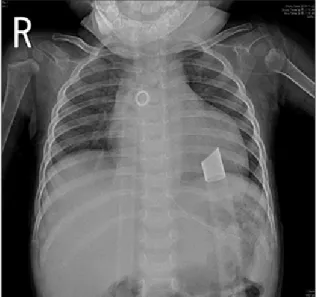
A 10-month-old female infant was referred to our hospi-tal for severe cardiomegaly. She had presented to her pri-mary care physician with symptoms of poor oral intake and lethargy lasting for a month. She became very lethar-gic during the examination by the primary care physician and was promptly transferred to our cardiac intensive care unit for evaluation of the cardiogenic cause. The patient’s initial vital signs were as follows: blood pressure, 110/63 mm Hg; heart rate, 159 beats/min; and respiratory rate, 54 breaths/min. A chest X-ray examination revealed marked cardiomegaly (Fig. 1). On an echocardiographic examina-tion, the left ventricular ejection fraction was estimated as 13%, and severe dilatation of the left ventricle and the left atrium was noted, which was consistent with dilated
car-diomyopathy. A tricuspid annular plane systolic excursion of 11 mm, a tissue Doppler imaging–derived tricuspid lat-eral annular systolic velocity of 8 cm/sec, and trivial tricus-pid regurgitation suggested a mild degree of right ventric-ular dysfunction. The sponge-like features of the left ventricular myocardium suggested left ventricular non- compaction. Medications including an angiotensin-con-verting enzyme inhibitor, an aldosterone antagonist, and a beta-blocker were administered along with intravenous milrinone. The patient partly recovered from her lethargic condition, but tachypnea and activity limitation persisted. The patient’s left ventricular ejection fraction slightly im-proved to 20%. Because her heart failure symptoms were refractory despite optimal medication, she was listed for heart transplantation. Because her blood type was O-posi-tive, she was expected to have a long waiting period. After 50 days of medical treatment, the patient’s condition dete-riorated rapidly. She was intubated and mechanically ven-tilated. Nevertheless, she was hypotensive and developed oliguria. Veno-arterial extracorporeal membrane oxygen-ation (ECMO) was initiated via neck cannuloxygen-ation. After 3 days of ECMO support, a left ventricular assist device was implanted with an extracorporeal pulsatile device (Berlin Heart EXCOR; Berlin Heart GmbH, Berlin, Germany). Her
80
https://doi.org/10.5090/kjtcs.2020.53.2.79
www.kjtcvs.org
KJTCVS
body surface area was 0.4 m2, and she was supported with
a 15-mL pump. When performing apical cannulation of the left ventricle, a thorough and extensive resection of the trabeculation was performed to address left ventricular non-compaction. A 9-mm apical cannula was fixed to the apical hole with multiple interrupted stitches with an au-tologous pericardial strip. For outflow graft connection, a short, 10-mm expanded polytetrafluoroethylene tube graft was anastomosed to the ascending aorta with partial clamping on the beating heart, and the outflow cannula was connected to the graft. Two silk ties were used to fix the cannula to the graft. Anticoagulation therapy with heparin was started 24 hours after the operation, and ace-tylsalicylic acid was initiated on postoperative day 3. On post-implantation day 6, delayed mediastinal bleeding was noted, and the hematoma compressing the right atrium was surgically removed. Bleeding from a needle hole was observed at the aortic graft anastomosis site. The patient recovered uneventfully and was managed in the general ward from postoperative day 8 onwards (Fig. 2). Anticoag-ulation therapy was maintained with warfarin, acetylsali-cylic acid, and clopidogrel at a target international normal-ized ratio range of 3.0–4.0. The pump was checked for abnormal membrane motion and thrombi by the nursing team every 2 hours. On post-implantation day 24, the pa-tient underwent heart transplantation from a 5-year-old donor with a body weight of 29 kg. The total ischemic time was 192 minutes. The transplanted heart was oversized for the patient, but she recovered without any evidence of hy-perperfusion syndrome. She was able to be weaned from
mechanical ventilation on postoperative day 4 and was dis-charged home on postoperative day 25. She is doing well, and has not shown any rejection episodes over the course of 6 months.
The parent of this patient provided written informed consent for the publication of clinical details and images.
Discussion
In small children and infants with end-stage heart fail-ure, heart transplantation is the only long-term treatment option. However, waitlist mortality is high because of the scarcity of heart donors. According to the data collected from the United States registry, during 6 months after be-ing listed for heart transplantation, 23% of patients died on the waiting list [4]. Although the total number of trans-plantations has not increased, the number of pediatric heart transplantations that are bridged with ventricular as-sist devices is increasing worldwide [5,6]. Post-transplant outcomes in patients after ventricular assist device support are similar to those of medically supported patients and are superior to that of patients treated with ECMO [7]. In Korea, the number of pediatric heart transplantations re-mains low, with less than 20 transplants a year, and the frequency of transplantations in young children and in-fants is especially low [8]. Until recently, mechanical circu-latory support for children in Korea was most often pro-vided by temporary support via ECMO. However, time limitations due to possible thromboembolic and hemor-rhagic complications are a major drawback of ECMO. The
Fig. 1. Initial chest radiography demonstrated marked
81
Jung Hoon Shin, et al. Pediatric Heart Transplantation after a Durable Ventricular Assist Device
www.kjtcvs.org
KJTCVS
Berlin Heart EXCOR (Berlin Heart GmbH) is a paracorpo-real, pneumatically-driven pulsatile pump device that is available with chambers of various stroke volumes. It is the most frequently used device in infants with end-stage heart failure as a bridge to transplantation [6]. The success rate of bridging to transplantation ranges from 37% to 72.5% [9].
The present case is the first successful pediatric heart transplantation bridged with the Berlin Heart EXCOR (Berlin Heart GmbH) in Korea. The severely decompensat-ed infant was successfully switchdecompensat-ed from ECMO to a dura-ble ventricular assist device and underwent transplantation safely. Frequent cerebrovascular complications have been reported with the Berlin Heart EXCOR (Berlin Heart GmbH) [10]. In this case, the patient received warfarin and dual antiplatelet therapy, and was free of any neurologic events. However, this case does not provide sufficient in-formation on the effect of the Berlin Heart EXCOR (Berlin Heart GmbH) on growth and development due to the short duration of support. Considering that coverage by the Na-tional Health Insurance Service for the Berlin Heart EX-COR (Berlin Heart GmbH) was approved in 2018, we expect an increase in the number of pediatric heart transplanta-tions bridged by durable ventricular assist devices in the future.
Conflict of interest
No potential conflict of interest relevant to this article was reported.
ORCID
Jung Hoon Shin: https://orcid.org/0000-0002-7319-9917 Han Ki Park: https://orcid.org/0000-0002-7472-7822 Se Yong Jung: https://orcid.org/0000-0003-1337-563X Ah Young Kim: https://orcid.org/0000-0002-0713-4461 Jo Won Jung: https://orcid.org/0000-0001-5384-9161 Yu Rim Shin: https://orcid.org/0000-0001-7685-0018
References
1. Fraser CD Jr, Jaquiss RD, Rosenthal DN, et al. Prospective trial of a pediatric ventricular assist device. N Engl J Med 2012;367:532-41. 2. Almond CS, Morales DL, Blackstone EH, et al. Berlin Heart
EX-COR pediatric ventricular assist device for bridge to heart transplan-tation in US children. Circulation 2013;127:1702-11.
3. Blume ED, Rosenthal DN, Rossano JW, et al. Outcomes of children implanted with ventricular assist devices in the United States: first analysis of the Pediatric Interagency Registry for Mechanical Circu-latory Support (PediMACS). J Heart Lung Transplant 2016;35:578-84.
4. Mah D, Singh TP, Thiagarajan RR, et al. Incidence and risk factors for mortality in infants awaiting heart transplantation in the USA. J Heart Lung Transplant 2009;28:1292-8.
5. Cassidy J, Dominguez T, Haynes S, et al. A longer waiting game: bridging children to heart transplant with the Berlin Heart EXCOR device: the United Kingdom experience. J Heart Lung Transplant 2013;32:1101-6.
6. International Society for Heart and Lung Transplantation. Interna-tional thoracic organ transplant (TTX) registry data slides [Internet]. Addison (TX): International Society for Heart and Lung Transplanta-tion; 2019 [cited 2018 Aug 20]. Available from: https://ishltregis-tries.org/registries/slides.asp.
7. Jeewa A, Imamura M, Canter C, et al. Long-term outcomes after transplantation after support with a pulsatile pediatric ventricular as-sist device. J Heart Lung Transplant 2019;38:449-55.
8. Korean Network for Organ Sharing. 2017 Annual report [Internet]. Seoul: Korean Network for Organ Sharing; 2017 [cited 2018 Aug 20]. Available from: https://www.konos.go.kr/konosis/common/biz-logic.jsp.
9. Rohde S, Antonides CF, Dalinghaus M, Muslem R, Bogers AJ. Clini-cal outcomes of paediatric patients supported by the Berlin Heart EXCOR: a systematic review. Eur J Cardiothorac Surg 2019;56:830-9.
10. Kanaya T, Ueno T, Taira M, et al. Impact of long-term support with Berlin Heart EXCOR(R) in pediatric patients with severe heart fail-ure. Pediatr Cardiol 2019;40:1126-33.