Communications to the Editor Bull. Korean Chem. Soc. 2010, Vol. 31, No. 8 2139 DOI 10.5012/bkcs.2010.31.8.2139
Design, Synthesis and Antiviral Activity
of 5-Hydroxymethyl-3-phosphonyl-4,5-dihydrofuran Analogs of Nucleotides
Hee-Yoon Lee,* Kiho Lee, Jung Hwan Hah, Deuk Kyu Moon, and Chong-Kyo Lee†Department of Chemistry, Korea Advanced Institute of Science and Technology, Daejeon 305-701, Korea
*E-mail: [email protected]
†Korea Research Institute of Chemical Technology Daejeon 305-600, Korea
Received May 25, 2010, Accepted June 14, 2010 Key Words: Antiviral, Nucleotide, Analog, Phosphonate
m-CPBA CH2Cl2, rt O OH (EtO)2P p-Cl-Ph O (EtO)2P p-Cl-Ph O O (EtO)2P p-Cl-Ph 1 2 3 basic work-up 85% O O O
Scheme 1. One-pot epoxidation and cyclization
O OH (EtO)2P p-Cl-Ph O (EtO)2P p-Cl-Ph O O N N N N Cl a or b,c d - g O OH (BnO)2P p-Cl-Ph O O B (HO)2P p-Cl-Ph O b, h, i 3d N N O NH2 N N N N NH2 B i ii iii 4a: B = i 4b: B = ii 4c: B = iii 6a: B = i 6b: B = ii 6c: B = iii 5
Reagents and conditions: (a) purines, PPh3, DEAD/THF, 75% for 4a, 64% for 4b,
(b) MsCl, Et3N/CH2Cl2, ‒10 oC, 86%, (c) cytosine, Cs2CO3/DMF, 70 oC, 87% (d)
BzCl, Et3N, DMAP/CH2Cl2, 88% (e) TMSBr/CH2Cl2; MeOH (f) BnOH, DCC/PhH
(g) K2CO3/MeOH, 41% for three steps (i) nucleic base, K2CO3, 18-C-6/DMF (j)
10% Pd-C/MeOH, 10% for 6a, 48% for 6b, 31% for 6c, for three steps
Scheme 2. Synthesis of nucleotide analogs
Phosphonate esters play an important role in studying the biological system as a hydrolytically stable replacement of phos-phate groups1a and as prodrugs of phosphonates.1b In continu-ation of our study on the chemistry of 1-alkenylphosphonates,4
we were interested in designing and developing versatile syn-thetic routes to conformationally constrained structures of al-kenylphosphonate nucleotide analogs.1-3 After reporting a novel synthesis of spatially equivalent analogs of 1-alkenylphospho-nates by introducing cyclopropane ring instead of olefin,5 we became interested in dihydrofuranyl phosphonate that would provide different constraint to the linker between phosphonate and the base. The dihydrofuran ring will serve as a rigid linker between purine/pyrimidine bases and phosphonyl groups of nucleotide inhibitors. A similar concept was introduced in a re-cent reports of dihydrofuryl nucleoside analogs that were shown to be anti-HCMV with resistance to enzymatic degradation,6 and tetrahydrofuryl phosphonate analogs of dideoxynucleo-sides.7 Though there have been many reports of synthesis of
functionalized dihydrofurans,8 only few examples have been reported on the synthesis of phosphonyl derivatives9 with limited applicability to the preparation of various derivatives. While we were working on the synthesis of cyclopropyl phospho-nates5 we encountered an unexpected formation of the phos-phonyl dihydrofuran ring and this observation led us to develop a facile synthesis of functionalized dihydrofuranyl phospho-nates. When 1-acyl-3-butenylphosphonate (1) was treated with m-CPBA with an anticipation of obtaining γ,δ-epoxyphospho-nate (2), 5-hydroxymethyl-3-phosphonyl-4,5-dihydrofuran (3), was obtained after basic work-up of the epoxidation reaction (Scheme 1). It appeared that the enolate was generated from the ketone under the basic condition and subsequent opening of the epoxide with the oxygen of the enolate produced the dihydrofuran ring during work-up.
With the compound 3 in hand, nucleotide analogs were syn-thesized. The replacement of hydroxy group could be achieved either by direct coupling with a base unit, or by transformation to a leaving group with subsequent substitution reaction.10 In our
system, direct Mitsunobu coupling reaction of hydroxy group was proven to be efficient with purine bases. The coupling re-actions of 3 with 6-chloropurine and adenine under Mitsunobu reaction conditions afforded 4a and 4b in yields of 75% and 64%, respectively (Scheme 2). While coupling reaction of 3 with 6-chloropurine underwent smoothly at 0 oC, the synthesis of
4b required lower reaction temperature of ‒10 oC to avoid the
competing coupling of primary amine group. In case of pyri-midine, however, an indirect route was more fruitful, where the hydroxy group was activated as the mesylate, and then was replaced by cytosine (Scheme 2). Among the two nitrogen atoms in cytosine, the amino nitrogen did not react in this con-dition, and there occurred only the desired attack of aromatic NH group to give 4c in 87% yield. Unfortunately, direct hydro-lysis7 of ethyl phosphonates 4a-c did not yield the desired phosphonate 6a-c. For the synthesis of 6a-c, ethyl phosphonate was replaced by benzyl phosphonate in four step sequence be-fore the introduction of purine/pyrimidine, and hydrogenolysis
2140 Bull. Korean Chem. Soc. 2010, Vol. 31, No. 8 Communications to the Editor
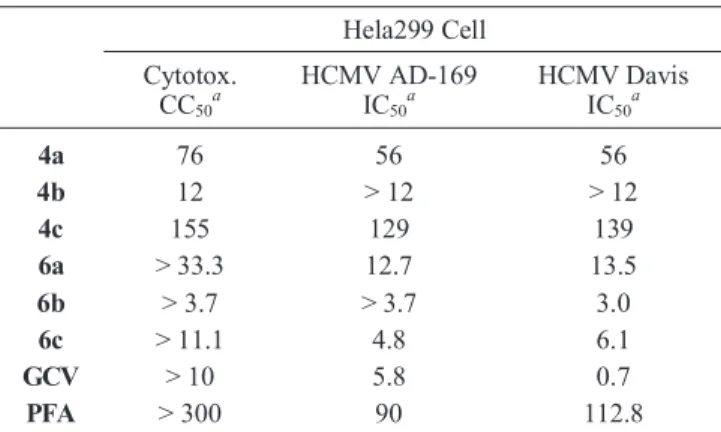
Table 1. Cytotoxicity and antiviral activityb
Hela299 Cell Cytotox. CC50a HCMV AD-169 IC50a HCMV Davis IC50a 4a 76 56 56 4b 12 > 12 > 12 4c 155 129 139 6a > 33.3 12.7 13.5 6b > 3.7 > 3.7 3.0 6c > 11.1 4.8 6.1 GCV > 10 5.8 0.7 PFA > 300 90 112.8
aµM, bstandard CPE inhibition assay13 was used for antiviral test.
of the benzylphosphonate at the last step produced the desired phosphonates.
These compounds were tested for antiviral activity and the result was summarized in the Table 1. For the evaluation of antiviral activity, CoxB3 strains Nancy, EMCV strains EMC, VSV strains Indiana, HSV-1 strains F, HSV-2 strains MS, HIV-1 strains IIIB, HIV-2 strains ROD, HCMV AD-169 and HCMV Davis were used. HeLa299 cell was used for cytotoxi-city assay. While cytotoxicytotoxi-city was observed from all the com-pounds tested, antiviral activity was observed only with HCMV strains at the concentration below the cytotoxic level. As antici-pated, phosphonates 6a and 6c showed the antiviral activity at the concentration that was much lower than the cytotoxic con-centration, and 6b showed antiviral activity near the cytotoxic level. This result was quite promising since the previous report on slightly different design of nucleoside phosphonates from Nair’s group did not show antiviral activity.7 The activity might be related to the distance between phosphonate groups and purine/pyrimidine bases. When ethyl phosphonates were tested, those compounds also showed cytotoxicity and antiviral activity close to the cytotoxic level (4a, 4c) or no antiviral activity below the cytotoxic level (4b). The fact that the antiviral activities of ethyl phosphonates (4a-c) were lower than that of phosphonates (6a-c) suggested that the ethyl phosphonates might be prodrugs of phosphonates that could be hydrolyzed under the test condi-tion, or more likely, they showed weak antiviral activity through different mechanisms from the nucleotide antiviral compounds.12 In summary, we have designed and synthesized functionaliz-ed dihydrofurylphosphonates that are constrainfunctionaliz-ed analogs of 1-alkenyl-phosphonate derivatives of purine/pyrimidine nucleo-tides as they bear phosphonyl groups at the 3-position and bases at the methyl group of the 5-position of the furan ring. This newly designed dihydrofurylphosphonate analogs of nu-cleotide showed antiviral activity. Through the current synthetic strategy, structural diversification can be easily attainable for structure activity relationship study and for the better antiviral compounds.
Acknowledgments. This research was supported by a grant from Marine Biotechnology Project funded by Ministry of Land, Transportation and Maritime Affair, Republic of Korea.
References
1. (a) Du, Y.; Wiemer, D. F. J. Org. Chem. 2002, 67, 5701 and re-ferences therein. (b) Hecker, S. J.; Erion, M. D. J. Med. Chem.
2008, 51, 2328.
2. (a) De Clercq, E.; Holy, A.; Rosenberg, I.; Sakuma, T.; Balzarini, J.; Maudgal, P. C. Nature 1986, 323, 464. (b) Bronson, J. J.; Gha-zzouli, I.; Hitchcock, M. J. M.; Webb, R. R., II.; Martin, J. C. J. Med. Chem. 1989, 32, 1457. (c) Balzarini, J.; Naesens, L.; Herde-wijn, P.; Rosenberg, I.; Holy, A.; Pauwels, R.; Baba, M.; Johns, D. G.; De Clercq, E. Proc. Natl. Acad. Sci. USA 1989, 86, 332. (d) Adefovir dipivoxil – anti-HIV and anti-HBV. Drugs Future
2000, 25, 844. (e) Harnden, M. R.; Parkin, A.; Parratt, M. J.;
Per-kins, R. M. J. Med. Chem. 1993, 36, 1343. (f) Holy, A.; Votruba, I.; Masojidkova, M.; Andrei, G.; Snoeck, R.; Naesens, L.; De Clerq, E.; Balzarini, J. J. Med. Chem. 2002, 45, 1918.
3. (a) Piperno, A.; Chiacchio, M. A.; Iannazzo, D.; Romeo, R. Curr. Med. Chem. 2006, 13, 3675. (b) Armstrong, P. D.; Cannon, J. G.; Long, J. P. Nature 1971, 220, 56. (c) Spande, T. F.; Garaffo, H. M.; Edwards, M. W.; Yeh, H. J. C.; Pannell, L.; Daly, J. W. J. Am. Chem. Soc. 1992, 114, 3475. (d) McGroddy, K. A.; Carter, A. A; Tubbert, M. M.; Oswald, R. E. Biophys. J. 1993, 64, 325. (e) Chen, X.; Wiemer, A. J.; Hohl, R. J.; Wiemer, D. F. J. Org. Chem. 2002, 67, 9331. (f) Bubenick, M.; Rej, R.; Nguyen-Ba, N.; Attardo, G.; Ouellet, F.; Chan, L. Bioorg. Med. Chem. Lett. 2002, 12, 2063. 4. (a) Gil, J. M.; Hah, J. H.; Oh, D. Y. Tetrahedron Lett. 1998, 39,
3205. (b) Gil, J. M.; Oh, D. Y. J. Org. Chem. 1999, 64, 2951. 5. Hah, J. H.; Gil, J. M.; Oh, D. Y. Tetrahedron Lett. 1999, 40, 8235. 6. Jeong, L. S.; Kim, H. O.; Moon, H. R.; Hong, J. H.; Yoo, S. J.;
Choi, W. J.; Chun, M. W.; Lee, C.- K. J. Med. Chem. 2001, 44, 806. 7. Zheng, Y.; Nair, V. Tetrahedron 1999, 55, 11803.
8. (a) Ma, S.; Gao, W. Synlett 2002, 65. (b) Ichikawa, J.; Fujiwara, M.; Wada, Y.; Okauchi, T.; Minami, T. J. Chem. Soc. Chem. Commun. 2000, 1887. (c) Feldman, K. S.; Wrobleski, M. L. J. Org. Chem. 2000, 65, 8659. (d) Lee, Y. R.; Kim, B. S. Tetrahedron Lett.
1997, 38, 2095. (e) Alonso, I.; Carretero, J. C.; Garrido, J. L.;
Magro, V.; Pedregal, C. J. Org. Chem. 1997, 62, 5682. 9. (a) Ruzziconi, R.; Gourves, H. C.; Gourves, J.-P.; Corbel, B.
Syn-lett 2001, 703. (b) Pevzner, L. M.; Ignat’ev, V. M.; Ionin, B. I. Zh. Obshch. Kim. 1994, 64, 135 (Chem. Abstr. 1994, 121, 134268u). (c) Brel, V. K. Synthesis 1999, 463. (c) Qunter, A. A. Z.; Melman, A.; Srebnik, H. Synlett 2002, 61. (d) Lee, C.-W.; Oh, D. Y. Hetero-cycles 1996, 43, 1171.
10. (a) Chen, W.; Flavin, M. T.; Filler, R.; Xu, Z.-Q. J. Chem. Soc. Perkin Trans. 1 1998, 3979. (b) Yu, K.-L.; Bronson, J. J.; Yang, H.; Patick, A.; Brankovan, V.; Datema, R.; Hithcock, M. J. M.; Martin, J. C. J. Med. Chem. 1993, 36, 2726.
11. (a) Barchi, J. J., Jr.; Jeong, L. S.; Maqbool, M. A.; Marquez, V. E. J. Biochem. Biophys. Methods 1997, 34, 11. (b) Snoeck, R.; Sakuma, T.; De Clerq, E.; Rosenberg, I.; Holy, A. Antimicrob. Agents Chemther. 1988, 32, 1839. (c) Vero cells in stationary phase were infected with 100 µL of the virus diluted with DME/2% FBS to make 100 CCID50 (50% cell culture inhibitory dose) per well of 96-well plates. After 1 hour adsorption at 37 oC, the liquid was removed and 100 µL of DME/2% FBS containing a compound was applied to each well in duplicate for each concentration and further incubated for 3 days. Antiviral activity was measured by MTT assay. Antiviral activity was expressed as the EC50, or the concentration required to inhibit virus-induced CPD by 50%. EC50 values were estimated from semilogarithmic graphic plots of the percentage of CPE as a function of the concentration of the test compound. Cytocidal assay was performed as a control experi-ment for antiviral assay. It was carried out simultaneously with the antiviral assay described previously using mock instead of virus for infection, and cell viability was measured by MTT assay. The concentration of compound responsible for 50% reduction of cell viability was calculated and expressed as CC50 (50% cytotoxic concentration).