2561 Copyrightⓒ The Korean Institute of Electrical Engineers
Lithium-ion Stationary Battery Capacity Sizing Formula for the
Establishment of Industrial Design Standard
Choong-koo Chang
†and Mumuni Sulley*
Abstract – The extension of DC battery backup time in the DC power supply system of nuclear power plants (NPPs) remains a challenge. The lead-acid battery is the most popular at present. And it is generally the most popular energy storage device. However, extension of backup time requires too much space. The lithium-ion battery has high energy density and advanced gravimetric and volumetric properties. The aim of this paper is development of the sizing formula of stationary lithium-ion batteries. The ongoing research activities and related industrial standards for stationary lithium-ion batteries are reviewed. Then, the lithium-ion battery sizing calculation formular is proposed for the establishment of industrial design standard which is essential for the design of stationary batteries of nuclear power plants. An example of calculating the lithium-ion battery capacity for a medium voltage UPS is presented.
Keywords: lead-acid battery, Lithium-ion battery, Battery capacity sizing formular, Industrial standard, Nuclear power plants.
1. Introduction
Recently, as a result of competitive research and development efforts around the world, high capacity and high performance of energy storage systems (ESS) are accelerating. The emergence of lithium-ion battery in 1991 has got a wide range of application in energy storage devices. It has been widely used for portable electronic devices in the early days. The application range is rapidly expanding for electric vehicles and large ESS. Industrial standards had been established for the sizing of conventional stationary batteries such as lead-acid and nickel-cadmium batteries. However, the industrial standard for the sizing of lithium-ion statlithium-ionary batteries is still under development.
IEC 62619-2017, ‘Safety requirements for secondary lithium cells and batteries, for use in industrial applications’ and IEC 62620-2014, ‘Secondary cells and batteries containing alkaline or other nonacid electrolytes -Secondary lithium cells and batteries for use in industrial applications’ are international standard for industrial lithium-ion batteries established recently. However, IEC 62619 & 62620 does not cover the capacity sizing method of lithium-ion stationary battery. Korea Electric Association published KEPIC EEG 1400, ‘Installation design and installation of lithium-ion batteries for station applications’ on December 31, 2017. KEPIC EEG 1400 describes how to size lithium-ion stationary batteries but
does not take into account all the characteristics of lithium-ion batteries.
Due to many advantages of lithium-ion over current industrial standard batteries such as lead-acid and nickel-cadmium pose a need of great concern. The Japanese earthquake and tsunami event on March 11, 2011 caused simultaneous loss of offsite power (LOOP) and onsite AC power (SBO). And, the extended loss of alternating current (ac) power (ELAP) condition led to loss of core cooling and a significant challenge to containment. Prior to recovery from an ELAP it is imperative that DC power remain available for indication and for control before AC power is restored. Nuclear energy institute (NEI), ‘Diverse and flexible coping strategies (FLEX) implementation guide’ (NEI 12-06, Aug. 2012) requires the 125 VDC class 1E batteries to last for at least 24 hours. But the backup time of existing lead-acid type safety related batteries is 8 hours. Due to the low energy density, extending battery backup time from 8 hours to 24 hours with current design is unrealistic. Therefore, lithium-ion battery is recommended as an alternative for lead-acid battery.
The objective of this paper is to propose the lithium-ion statlithium-ionary battery capacity sizing formula for the establishment of industrial design standard which is essential for the design and installation of stationary batteries of nuclear power plants. Sample calculation for the batteries of medium voltage UPS of a nuclear power plants is also presented as an example. For this purpose, comparative analysis of stationary batteries is performed in Section 2. Based on the review results of Section 2, stationary lithium-ion battery capacity sizing formular is proposed in Section 3. Then, Section 4 provides calculation example.
† Corresponding Author: Dept. of Nuclear Power Plant Engineering, KEPCO International Nuclar Graduate School, Korea.
(ckchang @kings.ac.kr)
* Dept. of Nuclear Power Plant Engineering, KEPCO International Nuclar Graduate School, Korea. ([email protected])
2. Stationary Battery Comparative Analysis Lithium-ion batteries have a high energy density of approximately five times of lead-acid batteries, a discharge loss of only 1/4 of that of nickel-metal hydride batteries, have no memory effect, and have a large number of charge and discharge cycles as shown in Table 1 [1]. On the other hand, lithium-ion batteries suffer from severe performance degradation at high temperatures, and when the batteries are completely discharged, the batteries lose their functions and on cost basis they are expensive compared to other batteries. Also, if handled inadvertently, there is a risk of explosion.
2.1 Single cell voltage
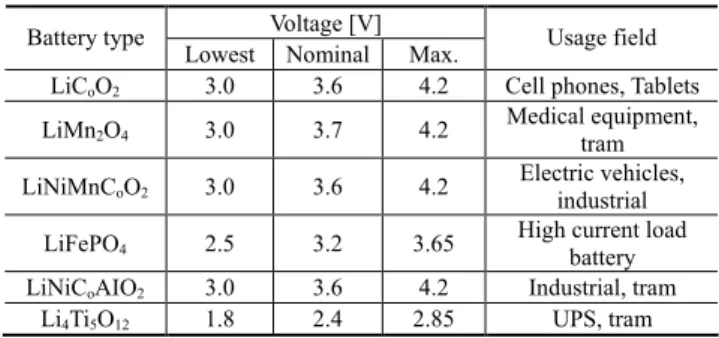
The lithium-ion battery can be manufactured by using lithium cobalt oxide (LiCoO2 or LCO), lithium manganese
oxide (LiMn2O4 or LMO), and lithium nickel manganese
cobalt oxide (LiNiMnCoO2 or NMC, NCM, CMN, CNM,
MNC, MCN), lithium iron phosphate (LiFePO4) and
lithium titanate (Li4Ti5O12) as shown in Table 2 [2]. 2.2 Discharge characteristics
The discharge characteristics of lead-acid batteries, which are mainly used for industrial purposes, are explained by the following Peukert’s law.
p k Q t I = (1) where;
Qp : Discharge capacity when discharging at 1A [Ah]
I : Discharge current [A]
t : Discharge time to reach discharge terminating voltage [s]
k : Constant, approximately 1.3.
The discharge capacity of the lead-acid battery varies depending on the discharge current due to the Peukert formula k constant. The larger the discharge current, the greater the difference in discharge capacity. In other words, the discharge capacity of a lead-acid battery exponentially decreases at high currents as shown in Fig. 1[3]. On the other hand, the lithium-ion battery has a k-constant close to unity. This means that the discharge capacity of the battery does not vary greatly depending on the magnitude of the discharge current and exhibits good discharge charac-teristics at high currents as shown in Fig. 2 [4].
2.3 Operating temperature characteristics
Lithium-ion batteries are capable of operating over a relatively wide temperature range. And, it is more affected by temperature during charging than discharging.
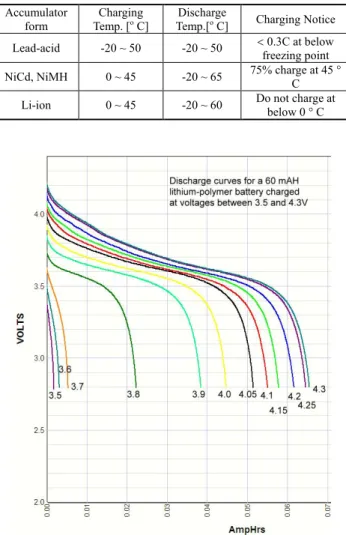
Charging performance deteriorates at extremely low or high temperatures. Lead-acid batteries can be charged at below 0°C. However, the recommended charging current is 0.3C. The higher the temperature, the greater the discharge capacity of lead-acid batteries as listed in Table 3[5]. All
Table 1. Types and performance of batteries
Accumulator kinds Operating voltage [V] Energy density [Wh /kg] Life expectancy [year] (Cycle) Battery efficiency [%] Lead accumulator 2.0 20-35 7-10 (1500) 65-80 Nickel hydrogen accumulator 1.2 20-70 (500~1500) ~ 84 Lithium-ion accumulator 2.4 -3.8 70-160 ≥ 10(≥ 3600) ~ 95
Table 2. Lithium-ion battery voltage
Voltage [V] Battery type
Lowest Nominal Max. Usage field LiCoO2 3.0 3.6 4.2 Cell phones, Tablets
LiMn2O4 3.0 3.7 4.2 Medical equipment, tram
LiNiMnCoO2 3.0 3.6 4.2 Electric vehicles, industrial
LiFePO4 2.5 3.2 3.65 High current load battery
LiNiCoAIO2 3.0 3.6 4.2 Industrial, tram
Li4Ti5O12 1.8 2.4 2.85 UPS, tram
Fig. 1. Typical discharge curves of lead-acid batteries
Fig. 2. Discharge characteristics of Lithium-ion battery
batteries achieve optimum service life if used at 20°C or slightly below. At 40°C, the loss jumps to a whopping 40 percent, and if charged and discharged at 45°C, the cycle life is only half of what can be expected if used at 20°C. The performance of all batteries drops drastically at low temperatures. At 0°C the temperature loss of the lithium-ion battery is about 10~20 percent of its rated capacity at 25°C [5].
2.4 State of charge and charging voltage
The state of charge(SOC) is one of the most important parameter for the stationary lithium-ion battery sizing. In general, stationary batteries are operated with floating charging, and discharge to the loads when charging source is interrupted. There is approximately a linear relationship between the SOC of the lead-acid battery and its open circuit voltage (OCV). Unlike the lead-acid battery, the Li-ion battery does not have a linear relatLi-ionship between the OCV and SOC [6]. The SOC of a battery is defined as the ratio of its current capacity ( ( )) to the nominal capacity ( ). The nominal capacity is given by the manufacturer
and represents the maximum amount of charge that can be stored in the battery. Most batteries have a distinct charge voltage. Below that voltage battery is not charged, above that voltage battery is fully charged, even though it might take a long time if the voltage is barely above the chemistry voltage. However, lithium-ion (lithium-ion, lithium polymer, lithium iron phosphate, etc.) batteries are not the same with other type of batteries. The amount of charging depends on the voltage as shown in Fig. 3[7]. Therefore, battery size shall be decided not by the nominal capacity but by the capacity at the time of starting discharge and it depends on float charging voltage.
3. Calculation of Lithium-ion Battery Capacity
3.1 Related industrial standards
The DC battery system of nuclear power plants should comply with the requirements of IEEE Std.946 for the numbers of battery [8], IEEE std.384 for the separation requirement [9], and regulatory guide RG1.75[10 ] for other requirements. The capacity of lead-acid battery is decided in accordance with IEEE std 485[11]. However, international industrial standards for the stationary lithium-ion battery capacity sizing is not yet established. Recently Korea electric industry code(KEPIC) EEG 1400 was issued and it is the only standard for the sizing and installation of stationary lithium-ion batteries. But it does not take account of state of charge (SOC) characteristics [12]. And not sufficient information and guidance are provided for the application of the code. Therefore, this paper proposes a method that can be used to determine the size of stationary lithium-ion battery taking into account the state of charge characteristics.
3.2 Battery capacity calculation formula
The following is the capacity and dimension sizing method for lithium-ion battery proposed by this paper.
Fs = Fd´Sf (2)
where
Fs is the capacity required by UPS [Wh];
Fd is the battery capacity uncorrected for temperature,
aging, and design margin etc.;
Sf is the capacity correction factor
and,
Sf = (1+ df)´(1+ tf)´(1+ cf)´(1+ cf)´(1+ if) (3)
where
df is the design margin;
tf is the temperature correction factor;
cf is the state of charge (SOC) correction; Table 3. Permissible temperature for battery operation
Accumulator form
Charging
Temp. [o C] Temp.[Discharge o C] Charging Notice
Lead-acid -20 ~ 50 -20 ~ 50 < 0.3C at below freezing point NiCd, NiMH 0 ~ 45 -20 ~ 65 75% charge at 45 ° C
Li-ion 0 ~ 45 -20 ~ 60 Do not charge at below 0 ° C
Fig. 3. Charging voltage and discharge capacity of
af is the aging compensation;
if is the inverter loss (for UPS battery only).
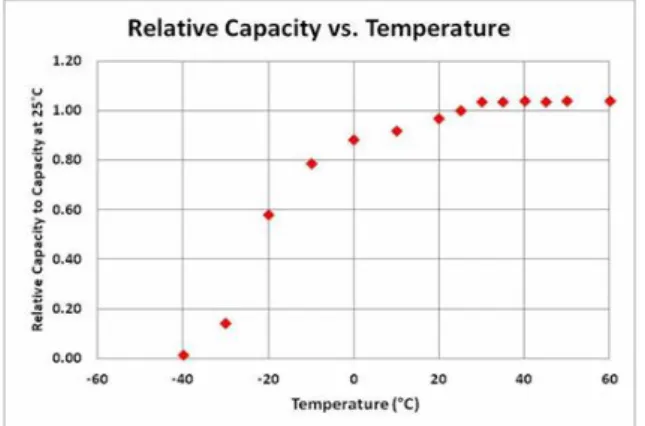
The capacity correction factors are estimated as below. The design margin df recommended by IEEE 485 is 10 to 15%. A lower capacity is expected for the low temperature thermal performance test (10°C), and a higher capacity is expected for the high temperature (45°C) due to the temperature-related kinetic and thermodynamic effects. For the exact tempertature correction factor, tfshould consult
with battery manufacturer and typical data in Fig. 4 may be used for preliminary input data [13]. Lithium-ion battery is degraded at above 35 ° C especially at beyond 50 ° C [14].
The SOC of the lithium-ion battery depends on the charging voltage. The stationary battery is operated with floating charging mode during normal operation. Discharge capacity of the lithium-ion battery is decided by the charging voltage just before starting discharge. Fig. 3 shows the example of discharge capacity curves which depends on charging voltage. The battery capacity will be monitored by conducting the performance test, normally it is done within the first two years of service for comparison purpose to check if the results are similar in duration to the battery duty cycle [15]. If the battery is replaced
when the discharge capacity of the battery reaches 80% of the manufacture’s rating, then the aging compensation factor is 25%.
4. Sample Calculation of Battery Capacity
4.1 Stationary batteries for nuclear power plants
Redundant DC 125V systems are installed for both safety and non-safety loads of the nuclar power plant. The 250 V DC systems are installed for non-safety large loads such as DC emergency motors for turbine and generator. However, calculation has been done for the medium voltage UPS DC batteries sizing, as an example instead of DC 125V or 250V system battery. That is because the capacity of proposed MV UPS battery is biggest in the nuclear power plants. Fig. 5 shows the 4.16 kV medium voltage UPS for the safety buses of an APR1400 NPP. It was proposed for the enhancement of reliability and safety of nuclear power plants [16]. The MV UPS is classified as non-safety related equipment and connected to safety related bus by isolation circuit breaker.
The operation duration of the 4.16kV UPS is limited to 15 minutes when the offsite and onsite power are lost at the same time. If the emergency diesel generator (EDG) fails to start, the UPS supplies power to the safety bus until the alternative AC (AAC) generator starts within 10 minutes after loss of offsite and onsite power. In addition to 10 minutes, interruption time of 5 minutes of safety margin is included. If the ACC fails to start, station blackout (SBO) countermeasures will be taken only by the DC power supply.
According to Table 4 required uncorrected battery capacity of Bus-01A(Fd-01A) and Bus-02A(Fd-02A) are as
below:
Fd-01A= 6.08 MW´15/60 hr = 1.52 MWh
Fd-02A= 2.49 MW´15/60 hr = 0.62MWh
and, capacity correction factor Sf is determined as follows:
Sf =(1+0.1:)´(1+0.05)´(1+0.10)´(1+0.25)´(1+0.005)
=1.596
where each correction factor was applied as below:
df;10% , tf; 5%, cf; 10%, af; 25% and i ; 0.5%
The design margin was decided as 10% because further extention of safety related loads is not highly expected.
Fig. 4. Relative capacity and temperature of lithium-ion
battery
Fig. 5. Class 1E 4.16 kV Buses of a APR1400 (Division I
only)
Table 4. Safety bus load capacity [MW]
Division 4.16 kV- 01A 4.16 kV – 02A During normal operation 4.62 1.19 Loss of coolant accident (LOCA) 6.08 2.49
Assuming that the HVAC system do not operate during the AC power loss, the ambient temperature of the batteries may go down below 25°C, so the temperature correction factor of 5% was applied (See Fig. 4). The SOC correction factor of 10% was applied to compensate the capacity reduction due to the floating charging voltage during normal operation being lower than cell maximum voltage. Rated voltage of the DC system is 777V±10%. In that case, battery cell voltage is 3.7V±10%. That means floating voltage is maximum 4.07 V and it is 97% of maximum cell voltage (4.2 V). As a result, battery discharge capacity reduction is minimum 10% [17]. The acceptence criteria of the battery aging test is 80% of rated capacity. Therefore aging compensation margin was decided as 25%. In an accerlerated aging test(60°C, 8.3 months), lithium-ion battery capacity was reduced to 87.03% [18]. In addition, 5% inverter loss was added based on manufacturer data. Required battery capacity of the bus Fs-01A and Fs-02A is as
below:
Fs-01A = 1.52´1.596 = 2.43 MWh
Fs-02A= 0.62´1.596 =0.99 MWh 4.2 Battery cell and system selection
The lithium-ion battery systems suitable for the above battery capacity are selected by referring to the ESS specification of a domestic company [19].
Battery system for Bus-01A : a) Battery Module
Capacity: 11,655 Wh
Cell Type: 150 Ah (75 Ah´2)
Nominal Voltage : 77.7 V (3.7 V´21) Connection Type : 21 Series´2 Parallels b) Battery Cubicle
Number of Modules : 10 Modules/Cubicle Connection Type : 10 Parallels
Cubicle Capacity : 1,500 Ah (150´10 Module) Dimension(W´D´H) : 1,150´740´2116 mm
The following factor was assumed c) Battery System Specification
Number of Cubicles: 20 Cubicles
System connection Type: 2P´10S Cubcles Capacity: 3,000 Ah (1,500 Ah´2 Cubicles) Energy: 2.33 MWh (3,000 Ah´777V) Nominal Voltage : 777 V
Foot Print: 17 m2 (0.85 m2´20 Cubicles)
d) Practical capacity correction factor : 2.33 MWh/ 1.52MWh=1.53.
Battery system for Bus-02A : a) Battery Module
Capacity: 11,655 Wh
Cell Type: 150 Ah (75 Ah´2)
Nominal Voltage : 77.7 V (3.7 V´21)
Connection Type : 21 Series´2 Parallels b) Battery Cubicle
Number of Modules : 10 Modules/Cubicle Connection Type : 10 Parallels
Cubicle Capacity : 1,500 Ah (150´10) Dimension(WxDxH) : 1,150´740´2116 mm
The following factor was assumed c) Battery System Specification
Number of Cubicles: 10 Cubicles System connection Type: 10S Cubcles Capacity: 1,500 Ah
Energy: 1.165 MWh (1,500 Ah´777V) Nominal Voltage : 777 V
Foot Print: 8.5 m2 (0.85 m2´10 Cubicles)
d) Practical capacity correction factor: 1.165MWh/0.62 MWh= 1.88.
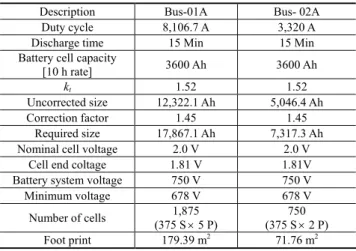
4.3 Equivalent lead-acid battery capacity and size
Selected a battery [20] qualified for nuclear power plant application and calculated estimated capacity and areas required for battery installation. Lead-acid battery capaciry sizing was performed in accordance of the equation (4) of IEEE 485. ( 1) 1 1 [ ] S N P s p p- t P S A A k = = = = =max
å
-F (4) whereF is uncorrected cell size;
S is the section f the duty cyclce being analyzed;
N is the number of periods in the duty cycle;
P is the period being analyzed;
Ap are the amperes required for period P;
t is the time in minutes from the beginning of period
P through the end of section S;
kt is the ratio of rated ampere-hour capacity of cell, to
the amperes that can be supplied by the cell for t minutes at 25°C and to a given minimum cell voltage.
Table 5. Equivalent lead-acid battery
Description Bus-01A Bus- 02A
Duty cycle 8,106.7 A 3,320 A
Discharge time 15 Min 15 Min
Battery cell capacity
[10 h rate] 3600 Ah 3600 Ah
kt 1.52 1.52
Uncorrected size 12,322.1 Ah 5,046.4 Ah
Correction factor 1.45 1.45
Required size 17,867.1 Ah 7,317.3 Ah Nominal cell voltage 2.0 V 2.0 V
Cell end coltage 1.81 V 1.81V
Battery system voltage 750 V 750 V
Minimum voltage 678 V 678 V
Number of cells (375 S´ 5 P)1,875 (375 S´ 2 P)750 Foot print 179.39 m2 71.76 m2
In this calculation analysis period(P) is one period because the load is UPS. The following is the ratings and calculated data of lead-acid battery system providing the same capacity with the above lithium-ion battery;
5. Results and Conclusions
This paper elaborated the charging and discharging characteristics of lithium-ion batteries and lead-acid batteries. Then, proposed the capacity sizing formula of stationary ion batteries. Unlike lead-acid batteries, lithium-ion batteries discharge capacity does not vary with the magnitude of discharge current, and state of charge (SOC) is decided by charging voltage. Therefore the capacity sizing formula of stationary lithium-ion batteries should be different from the sizing formula of lead-acid batteries recommended by IEEE 485.
The capacity and dimensions of the batteries for the medium voltage UPS of APR1400 have been calculated by the proposed method as shown above. For the comparison, calculated the lead-acid batteries capacity and dimensions also. The lead-acid batteries requires much more spaces than lithium-ion batteries. Foot prints of the lead-acid battery system for Bus-01A is 1,055% and Bus-02 is 842% of lithium-ion battery’s foot prints.
For the application of stationary lithium-ion batteries in the industrial plants, specially in the nuclear power plants, internationally approved industrial standard is essential. The formular proposed by this paper can be used for the establishment of new industrial standards or revision of existing industrial standard. On the other hand, all parameters required for the battery sizing calculations should be provided by manufacturers. For that reason, industrial standards related with the manufacturing and test of lithium-ion batteries also should be revised if required.
Acknowledgements
This research was supported by the Research Fund of the KEPCO International Nuclear Graduate School (KINGS).
References
[1] Kiyomoto Kawakami, “Development of large, highly safe, high performance lithium-ion batteries for stationary use to support a smart society,” Nature
Technology Forum, Sept. 24, 2013.
[2] Types of Lithium-ion, Battery University,
http://batteryuniversity.com/learn/article/types_of_lit hium_ion
[3] 12V 12Ah Deep Cycle Sealed Lead-acid Battery with F2 Terminals, Discharge Characteristic Curve,
https://www.upsbatterycenter.com/12v-12ah-deep-cycle-sealed-lead-acid-battery-with-f2-terminals [4] BU-501a: Discharge Characteristics of Li-ion Batteries
http://batteryuniversity.com/learn/article/discharge_c haracteristics_li
[5] Charging at High and Low Temperature,
http://batteryuniversity.com/learn/article/charging_at _high_and_low_temperatures
[6] M. Coleman, C. K. Lee, C. Zhu, and W. G. Hurley, “Stateof-charge determination from EMF voltage estimation: using impedance, terminal voltage, and current for lead-acid and lithium-ion batteries,” IEEE Transactions on Industrial Electronics, vol. 54, no. 5, pp. 2550-2557, 2007.
[7] How does capacity correlate with charge voltage for lithium ion batteries? http://www.powerstream.com/ lithium-ion-charge-voltage.htm
[8] IEEE std 946, IEEE Recommended Practice for the Design of DC Auxiliary Power Systems for Generating Stations, Section 4.2.
[9] IEEE std.384, IEEE Standard Criteria for Inde-pendence of Class 1E Equipment and Circuits. [10] Regulatory Guide 1.75, Physical Independence of
Electric Systems, Revision 2, Sept. 01, 1978.
[11] IEEE std.485, IEEE Recommended Practice for Sizing Lead-acid batteries for Stationary Applications [12] KEPIC, EEG 1400, Installation Design and Instal-lation of Lithium-ion Batteries for Stationary Applications, Dec. 31, 2017.
[13] Ahmad Pesaran, Shriram Santhanagopalan, Gi-Heon Kim, “Addressing the Impact of Temperature Extremes on Large Format Li-Ion Batteries for Vechicle Applications,” 30th International Battery Seminar,
March 11~14, 2013.
[14] Todd M. Bandhouse, Srinivas Garimella, and Tohams F. Fuller, “A Critical Review of the Thermal Issues in Lithium-Ion Batteries,” Jornual of The
Electro-chemical Society, vol. 158, no. 3, R1-R25(2011) .
[15] IEEE Std.450, IEEE Recommended Practice for Maintenance, Testing, and Replacement of Vented Lead-Acid Batteries for Stationary Applications, Section 5.2 - Section 7.
[16] Choong-koo Chang, “A new MV bus Transfer scheme for nuclear power plants,” EPJ Nuclear Science and
Technology., vol. 1, no. 12(2015).
[17] BU-808: How to Prolong Lithium-based Batteries, http://batteryuniversity.com/learn/article/how_to_pri me_batteries
[18] Yoo Jong-geul, Lithium-ion Battery Test and Analysis for the Development of Technical Standard for Nuclear Power Plant Use, Korea Testing Laboratory, Nov. 04, 2016.
[19] Kokam Battery Module KBM Series ‘KBM2P17S [20] EnerSys, PowerSafe GN battery specification,
Choong-koo Chang He received M.S.
in Electrical Engineering from Inha University in 1990, and Ph. D degree in Electrical Engineering from Myongji University in 2001. He participated in Younggwang NPP 3&4 and Ulchin NPP 3&4 design project as an electrical system engineer from 1985 to 1993 at KOPEC. From 1993 to 1998 he worked as a senior engineer for the plant control, and automation business team of Samsung Electronics. As an Executive Vice President and CTO at Sangjin Engineering from 2001 to 2012, he designed the electric power systems for nuclear power plants, thermal power plants, and combined cycle power plants. Since 2013, he serves as a professor in the NPP Engineering Department of KEPCO International Nuclear Graduate School (KINGS). His research interests are planning, design, and operation of the electric power systems for power plants
Mumuni Sulley Has a BSc. in
Electrical/Electronic Engineering from George Grant University of Mines and Technology in 2009. He worked as the electrical coordinator on the Kpone Thermal Power Project in Ghana from 2012 to 2016. Since 2017, he is a student of KEPCO International Nuclear Graduate School majoring in Engineering Design for Nuclear Process and Electrical Systems.