Abstract
BACKGROUND: Globally, large amounts of phosphogypsum (PG), which is a by-product of the phosphate fertilizer production, is deposited in open areas. As PG contains calcium, phosphate, and sulphate, it can be used as a soil amendment in farmlands. This study was conducted to investigate the effects of PG application on properties of field soil and yield and quality of garlic (Allium sativum L.), and to seek appropriate level of PG application into the field.
METHODS AND RESULTS: This experiment was conducted by applying PG at four different levels that were adjusted based on 65% calcium base saturation in the field soil: 0% (control), 50% (PG50, 100 kg/10a), 100% (PG100, 200 kg/10a), and 150% (PG150, 300 kg/10a). Following cultivation, soil electrical conductivity (EC), organic matter, available P and exchangeable Ca increased, whilst soil pH decreased. With increase in PG application level, soil EC and exchangeable Ca increased. PG application increased
concentrations of water soluble Ca and SO4 across the soil profile, especially in PG150. The highest yield of garlic was found in PG100 treatment. The plant’s uptake for N, P, Ca, and S increased by PG applications, but that for K decreased. Moreover, concentrations of S-related amino acids such as cysteine and methionine in garlic increased by PG applications. The increased content of nutrients and amino acids with PG supply might improve yield, quality, and favor of the crop.
CONCLUSION: Overall, PG application at 200 kg/10a into a field had the best effect on improving soil fertility as well as yield and quality of garlic. Further studies are required to maximize efficiencies of PG supply in soil management and production of various crops.
Key words: Amino Acids, Garlic Production, Phosphogypsum, Soil fertility, Sulphur
서 론
인산석고(Phosphogypsum, PG)는 인광석을 물과 황산 으로 반응시켜 인산을 제조하는 과정에서 만들어지는 부산물 로서, 다음과 같은 습식공정방식(wet acid method)에 따라 생성된다[1]: Ca5F(PO4)3 + 5H2SO4 + 10H2O → 3H3PO4 + †
These two authors contributed equally to this work. *Corresponding author: Yong Bok Lee
Phone: +82-55-772-1967; Fax: +82-55-772-1969; E-mail: [email protected]
Korean J Environ Agric. 2021;40(1):33-39. Korean Online ISSN: 2233-4173
Published online 2021 March 19. https://doi.org/10.5338/KJEA.2021.40.1.4 Print ISSN: 1225-3537
부산석고 시용에 의한 밭 토양 특성과 마늘의 수량 및 품질에 미치는 영향
김영남
1†, 조주영
2†, 윤영은
2, 최현지
2, 정미선
1, 이미나
3, 김권래
3, 이용복
1,2*1경상국립대학교 농업생명과학연구원(IALS), 2경상국립대학교 응용생명과학부(BK21 Four), 3경상국립대학교 스마트농산업학과
Effects of Phosphogypsum Application on Field Soil Properties and Yield and Quality
of Garlic (Allium sativum L.)
Young-Nam Kim1†, Ju Young Cho2†, Young-Eun Yoon2, Hyoen Ji Choe2, Mi Sun Cheong1, Mina Lee3, Kwon-Rae Kim3 and Yong Bok Lee1,2* (1Institute of Agriculture and Life Science (IALS), Gyeongsang National University, Jinju 52828, Korea, 2Division of Applied Life Science (BK21 Four), Gyeongsang National University, Jinju 52828, Korea, 3Department of Smart Agro-Industry, Gyeongsang National University, Jinju 52725, Korea)
Received: 2 March 2021/ Revised: 7 March 2021/ Accepted: 12 March 2021 Copyright ⓒ 2021 The Korean Society of Environmental Agriculture
This is an Open-Access article distributed under the terms of the Creative Commons Attribution Non-Commercial License (http://creativecommons.org/licenses/by-nc/3.0) which permits unrestricted non-commercial use, distribution, and reproduction in any medium, provided the original work is properly cited.
ORCID Yong Bok Lee
https://orcid.org/0000-0002-7651-4556
33
5CaSO4⋅2H2O + HF. 현재 생산되고 있는 인산의 90% 이 상은 이러한 공정을 통해 만들어지고 있으며, 인산 1톤을 생 성시 4-6톤의 부산석고가 발생한다[1, 2]. 이러한 인산 부산석 고는 전 세계적으로 매년 1-2.8 억 톤이 발생하고 있으며, 대 부분이 슬러리 형태로 매립되고 있다[2]. IAEA (2008)의 보 고에 따르면, 미국 플로리다를 포함한 50개 이상의 대규모 부 산석고 야적장이 전 세계적에 존재하며, 우리나라의 경우 남 해화학 부지에 약 2천만 톤 이상이 적치되어 있다. 부산석고는 주로 이수석고(CaSO4⋅2H2O)로 구성되어 있으며 인, 불소, 유기물 등이 포함되어 있다[2, 3]. 매립장에 방치되어진 부산석고는 도로건설 및 건축 자재 등 다양한 산 업분야의 원료로서 재활용되어져 왔다. 그리고 부산석고는 식 물의 필수 영양소인 칼슘, 인, 황 등을 포함하고 있기 때문에 토양 개량제로서의 활용 가치를 높게 평가받고 있다[4, 5]. 지 난 수십년 간의 해외 선행연구를 통해 토양 양분 및 작물 생 산량 증가[6-8], 토양 물리성 개선[5], 염분 정화[9, 10], 그리 고 산성토양의 알루미늄 독성완화[11, 12] 등 토양 개량 측면 에서 부석석고 활용의 긍정적인 효과가 많이 보고되었다. 우리나라에서는 2003년 이후 부산석고를 비료공정규격에 토양개량제로 등록하여 비료로서 재활용하고 있다[5]. 하지만 국내 농업분야에서의 부산석고 재활용에 대한 연구수준은 소 수의 연구를 통해 간척지 토양의 물리성 및 염도 개선, 산성 심토 개량 효과를 확인한 정도로 매우 낮은 실정이다[5, 13]. 따라서, 농업분야에서의 부산석고 활용가치을 널리 알리고 현 장 보급 활성화를 위해서는 부산석고 시용이 농경지 토양의 질과 작물 생산성에 미치는 영향을 구체적으로 구명하여 과 학적인 근거를 마련할 필요가 있다고 사료된다. 본 연구는 부 산석고 시용이 밭 토양 이화학성과 마늘의 수량 및 품질에 미 치는 영향을 알아보고, 부산석고의 적정 시비수준을 찾기 위 해 수행하였다.
재료 및 방법
현장 재배시험 본 연구에서는 경상남도 남해군 금평면에 위치한 마늘 재 배지(약 840 m2)를 시험포장지로 선정하였다. 2019년 10월 13일 부산석고를 시용한 후 로타리 작업을 실시하였고, 동년 10월 20일 20 cm x 10 cm 간격으로 마늘을 파종하였다. 마 늘 재배시 경종방법은 관행으로 실시하였으며, 이듬해인 2020 년 5월 18일 마늘을 수확하였다. 부산석고 처리구는 총 네 가지로 구성하였다: PG0(대조 구), PG50, PG100 및 PG150. 각 부산석고 처리구의 시비량은 대상 농경지 토양의 칼슘 포화도 65%를 기준으로, 이의 50% (PG50; 100 kg/10a), 100%(PG100; 200 kg/10a), 150% (PG150; 300 kg/ha)에 해당되는 양을 산출하였다. 재배 시험 포장지 중 모든 부산석고 처리구는 완전무선설계(randomized complete block design, RCBD)에 따라 배치하였으며, 처 리구 당 3반복을 설치하였다. 무기질 비료 시비량은 마늘 재 배지 토양 특성(Table 1)을 토대로 흙토람의 비료사용처방 프로그램을 이용하여 산출하였고, 대조구를 포함한 모든 처리 구 토양에 비료 3요소(N-P-K=9.0-7.7-4.5 kg/10a)를 균일하 게 시비하였다. 토양 채취 및 특성 분석 토양 이화학적 특성을 분석하기 위해 10 cm 깊이의 표토 를 부산석고 시용 전과 마늘 수확 후 채취하였다. 채취한 토 양은 풍건조 후, pH, EC, 유기물(organic matter, OM), 유 효인산(Av. P2O5) 및 교환성 K, Ca, Mg 농도를 측정하였다.경시적 토양 pH와 EC 변화를 조사하기 위해 부산석고 시용 후 8, 12, 16, 20, 24주 차에 토양을 채취하였다. 또한, 부산 석고 시용에 따른 토양 단면(soil profile) 중 칼슘(Ca) 및 황 (SO4)의 분포를 조사하기 위해 10 cm 간격으로 최대 70 cm
깊이의 토양을 채취하였다. 토양 pH와 EC는 토양과 증류수 (1:5=w/v)를 진탕한 후 각각 pH meter (Orion Star 2-Star, Thermo Scientific, USA)와 EC meter (Orion 3-Star, Thermo Scientific, USA)로 측정하였다. 토양 유기물은 Tyurin법[14] 으로 분석하였고, 유효인산(Av. P2O5)은 Lancaster법에 따라
침출하여 720 nm에서 UV/Vis 분광광도계(Varian CARY 50 CONC, USA)로 측정하였다. 양이온 교환용량(Cation exchange capacity, CEC)과 교환성 양이온(Ex. K, Ca, Mg) 은 1N NH4OAc (pH 7.0) 용액으로 침출하여, 각각 Kjedahl
(K-355, BÜCHI, Switzerland)과 ICP-OES (OPTIMA 5300DV, PerkinElmer, USA)으로 분석하였다. 수용성 Ca 과 SO4은 풍건조된 토양을 증류수(1:5=w/v)로 침출하여 각 각 ICP-OES (OPTIMA 5300DV, PerkinElmer, USA)와 IC (DIONEX AQUION, Thermo Scientific, USA)으로 분석하였다. 식물체 채취 및 특성 분석 마늘 수확량은 농촌진흥청 표준분석법에 따라 구중을 생 체중으로 측정하였다. 마늘 가식부 중 양분함량 분석은 3일 이상 60℃ 조건의 오븐에서 건조한 후, 분쇄하여 HNO3 습 식분해를 하였다. 그 후 분해용액 중 질소와 인 농도를 각각 Kjedahl법과 Vanadate법으로 분석하였다. 식물체 중 K, Ca, Mg 및 S 농도는 ICP-OES (OPTIMA 5300DV, PerkinElmer, USA)를 이용하여 측정하였다. pH EC (dS/m) OM (g/kg) Av. P2O5 (mg/kg)
CEC K Ca Mg Sand Silt Clay
Texture --- (cmolc/kg) --- (%)
---6.4 0.12 30 46.3 15.0 0.4 8.5 0.8 42.7 38.7 19.6 Loam Table 1. Physicochemical properties of soil in a field used in this study (n= 3)
마늘 가식부 중 유리 아미노산(free amino acids) 농도는 다음과 같이 분석하였다[15]. 식물체 시료 0.1 g을 100 mL 의 3% sulfosalicylic acid에 첨가하여 1시간 진탕한 후, 3,500 rpm의 조건(4℃)에서 1시간 원심분리를 하였다. 위의 추출과정을 세 번 반복한 후, 모든 추출액을 모아 0.45 µm syringe filter로 필터링하였다. 추출시료의 10 µL를 이용하여 inhydrin method에 따라 Ionex Ostion LCP5020 cation exchange column (22 x 0.37 cm)이 장착된 L-8900 high- speed amino acid analyzer (Hitachi High-Tech. Corp., Japan)에 주입하여 유기 아미노산을 정성⋅정량 하였다. 본 연구에서는 식물체 중 총 아미노산(Total amino acids) 함 량은 36가지의 유기 아미노산 함량을 측정하여 산출하였고, 이 중 황과 관련된 아미노산인 시스테인(cysteine)과 메티오 닌(methionine) 함량은 별도 정량하였다.
통계 분석
모든 분석 데이터는 Minitab16 (Minitab Inc., USA)을 이용하여 통계분석을 하였다. 본 연구에서는 부산석고 시용 유무 및 처리구간의 토양 및 식물체 특성 차이를 비교하기 위 해 일원분산분석(One-way ANOVA) 및 사후분석(Fisher’s LSD, p< 0.05)을 실시하였다.
결과 및 고찰
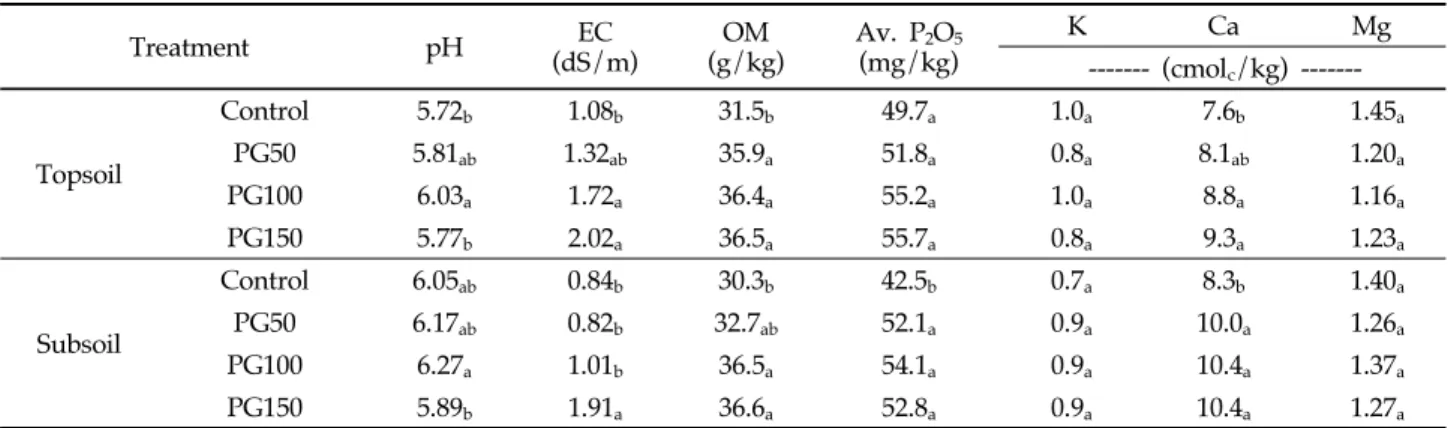
수확 후 토양 특성 변화 마늘 재배 전과 수확 후 토양 특성을 비교한 결과(Table 2 cf. Table 1), 다양한 토양 특성 인자에서 큰 차이가 있었다. 토양 pH는 감소한 반면 EC, 유기물, 유효인산, 교환성 칼륨 과 마그네슘은 증가하였다. 게다가 이들 토양 인자는 부산석 고 시용 및 시용수준에 따라 차이를 보였다(Table 2). 토양 EC, 유기물, 유효인산 및 교환성 칼슘의 경우, 부산석고 시용 수준이 높을수록 이들의 값은 더 증가하는 경향을 보였다. 특 히, PG150 처리구의 토양 EC, 유기물 및 교환성 칼슘 은 대 조구에 비해 유의적으로 상당히 높았다(p< 0.05). 반면 토양 pH는 PG100 처리수준까지 그 값이 증가하다가 PG150에서 는 대조구와 비슷한 수준으로 감소하였다. 이는 다른 처리구 에 비해 많은 양이 처리된 PG150에서 상대적으로 많은 SO42-이온이 용해되어 토양 산성화에 직접적으로 영향을 미 친 것으로 보이며, 또한 부산석고에서 용해된 Ca2+ 이온과 토 양 입자 중 H+간 치환 작용의 활성화로 인해 토양 용액 중 수소이온 활성도가 증가하여 토양 pH에 간접적으로 영향을 미친 것으로 판단된다[16]. 이러한 부산석고 시용에 따른 표 토 중 토양 특성 변화는 심토에서도 유사하게 나타났으며, 이 는 경작지 토양의 심토 개량에 있어 부산석고의 활용 효과를 보여주는 결과이다. 토양 pH 및 EC의 경시적 변화 마늘 재배기간 중 밭 토양 pH와 EC 값의 변동은 Fig. 1 에서 보여주는 것과 같다. 토양 pH는 재배기간 중 처리구간 의 유의적인 차이는 보이지 않았지만(p< 0.05), 서로 다른 변 동 경향을 보였다(Fig. 1A). 마늘 재배시험 8주차때에 대조구 를 제외한 모든 처리구의 토양 pH는 6.0 이하였고, 이는 토 양 첨가물로서 처리한 부산석고에 의해 경작 초기에 토양 산 성화가 진행되었을 보여주었다. 재배기간 16주차 후, 대조구 토양 pH는 급격히 감소하였지만, PG50 및 PG150 처리구 토양 pH는 큰 변화없이 pH 5.69-5.85 사이를 유지하였고 두 처리구간의 유의적인 차이는 없었다(p< 0.05). 반면, PG100 처리구 토양 pH는 동일 기간 동안 5.9에서 6.2로 증가하였다 (Fig. 1A). 이 결과로 볼 때, 본 연구에서는 PG100 처리구의 부산석고 시용량(200 kg/10a)이 밭토양의 산성도 관리 측면 에서 적절한 것으로 사료된다. 토양 pH와 달리, 토양 EC는 무기질 비료와 부산석고 시 용으로 인해 8주차에 급격히 증가하였고, 그 이후 모든 처리 구에서 동일하게 감소하는 경향을 보였다(Fig. 1B). 특히 부 산석고 시용 수준이 높을수록 EC값은 더 높았으며, 24주차에 는 모든 처리구에서 마늘재배 적정범위인 2.0 dS/m 이하 수 준을 보였다. 이와 같이, 마늘 재배 초기 부산석고 시용에 따 른 토양 EC 증가는 강우와 부산석고 반응 작용에 의해 토양 용액 중 Ca, SO4, F, Na 및 Cl 이온이 증가함에 따라 발생한 것으로 사료된다[2, 3, 17]. 따라서, 재배기간 초기 부산석고 Treatment pH (dS/m)EC (g/kg)OM Av. P(mg/kg)2O5 K Ca Mg --- (cmolc/kg) ---Topsoil Control 5.72b 1.08b 31.5b 49.7a 1.0a 7.6b 1.45a PG50 5.81ab 1.32ab 35.9a 51.8a 0.8a 8.1ab 1.20a PG100 6.03a 1.72a 36.4a 55.2a 1.0a 8.8a 1.16a PG150 5.77b 2.02a 36.5a 55.7a 0.8a 9.3a 1.23a Subsoil Control 6.05ab 0.84b 30.3b 42.5b 0.7a 8.3b 1.40a PG50 6.17ab 0.82b 32.7ab 52.1a 0.9a 10.0a 1.26a PG100 6.27a 1.01b 36.5a 54.1a 0.9a 10.4a 1.37a PG150 5.89b 1.91a 36.6a 52.8a 0.9a 10.4a 1.27aTable 2. Properties of top- and sub-soil in a field following garlic cultivation. Same letters in each column indicate no significant difference among treatments (n= 3, p< 0.05)
Fig. 1. Temporal change in pH (A) and EC (B) of soil with different soil amendments during 7 months. Data indicate mean ± standard deviations (n= 3).
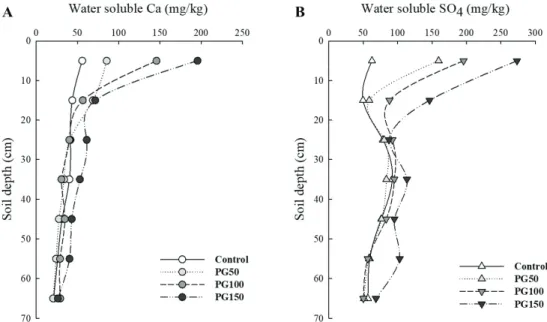
Fig. 2. Concentrations of water soluble Ca (A) and SO4 (B) across the soil profile following
garlic cultivation. 시용에 따른 염 피해를 방지하기 위해서는 재배지 토양 염 조 건을 고려하여, 시용 전 부산석고의 안정화 과정을 거치는 등 공급 방법과 시기에 대한 적절한 처리방안이 필요하다고 판 단된다. 칼슘과 황의 수직 이동 토양 단면의 깊이별 수용성 칼슘 및 황 농도를 조사한 결 과는 다음 Fig. 2와 같다. 전반적으로 수용성 칼슘과 황 농도 는 토심이 깊을수록 낮았다. 특히, 부산석고 시용에 의한 두 수용성 이온농도의 증가효과는 10cm 깊이에서 가장 두드러 졌으며, 처리구간 농도차이가 가장 크게 나타났다. 하지만 토 심이 깊어 질수록 처리구간 농도 차이는 감소하였다. 공통적 으로 20 cm 깊이까지 부산석고에 의한 토양 중 수용성 칼슘 및 황의 증가효과가 보였지만, 30 cm 아래 깊이에서는 PG150을 제외한 모든 처리구에서 대조구와 두 이온 농도 차 이가 없었다(Fig. 2). 일반적으로 이온의 용해도, 토성과 관련 된 배수등급, 그리고 강우량은 수용성 이온의 수직 하향 이동 에 큰 영향을 준다. 본 연구결과에 따르면, PG150 처리구에 서 가장 높은 칼슘 및 황의 수직이동율(최대 60 cm 깊이)을 관찰할 수 있었으며, 이는 고농도 부산석고 시비에 의해 증가 된 두 이온의 용해도 때문인 것으로 사료된다. 특히, 부산석 고 처리구에서 높은 칼슘의 수직 이동성은 심토 개량에 한계 가 있는 석회보다 부산석고의 높은 활용 가치를 보여준다[8]. 마늘 작물의 수량 변화 부산석고 시용에 따른 마늘 수확량 차이는 Fig. 3에서 보
Control PG50 PG100 PG150
Y
ie
ld (
ton/
10a
, F
W
)
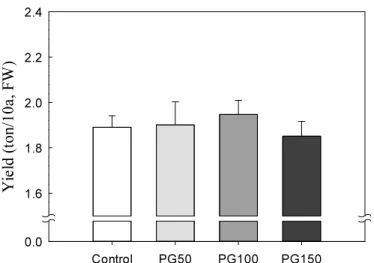
0.0 1.6 1.8 2.0 2.2 2.4Fig. 3. Yield of garlic in a field soil treated with different soil amendments. Data indicate mean ± standard deviations (n=3).
Treatment Nutrient content (g/kg)
N P S K Ca Mg
Control 21.5c 10.1a 4.16c 11.3a 0.13b 0.47b
PG50 22.4b 10.4a 4.73b 11.5a 0.24a 0.52a
PG100 23.3a 10.5a 4.59b 10.5a 0.25a 0.48b
PG150 23.3a 10.8a 4.94a 10.6a 0.24a 0.49b
Table 3. Nutrient content in eatable part of garlic treated with different amendments. Same letters in each column represent no significant difference among treatments (n= 3, p< 0.05)
여주는 바와 같다. 가장 많은 마늘 수확량을 보인 처리구는 PG100으로 1.95 ton/10a 이였고, 이는 대조구에 비해 수확 량이 0.06 ton/10a가 많았다. 반면에 가장 높은 수준의 부산 석고 처리구인 PG150에서는 대조구에 비해 0.04 ton/10a가 적었다. 이는 높은 수준의 부산석고 처리에 의해 재배기간 초 기 토양 EC가 3.2 dS/m까지 증가하여 생육초기 단계의 마 늘에 염 피해가 유발되었고, 이후 수확량에 악영향을 미친 것 으로 사료된다. 이와 유사한 연구결과로 토마토 재배시험을 통해서 보고된 바 있다[16]. 이 저자들은 고농도로 처리된 부 산석고가 작물의 칼륨 흡수에 장애가 발생시킬 뿐만 아니라 부산석고의 구성 성분인 중금속 등의 유해물질 독성 피해로 인해 작물의 생육과 생산량이 감소되는 것으로 설명하였다 [16]. 따라서, 본 연구에서는 마늘의 수확량 증진 측면을 고려 하였을 때 200 kg/10a의 부산석고 처리수준이 적합하다고 사료된다. 마늘 중 영양분과 아미노산 함량 변화 부산석고 시용에 의한 마늘 중 양분 함량 차이는 Table 3 에서 보는 바와 같다. 대조구와 비교하였을 때, 부산석고 처 리구의 마늘 중 질소, 황 및 칼슘 함량은 상당히 높았지만(p< 0.05), 인, 칼륨 및 마그네슘은 큰 차이가 없었다. 이 중 황의 함량은 부산석고 시용수준에 비례적으로 증가하였고, PG150 처리구에서 가장 높은 함량(4.94 g/kg)을 보였다(Table 3). 황은 마늘의 양분 흡수 및 생산량 뿐만 아니라 마늘 중 아미 노산(e.g. cysteine, methionine etc.), 단백질 및 2차 대사 물(e.g. allin, cycloallin, thiopropanol etc.) 생성에 중요한 역할을 하며, 마늘의 맛과 품질을 결정하는 주요 양분 요인이 다[18, 19]. 마늘 중 아미노산 함량 분석결과에 따르면, 부산석고 시용 에 의한 총 아미노산 함량 차이는 없었지만(Fig. 4A), 식물체 내 황과 밀접하게 관련된 시스테인 및 메티오닌 아미노산 함 량에는 증가효과가 발견되었다(Fig. 4B). 특히, 본 연구에서 는 PG100 처리구에서 재배된 마늘에서 가장 많은 두 아미노 산 함량(286 mg/100g)이 측정되었는데, 이는 마늘의 맛과 품질 향상 측면에서 PG100의 부산석고 시용량이 가장 효율 성이 높을 것으로 판단된다. 황과 달리, 질소와 칼슘 함량은 부산석고 시용수준 증가에 따른 두 양분의 이용률 증가는 없었다(Table 3). 반면 칼륨의 경우, PG100과 PG150에서의 마늘 중 함량이 대조구에서 보 다 낮았으며, 이는 앞에서 설명한 고농도 부산석고 시용에 따 른 작물의 칼슘부족 현상과 연관성이 높은 것으로 판단된다 [16]. 칼륨은 광합성, 기공 조절, 병해충에 대한 저항성 등 식 물의 대사작용에 있어서 중요한 역할을 한다[18, 20]. 또한, 마늘 경작 시 칼륨 시비는 결구의 수량 증가와 색상 및 광택
Fig. 4. Contents of total amino acid (A) and S-related amino acids including cysteine and methionine (B) in eatable part of garlic cultivated in soil treated with different soil amendments. Data indicate mean ± standard deviations (n= 3).
등 마늘의 품질 향상을 위해 중요하다[18]. 본 연구에서는 토 양 중 칼륨의 농도는 부산석고 시용에 의한 영향을 받지 않았 으나(Table 2), 마늘 중 칼륨 함량에는 악영향을 미치는 것으 로 나타났다(Table 3). 따라서 PG150 처리구와 같이 고농도 부산석고 시용으로 인해 마늘의 칼륨 이용률이 감소하며, 이 로 인해 마늘의 수확량 및 품질에 악영향을 미칠 수 있을 것 으로 판단된다[16]. 따라서, 농경지에서의 토양 개량제로서 효율적으로 부산석고를 활용하기 위해서는 경작지 토양 특성 뿐만 아니라 작물의 양분 흡수력 등을 고려하여 부족한 양분 의 추가적인 시비가 필요할 것으로 사료된다.
결 론
본 재배시험 연구결과는 마늘 경작 시 부산석고가 토양 개 량제로서의 활용가치가 있음을 보여 주었다. 부산석고 시용은 토양 중 EC, 유기물, 유효인산 및 교환성 칼슘 농도를 증가시 켰다. 하지만 부산석고 시용 후 급격히 증가한 토양 EC는 마 늘의 초기 생육 단계에서 염 피해가 발생할 수 있음을 보여주 었고, 이를 예방하기 위해 적절한 부산석고 시용 수준이 고려 되어 져야 할 것으로 사료된다. 가장 많은 마늘 수확량은 200 kg PG/10a가 처리된 PG100에서 나타났으며, 이보다 높은 부산석고 처리수준인 PG150에서는 오히려 마늘 수확량이 감 소되었다. 마늘의 양분 이용률을 분석해 볼 때, 부산석고 시 용에 의해 질소, 인, 황, 칼슘 이용률은 증가되었으나 칼륨 이 용률은 감소하였다. 마늘 품질과 관련된 황 함유 아미노산인 시스테인과 메티오닌 함량은 PG100 처리구에서 생산된 마늘 에서 가장 많았다. 본 연구결과를 종합적으로 볼 때, 마늘 재 배에 있어서 수확량 증진 및 품질 향상 측면에서 가장 적합한 부산석고 시용수준은 200 kg PG/10a 이였다. 앞으로 농업 분야에서 다양한 작물을 대상으로 부산석고를 활용하기 위해 서는 많은 연구가 필요하다. 특히 토양 개량 및 작물 생산성 향상 측면에서 부산석고 시비의 효율성을 높이기 위해, 대상 작물의 특성은 물론 경작지 토양의 특성 등 종합적으로 고려 하여 최적의 부산석고 활용방안을 모색할 필요가 있다고 판 단된다.Note
The authors declare no conflict of interest.
Acknowledgement
This work was supported by the Namhae Chemical Corporation.
References
1. Tayibi H, Choura M, López FA, Alguacil FJ, López- Delgado A (2009) Environmental impact and management of phosphogypsum. Journal of Environmental Management, 90, 2377-2386.
https://doi:10.1016/j.jenvman.2009.03.007.
2. Saadaoui E, Ghazel N, Romdhane CB, Massoudi N (2017) Phosphogypsum: potential uses and problems – a review. International Journal of Environmental Studies, 74, 558-567.
https://doi.org/10.1080/00207233.2017.1330582.
3. Elloumi N, Zouari M, Chaari L, Abdallah FB, Woodward S, Kallel M (2015) Effect of phosphogypsum on growth, physiology, and the antioxidative defense system in sunflower seedlings. Environmental Science and Pollution Research, 22, 14829-14840.
https://doi.org/10.1007/s11356-015-4716-z.
Gonçalves F, Römbke J, Pereira R (2015) Phosphogypsum as a soil fertilizer: Ecotoxicity of amended soil and elutriates to bacteria, invertebrates, algae and plants. Journal of Hazardous Materials, 294, 80-89.
https://doi.org/10.1016/j.jhazmat.2015.03.034.
5. Park BK (2004) Agricultural use of phosphogypsum fertilizer. Soil Fertilizer, 19, 18-27.
6. Li J, Wu HS, Gao ZQ, Shang XX, Zheng PH, Yin J, Kakpa D, Ren QQ, Faustin OK et al. (2015) Impact of phosphogypsum wastes on the wheat growth and CO2
emissions and evaluation of economic-environmental benefit. Huan Jing Ke Xue, 36, 3099–3105.
7. Liu M, Liang Z, Ma H, Huang L, Wang M (2010) Responses of rice (Oryza sativa L.) growth and yield to phosphogypsum amendment in saline-sodic soils of North-East China. Journal of Food Agriculture & Environment, 8(2), 827–833.
8. Blum SC, Caires EF, Alleoni LRF (2013) Lime and phosphogypsum application and sulfate retention in subtropical soils under no-till system. Journal of Soil Science and Plant Nutrition, 13, 279-300.
https://doi.org /10.4067/S0718-95162013005000024. 9. Gharaibeh MA, Rusan MJ, Eltaif NI, Shunnar OF
(2014) Reclamation of highly calcareous saline-sodic soil using low quality water and phosphogypsum. Applied Water Science, 4, 223-230.
https://doi.org/10.1007/s13201-014-0189-3.
10. Nayak AK, Mishra VK, Sharma DK, Jha SK, Singh CS, Shahabuddin M, Shahid M (2013) Efficiency of phosphogypsum and mined gypsum in reclamation and productivity of rice-wheat cropping system in sodic soil. Communications in Soil Science and Plant Analysis, 44, 909-921.
https://doi.org/10.1080/00103624.2012.747601. 11. Carvalho MCS, Van Raij B (1997) Calcium sulphate,
phosphogypsum and calcium carbonate in the amelioration of acid subsoils for root growth. Plant and Soil, 192, 37-48.
https://doi.org/10.1023/A:1004285113189.
12. Garrido F, Illera V, Vizcayno C, García‐González MT (2003) Evaluation of industrial by‐products as soil acidity amendments: chemical and mineralogical implications. European Journal of Soil Science, 54, 411-422. https://doi.org/10.1046/j.1365-2389.2003.00522.x.
13. Sohn BK, Lee DJ, Park BK, Chae KS (2007) Effects of phospho-gypsum fertilizer as reclamation material in the newly reclaimed paddy fields. Korean Journal of Soil Science and Fertilizer, 40, 145-150.
14. Nelson DW, Sommers LE (1996) Total carbon, organic carbon, and organic matter. pp. 961-1010, Soil Science Society of America and American Society of Agronomy, USA.
https://doi.org/10.2136/sssabookser5.3.c34.
15. Yoon YE, Kuppusamy S, Cho KM, Kim PJ, Kwack YB, Lee YB (2017) Influence of cold stress on contents soluble sugars, vitamin C and free amino acids including gamma-aminobutyric acid (GABA) in spinach (Spinacia oleracea). Food Chemistry, 215, 185-192.
https://doi.org/10.1016/j.foodchem.2016.07.167. 16. Smaoui-Jardak M, Kriaa W, Maalej M, Zouari M,
Kamoun L, Trabelsi W, Abdallah FB, Elloumi N (2017) Effect of the phosphogypsum amendment of saline and agricultural soils on growth, productivity and antioxidant enzyme activities of tomato (Solanum lycopersicum L.). Ecotoxicology, 26, 1089-1104. https://doi.org/10.1007/s10646-017-1836-x.
17. Amor RB, Gueddari M (2016) Major ion geochemistry of Ghannouch–Gabes coastline (at Southeast Tunisia, Mediterranean Sea): study of the impact of phosphogypsum discharges by geochemical modeling and statistical analysis. Environmental Earth Science, 75, 851. https://doi.org/10.1007/s12665-016-5666-6.
18. Magray MM, Chattoo MA, Narayan S, Mir SA (2017) Influence of sulphur and potassium applications on yield, uptake & economics of production of garlic. International Journal of Pure & Applied Bioscience, 5, 924-934. https://doi.org/10.18782/2320-7051.5095. 19. Majumdar B, Venkatesh MS, Kumar K, Patiram J. (2003)
Response of garlic (Allium sativum L.) to phosphorous and sulphur application in acid alfisol of Meghalaya. Jounrnal of Species and Aromatic Crops, 12, 183-186. 20. El-Morsy AE, El-Kasas AI, El-Tantawy AM (2016)
Onion plant growth and yield as affected by nitrogen, potassium and sulphur combinations under el-arish region conditions. Sinai Journal of Applied Science, 5, 345-362.