https://doi.org/10.7585/kjps.2017.21.1.62 Open Access
62
생산단계 잔류허용기준설정을 위한 Flubendiamide 및 Pyriofenone의
딸기(Fragaria ananassa Duch.) 중 경시적 잔류특성 연구
김희곤·김지윤·허경진·권찬혁1·허장현*
강원대학교 농업생명과학대학 환경융합학부, 강원대학교 친환경농산물안전성센터, 1식품의약품안전처 축산물기준과
Establishment of Pre-Harvest Residue Limits (PHRL)
of Flubendiamide and Pyriofenone on Strawberry
(Fragaria ananassa Duch.)
Hee-Gon Kim, Ji-Yoon Kim, Kyung-Jin Hur, Chan-Hyeok Kwon1 and Jang Hyun Hur* School of Natural Resources and Environmental Science, College of Agriculture and Life Sciences,
Kangwon National University, Chuncheon 200-701, Republic of Korea Environment Friendly Agricultural Products Safety Center, Chuncheon 200-701
1Animal Products Standard Division, Ministry of Food and Drug Safety, Chungbuk 28159, Republic of Korea
(Received on February 28, 2017. Revised on March 16, 2017. Accepted on March 18, 2017)
Abstract In this study, the residue patterns of flubendiamide and pyriofenone registered in the strawberry were investigated to predict pre-harvest residue limit (PHRL). The samples were harvested at 0, 1, 2, 3, 5, 7, 10 days after treatment and the pesticide residues were analyzed by HPLC/UVD. The limit of quantification (LOQ) was 0.01 mg kg−1 for flubendiamide and pyriofenone. The recovery levels of flubendiamide and pyriofenone were 90.9± 2.2% and 81.9 ± 0.8%, 87.7 ± 2.1% and 85.3 ± 1.1% for spiked levels of 0.01 and 0.1 mg kg−1, respectively. The values of biological half-lives for field 1 and field 2 were 8.1 and 7.2 days for flubendiamide, 7.0 and 6.9 days for pyriofenone. According to these results, we recommends the level of PHRL on strawberry for flubendiamide and pyriofenone as 1.87 and 3.76 mg kg−1 at 10 days before harvest, respectively.
Key words biological half-life, pre-harvest residue limit, flubendiamide, pyriofenone
서 론
식량문제는 인간의 생존과 직결되는 문제인 만큼 그 중요 성이 부각되고 있으며, 세계평균 농업 생산량이 소비량에 비해 낮아짐에 따라 중요한 문제로 논의되고 있다(Yoo 2014). 식량 확보를 위해 세계 각국에서는 농산물의 생산량 을 증대시키고 품질을 향상시킬 수 있는 농업생산 및 기술 개발의 방안확보가 이루어지고 있으며(Lee et al. 2015), 우 리나라의 경우 2000년부터 2015년까지의 등록된 농약의 품 목수가 959품목에서 1,870품목으로 1.95배 증가하였다(Ha et al. 2016). 사용할 수 있는 농약의 품목수가 다양해짐에 따라 농약의 안전성 문제 또한 사회적으로 끊이지 않고 대 두되고 있으며, 이를 해결하기 위해 각국에서는 농산물에 대한 잔류허용기준(Maximum Residue Limit, MRL)을 설정 하여 규제하고 있다(Lee et al. 2015). 그러나 매년 많은 양 의 농산물에 대한 잔류농약 안전성 검사 시 부적합 판정을 받은 농산물들이 지속적으로 발생하여 폐기처분되거나 출하 연기 판정을 받고 있는 실정이다(Do et al. 2013). 이에 국내 에서는 수확 시 잔류량이 잔류허용기준을 초과하지 않도록 일자별 잔류량을 설정한 생산단계 잔류허용기준(Pre-Harvest Residue Limit, PHRL)을 설정하여 방지하고 있다 (Ministry of Food and Drug Safety 2016).본 연구의 대상 작물인 딸기는 다년생 초본과 식물로서 비타민 C가 풍부하고, 항산화 물질이 함유되어 있어 소비량 이 많은 작물 중 하나로 일반적으로 시설재배로 재배되고 *Corresponding author E-mail: [email protected] ORIGINAL ARTICLES
있다(Lim et al. 2016; Yoon et al. 2013). 시설재배의 경우 외부와 격리되어있고 연작을 시행하기 때문에 토양 물리 화 학성 악화로 생육장해가 일어나 병해충에 대한 피해가 커 이를 방제하기 위하여 농약을 사용하고 있다(Jung et al. 2015). 현재 딸기에 대하여 168성분의 잔류허용기준과 53성 분의 생산단계 잔류허용기준이 설정되어 있으며(Ministry of Food and Drug Safety 2016), 본 연구에서는 농약 품목 에 대한 생산단계 잔류허용기준설정의 지속적인 확대를 위 해 살충제 flubendiamide와 살균제 pyriofenone에 대한 경 시적 잔류 특성을 파악하여 생물학적 반감기를 산출하고, 생산단계 잔류허용기준 설정을 위한 기초자료로 활용하고자 수행하였다.
재료 및 방법
시험시약 및 기구 본 연구에서 사용된 시약은 dichloromethane (Junsei Chemical, Japen), acetonitrile (Merk, Germany), sodium sulfate anhydrous (DAEJUNG, Korea), sodium chloride (DAEJUNG, Korea)를 이용하여 시료를 추출하였고, NH2SPE cartridge (1 g) (Phenomenex, USA)를 이용하여 정제 하였다. 분석 시 homegenizer (Nissei, Japan), rotary vacuum evaporator (EYELA, Japan), LC (Thermo scientific, USA), DIONEX UltiMate 3000 (Thermo scientific, USA)
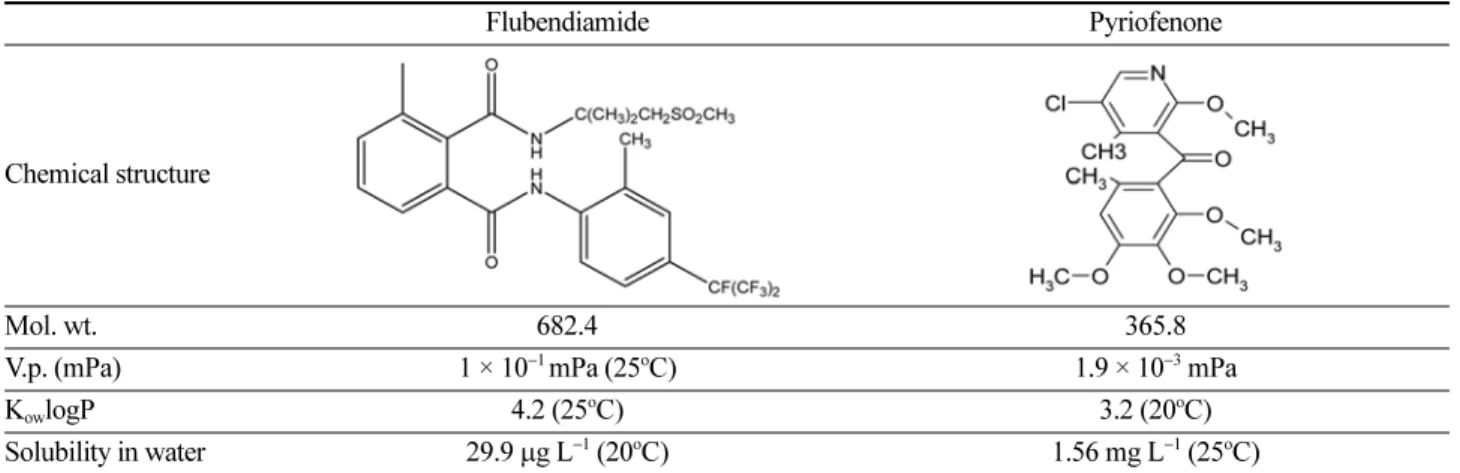
을 사용하여 딸기 중 flubendiamide 및 pyriofenone의 잔류 량을 분석하였다. 시험약제 및 농약 본 연구에서 사용된 약제 flubendiamide (순도, 98.00%) 및 pyriofenone (순도, 97.33%) 표준품은 Dr. Ehrenstorfer (Germany)로부터 구입하여 사용하였으며, 이화학적 특성은 Table 1과 같다. 살포 농약은 flubendiamide 20% (애니충, (주)한국삼공)와 pyriofenone 10% (옵션, (주)팜한농)를 사용 하였고 두 약제의 제형은 모두 액상수화제이며, 표준희석배 수는 2,000배이다. 시험포장 및 약제살포 시험에 사용된 딸기의 품종은 설향(Sulhyang)이며, 초세 가 강하고 뿌리발달이 좋아 흡비력, 저온 신장성이 우수한 작물이다. 본 시험은 충청남도 예산군 광시면(포장1)과 논산 시 상월면(포장2)에서 수행하였다. Flubendiamide 및 pyrio-fenone의 시험 구획은 포장 1에서 반복구별로 13.0 m × 1.0 m, 포장 2에서 12.8 m × 1.0 m 면적에 3 반복구를 배치하여 시 험을 수행하였다. 농약의 약제 살포는 농약사용지침서에 제 시된 안전사용기준에 따라 배부식 충전분무기(KS-PK2000, 압력: 2.1 kgf/cm2)를 이용하여 1회 경엽 살포 하였다. 두 약 제의 안전사용기준은 Table 2와 같다.
Table 2. Safety use guidelines for flubendiamide and pyriofenone on strawberry
Pesticide Formulation A.I.a) (%)
MRLb)
(mg kg−1)
Safe use guideline
PHIc) (day) MAFd) (time) Dilution
Flubendiamide SCe) 20 1.0 2 3 2,000
Pyriofenone SC 10 2.0 3 3 2,000
a)Active ingredient b)Maximum residue limit c)Pre-harvest interval
d)Maximum application frequency e)Suspension concentrate
Table 1. Chemical structures and physicochemical properties of pesticide
Flubendiamide Pyriofenone
Chemical structure
Mol. wt. 682.4 365.8
V.p. (mPa) 1 × 10⁻¹mPa (25oC) 1.9 × 10⁻³mPa
KowlogP 4.2 (25oC) 3.2 (20oC)
시료수확 및 개체량 측량 시료수확은 약제 살포 2시간 후를 0일차로 하여 0, 1, 2, 3, 5, 7, 10일차에 일자별로 실시하였으며, 한 반복구당 2 kg 이상의 시료를 수확하였다. 수확한 시료는 각 처리구별로 분리한 후 실험실로 운반하여 무게를 측정하고 균질화하였 다. 균질화된 시료는 분석 전까지 -20oC 이하의 deep freezer 에 보관하였다. 표준검량선 작성 정밀저울(XS105, Mettler-Toledo)을 이용하여 flubendiamide 표준품 102.041 mg을 weighing한 후 100 mL acetonitrile에 녹여 1,000 mg kg−1 stock solution을 조제하였다. 이와 같은 방법으로 pyriofenone 표준품 102.743 mg을 이용하여 1,000 mg kg−1 stock solution을 조제하였다. 이 stock solution 1 mL를 100 mL 부피플라스크에 넣은 후 acetonitrile을 100 mL로 정용하여 각각의 10 mg kg−1 용액을 만들었다. 동일 한 방법으로 0.1, 0.2, 0.5, 1.0, 2.0, 3.0, 5.0 mg kg−1의
working solution을 조제한 후 두 약제의 물리 화학적 특성 을 고려하여 식품공전(Ministry of Food and Drug Safety, 2013)에서 제시하고 있는 HPLC/UVD에 각각 10.0 µL 씩 주입하여 나타난 chromatogram상의 peak 면적을 기준으로 검량선을 작성하였다. 시료추출 및 정제 두 약제의 시료 추출 및 정제 방법은 다음과 같이 동일한 방법으로 수행하였다. 세절한 딸기 시료 20 g에 100 mL의 acetonitrile를 가하여 homogenizer로 3분간 고속·마쇄 (10,000 rpm) 추출하였다. 추출물은 acetonitrile을 이용하여 감압·여과하였다. 여액을 dichloromethane 50 mL로 2회 분 배 추출한 후, 분리된 유기 용매 층을 sodium sulfate anhydrous에 탈수시켜 감압·농축하였다. 농축 후 dichloro-methane 5 mL로 재용해 하였으며, NH2 1 g이 충진된 cartridge를 이용하여 정제하였다. 정제방법은 dichloromethane 5 mL로 pre-washing하여 고정상을 활성시킨 후, 추출액 5 mL를 loading하여 전개용매(dichloromethane:methanol = 95 : 5, v/v) 5 mL를 사용해 농약을 용출시켰다. 이 용출액을 감압·농축하고 건고물을 acetonitrile 2 mL로 재용해한 후, HPLC/UVD에 주입하여 최종 분석하였으며, flubendiamide 및 pyriofenone의 기기 분석 조건은 Table 3과 같다. 정량한계 및 회수율 시험 잔류분석을 위하여 flubendiamide 및 pyriofenone의 표준 품을 이용해 해당 분석기기 중 최소검출량(Minimum Detec-table Amount, MDA)과 정량한계(Limit of Detection, LOD) 를 산출하였다(Ministry of Food and Drug Safety, 2016). 본 연구에서 사용된 분석법에 대한 검증을 위하여 산출된 정량한계를 이용해 회수율 시험을 수행하였다. 회수율 시험 은 표준용액 0.2 mg kg−1 1 mL, 2 mg kg−1 1 mL를 각각 정 량한계 수준과(0.01 mg kg−1), 정량한계 10배(0.1 mg kg−1) 수준으로 무처리구 딸기 시료 20 g에 가하고, 30분 동안 방 치하여 약제가 작물에 완전히 스며든 후, 상기의 분석방법 과 동일한 방법으로 수행하였다. 시험농약의 생물학적 반감기 및 생산단계 잔류허용기준 의 산출 딸기 중 flubendiamide 및 pyriofenone 잔류량의 경시적 변화를 산출하기 위하여 잔류감소 회귀분석 그래프를 이용 하였으며, 산출된 감소상수와 일자별 농약 잔류량을 이용해 생물학적 반감기와 출하 전 딸기의 생산단계 잔류허용기준 을 산출하여 제안하였다(Kim et al. 2015; Ministry of Food and Drug Safety 2016).
결과 및 고찰
표준검량선 작성 딸기 중 flubendiamide 및 pyriofenone에 대한 표준검량 선을 작성한 결과, Table 4와 같으며 두 약제 모두 상관계수 (R2)가 0.999이상으로 높은 직선성을 보여 분석법의 적합성 을 확인할 수 있었다.Table 3. Instrumental operating conditions for residue analysis of the pesticides
Pesticide Flubendiamide Pyriofenone Instrument DIONEX UltiMate 3000 (Thermo scientific, USA)
Detector Ultra Violet Detector (UVD) (270 nm) Column Shiseido C18 (4.6 mm I.D. × 250 mm, 5 µm)
Column Temperature 40oC 40oC
Injection volume 10µL 10µL
Flow rate 1.0 mL min.−1 1.0 mL min.−1 Mobile phase Acetonitrile : Water = 65 : 35 Acetonitrile : Water = 80 : 20 Retention time 4.44 min. 6.77 min.
정량한계 및 회수율 시험 딸기 중 flubendiamide 및 pyriofenone의 분석 정량한계 는 모두 0.01 mg kg−1이었으며, 확립한 분석법을 검증하기 위해 진행한 회수율 시험 결과 각각 81.4~92.9%, 83.9~ 89.2%로 두 약제 모두 70~120% 이내로 잔류농약 분석 회 수율 범위 기준을 만족하였다(Table 5). 본 연구에서 확립된 분석 방법에 의한 flubendiamide 및 pyriofenone의 머무름 시간은 각각 4.44 min., 6.77 min.이었다. 기상조건과 딸기의 개체량 시험기간 중 포장 1의 평균온도와 습도는 12.9~16.7oC (CV: 9.2%), 51.0~72.9% (CV: 8.6%)이였으며, 포장 2의 평 균 온도와 습도는 14.0~20.4oC (CV: 12.6%), 72.6~83.4% (CV: 4.6%)로 기록되었다(Fig. 1). 또한 약제 살포 후 분석 시료의 개체량을 측정한 결과(PB3002-S, Mettler-Toledo), flubendiamide의 경우 약제 살포일에 25.30 ± 1.26 g, 약제 살포 10일 경과 후 30.94 ± 1.68 g이었고, pyriofenone의 경 우 24.84 ± 1.59 g, 30.45 ± 1.90 g으로 두 약제 모두 약제 살 포일의 개체량과 10일 경과 후의 개체량이 1.22배 증가하였 다. 이 등(2009)의 선행연구결과 비대성장하는 작물인 오이 의 경우 약제 살포일과 약제 살포 10일 후의 개체량이 21배, 25배 증체되는 것을 확인하였으며, 본 연구결과로 확인한 딸기의 증체율은 오이에 비해 20배 정도 낮은 증체율을 보 였다. 따라서 딸기의 경우 비대성장으로 인한 희석효과가 잔류량변화에 영향이 적을 것으로 판단된다. 딸기 중 flubendiamide 및 pyriofenone의 잔류특성과 생물 학적 반감기 시험기간 중 딸기에 잔류된 flubendiamide의 농도는 포장 1, 2에서 각각 0.31~0.91 mg kg−1, 0.31~1.02 mg kg−1 수준으 로 나타났으며, 포장 2의 0일차를 제외한 모든 처리구에서 MRL인 1.0 mg kg−1 보다 낮은 잔류량을 나타내었다. Pyrio-fenone의 경우 포장 1, 2에서 잔류량은 각각 0.10~0.33 mg kg−1, 0.09~0.26 mg kg−1 수준으로 나타났으며, 포장 1, 2 모 두 모든 처리구에서 MRL인 2.0 mg kg−1보다 낮은 잔류량 을 나타내었다. 생산단계 작물 중 농약은 작물에 처리된 농약의 이화학적 특성 및 제제형태와 작물생육 정도뿐만 아니라 다양한 환경 요인에 의하여 분해된다(Lee et al. 2009). 시설재배의 경우 포장에 살포된 농약은 시설 내의 높은 온도와 습도에 의해 분해 및 휘발이 이루어지고, 작물의 생육을 위한 관수 처리 등에 의해서 세척되어 농약의 잔류량이 감소하게 되거나 반 대로 세척된 농약이 땅에 집적되어 잔류량이 높아질 수 있 는 것으로 보고되고 있다(Lee et al. 2009). Flubendiamide 의 생물학적 반감기는 포장 1, 2에서 각각 8.1일과 7.2일이 었다. 딸기는 약제 살포 후 0일차와 10일차 간의 증체율이 크지 않고 사용된 약제의 내우성이 뛰고, 약효지속시간도 길게 나타나 flubendiamide의 잔류량 감소 추이가 완만하여 Table 4. A linear equation of calibration curve and correlation
coefficients of the pesticides
Pesticide Linear equation R2
Flubendiamide y = 0.1109x + 0.0019 0.9997 Pyriofenone y = 0.2002x + 0.0015 1.0000
Fig. 1. Changes in temperature and humidity during experimental period in field 1 and 2. Table 5. Recovery percents of flubendiamide and pyriofenone in strawberry
Pesticide Add. conc. (mg kg-1) Recovery± C.V. (%, average ± C.V.) MLOQ (mg kg−1)
Flubendiamide 0.01 90.9± 2.2
0.01 0.1 81.9± 0.8
Pyriofenone 0.01 87.7± 2.1 0.1 85.3± 1.1
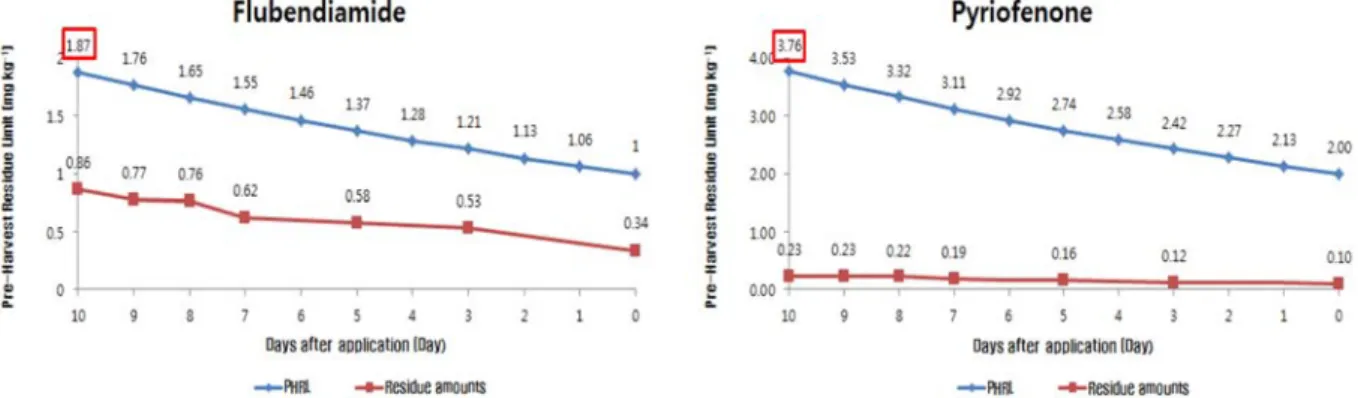
생물학적 반감기가 길게 나타난 것으로 판단된다(Chen et al. 2012; KCPA 2015). Pyriofenone의 잔류특성을 파악하여 산출한 결과 생물학 적 반감기는 포장 1, 2에서 각각 7.0일과 6.9일로 나타났다. Pyriofenone의 이화학적 특성 및 약제 특성상 증기압에 의 한 재분배 효과가 뛰어나며, 잔효성이 길어 약제 성분이 작 물에 오래 잔류되기 때문에 생물학적 반감기가 길게 나타난 것으로 판단된다(Park et al. 2014; KCPA 2015). 딸기 중 flubendiamide 및 pyriofenone의 10일차까지 잔류량을 파악 한 결과, 잔류량 감소가 크지 않았으며, 생물학적 반감기는 포장 1, 2에서 각각 8.1일, 7.2일과 7.0일, 6.9일로 산출되었다. Flubendiamide 및 pyriofenone의 생산단계 잔류허용기준 산출 작물 재배 기간 중 살포된 농약의 잔류량은 농약 자체의 물리 화학적 특성, 제제형태, 처리방법 및 조건 등에 따라 달라질 수 있기 때문에 수확 시 잔류량이 MRL을 초과하지 않도록 수확 전 일자별 잔류량을 설정한 생산단계 잔류허용 기준을 설정하여 관리하고 있다(Hwang et al, 2012). 본 연 구 결과, 산출된 flubendiamide의 잔류감소식은 포장 1과 포 장 2에서 각각 y=0.861e−0.0854x (R²=0.9487), y=0.9468e−0.0966x (R²=0.9704)이었으며, 포장 1의 잔류감소식을 이용하여 생 산단계 잔류허용기준을 산출한 결과 1.87 mg kg−1로 나타났 다. Pyriofenone의 경우 포장 1, 2에서 y=0.2704e−0.0993x (R²=0.9092), y=0.2618e−0.101x (R²=0.9865)이었으며, 포장 2 의 잔류감소식을 토대로 생산단계 잔류허용기준을 3.76 mg kg−1 제안하였다(Fig. 2). 딸기 중 flubendiamide 및 pyrio-fenone의 수확 10일 전 잔류량이 1.87 mg kg−1 , 3.76 mg kg−1 보다 낮은 잔류량을 나타낸다면 수확 시 MRL 이하의 안전한 농산물을 생산할 수 있을 것으로 사료된다. 본 연구 결과를 토대로 제안된 생산단계 잔류허용기준은 현재 식품 의약품안전처에 고시·등록되어 시행되고 있다(Ministry of Food and Drug Safety 2016).
감사의 글
본 연구는 2015년도 강원대학교 대학회계 학술연구조성 비와 식품의약품안전처에서 2015년 농산물의 생산단계 농 약 잔류허용기준설정 연구의 지원을 받아 연구하였음 이에 감사드립니다.Literature cited
Chen, X., C. Lu, S. Fan, H. Lu, H. Cui, Z. Meng and Y. Yang (2012) Determination of residual flubendiamide in the cabbage by QuECHERS-liquid chromatography-tandem mass spectrometry. Bull. Environ. Contam. Toxicol. 89:1021-1026.
Do, J. A., M. Y. Lee, H. J. Park, J. E. Kwon, H. J. Jang, Y. J. Cho, I. H. Kang, S. M. Lee, M. I. Chang, J. H. Oh and I. G. Hwang (2013) Development and Validation of an Analytical Method for the Insecticide Sulfoxaflor in Agricultural Commoditied using HPLC-UVD. Korean J. Food. Sci. 45(2):148-155.
Ha, H. Y., S. E. Park, A. S. You, G. H. Gil, J. E. Park, I. Y. Lee, K. W. Park and J. E. Park (2016) Survey of Pesticide Use in Leaf and Fruit Vegetables, Fruits, and Rice Cultivation Areas in Korea. Weed Turf. Sci. 5(4):203-212.
Hwang, J. I. and J. E. Kim (2014) Residual Patterns of Acaricides, Etoxazole and Flufenoxuron in Apples. Korean J. Pesti. Sci. 18(2):61-68.
Hwang, J. I., Y. H. Jeon, H. Y. Kim, J. H. Kim, J. W. Ahn and K. S. Kim (2011) Residue of Fungicide Boscalid in Ginseng Treated by Different Spraying Methods. Korean J. Pesti. Sci. 15(4):366-373.
Hwang, K. W., T. W. Kim, J. H. Yoo, B. S. Park and J. K. Moon (2012) Dissipation Pattern of Amisulbrom in Cucumber under Greenhouse Condition for Establishing Pre-harvest Residue Limit. Korean J. Pesti. Sci. 16(4):288-293. Jeffrey, R. B. (2015) The pesticide manual, flubendiamide,
pyriofenone, 17th ed., Turner, J. A.: Hampshire, UK., pp. 496:983-984.
Jung, Y. J., I. S. Nou and K. K. Kang (2015) Effects of Green Manure Crops on Tomato Growth and Soil Improvement for Reduction of Continuous Cropping Injury through Crop Rotation in Greenhouse. Korean J. Plant Res. 28(2):263-270.
Kim, J. B., B. H. Song, J. C. Chun, G. J. Im and Y. B. Im (1997) Effect of sprayable formulations on pesticide adhesion and persistence in several crops. Korean J. Pesti. Sci. 1(1):35-40. Kim, J. Y., M. J. Woo, K. J. Hur, s. Manoharan, C. H. Kwon and J. H. Hur (2015) Establishment of Pre-Harvest Residue Limit for Pyrimethanil and Methoxyfenozide during Cultivation of grape. Korean J. Pesti. Sci. 19(2):81-87. Korea Crop Protection Association (KCPA) (2015) Guideline
Crop Protection Agents. http://www.koreacpa.org/korea/ index.php. Accessed 30 Aprill 2015.
Korean Statistical Information Service (2016) Pesticide consumption. http://kosis.kr/. Accessed 10 October 2016. Lee, D. Y., D. K. Jeong, G. H. Choi, D. Y. Lee, Y. K. Kang and
J. H. Kim (2015) Residual Characteristics of Bistrifluron and Fluopicolide in Korean Cabbage for Establishing Pre-Harvest Residue Limit. Korean J. Pesti. Sci. 19(4):361-369. Lee, E. Y., H. H. Noh, Y. S. Park, K. W. Kang, K. H. Lee, H. K. Park, S. S. Yun, C. W. Jin, S. K. Han and K. S. Kyung (2009) Residual characteristics of Neonicotinoid Insecticide dinotefuran and thiacloprid in cucumber. Korean J. Pesti. Sci. 13(2):98-104.
Lee, J. H., Y. H. Jeon, K. S. Shin, H. Y. Kim, E. J. Park, T. H. Kim and J. E. Kim (2009) Biological Half-lives of fungicides in Korean melon under greenhouse condition. Korean J. Envir. Agri. 28:419-426.
Lee, S. C. (2004) Control of Major Disease in Greenhouse Crops. Korean Res. Soc. 17(2):2-9.
Lim, S. J., H. S. Hwang and Y. J. Shin (2016) Physicochemical Properties and Antioxidant Activities of ‘Seolhyang’ and ‘Janghee’ Strawberries from Different Ripening Stages Grown in Korea. East Asian J. Dietary Life Soc. 26(1):80-87.
Ministry of Food and Drug Safety (2013) Practical commentary korean food standards codex pesticide residues analysis method. Fourth ed. http://www.mfds.go.kr/index.do. Accessed 22 November 2013.
Ministry of Food and Drug Safety (2016) Toxic substances residue standard such as pre-harvest agricultural products. http://www.mfds.go.kr/index.do. Accessed 12 August 2016. Park, D. S., K. Y. Seong, K. I. Choi and J. H. Hur (2005) Field tolerance of pesticides in the strawberry and comparison of biological half-lives estimated from kinetic models. Korean J. Pesti. Sci. 9(3):231-236.
Park, H. J., H. J. Kim, J. A. Do, J. E. Kwon, J. Y. Yoon, J. Y. Lee, M. I. Chang and G. S. Rhee (2014) Development of an Analytical Method for the Determination of Pyriofenone residue in Agricultural Products using HPLC-UVD. Korean J. Pesti. Sci. 18(2):79-87.
Yoo, H. K. (2014) Food Security as a Nontraditional Security Issue: Implications for Korea. Korean J. Soc. Paradigm Studies. pp. 127-152.
Yoon, H. S., G. D. Ko, D. Y. Kim and C. H. Chun (2013) History of Korean Gardening. Korean J. Hort. Sci. pp. 97-102.
⊙ ··· ⊙
생산단계 잔류허용기준설정을 위한 Flubendiamide 및 Pyriofenone의
딸기(Fragaria ananassa Duch.) 중 경시적 잔류특성 연구
김희곤·김지윤·허경진·권찬혁1·허장현* 강원대학교 농업생명과학대학 환경융합학부, 강원대학교 친환경농산물안전성센터, 1식품의약품안전처 축산물기준과 요 약 본 연구는 딸기 중 flubendiamide 및 pyriofenone의 경시적 잔류변화를 조사하여 반감기를 산출함으로써 생산단계 잔류허용기준을 설정하고자 수행하였다. Flubendiamide 및 pyriofenone 농약을 안전사용기준에 준하여 포 장 1, 2에 각각 살포한 후 0, 1, 2, 3, 5, 7, 10일차에 딸기 시료를 채취하여 각각의 농약을 HPLC/UVD를 이용하여 분석하였다. 두 농약의 정량한계는 모두 0.01 mg kg−1이었고 0.2 mg kg−1와 2 mg kg−1 수준에서 회수율은 각각 flubendiamide의 경우 90.9 ± 2.2%와 81.9 ± 0.8%이었으며, pyriofenone은 87.7 ± 2.1%와 85.3 ± 1.1%이었다. 딸기 중 flubendiamide의 생물학적 반감기는 포장 1, 2에서 각각 8.1일과 7.2일이었으며, pyriofenone의 경우 7.0일과 6.9일이 었다. Flubendiamide 및 pyriofenone에 대하여 딸기 수확 10일 전 잔류량이 각각 1.87 mg kg−1와 3.67 mg kg−1으로 나타난다면 최종 잔류량은 MRL 수준 이하의 안전한 농산물을 생산할 수 있을 것으로 사료된다. 색인어 생물학적 반감기, 생산단계 잔류허용기준, flubendiamide, pyriofenone ⊙ ··· ⊙