| Abstract |
Purpose: The purpose of this study was to determine the effect of the side-bridge exercise on the thicknesses of the external and internal obliques, the transverse abdominis, and the erector spinae, which are some of the trunk muscles of healthy adult males and females.
Methods: There were 30 subjects divided into two groups with 15 subjects in the modified side-bridge exercise group and 15 subjects in the bridge exercise group. The changes in each variable were analyzed before the exercise, after three weeks, and after six weeks of exercise using a two-way repeated analysis of variance. The significance level was set at 0.05. When there was any interaction between the time of measurement and each group, a paired t-test was conducted to find the difference within groups and an independent-sample t-test was conducted to find the difference between groups. The significance level for both tests was set at 0.01.
Results: There was a significant difference in the external and internal obliques and the erector spinae according to changes over time and the interactions between the time and groups (p < 0.05). However, there was a significant difference in the transverse abdominis only according to the interaction between the length of times (p < 0.05).
Conclusion: The study results indicated that the modified side-bridge exercise significantly increased the thickness of the external and internal obliques and the erector spinae. This suggests the usability of the exercise in lumbar stabilization exercises in future studies and clinical fields.
Key Words: Bridge exercise, Thickness, Trunk muscle
†Corresponding Author : Yong-Nam Kim ([email protected])
Original Article Open Access
수정된 측면 교각운동이 정상 성인 몸통근육의 두께에 미치는 영향
박재철⋅김용남†1)
남부대학교 물리치료과
The Effect of a Modified Side-Bridge Exercise on the Thickness of Trunk Muscles in Healthy Adults
Jae-Cheol Park, P.T., Ph.D.⋅Yong-Nam Kim, P.T., Ph.D.†
Department of Physical Therapy, Nambu University Received: March 2, 2021 / Revised: March 19, 2021 / Accepted: April 1, 2021
ⓒ 2021 Journal of Korea Proprioceptive Neuromuscular Facilitation Association
This is an Open Access article distributed under the terms of the Creative Commons Attribution Non-Commercial License (http://creativecommons.org/licenses/by-nc/3.0) which permits unrestricted non-commercial use, distribution, and reproduction in any medium, provided the original work is properly cited.
Ⅰ. 서 론 몸통의 주요 근육으로 배바깥빗근과 배속빗근, 배 가로근, 척추세움근 뭇갈래근이 있다(Kang et al., 2016). 배가로근과 배속빗근, 뭇갈래근은 소근육으로 분류되며 척추의 분절 안정성을 제공하고 큰 근육인 척추세움근은 힘과 토크를 발생시킨다(Lee et al., 2013). 이 근육의 약화는 허리에 안정성을 감소 시켜 기능 부전을 야기시키고 일상생활에 부정적으로 작용 하므로(Alentorn-Geli et al., 2009) 원활한 기능적 활동 을 위해 몸통 근육 강화는 중요한 요소이다(Saragiotto et al., 2016). 임상에 근.뼈대계 질환을 예방하고 기능적인 움직 임을 개선하기 위해 몸통 근육 강화에 초점을 맞춰 허리안정화 운동을 이용하고 있고(Dafkou et al., 2020) 종류로는 크런치 운동(crunch exercise), 교각운동 (bridging exercise), 플랭크 운동(plank exercise), 네발기 기 운동(quadruped exercise)이 이용되고 있다(Kim & Kim, 2015; Narouei et al., 2020; Sipaviciene & Kliziene, 2020; Yoon et al., 2018).
이러한 운동들은 최소한의 신체 움직임을 특징으 로 하여 근재교육에 초점을 맞춘 운동으로 재활 운동 에 자주 적용되고 있고(Cho & Park, 2019) 건강한 사람 들도 자주 이용하고 있는 운동이다. 이중 교각운동은 누운 상태에서 중력과 본인의 체중을 이용한 운동으 로 다른 허리안정화 운동에 비해 자세조절 능력이 떨 어지는 근.뼈대계 질환과 신경계 질환 환자의 재활 초기에 적용 가능하고 골반과 다리의 기능 문제 해결 을 위해 자주 이용되고 있다(Park et al., 2016). 하지만 교각운동은 다른 허리안정화 운동에 비해 큰볼기근과 허리골반부의 근력 향상에 이득이 있는 운동으로 (Richardson et al., 1992) 다른 운동에 비해 몸통 근육의 강화에는 효과가 부족하다. 이러한 단점을 보안하여 오래전부터 팔과 다리의 위치 변경과 지지면의 변경으로 몸통 근육의 강화에 효율적인 수정된 교각운동들이 제시되고 있다. 관련 된 연구를 살펴보면 단일 다리 지지대로 수행하는 교 각운동(García-Vaquero et al., 2012), 불안정면에서 교 각운동(Czaprowski et al., 2014), 불안정 지지면과 엉덩 관절 벌림을 이용한 교각운동(Yoon et al., 2018), 엉덩 관절 모음근에 저항을 동반한 교각운동(Park & Lee, 2020) 등이 보고되고 있어 특정 도구와 자세 변화로 몸통 근육의 강화를 유도 할 수 있는 것을 확인할 수 있었다. 이처럼 변경된 교각운동이 몸통 근육에 가져다 주 는 효과에 대해 잘 알려져 있다. 하지만 대부분 도구와 저항을 이용한 방법과 근 활성화 변화에 대한 연구가 많고 본 연구처럼 기존 교각운동인 양쪽 엉덩관절 폄 의 운동이 아닌 다리와 몸통의 위치 변화를 주어 한쪽 지지다리의 엉덩관절에서만 폄의 움직임이 발생하는 교각운동을 적용하여 몸통 주변 근육의 두께 변화를 확인한 연구는 부족한 실정이다. 그러므로 본 연구는 수정된 측면 교각운동이 몸통 안정화 근육인 배바깥 빗근, 배속빗근, 배가로근, 척추세움근의 두께에 미치 는 영향을 확인하고자 하며 교각운동의 기초자료와 임상에서 활용하기 위함이다. Ⅱ. 연구 방법 1. 연구 대상 본 연구의 대상자는 광주광역시 N 지역에 허리안정 화 프로그램에 참여하고 있는 3,40대 남성 16명, 여성 14명 총 30명을 대상으로 무작위배정(ramdomized)을 이용하여 제비뽑기 방법으로 군을 다음과 같이 분류 하였다. 수정된 측면 교각운동군(modified side-bridge exercise group, MSBG) 15명, 교각운동군(bridge exercise group, BG) 15명으로 나누고 그룹에 대한 정보 를 알리지 않고 운동을 하였다. 연구 대상자의 표본 크기 선정은 선행연구(Moon et al., 2014)를 근거로 G*power3.1(Heinrich Heine University Düsseldorf, Germany)(Faul et al., 2007)을 이용하여 유의수준(α =0.05) 검정력(1-β=0.95) 효과크기(d=0.8)로 설정하여
각 그룹당 13명씩 산출되었다. 탈락률 20%를 고려하 여 각 그룹당 15명씩 총 30명을 모집하였다. 모든 대상 자는 연구 공고문을 통해 모집하였고 연구의 목적을 듣고 자발적으로 연구 참여 의사를 희망한 자로 하여 동의서를 작성하였다. 제외 기준은 교각운동이 어려 운 신경계와 정형외과적 질환이 있는 사람은 제외하 였다. 2. 연구방법 및 운동방법 1) 운동방법 및 기간 MSBG의 운동 자세는 측면으로 비스듬하게 누운 후 한쪽 다리는 무릎관절 45° 굽힘을 하고 넙다리 부위 바깥쪽이 바닥 면에 위치하게 하였고, 반대 다리는 바로 세워 무릎관절 45°굽힘 자세를 취하게 하여 한쪽 지지다리 운동을 하였다. 운동 시작과 동시에 바로 세워진 다리 쪽의 엉덩관절에서 폄의 움직임과 함께 날숨을 천천히 하면서 대각선 방향으로 몸통을 들어 올려 운동을 하였고 날숨이 끝나면 들숨을 하며 원래 자리로 돌아오게 하였다. 운동 1회에 소요된 시간은 10초이며 1분간 6회 운동 후 20초간 휴식을 취하고 자세를 바꾸어 반대 측의 운동을 하였다. BG의 운동은 바로 누운 자세에서 무릎 관절 45°굽힘을 하였고 양팔 은 바닥 면에 지지하게 하여 시작과 동시에 엉덩관절 을 들어 올려 등척성 운동을 하였고 운동 시간은 MSBG와 동일하게 적용하였다. 모든 그룹의 운동 기 간은 총 6주이며 주 3회, 하루 30분씩 적용하였고 운동 프로그램은 5분 트레드밀에서 가벼운 걷기 운동을 하 고 본 운동 20분 5분 마무리 운동으로 온몸 스트레칭을 하였다(Fig. 1). 2) 측정도구 및 측정방법 몸통 근육과 척추세움근의 두께 측정을 위해 초음 파 영상장치(MyLab25Gold, Esaote, Italy)를 이용하였 다. 이 장비의 주파수 범위는 6∼9㎒이며 gain은 20∼ 80으로 설정하였고, 변환기는 7.5㎒의 선형 탐촉자를 이용하였다. 근육의 두께 측정 오차 감소를 위해 해부 학적 지식과 초음파에 대한 해박한 지식이 있는 자 1인을 선정하여 측정하였다. 측정 자세로는 EO, IO, TrA은 바로 누운 상태에서 무릎에 베개를 두고 엉덩관 절 45°굽힘, 무릎관절 90°굽힘 자세를 취한 후 변환기 를 근육에 평행하게 위치하게 하여 배꼽에서 바깥쪽 으로 13㎝ 이동하여 EO가 초음파 화면에 왼쪽에 위치 하게 하여 초음파에 내장된 캘리퍼를 이용하여 근육 의 중앙의 두께를 측정하였다. 호흡이 몸통 근육 두께 에 영향을 미치는 것을 방지하기 위해 날숨 후 호흡을 멈춘 상태에서 측정하였다(Hodges & Gandevia, 2000). 척추세움근은 바로 엎드린 자세에서 변환기를 가로 방향으로 하여 허리뼈 3번 가시돌기에서 가쪽으로 4 ㎝ 이동하여 가시돌기와 가로돌기를 확인한 후 근막 에서 가로돌기 사이를 측정하였다. 모든 근육은 측정 위치의 오차를 줄이기 위해 유성 펜으로 표시하였고 변환기와 피부 사이에 충분한 양의 초음파 겔(Dayo medical Co., PROCEL-Ⅱ, Korea)를 도포하였다. 모든 근육의 두께는 좌측 근육만 측정하였고 총 3회 반복 측정한 후 평균값을 이용하였다. 3. 자료분석 모든 자료는 SPSS 19.0(SPSS Inc., USA)를 이용하였 다. 대상자의 정규분포를 확인하기 위해 Shapiro-wilk 검정을 하였다. 두 그룹의 실험 전, 3주 후, 6주 후의 두께 변화를 알아보고자 이요인 반복측정 분산분석 (two-way repeated ANOVA)을 이용하였고 유의수준은 0.05로 하였다. 시기와 군간 상호작용이 발생한 경우 집단 내 차이를 확인하기 위해 대응표본 t-검정(paired t-test)을 하였고 집단 간 차이를 확인하기 위해 독립표 본 t-검정(independent t-test)을 하였으며(Jung et al., 2009) Ⅰ종 오류를 줄이기 위해 Bonferroni 교정을 이용 하여 유의수준 0.01로 하였다.
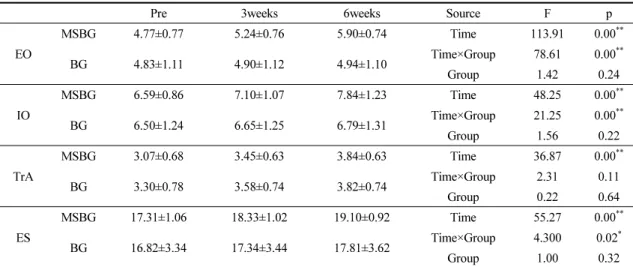
Ⅲ. 연구 결과 1. 연구 대상자의 일반적인 특성 본 연구의 MSBG에 참여한 대상자는 남자 8명, 여자 7명으로 평균 신장은 169.20±9.65㎝, 평균 연령은 39.00±4.03세, 평균 몸무게 64.94±15.92㎏이다. BG에 참여한 대상자는 남자 8명, 여자 7명으로 평균 신장은 171.00±7.32㎝, 평균 연령은 39.46±4.96세, 평균 몸무게 67.34±12.67㎏으로 나타났으며 대상자의 일반적 특성 은 다음과 같다(Table 1). 2. 중재방법에 따른 배배깥빗근의 두께 변화 중재방법에 따른 각 그룹의 배바깥빗근 두께 변화 는 시기별과 시기와 군간 상호작용에서 유의한 증가 를 보였고(p<0.05) 군간 변화에서는 유의한 차이가 없 었다(p>0.05)(Table 2, 3)(Fig. 2). 3. 중재방법에 따른 배속빗근의 두께 변화 중재방법에 따른 각 그룹의 배속빗근 두께 변화는 시기별과 시기와 군간 상호작용에서 유의한 증가를 보였고(p<0.05) 군간 변화에서는 유의한 차이가 없었 다(p>0.05)(Table 2, 3)(Fig. 2). 4. 중재방법에 따른 배가로근의 두께 변화 중재방법에 따른 각 군의 배가로근의 두께 변화는 시기별에서 유의한 증가 보였고(p<0.05) 시기와 군간 MSBG (n=15) BG (n=15) p Height (cm) 169.20±9.65 171.00±7.32 0.49 Age (years) 39.00±4.03 39.46±4.96 0.96 Weight (kg) 64.94±15.92 67.34±12.67 0.54 Gender (M/F) 8/7 8/7 Mean±SD
Table 1. General characteristics of subjects (n=30)
Pre 3weeks 6weeks Source F p
EO MSBG 4.77±0.77 5.24±0.76 5.90±0.74 Time 113.91 0.00** BG 4.83±1.11 4.90±1.12 4.94±1.10 Time×Group 78.61 0.00 ** Group 1.42 0.24 IO MSBG 6.59±0.86 7.10±1.07 7.84±1.23Time 48.25 0.00** BG 6.50±1.24 6.65±1.25 6.79±1.31 Time×Group 21.25 0.00** Group 1.56 0.22 TrA MSBG 3.07±0.68 3.45±0.63 3.84±0.63 Time 36.87 0.00** BG 3.30±0.78 3.58±0.74 3.82±0.74 Time×Group 2.31 0.11 Group 0.22 0.64 ES MSBG 17.31±1.06 18.33±1.02 19.10±0.92 Time 55.27 0.00** BG 16.82±3.34 17.34±3.44 17.81±3.62 Time×Group 4.300 0.02* Group 1.00 0.32
EO: external oblique, IO: internal oblique, TrA: transverse abdominis, ES: erector spinae, MSBG: modified side bridge exercise group, BG: bridge exercise group, Mean±SD, *p<0.05, **p<0.01
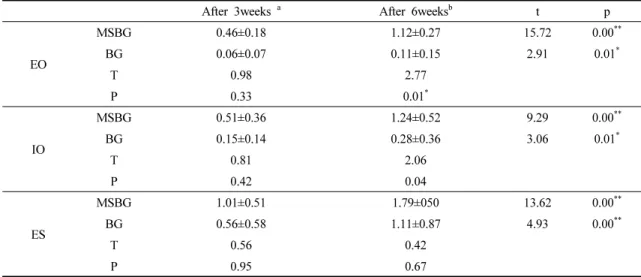
After 3weeks a After 6weeksb t p EO MSBG 0.46±0.18 1.12±0.27 15.72 0.00** BG 0.06±0.07 0.11±0.15 2.91 0.01* T 0.98 2.77 P 0.3 3 0.01* IO MSBG 0.51±0.36 1.24±0.52 9.29 0.00** BG 0.15±0.14 0.28±0.36 3.06 0.01* T 0.81 2.06 P 0.42 0.04 ES MSBG 1.01±0.51 1.79±050 13.62 0.00** BG 0.56±0.58 1.11±0.87 4.930.00** T 0.56 0.42 P 0.95 0.67
EO: external oblique, IO: internal oblique, ES: erector spinae, MSBG: modified side bridge exercise group, BG: bridge exercise group, aDifference between pre and 3weeks bDifference between pre and 6weeks Mean±SD *p<0.01 **p<0.001
Table 3. Intra-group changes and inter-group changes
Fig. 1. Modified side bridge exercise.
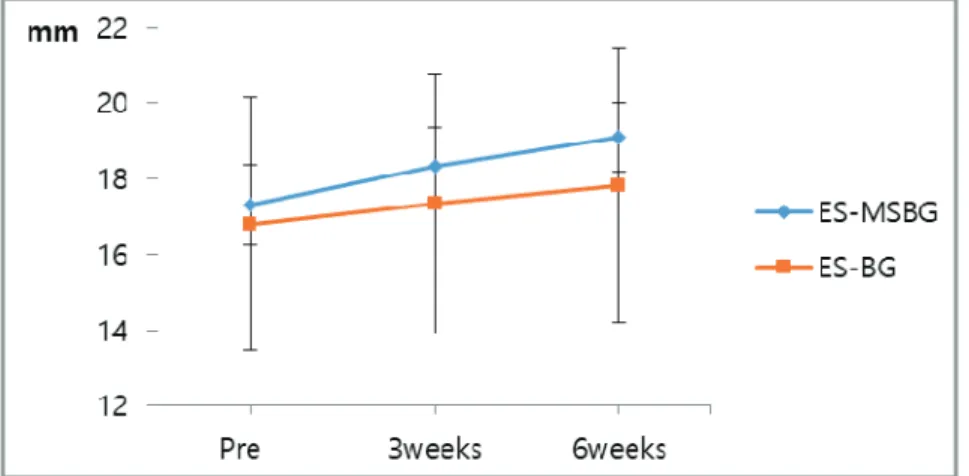
상호작용과 군간 변화에서는 유의한 차이가 없었다 (p>0.05)(Table 2, 3)(Fig. 2). 5. 중재방법에 따른 척추세움근의 두께 변화 중재방법에 따른 각 그룹의 척추세움근의 두께 변 화는 시기별과 시기와 군간 상호작용에서 유의한 증 가를 보였고(p<0.05) 군간 변화에서는 유의한 차이가 없었다(p>0.05)(Table 2, 3)(Fig. 3). Ⅳ. 고 찰 본 연구는 수정된 측면 교각운동이 배바깥빗근, 배 속빗근, 배가로근, 척추세움근의 두께에 미치는 영향 을 알아보고자 3∼40대 남성 16명, 여성 14명, 총 30명 을 대상으로 MSBG와 BG로 나누어 실험 전, 3주 후, 6주 후로 시기를 나누어 운동을 하였고 그 결과는 다음 과 같다. 배바깥빗근과 배속빗근, 척추세움근은 시기 별 변화와 시기와 군간 상호작용에서 유의한 차이가 발생하였고 배가로근은 시기별에서만 유의한 차이가 있었다. 이러한 결과는 몇 가지로 해석이 가능한데 첫째, 운동 역학적인 변화로 인해 달라진 근수축으로 이해 된다. 전통적 교각운동은 양쪽 엉덩관절 폄과 몸통 폄을 수행하면서 운동을 수행하기 때문에 엉덩관절 폄 근육과 허리 하부 섬유의 강화에 효과적이다. 하지 만 본 연구에서 이용한 수정된 측면 교각운동은 세워 진 한쪽 지지 다리쪽의 엉덩관절은 폄과 바깥 돌림, 몸통 가쪽 굽힘의 움직임이 발생하고 바닥면에 위치 한 다리쪽의 엉덩관절은 굽힘 상태를 유지하지만 바 깥 돌림과 몸통 가쪽 굽힘이 발생한다. García-Vaquero 등(2012)의 연구에서 한쪽 다리 지지를 한 교각운동은 배속빗근의 근활성도를 증가시킨다고 하였고, Vera-Garcia 등(2010)은 한 다리로만 지지하여 실시하 는 교각운동은 변화된 다리의 움직임으로 회전력이 발생하여 몸통의 불안정성이 발생하고 이를 방지하고 자 배속빗근의 근활성도가 증가한다고 하였다. 본 연 구의 수정된 측면 교각운동은 다리와 골반의 위치 변 경으로 인해 엉덩관절에서 폄 동작과 함께 바깥 돌림 이, 몸통에서는 가쪽 굽힘의 움직임이 발생하여 이로 인한 몸통의 회전력이 증가되어 몸통의 안정성을 유 지하고자 배속빗근이 수축한 결과로 해석된다. 몸통 근육의 수축은 몸통의 자세와 움직임 수행 과정에 의해 달라지며(Cholewicki & Vanvliet Iv, 2002) 변화된 외부 자극에 의해 발생하는 회전력과 자세 동 요에 대한 몸통 안정성을 유지하려고 몸통 근육을 수 축시킴으로써 발생한다(Aruin & Latash, 1995). 하지만 척추세움근은 선행연구와 차이가 있었다. Koh 등 (2012)은 교각운동과 함께 복부 넣기 동작은 척추세움
근의 활성도를 감소 시킨다고 하였는데 본 연구는 수 정된 측면 교각운동으로 배꼽 넣기 움직임이 적용되 지 않았고, 지지면이 줄어들고 측면에서 적용된 운동 으로 증가한 체중과 중력을 이겨내고자 척추세움근이 더욱 수축한 결과로 생각된다. 운동 방법은 다르지만, 엉덩관절 모음을 동반한 플 랭크 운동은 배곧은근과 배바깥빗근, 배속빗근의 근 활성화를 유도한다고 보고하였고(Kim et al., 2016), 엉덩관절 모음을 동반한 플랭크 운동이 6주 후에 배곧 은근, 배바깥빗근, 배속빗근, 배가로근의 두께 증가에 긍정적으로 작용한다고 보고하면서(Park & Jeong, 2019) 엉덩관절 모음근 수축은 몸통 근육의 수축을 유발한다고 하였다. 본 연구에서 다리 근육에 대한 두께를 확인을 하지 않아 단정 지을 수는 없지만 수정 된 측면 교각운동은 측면에서 굽힘 된 골반을 들어 올리면서 다리 쪽 근육의 수축이 증가하였고 다리 근 육과 이어진 골반에 불안정성을 유발하고 골반의 안 정성 증가를 위해 근막으로 연결된 배바깥빗근과 배 속빗근의 수축이 증가한 결과로 생각된다. 둘째, 운동과 함께 하는 호흡 방법이 몸통 근육에 영향을 미친다는 것이다. 본 연구는 운동 시작과 함께 날숨을 하면서 실시하였고 제자리로 돌아올 때 들숨 을 하였다. 몸통의 회전에 대하여 영향을 받는 배바깥 빗근과 배속빗근은 호흡에도 중요한 역할을 하며 들 숨보다 날숨 상태에서 더 큰 활성을 보여(Montes et al., 2016) 이러한 결과가 발생하였고, 배가로근에서 변화 없었던 이유는 Ishida 등(2012)은 날숨과 함께 이 용된 복부 드로잉-인(abdominal drawing-in) 운동은 배 가로근의 두께를 증가시킨다고 하였는데 MSBG에서 복부 드로잉-인 방법을 이용하지 않아 이러한 결과가 발생한 것으로 생각된다. 본 연구에서 시기와 군간 상호작용이 발생한 경우 3주 후와 6주 후의 변화량을 집단 내 변화와 집단 간 변화로 확인하였다. 배바깥빗근과 배속빗근, 척추세 움근의 집단 내 변화는MSBG와 BG에서 유의한 증가 를 했다. 하지만 증가 폭을 보면 MSBG가 BG보다 큰 폭의 변화를 보여 수정된 측면 교각운동이 효과적으로 몸통의 근육 두께를 증가시킨다는 것을 확인할 수 있었 다. 집단 간 변화에서는 배바깥빗근만 6주 후에 유의한 차이가 발생하였고 배속빗근과 척추세움근은 차이가 없었다. 이러한 결과는 연구 참가자의 구성비로 해석이 된다. Harms 등(1997)은 허리 안정화 운동 프로그램의 성공률은 성별 구성비에 따라 달라진다고 하였고 여 성과 남성은 구조적으로 호흡계 차이와 호르몬의 차 이로 남성보다 여성의 운동 반응 효과가 떨어진다고 하여(Harms & Rosenkranz, 2008) 본 연구의 14명의 여 성 참가자로 인해 발생한 결과로 생각되며 기간만 증 가된다면 유의한 차이가 발생할 가능성이 높다. 본 연구의 제한점으로 적은 연구 대상자와 짧은 연구 기간, 특정 지역의 연령층을 대상으로 하여 다양 한 연령층과 특정 질환을 가지고 있는 대상자에게는 일반화하기에는 어렵고 골반에 연결되어 있는 다리 근육과 엉덩관절 폄근의 두께 변화는 확인하지 않아 아쉬움이 남는다. 차후 연구에서는 본 연구에서 확인 하지 못한 여러 특정 질환 자에 대한 연구와 근육의 다변화를 통해 질적 연구가 필요해 보인다. Ⅴ. 결 론 본 연구에서는 3∼40대 성인을 대상으로 수정된 측면 교각운동이 몸통 근육 두께에 미치는 영향을 알 아보고자 하여 다음과 같은 결과를 확인할 수 있었다. 수정된 측면 교각운동은 배바깥빗근, 배속빗근, 척추 세움근의 두께 변화에서 시기별 시기와 군간 상호작 용에서 유의한 증가를 보여 향후 임상에서 3∼40대 연령층의 몸통 강화 운동 프로그램으로 활용 가능성 과 교각운동의 기초 자료로 활용 가능성을 제시한다. Acknowledgements
This research was supported by Nambu University Research Grants in 2020.
References
Alentorn-Geli E, Myer GD, Silvers HJ, et al. Prevention of non-contact anterior cruciate ligament injuries in soccer players. Part 1: Mechanisms of injury and underlying risk factors. Knee surgery, sports traumatology, arthroscopy. 2009;17(7):705-729. Aruin AS, Latash ML. Directional specificity of postural muscles
in feed-forward postural reactions during fast voluntary arm movements. Experimental brain research. 1995;103(2):323-332.
Cho S-H, Park S-Y. Immediate effects of isometric trunk stabilization exercises with suspension device on flexion extension ratio and strength in chronic low back pain patientss. Journal of back and musculoskeletal rehabilitation. 2019;32(3):431-436. Cholewicki J, Vanvliet Iv JJ. Relative contribution of trunk
muscles to the stability of the lumbar spine during isometric exertions. Clinical biomechanics. 2002;17(2):99-105.
Czaprowski D, Afeltowicz A, Gębicka A, et al. Abdominal muscle EMG-activity during bridge exercises on stable and unstable surfaces. Physical therapy in sport. 2014;15(3):162-168.
Dafkou K, Kellis E, Ellinoudis A, et al. The effect of additional external resistance on inter-set changes in abdominal muscle thickness during bridging exercise. Journal of sports science & medicine. 2020;19(1):102-111. Faul F, Erdfelder E, Lang A-G, et al. G* Power 3: a flexible
statistical power analysis program for the social, behavioral, and biomedical sciences. Behavior research methods. 2007;39(2):175-191.
García-Vaquero MP, Moreside JM, Brontons-Gil E, et al. Trunk muscle activation during stabilization exercises with single and double leg support. Journal of Electromyography and Kinesiology. 2012;22(3): 398-406.
Harms CA, Babcock MA, McClaran SR, et al. Respiratory muscle work compromises leg blood flow during maximal exercise. Journal of applied physiology. 1997;82(5):1573-1583.
Harms CA, Rosenkranz S. Sex differences in pulmonary function during exercise. Medicine and science in sports and exercise. 2008;40(4):664-668.
Hodges PW, Gandevia SC. Changes in intra-abdominal pressure during postural and respiratory activation of the human diaphragm. Journal of applied Physiology. 2000;89(3):967-976.
Ishida H, Hirose R, Watanabe S. Comparison of changes in the contraction of the lateral abdominal muscles between the abdominal drawing-in maneuver and breathe held at the maximum expiratory level. Manual therapy. 2012;17(5):427-431.
Jung DY, Koh EK, Kwon OY, et al. Effect of medial arch support on displacement of the myotendinous junction of the gastrocnemius during standing wall stretching. Journal of orthopaedic & sports physical therapy. 2009;39(12):867-874.
Kang SY, Choung SD, Jeon HS. Modifying the hip abduction angle during bridging exercise can facilitate gluteus maximus activity. Manual therapy. 2016;22:211-215. Kim CY, Kim HD. The effect of supplementary shouting
technique on muscle activity to rectus abdominis and external oblique during crunch exercise in healthy subjects. Journal of Korean Physical Therapy. 2015;27(1):1-6.
Kim SY, Kang MH, Kim ER, et al. Comparison of EMG activity on abdominal muscles during plank exercise with unilateral and bilateral additional isometric hip adduction. Journal of Electromyography and Kinesiology. 2016;30:9-14.
Koh EK, Jang JH, Jung DY. Effect of abdominal hollowing on muscle activity of gluteus maximus and erector spinae during bridging exercise. Journal of Korean
Physical Therapy. 2012;24(5):319-324.
Lee HK, Cho YH, Lee JC. The effect of improve the waist flexibility, the waist muscular strength and the waist balance which grafted in William & Mckenzie exercise with swiss ball. Journal of Korean Society of Physical Medicine. 2013;8(4):479-487.
Montes AM, Baptista J, Crasto C, et al. Abdominal muscle activity during breathing with and without inspiratory and expiratory loads in healthy subjects. Journal of Electromyography and Kinesiology. 2016;30: 143-150.
Moon HJ, Choi YR, Lee SK. Effects of virtual reality cognitive rehabilitation program on cognitive function, physical function and depression in the elders with dementia. Journal of International Academy of Physical Therapy Research. 2014;5(2):730-737.
Narouei S, hossein Barati A, Akuzawa H, et al. Effects of core stabilization exercises on thickness and activity of trunk and hip muscles in subjects with nonspecific chronic low back pain. Journal of Bodywork and Movement Therapies. 2020;24(4):138-146. Park JC, Lee DK. The effects of bridge exercise with one
hip joint adduction on trunk muscle thickness. The Journal of Korean Physical Therapy. 2020;32(6): 354-358.
Park JC, Jeong JG. Effects of plank exercises with resistance of one-sided hip adduction on the abdominal muscle
thickness. The Journal of Korean Physical Therapy. 2019;31(2):82-87.
Park KN, Kwon OY, Yi CH, et al. Effects of motor control exercise vs muscle stretching exercise on reducing compensatory lumbopelvic motions and low back pain: a randomized trial. Journal of manipulative and physiological therapeutics. 2016;39(8):576-585. Richardson C, Jull G, Toppenberg R, et al. Techniques for
active lumbar stabilisation for spinal protection: a pilot study. Australian Journal of Physiotherapy. 1992;38(2):105-112.
Saragiotto BT, Maher CG, Yamato TP, et al. Motor control exercise for chronic non‐specific low‐back pain. Cochrane Database of Systematic Reviews. 2016;8(1):CD012004.
Sipaviciene S, Kliziene I. Effect of different exercise programs on non-specific chronic low back pain and disability in people who perform sedentary work. Clinical Biomechanics. 2020;73(1):17-27.
Vera-Garcia FJ, Moreside JM, McGill SM. MVC techniques to normalize trunk muscle EMG in healthy women. Journal of electromyography and kinesiology. 2010;20(1):10-16.
Yoon JO, Kang MH, Kim JS, et al. Effect of modified bridge exercise on trunk muscle activity in healthy adults: a cross sectional study. Brazilian Journal of physical therapy. 2018;22(2):161-167.