Etiology of Invasive Bacterial Infections in Immunocompetent
Children in Korea (1996-2005): A Retrospective Multicenter Study
The purpose of this study was to identify the major etiological agents responsible for invasive bacterial infections in immunocompetent Korean children. We retrospectively surveyed invasive bacterial infections in immunocompetent children caused by eight major pediatric bacteria, namely Streptococcus pneumoniae, Haemophilus influenzae, Neisseria meningitidis, Staphylococcus aureus, Streptococcus agalactiae,
Streptococcus pyogenes, Listeria monocytogenes, and Salmonella species that were diagnosed at 18 university hospitals from 1996 to 2005. A total of 768 cases were identified. S. agalactiae (48.1%) and S. aureus (37.2%) were the most common pathogens in infants younger than 3 months. S. agalactiae was a common cause of meningitis (73.0%), bacteremia without localization (34.0%), and arthritis (50%) in this age group. S. pneumoniae (45.3%) and H. influenzae (20.4%) were common in children aged 3 months to 5 yr. S. pneumoniae was a common cause of meningitis (41.6%), bacteremia without localization (40.0%), and bacteremic pneumonia (74.1%) in this age group. S. aureus (50.6%), Salmonella species (16.9%), and S. pneumoniae (16.3%) were common in older children. A significant decline in H. influenzae infections over the last 10 yr was noted. S. agalactiae, S. pneumoniae, and S. aureus are important pathogens responsible for invasive bacterial infections in Korean children.
Key Words: Bacterial Infections; Epidemiology; Bacteremia; Meningitis; Streptococcus agalactiae; Streptococcus pneumonia; Staphylococcus aureus Joon-Ho Lee1, Hye Kyung Cho2,
Kyung-Hyo Kim2, Chang Hwi Kim3, Dong Soo Kim4, Kwang Nam Kim5,
Sung-Ho Cha6, Sung Hee Oh7, Jae Kyun Hur8, Jin Han Kang8, Jong Hyun Kim8,
Yun-Kyung Kim9, Young Jin Hong10, Eun Hee Chung11, Soo-Eun Park12, Young Youn Choi13, Jung Soo Kim14, Hwang Min Kim15, Eun Hwa Choi1, and Hoan Jong Lee1
1Department of Pediatrics, Seoul National University
College of Medicine, Seoul; 2Department of Pediatrics,
School of Medicine, Ewha Womans University, Seoul;
3Department of Pediatrics, College of Medicine,
Soonchunhyang University, Seoul; 4Department of
Pediatrics, Yonsei University College of Medicine, Severance Children’s Hospital, Seoul; 5Department of
Pediatrics, Hallym University College of Medicine, Seoul;
6Department of Pediatrics, College of Medicine, Kyunghee
University, Seoul; 7Department of Pediatrics, Hanyang
University College of Medicine, Seoul; 8Department of
Pediatrics, College of Medicine, The Catholic University of Korea, Seoul; 9Department of Pediatrics, Korea
University College of Medicine, Seoul; 10Department of
Pediatrics, Inha University College of Medicine, Incheon;
11Department of Pediatrics, Dankook University College of
Medicine, Cheonan; 12Department of Pediatrics, College of
Medicine, Pusan National University, Busan; 13Department
of Pediatrics, Chonnam National University Medical School, Gwangju; 14Department of Pediatrics, Chonbuk
National University Medical School, Jeonju; 15Department
of Pediatrics, Yonsei University Wonju College of Medicine, Wonju, Korea
Received: 28 June 2010 Accepted: 9 November 2010 Address for Correspondence: Hoan Jong Lee, MD
Department of Pediatrics, Seoul National University Children’s Hospital, 101 Daehang-no, Jongno-gu, Seoul 110-769, Korea
Tel: +82.2-2072-3633, Fax: +82.2-745-4703 Email: [email protected]
This study was supported by a grant from the Korea Center for Disease Control and Prevention (2006).
DOI: 10.3346/jkms.2011.26.2.174 • J Korean Med Sci 2011; 26: 174-183
INTRODUCTION
Invasive bacterial infection is a major cause of morbidity and mortality in children. The etiology of invasive bacterial infec-tions in immunocompetent children can vary according to study conditions, such as the country of origin, age of patients, level
of hygiene, vaccine policy, survey time, and types of diagnostic tests performed.
In the United States, the major etiologic agents associated with invasive bacterial infections during the neonatal period during the 1950s-1960s were Staphylococcus aureus and Escherichia
Strepto-coccus agalactiae) and Gram-negative enteric bacteria have
be-come the most common pathogens (1). However, the epidemi-ology of group B streptococcus has changed over time with the implementation of antenatal antimicrobial prophylaxis for group B streptococcus (2). Recently, changes in the epidemiology of two major pathogens in post-neonatal infants, namely
Strepto-coccus pneumoniae and Hemophilus influenzae type b (Hib),
have been observed in countries where the vaccine coverage rates are high among young infants and children (3, 4). The rel-ative incidence of each bacterial pathogen has important impli-cations for vaccine policy and empirical antibiotic treatment. Therefore, it is important to know the distribution of the major etiological agents of invasive bacterial infections in children in the setting of a local community.
In Korea, antenatal antimicrobial prophylaxis for group B strep-tococcus is not yet implemented as part of routine clinical prac-tice. The vaccination rate for Hib increased gradually from 16% in 2002 to about 50% in 2005 (5, 6) and was estimated to be over 80% in 2008. Although the 7-valent pneumococcal conjugate vaccine was introduced in November 2003, its coverage rate was still very low by 2005 (7).
We conducted a retrospective, multicenter study to analyze the prevalence of the major bacterial etiological agents present in immunocompetent Korean children according to age, clini-cal features, and time.
MATERIALS AND METHODS
Participating hospitals
The population of infants and children less than 18 years of age is about 10 million in Korea. About 48% of infants and children live in the National Capital Region that includes two metropoli-tan cities, Seoul and Incheon, and Gyeonggi-do. Another 21% live in regional metropolitan cities, based on the population data from the 2005 Census (8). Out of the 89 university-affiliated hos-pitals in Korea, 50 hoshos-pitals are located in the National Capital Region. Seventeen university-affiliated hospitals participated in this study. These 18 hospitals have a nationwide distribution: 13 hospitals are located in the National Capital Region (St. Paul’s Hospital, Kyunghee University Hospital, Seoul National Univer-sity Children’s Hospital, Soonchunhyang UniverUniver-sity Hospital, Severance Children’s Hospital, Ewha Womans University Mok-dong Hospital and Ewha Womans University Dongdaemoon Hospital, Kangnam Sacred Heart Hospital, Hanyang University Hospital, Incheon St. Mary’s Hospital, Inha University Hospital, Korea University Ansan Hospital, St. Vincent’s Hospital), and five hospitals are located in the regional central cities of prov-inces (Gangwon-do-Wonju Christian Hospital, Chungcheong-nam-do-Dankook University Hospital, Jeollabuk-do-Chonbuk National University Hospital, Gwangju/Jeollanam-do-Chonnam National University Hospital and
Busan/Gyeongsangnam-do-Pusan National University Hospital).
Data collection
The survey period was from January 1996 to December 2005. The medical records of children less than 18 yr of age with invasive bacterial infections were reviewed retrospectively at the 18 uni-versity hospitals. Cases were selected from databases of hospi-tal discharge records and the microbiology registry of the de-partments of laboratory medicine. Initially, cases with positive results for the target organisms were selected. Investigators then reviewed the medical records of the cases and determined wheth-er the case should be included in the study based on the case definition of the study protocol. Both community onset and hospital-acquired infections were included. A standard case re-port form was used to collect case information. Demographic data, underlying illnesses, clinical diagnoses, isolated organisms, site(s) of bacterial isolation, clinical manifestations, laboratory findings, antibiotic susceptibility, and treatment results were collected. The distribution of bacterial pathogens was analyzed according to age, clinical diagnosis, and time.
Case definition
An ‘invasive bacterial infection’ was defined as the isolation of a bacterial organism from a normally sterile body fluid, such as blood, cerebrospinal fluid, pleural fluid, pericardial fluid, joint fluid, bone aspirate, or a deep tissue abscess (2). If the same pathogen was found in another sample taken within 30 days af-ter the previous positive sample, or during the same admission period, the episode was considered a single case. Cases with conditions predisposing to invasive bacterial infections, such as congenital or acquired immunodeficiency, steroid or cancer chemotherapy, prematurity, and infections associated with an-atomic abnormalities (e.g., cerebrospinal fluid leakage), were excluded (9). Urinary tract infections without bacteremia were excluded because culture results for specimens collected by the bag method, which was used in most cases, are not reliable. In addition, superficial infections such as acute otitis media were not included unless a bacterial organism was isolated simulta-neously from other sterile body fluids.
An invasive infection was classified on the basis of consistent clinical findings and isolation of pathogens from the specimens. ‘Bacteremia without localizing signs’ was defined as cases with no identifiable focus where the bacterial organism was isolated only from blood. A clinical diagnosis with a focal lesion such as ‘meningitis’, ‘pneumonia’, ‘arthritis’, ‘osteomyelitis’, ‘peritoni-tis’, or ‘deep tissue abscess’ was defined according to the bacte-rial organism isolated from the corresponding body fluid such as cerebrospinal fluid, pleural fluid, joint fluid, bone aspirate, or abscess, or the bacterial organism isolated only from blood with clinical manifestations compatible with the diagnosis.
Microbiological methods
Target organisms were limited to eight major pediatric bacterial pathogens, namely S. pneumoniae, S. aureus, H. influenzae,
Neis-seria meningitidis, S. agalactiae, Streptococcus pyogenes, Listeria monocytogenes, and Salmonella species. These eight organisms
were found to be responsible for 90%-95% of invasive bacterial infection other than urinary tract infections among infants and children in Korea older than 3 months of age in previous stud-ies (10, 11).
Clinical specimens were collected and processed by standard methods at each of the participating hospitals. Blood specimens were initially inoculated in brain-heart infusion broth and tet-rathionate broth and processed using an automated culture sys-tem such as BACTEC or BacT/ALERT. The culture media was subcultured on chocolate agar and blood agar plates when tur-bidity was evident and, in some hospitals, before discarding af-ter 1 week of incubation. Blood agar and chocolate agar plates were used for the direct plating of cerebral, pleural, or other body fluids. Salmonella isolates were serogrouped using serogroup-specific typing sera.
Clinical outcomes
Final outcomes were evaluated on discharge. The final outcome on discharge was categorized as follows: full recovery, recovery with sequelae, death, or hopeless discharge. Cases classified as ‘transfer to another hospital’ and ‘discharge against medical advice, expected not to die’ were considered missing data be-cause the final outcome could not be determined. The case-fa-tality rate was calculated for each pathogen.
Statistical analysis
All statistics were calculated using SPSS version 12.0 (SPSS, Chi-cago, IL, USA). Pearson’s chi-square test, Fisher’s exact test, or the chi-square test for trends was used to compare the relative frequencies of bacterial organisms and to analyze temporal trends. All tests were two-tailed and differences were consid-ered significant at P < 0.05.
Ethics statement
This study was approved by the institutional review board of Seoul National University Hospital (No. H-1006-043-321), and the need for informed consent was waived.
RESULTS
A total of 768 episodes of invasive bacterial infections were iden-tified during the study period. The number of cases in which the causative organism was detected only from the blood was 350. The number of cases in which the organism was detected from sterile body fluids other than blood was 287. Among these, 147 cases were diagnosed as meningitis. The number of cases in which the organism was detected from both blood and other sterile body fluids was 131. The male-female ratio was 1.4:1. Re-gardless of age and clinical diagnosis, S. aureus was the most frequently isolated organism (238 cases, 31.0%), followed by S.
pneumoniae (179 cases, 23.3%), and S. agalactiae (145 cases,
18.9%). Salmonella species and H. influenzae accounted for 78 cases (10.2%) each. There were very few cases of N. meningitidis (16 cases) or L. monocytogenes (5 cases) infections. Of the S.
au-reus isolates, 25.2% were oxacillin resistant.
Distribution of causative bacterial organisms by age
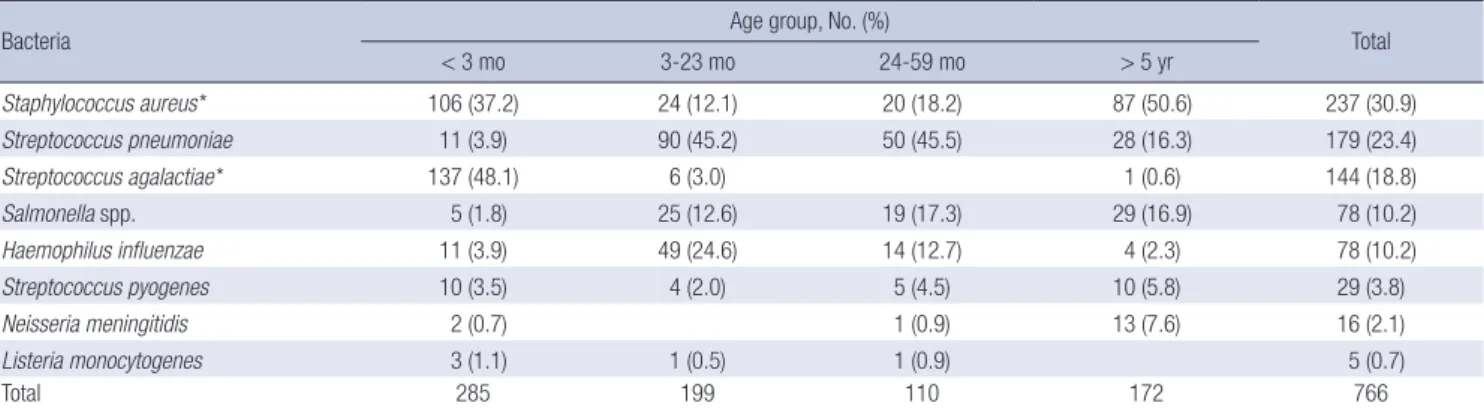
Age groups were stratified as follows: under 3 months, 3 to 23 months, 24 to 59 months, and 5 yr or older. The number of cases was highest in the under-3-months age group, with 285 cases (37%), followed by the 3-23 month age group with 199 cases (26%) and the 5 yr and older age group with 172 cases (22%). Patients under 5 yr of age accounted for 77% of all cases. The age-related distribution of causative bacterial organisms is shown in Table 1. The distribution of bacteria differed by age group, es-pecially at < 3 months and ≥ 5 yr of age. S. agalactiae was most frequently isolated from infants less than 3 months of age and accounted for 48.1% of the cases in this age group, followed by
S. aureus, which accounted for 37.2% of cases; these two
organ-isms were responsible for 85.3% of all invasive bacterial
infec-Table 1. Age distribution of causative organisms among 766 invasive infections from 1996 to 2005
Bacteria Age group, No. (%) Total
< 3 mo 3-23 mo 24-59 mo > 5 yr Staphylococcus aureus* 106 (37.2) 24 (12.1) 20 (18.2) 87 (50.6) 237 (30.9) Streptococcus pneumoniae 11 (3.9) 90 (45.2) 50 (45.5) 28 (16.3) 179 (23.4) Streptococcus agalactiae* 137 (48.1) 6 (3.0) 1 (0.6) 144 (18.8) Salmonella spp. 5 (1.8) 25 (12.6) 19 (17.3) 29 (16.9) 78 (10.2) Haemophilus influenzae 11 (3.9) 49 (24.6) 14 (12.7) 4 (2.3) 78 (10.2) Streptococcus pyogenes 10 (3.5) 4 (2.0) 5 (4.5) 10 (5.8) 29 (3.8) Neisseria meningitidis 2 (0.7) 1 (0.9) 13 (7.6) 16 (2.1) Listeria monocytogenes 3 (1.1) 1 (0.5) 1 (0.9) 5 (0.7) Total 285 199 110 172 766
tions identified in this age group. When this age group was di-vided by 1 week, separating neonatal infections into early and late onset infections (12), S. agalactiae accounted for 33.3% (28/ 84) of the early onset neonatal infections and 54.2% (109/201) of late onset neonatal infections, while S. aureus accounted for 56.0% (47/84) and 29.4% (59/201) of the early and late onset neonatal infections, respectively. Only 20.4% (28/137) of S.
aga-lactiae infections were early neonatal infections.
S. pneumoniae, H. influenzae, and Salmonella species were isolated frequently in infants and children 3 months of age or older. S. pneumoniae was the most common bacterial agent re-sponsible for invasive infections in infants and children aged 3 months to 5 yr, accounting for 45.3% (140/309) of cases. In con-trast, S. pneumoniae was the third most common cause of bac-terial infection in children older than 5 yr of age (16.3% of cases).
H. influenzae was a significant cause of infections in children
between 3 months and 5 yr of age and accounted for 21.0% of invasive infections that developed in this age group. H.
influen-zae infections were rare in children aged 5 yr or older.
Salmonel-la species accounted for 15.2% of invasive infections in children
aged 3 months or older. The percentage of S. aureus dropped to 14.2% in children between the ages of 3 months and 5 yr, and then increased sharply to 50.5% in children older than 5 yr.
Distribution of etiologic organisms according to clinical features
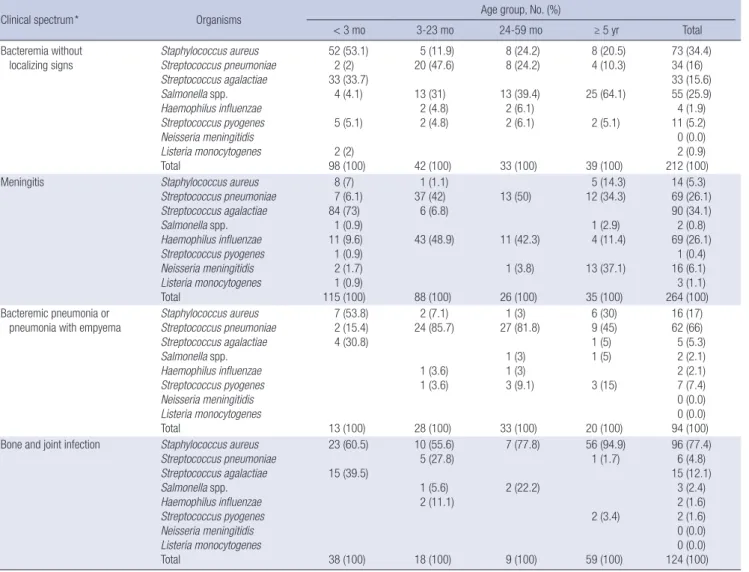
Among the 768 invasive bacterial infections identified, menin-gitis and bacteremia without localizing signs were the most fre-quent infections and accounted for 34.5% and 27.6% of all cas-es, respectively. Pneumonia with bacteremia or empyema counted for 12.4% of infections. Arthritis and osteomyelitis ac-counted for 8.5% and 7.7% of infections, respectively. Deep ab-scess formation and peritonitis accounted for 2.0% and 0.4% of infections, respectively. Other diseases not assigned to one of the above clinical entities accounted for 7.0% of infections. De-tailed age-specific distributions of causative organisms accord-ing to clinical features are presented in Table 2.
There were age-related differences in the distributions of
caus-Table 2. Distribution of causative bacterial organisms among 694 invasive infections from 1996 to 2005 by age and clinical spectrum
Clinical spectrum* Organisms Age group, No. (%)
< 3 mo 3-23 mo 24-59 mo ≥ 5 yr Total Bacteremia without localizing signs Staphylococcus aureus Streptococcus pneumoniae Streptococcus agalactiae Salmonella spp. Haemophilus influenzae Streptococcus pyogenes Neisseria meningitidis Listeria monocytogenes Total 52 (53.1) 2 (2) 33 (33.7) 4 (4.1) 5 (5.1) 2 (2) 98 (100) 5 (11.9) 20 (47.6) 13 (31) 2 (4.8) 2 (4.8) 42 (100) 8 (24.2) 8 (24.2) 13 (39.4) 2 (6.1) 2 (6.1) 33 (100) 8 (20.5) 4 (10.3) 25 (64.1) 2 (5.1) 39 (100) 73 (34.4) 34 (16) 33 (15.6) 55 (25.9) 4 (1.9) 11 (5.2) 0 (0.0) 2 (0.9) 212 (100) Meningitis Staphylococcus aureus
Streptococcus pneumoniae Streptococcus agalactiae Salmonella spp. Haemophilus influenzae Streptococcus pyogenes Neisseria meningitidis Listeria monocytogenes Total 8 (7) 7 (6.1) 84 (73) 1 (0.9) 11 (9.6) 1 (0.9) 2 (1.7) 1 (0.9) 115 (100) 1 (1.1) 37 (42) 6 (6.8) 43 (48.9) 88 (100) 13 (50) 11 (42.3) 1 (3.8) 26 (100) 5 (14.3) 12 (34.3) 1 (2.9) 4 (11.4) 13 (37.1) 35 (100) 14 (5.3) 69 (26.1) 90 (34.1) 2 (0.8) 69 (26.1) 1 (0.4) 16 (6.1) 3 (1.1) 264 (100) Bacteremic pneumonia or
pneumonia with empyema
Staphylococcus aureus Streptococcus pneumoniae Streptococcus agalactiae Salmonella spp. Haemophilus influenzae Streptococcus pyogenes Neisseria meningitidis Listeria monocytogenes Total 7 (53.8) 2 (15.4) 4 (30.8) 13 (100) 2 (7.1) 24 (85.7) 1 (3.6) 1 (3.6) 28 (100) 1 (3) 27 (81.8) 1 (3) 1 (3) 3 (9.1) 33 (100) 6 (30) 9 (45) 1 (5) 1 (5) 3 (15) 20 (100) 16 (17) 62 (66) 5 (5.3) 2 (2.1) 2 (2.1) 7 (7.4) 0 (0.0) 0 (0.0) 94 (100) Bone and joint infection Staphylococcus aureus
Streptococcus pneumoniae Streptococcus agalactiae Salmonella spp. Haemophilus influenzae Streptococcus pyogenes Neisseria meningitidis Listeria monocytogenes Total 23 (60.5) 15 (39.5) 38 (100) 10 (55.6) 5 (27.8) 1 (5.6) 2 (11.1) 18 (100) 7 (77.8) 2 (22.2) 9 (100) 56 (94.9) 1 (1.7) 2 (3.4) 59 (100) 96 (77.4) 6 (4.8) 15 (12.1) 3 (2.4) 2 (1.6) 2 (1.6) 0 (0.0) 0 (0.0) 124 (100) *Data are not presented for the 72 episodes of invasive infections that were not categorized as bacteremia, meningitis, bacteremic pneumonia, or bone and joint infections.
ative bacterial organisms among patients with bacteremia with-out localizing signs, meningitis and pneumonia. Among patients with bacteremia without localizing signs, S. aureus was frequent-ly isolated from infants less than 3 months of age and from chil-dren 5 yr of age or older. S. agalactiae was identified exclusively in infants less than 3 months old. S. pneumoniae and
Salmonel-la species were consistently isoSalmonel-lated from children 3 months of
age or older. As for meningitis, most cases that developed in the younger-than-3-months age group were attributed to S.
agalac-tiae (73.0%). However, in children aged between 3 months and
59 months, S. pneumoniae and H. influenzae were responsible for the majority of cases, accounting for 43.9% and 47.4% of in-fections, respectively. N. meningitidis was a significant cause of infection in the older-than-5-yr age group and was identified in 37.1% (13/35) of cases. Similarly, in cases with pneumonia, S.
aureus and S. agalactiae were frequently identified in younger
children while S. pneumoniae was more often identified in old-er children. In contrast, in deep tissue abscesses and bone and joint infections, S. aureus was the predominant organism across all age groups.
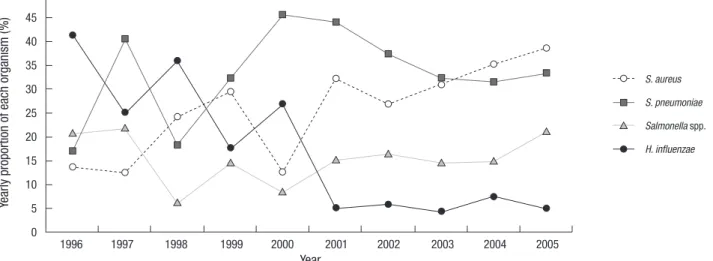
Ye ar ly p ro po rti on o f e ac h or ga ni sm (% ) Year 1996 1997 1998 1999 2000 2001 2002 2003 2004 2005 50 45 40 35 30 25 20 15 10 5 0 S. aureus S. pneumoniae Salmonella spp. H. influenzae
Fig. 2. Temporal changes in the relative proportions of the four most prevalent causative bacterial organisms of invasive infections in immunocompetent Korean children 3 months of age or older between 1996 and 2005.
Fig. 1. Distribution of causative bacterial organisms in invasive infections in immunocompetent Korean children between 1996 and 2005 according to age group and clinical spectrum. Pr op or tio n of o rg an is m (% ) 100 90 80 40 60 50 40 30 20 10 0 < 3 mo 10 6 73 34 40 61 54 15 31 5 53 7 Menin gitis Bacte temia witho ut focus Bone and J oint Infec tions Pneu monia 3-59 mo Menin gitis Bacte temia witho ut focus Bone and J oint Infec tions Pneu monia ≥ 5 yr Menin gitis Bacte temia witho ut focus Bone and J oint Infec tions Pneu monia 43 5 48 36 36 17 14 20 95 30 45 5 5 15 10 5 65 34 11 37 63 83 7 19 11 7 5 5 L. monocytogenes N. meningitidis S. pyogenes H. influenzae Salmonella spp. S. agalactiae S. pneumoniae S. aureus
The different distributions of organisms according to age group (especially, under 3 months, 3-59 months, and over 5 yr) for most clinical diagnoses are illustrated in Fig. 1.
Changes in the prevalence of bacterial organisms over time
The relative frequency of bacterial organisms was analyzed on a yearly basis (Fig. 2). The study was divided into two periods; the five years until the year 2000 (first period), and the five years after 2000 (second period). The relative frequency of each bac-terial organism during the first period was compared to the fre-quency during the second period (Table 3).
This analysis revealed a significant decline in invasive H.
in-fluenzae infections. During the first 5 yr of the study, 20.1% of all
invasive bacterial infections were attributed to H. influenzae; however, only 4.5% were due to H. influenzae during the latter five years (P < 0.001). This change was significant from 2001. The decreased frequency of H. influenzae infections was accompa-nied by a relative increase in S. pneumoniae and S. aureus tions (P = 0.475, P = 0.002). The increase in S. agalactiae infec-tions among infants less than 3 months of age during the study period was not significant (P = 0.130) based on a likelihood ra-tio for trends test.
Clinical outcomes
Clinical outcome were available for 671 (87%) of the 768 cases. The overall case-fatality rate was 6.4% (43/671) regardless of the type of bacterial organism or clinical diagnosis. When the data were analyzed according to clinical diagnosis, meningitis showed the highest case-fatality rate (11.9%, 28/235), followed by bacte-remia without localizing signs (5.6%, 10/180) and pneumonia (4.9%, 4/82). There was a slight but non-significant improvement in clinical outcomes over time. When the case fatality rate was analyzed according to age group, we found that the case fatality rate decreased with increasing age; infants less than 3 months of age showed the highest case-fatality rate (7.9%, 19/240), fol-lowed by the 3-23 month group (7.1%, 13/184), 24-59 month group (6.3%, 5/151), and children older than 5 years of age (3.3%,
5/151).
Among the bacterial organisms studied, N. meningitidis was associated with the highest case-fatality rate of 15.4% (2/13); however, the overall number of cases of N. meningitidis infec-tion was relatively small. When bacterial organisms found in 50 or more cases were analyzed, we found that S. pneumoniae had the highest case-fatality rate of 12.4% (20/161) followed by S.
aga-lactiae with a case fatality rate of 10.4% (13/125). S. aureus and Salmonella species had low case fatality rates of 3.0% (6/201) and
1.4% (1/69), respectively. No fatalities associated with H.
influ-enzae infection were identified during the study period. Although
not statistically significant, the case-fatality rates due to S.
pneu-moniae and S. agalactiae infections, which are associated with
higher mortality, improved in the latter half of the study period from 16.1% and 14.6% to 9.1% and 4.4%, respectively.
In terms of the frequency of sequelae associated with menin-gitis cases, H. influenzae had a very high sequelae rate of 31.8% (21/66). Sequelae associated with meningitis caused by the oth-er common infective organisms, namely S. pneumoniae, S.
aga-lactiae, and S. aureus, showed similar trends compared to the
case-fatality rates and were 47.8% (22/46), 34.8% (24/69), and 11.1% (1/9), respectively. The most common sequelae were hy-drocephalus and paralysis. Long term sequelae such as devel-opmental delay and cognitive impairment were not evaluated because of the retrospective nature of the study design.
DISCUSSION
The purpose of this study was to investigate the bacterial etiolo-gy of invasive infections in a pediatric population in Korea based on a retrospective multicenter review of hospital data. Although only 18 out of 89 university hospitals were included in this study, these hospitals have a nationwide distribution.
The distribution of causative bacteria responsible for invasive bacterial infections differs according to country and study peri-od. Saarinen et al. reported in a Finnish study performed during the 1980s that S. agalactiae and S. aureus accounted for 31% and 15% of invasive infections among neonates younger than 1 month
Table 3. Temporal trends in the relative proportions of bacterial organisms among 768 invasive infections from 1995 to 2005
Organisms Year, No. (%)
1996 1997 1998 1999 2000 Subtotal 2001 2002 2003 2004 2005 Subtotal Staphylococcus aureus 6 13 18 14 16 67 (24) 34 35 36 34 32 171 (35) Streptococcus pneumoniae 8 14 6 11 22 61 (21.9) 26 26 28 18 20 118 (24.1) Streptococcus agalactiae 3 5 10 13 21 52 (18.6) 15 23 20 16 19 93 (19) Salmonella spp. 7 7 3 5 5 27 (9.7) 9 11 11 8 12 51 (10.4) Haemophilus influenzae 11 9 13 8 15 56 (20.1) 7 4 3 5 3 22 (4.5) Streptococcus pyogenes 4 1 1 1 1 8 (2.9) 2 2 5 10 2 21 (4.3) Neisseria meningitidis 1 3 1 5 (1.8) 5 6 11 (2.2) Listeria monocytogenes 1 2 3 (1.1) 1 1 2 (0.4) Total 39 50 54 54 82 279 (100) 93 107 110 91 88 489 (100)
of age, while H. influenzae and S. pneumoniae accounted for 29% and 19% of infections among infants older than 1 month of age (9). During a similar period, S. pneumoniae was most fre-quently detected in Korean children older than 2 months of age, and accounted for 24% of infections, similar to the Finnish study (10). However, S. aureus and Salmonella species were more com-mon in Korea than in Finland with a frequency of 24% and 23%, respectively, while H. influenzae was relatively less common, accounting for only 14% of infections in Korea. In addition, there were fewer N. meningitidis infections in Korea than in other coun-tries (10).
It is well known that the distribution of causative bacterial or-ganisms changes with time. We detected significant changes in bacterial etiology in Korea compared to previous studies (10). Previously, Nam et al. (10) reported on the distribution of the bacterial pathogens responsible for invasive infections among immunocompetent children aged 2 months to 15 yr between 1986 and 1995. These authors found that S. aureus, S.
pneumoni-ae, Salmonella species, and H. influenzae were responsible for
the majority of invasive infections and accounted for 24%, 24%, 23%, and 14% of infections, respectively (10). Several previous studies performed in Korea reported that the estimated inci-dence of neonatal S. agalactiae infection was much lower than in other developed and developing countries, due to the low prevalence of S. agalactiae colonization in pregnant women (13, 14). Some notable findings of our study compared to previous studies are as follows. First, our data show that the proportion of S. pneumoniae and S. aureus infections increased, but the proportion of Salmonella species and H. influenzae infections decreased sharply in children older than 3 months of age. Sec-ond, the proportion of S. agalactiae infections was much higher than expected from previous reports.
S. aureus colonizes 50% of the general population at least once in their lifetime and causes a variety of diseases across all ages (15). S. aureus has been reported to be the dominant neonatal pathogen in western countries and in Korea (1, 13, 16). S.
aure-us caaure-uses the majority of skin, soft tissue, bone, and joint
infec-tions. Bacteremic infections caused by S. aureus are frequently nosocomial but in a pediatric study, about half of these infec-tions were community-acquired and common in infants young-er than 1 yr of age (17). Pneumonia due to S. aureus is common in early infancy (18). Generally, the frequencies of S. aureus in-fections in different age groups found in our study are consis-tent with those reported in previous studies. Although we could not determine the absolute increase in the incidence rate of S.
aureus infections in our study, we did observe an increase in
the relative proportion of S. aureus infections during the study period. This finding may be due either to the relative decrease in the number of H. influenzae infections or an increase in the number of nosocomial infections (19). However, considering that the subjects included in our study were apparently
immu-nocompetent infants and children, the proportion of S. aureus nosocomial infections in our study was likely very small. S. agalactiae remains the most important pathogen respon-sible for neonatal invasive infections in developed countries, despite the great improvements achieved by maternal antimi-crobial prophylaxis programs. Furthermore, although maternal screening programs have reduced early onset S. agalactiae in-fections, late onset infections have not been prevented (20). In this study, the proportion of S. agalactiae infections among in-fants less than 3 months of age was high throughout the study period, ranging from 30% to 65% of cases, and appears to have increased slightly since the late 1990s. This is a significant find-ing, because S. agalactiae was not previously regarded as an im-portant organism associated with neonatal infections in Korea. Previous Korean studies on the etiology of neonatal invasive in-fections reported that the most prevalent organisms were E. coli in the 1960s, S. aureus in the 1970s, and S. aureus and S.
epider-midis since the 1980s (16). A recent study also reported that S. aureus and coagulase-negative staphylococci were the most
fre-quently detected pathogens among neonates; S. agalactiae was identified in only 0.4% of cases (13). In contrast, we reported in a previous study that S. agalactiae and S. aureus were the most frequent organisms and accounted for 38% and 19% of invasive infections that occurred in infants less than 3 months of age, re-spectively, consistent with the results of the current study (11). This discrepancy may partly be due to differences in case defi-nitions. In the prior Korean studies, cases with a single positive blood culture result with clinical features suggesting sepsis were included and all neonatal infections were enrolled, including infections in premature babies, patients with congenital anom-alies, and patients in the intensive care unit. However, in the current study, only infections from previously healthy full-term neonates were analyzed. For a more accurate description of the epidemiology of neonatal infections, further studies that specif-ically target this age group are required. Based on our findings, we conclude that S. agalactiae infections are as prevalent as S.
aureus infections in healthy Korean neonates.
S. pneumoniae is the major etiologic agent of invasive bacte-rial infections in children. In this study, S. pneumoniae account-ed for 45% of infections that occurraccount-ed among children agaccount-ed be-tween 3 months and 5 yr of age, consistent with the findings of previous studies. With the reduction in the number of H.
influ-enzae infections, S. pneumoniae was the predominant pathogen
associated with meningitis, bacteremia without localizing signs, and pneumonia in this age group during the study period. In addition to the large number of cases, its severity, measured as the case-fatality rate, and residual sequelae make S.
pneumoni-ae an important bacterial pathogen and target for a vaccination
program. Furthermore, S. pneumoniae has a high rate of resis-tance to antibiotics in Korea (21). As noted from the experience of other countries, S. pneumoniae infections can be
dramatical-ly reduced with universal vaccination using a 7-valent pneumo-coccal conjugate vaccine. Data from the Active Bacterial Core surveillance (ABCs) showed a rapid decline in the incidence of invasive pneumococcal infections from 87.4 per 100,000 chil-dren younger than 5 yr of age in 1999 to 21.2 in 2005 (22, 23). The pneumococcal conjugate vaccine was introduced in Korea in 2003. By 2007, only 12.5% of Korean children had completed the primary series of pneumococcal conjugate vaccinations (unpub-lished data). Therefore, the proportion of S. pneumoniae infec-tions in this study represents the pre-vaccination era incidence of S. pneumoniae infections.
H. influenzae was an important cause of invasive bacterial infections such as meningitis, pneumonia, epiglotitis, arthritis, and cellulitis in infants and young children before an effective vaccine was introduced. Although few studies on the disease burden associated with H. influenzae infections in Eastern Asian countries in the pre-vaccination era are available, it has been assumed that the incidence of H. influenzae infections was slight-ly lower in these countries than in the United States or Europe-an countries (5, 24). In a compilation of seven studies, H.
influ-enzae was the etiologic agent in only 30% of bacterial
meningi-tis infections among Korean children (24). Nam et al. also re-ported that H. influenzae infections accounted for only 13.9% of all invasive infections that occurred in children older than 2 months of age. Nevertheless, H. influenzae was a more common cause of bacterial meningitis than S. pneumoniae in the pre-vac-cination era in Korea (5, 10).
In many developed countries where H. influenzae conjugate vaccine is routinely given to all infants, the incidence of H.
in-fluenzae invasive infections has declined dramatically (25). In
Korea, H. influenzae conjugate vaccine has been available since 1996. H. influenzae vaccine has not been included in the Nation-al Immunization Program to date; it is available as an optionNation-al vaccine, and there has been a gradual increase in its use. Kim et al. estimated the vaccine uptake rate to be 16% in Jeollabuk-do in 2002 (5); in a recent nationwide surveillance study, the vac-cine uptake rate was estimated to be 65.2% in 2007 (unpublished data). In this study, H. influenzae infections comprised 10.2% of all invasive bacterial infections and 38.9% of meningitis infec-tions that occurred in children 3 months of age or older. These findings are consistent with data from the pre-vaccination era. However, a vaccination effect was observed when the results were analyzed by dividing the study period into two parts. In the first half of the study period, H. influenzae infections accounted for 20.1% (56/279) of all invasive infections and 54.2% (45/83) of meningitis infections in children 3 months of age or older. However, this dropped to 4.5% (22/489) of all invasive infections and 19.7% (13/66) of all meningitis infections in the latter half of the study period. Therefore, a vaccination effect is evident in Korea.
Salmonella species are one of the most important water- and
food-borne pathogens in developing countries. With improve-ments in hygiene in developed countries, Salmonella infections have decreased although in some countries, an increase in
monella bacteremia has been reported (26). In this study, Sal-monella infections decreased from 23% in the ten years prior to
1996 to 10% between 1996 and 2005 (10); however, a constant rate of infection was observed during the study period. This ob-served decrease was probably due to improvements in hygiene since the study period investigated by Nam et al. (10). However,
Salmonella species were still very commonly isolated in
bacte-remia without localizing signs in children 3 months of age or older; 21% of the infections in this age group were attributed to this organism. Of 78 Salmonella isolates, serogroup data was available for 70. Among these, 33 isolates were S. typhi and an-other 3 isolates were S. paratyphi. Although S. typhi and S.
para-typhi may cause extra-intestinal salmonellosis, the proportions
of these two isolates were quite high compared to the findings reported by other countries (27, 28). Among non-typhoid salmo-nellosis cases, serogroups B and D were most frequently isolat-ed and accountisolat-ed for 17% and 16% of all Salmonella isolates for which serogroup data was available.
In this study, the pathogens associated with a high case fatal-ity rate were S. pneumoniae, S. agalactiae, and N. meningitidis with fatality rates of 12.4%, 10.4%, and 15.4%, respectively. The case fatality rate due to invasive pneumococcal infections was comparable to the 13.0% reported by Nam et al. (10) and the 12.0% reported by Lee et al. (11). However, the case fatality rates were slightly worse than those reported by ABCs for S.
pneumoni-ae, S. agalactipneumoni-ae, and N. meningitidis of 9.3%, 9.5%, and 13.7%,
respectively. The overall case fatality rate (11.9%) due to menin-gitis was slightly better than that reported by Nam et al. (14.3%) a decade earlier and that reported by Lee et al. (18%) for a single tertiary center. This difference may be due to improved manage-ment over time and patient selection bias. However, when ana-lyzed by organism, the case fatality rate of pneumococcal versus non-pneumococcal meningitis was 26.7% vs 4.5%. Although case fatality rate due to pneumococcal meningitis improved in the latter half of the study period from 31.8% to 21.7%, this fatal-ity rate is still significantly higher than that of developed coun-tries (29). The case fatality rates due to invasive pneumococcal infections other than meningitis were low at 4.9%. The reason for the higher fatality rate due to pneumococcal meningitis in Korea is unclear. However, this finding highlights the importance of implementation of pneumococcal conjugate vaccination in Korea. The case fatality rate of bacteremia without localizing signs was 5.9%. All mortalities due to this clinical entity were at-tributed to three organisms: S. pneumoniae, S. aureus, and S.
agalactiae. The case fatality rate due to infection by S. pneumoni-ae, S. aureus, and S. agalactiae was 9.7%, 4.6%, and 11.1%,
re-spectively. The case fatality rate due to other clinical entities was 2.0%.
This study had several limitations. We targeted only eight bac-terial organisms. However, in a previous study that we performed at the Seoul National University Hospital and published in 2005, we showed that these eight organisms accounted for 88% of all invasive bacterial infections (11). Therefore, by focusing on these eight bacterial organisms, most of the invasive bacterial infec-tions were likely included in our analysis. Nevertheless, Gram-negative bacteria and bacteria with low pathogenicity such as coagulase-negative staphylococci are relatively important or-ganisms in neonates, thus our study results might have been skewed by focusing only on eight bacterial organisms. In addi-tion, because we included hospital-acquired infections in our study in contrast to previous studies, the possibility of bias can-not be ruled out. The retrospective design of the study may also have resulted in a bias. A selection bias might also have been introduced by doctors requesting laboratory tests for office pa-tients; however, cases with mild illness such as occult bactere-mia, where the attending doctor might not perform cultures, were excluded from this study. Because S. pneumoniae is the most common cause of occult bacteremia (30), the proportion of S. pneumoniae might have been underestimated. Variations in laboratory protocols for detection of bacteria in the participat-ing hospitals could also have affected our results. Earlier cases might have been missed because of missing medical record in-formation. For a more accurate description of the distribution and etiology of invasive bacterial infections in Korea, further well-designed prospective studies are needed.
In conclusion, the relative importance of H. influenzae and
Salmonella species as invasive pathogens in Korean children is
decreasing compared to S. pneumoniae and S. aureus. In con-trast to previous studies, invasive S. agalactiae infections were as common as S. aureus infections in young infants. Future health policies need to focus on S. pneumoniae and S. agalactiae in-fections because these inin-fections are both common and severe.
REFERENCES
1. McCracken GH Jr. Group B streptococci: the new challenge in neonatal
infections. J Pediatr 1973; 82: 703-6.
2. Schuchat A, Hilger T, Zell E, Farley MM, Reingold A, Harrison L, Lefkow-itz L, Danila R, Stefonek K, Barrett N, Morse D, Pinner R; Active Bacte-rial Core Surveillance Team of the Emerging Infections Program Net-work. Active bacterial core surveillance of the emerging infections
pro-gram network. Emerg Infect Dis 2001; 7: 92-9.
3. Adams WG, Deaver KA, Cochi SL, Plikaytis BD, Zell ER, Broome CV, Wenger JD. Decline of childhood Haemophilus influenzae type b (Hib)
disease in the Hib vaccine era. JAMA 1993; 269: 221-6.
4. Hsu K, Pelton S, Karumuri S, Heisey-Grove D, Klein J; Massachusetts Department of Public Health Epidemiologists. Population-based
sur-veillance for childhood invasive pneumococcal disease in the era of con-jugate vaccine. Pediatr Infect Dis J 2005; 24: 17-23.
5. Kim JS, Jang YT, Kim JD, Park TH, Park JM, Kilgore PE, Kennedy WA,
Park E, Nyambat B, Kim DR, Hwang PH, Kim SJ, Eun SH, Lee HS, Cho JH, Kim YS, Chang SJ, Huang HF, Clemens JD, Ward JI. Incidence of
Hae-mophilus influenzae type b and other invasive diseases in South Korean children. Vaccine 2004; 22: 3952-62.
6. Shin S, Shin YJ, Ki M. Cost-benefit analysis of Haemophilus influenzae
type B immunization in Korea. J Korean Med Sci 2008; 23: 176-84.
7. Choi E. Direct and indirect effects of pneumococcal protein conjugate
vaccine. J Korean Med Assoc 2008; 51: 119-26.
8. KOSIS. Korean statistical information service. Available at http://kosis.
kr/nsportal/index/index.jsp [accessed on 18 Aug 2010].
9. Saarinen M, Takala AK, Koskenniemi E, Kela E, Rönnberg PR, Pekkanen E, Kiiski P, Eskola J. Spectrum of 2,836 cases of invasive bacterial or
fun-gal infections in children: results of prospective nationwide five-year sur-veillance in Finland. Finnish Pediatric Invasive Infection Study Group. Clin Infect Dis 1995; 21: 1134-44.
10. Nam SG, Lee HJ. Etiology of invasive bacterial infections in apparently
healthy children. Korean J Infect Dis 1998; 30: 227-34.
11. Lee JH, Song EK, Lee JA, Kim NH, Kim DH, Park KW, Choi EH, Lee HJ.
Clinical entities and etiology of invasive bacterial infections in apparent-ly healthy children. Korean J Pediatr 2005; 48: 1193-200.
12. Stoll BJ. Infections of the neonatal infant. In: Kligman RM, Behrman RE,
Jenson HB, Stanton BF, eds. Nelson textbook of pediatrics, 18th ed. Phila-delphia: Elsevier Saunders 2007; 794-811.
13. Kim KA, Shin SM, Choi JH. A nationwide survey on the causative
organ-isms of neonatal sepsis in Korea. J Korean Pediatr Soc 2002; 45: 55-63.
14. Moon JH, Oh SH, Kim HW, Moon SJ, Choi TY. Neonatal sepsis and
an-timicrobial susceptibilities in the neonatal intensive care unit and nurs-ery. Korean J Pediatr Infect Dis 2002; 9: 163-74.
15. Ammerlaan HS, Kluytmans JA, Wertheim HF, Nouwen JL, Bonten MJ.
Eradication of methicillin-resistant Staphylococcus aureus carriage: a systematic review. Clin Infect Dis 2009; 48: 922-30.
16. Lee JH, Park JJ, Sung IK, Lee BC. Clinical observation in 40 cases with
neonatal sepsis. J Korean Pediatr Soc 1990; 33: 1489-94.
17. Suryati BA, Watson M. Staphylococcus aureus bacteraemia in children:
a 5-year retrospective review. J Paediatr Child Health 2002; 38: 290-4.
18. Sattler CA, Correa AG. Coagulase-positive staphylococcal infections
(Staphylococcus aureus). In: Feigin RD, Cherry JD, Demmler GJ, Kaplan SL, eds. Textbook of pediatric infectious diseases, 5th ed. Philadelphia: Elsevier Saunders 2004; 1099-129.
19. Lowy FD. Staphylococcus aureus infections. N Engl J Med 1998; 339:
520-32.
20. Centers for Disease Control and Prevention (CDC). Perinatal group B
streptococcal disease after universal screening recommendations-United States, 2003-2005. MMWR Morb Mortal Wkly Rep 2007; 56: 701-5.
21. Jang GC, Shin KM, Yong DE, Lee KW, Kim DS. Changing patterns of
an-tibiotic-resistant rates and clinical features in pneumococcal infections. Korean J Pediatr Infect Dis 2003; 10: 81-6.
22. Centers for Disease Control and Prevention. Active Bacterial Core
Sur-veillance Report, Emerging Infections Program Network, Streptococcus pneumoniae, 1999. Available at http://www.cdc.gov/abcs/survreports/ spneu99.pdf [accessed on 18 Aug 2010].
23. Centers for Disease Control and Prevention. Active Bacterial Core
Sur-veillance Report, Emerging Infections Program Network, Streptococcus pneumoniae, 2005. Available at http://www.cdc.gov/abcs/survreports/ spneu05.pdf [accessed on 18 Aug 2010].
24. Lee HJ. Epidemiology of systemic Haemophilus influenzae disease in
Ko-rean children. Pediatr Infect Dis J 1998; 17 (9 Suppl): S185-9.
25. Peltola H. Worldwide Haemophilus influenzae type b disease at the
be-ginning of the 21st century: global analysis of the disease burden 25 years after the use of the polysaccharide vaccine and a decade after the advent of conjugates. Clin Microbiol Rev 2000; 13: 302-17.
26. Yagupsky P, Maimon N, Dagan R. Increasing incidence of nontyphi
Sal-monella bacteremia among children living in southern Israel. Int J Infect Dis 2002; 6: 94-7.
27. Ispahani P, Slack RC. Enteric fever and other extraintestinal
salmonello-sis in University Hospital, Nottingham, UK, between 1980 and 1997. Eur J Clin Microbiol Infect Dis 2000; 19: 679-87.
28. Vugia DJ, Samuel M, Farley MM, Marcus R, Shiferaw B, Shallow S, Smith
K, Angulo FJ; Emerging Infections Program FoodNet Working Group.
Invasive Salmonella infections in the United States, FoodNet, 1996-1999: incidence, serotype distribution, and outcome. Clin Infect Dis 2004; 38 Suppl 3: S149-56.
29. Arditi M, Mason EO Jr, Bradley JS, Tan TQ, Barson WJ, Schutze GE, Wald ER, Givner LB, Kim KS, Yogev R, Kaplan SL. Three-year multicenter
sur-veillance of pneumococcal meningitis in children: clinical characteris-tics, and outcome related to penicillin susceptibility and dexamethasone use. Pediatrics 1998; 102: 1087-97.
30. Alpern ER, Alessandrini EA, Bell LM, Shaw KN, McGowan KL. Occult
bacteremia from a pediatric emergency department: current prevalence, time to detection, and outcome. Pediatrics 2000; 106: 505-11.
AUTHOR SUMMARY
Etiology of Invasive Bacterial Infections in Immunocompetent Children in Korea
(1996-2005): A Retrospective Multicenter Study
Joon-Ho Lee, Hye Kyung Cho, Kyung-Hyo Kim, Chang Hwi Kim, Dong Soo Kim, Kwang Nam Kim, Sung-Ho Cha, Sung Hee Oh, Jae Kyun Hur, Jin Han Kang, Jong Hyun Kim, Yun-Kyung Kim, Young Jin Hong, Eun Hee Chung, Soo-Eun Park, Young Youn Choi, Jung Soo Kim, Hwang Min Kim, Eun Hwa Choi, and Hoan Jong Lee
The aim of this study was to investigate distribution of 8 major causative organisms of childhood invasive infectious diseases by retrospective measure in 18 university hospitals during 1996-2005. S. agalactiae was frequent in meningitis, bacteremia and bone and joint infections of young infants (< 3 months). S. aureus was frequent in meningitis and bacteremia of young infants and bone and joint infections of all age groups. S. pneumoniae was frequent in meningitis, bacteremia and pneumonia of the elder patients (> 3 months) H. influenzae was frequent in meningitis in the first half of study period but significantly decreased during the latter half of the study period. Salmonella species were frequent in bacteremia and bone and joint infections of the elder patients. S. pyogenes, N. meningitidis and L. monocytogenes were less frequently identified.