New Complementary Points of Cyber Security
Schemes for Critical Digital Assets
at Nuclear Power Plants
JUNYOUNG SON 1,2, (Member, IEEE), JONGGYUN CHOI1, AND HYUNSOO YOON 2, (Member, IEEE)
1Department of Nuclear ICT, Korea Atomic Energy Research Institute, South Korea
2Department of Graduate School of Information Security, Korea Advanced Institute of Science and Technology, South Korea
Corresponding author: JunYoung Son ([email protected])
ABSTRACT As the importance of cyber security for nuclear power plants has recently increased, related organizations such as manufactures, operators, regulators, and research institutes have taken into consider-ation the many concerns for effective applicconsider-ation of cyber security to critical digital assets at nuclear power plants. It is essential to analyze and research how to effectively apply nuclear cyber security requirements and what complementary factors are present in the overall process for a nuclear security technology system. The complementary points of nuclear cyber security technology could be analyzed through diverse cyber security methods such as cyber security assurance, assessments, and software development life cycle. It is necessary to apply nuclear cyber security technology effectively in accordance with the operation, assurance, and system development process of a nuclear facility. These analysis results could be applied to technical points for the cyber security of critical digital assets at nuclear power plants in the future and to technology that needs to be at the appropriate level of cyber security to ensure technical assurance. This paper is a new approach to compare and analyze various methods used in the cyber security field to discover complementary points for the application of cyber security to critical systems in nuclear power plants. Additionally, this paper also presents effective methods for developing and applying, evaluating, and regulating cyber security in nuclear digital critical systems using the complementary points of various cyber security methods identified in the analysis.
INDEX TERMS Nuclear power plant, I&C, digital system, cyber security, regulatory guide, safety,
assurance, CC, SDOE, V&V, SDL, assessment, ICS.
I. INTRODUCTION
In today’s modern world, Information Technology (IT) has advanced dramatically and been applied to the Industrial Control Systems (ICSs) of critical national infrastructures, including power, energy, water, transportation, telecommu-nication and nuclear power. As the use of digital systems in infrastructure facilities increases and the possibility of intelligent cyber-attacks against infrastructures is emerging, the enhancement of cyber security is needed for the critical digital systems of various infrastructure facilities. Among these facilities, nuclear facilities are classified as the most important facilities; thus, the possibility of any attack also needs to be neutralized. In fact, cyber-attacks such as Stuxnet The associate editor coordinating the review of this manuscript and approving it for publication was Yang Li.
succeeded in attacking nuclear power plants (NPPs), and since then, cyber-attacks have been increasing and becom-ing more diverse and offensive. For instance, a malware-based attack hit the Japanese Monju NPP in 2014, and the computer systems at a NPP in South Korea were hacked in 2014. There was a Ukraine power grid cyber-attack in 2015, and a German NPP was found to be infected with computer viruses. And recently, the US government and var-ious energy fields announced there have been some consis-tent poconsis-tential hacking attacks, which have the code name ‘‘Nuclear 17.’’ Thus, there have been many potential cyber-attacks. Because cyber-attacks against digitalized systems have become more complex and sophisticated, research on the application and strengthening of cyber security func-tions for Nuclear digital systems against possible cyber-attack scenarios has become even more important. The US
Nuclear Regulatory Commission (NRC) issued Regulatory Guide (RG) 5.71, ‘‘Cyber Security Programs for Nuclear Facilities’’ [2], complying with the 10th Code of Federal Regulations (CFR) 73.54 in 2010 and RG 1.152 revision 3, ‘‘Criteria for Use of Computers in Safety Systems of Nuclear Power Plants’’ [1], complying with both 10 CFR Part 50 and the General Design Criteria (GDC). The computer security at Nuclear Facilities (2011) [39], published by the International Atomic Energy Agency (IAEA), provides technical guid-ance on recommendations and implementation to ensure the security and safety of digital instrumentation control (I&C) systems and communication networks against cyber infil-tration and malicious behavior. In addition, the Nuclear Energy Institute (NEI), Department of Energy (DOE), US and ICS Computer Emergency Readiness Team (CERT), Idaho National Laboratory (INL), National Institute of Standards and Technology (NIST), Sandia National Laboratory (SNL), and Pacific Northwest National Laboratory (PNNL) have presented the importance of nuclear-related cyber secu-rity and are engaged in research and activities related to cyber security. This paper explores the complementary points of various methods of applying cyber security technology to nuclear digital control systems compared to references which have been developed for the assessment and devel-opment of IT cyber security. Because existing cyber security evaluation methods and application technologies are continu-ously being developed, their analyses could help find comple-mentary points in various cyber security evaluation methods and applications in infrastructure facilities and NPPs. The evaluation technology of cyber security for commercial IT products is continuously evolving and uses the Common Criteria (CC) certification technique [25]–[28]. Korean pub-lic institutions require the use of CC-certified commercial IT products. However, infrastructure control and nuclear I&C systems are not included in the CC certification for eval-uating and applying security requirements. Nuclear power control systems should have their own cyber security eval-uation and regulation architecture due to existing licens-ing and development and operational life cycle. Typically, the nuclear field has focused on licensing and regulating safety functions and have applied Verification and Valida-tion (V&V) for the funcValida-tional evaluaValida-tion of safety in I&C systems [32]. RG 1,152 and RG 5.71 have been developed in accordance with the system of regulations and technol-ogy application for these NPP I&C system functions. There are typical software development life-cycle techniques that apply security to software products. Some of the methods to integrate security into the software development lifecy-cle (SDL) are the OenSAMM, BSIMM, SAFECode and Securosis [9]–[17]. They are used to build and maintain safer software products. Nowadays, secure software development lifecycles (SSDLs) are used to find and eliminate vulnera-bilities early in the development process. The typical meth-ods are OWASP Comprehensive, Lightweight Application Security Process (CLASP) [18], Microsoft-Secure Develop-ment Lifecycle (MS-SDL) [15], [16], and Software Security
Touchpoints [11]. Complementary points could be found through a comparative analysis of these advanced schemes for the evaluation of nuclear cyber security. Although regulatory and appraisal assessment methods have been discussed on how to implement cyber assessments and presented in RG 1.152 and RG 5.72, there are difficulties for which specific cyber security functions have to be developed and applied and evaluated according to the viewpoints in the regulations system. This paper presents three viewpoints. First, this paper explains that the analysis points differ depending on each relationship between the existing safety views and the recent important cyber security views. Second, this paper describes the complementary points of nuclear I&C cyber security com-pared with advanced security application schemes. Secure Development Operational Environment (SDOE) in RG 1.152, applied V&V methods in nuclear I&C and secure coding are analyzed and compared with other cyber security schemes to find complementary points. Third, this paper discusses addi-tional issues that should be considered in the application of cyber security assessment technology in nuclear I&C systems by comparing with CC and other evaluation schemes which are the cyber security assessment technologies that have been implemented in existing IT systems. Additionally, this paper proposes a necessary assessment scheme for application to cyber security for nuclear I&C. This paper analyzes RG 1.152 and RG 5.71, which are lacking in comparison with other cyber security development methods and assessment methods for application to I&C cyber security requirements of NPPs. Nuclear power regulations require software assur-ance by classifying systems. This paper also describes the various considerations required for introducing the assurance concept to the assurance assessment of nuclear cyber security.
II. NUCLEAR CYBER SECURITY FRAMEWORK
A. NUCLEAR CYBER SECURITY REGULATORY PROCESS CONCEPT
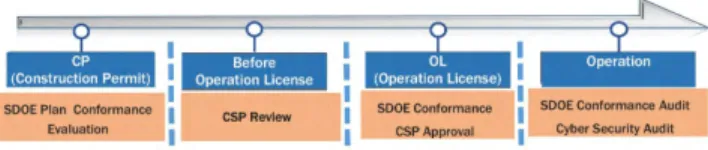
To date, the regulatory framework has classified a nuclear system as a safety system and a non-safety system, and it has focused on safety functions. Safety related features have been identified through such means as software quality assur-ance (QA) and V&V. Security seems to be classified as one of the features which is an unsafe function. The application of nuclear cyber security could be defined in two ways with reference to US regulatory requirements which are the SDOE and Cyber Security Plan (CSP). The overall summary scheme for nuclear cyber security regulations including the SDOE and CSP regulatory inspections are shown in Fig.1. For the developer, the SDOE should be submitted together with the relevant information before applying for a construction license in the Korean regulatory process [3]. Details of the SDOE can be found in RG 1.152 and KINS/RG-N0813 [3]. The CSP should be submitted before applying for an oper-ation license (OL). And then, after the OL which includes the SDOE conformity and CSP approval, a SDOE confor-mance audit and cyber security audit are conducted under commercial operation.
FIGURE 1. Nuclear cyber security regulation application process in Korea.
FIGURE 2. Security-safety relationships.
B. CYBER SECURITY & SAFETY RELATIONSHIP IN NUCLEAR I&C
Cyber security should be considered in terms of confiden-tiality, integrity, and availability of Critical Digital Asset (CDA) [2], [4], [5]. This paper describes the relationship between safety and cyber security from three perspectives, cyber security in terms of safety, safety in terms of cyber security, the intersection of safety and cyber security. If mali-cious codes infect the safety system, it may not affect any safety functions. Cyber-attacks can hardly be detected and defended against using current nuclear regulations that focus on safety functions. Depending on the technical viewpoints of safety and cyber security, the following cases, shown in Fig.2, can be defended and overlooked. First, if a cyber-attack is considered as an attribute of safety, the parts that affect safety functions need to be considered. The ENB-6370/IEEE Std. 7-4.3.2-2003 5.6 [35] describes that non-safe functions do not affect the safety functions of software or firmware. It should be ensured that it does not affect the existing safety due to the security function, but it is also not correct if an insufficient security function causes a serious threat to the safety of an existing system. The focus on safety functions in nuclear I&C has evolved from criteria to classifying and adhering to features that can affect safety functions, which could include cyber security. Thus, integrity and availability related to safety functions are import to safety-related system. Second, if safety is considered as an attribute of cyber security, any threat or cyber-attack on confidentiality, integrity, and avail-ability must be detected and defended against. Having a bad influence on the safety function is just one of the cyber-attack scenarios which are attacking the original operation functions of the system. And if a nuclear power plant trip occurs but the safety function has been functioning normally from a safety set point, there is no problem with the safety function. However, cyber-attacks that cause a plant to trip must be defended against and studied because the cyber-attacks could adversely affect the operation of NPPs and the economy of a country. Third, safety and cyber security are defined at the same level and in relation to each other. In this case, the parts
to be applied and regulated by each viewpoint of cyber security and safety are studied, and the parts that intersect are considered together. Although there may be several things, event and accident investigations of nuclear I&C systems could be the intersection where safety and cyber security must cooperate. In terms of safety, technologies for regulatory and system stabilization have been developed. On the other hand, in terms of cyber security, more intelligent and aggressive cyber-attacks are being tried. The problem is that the level of cyber-attacks and cyber security are rapidly developing. Infrastructure, including nuclear power, which is complicated and physically secure, is no exception. These critical facilities also need to continuously develop countermeasures in accor-dance with the level of attack and possible technical cyber-attacks. In order to develop these defensive and applicable technologies, it is necessary to carry out a comparative anal-ysis of the complementary points of cyber security applied to infrastructure facilities and reference points as the cyber security technology of commercial IT technology develops.
III. SOFTWARE DEVELOPMENT AND SECURITY
The SDL is a conceptual model used to manage software analysis, development, control, and maintenance processes in a software company. Security awareness was not enough and not considered at the time SDL was developed. Thus, the SDLs in the past are not effective as security systems against security threats. The three most relevant secure SSDL that development companies have adopted are the Microsoft Security Development Lifecycle, the CLASP and the Soft-ware Security Touchpoints. And there are three method-ologies that could be adapted to an existing SDL – the OpenSAMM, the BSIMM and the SAFECode, and Securosis built a web application as a security program
A. MS-SDL
Microsoft has adopted its own SDL methodology to develop secure software and is considered as a mandatory policy since 2004. The method is based on threat modeling per-formed during the early stages of development. Potential attack vectors or threats are added to the model, which can correct the product design flaws and prevent these cyber-attacks. To find design defects, the system is decomposed into components, and each component is analyzed according to each method of STRIDE (Spoofing, Tampering, Repudi-ation, Information disclosure, Denial of service, Elevation of privilege). The Microsoft SDL model takes into account aspects such as fuzzing, cryptographic standards, bug bar, verification testing, banned Application Programming Inter-face, Privacy standard, Runtime verification testing, Online services requirements, Cross-site request forgery defenses, SQL injection defenses, XML parsing defenses, Address space layout randomization (ASLR), Operational security reviews, and third-party licensing security requirements to enhance the ability to defend against security attacks. The overall basic steps of Microsoft SDL are shown in Fig. 3.
FIGURE 3. Microsoft SDL.
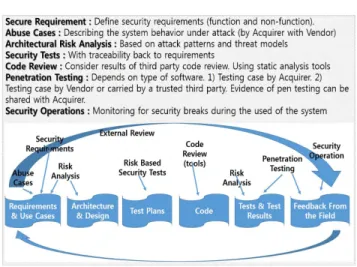
FIGURE 4. Seven touchpoints SDL. B. SEVEN TOUCHPOINTS
The Seven Touchpoints model, which is one of the secu-rity development methods, enhances explicit tracking and monitoring of software security risk factors according to the risk management framework during development. It requires developers to focus on seven security enhancement activi-ties at each step of the software security touchpoints. This method has two important aspects, source code analysis and architectural risk analysis, which focus on finding bugs in the code and design. The activities of the touchpoints are code review, risk analysis, penetration testing (PT), risk-based security tests, abuse cases, security requirements, and security operation shown in Fig. 4. The touchpoints provide a mix of black-hat and white-hat activities, both of which are necessary to get effective results. Black-hat activities are attacks, exploits and breaking software (e.g., PT). White-hat activities are more constructive in nature and cover design, controls and functionality (e.g., code review).
C. CLASP
The CLASP has been round since 2006 and the OWASP project. The CLASP provides a well-organized and struc-tured approach with formalized security and best practices for moving security concerns into the early stages of the SDL. There are five high level perspectives called CLASP views, and these views are broken down into activities which contain process components. There is a set of 24 security related activities that can be easily integrated into the SDL of an application which enables systematically addressing security vulnerabilities. Eleven CLASP resources provide tools and other artifacts to help automate the process wherever possible.
The CLASP relies on the organization of the project team in roles where each one has a perfectly defined set of activities and responsibilities that they must take care of. The Clasp process is as follows: 1) Concepts View, the basics of which must be satisfied for authorization, confidentiality, authen-tication, availability, accountability, and non-repudiation; 2) Role-Based View, the authentication management that a project team should execute for security issues depending on the specific responsibilities of ever role (project man-agers, security auditors, developers, architects, testers, and others); 3) Activity-Assessment View, there are 24 security related process activities. These are the Institute security awareness program, Monitor security metrics, Specify oper-ational environment, Identify global security policy, Iden-tify resources and trust boundaries, IdenIden-tify user roles and resource capabilities, Document security-relevant require-ments, Detail misuse cases, Identify attack surface, Apply security principles to design, Research and assess security posture of technology solutions, Annotate class designs with security properties, Specify database security configuration, Perform security analysis of system requirements and design (threat modeling), Integrate security analysis into source management process, Implement interface contracts, Imple-ment and elaborate resource 9 policies and security technolo-gies, Address reported security issues, Perform source-level security review, Identify, implement and perform security tests Verify security attributes of resources, Perform code signing, Build operational security guide, and Manage secu-rity issue disclosure process; 4) Activity Implementation View, Analyze the security related activities, and 5) Vul-nerability View, state risks, problem types, consequences, exposure periods, avoidance and mitigation techniques of security vulnerabilities. It manages 104 vulnerability types under 5 high-level categories.
D. SEVERAL INITIATIVES AIMED AT INTEGRATING SECURITY IN THE CURRENT SDL
There are several initiatives aimed at integrating security in the SDL currently being used by organizations. These are OpenSAMM, BSIMM, SAFECode and Securosis. The following is brief explanations on their contents. New NPPs are subject to the new requirements for nuclear cyber secu-rity regulations. In the case of operating power plants, this section’s methods could be considered as ways to enhance security in existing life cycle systems to decrease and reduce development costs of security application development. 1) OPEN SOFTWARE ASSURANCE MATURITY
MODEL (OPENSAMM)
The OpenSAMM was designed to be easily followed by non-security professionals. The model has four steps (Gov-ernance, Construction, Verification, and Deployment) that have three security practices in each step shown in Fig.5. The model can be used to evaluate a security assurance program and to score the security level. It helps organizations build
FIGURE 5. The openSAMM model (adapted from Pravir Chandra, 2009).
FIGURE 6. BSIMM (adapted from McGraw et al., 2009).
FIGURE 7. SAFECode activities.
and implement software security strategies. According to this model project or time-based audit, it can improve the level of organization security
2) BUILDING SECURITY IN MATURITY MODEL (BSIMM) The BSIMM consists of 12 normalized practices, each with several activities and grouped into four domains shown in Fig.6. A use of this model is similar with OpenSAMM to consider the three levels of maturity with software security. This model is simpler to implement than OpenSAMM, but lacks some information, such as guidance on how to measure and rank activities to achieve similar benchmarks that can be used throughout the organization.
3) SOFTWARE ASSURANCE FORUM FOR EXCELLENC-E IN CODE (SAFECODE)
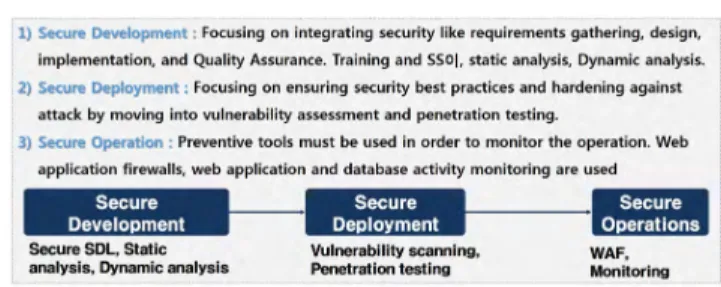
SAFECode is an industry-leading consortium founded in 2007, including EMC, Juniper Networks, Microsoft, Nokia, SAP and Symantec. It is intended to increase the trust of information and communication technology products and services. SAFECode focuses on the six steps shown in Fig.7 4) SECUROSIS BUILDING A WEB APPLICATION
SECU-RITY PROGRAM
SAFECode is an industry-leading consortium founded in 2007, including EMC, Juniper Networks, Microsoft, Nokia, SAP and Symantec. It is intended to increase the trust of information and communication technology prod-ucts and services. SAFECode focuses on six steps shown in Fig.8.
FIGURE 8. Securosis building a web application security program.
IV. COMPARATIVE ANALYSIS BETWEEN SDOE AND SDL AND SSDL
A. SDOE DESCRIPTION
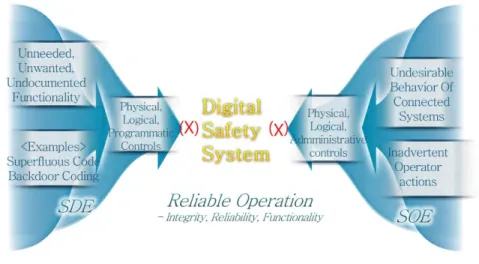
The regulations 1.152 and KINS/RG-N08.13 describe regula-tions for promoting high functional reliability, design quality, and a SDOE for the use of digital computers in the safety systems of NPPs shown in Fig. 9. The regulations do not address the ability of protective features against malicious attacks. These regulations are limited to ensuring that the designed features do not adversely affect or degrade the sys-tem’s reliability or its capability to perform its safety function. Secure development environment (SDE) must ensure a secure environment for the development of digital safety systems against unwanted, unneeded and undocumented functions by physical, logical, programmatic controls. SOE must ensure a secure environment during operation of digital safety sys-tems against undesirable connected syssys-tems and inadvertent operator actions by physical, logical and administrative con-trols. SDOE must ensure the reliable operation of digital safety systems against challenges to the integrity, reliability, or functionality. SDOE has a different definition compared to SDLs and SSDLs. The contents specified in RG 1.152 and KINS/RG-N08.13 do not intend to comply with the cyber security requirements of 10 CFR 73.54. Because the defini-tion of SDOE is different with existing security development concepts, it is concerned with which specific controls must be applied to the digital safety system shown in Fig.10. SDE describes considerable cases of unwanted, unneeded and undocumented functions as superfluous code and backdoor coding during the development phase. Other sections present an analysis of the technical controls against superfluous code, backdoor coding and undesirable, inadvertent events. SDE describes considerable cases of undesirable behavior of con-nected systems and inadvertent operator actions. It is difficult to understand exactly what SDOE means and what activities should be carried out in detail for the operators, developers, and regulatory portions. The next section compares the SDOE activities with other cyber security documents.
B. SDOE IN COMMON CRITERIA
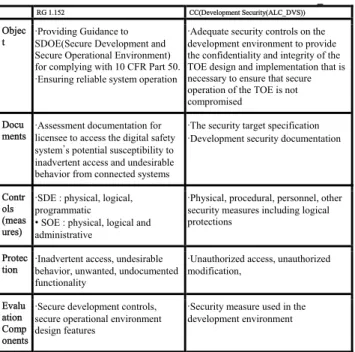
CC describes development security ALC-DVS related to RG1.152. Table 1 shows a comparative analysis between RG 1.152 and CC development security, ALC_DVS. The RG 1.152 requires control from the physical, logical,
FIGURE 9. SDOE.
FIGURE 10. SDOE regulatory position in the life cycle phases. programmatic, and administrative perspective, but it is dif-ficult to understand what activities are specified in detail for both operators and evaluators. Among the controls for a secure development environment, there is more detail in
the CC, and it is worth analyzing. This section compares and analyzes the contents of the ALC_DVS related to the devel-opment environment security with that of CC, and presents the details of the CC as well as the detailed activities that
TABLE 1. Comparison of RG1.152 to CC development security (ALC_DVS).
could be performed from the viewpoint of the SDOE in RG 1.152. CC assessment requires 1) and the ST 2) the devel-opment security documentation. According to ALC-DVS, it requires physical, procedural, personnel, and other secu-rity measures to protect the confidentiality and integsecu-rity of the target system in the development environment through development security assessment. Physical countermeasures define the physical access controls used to prevent unautho-rized access to the target system development environment. Procedural measures include the following: 1) limiting access 2) abolishing access to people who have left 3) transferring material that must be protected between development sites 4) allowing visitors to enter and escort them to the develop-ment environdevelop-ment and 5) roles and responsibilities to ensure continuous application of security measures and detection of security breaches. Personnel describes controls and confir-mations to establish trust for new development staff. Other security measures define logical protections against develop-ment equipdevelop-ment. The developdevelop-ment security docudevelop-mentation requires the following: 1) identify the locations at which development occurs and 2) describe the aspects applied to the development place. Because it is covered by the vulnerability analysis (AVA_VAN), the development security documen-tation should demonstrate the degree of protection required to maintain the confidentiality and integrity of the Target of Evaluation. Nuclear cyber security also requires vulnerability analysis in RG 5.71.
C. BACKDOORS AND SUPERFLUOUS CODES IN SDOE & SECURE CODING
Examples of undocumented code and functionality in the RG1.152 guide are superfluous codes and backdoor codes.
It is stated that they should be controlled so as not to be exploited or added. There are many techniques to prevent the incorrect use of backdoors or superfluous code. Recent technological trends have highlighted the importance of cyber security exploits, especially for backdoors. Backdoors are possible routes to access information resources which bypass regular authentication and authorization. A backdoor may be needed in some situations and may be exploited in cyber-attacks. There may be situations where backdoors are nec-essary, but the existence of backdoors could be a cyber security risk. Therefore, it is necessary to establish exam-ples of backdoors used in the digital systems of NPPs and to explore defense techniques. Although backdoors could include diagnostics, troubleshooting or system tests, it could be a good method to apply efficient techniques for detec-tion and management against cyber risks. A secure cod-ing scheme is one of the methods to prevent and manage backdoors in advance. The CLASP process also describes backdoors which could be malicious codes. Backdoors could be divided into diverse categories according to their classification schemes, which are 1) conventional (hidden parameters, redundant interfaces)/unconventional backdoor, 2) system/application/crypto backdoor, and 3) symmetric/ asymmetric backdoor. OWASP presents the top ten back-doors [38]: 1) administration and management interfaces exposed 2) redundant interfaces/functions/features 3) hidden parameters 4) redundant users 5) Authorization fort third party access 6) authentication and authorization between application components 7) old users in systems 8) flawed hardening 9) exposed configuration data and 10) Lack of separation between environments. They are also gen-erally divided into 1) hardware, 2) operation systems, 3) applications/systems, 4) default passwords, and 5) APIs, services/components [20]. The use of superfluous codes and backdoors specified in the RGs should be classified in the units of the systems to minimize the impact on criti-cal systems and to present exploitation. Both RG1.152 and RG 5.71 do not specify secure coding as a requirement. On the other hand, it is recommended to observe secure coding application techniques in IT cyber security evaluation methods. Typical references to secure coding are the CERT secure coding standards [33], MITRE common weakness enumeration (CWEs) [37], and OWASP secure coding prin-ciples. If the secure coding guidelines are well developed and implemented in critical digital systems in nuclear I&C, it is possible to apply preemptive defense techniques against cyber-attacks. Because NPPs have many kinds of OSs and development languages, it is necessary to explore secure coding techniques applicable to each critical digital system in nuclear I&C. If a secure coding guideline is developed, it can be evaluated whether the secure coding is correctly applied in the implementation phase of the nuclear lifecycle scheme. RG1.1.52 explains that the guide is not intended to be used in lieu of the guidance provided in RG 5.71 to comply with the cyber security requirements of 10 CFR 73.54. Secure coding
TABLE 2. IEEE 1012-2012 SW V&V and IEC62443-4-1 security V&V.
techniques and detection functions related to cyber security methods can effectively satisfy cases that need to be defended as described in RG1.1.52.
V. ADDITIONAL CONSIDERATIONS OF THE V&V PROCESS FOR SECURITY FEATURES
The nuclear I&C system has been using the SW V&V tech-nique referring to IEEE 1012-2012. Table 2 shows the nuclear I&C system test methods using V&V. The standard describes systematic and detailed testing and applies to SW develop-ment life cycle testing. Nuclear cyber security should also be researched as to how to conduct the test and what factors should be considered. Table 2 also shows the test factors that the IEC 62443-4-1 is using for security V&V in ICS cyber security [31]. In comparison with various cyber security field methods in the above sections, the CC and IEC documents
state that the following factors are different additional con-siderations in the nuclear cyber security field: 1) Periodic Vulnerability Analysis 2) Penetrating testing 3) Patch update against recently effective cyber-attacks 4) Algorithm CMVP 5) Secure coding and 6) Security suitability. One, two and three are elements that should be considered in light of ever-evolving cyber-attacks. Vulnerabilities could always be dis-covered and exploited. Thus, for example, as the CC receives an assessment, it sets a maximum certification period, and when the term expires, re-certification should be performed for cyber security. Element four states that the cryptographic module implemented for the security function should be ver-ified by the CMVP method [30]. Element five is a scheme that analyzes whether the developed codes are implemented in compliance with the recommended secure coding guide-line in order to preemptively prevent cyber exploitation. The sixth element is an important factor to analyze in the Korean CC assessment. Overall, it is an element that analyzes the suitability of security functions and products.
VI. PROPOSED ASSESSMENT AND ASSURANCE
A. PROPOSED NUCLEAR CYBER SECURITY ASSESSMENT SCHEME
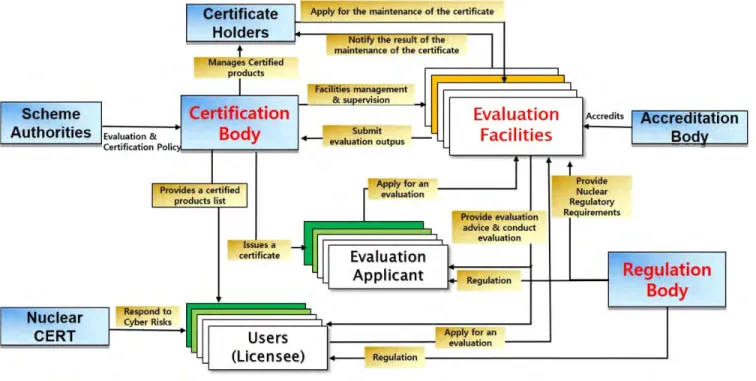
While CC certification has the assessment system, there has been no cyber security evaluation scheme for critical systems of infrastructure facilities including NPPs. There-fore, this paper presents a proposed nuclear cyber security evaluation system shown in Fig.11 with reference to CC assessment system. [Scheme Authorities]: 1) Enactment and amendment of the laws related to the evaluation and cer-tification scheme. 2) Establishment of the evaluation and
certification scheme. 3) Securing budgets for the evaluation and certification scheme. [Certification Body]: 1) Approval of evaluation results and issuance of certificates. 2) Licens-ing and management of evaluation facilities and supportLicens-ing the establishment of a nuclear cyber security certification policy. 3) International activities such as interactions and cooperation 4) Secure coding guide develop and provide. 5) Education and training of evaluators. [Evaluation Facil-ities]: 1) Operation of the evaluation facility based on the quality manual as an accredited testing laboratory. 2) Eval-uation of products including examination of the evalEval-uation deliverables, testing and vulnerability analysis. [Evaluation Applicant, Licensee]: 1) Apply for evaluation 2) Perform periodic vulnerability assessment 3) Periodic security assess-ment [Regulation Body]: 1) Regulations complying with reg-ulatory requirements 2) Enactment of the regreg-ulatory laws and develop the regulatory guide RG and requirements 3) Cyber-attacks Investigation for nuclear system function impact analysis. [CERT]: 1) Receipt and handling of Cyber-attacks 2) Responding to and recovering from security threats 3) Cyber-attack event investigation. [Certificate Holders]: 1) Apply for the maintenance of the certificate. The cer-tificate holders could be users or applicants. [Accredita-tion body]: 1) Quality management and accredita[Accredita-tion on evaluation facilities CERT, Certification Body, Regulation Body must be independent so that each role can perform well. The CERT, Regulation Body, Certification Body, and Evaluation Facilities should each serve as an independent organization. Specialists of the above organizations should have both a professional knowledge of nuclear systems and a professional knowledge of cyber security. Regulation has a major role in reviewing whether cyber security issues could affect the operation of nuclear system functions, and whether the nuclear facility meets the nuclear cyber security requirements. CERT should have an incident response role to nuclear cyber security accident investigations. It is different from other infrastructure facilities that investigate an incident without affecting critical nuclear energy systems. Therefore, the investigating specialists consists of members of the cer-tification body and regulation body for incident responses at NPPs. The certification body should review all the cyber security requirements in the nuclear field and assess the abil-ity of the evaluation facilities. Additionally, it is necessary to study what needs to be supplemented in the nuclear security assessment and application architecture. Evaluation Facilities evaluate nuclear cyber security requirements based on expert knowledge of the nuclear systems and cyber security.
B. ASSESSMENT ASSURANCE LEVELS
CC provides an assurance level by defining the Evaluation Assurance Levels (EALS). In order to receive the CC certi-fication, the certification phase can be divided according to the requirements of the applicant who wants to obtain the CC certificate or product. Depending on the system used in accordance with the national policy, the minimum level of assurance may be required. For each level of assurance,
FIGURE 12. Evaluation of the assurance level at CC.
FIGURE 13. Analyzed classification of the importance of safety for nuclear I&C system safety.
CC considers resistance to attacks and exploits by attackers with an attack potential of Beyond High, High, Moderate, Enhanced-Basic, and Basic shown in Fig.12. The factors con-sidered in analyzing the attack potential consist of 1) Elapsed Time (Time taken into identify and exploit), 2) Specialist Expertise (Specialist technical expertise required), 3) Knowl-edge of the TOE (KnowlKnowl-edge of the TOE design and opera-tion), 4) Window of opportunity, and 5) IT hardware/software or other equipment required for exploitation. Additionally, the CC analyzes the CC sets and assurance level with Devel-opment, Guidance documents, Life-cycle support, Security Target evaluation, Tests, and Vulnerability assessment.
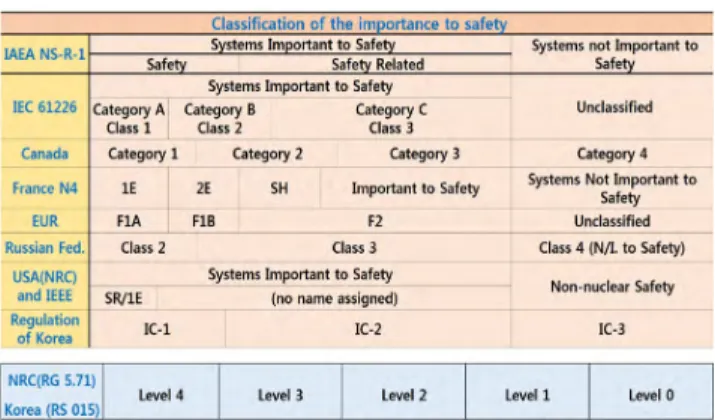
Moreover, in the nuclear power sector, because I&C system has been also classified into different classifications, reg-ulatory requirements and QA have been required for each classification shown in Fig.13. The systems are classified according to each criteria in each country or standard doc-ument For example, the IEC standard docdoc-uments are catego-rized by the functional role of the system shown in Fig.14.
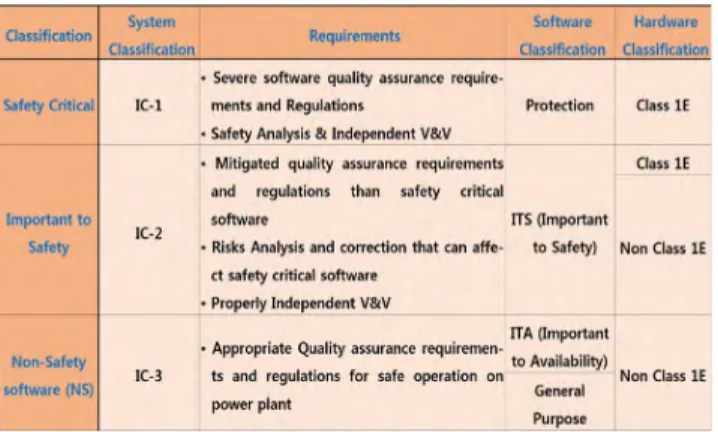
The Korean nuclear regulatory body recently has required software QA for digital systems in new NPPs, which consists of Protection, ITS (Important to safety), ITA (Important to availability), and General purpose shown in Fig.15. In the documents related to the nuclear cyber security regulation, the target of cyber security is identifying digital assets as CDAs, and the cyber security defensive architecture includes 5 cyber security defensive levels. The CDAs have to satisfy
FIGURE 14. Example of classification in the IEC standard.
FIGURE 15. Software Classification in Korean nuclear regulations.
FIGURE 16. Proposed factors to be considered for leveling.
cyber security controls provided by the regulation guide, and each cyber security defensive level has to be controlled by each policy for the direction of the communication so that the low level does not affect the high level which describes that only one-way data flows are allowed from a high level to a low level except for level 2 to level 1 and level 1 to level 0. However, it is necessary to consider the concept of assur-ance described above in the current nuclear cyber security architecture. CDAs should be classified by established crite-ria and defined with a degree of satisfaction with the nuclear cyber security requirements for each classification. Addition-ally, they define the degree of assurance and analysis as well as the impact of the simple communication control.
The proposed following factors could be taken into consid-eration when classifying levels as shown in Fig.16: 1) Sys-tem functions, 2) Cyber Security Attack Potential, 3) Cyber
Security Attack Impact, and 4) Data Criticality. System func-tions could be considered as funcfunc-tions related to power plant operation, safety, and security. Cyber Security Attack Poten-tial could be considered as 5 factors (¨ Elapsed Time (Time taken to identify and exploit), ≠ Specialist Expertise (Spe-cialist technical expertise required), Æ Knowledge of the TOE (Knowledge of the TOE design and operation), Ø Window of opportunity, and ∞ IT hardware/software or other equipment required for explosion as described in the CC. The level of cyber security and the sufficiency of the requirements may vary depending on the level of the attacker. However, high cyber security expertise should be considered because nuclear cyber-attacks are more likely to be national, terrorist, malicious or high-level hacker groups. It is very important to consider the cyber security attack potential. The appli-cation order of cyber security functions can be determined. By considering the cyber security attack potential, it is pos-sible to determine the cyber security functions that can be applied step by step by establishing the basis to apply the cyber security functions over time. Cyber Security Impact could be considered as the degree of impact on a nuclear system by cyber-attacks and the degree of cyber-attack code propagation. Cyber Security Impact should be taken into con-sideration because the incident response and recovery process may vary. Data Criticality should be considered as impacts of data exposure and data alteration. Although the target system function is not important, it should be protected as important if the data could be exploited effectively for a cyber-attack against a critical system. After classifying with the proposed factors, three points could be differently considered at each classification: 1) degree of satisfaction with the cyber security requirements in the nuclear RG, 2) Assessment assurance and 3) Cyber-attack countermeasures.
FIGURE 17. Proposed complementary points. C. SUMMARY OF DISCOVERED COMPLEMENTARY POINTS
The cyber Security for nuclear facilities of industrial facilities is the most important, but it is not enough to identify the important factors to be considered. This paper is the first paper that presents guidelines for these areas and will be a reference model for the development of methodologies for researching and applying the field of nuclear cyber security. In summary, based on the information described in this paper, the following five elements in Fig.17 should be studied for the complementary points of cyber security in NPPs. The above-mentioned comparisons are the results of the newly analyzed studies, and based on the research, the complementary points could be founded. These points could be analyzed and applied by utilizing the described and proposed statements in this paper.
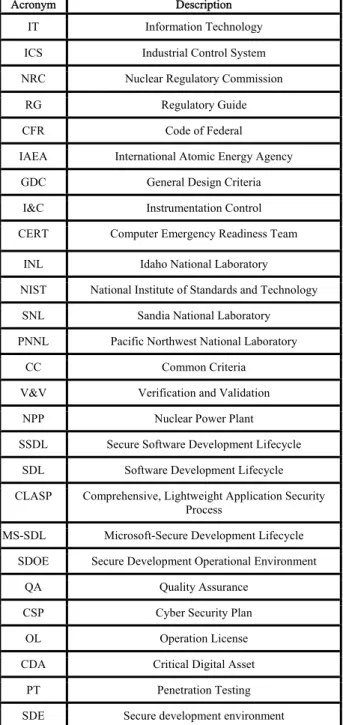
TABLE 3. A summary of terms.
VII. CONCLUSION
Cyber security for infrastructure facilities has recently gained much interest. Nuclear cyber security has recently been con-sidered also important, and it is difficult to find methods for applying prevention, detection, analysis, response, recovery and threat assessment which should be considered in nuclear cyber security. For these issues, cyber security functions and defenses should be developed for all the critical systems in these digital systems to ensure security against cyber-attacks, which have been continuously increasing. Thus, cyber secu-rity requirements related to infrastructure have been pub-lished by various organizations and in standard documents
as described in the above sections. Regulatory guides RGs related to nuclear cyber security have also been announced, but both operators, regulators and developers are worried about how to effectively apply these requirements to CDAs at NPPs. Because cyber security has been studied and developed for a long time in IT, it is worthwhile to use this knowledge to understand the requirements required in nuclear cyber secu-rity by comparing and analyzing various techniques used in general cyber security. Nuclear cyber security requires essen-tial knowledge of both the digital systems of NPPs and cyber security. Additionally, general cyber security methods cannot be just simply used, and they do not fit with nuclear regula-tions, development, evaluation, and operation. This paper’s analysis could be used to understand the requirements of nuclear regulations and to find complementary considerations in nuclear cyber security. Nuclear cyber security is a field that must be continuously studied to enhance cyber security which is very important in infrastructure facilities. Nuclear cyber security should consider the technological measures that could increase the level of assurance in the future. First, it is necessary to make a system that can enhance the assur-ance level of nuclear cybersecurity in an organization such as a research institute by supplementing the contents mentioned in this paper. This paper’s proposed complementary points, analysis, and methods could be used to enhance the cyber security of NPPs. The authors believe this is the first paper in which the proposed methods will present a direction for resolving the nuclear cyber security issues and help discover the deficiencies in nuclear cyber security schemes. In addi-tion, meaningful results could continue to emerge, if the proposed complementary points and schemes presented in this paper are further analyzed and researched in the future.
APPENDIX
This sections describes terms in this paper as shown in the Table 3.
ACKNOWLEDGMENT
This work was supported by a grant from the Korea Ministry of Science and ICT, under the establishment and operation of cyber security attack response system at national nuclear facilities (Project Number: 524330-19).
REFERENCES
[1] Criteria for Use of Computers in Safety Systems of Nuclear Power Plants, Regulatory Guide 1.152, Revision 3, U.S Nucl. Regulatory Commission, U.S. Dept. Energy, Washington, DC, USA, Jul. 2011.
[2] Cyber Security Programs for Nuclear Facilities, Regulatory Guide 5.71, U.S. Nucl. Regulatory Commission, U.S. Dept. Energy, Washington, DC, USA, Jan. 2010.
[3] KINS, KINS/RG-N08.13, Revision 3. KOREA. [4] KINAC, KINAC RS-015 Revision 01, KOREA. [5] KINAC, KINAC RS-019 Revision 00, KOREA.
[6] Core Knowledge on Instrumentation and Control Systems in Nuclear Power Plants, Int. At. Energy Agency, Vienna, Austria, 2011.
[7] Regulatory Requirements, Acceptance Criteria, and Guidelines for Instru-mentation and Control Systems Important to Safety, U.S. Nucl. Regulatory Commission, Rockville, MD, USA, Aug. 2016.
[8] Regulatory Requirements, Acceptance Criteria and Guidelines For Instru-mentation And Control Systems Important to Safety, U.S. Nucl. Regulatory Commission, Rockville, MD, USA, Aug. 2016.
[9] Building a Web Application Security Program, Version 1.0, Securities, L.L.C, New York, NY, USA, Mar. 2009.
[10] J. Fonseca and M. Vieira, ‘‘A survey on secure software development lifecycles,’’ DEI/CIUS, Polytech. Inst. Coimbra, Coimbra, Protugal, Tech. Rep.
[11] K. Tiirik, Comparison of SDL and Touchpoints.
[12] M. H. Diallo, J. Romero-Mariona, S. Sim, T. A. Alspaugh, and D. J. Richardson, ‘‘A comparative evaluation of three approaches to spec-ifying security requirements,’’ to be published.
[13] A. Abran, J. W. Moore, P. Bourque, and R. Dupuis, ‘‘SWEBOK,’’ IEEE Comput. Soc., May 2001.
[14] M. Kara, ‘‘Review on common criteria as a secure software development model,’’ Int. J. Comput. Sci. Inf. Technol., vol. 4, pp. 83–94, Apr. 2012. [15] D. Ladd, ‘‘The SDL progress report,’’ Tech. Rep., 2010.
[16] Microsoft. [Online]. Available: https://www.microsoft.com/en-us/SDL/ process/training.aspx
[17] G. McGraw, Software Security: Building Security. Reading, MA, USA: Addison-Wesley, 2006.
[18] CLASP Concepts View, Version 12, U.S. OWASP CLASP, Mar. 2006. [19] OWASP Secure Coding Practices Reference Guide, Version 2.0, Open Web
Appl. Secur. Project, Melbourne, VIC, Australia, Nov. 2010. [20] J. Spacey, 5 Examples of a Backdoor. Sep. 2017.
[21] T. Bartman and K. Carson, ‘‘Securing communications for and critical industrial systems,’’ Tech. Rep.
[22] Safety Checker by TASKING User Guide.
[23] Understanding and Implementing Encryption Backdoors.
[24] D. Svoboda, Common Exploits and How to Prevent Them. Pittsburgh, PA, USA: Software Engineering Institute, Carnegie Mellon Univ., 2016. [25] Introduction and General Model, Revision 5, Common Criteria Inf.
Tech-nol. Secur. Eval., Apr. 2017.
[26] Part 3, Security Assurance Components, Revision 5, Common Criteria Inf. Technol. Secur. Eval., Apr. 2017.
[27] Evaluation Methodology, Revision 5, Common Criteria Inf. Technol. Secur. Eval., Apr. 2017.
[28] Evaluation Methodology, Revision 5, Common Criteria Inf. Technol. Secur. Eval., Apr. 2017.
[29] Guidelines for Field Test of Cryptographic Modules, TTA, Jun. 2016. [30] Security Requirements for Cryptographic Modules, NIST, Gaithersburg,
MD, USA, May 2001.
[31] Security for industrial automation and control system - Part 4-1: Secure product development lifecycle requirements, document IEC 62443-4-1, IEC, Jan. 2018.
[32] IEEE Standard for System and Software Verification and Validation, IEEE Standard 1012-2012, IEEE Computer Society, May 2012.
[33] R. Seacord, Top 10 Secure Coding Practices, Standard, SECI CERT Cod-ing Standards.
[34] The Safety Evaluation, Instrumentation and Controls, ML110030049, U.S. Nucl. Regulatory Commission, Rockville, MD, USA.
[35] IEEE Standard Criteria for Digital Computers in Safety Systems of Nuclear Power Generating Stations, IEEE Standard 7-4.3.2-2003, 2003. [36] US-APWR Software Program Manual, MUAP-07107-NP(R5), Mitsubishi
Heavy Ind., LTD, Tokyo, Japan, Nov. 2013.
[37] Systems Engineering Guide, MITRE, McLean, VA, USA, 2014. [38] Y. Simsolo, ‘‘OWASP top ten backdoors,’’ COMSEC Consulting, London,
U.K.
[39] Computer Security at Nuclear Facilities, IAEA Nuclear Security Series No. 17, Int. Atomic Energy Agency, Vienna, Austria, 2011.
JUNYOUNG SON received the Ph.D. degree in computer science from the Graduate School of Information Security, Korea Advanced Institute of Science and Technology (KAIST). He was a Research Student with the Electronics and Telecommunication Research Institute (ETRI), from 2007 to 2009. He was a Researcher with the National Security Research Institute (NSRI), from 2009 to 2012. He was a Senior Researcher and Auditor with Korea Institute of Nuclear Safety (KINS), from 2013 to 2017. Since 2017, he has been a Senior Researcher for nuclear cyber security with Korea Atomic Energy Research Institute (KAERI).
JONGGYUN CHOI received the B.S. degree from Hanyang University, and the M.S. and Ph.D. degrees from Korea Advanced Institute of Sci-ence and Technology (KAIST), all in nuclear engineering. He worked as a Contract Researcher with Korea Atomic Energy Research Institute (KAERI), from 2002 to 2003. He worked as a Senior Researcher with KAERI, from 2004 to 2012. Since 2013, he has been a Principal Researcher for nuclear cyber security with KAERI.
HYUNSOO YOON received the B.E. degree in electronics engineering from Seoul National. Uni-versity, South Korea, in 1979, the M.S. degree in computer science from the Korea Advanced Insti-tute of Science and Technology (KAIST), in 1981, and the Ph.D. degree in computer and information science from The Ohio State University, Colum-bus, OH, USA, in 1988. He is a Professor with the Graduate School of Information Security and EECS Department with Korea Advanced Institute of Science and Technology (KAIST). From 1988 to 1989, he was a Technical Staff Member with AT&T Bell Labs. Since 1989, he has been a Faculty Member with the School of Computing, KAIST. His main research interests include wireless sensor networks, 4G networks, and network security.