Kim NY, et al. •Food allergen sensitization in young children with food allergies
Food allergen sensitization in young children
with typical signs and symptoms of
immediate-type food allergies: a comparison between
monosensitized and polysensitized children
Na Yeon Kim, MD1, Ga Ram Kim, MD1, Joon Hwan Kim, MD1, Ji Hyeon Baek, MD2, Jung Won Yoon, MD3, Hye Mi Jee, MD1,4, Hye Sung
Baek, MD5, Yong Ho Jung, MD1,4, Sun Hee Choi, MD, PhD6, Ki Eun Kim, MD4,7, Youn Ho Shin, MD4,7,8, Hye Yung Yum, MD, PhD9, Man
Yong Han, MD1,4, Kyu-Earn Kim, MD, PhD10
1Department of Pediatrics, CHA Bundang Medical Center, Seongnam, 2Department of Pediatrics, Hallym University Dongtan Sacred Heart Hospital, Hallym
University College of Medicine, Hwaseong, 3Department of Pediatrics, Myongji Hospital, Goyang, 4CHA University School of Medicine, Pocheon, 5Department of
Pediatrics, Hallym University Kangdong Sacred Heart Hospital, Hallym University College of Medicine, Seoul, 6Department of Pediatrics, Kyung Hee University
Hospital at Gangdong, Kyung Hee University School of Medicine, Seoul, 7Department of Pediatrics, CHA Gangnam Medical Center, Seoul, 8Department of Medicine,
The Graduate School, Yonsei University, Seoul, 9Department of Pediatrics, Seoul Medical Center, Seoul, 10Department of Pediatrics, Yonsei University College of
Medicine, Seoul, Korea
Purpose: The clinical interpretation of children sensitized to allergens is challenging, particularly in children with food allergies. We aimed to examine clinical differences between children with monosensitization and those with polysensitization to common food allergens and to determine risk factors for polysensitization in young children <10 years of age with immediate-type food allergies.
Methods: The study included children <10 years of age with signs and symptoms indicative of immediate-type food allergies. Serum total IgE level was measured, and ImmunoCAP analysis for food allergens was performed.
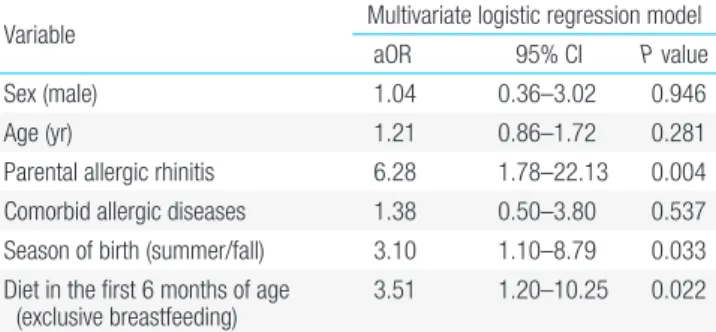
Results: The mean age of the study subjects was 1.6±1.6 years (75 boys and 51 girls). Thirty-eight children (30.2%) were monosensitized and 88 children (69.8%) were polysensitized. Multivariate logistic regression analysis showed that the development of polysensitization to common food allergens was positively associated with a parental history of allergic rhinitis (adjusted odds ratio [aOR], 6.28; 95% confidence interval [CI], 1.78–22.13; P=0.004), season of birth (summer/fall) (aOR, 3.10; 95% CI, 1.10–8.79; P=0.033), and exclusive breastfeeding in the first 6 months of age (aOR, 3.51; 95% CI, 1.20–10.25; P=0.022).
Conclusion: We found significant clinical differences between children with monosensitization and those with polysensitization to common food allergens and identified risk factors for the development of polysensitization in young children with immediate-type food allergies. Clinicians should consider these clinical risk factors when evaluating, counseling, treating, and monitoring young children with food allergies.
Key words: Child, Food hypersensitivity, Sensitization
Introduction
Allergic diseases are an important public health problem due to the fact that they impose a significant socioeconomic burden on society by lowering the quality of life of allergic patients and their families. Among various allergic diseases, food allergy is especially
Corresponding author: Youn Ho Shin, MD Department of Pediatrics, CHA Gangnam Medical Center, CHA University School of Medicine, 566 Nonhyeon-ro, Gangnam-gu, Seoul 06135, Korea Tel: +82-2-3468-3032 Fax: +82-2-3468-3697 E-mail: [email protected] Received: 28 August, 2014 Revised: 5 October, 2014 Accepted: 30 October, 2014
Copyright © 2015 by The Korean Pediatric Society This is an open-access article distributed under the terms of the Creative Commons Attribution Non-Commercial License (http://creativecommons.org/ licenses/by-nc/3.0/) which permits unrestricted non-commercial use, distribution, and reproduction in any medium, provided the original work is properly cited. Korean J Pediatr 2015;58(9):330-335
http://dx.doi.org/10.3345/kjp.2015.58.9.330 pISSN 1738-1061•eISSN 2092-7258
concerning in that it can cause serious and even fatal reactions in individuals of all age groups, particularly in children. A nation wide epidemiological study conducted on Korean children found that the estimated overall prevalence of immediatetype food allergies was 0.6% in children aged 6–7 years and 1.6% in child ren aged 12–13 years1).
Food allergies are diagnosed when both allergenspecific IgE (sIgE) to food allergens is present and the typical signs and symp toms develop upon exposure to a certain food1,2). Previous studies have suggested that some people are sensitized to only one class of allergen (monosensitization), whereas others are sensitized to two or more classes of allergen (polysensiti zation)3,4). Additionally, studies have reported that polysensitization differs both clinically and immunologically from monosensitization5,6). Researchers have demonstrated that there are significant differ ences between monosensitized and polysensitized subjects with allergic rhinitis3) and asthma4). However, to date, there is no data available report ing whether children with food allergies may present different clinical characteristics in regard to the number of sensitized food allergens.
The aims of the present study were to determine clinical differ ences between children with monosensitization and those with polysensitization to common food allergens and to identify risk factors for polysensitization in young children less than 10 years of age with immediatetype food allergies.
Materials and methods
1. Study subjects
This is a retrospective review of data from pediatric patients treated between January 2008 through December 2013 at the Pediatric Allergy and Immunology Clinic at the CHA Gangnam Medical Center, Seoul and the CHA Bundang Medical Center, CHA University School of Medicine, Seongnam, Korea. The patients were identified from a large clinical database, if they fulfilled the inclusion criteria. The inclusion criteria for this study were child ren aged 0–10 years presenting with typical signs and symptoms of immediatetype food allergies, who underwent allergy testing for the following foods: hen’s eggs, cow’s milk, peanuts, soybeans, and wheat by measuring foodspecific serum IgE, and who had more than one clinic visit during the study period. Food allergies were diagnosed based on a convincing history of reproducible signs and symptoms within 2 hours following ingestion of a sin gle food7) and specific IgE level to the suspected food ≥0.35 IU/ mL8). The charts of 223 children were examined; 57 children were excluded because all of their foodspecific IgE levels tested were <0.35 IU/mL and 40 children were excluded because the offending food, according to their parents’ report, did not match their food specific IgE positivity. Children who presented with food allergy
signs and symptoms following ingestion of a fruit or vegetable were excluded because specific IgE tests for commercially avail able fruit or vegetable allergens are often negative owing to struc tural instability9). Thus, a total of 126 children were included for the final analysis. We divided the signs and symptoms of the children that developed within 2 hours of food intake in regard to the affected organs: (1) skin re actions, such as urticaria, rash, itching, or redness; (2) gastrointes tinal reactions, including nausea, vomiting, abdominal pain, diarrhea, or bloody stool; (3) respiratory reactions, such as respi ratory difficulty, dyspnea, wheezing, cough, rhinorrhea, nasal obstruction, or chest tightness; (4) isolated angioedema; (5) oro pharyngeal reactions, such as itching of the mouth, tongue, and throat or lip swelling; and (6) anaphylaxis7). Anaphylaxis was defined as signs and symptoms that developed immediately after exposure to certain foods and involved at least two major organ systems according to the established guidelines10). Other clinical factors recorded included sex, age, gestational age at birth, birth weight, diet during the first 6 months of age, number of previous live births, season of birth, patient and parental history of allergic diseases including asthma11), allergic rhinitislike symptoms12), atopic dermatitis13) and food allergy7), and type of delivery. The Institutional Review Board reviewed and approved the study; in formed consent was waived by the ethical review board because this was a retrospective analysis of stored labo ratory data.
2. Serum specific IgE measurements
The ImmunoCAP system (Phadia AB, Uppsala, Sweden) was used for specific IgE assessment throughout the study period. Sen sitization was defined as a specific IgE concentration ≥0.35 IU/mL8).
3. Statistical analysis
All continuous variables are presented as mean values with standard deviation. The Student t test was used to examine the statistical differences in age, gestational age, birth weight, and total IgE levels between monosensitized and polysensitized child ren. The chisquare test was used to examine the statistical differ ences in sex, the number of siblings, diet within the first 6 months of age, seasons of birth, type of delivery, family history of allergic diseases, and comorbid allergic diseases of the subjects between groups. All statistical analyses were performed by using IBM SPSS Statistics ver. 21.0 (IBM Co., Armonk, NY, USA). All statis tical tests were twosided, and statistical significance was deter mined at a P value <0.05.
Results
1. Population characteristics
population are presented in Table 1 (75 boys and 51 girls). The mean age of the study subjects were 1.6±1.6 years. Diets during the first 6 months of age were exclusive breastfeeding (53.4%), formula (7.8%), and mixed (38.8%). The percentage of the study subjects who were a first child was 72.1% and 49.1% of the study subjects had a parental history of allergic diseases. With respect to the child’s history of allergic diseases, 57.3% of the study sub jects were found to have comorbid allergic diseases such as asthma, allergic rhinitislike symptoms, or atopic dermatitis (Table 1). There were no statistically significant differences in clinical parameters between boys and girls.
2. Signs and symptoms of the study subjects and causative food allergens
Table 2 shows the reported signs and symptoms that developed
within 2 hours of ingestion of the offending food according to the afflicted organs; 90.0% of the children showed cutaneous mani festations, 10.0% with gastrointestinal reactions, 7.3% had respi ra tory reactions, 12.7% displayed angioedema, 5.5% with oroph aryngeal reactions, and 12.7% suffered anaphylaxis. Of the young children with typical signs and symptoms of food allergies, hen’s eggs (85.5%) were the most frequent food allergen, followed by cow’s milk (73.3%), wheat (42.4%), peanuts (38.5%), and soybeans (33.6%).
3. Comparison of clinical variables between monosensitized and polysensitized subjects
Of the 126 children with food allergies, 38 children (30.2%) were monosensitized and 88 children (69.8%) were polysen sitized. Polysensitized children were more likely to have been born in summer or fall, as opposed to monosensitized children in spring or winter, although the difference was not statistically significant (P=0.057). Polysensitized children were more likely to have parents with allergic rhinitis (43.8% vs. 20.6%, P=0.019) and to have been exclusively breastfed during the first 6 months of life when compared with monosensitized children (62.2% vs. 32.4%, P=0.005) (Table 3). The percentage of children with co morbidities, such as atopic dermatitis, allergic rhinitislike symp toms, and asthma, was 63.6% in the polysensitized group and 42.4% in the monosensitized group (P=0.039). Polysensitized children showed higher total IgE levels when compared with monosensitized children, although the difference was not statistically significant (299.1±491.3 IU/mL vs. 180.1±345.9 IU/ mL, P=0.195) (Table 3).
4. Risk factors for polysensitization to food allergens in young children with food allergies
The multivariate logistic regression analysis was performed to determine independent relationships between polysensitization and clinical parameters in children with food allergies. The results suggest that a parental history of allergic diseases (i.e., allergic rhinitis) (adjusted odds ratio [aOR], 6.28; 95% confidence interval [CI], 1.78–22.13; P=0.004), season of birth (summer/fall) (aOR,
Table 1. Clinical characteristics of the study population (n=126)
Characteristic (n=126)Total (n=75)Boys (n=51) P valueGirls
Age (yr) 1.6±1.6 1.8±1.7 1.4±1.3 0.189
Gestational age (wk) 39.2±1.5 39.3±1.3 38.9±1.9 0.217 Birth weight (kg) 3.3±0.4 3.3±0.4 3.2±0.5 0.458
Diet during first 6 months of age 0.124
Exclusive breastfeeding 67 (53.2) 35 (46.7) 33 (64.7)
Formula 10 (7.9) 5 (6.6) 4 (7.8)
Mixed 49 (38.9) 35 (46.7) 14 (27.5)
No. of previous live births 0.397
0 91 (72.2) 52 (69.3) 39 (76.5) ≥1 35 (27.8) 23 (30.7) 12 (23.5) Season of birth 0.430 Spring 26 (20.6) 18 (24.0) 8 (15.7) Summer 33 (26.2) 16 (21.4) 17 (33.3) Fall 36 (28.6) 22 (29.3) 14 (27.5) Winter 31 (24.6) 19 (25.3) 12 (23.5)
Parental history of allergic disease 62 (49.2) 40 (53.3) 22 (43.1) 0.321 Maternal 34 (27.0) 24 (32.0) 10 (19.6) 0.132 Paternal 46 (36.5) 30 (40.0) 16 (31.4) 0.441 Comorbid allergic diseases 72 (57.1) 45 (60.0) 27 (52.9) 0.387 Atopic dermatitis 62 (49.2) 39 (52.0) 23 (45.1) 0.550 Allergic rhinitis-like symptoms 13 (10.3) 11 (14.7) 2 (3.9) 0.108
Asthma 2 (1.6) 1 (1.3) 1 (2.0) 0.869 Type of delivery 0.126 NSVD 87 (69.0) 56 (74.2) 30 (58.8) Cesarean section 39 (31.0) 19 (25.8) 21 (41.2) Number of sensitization 0.585 Monosensitization 38 (30.2) 24 (32.0) 14 (27.5) Polysensitization 88 (69.8) 51 (68.0) 37 (72.5) Values are presented as mean±standard deviation or number (%). P values from the chi-square test or the Student t test.
NSVD, normal spontaneous vaginal delivery.
Table 2. Signs and symptoms of the study subjects with food allergies upon ingestion of the offending food allergen (n=126)
Typical signs and symptoms %
Skin reactions (urticaria, rash, itching, or redness) 90.0 Gastrointestinal reactions (vomiting, nausea, abdominal pain,
diarrhea, or bloody stool) 10.0
Respiratory reactions (respiratory difficulty, dyspnea, wheezing, cough, rhinorrhea, nasal obstruction, or chest tightness) 7.3 Angioedema (isolated angioedema, skin reaction with angioedema) 12.7 Oropharyngeal reactions (itching of the mouth, tongue, and throat or
lip swelling) 5.5
breastfeeding within the first 6 months of age are significantly associated with the development of polysensitization to food allergens in young children with immediatetype food allergies. To the best of our knowledge, this is the first study to determine clinical risk factors for the development of polysensitization to common food allergens in young children with immediatetype food allergies.
The results of the present study correspond well with previous studies showing that polysensitized subjects tend to have a higher incidence of a parental history of allergic disease compared to monosensitized subjects4,14). It is not clear why subjects become sensitized to one or more classes of allergens, although genetic and environmental factors have been implicated. There is a signi ficant difference in clinical characteristics between monosen sitized and polysensitized groups, such that polysensitized child ren tend to demonstrate more severe symptoms3,4) and have a lower healthrelated quality of life15) than monosensitized child ren. Considering that the regulation of specific IgE synthesis is coordinated by the skewness of antigenpresenting cells in response to microbial exposure via tolllike receptors, it can be inferred that environmental exposure to microorganisms plays an important role in the evolution of polysensitization through increasing the tendency to produce IgE. This hypothesis was sup ported by a previous study of an analysis of specific IgE tests in children 0–18 years of age showing a strong association between total serum IgE levels and the degree of polysensiti zation16).
Previous studies have suggested that season of birth is asso ciated with the risk of the development of food allergies7,17,18). We found that the season of birth, namely summer or fall, was a risk factor for polysensitization in children with food allergies. Our results correspond in part with previous studies demonstrating fall birth being associated with increased risk of food allergies7,19) and sensitization to food allergens18). These results may support 3.10; 95% CI, 1.10–8.79; P=0.033), and exclusive breastfeeding
within the first 6 months of age (aOR, 3.51; 95% CI, 1.20–10.25;
P=0.022) were significantly associated with the development of
polysensitization to common food allergens in young children with immediatetype food allergies (Table 4).
Discussion
This study shows that a parental history of allergic diseases (i.e., allergic rhinitis), season of birth (i.e., summer/fall), and exclusive
Table 3. Comparison of clinical parameters between children with monosensitization and those with polysensitization
Variable monosensitization Children with (n=38) Children with polysensitization (n=88) P value Sex Male:female 24:14 51:37 0.585 Age (yr) 1.8±1.8 1.6±1.5 0.359 Gestational age (wk) 38.8±1.5 39.3±1.5 0.157 Birth weight (kg) 3.2±0.5 3.3±0.4 0.226
No. of previous live births 0.189
0 24 (63.2) 67 (76.1) ≥1 14 (36.8) 21 (23.9) Seasons of birth 0.057 Spring 11 (28.9) 15 (17.0) Summer 8 (21.1) 25 (28.4) Fall 6 (15.8) 30 (34.1) Winter 13 (34.2) 18 (20.5) Type of delivery 0.891 NSVD 26 (68.4) 61 (69.3) Cesarean section 12 (31.6) 27 (30.7)
Parental history of allergic diseases 16 (41.2) 46 (52.3) 0.269
Atopic dermatitis 8 (21.1) 11 (12.5) 0.267
Allergic rhinitis 8 (21.1) 38 (43.2) 0.019
Asthma 2 (5.3) 3 (3.4) 0.611
Food allergies 3 (7.9) 5 (5.7) 0.623
Diet during first 6 months of age 0.005
Exclusive breastfeeding 12 (31.6) 55 (62.5)
Formula 2 (5.3) 7 (8.0)
Mixed 24 (63.1) 26 (29.5)
Comorbid allergic diseases 16 (42.1) 56 (63.6) 0.039
Atopic dermatitis 13 (34.2) 48 (54.6) 0.055
Allergic rhinitis-like symptoms 4 (10.5) 9 (10.2) 0.857
Asthma 1 (2.6) 1 (1.1) 0.531
Total IgE (IU/mL) 180.1±345.9 299.1±491.3 0.195 Values are presented as mean±standard deviation or number (%).
P values from the chi-square test or the Student t test. NSVD, normal spontaneous vaginal delivery.
Table 4. Multivariate logistic regression analysis to assess independent relationships between polysensitization and clinical variables in young children with food allergies
Variable Multivariate logistic regression model
aOR 95% CI P value
Sex (male) 1.04 0.36–3.02 0.946
Age (yr) 1.21 0.86–1.72 0.281
Parental allergic rhinitis 6.28 1.78–22.13 0.004 Comorbid allergic diseases 1.38 0.50–3.80 0.537 Season of birth (summer/fall) 3.10 1.10–8.79 0.033 Diet in the first 6 months of age
(exclusive breastfeeding) 3.51 1.20–10.25 0.022 Multivariate logistic regression analysis included sex (male), age (year), paren-tal history of allergic rhinitis, comorbid allergic diseases, season of birth (summer/fall), and diet in the first 6 months of age (exclusive breastfeeding) as independent variables.
the hypothesis that food allergens and environmental exposure, according to different seasons during fetal period, may be risk factors for the development of allergic diseases in offspring7). Studies have suggested that many cytokine responses, specifically interferon (IFN)α and IFNγ, vary by season of birth20). In utero timing and its relationship to seasonal differences in viral and other prenatal factors might be crucial in regulating the effects of these factors on immune evolution of offspring21,22). Collectively, it is possible that various seasonal factors, such as microbial exposure, viral infection, allergen exposure, 25hydroxyvitamin D concentration, or pollution, etc., could have a significant effect on the development of sensitization to various food allergens.
It is generally accepted that exclusive breastfeeding has a preventive effect on the early development of allergic diseases, including food allergies; however this preventive strategy has recently been called into question. A recent birth cohort study, which followed children through 5 years of age, found that breastfeeding for any duration was significantly associated with the development of food allergies and sensitization in the children8). Another prospective birth cohort study of 970 children demonstrated that children who were ever breastfed (including exclusively breastfed children) were at 1.5 times higher risk of developing food sensitization than never breastfed children; this positive association was modified by rs425648 in the gene encoding interleukin12 receptor β123). In line with these previous studies, we found that exclusive breastfeeding increased the risk of polysensitization to common food allergens. There is no clear explanation as to why exclusive breastfeeding increased the risk of polysensitization to food allergens in our study subjects. One possible mechanism for this finding is that food allergens delivered via breast milk can promote sensitization to food allergens in exclusively breastfed infants, generating a T cell mediated allergenspecific immune response24). Although we did not measure Th1 or Th2 lymphocytes or perform genotyping of the study subjects, it is plausible that various food allergens ingested by mothers during lactation may have been passed via breast milk, resulting in Th2skewed immune modulation of offspring. Further research with a larger sample size is warranted to expand and delineate the relationship between exclusive breastfeeding and the development of polysensitization to food allergens.
Children with food allergies present with various signs and symptoms, with skin reaction being the most common7). In line with previous studies, we found that skin reaction was the most prevalent. Contrary to a previous study7), the present study show ed significant proportions of subjects with gastrointestinal reac tions, respiratory reactions, angioedema, oropharyngeal reactions, and anaphylaxis. This finding may be ascribed to the fact that the present study included subjects who visited a Pediatric Allergy and Immunology Clinic at general hospitals, as opposed to the pre
vious study, which included subjects from the general popula tion. Based on our results, we suggest that clinicians inquire into each individual’s various manifestations, not only of skin reac tions, but also of reactions affecting other organs, when examining patients presenting with signs and symptoms of food allergies.
Limitations of our study include a relatively small number of subjects, retrospective study design, and the fact that a double blind placebocontrolled food challenge was not performed to confirm food allergies in the study subjects. A prospective study with a large sample size is needed to confirm the findings sug gested by the present study.
In conclusion, the present study found that there are significant clinical differences between children with monosensitization and those with polysensitization to common food allergens and that a parental history of allergic diseases (i.e., allergic rhinitis), season of birth (i.e., summer/fall), and exclusive breastfeeding within the first 6 months of age are significantly associated with the de velopment of polysensitization to common food allergens in young children with immediatetype food allergies. Clinicians should take these clinical risk factors into consideration when evaluating, counseling, treating, and monitoring young children with food allergies.
Conflict of interest
No potential conflict of interest relevant to this article was reported.
References
1. Ahn K, Kim J, Hahm MI, Lee SY, Kim WK, Chae Y, et al. Prevalence of immediatetype food allergy in Korean schoolchildren: a pop ulationbased study. Allergy Asthma Proc 2012;33:4817. 2. Han Y, Kim J, Ahn K. Food allergy. Korean J Pediatr 2012;55:153
8.
3. Ciprandi G, Cirillo I. Monosensitization and polysensitization in allergic rhinitis. Eur J Intern Med 2011;22:e759.
4. Kim KW, Kim EA, Kwon BC, Kim ES, Song TW, Sohn MH, et al. Comparison of allergic indices in monosensitized and polysen sitized patients with childhood asthma. J Korean Med Sci 2006;21: 10126.
5. Ciprandi G, Klersy C, Cirillo I, Marseglia GL. Quality of life in allergic rhinitis: relationship with clinical, immunological, and functional aspects. Clin Exp Allergy 2007;37:152835.
6. Ciprandi G, Alesina R, Ariano R, Aurnia P, Borrelli P, Cadario G, et al. Characteristics of patients with allergic polysensitization: the POLISMAIL study. Eur Ann Allergy Clin Immunol 2008;40:7783. 7. Kim J, Chang E, Han Y, Ahn K, Lee SI. The incidence and risk
factors of immediate type food allergy during the first year of life in Korean infants: a birth cohort study. Pediatr Allergy Immunol 2011;22:7159.
Sandel M, et al. Influence of earlylife exposures on food sensi tization and food allergy in an innercity birth cohort. J Allergy Clin Immunol 2015;135:1718.
9. Ortolani C, Ispano M, Pastorello EA, Ansaloni R, Magri GC. Com parison of results of skin prick tests (with fresh foods and com mercial food extracts) and RAST in 100 patients with oral allergy syndrome. J Allergy Clin Immunol 1989;83:68390.
10. Sampson HA, MunozFurlong A, Campbell RL, Adkinson NF Jr, Bock SA, Branum A, et al. Second symposium on the definition and management of anaphylaxis: summary reportSecond Na tional Institute of Allergy and Infectious Disease/Food Allergy and Anaphylaxis Network symposium. J Allergy Clin Immunol 2006; 117:3917.
11. The Global Initiative for Asthma. GINA Report, Global strategy for asthma management and prevention. Revised 2014 [Internet]. The Global Initiative for Asthma; c2014 [cited 2014 Oct 8]. Available from: http://www.ginasthma.org/local/uploads/files/GINA_ Report_2014_Jun11.pdf.
12. Herr M, Clarisse B, Nikasinovic L, Foucault C, Le Marec AM, Giordanella JP, et al. Does allergic rhinitis exist in infancy? Find ings from the PARIS birth cohort. Allergy 2011;66:21421. 13. Hanifin JM, Rajka G. Diagnostic features of atopic dermatitis. Acta
Derm Venereol Suppl (Stockh) 1980;92:447.
14. Arshad SH, Tariq SM, Matthews S, Hakim E. Sensitization to common allergens and its association with allergic disorders at age 4 years: a whole population birth cohort study. Pediatrics 2001; 108:E33.
15. Cirillo I, Vizzaccaro A, Klersy C, Baiardini I, Marseglia GL, Cano nica GW, et al. Quality of life and polysensitization in young men with intermittent asthma. Ann Allergy Asthma Immunol 2005; 94:6403.
16. de Jong AB, Dikkeschei LD, Brand PL. Sensitization patterns to food and inhalant allergens in childhood: a comparison of non
sensitized, monosensitized, and polysensitized children. Pediatr Allergy Immunol 2011;22:16671.
17. Vassallo MF, Banerji A, Rudders SA, Clark S, Mullins RJ, Camargo CA Jr. Season of birth and food allergy in children. Ann Allergy Asthma Immunol 2010;104:30713.
18. Pyrhonen K, Laara E, Hiltunen L, Kaila M, Hugg T, Nayha S. Season of the first trimester of pregnancy predicts sensitisation to food allergens in childhood: a populationbased cohort study from Finland. J Epidemiol Community Health 2012;66:4956.
19. Keet CA, Matsui EC, Savage JH, NeumanSunshine DL, Skripak J, Peng RD, et al. Potential mechanisms for the association between fall birth and food allergy. Allergy 2012;67:77582.
20. Gold DR, Bloomberg GR, Cruikshank WW, Visness CM, Schwarz J, Kattan M, et al. Parental characteristics, somatic fetal growth, and season of birth influence innate and adaptive cord blood cytokine responses. J Allergy Clin Immunol 2009;124:107887.
21. Knudsen TB, Thomsen SF, Ulrik CS, Fenger M, NepperChristensen S, Backer V. Season of birth and risk of atopic disease among children and adolescents. J Asthma 2007;44:25760.
22. Sullivan Dillie KT, Tisler CJ, Dasilva DF, Pappas TE, Roberg KA, CarlsonDakes KT, et al. The influence of processing factors and nonatopyrelated maternal and neonate characteristics on yield and cytokine responses of cord blood mononuclear cells. Clin Exp Allergy 2008;38:298304.
23. Hong X, Wang G, Liu X, Kumar R, Tsai HJ, Arguelles L, et al. Gene polymorphisms, breastfeeding, and development of food sensi tization in early childhood. J Allergy Clin Immunol 2011;128:374 81.e2.
24. Lucarelli S, Di Nardo G, Lastrucci G, D'Alfonso Y, Marcheggiano A, Federici T, et al. Allergic proctocolitis refractory to maternal hypo allergenic diet in exclusively breastfed infants: a clinical obser vation. BMC Gastroenterol 2011;11:82.