Original Article
Functional Components and Antioxidant Effects of Colored Onions
Xiao Nan Yang1, Enning Xu1, Mi Jin Park1, In Jong Ha2, Jin Seong Moon2, and Young-Hwa Kang1*1Department of Horticultural Sciences, Kyungpook National University, Daegu 702-701, Korea
2Onion Research Institute, Gyeongnam Agricultural Research and Extension Services, Upo2 ro 1055, Changnyeong 635-821, Korea
Received: December 14 2015 / Revised: December 21 2015 / Accepted: December 21 2015
Abstract The antioxidant capacities, total phenolic contents (TPC), and total quercetin contents (TQC) of a red (Chenjujuck), a yellow (Sunpower), and a white (Grasier) onion cultivar were determined in this study. Onion was separated into edible portion and dry skin. In the case of edible portion, the yellow onion had the highest antioxidant activity, followed by the red onion. The white onion showed neither antioxidant activity nor quercetin compounds. On the other hand, the dry skin of the red onion showed higher antioxidant activity than yellow onion skin. The white onion skin had slight antioxidant activity, low TPC, and no quercetin compounds. In addition, the flavonoid compounds of the edible portion and dry skins of these colored onions were analyzed by UFLC(ultra-fast liquid chromatography). The major compounds were quercetin 3,diglucoside and quercetin 4-glucoside in yellow and red onion edible portion, whereas the major compounds in yellow and red onion skins were quercetin 4-glucoside, quercetin, and quercetin 3,4-diglucoside.
Keywords: Colored onion, Antioxidant, Flavonoid, Total
phenolic contents
Introduction
Among horticultural crops, onions are the second most important vegetable in the family Liliaceae. Species of onion are found across the world in Europe, Asia, North America, and Africa. They have long been used in the human diet as a source of nutrients, spicy garnish, and health-promoting components. Onion bulbs contain abundant phenolic compounds such as flavonoids (Slimestad et al., 2007). The flavonoids from onions were found to possess many biological effects, including free radical scavenging; inhibition of cell proliferation; antiulcer, anti-inflammation, antiallergy, and antidiarrheal effects. Regular consumption of onions can prevent certain diseases such as neurodegenerative disorders, cataract formation, cardiovascular diseases, cerebrovascular diseases, and cancer (Bravo, 1998; Garcia-Closas et al., 1999; Griffiths et al., 2002; Kaur and Kappor, 2009; Yochum et al., 1999).
The major flavonoid compounds of onions can be classified as either flavonols or anthocyanins. The flavonol content of yellow onions has been reported to range between 15 and 1831 mg/kg FW (Bilyk et al., 1984), whereas the flavonol content of red onions ranges between 117 and 2549 mg/kg FW (Patil et al., 1995; Lachman et al., 2003). The main flavonol compounds in onions have been identified as quercetin 3',4-diglucoside and quercetin 4'-glucoside, whereas the main anthocyanins have been identified as cyanidin malonylglucoside), cyanidin (6''-malonyl-laminaribioside), cyanidin glucoside, and cyanidin 3-laminaribioside (Pérez-Gregorio et al., 2010). Quercetin also has been detected in onion bulbs as a minor component, comprising less than 2% of the total flavonoid content (Price and Rhodes, 1997). However, the quercetin content is the highest in the dried skin, wherein it is the major flavonoid after quercetin 4'-glucoside (Bilyk et al., 1984). Furthermore, onions can be generally classified by color as red, yellow, or white. The contents of active compounds and antioxidant activities differ among cultivars. The functional components and antioxidant activities of three colored onions were examined and compared in this study. In addition, the *Corresponding author: Young-Hwa Kang
Tel: 82-53-950-7752; Fax: 82-53-950-5722 E-mail: [email protected]
This is an Open Access article distributed under the terms of the Creative Commons Attribution Non-Commercial License (http://creativecommons. org/licenses/by-nc/3.0/) which permits unrestricted non-commercial use, distribution, and reproduction in any medium, provided the original work is properly cited.
© 2015 Institute of Agricultural Science and Technology, Kyungpook National University
TQC and flavonoid profile from three different cultivars were examined with ultra-fast liquid chromatography (UFLC).
Materials and Methods Sample preparation
Bulb onions were collected in May 2014 from the onion research center of Daegu, South Korea. The red cultivar was Chenjujuck, and the yellow and white cultivars were Sunpower and Grasier, respectively. Onion was separated into edible portion (red, yellow. and white onion) and dry skin (red, yellow, and white onion skin). For red onions, the edible portion was extracted with 0.1% HCl-80% MeOH (S:L=1:4) by using sonication at 45oC for 1 h. The dry skin was ground to a fine powder and extracted with 0.1% HCl-80% MeOH (S:L=1:20) under the same conditions. For white and yellow onions, the edible portion was extracted with 80% MeOH (S:L=1:4) without HCl by using sonication at 45oC for 1 h. Dry skin was ground to a fine powder and extracted with 80% MeOH (S:L=1:20) under the same conditions. The extracts were centrifuged at 3500 rpm for 10 min. Supernatants were filtered through a 0.22µm PTFE membrane filter in a preparation used for DPPH (1,1-diphenyl-2-picrylhydrazyl), total phenolic content (TPC), and UFLC analysis. After the chemical experiments, the fresh onions were lyophilized and the dried material contents were determined.
Antioxidant activity
The antioxidant activity of onion extract was tested according to the DPPH scavenging method described by Tepe et al. (2007). Briefly, DPPH powder was dissolved using methanol and kept at 4°C for at least 6 h to attain stability. Then, DPPH solution was added into 10µl of each supernatant. After 30 min of incubation under dark conditions, the absorbance of each test sample was recorded at 517 nm by a Powerwave XS microplate spectrophotometer (Bio-Tek, USA) against a blank. Trolox (0-1 mM) was used to calibrate the antioxidant capacity. The DPPH scavenging activity(DPPHSA) was expressed as mmol Trolox equivalent (TE) per 100 g dried material weight (DW).
Total phenolic content
The TPC of the onion extracts was determined with Folin-Ciocalteu reagent according to the method described by Li et al. (2008). Briefly, each 10µl of extract supernatant diluted with distilled water was mixed with a mixture of 0.2 N Folin-Ciocalteu reagent and 7.5% sodium carbonate. The absorbance of each sample was recorded at 725 nm against a blank after incubation in the dark at room temperature for 20 min. Gallic acid (GA, 0-0.5 mg/ml) was used to calibrate the TPC, which was expressed as milligrams of gallic acid equivalent (GAE) per 100 g dried material weight. Each sample was conducted in triplicates.
Flavonoid analysis by UFLC
The flavonoid compounds were analyzed by a Shimadzu LC-20AD system equipped with an SPD-M20A diode array detector (Shimadzu, Kyoto, Japan). Compounds were separated by a YMC-Triart C18 (4.6× 250 mm, 5 µm) column (YMC, Korea) in a 40°C oven (CTO-20A, Shimadzu, Kyoto, Japan). The mobile phase consisted of 0.5% H3PO4 (A) and 0.5% H3PO4 in methanol
(B). The gradient elution was set as follows: 0-6 min, 30-40% B; 6-10 min, 40-50% B; 10-17 min, 50-55% B; 17-30 min, 55-100% B; 30-31 min, 100% B; 31-32 min, 100-30% B; 32-36 min, 30% B. The flow rate was 1 ml/min, and the injection volume was 20µl. The monitoring wavelength was set at 360 nm for flavonoid compounds. The major flavonoid compounds were identified by comparing these to the reference (Yoo et al., 2010). The peak areas of the flavonoid compounds can be calibrated to quercetin concentrations by using a quercetin standard (Sigma-Aldrich, USA). The external standard of quercetin ranging from 0-100µg/ ml was used.
Results and Discussion
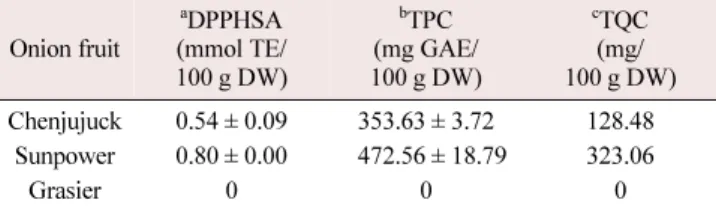
The antioxidant activity, TPC, and flavonoid compounds of colored onions were examined. As shown in Table 1, the DPPH scavenging activity of red onion (edible portion) was 0.54 mmol TE/100 g DW, whereas the antioxidant activity of yellow onion was 0.80 mmol TE/100 g DW. The TPC of red onion was 353.63 mg GAE/100 g DW, whereas the TPC of yellow onion was 472.56 mg GAE/100 g DW. The total quercetin contents (TQC) of red and yellow onion, tested by UFLC, were 128.48 and 323.06 mg/100 g DW, respectively. However, the white onion showed no antioxidant activity, and phenolic compounds and quercetin were not detected. Thus, the antioxidant activity and active components of the yellow onion were higher than those of the red onion.
The antioxidant activity and the active component contents of colored onion skin were also evaluated (Table 2). The DPPH scavenging activities of red, yellow, and white onion skin were 11.18, 9.77, and 0.34 mmol TE/100 g DW, respectively. The TPC of red, yellow, and white onion skin were 5110.48, 2965.41, and 72.15 mg GAE/100 g DW, respectively. The TQC of red onion skin was 4621.13 mg/100 g DW and the content of yellow onion skin was 2939.30 mg/100 g DW. Phenolic compounds and quercetin were not detected in white onion skin. Thus, the red onion skin had the highest antioxidant activity, TPC, and TQC.
Furthermore, the major flavonoid compounds of onion (edible portion) were determined by UFLC (Figure 1). As shown in Table 3, there were a total of 6 peaks, which were identified as 1: quercetin 4',7-diglucoside (Q4',7G); 2: quercetin 3,4'-diglucoside (Q3,4G) 3: quercetin 3-glucoside (Q3G); 4: quercetin 4'-glucoside(Q4'G); 5: isorhamnetin 4'-glucoside (IR4'G); and 6: quercetin. The contents of
compounds 2, 4, 5, and 6 of yellow onion were higher than those of red onion, whereas the contents of compounds 1 and 3 of yellow onion were lower than those of red onion. Compounds 2 (Q3,4'G) and 4 (Q4'G) were major compounds in both red and yellow onion. The contents of Q3,4'G in red and yellow onion were 41.88
and 98.03 mg/100 g DW, respectively, whereas the Q4'G contents in red and yellow onion were 73.55 and 209.87 mg/100 g DW, respectively. The TQC of red and yellow onion were 128.48 and 323.06 mg/100 g DW, respectively. There were no flavonoid compounds detected in the white onion. Yoo et al. (2010) have reported that the TQC of a red onion (TX 90977) was 101.2µg/ g FW (fresh weight), whereas the TQC of yellow onions had a range of 83.2-332.8µg/g FW. Rodrigues et al. (2011) also reported that the total flavonol content (among which the major compounds were quercetins) of red onions was 226.7-402.5 mg/ kg FW (for onions cultivated between 2004 and 2008), whereas the total flavonol content of white onions was 78.9-186.8 mg/kg FW. In our study, the TQC of red onion was 128.48 mg/100 g DW, which could be converted to 141.6 mg/kg FW, and the TQC of yellow onion could be converted to 321.4 mg/kg FW (calculated according to the moisture content). As compared to the previous reports, the TQC of the red and yellow onions in our study were relatively high. In our present investigation, Q3,4'G and Q'4G were identified as major compounds, and this agreed with the previous reports.
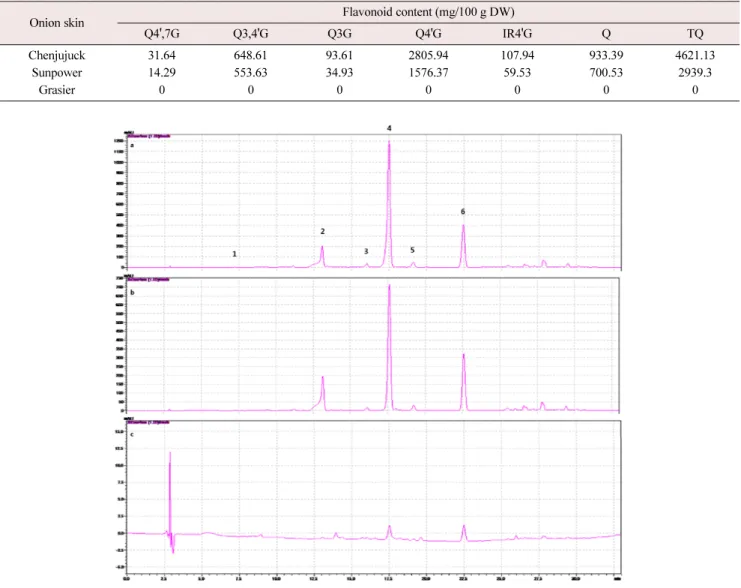
The same flavonoid compounds of colored onion skin were also determined (Figure 2). The contents of all flavonoid compounds of red onion skin were higher than those of yellow Table 1. Antioxidant, total phenolic content and total quercetin content of
colored onion fruit
Onion fruit aDPPHSA (mmol TE/ 100 g DW) bTPC (mg GAE/ 100 g DW) cTQC (mg/ 100 g DW) Chenjujuck 0.54 ± 0.09 353.63 ± 3.72 128.48 Sunpower 0.80 ± 0.00 0472.56 ± 18.79 323.06 Grasier 0 0 0
aDPPHSA, DPPH scavenging activity; bTPC, total phenolic content; cTQC,
total quercetin content.
Table 2. Antioxidant, total phenolic content and total quercetin content of colored onion skin
Onion skin DPPHSA (mmol TE/ 100 g DW) TPC (mg GAE/ 100 g DW) TQC (mg/ 100 g DW) Chenjujuck 11.18 ± 0.07 5110.48 ± 120.08 4621.13 Sunpower 9.77 ± 0.49 2965.41 ± 547.19 2939.3 Grasier 0.34 ± 0.27 72.15 ± 5.03 0
Figure 1. Ultra-fast liquid chromatography profile of the flavonoid compounds of colored onion edible portion. a, UFLC profile of Chunjujuck edible portion; b, UFLC profile of Sunpower edible portion; c, UFLC profile of Grasier edible portion. The peaks were determined as 1, quercetin 4',7-diglucoside; 2, quercetin 3,4'-diglucoside; 3, quercetin 3-glucoside; 4, quercetin 4'-glucoside; 5, isorhamnetin 4'-glucoside; 6, quercetin.
onion skin, and much higher than those of onion. The major flavonoid compounds were identified as Q4'G (2805.94 and 1576.37 mg/100 g DW in red and yellow onion skin, respectively), quercetin (933.39 and 1700.53 mg/100 g DW in red and yellow onion skin, respectively), and Q3,4'G (648.61 and 553.63 mg/ 100 g DW in red and yellow onion skin, respectively). No flavonoid compounds were detected in the white onion skin. The
flavonoid contents in the skin were much higher than those in the edible portion. The Q3,4'G and quercetin aglycone contents of red onion skin reported by Albishi et al. (2013) were 652 and 315.1 mg/100 g DW, respectively. In another article, the Q4G extracted from yellow onion skin was 372 mg/100 g DW, whereas the quercetin was 1763 mg/100 g DW (Ko et al., 2011). The quercetin compound contents in both red and yellow onion skins Table 3. Flavonoid compound content of colored onion edible portion.
Onion fruit Flavonoid content (mg/100 g DW)
Q4',7G Q3,4'G Q3G Q4'G IR4'G Q TQ
Chenjujuck 1.77 41.88 7.36 73.55 3.11 3.91 128.48
Sunpower 1.08 98.03 6.45 209.87 7.39 7.63 323.06
Grasier 0 0 0 0 0 0 0
Q4',7G, quercetin 4',7-diglucoside; Q3,4'G, quercetin 3,4'-diglucoside; Q3G, quercetin 3-glucoside; Q4'G, quercetin 4'-glucoside; IR4'G, isorhamnetin 4' -glucoside; Q, quercetin; TQ, total quercetin.
Table 4. Flavonoid compound content of colored onion skin.
Onion skin Flavonoid content (mg/100 g DW)
Q4',7G Q3,4'G Q3G Q4'G IR4'G Q TQ
Chenjujuck 31.64 648.61 93.61 2805.94 107.94 933.39 4621.13
Sunpower 14.29 553.63 34.93 1576.37 59.53 700.53 2939.3
Grasier 0 0 0 0 0 0 0
Figure 2. Ultra-fast liquid chromatography profile of the flavonoid compounds of colored onion skin. a, UFLC profile of Chunjujuck skin; b, UFLC profile of Sunpower skin; c, UFLC profile of Grasier skin. The peaks were determined as 1, quercetin 4',7-diglucoside; 2, quercetin 3,4'-diglucoside; 3, quercetin 3-glucoside; 4, quercetin 4'-glucoside; 5, isorhamnetin 4'-glucoside; 6, quercetin.
in our study were higher than in the previous studies.
In addition, the ratios of quercetin aglycone contents of red and yellow onion skins were much higher than those of edible portion. It has been reported that the amount of flavonoids in the different parts of the onion bulb increases from the inner layer to the outer layer (Prakash et al., 2007). The different light exposure may affect the distribution of flavonoids in the onion bulbs. In addition, the varietal distribution of the enzymes, such as the light-induced enzyme phenylalanine ammonia-lyase, having higher levels in the outer layer epidermis than inner layers and catalyzing the biosynthesis of flavonoids (Hirota et al., 1999), can have an influence. In addition, some anthocyanin compounds in red onion skin may contribute to a higher TPC than in yellow onion skin. Overall, the yellow onion (edible portion) had better antioxidant activity and more active compounds, but the red onion skin had better antioxidant activity and more active compounds. Furthermore, onion skin had better antioxidant value than edible portion.
Acknowledgement
This research was supported by Golden Seed Project (Center for Horticultural Seed Development, No. 213003-04-3-WTB11), Ministry of Agriculture, Food and Rural Affairs (MAFRA), Ministry of Oceans and Fisheries (MOF), Rural Development Administration (RDA) and Korea Forest Service (KFS).
Reference
Albishi T, John JA, Al-Khalifa AS, Shahidi F (2013) Antioxidative phenolic constituents of skins of onion varieties and their activities. J Funct Foods 5: 1191-1203.
Bilyk A, Cooper PL, Sapers GM (1984) Varietal differences in distribution of quercetin and kaempferol in onion (Allium cepa L.) tissue. J Agric Food Chem 32: 274-276.
Bravo L (1998) Polyphenols: chemistry, dietary sources, metabolism, and nutritional significance. Nutr rev 56: 317-333.
Garcia-Closas R, Gonzalez CA, Agudo A, Riboli E (1999) Intake of
specific carotenoids and flavonoids and the risk of gastric cancer in Spain. Cancer Causes Control 10: 71-75.
Griffiths G, Trueman L, Crowther T, Thomas B, Smith B (2002) Onions-a global benefit to health. Phytother Res 16: 603-615.
Hirota S, Shimoda T, Takahama U (1999) Distribution of flavonols and enzymes participating in the metabolism in onion bulbs: mechanism of accumulation of quercetin and Its glucosides in the abaxial epidermis. Food Sci Technol Res 5: 384-387.
Kaur C, Joshi S, Kapoor HC (2009) Antioxidants in onion (Allium Cepa L) cultivars grown in India. J food biochem 33: 184-200.
Ko MJ, Cheigh CI, Cho SW, Chung MS (2011) Subcritical water extraction of flavonol quercetin from onion skin. J Food Eng 102: 327-333.
Lachman J, Pronek D, Hejtmankova A, Dudjak J, Pivec V, Faitová K (2003) Total polyphenol and main flavonoid antioxidants in different onion (Allium cepa L.) varieties. Hort Sci 30: 142-147.
Li HB, Wong CC, Cheng KW, Chen F (2008) Antioxidant properties in vitro and total phenolic contents in methanol extracts from medicinal plants. LWT-Food Sci Technol 41: 385-390.
Patil BS, Pike LM, Yoo KS (1995) Variation in the quercetin content in different colored onions (Allium cepa L.). J Amer Soc Hort Sci 120: 909-913.
Pérez-Gregorio RM, García-Falcón MS, Simal-Gándara J, Rodrigues AS, Almeida DPF (2010) Identification and quantification of flavonoids in traditional cultivars of red and white onions at harvest. J Food Comp Anal 23: 592-598.
Prakash D, Singh BN, Upadhyay G (2007) Antioxidant and free radical scavenging activities of phenols from onion (Allium cepa). Food chem 102: 1389-1393.
Price KR, Rhodes MJC (1997) Analysis of the major flavonol glycosides present in four varieties of onion (Allium cepa) and changes in composition resulting from autolysis. J Sci Food Agr 74: 331-339. Rodrigues AS, Pérez-Gregorio MR, García-Falcón MS, Simal-Gándara J,
Almeida DPF (2011) Effect of meteorological conditions on antioxidant flavonoids in Portuguese cultivars of white and red onions. Food Chem 124: 303-308.
Slimestad R, Fossen T, Vågen IM (2007) Onions: a source of unique dietary flavonoids. J Agric food chem 55: 10067-10080.
Tepe B, Daferera D, Tepe AS, Polissiou M, Sokmen A (2007) Antioxidant activity of the essential oil and various extracts of Nepeta flavida Hub.-Mor. from Turkey. Food Chem 103: 1358-1364.
Yochum L, Kushi LH, Meyer K, Folsom AR (1999) Dietary flavonoid intake and risk of cardiovascular disease in postmenopausal women. Am J Epidemiol 149: 943-949.
Yoo KS, Lee EJ, Patil BS (2010) Quantification of quercetin glycosides in 6 onion cultivars and comparisons of hydrolysis-HPLC and spectrophotometric methods in measuring total quercetin concentration. J food sci 75: 160-165.