A Preliminary Calculation of Multi-Core Design for a High-flux
Advanced Research Reactor
Byung-Jin JUN, Hak-Sung KIM, Sang-Jun PARK
Korea Atomic Energy Research Institute
150 Deokjin-dong, Yuseong-gu, Daejeon 305-353, KOREA [email protected]
1. Introduction
Many of research reactors in operation over the world become old and the number of research reactors is expected to be reduced around 1/3 within a next decade. So it may be necessary to prepare in advance for the future demands of research reactors with a high performance. Therefore, based on the HANARO experiences through design to operation, a concept development of an improved research reactor is under doing. In this paper, conceptual multi-core which is satisfied with various power levels is proposed and its basic characteristics were analyzed as a preliminary step.
2. Design Description
Neutron flux is one of the important factors in performance evaluation of a research reactor. Accordingly providing the high flux environment to the reactor users is to be an inevitable requirement in the research reactor core design. The concept of multi-core which is composing of the several small size cores is proposed in this paper. It is to meet the use of spacious irradiation area where the high neutron flux can be obtained. This work is focusing on the neutron flux only, and MCNP code was used for its physics calculation.
2.1 Nuclear fuel
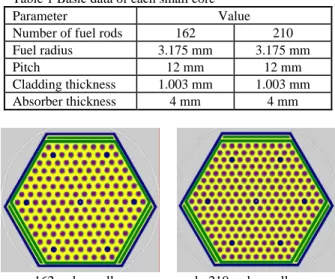
In general, the research reactor uses various types of fuels such as rod, plate and tube. Plate or tubular type fuel is popular in research reactors due to their outstanding thermo-hydraulic characteristics comparing with the rod type fuels. For all that we choose rod type LEU fuel of HANARO as an advanced research reactor fuel because one of the most important safety principles for nuclear installations is to use proven technology. Using HANARO fuel, a large hexagonal fuel assembly was composed as a small core. A fuel bundle is made of 162 or 210 fuel rods with 3.15gU/cc, U3Si and is
assigned to the individual small core as shown in figure 1. The characteristics of the fuel rod and the basic design data of the fuel bundle are indicated in Table 1. As sown in Fig. 1, three control plates inserted outside of small core.
Table 1 Basic data of each small core
Parameter Value
Number of fuel rods 162 210
Fuel radius 3.175 mm 3.175 mm
Pitch 12 mm 12 mm
Cladding thickness 1.003 mm 1.003 mm
Absorber thickness 4 mm 4 mm
a. 162 rods small core b. 210 rods small core Fig. 1 Cross sectional view of each small core
2.2 Core Configuration
The multi-core consists of several small cores to provide the high thermal neutron flux in the center reflector region as well as outer reflector region. Two kinds of multi-core, which configured with 2 and 4 small cores respectively, are investigated for the different fuel assemblies. Considering the design basis of the HANARO fuel performance, the thermal power capacities are 10MW and 20MW respectively for the 2 and 4 small cores. H2O and D2O are used as the coolant
and reflector materials. The basic design data and the cross sectional view of the multi-core are presented in Table 2 and Fig. 2, respectively.
Table 2 Basic design data of multi-core
A B C D Core Type
162 rods core 210 rods core
Number of small core 4 2 4 2
Number of fuel rods 648 324 840 420
Total U loading (kg) 69.1 34.5 89.4 44.7 Core distance from
C/L(cm) 28 24 32 28
Transactions of the Korean Nuclear Society Autumn Meeting Busan, Korea, October 27-28, 2005
a. 20MW multi-core b. 10MW multi-core Fig. 2 Cross sectional view of the multi-cores
2.3 Results
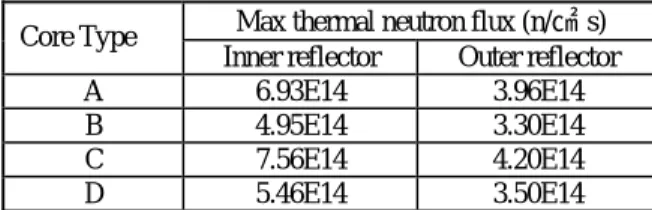
Table 3 and Table 4 show the maximum thermal neutron flux and flux to power ratio at the inner and outer reflector regions of each core types. All values in Table 3 and 4 are the unperturbed neutron flux. Around 7.0E14 n/㎠s of thermal flux can be obtained at the inner reflector region of type-A or type-C, and at the outer reflector region 3.0~4.0E14 n/㎠s of thermal neutron flux is expected. If the perturbed flux is assumed as about 70% of unperturbed flux in usual research reactors, the maximum thermal flux is 5.0E14
n/㎠s at the inner reflector region of type-A and type-C.
Table 3 Maximum thermal neutron flux of each core Max thermal neutron flux (n/㎠s) Core Type
Inner reflector Outer reflector
A 6.93E14 3.96E14 B 4.95E14 3.30E14 C 7.56E14 4.20E14 D 5.46E14 3.50E14 Table 4 Flux to power ratio of each core
Flux to Power ratio(n/㎠s/MW) Core Type
Inner reflector Outer reflector
A 3.15E13 1.80E13 B 4.50E13 3.10E13 C 2.70E13 1.50E13 D 3.89E13 2.50E13
Comparing the flux to power ratio including perturbed effect between the present results and the other representative research reactors listed in Table 5.
Table 5 Flux to power ratio of other research reactors Flux to Power Ratio in reflector
(n/㎠s/MW)
JRR-3M (Japan) 0.6E13 (20MW)
HANARO (Korea) 0.7E13 (30MW)
CARR (China) 1.3E13 (60MW)
OPAL (Australia) 2.0E13 (20MW)
ORPHEE (France) 2.1E13 (14MW)
It was shown from Table 4 and Table 5 that the performance of annular core would be better than other research reactors in the world in the neutron flux point of view.
3. Conclusion
In order to prepare the expected future needs for a research reactor, a study on the concept of advanced research reactor with high neutron performance has been performed based on the experiences of HANARO construction and operation. A conceptual multi-core which is satisfied with various power levels using rod type fuel of low enriched uranium is proposed as a candidate. The performance of the multi-core is judged to be good from the high ratio of power to thermal neutron flux.
REFERENCES
[1] C. Park, “Status and Design Characteristics of Research Reactor”, KAERI Report, AR-657/2002, KAERI (2002) [2] C. Park, “Design Characteristic sand Requirements of Irradiation Holes for Research Reactor Experimental Facilities”, KAERI Report, AR-680/2003, KAERI (2003) [3] C. Park, “Review of Considerations on Fuel Selection”, KAERI Technical Report, TR-2554/2003, KAERI (2003) [4] B.C.Lee, “Preliminary Conceptual Core Design for A New Research Reactor”, KAERI Technical Report, TR-2782/2004, KAERI (2004)
[5] C. Park, “Design Approach to the Development of an Advanced HANARO Research Reactor”, Proc. of International Symposium HANARO 2005, HANARO 2005 (2005)