반응적응 시험설계법을 이용하는 통계적 해석모델 검증 기법 연구
A Study on the Statistical Model Validation using Response-adaptive
Experimental Design
정병창
†·
허영철*
·
문석준*
·
김영중*
Byung Chang Jung, Young-Chul Huh, Seok-Jun Moon and Young Joong Kim
Key Words : Statistical Model Validation, Hypothesis Test for Validity Check, Design of Validation Experiment (통계적 해석
모델 검증, 모델 유효성 가설 검정, 모델 검증 시험 계획법) ABSTRACT
Model verification and validation (V&V) is a current research topic to build computational models with high predictive capability by addressing the general concepts, processes and statistical techniques. The hypothesis test for validity check is one of the model validation techniques and gives a guideline to evaluate the validity of a computational model when limited experimental data only exist due to restricted test resources (e.g., time and budget). The hypothesis test for validity check mainly employ Type I error, the risk of rejecting the valid computational model, for the validity evaluation since quantification of Type II error is not feasible for model validation. However, Type II error, the risk of accepting invalid computational model, should be importantly considered for an engineered products having high risk on predicted results. This paper proposes a technique named as the response-adaptive experimental design to reduce Type II error by adaptively designing experimental conditions for the validation experiment. A tire tread block problem and a numerical example are employed to show the effectiveness of the response-adaptive experimental design for the validity evaluation.
기 호 설 명
Di(α) : 유의수준 α 에 대한 임계값 fu,i : Area metric 의 확률밀도함수 y : 가상 시험 결과 모델 Um : Area metric ψ : 가상 해석 결과 모델 1. 서§ 론 경쟁적인 시장 환경에서 제품 개발의 시간과 비용 을 줄이기 위해 컴퓨터 해석 모델의 중요성이 점점 증가하고 있으나, 제품에 내포된 다양한 불확실성 (제작공차, 재료물성, 물리상수, 경계조건, 하중 등) † 교신저자, 발표자; 정회원, 한국기계연구원 E-mail : [email protected] Tel : 042-868-7463 , Fax : 042-868-7418 * 한국기계연구원 시스템다이나믹스연구실 및 시험 측정불확도로 인하여 해석과 시험 결과가 정확하게 일치하는 해석 모델을 개발하는 것은 결 코 쉽지 않다. 최근 이러한 불확실성을 고려하는 모 델 V&V(Verification and Validation)에 관한 연구가 다 양하게 이루어지고 있다(1-3). 모델 V&V 의 핵심인 통계적 해석 모델 보정/검증 기법(statistical model calibration/validation)은 시험 결과와 해석 결과를 통 계적으로 비교함으로써 해석 모델의 정확성 향상/유 효성 검증을 수행하여 결정론적 방법의 한계(1. 평 균에서 많이 벗어난 시험 결과를 이용한 모델 보정 시 모델 정확성 감소, 2. 해석과 시험 결과의 절대적 또는 상대적 비교가 일치하지 않을 경우 모델에 대 한 유효성(validity) 판단의 어려움)를 극복할 수 있 는 장점이 있다. 통계적 모델 검증을 위한 가설 검 정법(hypothesis test for validity check)(3)이 최근 발표되 었으며, 본 연구에서는 해석 모델 가설 검정법에서 정량화가 불가능한 제 2 종 오류(type II error)를 최소 화하기 위한 반응적응 시험설계법(Response-adaptive 한국소음진동공학회 2014년 추계학술대회
experimental design)을 tire tread block 문제와 간단한 수학적 문제를 이용하여 소개하고자 한다. 2. 통계적 해석 모델 가설 검정법 2.1 개요 통계적 해석 모델 가설 검정법은 통계적 해석 모 델의 예측결과와 유한개의 샘플을 이용하여 수행한 시험 결과를 상호 비교하여 해석 모델의 유효성을 판단하는 방법이다. 가설 검정을 위한 기준(metric) 으로는 시험 결과에 대한 해석 결과의 누적 밀도 (cumulative density)를 이용하는 area metric을 사용하 며, 다양한 조건에서 수행한 시험 결과들을 유효성 검증에 동시에 이용하기 위해 u-pooling 기법을 사용 한다. 가설 검정을 위한 기각역(rejection region)은 식 (1)과 같이 정의되며, 식(1)을 만족할 경우 ‘해석 모 델이 유효하다’라고 정의한 귀무 가설(null hypothesis) 을 기각할 수 있다. Um > Di(α) (1) 이때 Um은 해석 결과와 시험 결과를 비교하여 계산 한 area metric의 값이며, Di(α)는 i개의 시험 샘플을 이용한 모델 검증에서 α의 유의 수준(significance level)을 가정할 때의 임계값(critical value)을 나타낸 다. 유의 수준은 식(2)와 같이 정의된 제1종 오류, 즉 해석 모델이 유효할 때 기각할 확률을 나타낸다. Type I error = ∫ ,() () (2) 이때 fu,i는 i개의 시험 샘플을 이용할 경우의 유효 area metric의 확률밀도함수를 나타낸다. 해석 모델 이 유효하지 않음에도 불구하고 기각하지 못할 확 률인 제2종 오류는 시험 결과의 모집단을 알 수 없 기 때문에 고려가 불가능하다. 때문에 제1종 오류를 이용하여 유효성 검증을 수행한다. 그러나 위험도가 큰 제품의 경우 제2종 오류를 최소화할 필요가 있 으며, 이를 위하여 본 연구에서는 반응적응 시험설 계법을 제안하였다. 2.2 반응적응 시험설계법 해석 모델 검증에 사용되는 유한개의 시험 샘플 들은 모델 검증을 위해 제품의 검증 영역(validation domain)안에서 적절하게 배치 후 시험을 수행하여야 한다. 반응적응 시험설계법은 제2종 오류를 최소화 하기 위해 i개의 시험 결과들을 이용한 모델 검증 결과를 바탕으로 i+1 번째의 시험 조건을 선정한다. 이때 다음 시험 조건 선정을 위한 기준으로 (1)validity distance(시험 결과를 이용하여 샘플링 된 누적밀도함수의 치우침 정도)와 (2)validity variance(시험 결과를 이용하여 샘플링 된 누적밀도 함수들의 분산) 를 정의하여 반복 사용하였다. 3. Case Study
그림 1은 tire tread block 시험과 해석 모델을 보여 준다. 그림 2(a)는 수직하중 3, 5, 7kgf에 대하여 1cm/sec의 속도로 block이 미끄러졌을 때 block과 바 닥면 사이의 마찰력에 대한 해석(선)/시험(점) 결과 이다. 시험 결과는 반응적응 시험설계법 적용 없이, 각각의 수직하중 조건에서 6개씩 총 18개 샘플을 이용하여 획득하였다. 그림 2(b)와 같이 유효성 검 증을 위해 계산한 Um 값은 0.0525이다. fu,18는 5000 회 반복 샘플링을 통해 계산되었으며(3), 임계값 (D18(0.05))인 0.137보다 작으므로 해석 모델이 유효 하다고 판단하였다.
Fig. 1 FE Model and Analysis Results of the Bimorph
(a) Test&simulation result (b) Area metric
Fig. 2 FE Model and Analysis Results of the Bimorph
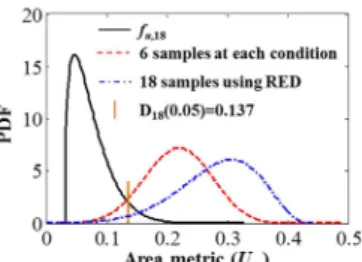
반응적응 시험설계법의 유용성을 검증하기 위하 여 식(3)과 같이 block 문제와 닮은꼴의 가상의 시 험 결과 모델(y)과 해석 모델(Ψ)을 정의하였다. 가상 시험 결과 모델 : y = (0.896*β)*(ζ1.1 ) 가상 해석 결과 모델 : Ψ = (1.0*β)*(ζ1.0 ) (3) β ~ Normal(1.0, 0.05) 1개의 모델 변수 β는 노말 분포를 따르며, 시험 환경변수 ζ는 3, 5, 7로 가정하였다. 그림 3은 모델 검증 시 환경변수 각각에 대하여 동일하게 6개의 샘플을 추출하여 모델 검증한 경우와 반응적응 시 험설계법을 적용하여 모델 검증한 경우의 area metric 확률밀도함수를 보여준다. 제1종 오류가 5%인 경우 반응적응 시험설계법을 적용할 경우 제2종 오류가 6.8%에서 2.6%로 줄어듦을 확인하였다. 348
Fig. 3 PDFs of Um: three different test designs 4. 결론 본 연구에서는 해석 모델 가설 검정에서 제2종 오 류를 감소시키기 위한 반응적응 시험설계법을 제안 하였다. 해석과 시험결과의 상이한 정도에 따라 제2 종 오류의 감소량이 달라지지만, 반응적응 시험설계 법을 이용하여 시험계획을 수행 할 경우 그렇지 않 은 경우보다 제2종 오류를 감소시킬 수가 있으며, 예측 결과에 대한 위험도가 큰 제품의 해석 모델의 경우 효율적인 시험 설계를 통해 보다 정확한 통계 적 해석 모델 검증을 수행할 수 있음을 확인하였다. 후 기 본 연구는 한국기계연구원 일반사업(SC1000)의 지원을 받아 수행되었으며 지원에 감사드립니다. 참 고 문 헌
(1) W.L. Oberkampf, et al., “Verification, validation and predictive capability in computational engineering and physics,” Applied Mechanics Reviews, Vol.57, pp.345, 2004
(2) S. Ferson, et al., “Model validation and predictive capability for the thermal challenge problem,” Computer Methods in Applied Mechanics and Engineering, Vol.197, pp.2408~2430, 2008
(3) B.C. Jung, et al., “A Framework of Virtual Product Testing with Limited Experimental Data Based on Statistical Inference,” Structural Multidisciplinary Optimization, Accepted in 29 July 2014.