A THESI
S
FOR THE DEGREE OF MASTER OF ENGI
NEERI
NG
Characteristics of Pressurized Liquid Extracts
from Natural Plants in Jeju
Kim Mi Bo
Department of Food Science and Engineering
GRADUATE SCHOOL
CHEJU NATIONAL UNIVERSITY
Characteristics of Pressurized Liquid Extracts
from Natural Plants in Jeju
Kim Mi Bo
(Supervised by Professor Sang-Bin Lim )
A thesis submitted in partial fulfillment of the requirement
for the degree of Master of Engineering
2008. 12.
This thesis has been examined and approved.
...
Soo-Hyun Kim, Thesis director, Prof. of Food Science and
Engineering
...
Young-Hwan Ko, Prof. of Food Science and Engineering
...
Sang-Bin Lim, Prof. of Food Science and Engineering
...
December 2008
………
Date
Department of Food Science and Engineering
GRADUATE SCHOOL
CHEJU NATIONAL UNIVERSITY
Cont
ent
s
요약
·
·
·
·
·
·
·
·
·
·
·
·
·
·
·
·
·
·
·
·
·
·
·
·
·
·
·
·
·
·
·
·
·
·
·
·
·
·
·
·
·
·
·
·
·
·
·
·
·
·
·
·
·
·
·
·
·
·
·
·
·
·
·
·
·
·
·
·
·
·
·
·
·
·
·
·
·
·
·
·
·
·
·
·
·
·
·
·
·
·
·
·
·
·
·
·
·
·
·
·
·
·
·
·
·
·
·
·
·
·
·
·
·
·
·
·
·
ⅳ
Li
stofFi
gur
es
·
·
·
·
·
·
·
·
·
·
·
·
·
·
·
·
·
·
·
·
·
·
·
·
·
·
·
·
·
·
·
·
·
·
·
·
·
·
·
·
·
·
·
·
·
·
·
·
·
·
·
·
·
·
·
·
·
·
·
·
·
·
·
·
·
·
·
·
·
·
·
·
·
·
·
·
·
·
·
·
·
·
·
·
·
·
·
·
·
·
·
ⅵ
Li
stofTabl
es
·
·
·
·
·
·
·
·
·
·
·
·
·
·
·
·
·
·
·
·
·
·
·
·
·
·
·
·
·
·
·
·
·
·
·
·
·
·
·
·
·
·
·
·
·
·
·
·
·
·
·
·
·
·
·
·
·
·
·
·
·
·
·
·
·
·
·
·
·
·
·
·
·
·
·
·
·
·
·
·
·
·
·
·
·
·
·
·
·
·
·
·
·
ⅷ
I
NTRODUCTI
ON
·
·
·
·
·
·
·
·
·
·
·
·
·
·
·
·
·
·
·
·
·
·
·
·
·
·
·
·
·
·
·
·
·
·
·
·
·
·
·
·
·
·
·
·
·
·
·
·
·
·
·
·
·
·
·
·
·
·
·
·
·
·
·
·
·
·
·
·
·
·
·
·
·
·
·
·
·
·
·
·
·
·
·
·
·
·
·
·
1
Par
t I
: I
nt
egr
al Ant
i
oxi
dat
i
ve Capaci
t
y of Pr
essur
i
zed
Li
qui
dExt
r
act
sf
r
om Nat
ur
alPl
ant
si
n J
ej
u
1.ABSTRACT
·
·
·
·
·
·
·
·
·
·
·
·
·
·
·
·
·
·
·
·
·
·
·
·
·
·
·
·
·
·
·
·
·
·
·
·
·
·
·
·
·
·
·
·
·
·
·
·
·
·
·
·
·
·
·
·
·
·
·
·
·
·
·
·
·
·
·
·
·
·
·
·
·
·
·
·
·
·
·
·
·
·
·
·
·
·
·
·
·
·
·
·
·
6
2.MATERI
ALS AND METHODS
·
·
·
·
·
·
·
·
·
·
·
·
·
·
·
·
·
·
·
·
·
·
·
·
·
·
·
·
·
·
·
·
·
·
·
·
·
·
·
·
·
·
·
·
·
·
·
·6
2
.
1
.Pl
a
ntma
t
e
r
i
a
l
s·
·
·
·
·
·
·
·
·
·
·
·
·
·
·
·
·
·
·
·
·
·
·
·
·
·
·
·
·
·
·
·
·
·
·
·
·
·
·
·
·
·
·
·
·
·
·
·
·
·
·
·
·
·
·
·
·
·
·
·
·
·
·
·
·
·
·
·
·
·
·
·
·
·
·
·
·
·
·
·
·
·
·
·
·
·
·
·
·
6
2
.
2
.Pr
e
s
s
ur
i
z
e
dl
i
qui
de
xt
r
a
c
t
i
on·
·
·
·
·
·
·
·
·
·
·
·
·
·
·
·
·
·
·
·
·
·
·
·
·
·
·
·
·
·
·
·
·
·
·
·
·
·
·
·
·
·
·
·
·
·
·
·
·
·
·
·
·
·
·
·
·
·
·
·
·
·
·
·
7
2
.
3
.Tot
als
ol
i
dsa
s
s
a
y·
·
·
·
·
·
·
·
·
·
·
·
·
·
·
·
·
·
·
·
·
·
·
·
·
·
·
·
·
·
·
·
·
·
·
·
·
·
·
·
·
·
·
·
·
·
·
·
·
·
·
·
·
·
·
·
·
·
·
·
·
·
·
·
·
·
·
·
·
·
·
·
·
·
·
·
·
·
·
·
·
·
·
9
2
.
4
.Tot
alphe
no
l
i
c
sa
s
s
a
y·
·
·
·
·
·
·
·
·
·
·
·
·
·
·
·
·
·
·
·
·
·
·
·
·
·
·
·
·
·
·
·
·
·
·
·
·
·
·
·
·
·
·
·
·
·
·
·
·
·
·
·
·
·
·
·
·
·
·
·
·
·
·
·
·
·
·
·
·
·
·
·
·
·
·
·
9
2
.
5
.I
nt
e
gr
a
la
nt
i
oxi
dat
i
vec
a
pa
c
i
t
ya
s
s
a
y·
·
·
·
·
·
·
·
·
·
·
·
·
·
·
·
·
·
·
·
·
·
·
·
·
·
·
·
·
·
·
·
·
·
·
·
·
·
·
·
·
·
·
·
·
·1
0
2
.
5
.
1
.ACW pr
o
t
oc
ol·
·
·
·
·
·
·
·
·
·
·
·
·
·
·
·
·
·
·
·
·
·
·
·
·
·
·
·
·
·
·
·
·
·
·
·
·
·
·
·
·
·
·
·
·
·
·
·
·
·
·
·
·
·
·
·
·
·
·
·
·
·
·
·
·
·
·
·
·
·
·
·
·
·
·
·
·
·
·
·
·
·
·
1
0
2
.
5
.
2
.ACL pr
ot
oc
ol·
·
·
·
·
·
·
·
·
·
·
·
·
·
·
·
·
·
·
·
·
·
·
·
·
·
·
·
·
·
·
·
·
·
·
·
·
·
·
·
·
·
·
·
·
·
·
·
·
·
·
·
·
·
·
·
·
·
·
·
·
·
·
·
·
·
·
·
·
·
·
·
·
·
·
·
·
·
·
·
·
·
·
·
·
1
0
2
.
6
.St
at
i
s
t
i
c
alana
l
ys
i
s·
·
·
·
·
·
·
·
·
·
·
·
·
·
·
·
·
·
·
·
·
·
·
·
·
·
·
·
·
·
·
·
·
·
·
·
·
·
·
·
·
·
·
·
·
·
·
·
·
·
·
·
·
·
·
·
·
·
·
·
·
·
·
·
·
·
·
·
·
·
·
·
·
·
·
·
·
·
·
·
1
1
3.RESULTS AND DI
SCUSSI
ON
·
·
·
·
·
·
·
·
·
·
·
·
·
·
·
·
·
·
·
·
·
·
·
·
·
·
·
·
·
·
·
·
·
·
·
·
·
·
·
·
·
·
·
·
·
·
·
·
1
1
3
.
1
.Tot
als
ol
ubl
es
ol
i
ds·
·
·
·
·
·
·
·
·
·
·
·
·
·
·
·
·
·
·
·
·
·
·
·
·
·
·
·
·
·
·
·
·
·
·
·
·
·
·
·
·
·
·
·
·
·
·
·
·
·
·
·
·
·
·
·
·
·
·
·
·
·
·
·
·
·
·
·
·
·
·
·
·
·
·
·
·
·
·
1
1
3
.
2
.Tot
alphe
no
l
i
c
s·
·
·
·
·
·
·
·
·
·
·
·
·
·
·
·
·
·
·
·
·
·
·
·
·
·
·
·
·
·
·
·
·
·
·
·
·
·
·
·
·
·
·
·
·
·
·
·
·
·
·
·
·
·
·
·
·
·
·
·
·
·
·
·
·
·
·
·
·
·
·
·
·
·
·
·
·
·
·
·
·
·
·
·
·
·
1
2
3
.
3
.I
nt
e
gr
a
la
nt
i
oxi
dat
i
vec
a
pa
c
i
t
y·
·
·
·
·
·
·
·
·
·
·
·
·
·
·
·
·
·
·
·
·
·
·
·
·
·
·
·
·
·
·
·
·
·
·
·
·
·
·
·
·
·
·
·
·
·
·
·
·
·
·
·
·
·
·
·
·
·
·
1
3
Par
tI
I
:Opt
i
mi
zat
i
on ofExt
r
act
i
on Condi
t
i
ons f
orTot
al
phenol
i
cs f
r
om Sapi
um j
aponi
cum usi
ng a Pr
essur
i
zed
Li
qui
dExt
r
act
or
1.ABSTRACT
·
·
·
·
·
·
·
·
·
·
·
·
·
·
·
·
·
·
·
·
·
·
·
·
·
·
·
·
·
·
·
·
·
·
·
·
·
·
·
·
·
·
·
·
·
·
·
·
·
·
·
·
·
·
·
·
·
·
·
·
·
·
·
·
·
·
·
·
·
·
·
·
·
·
·
·
·
·
·
·
·
·
·
·
·
·
·
·
·
·
·
1
6
2.MATERI
ALS AND METHODS
·
·
·
·
·
·
·
·
·
·
·
·
·
·
·
·
·
·
·
·
·
·
·
·
·
·
·
·
·
·
·
·
·
·
·
·
·
·
·
·
·
·
·
·
·
·1
6
2
.
1
.Pl
a
ntma
t
e
r
i
a
l
s·
·
·
·
·
·
·
·
·
·
·
·
·
·
·
·
·
·
·
·
·
·
·
·
·
·
·
·
·
·
·
·
·
·
·
·
·
·
·
·
·
·
·
·
·
·
·
·
·
·
·
·
·
·
·
·
·
·
·
·
·
·
·
·
·
·
·
·
·
·
·
·
·
·
·
·
·
·
·
·
·
·
·
·
·
·
·
1
6
2
.
2
.Pr
e
s
s
ur
i
z
e
dl
i
qui
de
xt
r
a
c
t
i
on·
·
·
·
·
·
·
·
·
·
·
·
·
·
·
·
·
·
·
·
·
·
·
·
·
·
·
·
·
·
·
·
·
·
·
·
·
·
·
·
·
·
·
·
·
·
·
·
·
·
·
·
·
·
·
·
·
·
·
·
·
·
1
7
2
.
2
.
1
.Ext
r
a
c
t
i
ons
ol
ve
nta
ndr
a
t
i
oofs
ol
ve
ntt
owa
t
e
r·
·
·
·
·
·
·
·
·1
7
2
.
2
.
2
.Ext
r
a
c
t
i
ons
t
e
ps·
·
·
·
·
·
·
·
·
·
·
·
·
·
·
·
·
·
·
·
·
·
·
·
·
·
·
·
·
·
·
·
·
·
·
·
·
·
·
·
·
·
·
·
·
·
·
·
·
·
·
·
·
·
·
·
·
·
·
·
·
·
·
·
·
·
·
·
·
·
1
7
2
.
2
.
3
.Te
mpe
r
at
ur
e·
·
·
·
·
·
·
·
·
·
·
·
·
·
·
·
·
·
·
·
·
·
·
·
·
·
·
·
·
·
·
·
·
·
·
·
·
·
·
·
·
·
·
·
·
·
·
·
·
·
·
·
·
·
·
·
·
·
·
·
·
·
·
·
·
·
·
·
·
·
·
·
·
·
·
·
·
1
7
2
.
2
.
4
.Pr
e
s
s
ur
e·
·
·
·
·
·
·
·
·
·
·
·
·
·
·
·
·
·
·
·
·
·
·
·
·
·
·
·
·
·
·
·
·
·
·
·
·
·
·
·
·
·
·
·
·
·
·
·
·
·
·
·
·
·
·
·
·
·
·
·
·
·
·
·
·
·
·
·
·
·
·
·
·
·
·
·
·
·
·
·
·
·
·
·
1
8
2
.
3
.Tot
als
ol
i
dsa
s
s
a
y·
·
·
·
·
·
·
·
·
·
·
·
·
·
·
·
·
·
·
·
·
·
·
·
·
·
·
·
·
·
·
·
·
·
·
·
·
·
·
·
·
·
·
·
·
·
·
·
·
·
·
·
·
·
·
·
·
·
·
·
·
·
·
·
·
·
·
·
·
·
·
·
·
·
·
·
·
·
·
·
·
1
8
2
.
4
.Tot
alphe
no
l
i
c
sa
s
s
a
y·
·
·
·
·
·
·
·
·
·
·
·
·
·
·
·
·
·
·
·
·
·
·
·
·
·
·
·
·
·
·
·
·
·
·
·
·
·
·
·
·
·
·
·
·
·
·
·
·
·
·
·
·
·
·
·
·
·
·
·
·
·
·
·
·
·
·
·
·
·
·
·
·
·
1
8
3.RESULTS AND DI
SCUSSI
ON
·
·
·
·
·
·
·
·
·
·
·
·
·
·
·
·
·
·
·
·
·
·
·
·
·
·
·
·
·
·
·
·
·
·
·
·
·
·
·
·
·
·
·
·
·
·
·
·
1
8
3
.
1
.Ext
r
a
c
t
i
ons
ol
ve
nt·
·
·
·
·
·
·
·
·
·
·
·
·
·
·
·
·
·
·
·
·
·
·
·
·
·
·
·
·
·
·
·
·
·
·
·
·
·
·
·
·
·
·
·
·
·
·
·
·
·
·
·
·
·
·
·
·
·
·
·
·
·
·
·
·
·
·
·
·
·
·
·
·
·
·
·
·
·
·
·
·
1
8
3
.
2
.Ra
t
i
oofs
ol
ve
ntt
owa
t
e
r·
·
·
·
·
·
·
·
·
·
·
·
·
·
·
·
·
·
·
·
·
·
·
·
·
·
·
·
·
·
·
·
·
·
·
·
·
·
·
·
·
·
·
·
·
·
·
·
·
·
·
·
·
·
·
·
·
·
·
·
·
·
·
·
·
·
·
2
0
3
.
3
.Ext
r
a
c
t
i
ons
t
e
ps·
·
·
·
·
·
·
·
·
·
·
·
·
·
·
·
·
·
·
·
·
·
·
·
·
·
·
·
·
·
·
·
·
·
·
·
·
·
·
·
·
·
·
·
·
·
·
·
·
·
·
·
·
·
·
·
·
·
·
·
·
·
·
·
·
·
·
·
·
·
·
·
·
·
·
·
·
·
·
·
·
·
·
·
·
2
3
3
.
4
.Te
mpe
r
at
ur
ee
f
f
e
c
t·
·
·
·
·
·
·
·
·
·
·
·
·
·
·
·
·
·
·
·
·
·
·
·
·
·
·
·
·
·
·
·
·
·
·
·
·
·
·
·
·
·
·
·
·
·
·
·
·
·
·
·
·
·
·
·
·
·
·
·
·
·
·
·
·
·
·
·
·
·
·
·
·
·
·
·
·
2
5
3
.
5
.Pr
e
s
s
ur
ee
f
f
e
c
t·
·
·
·
·
·
·
·
·
·
·
·
·
·
·
·
·
·
·
·
·
·
·
·
·
·
·
·
·
·
·
·
·
·
·
·
·
·
·
·
·
·
·
·
·
·
·
·
·
·
·
·
·
·
·
·
·
·
·
·
·
·
·
·
·
·
·
·
·
·
·
·
·
·
·
·
·
·
·
·
·
·
·
·
·
·
·
2
7
Par
tI
I
I
:Char
act
er
i
st
i
cs ofPr
essur
i
zed Li
qui
d Ext
r
act
s
f
r
om Nat
ur
alPl
ant
si
n J
ej
u
1. ABSTRACT
·
·
·
·
·
·
·
·
·
·
·
·
·
·
·
·
·
·
·
·
·
·
·
·
·
·
·
·
·
·
·
·
·
·
·
·
·
·
·
·
·
·
·
·
·
·
·
·
·
·
·
·
·
·
·
·
·
·
·
·
·
·
·
·
·
·
·
·
·
·
·
·
·
·
·
·
·
·
·
·
·
·
·
·
·
·
·
·
·
3
1
2. MATERI
ALS AND METHODS
·
·
·
·
·
·
·
·
·
·
·
·
·
·
·
·
·
·
·
·
·
·
·
·
·
·
·
·
·
·
·
·
·
·
·
·
·
·
·
·
·
·
·
·
3
2
2
.
1
.Pl
a
ntma
t
e
r
i
a
l
s·
·
·
·
·
·
·
·
·
·
·
·
·
·
·
·
·
·
·
·
·
·
·
·
·
·
·
·
·
·
·
·
·
·
·
·
·
·
·
·
·
·
·
·
·
·
·
·
·
·
·
·
·
·
·
·
·
·
·
·
·
·
·
·
·
·
·
·
·
·
·
·
·
·
·
·
·
·
·
·
·
·
·
·
·
·
·
3
2
2
.
2
.Pr
e
s
s
ur
i
z
e
dl
i
qui
de
xt
r
a
c
t
i
on·
·
·
·
·
·
·
·
·
·
·
·
·
·
·
·
·
·
·
·
·
·
·
·
·
·
·
·
·
·
·
·
·
·
·
·
·
·
·
·
·
·
·
·
·
·
·
·
·
·
·
·
·
·
·
·
·
·
·
·
·
·
3
2
2
.
3
.Tot
als
ol
i
dsa
s
s
a
y·
·
·
·
·
·
·
·
·
·
·
·
·
·
·
·
·
·
·
·
·
·
·
·
·
·
·
·
·
·
·
·
·
·
·
·
·
·
·
·
·
·
·
·
·
·
·
·
·
·
·
·
·
·
·
·
·
·
·
·
·
·
·
·
·
·
·
·
·
·
·
·
·
·
·
·
·
·
·
·
·
3
2
2
.
4
.Tot
alphe
no
l
i
c
sa
s
s
a
y·
·
·
·
·
·
·
·
·
·
·
·
·
·
·
·
·
·
·
·
·
·
·
·
·
·
·
·
·
·
·
·
·
·
·
·
·
·
·
·
·
·
·
·
·
·
·
·
·
·
·
·
·
·
·
·
·
·
·
·
·
·
·
·
·
·
·
·
·
·
·
·
·
·
3
2
2
.
5
.I
nt
e
gr
a
la
nt
i
oxi
dat
i
vec
a
pa
c
i
t
ya
s
s
a
y·
·
·
·
·
·
·
·
·
·
·
·
·
·
·
·
·
·
·
·
·
·
·
·
·
·
·
·
·
·
·
·
·
·
·
·
·
·
·
·
·
·
·
·
·
·3
2
2
.
6
.GC/
MS a
na
l
ys
i
s·
·
·
·
·
·
·
·
·
·
·
·
·
·
·
·
·
·
·
·
·
·
·
·
·
·
·
·
·
·
·
·
·
·
·
·
·
·
·
·
·
·
·
·
·
·
·
·
·
·
·
·
·
·
·
·
·
·
·
·
·
·
·
·
·
·
·
·
·
·
·
·
·
·
·
·
·
·
·
·
·
·
·
·
3
2
2
.
7
.Ce
l
lt
oxi
c
i
t
yandni
t
r
i
t
ea
s
s
a
y·
·
·
·
·
·
·
·
·
·
·
·
·
·
·
·
·
·
·
·
·
·
·
·
·
·
·
·
·
·
·
·
·
·
·
·
·
·
·
·
·
·
·
·
·
·
·
·
·
·
·
·
·
·
·
·
·
·
·
3
4
2
.
7
.
1
.Ce
l
lc
ul
t
ur
e·
·
·
·
·
·
·
·
·
·
·
·
·
·
·
·
·
·
·
·
·
·
·
·
·
·
·
·
·
·
·
·
·
·
·
·
·
·
·
·
·
·
·
·
·
·
·
·
·
·
·
·
·
·
·
·
·
·
·
·
·
·
·
·
·
·
·
·
·
·
·
·
·
·
·
·
·
·
·
·
·
·
·
·
·
·
·
·
·
3
4
2
.
7
.
2
.Ce
l
lt
oxi
c
i
t
ya
s
s
a
y·
·
·
·
·
·
·
·
·
·
·
·
·
·
·
·
·
·
·
·
·
·
·
·
·
·
·
·
·
·
·
·
·
·
·
·
·
·
·
·
·
·
·
·
·
·
·
·
·
·
·
·
·
·
·
·
·
·
·
·
·
·
·
·
·
·
·
·
·
·
·
·
·
·
·
3
4
2
.
7
.
3
.Ni
t
r
i
t
ea
s
s
a
y·
·
·
·
·
·
·
·
·
·
·
·
·
·
·
·
·
·
·
·
·
·
·
·
·
·
·
·
·
·
·
·
·
·
·
·
·
·
·
·
·
·
·
·
·
·
·
·
·
·
·
·
·
·
·
·
·
·
·
·
·
·
·
·
·
·
·
·
·
·
·
·
·
·
·
·
·
·
·
·
·
·
·
·
·
·
3
5
3.RESULTS AND DI
SCUSSI
ON
·
·
·
·
·
·
·
·
·
·
·
·
·
·
·
·
·
·
·
·
·
·
·
·
·
·
·
·
·
·
·
·
·
·
·
·
·
·
·
·
·
·
·
·
·
·
·
·
3
5
3
.
1
.Tot
als
ol
ubl
es
o
l
i
ds·
·
·
·
·
·
·
·
·
·
·
·
·
·
·
·
·
·
·
·
·
·
·
·
·
·
·
·
·
·
·
·
·
·
·
·
·
·
·
·
·
·
·
·
·
·
·
·
·
·
·
·
·
·
·
·
·
·
·
·
·
·
·
·
·
·
·
·
·
·
·
·
·
·
·
·
·
·
3
5
3
.
2
.Tot
alphe
no
l
i
c
s·
·
·
·
·
·
·
·
·
·
·
·
·
·
·
·
·
·
·
·
·
·
·
·
·
·
·
·
·
·
·
·
·
·
·
·
·
·
·
·
·
·
·
·
·
·
·
·
·
·
·
·
·
·
·
·
·
·
·
·
·
·
·
·
·
·
·
·
·
·
·
·
·
·
·
·
·
·
·
·
·
·
·
·
·
·
3
6
3
.
3
.I
nt
e
gr
a
la
nt
i
oxi
dat
i
vec
a
pa
c
i
t
y·
·
·
·
·
·
·
·
·
·
·
·
·
·
·
·
·
·
·
·
·
·
·
·
·
·
·
·
·
·
·
·
·
·
·
·
·
·
·
·
·
·
·
·
·
·
·
·
·
·
·
·
·
·
·
·
·
·
·
3
7
3
.
4
.Quant
i
t
a
t
i
vede
t
e
r
mi
nat
i
onofi
ndi
vi
dua
lphe
nol
i
c
sbyGC/
MS 4
0
3
.
5
.Ce
l
lt
oxi
c
i
t
yandLPS-i
nduc
e
dNO pr
oduc
t
i
on·
·
·
·
·
·
·
·
·
·
·
·
·
·
·
·
·
·
·
·
·
·
·
·
·
·
·
·
·4
5
SUMMARY
·
·
·
·
·
·
·
·
·
·
·
·
·
·
·
·
·
·
·
·
·
·
·
·
·
·
·
·
·
·
·
·
·
·
·
·
·
·
·
·
·
·
·
·
·
·
·
·
·
·
·
·
·
·
·
·
·
·
·
·
·
·
·
·
·
·
·
·
·
·
·
·
·
·
·
·
·
·
·
·
·
·
·
·
·
·
·
·
·
·
·
·
·
·
·
·
·
·
·
4
9
REFERENCES
·
·
·
·
·
·
·
·
·
·
·
·
·
·
·
·
·
·
·
·
·
·
·
·
·
·
·
·
·
·
·
·
·
·
·
·
·
·
·
·
·
·
·
·
·
·
·
·
·
·
·
·
·
·
·
·
·
·
·
·
·
·
·
·
·
·
·
·
·
·
·
·
·
·
·
·
·
·
·
·
·
·
·
·
·
·
·
·
·
·
·
·
5
2
PUBLI
CATI
ON LI
ST
·
·
·
·
·
·
·
·
·
·
·
·
·
·
·
·
·
·
·
·
·
·
·
·
·
·
·
·
·
·
·
·
·
·
·
·
·
·
·
·
·
·
·
·
·
·
·
·
·
·
·
·
·
·
·
·
·
·
·
·
·
·
·
·
·
·
·
·
·
·
·
·
·
·
·
·
6
0
요 약
제주 자생식물 20종을 대상으로 고압용매 추출하여 총고형분 함량,총페놀 함량, 통합적 항산화 능력,세포독성 및 NO 생성 저해 활성,GC/MS에 의한 개별폴리 페놀 성분을 정성․정량하였다. (1)제주 자생식물 20종을 대상으로 고압용매 추출 (추출용매 100% MeOH,추출 온도 40℃,추출 압력 13.6 MPa,추출 시간 10분)하여 총고형분 함량,총페놀 함량과 통합적 항산화 능력을 측정함으로써,고압용매 추출에 의한 폴리페놀 성 분의 추출 가능성 여부를 확인 하였다.고압용매 추출물의 총고형분 추출수율은 붉나무,말오줌때,사방오리나무,사람주나무,팥배나무가 각각 21.8,21.5,21.1, 20.7,20.1%로 가장 높았다.총페놀 함량은 아그배나무가 68.3 mg GAE/g dry sample로 가장 높았고,다음으로 사람주나무,석위,말오줌때가 각각 57.6,56.6, 55.1mg GAE/g를 나타내었다.수용성 항산화 능력은 이질풀,사람주나무,산딸나무,붉나무가 각각 598,394,293,270μmolascorbicacidequivalents/g로 높았
고,지용성 항산화 능력은 백량금,새우나무,이질풀,붉가시나무가 611,314,296,
242μmoltroloxequivalents/g로 높았다.
(2)사람주나무를 대상으로 추출변수 (추출용매의 종류 및 농도,추출횟수,추출
온도,추출압력)를 달리하여 고압용매 추출하고 총고형분 함량과 총페놀 함량을
측정하여 고압용매 추출조건을 최적화하였다.추출수율은 용매 종류 및 농도,추 출 횟수,추출온도에 의하여 변화되었다.추출용매에 따른 고압용매 추출물의 총
고형분 추출수율은 H2O,MeOH,EtOH가 각각 17.3,17.9,8.4%로 MeOH 추출물
이 가장 높았고,총페놀 함량도 H2O,MeOH,EtOH이 각각 48.8,50.4,27.2mg
GAE/g로 MeOH 추출물이 가장 높았다.추출용매의 농도에 따른 고압용매 추출
물의 총고형분 추출수율은 MeOH:H2O (40:60,60:40 v/v)와 EtOH:H2O (40:60,
60:40v/v)가 각각 24.4,23.8,23.6,22.1%로 MeOH:H2O (40:60,v/v)추출물이 가
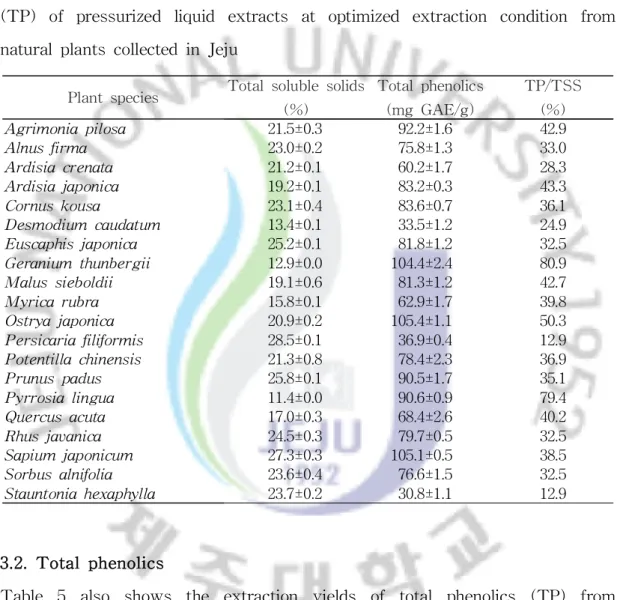
60:40v/v)추출물이 각각 85.0,84.3,90.6,76.8mg GAE/g로 EtOH:H2O (40:60, v/v)추출물이 가장 높았다.추출횟수가 증가할수록 총고형분 추출수율과 총페놀 함량은 증가하였다.추출온도에 따른 고압용매 추출물의 총페놀 함량은 추출온도 가 40℃(97.4mg GAE/g)에서 50℃ (108.3mg GAE/g)으로 증가하였을 때 11% 증가하였으나,그 이상의 추출온도에서는 변화가없었다.추출압력 증가에 따른 고압용매 추출물의 총고형분 추출수율과 총페놀 함량은 추출압력에 관계없이 변 화가 없었다.고압용매 최적추출조건은 추출용매와 농도 EtOH:H2O (40:60,v/v), 추출횟수 2회,추출온도 40℃,추출압력 10.2MPa이었다. (3)고압용매 최적추출조건에서 제주 자생식물 20종을 추출하여 항산화 활성,세 포독성 및 NO 생성 저해 활성,폴리페놀 성분을 동정․정량하여 식품산업에 응 용할 천연항산화소재로서의 가능성을 검정하였다.고압용매 추출물의 추출수율은 이삭여뀌가 28.5%로 가장 높았으며,사람주나무,귀룽나무,말오줌때가 각각 27.3, 25.8,25.2%를 나타내었다.총페놀 함량은 새우나무,사람주나무,이질풀,짚신나 물,석위가 각각 105.4,105.1,104.4,92.2,90.6,90.5mg GAE/g로 가장 높았다. 수용성 항산화 능력은 이질풀과 석위가 976, 948 μmol ascorbic acid
equivalents/g로 가장 높았고,지용성 항산화 능력은 백량금과 이질풀이 945,520
μmoltrolox equivalents/g로 가장 높았다.GC/MS에 의하여 폴리페놀 성분을 동
정한 결과 8개의 폴리페놀 피크를 얻었는데,gallicacid와 catechin이 가장 많이 함유되어 있었다.폴리페놀 전체 함량은 catechin이 많이 함유된 새우나무와 gallic acid가 많이 함유된 사람주나무가 2,970 ppm,2,963 ppm로 가장 높았다. 세포독성을 고려한 NO 생성 저해 활성인 선택지수는 사람주나무,사방오리나무, 산딸나무,아그배나무가 각각 4.5,3.4,2.3,2.2로 자생식물 추출물 중 가장 높았 다.자금우,된장풀,아그배나무,귀룽나무,붉나무 추출물은 HS-68세포에 대한 독성이 없었다.
Li
stofFi
gur
es
Fig.1. Schematicdiagram ofpressurizedliquidextractionsystem
Fig.2. Influence ofneatsolvents on the extraction yield oftotalsoluble
solidsfrom Sapium japonicum
Fig.3. Influence of neat solvents on the extraction efficiency of total
phenolicsfrom Sapium japonicum
Fig.4. Influence of solvent composition on the extraction yield of total
solublesolidsfrom Sapium japonicum
Fig.5. Influenceofsolventcomposition on theextraction efficiency oftotal
phenolicsfrom Sapium japonicum
Fig.6. Influenceofextraction stepson theextraction yield oftotalsoluble
solidsfrom Sapium japonicum
Fig.7. Influence of extraction steps on the extraction efficiency of total
phenolicsfrom Sapium japonicum
Fig.8. Influence of temperature on the extraction yield of totalsoluble
solidsfrom Sapium japonicum
Fig.9. Influence of temperature on the extraction efficiency of total
phenolicsfrom Sapium japonicum
Fig.10.Influence ofpressure on the extraction yield oftotalsoluble solids
from Sapium japonicum
Fig.11.Influence ofpressure on the extraction efficiency oftotalphenolics
from Sapium japonicum
Fig.12.CorrelationbetweenTP/TSS versusACW
Fig.13.CorrelationbetweenTP/TSS versusACL
Fig.14.Totalion chromatogram ofpressurized liquid extractfrom Cornus
Fig.15-1.Cell toxicity of pressurized liquid extracts from natural plants
collectedinJejuusingHS-68normalskinfibroblastcells
Fig.15-2Cell toxicity of pressurized liquid extracts from natural plants
Li
stofTabl
es
Table1.Listofnaturalplantsusedforexperiments
Table2.PLE conditionforextractionofnaturalplantscollectedinJeju
Table3.Extraction yields oftotalsoluble solids (TSS)and totalphenolics
(TP)ofpressurizedMeOH extractsfrom naturalplantscollected in
Jeju
Table4.Integralantioxidative capacity (IAC)ofpressurized MeOH extracts
from naturalplantscollectedinJeju
Table5.Extraction yields oftotalsoluble solids (TSS)and totalphenolics
(TP)ofpressurized liquid extractsatoptimized extraction condition
from naturalplantscollectedinJeju
Table6.Integralantioxidativecapacity(IAC)ofpressurizedliquidextractsat
optimizedextractionconditionfrom naturalplantscollectedinJeju
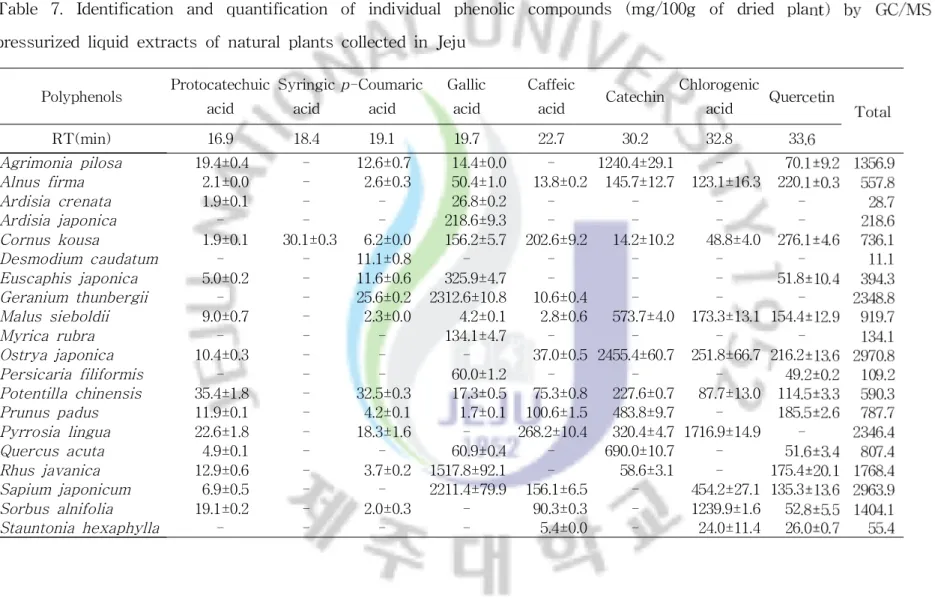
Table7.Identification and quantification of individual phenolic compounds
(mg/100g of dried plant) by GC/MS from pressurized liquid
extractsofnaturalplantscollectedinJeju
Table8.Celltoxicity and LPS-induced NO production ofpressurized liquid
I
NTRODUCTI
ON
Freeradicals areproduced in oxidation processes thatare essentialto most
living organisms for the production of energy to fuelbiologicalprocesses
(Soaresetal.,2009).However,theexcessiveproduction offreeradicals,such
assuperoxideradicals(O2-․),hydroxylradicals(․OH),andperoxylradicals
(ROO․),andtheunbalancedmechanismsofantioxidantprotection havebeen
associatedwith carcinogenesis,coronary heartdisease,andmany otherhealth
issuesrelatedtoadvancingage(Borneoetal.,2009;Slusarczyketal.,2009).
Almost all organisms are wellprotected against free radical damage by
oxidative enzymes such as superoxide dismutase and catalase or chemical
compoundssuch as α-tocopherol,ascorbicacid,carotenoids,and polyphenolic
compounds. However, these systems are frequently insufficient to totally
prevent diseases and accelerated ageing (Soares et al., 2009). Since
antioxidants terminate directly reactive oxygen species mediated oxidative
reactions,they may be used as a method of preventing aging-associated
diseasesandhealthproblems(Borneoetal.,2009).
Naturalproducts with antioxidantactivity may be used to help the human
body to reduceoxidative damage(Soaresetal.,2009).Therefore,thereisa
growing interestin naturalsubstances exhibiting antioxidantproperties that
are supplied to human and animals as food components or as specific
preventive pharmaceuticals (Slusarczyk et al.,2009).This has led to an
accelerated research for the identification of natural resources and the
isolationofactiveantioxidantmolecules(Borneoetal.,2009).
The plantkingdom offers a wide range ofnaturalantioxidants.However,
thegroupofsecondary plantmetabolites,antioxidantphenolicsarecommonly
found in various fruits,vegetables,herbs,cereals,sprouts,seeds,and edible
mushroomsandthey havebeenshowntoprovideadefenceagainstoxidative
stress from oxidizing agents and free radicals (Slusarczyk etal.,2009).A
generalrecommendation to thepublicisto increasetheintakeoffoodsrich
in antioxidantcompounds due to theirwellknown healthy effects (Borneo et
al.,2009).
Phenoliccompoundsarealargeclassofsecondary plantmetabolitesthatare
distributed widely in the plantkingdom and possess an aromatic ring with
oneormorehydroxylsubstituents(Mukhopadhyay etal.,2006).Polyphenols,
possessing two ormore phenolic subunits,include flavonoids (anthocyanins,
flavanols, flavonols, flavanones) and several classes of non-flavonoids
(phenolicacids,stilbenesandcomplex moleculesderivedfrom them)(Chirinos
etal.,2007).Phenoliccompoundsareknowntoexhibitvarioushealthbenefits
such as antioxidant, antiinflammatory, antihepatotoxic, antitumor,
atherosclerosis, arthritis, diabetes, antimutagenic, anticarcinogenic,
antithrombotic,vasodilatory activities and antimicrobialactivities (Cook and
Samman,1996;Proestosetal.,2004;Rice-Evansetal.,1997;TsaoandDeng,
2004;Yoshimotoetal.,2001).Phenoliccompoundsalsoplayanimportantrole
in the nutritional, organoleptic and commercial properties of agricultural
foodstuffs,since they contribute to their sensory properties such as color,
astringency,bitternessandflavor(Alonso-Salcesetal.,2001).
The chemical structure of the phenolic compounds varies from simple
phenolics to complex polymerics thatmay possess multiple hydroxylgroups
conjugated to sugars, acids or alkyl groups. The polarities of phenolic
compounds also vary significantly.Thus,extraction ofphenolic compounds
Mukhopadhyayetal.,2006).
Traditionally, the techniques employed in the extraction of phenolic
compounds from fruits and vegetables involve the use of organic solvent
mixtures including methanol,ethanoland acetone (Howard and Pandjaitan,
2008).Thesetraditionalextraction methodshaveseveraldrawbacks.Theyare
time consuming and laborious.They are also employed large amounts of
organicsolventswhich areexpensiveand environmentally unfriendly (P'eres
etal.,2006).
Atpresent,thereisagrowing interestin developing new extraction methods
ofnaturalplantsbasedontheuseofsupercriticalfluidsorsmallamountsof
organic solvents.Among them,pressurized liquid extraction (PLE) is the
mostpromisingprocess.
PLE is an excellent alternative to conventionalorganic solvent extraction
techniques that combines elevated temperature and pressures with liquid
solvents to increase the extraction efficiency of phenolic compounds from
naturalplants.TheuseofPLE withwaterandethanoloffersthepotentialto
minimize or eliminate the use oftoxic solvents (Howard and Pandjaitanet,
2008). Since PLE is conducted at elevated pressures, it allows liquid
extraction at temperatures above the boiling points of the solvent at
atmospheric pressure,thereby improving analytesolubility and its desorption
from thematrix (Rostagnoetal.,2004).Pressureisalsousedtoincreasethe
contact between the extracting fluid and the sample,thus enabling rapid
extractions (P´eres et al., 2006). Temperature is used to break the
analyte-matrix bonds and modify the relative permittivity ofthe extracting
fluid.Thistechniquealsoallowstherequired volumeofextraction solventto
Palmaetal.,2001).
The main reasons for the enhanced performance of PLE over other
conventional extraction methods are the higher solubility of analytes in
solventandhigherdiffusion rateasaresultofhighertemperature.Athigher
temperatures,the strong solute-matrix interaction caused by van derWaals
forces,hydrogen bonding and dipoleattractionsbetween solutemoleculesand
activesitesonthematrixaredisrupted(Sae-Yunetal.,2006).
Lightand oxygen in the airare two mostimportantfactors thatfacilitate
degradation reaction of phenolic compounds.PLE offers the possibility of
performing the extractions under an inert atmosphere and protected from
light,which representsan attractiveadvantagesincephenoliccompoundsare
sensitivetothesetwofactors(Rostagnoetal.,2004;Palmaetal.,2001).
Thereareseveralmethodstomeasureantioxidativecapacity.However,most
techniques require long experimental times and high costs to determine
antioxidativecapacityofhydrophilicorlipophiliccompound.
In photochemiluminescence (PCL) method, free radicals are generated
photochemicallybyUV irradiationofaphotosensitizer(dye)compound.These
radicalsarepartially eliminated by reaction with antioxidantsin theextracts.
The remaining radicals are quantified by the measurementofthe produced
lightasaresultofthechemicalreactionwithadetectionchemical,"luminol".
The PCL assay is easy and rapid to perform,and does notrequires high
temperatures to generate radicals. It is suitable to measure the radical
scavengingpropertiesofsingleantioxidantsaswellasmorecomplexsystems
in thenanomolarrange(Besco etal.,2007;Shlesieretal.,2002;Popov and
The objectives ofthis study were (1)to verify the applicability ofPLE on
the extraction of phenolic compounds from naturalplants in Jeju,(2) to
determine the optimalextraction conditions fortotalphenolics from Sapium
japonicum asa modelsubstrateusing a pressurized liquid extractor,and (3)
to characterize the extracts of plant materials at the optimized extraction
Par
tⅠ
I
nt
egr
alAnt
i
oxi
dat
i
veCapaci
t
y ofPr
essur
i
zedLi
qui
d Ext
r
act
s
f
r
om Nat
ur
alPl
ant
si
nJ
ej
u
1.ABSTRACT
Twenty naturalplants collected from Jeju were extracted by pressurized
organic solvent(100% MeOH,40℃,13.6 MPa,10 min).Extraction yieldsof
totalsolublesolids(TSS)and totalphenolics(TP),and integralantioxidative
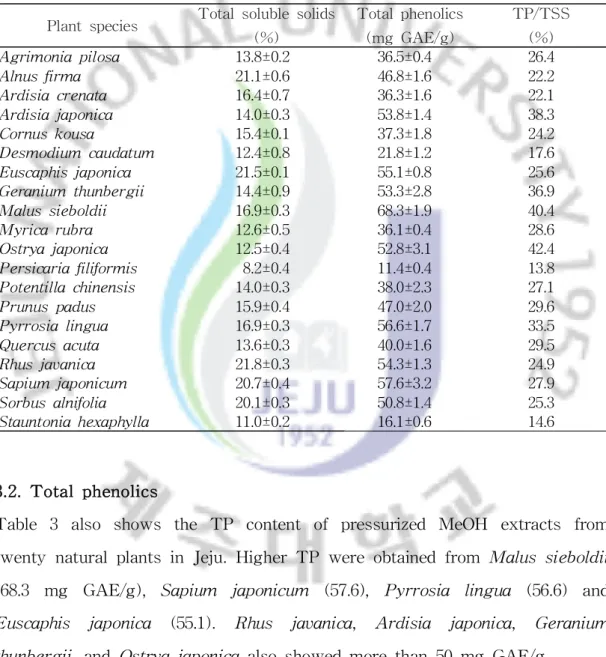
capacity wereevaluated.Extraction yieldsofTSS werehigheras21.8,21.5,
21.1,20.7,and 20.1% in Rhus javanica, Euscaphis japonica,Alnus firma,
Sapium japonicum,andSorbusalnifolia,respectively.HigherTP (mg GAE/g)
wereobtainedfrom Malussieboldii(68.3),Sapium japonicum (57.6),Pyrrosia
lingua (56.6),and Euscaphis japonica (55.1).Integralantioxidative capacities
ofwater-soluble substances were 598,394,293,and 270 μmolascorbic acid
equivalents/g in Geranium thunbergii,Sapium japonicum,Cornuskousa,and
Rhus javanica,respectively.Integralantioxidative capacities of lipid-soluble
substanceswere611,314,296,and 242μmoltrolox equivalents/g in Ardisia
crenata, Ostrya japonica, Geranium thunbergii, and Quercus acuta,
respectively.
2.MATERIALS AND METHODS
2.1.Plantmaterials
Table 1 shows the scientific and traditionalnames oftwenty naturalplants
collected in Jeju,Korea.The plants werewashed,dried,grinded (Ika Work,
Inc.,USA),and passed through a standard sieve No.30 (Chung Gye Sang
Gong SA.,Seoul,Korea).Thesampleswerestored in freezerat-20℃ until
Table1.Listofnaturalplantsusedforexperiments
Scientificname Traditionalname Partused
Agrimoniapilosa Jibsinnamul stem,leaves
Alnusfirma Sabangorinamu leaves,branch
Ardisiacrenata Baegryanggum leaves,branch
Ardisiajaponica Jakumwu leaves,branch
Cornuskousa Sanddalnamu leaves,branch,fruit
Desmodium caudatum Dounjangpul leaves,branch
Euscaphisjaponica Malojumttaenamu leaves,branch,fruit
Geranium thunbergii Ijilpul stem,leaves
Malussieboldii Agubaenamu leaves,branch
Myricarubra Sogwuinamu leaves,branch
Ostryajaponica Saeunamu leaves,branch
Persicariafiliformis Isacyouggui stem,leaves
Potentillachinensis Ddakjiggot leaves,branch
Prunuspadus Kwuirungnamu leaves,branch,fruit
Pyrrosialingua Sukwi stem,leaves
Quercusacuta Buggasinamu leaves,branch
Rhusjavanica Bugnamu leaves,branch
Sapium japonicum Saramjunamu leaves,branch
Sorbusalnifolia Patbaenamu leaves,branch,fruit
Stauntoniahexaphylla Moulggul leaves,branch
2.2.Pressurizedliquidextraction
Dried powder(1 g)ofnaturalplants was extracted using enhanced solvent
extractionsystem (SFX 3560,IscoInc.,USA).Thesystem wasoutfittedwith
twosyringepumps,one(B)fororganicsolvent(Model260DX)andtheother
(A)forCO2(Model100DX),andanvariablerestrictor(Fig.1).
Theextraction involved firstplacing an extraction cartridge(9mL)with the
sampleinsidetheextractionchamber.Next,thesupplyvalvewasswitchedto
the open position which allowed organic solvent(MeOH)from pump B to
enterthe extraction cartridge.The extraction chamberwas then pressurized
tothedesired pressure.Afterattaining equilibrium (13.6MPa,40℃),astatic
extraction was initiated.After completion ofthe static period (3 min),the
analyte valve was switched to the open position which allowed a certain
theextraction cartridgeataflow rateof1mL/min.Aftercompletion ofthe
dynamic extraction period (10 min), pump A which was filled with
pressurized CO2flushed theremaining solventoutoftheextraction chamber
for5 min.A 20 mL vialatambienttemperature was used to collectthe
extract.Aftercompletion ofthe CO2flush,both supply and analyte valves
were closed and the system was vented.Extraction of the sample was
carried outusing three extraction steps,and the extracts were collected in
one vial(Table 2).Afterthe extraction solventwas evaporated in a rotary
vacuum evaporatorat40℃,itwasadjusted to 10mL with neatMeOH and
filtered through a 0.45 μm cellulose acetate filter (Advantec,Toyo Roshi
Kaisha,Ltd.,Japan).Theextractwaskeptin the dark in a freezer(-20℃)
beforeanalysis.Eachextractionandanalysiswascarriedoutintriplicate.
Table2.PLE conditionforextractionofnaturalplantsinJeju
Extractionpressure 13.6MPa
Extractiontemperature 40℃
Extractionsolvent 100% MeOH
Collectiontrap 20mL emptyvial
Extractioncartridgevolume 10mL
Staticextractiontime 3min
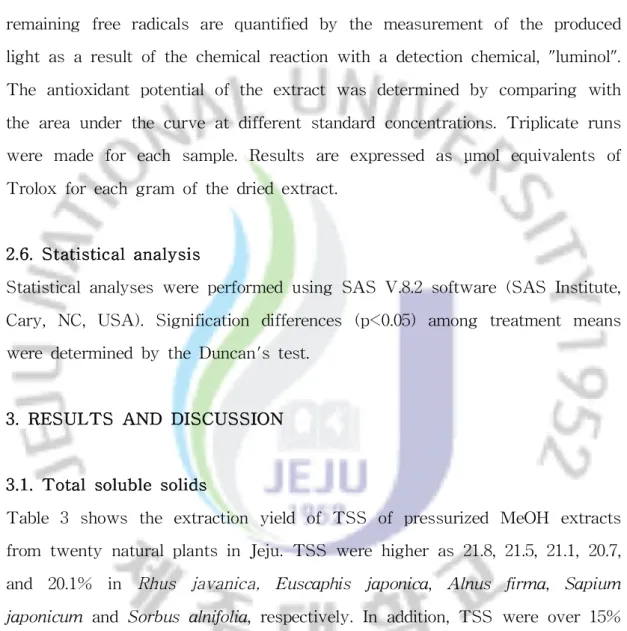
Dynamicextractiontime 10min
Flushsolvent CO2
Flushtime 5min
2.3.Totalsolidsassay
Totalsolidcontentwasmeasuredby drying methodat105℃.Theextraction
yield oftotalsoluble solids (TSS)was calculated from the solid contentin
theextractbasedonthatinthedriedsample.
2.4.Totalphenolicsassay
Total phenolics (TP) content in the extract was determined by the
Folin-Ciocalteu method (Peschel et al., 2006).The reaction mixture was
composed of 0.1 mL extract, 7.9 mL distilled water, 0.5 mL of
Folin-Ciocalteu'sreagent(Fluka,Switzerland),and 1.5 mL ofa 20% sodium
carbonate solution (added 2 min after the Folin-Ciocalteu's reagent).After
initialmixing,theflaskswereallowedtostand for2hr.Theopticaldensity
ofthe blue-coloured samples was measured at765 nm using the UV/VIS
spectrophotometer(ThermoSpectronic,NY,USA).Resultswereexpressed in
mg gallic acid equivalents per gram of dry sample (mg GAE/g) by
comparison with a calibration curve builtwith standard gallic acid (Sigma,
2.5.Integralantioxidativecapacity assay
Integralantioxidativecapacity oftheextractwasmeasuredin thePhotochem
system (Analytik Jena AG,Jena,Germany) with the kits ofantioxidative
capacity ofwater-soluble substances (ACW)and oflipid-soluble substances
(ACL)(Kranletal.,2005;Bescoetal.,2007;Chuaetal.,2008).
2.5.1.ACW protocol
A 490 μL ofreagent1 (buffer solution,pH 10.5)and 10 μL H2SO4 were
addedtothereagent4containingascorbicacidandmixedbyvortex for20~
30sec.Thisstocksolutionwasthendiluted1:100withreagent1.A 10μL of
thisworkingsolutioncontain1nmolascorbicacidasacalibrationstandard.
Integral antioxidative capacity of water-soluble substances was measured
withtheACW kit.A 1.5mL ofreagent1,1mL ofreagent2(water),25μL
ofreagent3 (photosensitizer)and 10 μL ofthe extractwere mixed.Free
radicalsaregenerated photochemically by UV irradiation ofaphotosensitizer
(dye)compound and arepartially eliminated by reaction with antioxidantsin
theextracts.Theremainingradicalsarequantifiedbythemeasurementofthe
producedlightasaresultofthechemicalreaction with adetection chemical,
"luminol". The antioxidant potential of the extract was determined by
comparing with the lag phase at different standard concentrations.
Measurements were repeated triplicate. Results are expressed as μmol
equivalentsofascorbicacidforeachgram ofthedriedextract.
2.5.2.ACL protocol
A 500 μL ofreagent 1 (MeOH) were added to the reagent4 containing
Trolox and mixed by vortex for20~30 sec.This stock solution was then
diluted1:100withreagent1.A 10μL ofthisworkingsolutioncontain1nmol