Investigation of Applicability of Emergency Operational Procedure of Steam Generator Tube
Rupture Event using Nuclear Plant Analyzer
Sang Won Lee, Yeon Kyoung Bae
Korea Hydro & Nuclear Power Co., Ltd., Munji-Dong Yusung-Gu, Daejeon, 103-16, Korea Tel:+82-42-865-7669 , Fax:+82-42-865-7604 , Email:[email protected]
1. Introduction
The Nuclear Plant Analyzer, called Visual System Analyzer (ViSA) has been developed by KHNP and KAERI1). The main objective of this analysis tool is to facilitate the use of safety analysis code by adopting the easily assessable GUI including the plant mimic. Also, the interactive control function can provide the appropriate operator action that can be implemented during the accident analysis. This function is useful to simulate the required operator action in the Emergency Operation Procedure (EOP) process. Recently, EOP operator action step at Steam Generator Tube Rupture event is modified in Ulgin 3, 4 to minimize the radiation release to the environment. In this paper, the effect of this change to the plant behavior is investigated using ViSA system to examine the applicability of ViSA to the EOP procedure.
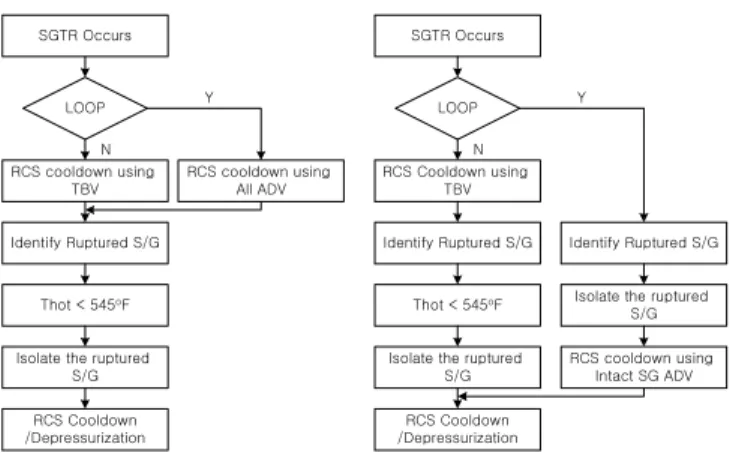
2. Description of modified SGTR EOP process The SGTR event is one of the worst events in respect to the radiation release to the environment. When the SGTR event occurs, containment integrity is not effective because of the direct bypass of containment via the steam generator to the MSSV and MSADV is formed. To prevent this path, the EOP of KSNP type indicates the use of Turbine Bypass Valve (TBV) as an effective means to cool-down the RCS indirectly. But the TBV is not operable when the SGTR event and offsite power is not available (LOOP). In this situation, the RCS cool-down is achieved using the MSSV and MSADV. But this action causes the radiation release to the environment. This effect is questioned in the licensing process of Ulgin 5, 6 and the EOP is modified to minimize the radiation release. The simplified procedure is illustrated in Fig 1.
As shown in the figure, the procedure without LOOP event is same as the previous one. When the LOOP is occurred simultaneously with the reactor trip, the TBVs are not available and the RCS cool-down process is implemented using both intact and ruptured SG ADV. When the RCS is sufficiently cool-down by release of steam, the operator should identify the ruptured SG and isolate the ADV when RCS hot leg temperature is reached below the MSSV lifting temperature.
SGTR Occurs LOOP RCS cooldown using TBV Identify Ruptured S/G Thot < 545oF
Isolate the ruptured S/G RCS Cooldown /Depressurization RCS cooldown using All ADV N SGTR Occurs LOOP RCS Cooldown using TBV Identify Ruptured S/G Thot < 545oF
Isolate the ruptured S/G RCS Cooldown /Depressurization Identify Ruptured S/G Y N
Isolate the ruptured S/G
RCS cooldown using Intact SG ADV Y
Fig. 1 Comparison of EOP of SGTR event But this procedure causes the release of radiation significantly via the ruptured SG ADV. To improve this negative effect, the isolation process proceeds to the cool-down process at the modified procedure. However, this process might lead to an unexpected event scenario. For example, the early isolation of ruptured SG results in the over-pressurization and MSSV can be open several times. In addition, the steam generator inventory can overfill to the main steam line due to the continuous break flow. To assess the degree of this negative effect and applicability, the overall system behavior is simulated using the ViSA based on the EOP operator action.
3. SGTR accident analysis using ViSA system
3.1 Plant Modeling
The nodding diagram of Ulgin 3, 4 is composed of 123 junctions and 191 volumes. The EOP process is basically the best estimate assessment, so the most control system, protection system, and ESFAS (Engineered Safety Features Actuation System) is modeled in ViSA based on RETRAN code for non-LOCA accident analysis
3.2 Event Scenario
Transactions of the Korean Nuclear Society Autumn Meeting Busan, Korea, October 27-28, 2005
At time 0.0sec, SG 1 single tube rupture is initiated. From that time, the RCS inventory is discharged to the broken cold leg continuously. The reactor trip signal is generated by the low pressurizer pressure at ~1280sec and the LOOP is generated simultaneously. In real situation, the operator enters into the EOP process after the reactor trip condition. From this time, the operator should implement the SPTA (Standard Post Trip Action) and DA (Diagnosis Action). After the SGTR is identified, the operator should implement the cool-down (case1) or isolation procedures (case 2). In this calculation, 10 min is assumed. The detailed sequence of event is described in table 1 and 2.
Table 1. SGTR Event Scenario of Previous EOP
Time Event 0s SGTR occurs in loop 1
1279s PZR Low pressure
1280s Rx trip by PZR low pressure, TBN trip RCP trip, MFW pump trip, TBV close by LOOP(loss of offsite power)
1309s SIAS by PZR lo pressure 1310s Lo Tavg
1880s SG 1/2 ADV open for RCS cool-down 2094s MSIV isolation by SG low pressure 2280s Isolate ruptured SG 1
Table 2. SGTR Event Scenario of modified EOP
Time Event ~1879
s
Same as table 1
1880s Intact SG 2 ADV open for RCS cool-down Isolate ruptured SG 1
2256 MSIV isolation by SG lo pressure
3.3 Analysis Results
Fig 2 shows the PZR and SG pressure. As shown in the figure, the pressure of case 1 is decreased rapidly rather than the case 2. This is due to the ADV opening action on both SG and it lead to the more cooling of RCS and SG. However, both cases show that the pressure equilibrium is reached before 4000sec and no significant MSSV lifting occurrence is predicted. Fig 2 shows the SG inventory behavior. The ruptured SG inventory in case 2 is higher than the case 1 due to the early isolation of ruptured SG, and it reduce the discharge of SG inventory. However, the total volume of ruptured SG inventory is far below the total SG volume. It means that the margin for the overfill concerns is sufficient. Overally, the negative concerns on the modified EOP procedure is not significant and the release of radiation to the environment period (slashed box in Fig 2) is reduced. So, modified procedure can be
applicable to mitigate the SGTR event scenario.
0 500 1000 1500 2000 2500 3000 3500 4000 20 40 60 80 100 120 140 160 180 Rx trip ADV open P res su re (k g/ cm 2) Time(sec) Case 1 PZR SG 1 SG 2 Case 2 PZR SG 1 SG 2
Fig 2. Pressure of Pressurizer and SG
0 500 1000 1500 2000 2500 3000 3500 4000 1000 2000 3000 4000 5000 6000 7000 8000 9000 SG liquid volum e (ft 3) Time(sec) Case 1 SG 1 SG 2 Case 2 SG 1 SG 2
Fig 3. Wide range level of SG 1&2 4. Conclusion
The applicability of ViSA system to the EOP validation process is examined. Modified SGTR event results shows that the radiation release is significantly reduced. And the negative effect is not considerable. This tool can be useful to assess the EOP procedure validation tool.
REFERENCES
[1] S.W.Lee et. al, Application of the ViSA for RETRAN-3D, Proceeding of KNS meeting, May. 2004.