© Korean Powder Metallurgy Institute 1169
-1. Introduction
Generally, insulated steel plates below a thickness of 1 mm are taken to motor cores to reduce the eddy current loss that is generated by magnetic flux density variation due to motor revolution. Recent years, the silicon steel plate with a thickness of 0.1 mm is taken to motors with high frequency magnetic field variation to reduce the eddy current loss as low as possible. On the other hand, applications of powder magnetic cores to motors have been studied nowadays [1-4]. The powder magnetic cores are made by adding the binders to the insulated soft magnetic powders, molding the mixtures and heat treatment. They have some features those are isotropic magnetic properties, small eddy current loss in high frequency field, simple production for three- dimensional shapes, and easy recycling. However, difference in magnetic properties from electromagnetic steel can’t be disregarded for motor design engineers. We made a high-speed motor having the powder magnetic cores superior in the high frequency field and the DC blushless motor having three-dimensional shaped powder magnetic stator core superior in the isotropical magnetic circuit, and compared them with electromagnetic steel core motors.
2. Evaluation of high-speed motor
The experimental motors were high-speed motor for hand grinding tools on the market.
The stator cores were made of the powder magnetic core materials A, B, and the silicon steel plate with a thickness of 0.1 mm, where the material B is the low core loss material with reduced hysteresis losses. The iron losses of the powder magnetic cores in this work were from 6 to 10 times larger than those of silicon steel plate whose iron loss had been smallest on the market. To consider the influence of the core size, we made the tall ring specimens similar to the
experimental motor cores of the powder magnetic core A and the silicon steel plate. The iron loss of the core A was 86 W/kg (0.7 T, 1 kHz), and that of the silicon steel was 19 W/kg, the former is 5 times larger than the latter, namely the iron loss ratio of the former to the latter is a half compared with the ratio of catalog data. It is considered that the change of iron loss ratio is due to increase of hysteresis loss of the silicon steel plate caused by residual strain.
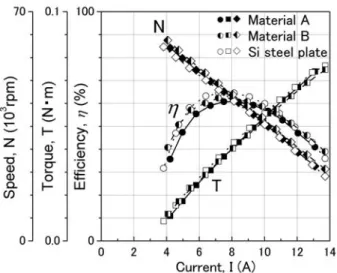
Fig. 1 shows the motor output performance of high -speed experimental motor on the load test, where these curves indicate speed of revolution (diamond mark), torque (square mark) and efficiency (circle mark) as a function of current. The torque of the all materials is almost the same in the all currents range, and the speed of them, too. The output performances are almost the same though the distinct difference in magnetizing characteristics. Because, the experimental motors have a rather wide air gap of 0.8 mm
Fig. 1. Motor output performance curve of high-speed motors.
2006 POWDER METALLURGY World Congress
PC09-W-03
Evaluation of DC Brush-less Motors Using Powder Magnetic Cores
Katsuhiko Mori1, a, Ryoji Nakayama1,b and Kinji Kanagawa1,c1
Central Research Institute, Mitsubishi Materials Corp., 1002-14 Mukouyama, Naka-shi, Ibaraki 311-0102, Japan a
[email protected], [email protected], [email protected] Abstract
We made a high-speed motor and a DC brush-less motor for factory automation (FA) to investigate applicability of powder magnetic core to motor application, and compared those performances with the similar motors having conventional electro magnetic steel core. Permeability and saturated magnetization of powder magnetic core are less than those of elect romagnetic steel core, however output performances of each core motor are almost the same. The FA motor with powder magnetic core using three-dimensional magnetic circuit showed higher torque than the same volume motor with electromag netic steel core.
© Korean Powder Metallurgy Institute 1170 -between rotor and stator compared with usual magnetic circuit due to the rare-earth magnet rotor and high-speed revolution. The calculation about the magnetic field indicates that the field in the stator core is much one-hundredth times lower than that in the air gaps, so that the magnetic fluxes are affected by not the magnetic properties of the core materials but the air gaps.
3. Evaluation of three-dimensional core motor The experimental motor was servomotor for factory automation (FA) on the market. The experimental motor has an air gap of 0.4 mm with usual width as a similar motor, so that it was predicted that the magnetic properties affected the output performance. The stator cores were made of the powder magnetic core and the electromagnetic steel plate with thickness of 0.35 mm. To prevent the deterioration of the torque for the difference of the magnetic properties between the powder core and the silicon steel, we adopted the three-dimensional magnetic circuit stator core of "sword-guard" shape structure with the extended inner face to the coil-end as shown in Fig. 2.
Fig. 2. Illustration of "Sword-guard" shaped powder magnetic stator core having three-dimensional magnetic circuit.
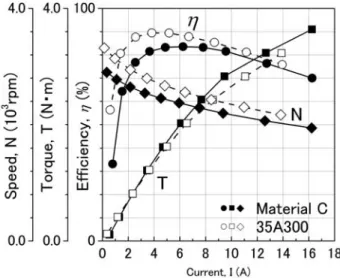
Fig. 3. Motor output performance curve of FA motors.
Fig. 3 shows the motor performance of experimental FA motor on the load test, where these curves indicate speed of revolution (diamond mark), torque (square mark) and efficiency (circle mark) as a function of current. The permeability and saturated magnetization of the powder magnetic core was lower than that of the electromagnetic steel plate, however the torque of the former as the function of current is higher than that of the latter. This is the effect of the increased stator area opposite to the rotor for "sword-guard" structure on the inner stator face.
4. Summary
We made a high-speed motor and a DC brush-less motor for factory automation (FA) to investigate applicability of powder magnetic cores to motor application, and measured and evaluated output performances of these motors. The results are as follows.
(1) By evaluation of the high-speed motors, those have a wide air gap compared with usual motor volume, the motors of these materials indicated almost the same output performance as that of the silicon steel plate with thickness of 0.1 mm.
(2) By evaluation of FA motor, that have a stator core of three-dimensional magnetic circuit structure indicates higher torque than electromagnetic steel plate core of conventional structure.
These results revealed that the powder magnetic cores were applicable to the motor core by making the most of their features that were high frequency magnetic properties and/or three-dimensional magnetic circuit.
5. References
1. S.Minett and C.jonsson: “3D-a new dimension for elec-tric motors” , Metal powder report by hoganas AB FEB. (2003).
2. Y.G. Guo and J.G.Zhu: IEEE Tran. Ind. Appl. 39[6], 1696 (2003).
3. Y.Kawase et al.: IEE of Japan, RM-04-18(2004). 4. Y.Enomoto et al.: IEEJ Trans. IA, 125[1] (2005).