128
제6회 EDISON SW 활용 경진대회Driving Force of Inverse Electron Demand Diels-Alder Reactions of
Diphenyl Tetrazines
Yeil Kim, Suhwan Song, and Eunji Sim*
Department of Chemistry, Yonsei University, 50 Yonsei-ro Seodaemun-gu, Seoul 03722, KOREA [email protected]
Abstract
We explore the inverse electron demand Diels-Alder reactions of tetrazines with various functional groups employing quantum calculations. In general, the rate of inverse electron demand Diels-Alder reaction depends on molecular orbital levels of electron donor and electron acceptor. Likewise, π orbital of the dienophile and π* orbital of the diene is a key factor. In this work, we discuss the case where the energy of diene’s π* molecular orbital is not the sole governing factor to determine the reaction rate, rather the rate shows strong correlation with the charge density of dienes.Introduction
The Diels-Alder reaction, one of the most widely used methodology in organic synthesis today,1 is an organic chemical reaction between a conjugated electron-rich diene and an electron-poor alkene.2 Unlike the Diels-Alder reaction, the inverse electron demand Diels-Alder (IEDDA) reaction is reaction between an electron-poor diene and an electron-rich dienophile.3
Cycloadditions of tetrazine are one of most important reactions in bioorthogonal chemistry4 owing to the application of IEDDA reactions of 1,2,4,5-tetrazines.5 Tetrazine has lower activation barrier than benzene and other azobenzenes.6 Therefore, tetrazine cycloadditions have been used in various synthesis like natural products,7 metal-organic frameworks,8 functionalization of carbon
nanotubes,9 and microarrays constructions.10 There has been a number of trials to control the reactivity of IEDDA. Types of dienophile are known to alter the reaction rate. In particular, strained dienophiles with low distortion and activation energy have higher reactivity due to their structural unstability.11 Reaction rate also depends strongly on the functional group of diene. For instance, dipyridyltetrazine has been reported to be more reactive than diphenyltetrazine (DPTZ).12
Further theoretical and experimental studies show interesting results of controlling rates by functional groups of dienes. π-electrons occupying frontier molecular orbital play a decisive role in chemical activation.14 To see the reactivity, Houk’s group used LUMO+1 level comparison and activation energy using transition state optimization.15 Because electron withdrawing functional groups lower the energy
129
제6회 EDISON SW 활용 경진대회
Driving Force of Inverse Electron Demand Diels-Alder Reactions of
Diphenyl Tetrazines
Yeil Kim, Suhwan Song, and Eunji Sim*
Department of Chemistry, Yonsei University, 50 Yonsei-ro Seodaemun-gu, Seoul 03722, KOREA [email protected]
Abstract
We explore the inverse electron demand Diels-Alder reactions of tetrazines with various functional groups employing quantum calculations. In general, the rate of inverse electron demand Diels-Alder reaction depends on molecular orbital levels of electron donor and electron acceptor. Likewise, π orbital of the dienophile and π* orbital of the diene is a key factor. In this work, we discuss the case where the energy of diene’s π* molecular orbital is not the sole governing factor to determine the reaction rate, rather the rate shows strong correlation with the charge density of dienes.Introduction
The Diels-Alder reaction, one of the most widely used methodology in organic synthesis today,1 is an organic chemical reaction between a conjugated electron-rich diene and an electron-poor alkene.2 Unlike the Diels-Alder reaction, the inverse electron demand Diels-Alder (IEDDA) reaction is reaction between an electron-poor diene and an electron-rich dienophile.3
Cycloadditions of tetrazine are one of most important reactions in bioorthogonal chemistry4 owing to the application of IEDDA reactions of 1,2,4,5-tetrazines.5 Tetrazine has lower activation barrier than benzene and other
azobenzenes.6 Therefore, tetrazine
cycloadditions have been used in various synthesis like natural products,7 metal-organic
frameworks,8 functionalization of carbon
nanotubes,9 and microarrays constructions.10 There has been a number of trials to control the reactivity of IEDDA. Types of dienophile are known to alter the reaction rate. In particular, strained dienophiles with low distortion and activation energy have higher reactivity due to their structural unstability.11 Reaction rate also depends strongly on the functional group of diene. For instance, dipyridyltetrazine has been reported to be more reactive than diphenyltetrazine (DPTZ).12
Further theoretical and experimental studies show interesting results of controlling rates by functional groups of dienes. π-electrons occupying frontier molecular orbital play a decisive role in chemical activation.14 To see the reactivity, Houk’s group used LUMO+1 level comparison and activation energy using transition state optimization.15 Because electron withdrawing functional groups lower the energy
제6회 EDISON SW 활용 경진대회
of Lowest Unoccupied Molecular Orbital (LUMO) of tetrazine, it is expected that with more electron withdrawing effects, faster reaction will result.
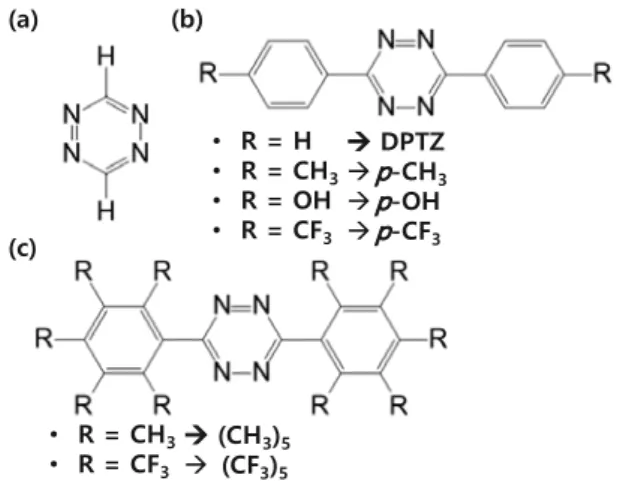
To better understand the effect of various functional groups, we explored a series of DPTZ derivatives shown in Scheme 1. Density functional theory (DFT) with B3LYP functional was used.16 Computation details appear later.
Scheme 1. (a) Tetrazine structure, (b) para-substituted diphenyl tetrazine structure, and (c) di(penta substituted)phenyl tetrzaine structure.
Results and Discussion
A.
LUMO+1 Energy Level
Tetrazine is widely used as diene for IEDDA reactions. In particular, diphenyl functionalized DPTZ undergoes efficient IEDDA reaction due to the low LUMO+1 energy level. Setting DPTZ as a stardard, the LUMO+1 energy of DPTZ is further lowered by attaching additional electron withdrawing groups on para (p-) position of phenyl ring. Likewise, electron donating groups raise LUMO+1 energy. In Figure 1, the energy
levels of LUMO+1 of various DPTZ derivatives follow the general trend that the more electron withdrawing group, the lower LUMO+1 energy.
Figure 1. Energy level of LUMO+1 state of DPTZ derivatvies in Scheme 1.
According to the frontier molecular orbital theory, the reactivity of compounds can be easily deducted. LUMO+1 energy of p-OH is close to that of p-CH3. Thus, the reactivity of the two compounds is expected to be similar. Likewise, p-CF3 is expected to be most reactive. Thus, it is a general trend that electron withdrawing groups increase the reactivity of dienes in IEDDA reactions and it is reasonable to compare reactivity with π* orbital of diene.
Table 1. Total charge of tetrazine ring with additional functional groups substituted.
DPTZ p-OH p-CH3 p-CF3 (CH3) 5 (CF3)5 Q -0.10 -0.13 -0.12 -0.09 -0.38 -0.15
With different functional groups, the Mülliken charge of center ring could be affected. The trend is that with more donating group, the more negative the charge is. As shown in Table
(a) (b) (c) • R = H • R = CH3 • R = OH • R = CF3 DPTZ p-CH3 p-OH p-CF3 • R = CH3 • R = CF3 (CH3)5 (CF3)5 -3.2 -2.8 -2.4 -2 LUM O+ 1 En er gy [eV] DPTZ (CH3)5 p-OH p-CH3 p-CF3 (CH3)5
130
제6회 EDISON SW 활용 경진대회
1, the total charge of tetrazine ring is more negative if there is electron donating group. The result shows that if the charge of the center ring in substituted DPTZ is more positive, the more reactive the compound is. Tetrazine ring
charge of Penta CH3 has negative charge
following the trend, while Penta CF3 doesn’t. In this result, electron withdrawing effect seems small than the electron donating effect. This trend is opposite to the LUMO+1 energy trend.
Figure 2. Plot of LUMO+1 energy versus tetrazine ring charge.
In Figure 2, DPTZ and para derivatives show linear correlation. For p-(electron donating group), it is easy to see the correlation between LUMO+1 energy and tetrazine ring charge. However, with penta derivatives, for example for (CF3)5, the tetrazine ring charge is more negative than p-(CF3). Despite the low LUMO+1 energy, (CF3)5 might have lower reactivity.
B.
Charge Density
We compare the effect of the functional groups in the charge density, as shown in Figure 3. For para position, CF3 derivatives the tetrazine ring are relatively low and for CH3
derivatives, the density is relatively high. Thus, tetrazine ring charge density of CH3 derivatives, which is charge donating group, is higher than CF3 derivatives. We can see the same trend in penta substituted compounds.
-0.020 0.015
Figure 3. Charge density of DPTZ and deriva tives drawn in 4x10⁻² e-/Bohr3 isovalue level (a) DPTZ, (b) p-OH, (c) p-CH3, (d) p-CF3 (e) (CH3)5, and (f) (CF3)5.
Conclusion
Using DFT, we have studied several DPTZ derivatives to find the substituent effect on DPTZ. By comparing molecular orbital energy, electron withdrawing substituents on phenyl ring lower the LUMO+1 energy, leading to stronger interaction energy. Same trend was found in the charge of the center ring except
(CF3)5 case. It showed that the electron
donating group has more negative charge on tetrazine ring, thus, the electron rich dienophile hardly reacts with the diene. By examing the charge density, we found that compound with the lower LUMO+1 state has higher electron desity on the tetrazine ring atoms.
To reduce computational cost calculating the transition state of molecules, charge density -3.5 -2.5 -1.5 -0.4 -0.3 -0.2 -0.1 0 (CH3)5 (CF3)5 p-CF3 p-OH DPTZ p-CH3 LU MO + 1 En er g y [eV]
Tetrazine ring charge
(a) (b)
(c) (d)
131
제6회 EDISON SW 활용 경진대회
1, the total charge of tetrazine ring is more negative if there is electron donating group. The result shows that if the charge of the center ring in substituted DPTZ is more positive, the more reactive the compound is. Tetrazine ring
charge of Penta CH3 has negative charge
following the trend, while Penta CF3 doesn’t. In this result, electron withdrawing effect seems small than the electron donating effect. This trend is opposite to the LUMO+1 energy trend.
Figure 2. Plot of LUMO+1 energy versus tetrazine ring charge.
In Figure 2, DPTZ and para derivatives show linear correlation. For p-(electron donating group), it is easy to see the correlation between LUMO+1 energy and tetrazine ring charge. However, with penta derivatives, for example for (CF3)5, the tetrazine ring charge is more negative than p-(CF3). Despite the low LUMO+1 energy, (CF3)5 might have lower reactivity.
B.
Charge Density
We compare the effect of the functional groups in the charge density, as shown in Figure 3. For para position, CF3 derivatives the tetrazine ring are relatively low and for CH3
derivatives, the density is relatively high. Thus, tetrazine ring charge density of CH3 derivatives, which is charge donating group, is higher than CF3 derivatives. We can see the same trend in penta substituted compounds.
-0.020 0.015
Figure 3. Charge density of DPTZ and deriva tives drawn in 4x10⁻² e-/Bohr3 isovalue level (a) DPTZ, (b) p-OH, (c) p-CH3, (d) p-CF3 (e) (CH3)5, and (f) (CF3)5.
Conclusion
Using DFT, we have studied several DPTZ derivatives to find the substituent effect on DPTZ. By comparing molecular orbital energy, electron withdrawing substituents on phenyl ring lower the LUMO+1 energy, leading to stronger interaction energy. Same trend was found in the charge of the center ring except (CF3)5 case. It showed that the electron donating group has more negative charge on tetrazine ring, thus, the electron rich dienophile hardly reacts with the diene. By examing the charge density, we found that compound with the lower LUMO+1 state has higher electron desity on the tetrazine ring atoms.
To reduce computational cost calculating the transition state of molecules, charge density -3.5 -2.5 -1.5 -0.4 -0.3 -0.2 -0.1 0 (CH3)5 (CF3)5 p-CF3 p-OH DPTZ p-CH3 LU MO + 1 En er g y [eV]
Tetrazine ring charge
(a) (b)
(c) (d)
(e) (f)
제6회 EDISON SW 활용 경진대회
and ring charge could be a good alternative method.
Computational Details
The DFT calculations were performed with TURBOMOLE and UCHEM in Edison web site (http://www.edison.re.kr). To study solely for the substituent effect on electron configuration by density calculation, we fixed the atoms of DPTZ and ingle point calculation is done at the B3LYP level with def2-TZVP basis set. The frontier molecular orbitals and their energies were computed at the same level.
Acknowledgement
This research was supported by the EDISON Program through the National Research Foundation of Korea (NRF) funded by the Ministry of Science, ICT & Future Planning (NRF-2011-0020576)
References
[1] F. Fringuelli and A. Taticchi, Editor, The Diels-Alder Reaction: Selected Practical Methods, John Wiley & Sons, LTD, England (2002)
[2] M. C. Kloetzel, Organic Reactions. 4: 1–59 (1948) [3] D. Boger. Progress in heterocyclic chemistry. New York: Pergamon (1st ed.) (1989)
[4] (a) N. K. Devaraj, R. Weissleder, Acc. Chem.Res. 44, 816 (2011) (b) M. J. Schmidt, D. Summerer, ChemBioChem 13, 1553 (2012) (c) A.-C. Knall, C. Slugovc, Chem. Soc. Rev., 42, 5131 (2013) (d) L. Carroll,; H. L. Evans; E. O. Aboagye; A. C. Spivey, Org. Biomol. Chem. 11, 5772 (2013) (e) M. F. Debets; J. C. M. van Hest; F. P. Rutjes, J. T. Org. Biomol. Chem. 11, 6439 (2013) (f) K. Lang; J. W. Chin, ACS Chem. Biol. 9, 16 (2014) (g) D. M. Patterson; L. A. Nazarova; J. A. Prescher, ACS Chem. Biol. 9, 592 (2014)
[5] ) (a) M. L. Blackman; M. Royzen; J. M. Fox, J. Am.
Chem. Soc. 130, 13518 (2008) (b) N. K. Devaraj; R Weissleder; S. A. Hilderbrand, Bioconjugate Chem. 19, 2297 (2008)
[6] Yang, Yun-Fang, et al. J. Am. Chem. Soc. 138.5 1660 (2016)
[7] (a) D. L. Boger; S. E. Wolkenberg, J. Org. Chem. 65, 9120 (2000) (b) D. L. Boger; J. Hong J. Am. Chem. Soc. 123, 8515 (2001) (c) A. Hamasaki; J. M. Zimpleman; I. Hwang; D. L. Boger, J. Am. Chem. Soc. 127, 10767 (2005) (d) J. S. Oakdale; D. L. Boger Org. Lett. 12, 1132 (2010) (e) L. Fu.; G. W. Gribble, Tetrahedron Lett. 51, 537 (2010)
[8] C. Chen; C. A. Allen; S. M. Cohen, Inorg. Chem. 50, 10534 (2011)
[9] (a) H. Hayden; Y. K. Gun’ko; T. S. Perova, Chem. Phys. Lett. 435, 84 (2007) (b) H. Hayden; Y. K. Gun’ko; T. Perova; S. Grudinkin; A. Moore; E. D. Obraztsova, Plast. Rubber Compos. 38, 253 (2009) (c) J. Zhu; J. Hiltz; R. B. Lennox,; R. Schirrmacher, Chem. Commun. 49, 10275 (2013)
[10] (a) H. S. G. Beckmann; A. Niederwieser; M. Wiessler; V. Wittmann Chem. Eur. J. 18, 6548 (2012) (b) C. J. Zhang; C. Y. J. Tan; J. Ge; Z. Na; G. Y. J. Chen,; M. Uttamchandani; H. Sun; S. Q. Yao Angew. Chem., Int. Ed. 52, 14060 (2013)
[11] S. Paton, Robert, Angewandte Chemie International Edition 50.44 10366 (2011)
[12] W. Chen; D. Wang; C. Dai; D. Hamelberg; B. Wang, Chem. Commun. 48, 1736 (2012)
[13] R. A. Carboni; R. V., Jr. Lindsey, J. Am. Chem. Soc. 81, 4342 (1959)
[14] K. Fukui; T. Yonezawa; H. Shingu, J. Chem. Phys 20 (4): 722. (1952)
[15] F. Liu; L. Yong; K. N. Houk, J. Am. Chem. Soc. 136.32, 11483 (2014)
[16] L. R. Domingo; C. Eduardo; P. Patricia J. Phys. Chem. A 112.17, 4046 (2008)