LETTERS AND
CORRESPONDENCE
Letters and correspondence submitted for possible publication mustbe identified as such. Text length must not exceed 500 words and five bibliographic references. A single concise figure or table may be included if it is essential to support the communication. Letters not typed double-spaced will not be considered for publication. Letters not meeting these specifications will not be returned to authors.Letters to the Editorare utilized to communicate a single novel observation or finding.Correspondenceis to be used to supplement or constructively comment on the contents of a publication in the journal and cannot exceed the restrictions forLetters to the Editor.The Editor reserves the right to shorten text, delete objectional comments, and make other changes to comply with the style of the journal. Permission for publication must be appended as a postscript. Submissions must be sent to Paul Chervenick, M.D., Editor of Brief Reports/Letters to Editors, American Journal of Hematology, H. Lee Moffitt Cancer Center, University of South Florida, 12902 Magnolia Drive, Tampa, FL 33612 to permit rapid consideration for publication.
CD4 and CD8 Coexpressed T-Lymphocytosis in Adult Onset Still’s Disease
To the Editor: Adult onset Still’s disease (AOSD) is a febrile disorder with typical spiking fever, evanescent rash and involvement of various organs. Although increase of TCR␥␦+ T cells in peripheral blood lymphocyte (PBL) were reported, the details of T-cell abnormalities in the AOSD remain obscure [1]. According to normal T-cell ontogeny, T cells in PBL typically express high density of T-cell receptor/CD3 complex and either CD4 or CD8 surface antigens. T lymphocytes bearing only CD4 or CD8 are released in the circulation after a maturation process in the cortex where most T lymphocytes simultaneously coexpress CD4 and CD8 antigens. However, a very low percentage (1–2%) of T cells that coexpress CD4 and CD8 also are found in the PBL. We report herein a patient of adult onset Still’s disease with CD4/8 coexpressed lymphocytosis.
A 20-year-old woman had diagnosis of AOSD according to the 1992 criteria, proposed by Yamaguchi [2]. Six months later, she was admitted with fever, vomiting, and arthralgia. Examinations on admission revealed a blood pressure of 120/60 mmHg, body temperature of 39.8°C, tachycar-dia, macular eruption on the neck, and trunk. Although the hemoglobin, white blood cells (WBC), and platelet were normal at the time of admis-sion, leukocytosis, anemia and thrombocytopenia developed after 2 weeks. On day 16 of the admission, the patient’s WBC rose to 74.6 × 10⁹/l (neutrophils 28%, lymphocytes 38%, reactive lymphocytes 28%, mono-cytes 3%, eosinophils 3%) and hemoglobin and platelets dropped to 7.9 g/dl and 61.0 × 10⁹/l, respectively. PBL showed 97.6% T cells (CD3+), 4.7% NK cells (CD16/56+), and less than 1% B cells (CD19+). T-cell subsets were analysed as follows; CD4+/CD8− 8.9%, CD4+/CD8+ 19.9%, CD4−/CD8+ 68.8%. Markedly increased liver enzyme (AST 524 IU/l, ALT 59 IU/l), and hyperferritinemia (155,010g/l) were observed. Posi-tive fibrin/fibrinogen degradation product and D-dimer, decreased levels of
fibrinogen and anti-thrombin III, presence of schistocytes, prolonged pro-thrombin, and activated partial thromboplastin time revealed disseminated intravascular coagulation (DIC) state. Blood, urine, and stool cultures were negative. Serologic evaluations for viral markers, including hepatitis B and C, Epstein-Barr, cytomeglovirus, herpes simplex, and varicella were all negative. The course of the disease was refractory to steroid pulse therapy and the patient died from DIC and hepatic failure.
Although the increase of CD4+CD8+ cells in PBL has been reported previously in a few benign disorders such as idiopathic thrombocytopenic purpura, Behcet’s syndrome, myasthenia gravis, and one normal adult male [3,4], this is the first report of AOSD with CD4+CD8+ lymphocytosis. The clinical significance of large numbers of circulating CD4+CD8+ cells is not clear at this time. This finding may represent the manifestation of enhanced or abnormal immune reactivity in AOSD.
HYUNKYUNGKIM KYUNGSOONSONG QUEHNPARK Department of Clinical Pathology, College of Medicine, Yonsei University, Seoul, Korea
SOOKONLEE Department of Internal Medicine, College of Medicine, Yonsei University, Seoul, Korea
REFERENCES
1. Hoshino T, Ohta A, Nakao M, Ota T, Inokuchi T, Matsueda S, Gouhara R, Yamada A, Itoh K, Oizumi K. TCR␥␦+ T cells in peripheral blood of patients with adult Still’s disease. J Rheumatol 1996;23:124–129.
2. Yamaguchi M, Ohta A, Tsunematsu T, Kasukawa R, Mizushima Y, Kashiwagi H, Kashiwazaki S, Tanimoto K, Matsumoto Y, Ota T. Preliminary criteria for clas-sification of adult Still’s disease. J Rheumatol 1992;19:424–430.
3. Mizutani H, Katagiri S, Uejima K, Ohnishi M, Tamaki T, Kanayama Y, Tsubakio T, Kurata Y, Yonezawa T, Tarui S. T-cell abnormalities in patients with idiopathic thrombocytopenic purpura: the presence of OKT4+8+ cells. Scand J Haematol 1985;35:233–239.
4. Sala P, Tonutti E, Feruglio C, Florian F, Colombatti A. Persistent expansions of CD4+CD8+ peripheral blood T cells. Blood 1993;82:1546–1552.
Vancomycin-Induced Thrombocytopenia
To the Editor: Vancomycin is widely used to treat Gram-positive bacterial infections. Vancomycin-associated thrombocytopenia has been reported and ascribed to an immunological mechanism [1–3]. In these rare reports, patients had chemotherapy-induced pancytopenia that could not be distin-guished from the effects of vancomycin. We report a patient who devel-oped severe thrombocytopenia during vancomycin therapy that resolved promptly after cessation of therapy.
American Journal of Hematology 62:122–125 (1999)
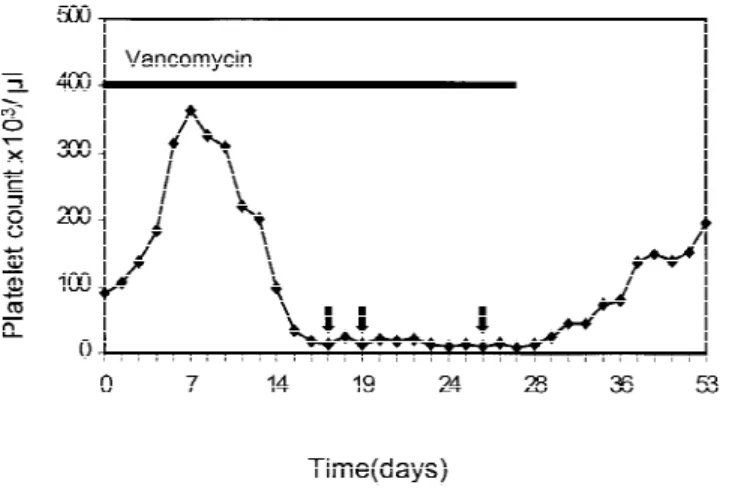
A 72-year-old white male with metastatic pancreatic cancer on gem-citabine was started on vancomycin for staphylococcal sepsis after recov-ery of his peripheral blood counts (side effect of gemcitabine). After sur-gery for associated cervical spinal cord compression, which revealed staph-ylococcal epidural abscess, a 6-week course of vancomycin therapy was planned. After 12 days of therapy with vancomycin, he developed throm-bocytopenia, which became severe on day 18 (platelet count 13 × 103/l) and did not respond to platelet transfusions (Fig. 1). A bone marrow biopsy showed adequate megakaryocytes. Platelet-associated immunoglobulin as-say by flow cytometry showed elevated IgG level (4.66) and IgG index (5.19), as well as elevated IgM levels (7.16) and IgM index (7.97). (Normal IgG level 1.18, IgG index 2.67, IgM level 1.43, IgM index 4.24; negative patient IgG level 0.63, IgG index 1.54, IgM level 1.03, IgM index 2.49). Vancomycin therapy was discontinued on day 28 and trimethoprim/ sulfmethoxazole was administered, with prompt recovery of his platelet count from 13 × 103/l to 136 × 103/l in 10 days (Fig. 1).
Thrombocytopenia during vancomycin therapy has previously been de-scribed in patients with decreased platelet production due to intrinsic bone marrow disease or bone marrow toxicity. Although some of these patients had vancomycin-dependent antiplatelet antibodies and resolution of throm-bocytopenia after cessation of vancomycin therapy, the role of immune mediated platelet destruction was not established [3]. Our patient had ad-equate bone marrow megakaryocytes, failed to respond to platelet trans-fusions, had increased platelet-associated immunoglobulins, and had rapid recovery of the platelet count after cessation of therapy, suggesting im-mune thrombocytopenia. The temporal relationship between the start of vancomycin therapy, detection of thrombocytopenia and rapid recovery after stopping vancomycin suggests that vancomycin-induced immune thrombocytopenia can be an independent cause of thrombocytopenia in patients with adequate platelet production.
RANGASWAMYGOVINDARAJAN DONNABAXTER CARLAWILSON CLIVEZENT University of Arkansas for Medical Sciences, Little Rock, Arkansas
REFERENCES
1. Christie DJ, van Buren N, Lennon SS, Putnam JL. Vancomycin-dependent anti-bodies associated with thrombocytopenia and refractoriness to platelet transfusion in patients with acute leukemia. Blood 1990;75:518–523.
2. Zenon GJ, Cadle RM, Hamill RJ. Vancomycin induced thrombocytopenia. Arch Intern Med 1991;151:995–996.
3. Howard CE, Adams LA, Admire JL, Chu MA, Alred GL. Vancomycin-induced thrombocytopenia: a challenge and rechallenge. Ann Pharmacother 1997;31:315– 318.
Transient Cytomegalovirus-Induced Hemolysis in an Immunocompetent Woman
To the Editor: Previously, cytomegalovirus (CMV)-induced hemolysis with negative direct antiglobulin test in immunocompetent adults which responded to treatment with ganciclovir or high-dose gamma-globulin have been reported [1,2]. We here report a new case of CMV-induced hemolysis with negative direct antiglobulin test and that associated with increased osmotic fragility.
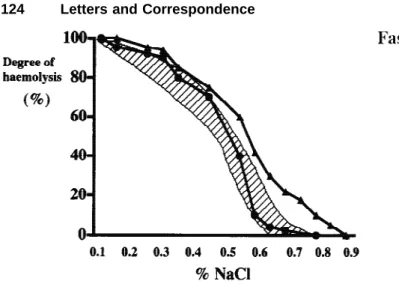
A 18-year-old woman was admitted to our hospital with 6 days history of fever and general malaise. Physical examination revealed anemia, ic-terus, together with fever (38.1°C). A blood examination revealed hemo-globin (Hb) 7.4 g/dl, white blood cells 13.2 × 10⁹/l, and platelets counts 401 times 109/l. Reticulocyte percentage was 4.8%. The blood film re-vealed no red cell fagmentations and spherocytes. Serum chemistry values were as follows: bilirubin 2.4 mg/dl; alanine aminotransferase 129 IU/l; aspartate aminotransferase 298 IU/l; lactate dehydrogenase 1,009 IU/l. Di-rect antiglobulin test was repeatedly negative and serum haptoglobin level was undetectable. Immunological tests including cryoglobulins, cold ag-glutinins, rheumatic factor, and antinuclear antibodies were negative. The bone marrow picture showed erythroid hyperplasia. Parvovirus DNA was not detected in the serum by polymerase chain reaction. However, the detection of IgM antibodies to CMV on three consecutive occasions and demonstration of a four-fold rise in the IgG titre in the month following presentation suggested an active CMV infection. After diagnosis was made of hemolytic anemia with negative direct antiglobulin test, we performed the following tests. Ham and sugar water tests were negative. Pattern of haemoglobin fraction was normal. Red cell enzyme activities of glucose-6-phosphate dehydrogenase and pyruvate kinase were normal. Red cells osmotic fragility test (Parpart’s method) revealed increased osmotic fra-gility (Fig. 1,䉱). Because she did not have symptoms due to anemia, the clinical course was carefully followed with no treatment. After 4-weeks from admission, the Hb level spontaneously increased to 11.4 g/dl and the haptoglobin level recovered to normal range (97 mg/dl). Osmotic fragility test was reexamined and osmotic fragility was normal (Fig. 1,䊉). She has been regularly followed for more than 3 months after initial presentation and is well without any symptoms or signs of hemolysis.
CMV-induced hemolysis with positive direct antiglobulin test was well described [3,4]. CMV-induced hemolysis with negative direct antiglobulin test in which responded to treatment with ganciclovir or high-dose gamma-globulin have been also reported [1,2]. In contrast to previous reports, spontaneous improvements of hemolysis and osmotic fragility were ob-served in our case. The mechanism for CMV-induced hemolysis is unclear. Because increased osmotic fragility spontaneously improved together with improvement of hemolysis, we speculated that CMV infection induced an increase in red cells osmotic fragility. In the future, red cells osmotic
Fig. 1. Relationship of platelet counts to the administration of vancomycin. The initial chemotherapy induced thrombo-cytopenia recovered promptly. Subsequent vancomycin therapy was associated with thrombocytopenia that did not respond to platelet transfusions (↓), but promptly recovered after the discontinuation of the drug.
fragility test should be performed when encountering the patients of CMV-induced hemolysis with negative direct antiglobulin test.
MASANORISAITO1,2 SHINOBUNAKAMURA1 SUGURUKAWASAKI2 MAKOTOKIKUCHI2 1Third Department of Internal Medicine, Kanazawa University School of Medicine, Kanazawa, Japan
2Kanazawa West Hospital, Kanazawa, Japan REFERENCES
1. van Spronsen DJ, Breed WPM. Cytomegalovirus-induced thrombocytopenia and haemolysis in an immunocompetent adult. Br J Haematol 1996;92:218–220. 2. Juneja SK, Phillips KA, Speed B, Januszewicz EH. High-dose gamma-globulin
responsive haemolysis due to cytomegalovirus in an immunocompetent adult. Br J Haematol 1996;95:433–435.
3. Horwitz CA, Henle G, Snover D,, Rudnick H, Balfour HH, Mazur MH, Watson R, Schwartz B, Moller N. Clinical and laboratory evaluation of cytomegalovirus-induced mononucleosis in previously healthy individuals. Medicine 1986;65:124– 134.
4. Salloum E, Lundberg WB. Hemolytic anemia with positive direct antiglobulin test secondary to spontaneous cytomegalovirus infection in healthy adults. Acta Hae-matologica 1994;92:39–41.
Decreased Expression of the Fas Ligand on Peripheral Blood Mononuclear Cells and Undetectable Levels of Soluble Fas Ligand in the Serum of Patients With Aplastic Anemia and Myelodysplastic Syndrome
To the Editor: Increased expression of Fas antigen (Fas) is observed in the hematopoietic progenitors of aplastic anemia [1] and myelodysplastic syn-drome (MDS) [2]; thus, increased apoptosis has been considered a patho-genetic mechanism of these disorders [1,2].
Fas ligand (FasL) is a cell type II transmembrane protein homologous to members of tumor necrosis factor (TNF) family, is mainly expressed on
natural killer cells and T lymphocytes, and induces apoptosis by binding to its receptor, Fas [3]. Fas L exists into two forms; an insoluble form that is membrane-bound—mFasL—and a soluble form—sFasL—which is cleaved from mFasL by metalloproteinase, consists of an extracellular region of FasL [4], and was recently found to down-regulate mFasL by shedding depending on the cells [5].
The pathological significance of the Fas L system (mFasL and sFasL) on the pathogenesis of aplastic anemia and MDS is unknown.
We studied 8 patients with severe or moderate aplastic anemia, 12 pa-tients with MDS including 9 papa-tients with refractory anemia (RA) and 3 patients with RA with excess of blasts (RAEB).
The expression of mFasL on peripheral blood mononuclear cells was measured by flow cytometry using anti-human Fas L monoclonal antibody (Medical and Biological Laboratories, Nagoya, Japan). sFasL levels in the serum were measured by using the enzyme-linked immunosorbent assay kit produced by the same laboratory.
The expression of Fas L on peripheral blood mononuclear cells was significantly reduced in patients with aplastic anemia (6.3 ± 2.8%, mean ± SD, p⳱ 0.0025) and MDS (5.6 ± 2.4, p < 0.0001) compared to those in normal controls (10.1 ± 1.8) (Fig. 1).
sFasL was not elevated and was undetectable in all patients with aplastic anemia and MDS; <0.31 ng/ml.
The present results indicate that the signaling of apoptosis for the
cyto-Fig. 1. Osmotic fragility curves (Parpart’s method). The pa-tient’s blood was defibrinated and incubated for 24 hr at 37°C. (䉱) At admission, (䊉) after 4-weeks. The shaded area indicates normal range.
Fig. 1. The expression of the Fas L on peripheral blood
mononuclear cells of patients with aplastic anemia (A), my-elodysplastic syndrome (M), and normal controls (N).
toxicity by these Fas L systems is not always accentuated in aplastic anemia and MDS. The results indicate the following possible mechanisms. The Fas system-dependent T-cell mediated cytotoxicity may only act when lymphocytes bearing the Fas L are activated by certain stimuli including viral infection or cytokines such as TNF-␣ or interferon-␥, and this effect may occur locally in the bone marrow [6]. It was demonstrated that a small amount of interferon-␥ constitutively expressed in the stromal microenvi-ronment of human marrow culture-mediated potent hemetopoietic inhibi-tion [7]. The same phenomenon as in AIDS may operate in that a small fraction of Fas L bearing cells or low concentrations of sFasL work [8]. Or, cytokine such as TNF-␣ may activate TNF receptor of the target hemato-poietic cells and induce apoptosis without via Fas L system [6]. More detailed study is necessary.
KENJISHINOHARA TORUTAKAHAHI RYOHEINAWATA Division of Hematology, Department of Medicine, Yamaguchi
Prefecture Central Hospital, Hofu, Japan
EIICHIOEDA Department of Medicine, Shimonoseki Kosei Hospital, Shimonoseki, Japan
REFERENCES
1. Maciejewski J, Selleri C, Anderson S, Young NS. Fas antigen expression on CD34+ human marrow cells is induced by interferon␥ and tumor necrosis factor
␣ and potentiates cytokine-mediated hematopoietic suppression in vitro. Blood
1995;85:3183–3190.
2. Hatake K, Tomizuka H, Ikeda M, Tsunoda JI, Hoshino Y, Otsuki T, Kasahara T, Yonehara S, Miura Y. The presence of apoptosis in refractory anemia or myelo-dysplasia. In: Abraham NG, editor. Molecular Biology of Haematopoiesis. An-dover: Intercept; 1994. p 122–123.
3. Suda T, Okazaki T, Naito Y, Yokota T, Arai N, Ozaki S, Nakao K, Nagata S. Expression of the Fas ligand in cells of T cell lineage. J Immunol 1995;154:3806– 3813.
4. Tanaka M, Suda T, Takahashi T, Nagata S. Expression of the functional soluble form of human Fas ligand in activated lymphocytes. EMBO J 1995;14:1129–1135. 5. Tanaka M, Itai T, Adachi M, Nagata S. Downregulation of Fas ligand by shedding.
Nat Med 1998;4:31–36.
6. Nagata S. Apoptosis by death factor. Cell 1997;88:355–365.
7. Selleri C, Maciejewski JP, Sato T, Young NS. Interferon-␥ constitutively ex-pressed in the stromal microenvironment of human marrow cultures mediates potent hematopoietic inhibition. Blood 1996;87:4149–4157.
8. Katsikis PD, Wunderlich ES, Smith CA, Herzenberg LA. Fas antigen stimulation induces marked apoptosis of T lymphocytes in human immunodeficiency virus-infected individuals. J Exp Med 181:2029–2036.