LOCA Test of Class 1E Cables Using Modified LOCA Profile
aByungju Lim, aChisung Song, aChangdae Park, aSeongyong Kim, aHeebeom Roh
bHyunseon Lee
a Korea Institute of Machinery and Materials, Daejeon b Hanyang University, Seoul
1. Introduction
A LOCA (Loss of Coolant Accident) test has been performed for EQ(Equipment Qualification) for class 1E cable of nuclear facilities[1]. We have constructed the test facilities which can simulate large LOCA conditions (temperature, pressure, chemical spray) of domestic nuclear power plants. Class 1E Cables are consisted of various polymer, we choose CSP (ChloroSulfonated Polyethylene rubber) and CR (Chloroprene Rubber) placed at the part of cable sheath as specimen. UTM (Universal Testing Machine) and TGA (Thermo-Gravimetric Analyzer) have been used for analyzing specimens before and after the test to investigate elongation and activation energy, respectively.
2. Experiment
It is difficult to do qualification test because LOCA test of DBE (Design Basis Event) takes long time, usually 6 months. Though testing time may not be changed due to radioactive irradiation, it is possible to shorten the testing time, considering activation energy of specimens which are tested in LOCA without radiation and similar environmental conditions of aging test.
We could define hardening of CR and CSP after the test through the strain and stress graph obtained from tensile test of UTM analyzer[2,3] and could get activation energy of specimen before and after the test from TGA[4].
2.1 Test Conditions
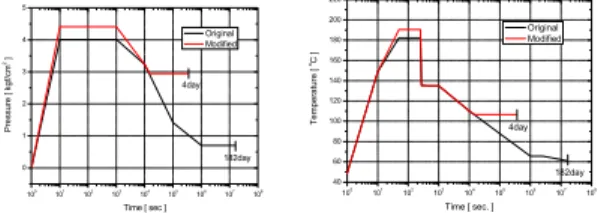
LOCA profiles for temperature and pressure are shown in Figure 1 which is applied to Young-gwang 3& 4 Nuclear Power Plant. Overall testing time is 182 day, but it can be shortened by concept of thermal aging considering the environmental condition and material of cables. Arrhenius Equation (1) gives such quantitative information for shortened period of LOCA test when knowing activation energy.
)] / 1 / 1 )( / [( 2 1 1 2 T T k Ea
e
t
t
=
− (1)k: Boltzman constant [0.8617×10⁻³, eV/K], Ea:
activation energy [eV], t: time [sec], T: temperature [K]
Activation energy was acquired from UTM analysis beforehand and we confirmed that it almost corresponds to Wyle Lab. database as shown in Table 1. The modified LOCA profiles for temperature and pressure are considered margin with IEEE-323 [2] and are shown in Figure 1. Temperature and pressure of tail range on the modified profile were increased so that overall testing time is shortened. These profiles may not be applied to all the nuclear equipment. In case of valves and pumps, for example, testing time may not be shortened through this method considering an assigned basic role and function under specific environmental conditions. 100 101 102 103 104 105 106 107 108 0 1 2 3 4 5 Pre ssu re [ kg f/cm 2 ] Time [ sec ] Original Modified 4day 182day 100 101 102 103 104 105 106 107 108 40 60 80 100 120 140 160 180 200 220 T e m per atu re [ oC ] Time [ sec. ] Original Modified 4day 182day
Figure 1. LOCA profile for pressure and temperature Testing cables are rolled around the mandrel which is placed at the center of the test chamber (diameter 80 cm × length 200 cm). Temperature and pressure in the chamber are controlled according to the modified LOCA profile by Auto-Control System, and chemicals consisted of boron 3,000 ppm and sodium hydroxide 0.28 molar are sprayed out over specimen.
Figure 2. Specimen setup around mandrel
2.2 Analysis
UTM is used to investigate degradation for hardening of cables and TGA to acquire activation energy of material. Activation energy is calculated with heating rate ß and temperature T using Ozawa method (2) Transactions of the Korean Nuclear Society Autumn Meeting
which is integral method [6] for measuring activation energy of TGA [7] when weight loss of 5% is reached on thermal degradation curve as shown in Figure 3
1
log
35
.
4
−−
≈
dT
d
E
aβ
(2)Ea : activation energy [eV], ß : heating rate [oC/min],
T : temperature [K] 93.0 93.5 94.0 94.5 95.0 95.5 96.0 96.5 97.0 W ei ght ( % ) 180 200 220 240 260 280 300 Temperature (캜) TGA Sample: 20050531-600VEPRCR_5c_test01 Operator: RHB Run Date: 2005-05-31 10:54:37 Comment: heating=5C, Gas=N2@60mL/min
T A I nstruments
Figure 3. Thermal degradation curve of CR 3. Results
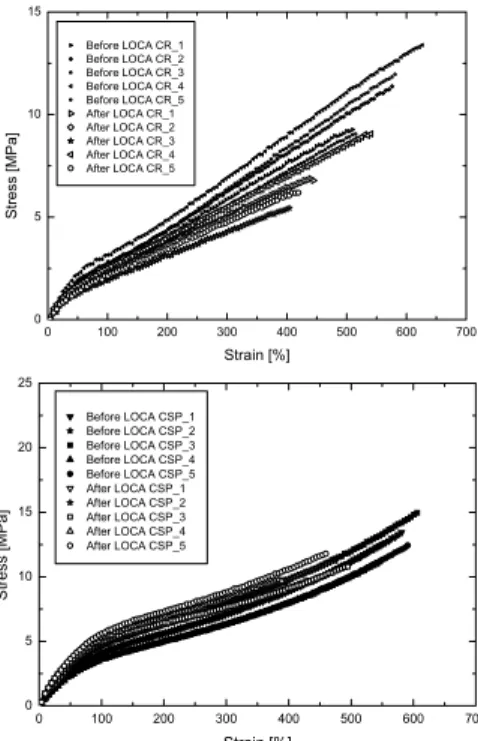
Cables after the test are deteriorated judging from the fact of reduced strain at breaking point as shown in Figure 4. The strains are decreased to about 40% for CR and 20% for CSP, respectively. This result could be easily expected considering conditions of high temperature and pressure in LOCA environment.
0 100 200 300 400 500 600 700 0 5 10 15 Stress [MPa] Strain [%] Before LOCA CR_1 Before LOCA CR_2 Before LOCA CR_3 Before LOCA CR_4 Before LOCA CR_5 After LOCA CR_1 After LOCA CR_2 After LOCA CR_3 After LOCA CR_4 After LOCA CR_5 0 100 200 300 400 500 600 700 0 5 10 15 20 25 St re ss [ M Pa] Strain [%] Before LOCA CSP_1 Before LOCA CSP_2 Before LOCA CSP_3 Before LOCA CSP_4 Before LOCA CSP_5 After LOCA CSP_1 After LOCA CSP_2 After LOCA CSP_3 After LOCA CSP_4 After LOCA CSP_5
Figure 4. Stress and strain curve CR(Top) and CSP(Bottom)
Activation energy obtained from TGA is also decreased after the test as shown in Table 1, indicating shortened life of the cables. Activation energy of cables obtained from this experiment is indispensable to expect the life of cables.
Before
KIMM Wyle Lab. After
CR
[eV] 0.77 0.65 0.135
CSP
[eV] 1.184 1.07 1.10
Table 1. Activation energy of CR and CSP before and after LOCA test
4. Conclusion
LOCA test of cables was successfully performed with LOCA test facilities in KIMM. This research implies many possibilities that LOCA test of EQ can be applied to other equipment related to primary facilities of nuclear power plant as well as cables. Furthermore, MSLB(Main Steam Line Break) and HELB(High Energy Line Break) as well as LOCA are possible if test conditions are modified to all DBE. Therefore, we expect that LOCA facilities in KIMM will play an active role in EQ of domestic nuclear facilities.
Acknowledgement
This work has been carried out under the Nuclear Research and Development program supported by MOST
REFERENCES
[1] IEEE Std 383-1974, IEEE Standard for Type Test Class 1E Cable, Field Splices and Connections for Nuclear Power Generation Stations
[2] ASTM D 638-2002, Standard Test Method for Tensile Properties of plastic.
[3] ASTM D 412-1998, Vulcanized Rubber and Thermoplastic Elastomers-Tension.
[4] ASTM E 1131-1998, Standard Test Method for Compositional Analysis by Thermogravimetry.
[5] IEEE Std 323–2003, IEEE Standard for Qualifying Class 1E Equipment for Nuclear Power Generating Stations.
[6] ASTM E 1641-1999, Standard Test Method for Decomposition Kinetics by Thermogravimetry.
[7] Takeo Ozawa, A New Method of Analyzing Thermo gravimetric Data, 1965.