© Korean Powder Metallurgy Institute 1175
-1. Introduction
Soft magnetic composites (SMC’s) [1,2], made by compaction of the mixture of insulator-coated iron powder and binder followed by heat treatment for hardening the binder, have a structure in which iron powder particles are electrically isolated and bonded together by the binder. SMC’s have attracted much attention because of the advantages in motor applications, such as low iron losses at high frequencies and capability of 3-dimensional magnetic circuit design, and they have been already commercially utilized as motor cores.
Although, in many applications, SMC motor cores require machining to achieve high dimensional accuracy, influences of machining on magnetic properties are not clear so far. In this study, the magnetic properties of SMC compacts prepared with and without machining were evaluated and change in the properties caused by machining was clarified.
2. Experimental and Results
Two types of SMC powders were prepared using commercial phosphate-insulated iron powder, Somaloy500 produced by Höganäs AB as follows: organic-binder type; mixing the insulated iron powder and polyimide powder, inorganic-binder type; mixing the insulated powder and silicone compound in solvent and then drying the mixture. These powders were molded into ring-shaped specimens with OD35mm×ID25mm×H5mm, bar-shaped ones with 5mm×10mm×60mm, and cylindrical blanks with OD100 mm×H50mm by warm compaction process with die-wall lubrication technique. Temperature of the powders and that of the die was held 150℃, and compaction pressure was 780 MPa. The green compacts of the organic- binder type and those of the inorganic-binder type were heat-treated in
air at 250℃ and 500℃, respectively. From the heat-treated blanks, the ring-shaped specimens were prepared by turning, and bar-shaped ones by face milling, of the dimentions described above. Hereafter, they are refered to as specimens “with machining.” DC magnetic properties and iron losses of the ring-shaped specimens were measured with a B-H curve tracer and a B-H analyzer, respectively. Resistivity of the bar-shaped specimens was evaluated with a four-terminal method.
Table 1 shows the DC magnetic properties, i.e., coersivity Hc, relative maximum permeability µmax /µ0 and magnetic flux density at a magnetic field of 10kA/m B10kA/m, for the organic-binder-type specimens. No difference in these properties is seen between the specimen with and without machining. It is well known that coercivity and permeability of the soft magnetic materials are structure- sensitive, and are degradated by residual stress. Therefore, it can be thought that little affect of machining in SMC’s is attributed to their particular structure as follows. Since, in SMC’s, magnetic powder particles are highly isolated by the insulation coating and the additive binder, stress introduced on the surface would not propagate into the specimen. The volume fraction of the deformed surface layer is so small that it does not affect the magnetic properties of the whole specimen.
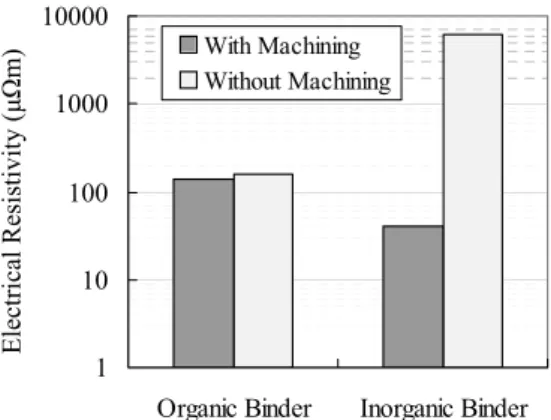
Fig. 1 shows iron losses of the organic-binder-type specimens (a) and the inorganic-binder-type ones (b) with and without machining. While iron loss of the organic-binder-type specimen is not affected by machining, that of inorganic-binder-type one is significantly increased after machining. Electrical resistivity of these specimens is shown in Fig. 2. High resistivity of the organic-binder-type specimen remains the same after machining. On the other hand, machining drastically lowers resistivity of the inorganic-binder-type specimen. It can be considered that the decrease in resistivity leads to increase in eddy current
2006 POWDER METALLURGY World Congress
PC09-W-06
Influence of Machining on Magnetic Properties of Soft Magnetic Composites
Kazunori Igarashi1,a, Masahisa Miyahara1,b and Koichiro Morimoto1,c 1
Mitsubishi Materials PMG Corporation, 3-1-1 Koganecho, Niigata-shi, Niigata 950-8640, Japan a
[email protected], [email protected], [email protected] Abstract
Influences of machining on magnetic properties of soft magnetic composites (SMC’s) with addition of two kinds of binder, i.e., organic binder and inorganic one, were investigated. Machining does not affect DC magnetic properties of the SMC compacts. This can be ascribed to their particular structure in which the ironpowder particles are highly isolated by the binder. On the other hand, decrease in resistivity and resultant increase in eddy current loss was confirmed in the machined compacts containing inorganic binder. It is supposed that the brittleadditive binder existing between the iron particles is partly broken, and iron-to-iron contact is formed on the machined surface.
© Korean Powder Metallurgy Institute 1176 -Table 1. DC magnetic properties of organic-binder- type
specimens with and without machining. Hc
(A/m) μmax/μ0 B10kA/m(T)
With Machining 339 514 1.61 Without Machining 335 520 1.60 0.1 1 10 100 100 1000 10000 Frequency (Hz) Iron loss at 0.1T (W/kg ) With Machining Without Machining
(a) Organic Binder
0.1 1 10 100 100 1000 10000 Frequency (Hz) Iron loss at 0.1T (W/kg ) With Machining Without Machining (b) Inorganic Binder Fig. 1. Iron losses of SMC specimens.
1 10 100 1000 10000
Organic Binder Inorganic Binder
El ect ri cal Resi st iv it y (µ Ω
m) With MachiningWithout Machining
Fig. 2. Electrical Resistivity of SMC specimens. losses and consequently rise of total iron losses in the inorganic-binder-type specimen. Brittle inorganic binder between the iron powder particles seems to be partly broken by machining, resulting in degradation of insulation between the particles.
3. Summary
Influences of machining on magnetic properties of SMC’s with addition of organic binder and inorganic one were investigated. It has been clarified that machining increases iron loss of SMC containing inorganic binder. This can be attributed to decrease in electrical resistivity. It has been also shown that DC magnetic properties of SMC’s with addition of both type of binder are not affected by machining.
4. References
1. O. Anderson and A. Jack, PM2TEC 2001, MPIF, New Oeleans, USA, p7-26-7-34 (2001).
2. L. Hultman, O. Anderson and A. Jack, Proc. SAE, World Conference, Detroit, USA, 2003-01-0449, p69-77 (2003).