112222
2019 ⦽ǎႊᔍᖒ⠱ʑྜྷ⦺⫭⇹ĥ⦺ᚁݡ⫭םྙ᧞ḲDesign of Modular Electrolytic Reduction Equipment
Jong Kwang Lee*, Sung-Wook Kim, Dong-Seok Ryu, Sun Seok Hong, and Eun-Young Choi
Korea Atomic Energy Research Institute, 111, Daedeok-daero 989beon-gil, Yuseong-gu, Daejeon, Republic of Korea *
1. Introduction
The electrolytic reduction process reduces oxide fuel to metal for feedstock to the electrorefiner. To increase remote operation efficiency and explore cost-effective electrochemical process, we are developing a conceptual design of the automated workflow and its related process equipment. In this work, novel equipment consisting of modules with self-assembly concept and automation components has been designed for successful electrochemical processing and convenient remote operation.
2. Design of Equipment Modules
2.1 Flange Module
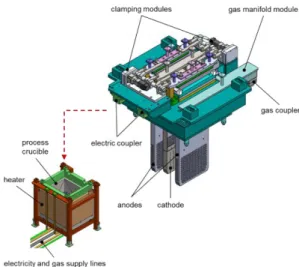
The flange module shown in Fig. 1 is an integrated structure, providing several interface services: installing anode module, cathode module, reference electrode and sensors, supplying electrical power and argon gas, and exhausting off-gas. It also needs to prevent heat loss from the reactor vessel while maintaining the temperature of the top surface as low as possible. On the center of the flange module, three rectangular slots are formed to install one cathode module and two anode modules. In addition, it is equipped with gas inlet and outlet tubes for supplying pure argon gas to reactor vessel and exhausting off-gas from the inside of the anode shroud to scrubbing system installed outside of the processing cell. Electrical busbar systems are installed on the top surface of the flange and extended to facility feedthrough.
Fig. 1. Heater and process crucible (left) and flange module (right) of the electrolytic reduction equipment.
2.2 Gas Manifold Module
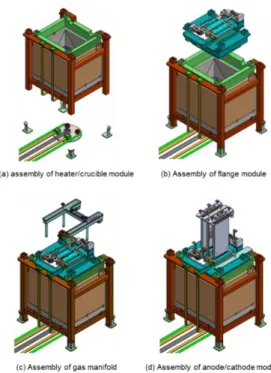
High-temperature corrosion of the off-gas tube is one of the most critical concerns in maintaining the structural integrity of the processing equipment because various corrosive gases are produced in the electrolytic reduction process with a consumable carbon anode. Therefore, the interchangeable gas manifold module has been designed for easy maintenance or repair. It has a similar configuration with the shell and tube heat exchanger: hot off-gas flows through the inner tube while pure argon gas with room temperature or below flows outside of the gas tube. This concept helps to cool down the off-gas, therefore less high-temperature corrosion may be expected. In addition, four equally spaced inflow tubes could play an important role in proper positioning of the gas manifold during the assembling step, as shown in Fig. 2(c).
2019 ⦽ǎႊᔍᖒ⠱ʑྜྷ⦺⫭ ⇹ĥ⦺ᚁݡ⫭ םྙ᧞Ḳ
112233
2.3 Clamping Module
Reducing electrical contact resistance is an important factor for increasing current efficiency. In this work, the clamped joint method is used for connection between the anode/cathode module and the main busbar system and its contact should be tightly maintained during the process operation. To provide a proper clamping force, we designed a spring-loaded clamping module. As the torsion bar coupled with driving unit rotates, spring-loaded clamping arms with different length simultaneously push anode/cathode conductor plates tightening them to the main busbar system. The initial compressed lengths of springs are adjusted in advance to have desired clamping force or contact resistance.
3. Analysis on Remote Assembly Operation
Assembly simulation using 3D design model has been conducted to find mechanical interferences and to establish proper remote operation procedure as shown in Fig. 2. With a plug and play concept, as soon as the frame module consisting of a heater and process crucibles is installed on the feed-through of the cell floor, electrical and gas services are provided to the assembled module. Similarly, when the flange module is assembled on to the frame module, those services are ready to use for the process operation. This could dramatically improve the work efficiency comparing with the conventional labor-intensive remote operation. In addition, once the lower part of the anode or cathode module is inserted into the rectangular slot of the flange module, each module can also be accurately aligned and positioned with the aid of the V-shape guide.
Fig. 2. Assembly simulation of equipment modules.
4. Conclusion
In this work, novel electrolytic reduction equipment consisting of the heater, process crucible, flange, anode, cathode, gas manifold, and clamping device has been designed with the modular concept to increase remote operation efficiency. Key design concepts and remote operation procedures have been evaluated by means of 3D modeling simulation of the assembly operations. We are performing design optimization, especially of the heat exchanger in the gas manifold module.
ACKNOWLEDGEMENTS
This work was supported by the Nuclear Research & Development Program of National Research Foundation of Korea (NRF) funded by the Ministry of Science and ICT (MSIT).