2019 ⦽ǎႊᔍᖒ⠱ʑྜྷ⦺⫭ ⇹ĥ⦺ᚁݡ⫭ םྙ᧞Ḳ
117733
Review of Finnish Posiva Methodology for the Canister Lifetime Assessment
Heui-Joo Choi*, Dong-Keun Cho, and Sung-Hoon Ji
Korea Atomic Energy Research Institute, 111, Daedeok-daero 989beon-gil, Yuseong-gu, Daejeon, Republic of Korea
*
1. Introduction
The spent nuclear fuels generated from the nuclear reactors should be managed safely. The geological disposal using a disposal tunnel located at the 500 meter depth is one of the promising methods. Sweden and Finland proposed a KBS-3 type repository for the spent nuclear fuels several tens ago. The safety of this concept relies on a copper canister. The most important challenge in KBS-3 concept lies in how to estimate and prove the very long-term lifetime of the canister. Finnish Posiva published the Safety Case report for a construction license [1].
A disposal canister which is the most important engineered barrier in a repository for high-level radioactive waste should maintain its lifetime for a long period (at least several thousand years in Korea) after the closure of the repository. It is very difficult to confirm the long lifetime of a disposal canister through an experiment. Thus, it is predicted by the numerical modeling work in most cases.
In this paper, the methodologies used in a Safety Case report made by the Finnish Posiva that advanced in the construction of the repository were reviewed. And based on the Posiva methodologies a computer program was made and applied to the Korean disposal concepts. Also, some research items were recommended for the further study.
2. FEPs and Requirements
2.1 Climate Change
Generally, the safety assessment including the estimation of lifetime of a canister requires long-term prediction of repository environment. One of the most important conditions is the climate change since it may influence the boundary conditions for groundwater flows.
The future climate was derived from the past records, and it was assumed that the climate change might repeat for one million years in Posiva Safety Case. Fig. 1 briefly showed the past records and the future climate used by Posiva. That is, one glacial cycle of climate was assumed from the construction of a repository to 170,000 years after present as shown in Fig. 1. After 170,000 years, seven cycles are assumed to occur repeatedly for one million years.
Fig. 1. Climate evolution for Posiva Safety Case.
2.2 Performance Requirements
The performance requirements for a final disposal are described by Government Decree 736/2008 in Finland. Posiva developed a VAHA requirement management system, which covers all requirements in levels 1 ± 4. They are classified by performance targets and design requirements. Some important targets related to the canister are as follows:
- In the expected repository conditions the canister shall remain intact for hundreds of thousands of years except for incidental deviations.
- The canister shall withstand corrosion in the expected repository conditions
- The canister shall not impair the safety functions of other barriers.
3. Posiva Methodologies
3.1 Excavation and Operational Phase
In Posiva Safety Case report the safety assessment including the prediction of canister lifetime was carried out at four phases. The excavation and operational phase was expected to continue around 100 years. During this period, the most important corroding agent was oxygen trapped in buffer and backfill.
Posiva calculated the corrosion depth due to oxygen based on the assumption that all the oxygen in buffer and backfill was consumed by reaction with copper. According to the Posiva approach, the corrosion depth of a KAERI disposal canister due to oxygen in buffer was calculated to be around 0.062 mm.
117744
2019 ⦽ǎႊᔍᖒ⠱ʑྜྷ⦺⫭ ⇹ĥ⦺ᚁݡ⫭ םྙ᧞Ḳ3.2 Post-closure Evolution
After the oxygen in the repository is consumed, the main corroding agent is sulphide. Two kinds of buffer conditions were considered in Posiva Safety Case: intact buffer and eroded buffer. In all the corrosion calculations, a steady state mass transport of corroding agents was assumed [2].
In the case of an intact buffer, two cases were considered, one for the corroding agent from the groundwater and the other from the backfill. The relevant equations were derived respectively.
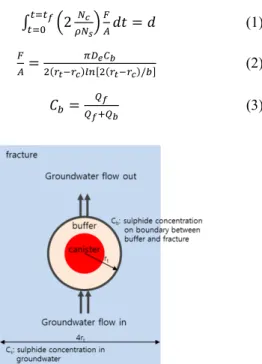
The first case of intact buffer is the corrosion due to sulphide from groundwater, which might be converted from sulphate. The sulphide in groundwater flowing fracture (see Fig. 2) will diffuse through the buffer, and be consumed by the reaction with copper. The canister failure time (tf) by this
reaction was calculated using the following equations: ቀʹே ఘேೞቁ ி ௧ୀ௧ ௧ୀ ݀ݐ ൌ ݀ (1) ி ൌ గ್ ଶሺିሻሾଶሺିሻȀሿ (2) ܥൌ ொ ொାொ್ (3)
Fig. 2. Schematic view of groundwater flow around the buffer.
The second case of intact buffer is the corrosion due to sulphide from backfill. The reaction rate equivalent to equation (2) was obtained as follows:
ி ൌ ೞ గమቐ ʹగమ ܦට ଶ Ȁ ൬ʹට ଶ గ ܦ൰ ݍܣ௦ (4)
Finally, the corrosion due to a partially eroded buffer was calculated using the following equation:
ி ൌ ೞ గሺିሻቊඥ ܳܳ ܳ (5)
A sample calculation for the eroded buffer was illustrated with data used by Posiva. With a sulphide concentration of 3 mg/L, the corrosion depth of a copper canister was 6.24 mm for KAERI and 7.5 mm for Posiva for 1 million years. These differences were caused by the buffer thickness.
4. Conclusion
A computer program was developed using MS Excel to calculate the lifetime of a copper disposal canister based on Posiva methodologies. Steady state mass transport was assumed. The results of the calculation for a disposal canister developed for Korean spent fuels under the Posiva geological conditions showed that no canister failures were expected due to the corrosion for one million years.
The following research items were identified for the further study related to the corrosion of a disposal canister. A study on the erosion of buffer is needed. The groundwater velocities in the fractures intersecting the deposition hole were obtained for the whole repository site in the Posiva project, but the similar results were not available in Korea. So far, the study on the backfill material in a repository has not yet been carried out. We used the data used for the Posiva repository. The reactive transport modeling should be included to estimate the geochemistry of groundwater for one million years after the closure of the repository.
ACKNOWLEDGEMENT
This work was supported by the Ministry of Science and ICT within the framework of the national long-term nuclear R&D program (NRF-2017M2A8A5014856). The first author would like to express his special thanks to Professor Mari Lundström and Aalto University. Most of this study was carried out during his sabbatical stay at Aalto University.
REFERENCES
[1] Posiva, Safety Case for the disposal of spent nuclear fuel at Olkiluoto-performance assessment 2012, Posiva 2012-04, 2012.
[2] Paul Smith, Lawrence Johnson, Margit Snellman, Barbara Pastine, Peter Gribi, Safety Assessment for a KBS-3H Spent Nuclear Fuel Repository at Olkiluoto-Evolution Report, Posiva 2007-08. 2007.