© Korean Powder Metallurgy Institute 1213
-1. Introduction
In resent year, as the working frequency and integration of electronic device increase, electromagnetic interference (EMI) has become a major problem. Thus, it is very important to be prevented undesirable effects of EMI, various suppressing and shielding materials have been reported. [1]
The present work in EMI suppressing and shielding technology is to produce a functional material such as thin, flexible, strong absorbers with complexed materials. Especially, Fe-Si-Al powder was well-known as a good magnetic absorption material because of their broad dispersion of imaginary permeability. [2]
In this study, we report electromagnetic properties of silver coated sendust powder, and suggest a composite of high-permittivity silver coated sendust powder for the aim of thin electromagnetic wave absorbers in quasi-microwave frequency of GHz range.
2. Experimental and Results
The sendust flake powders were prepared by mechanical crushing and milling process of Fe-Si-Al ingots (base Fe, 9.4 wt % Si, 5.5 wt % Al). The milling was carried out in a hydrocarbon solvent added a coupling agent by using attritor. The silver coated sendust powders (Ag:1-10 wt%) were synthesized by chemical reduction process in aqueous silver nitrate solution containing core materials and glucose as a reduction agent. The properties of the powders were examined by scanning electron microscope and particle size analyzer. The structure analysis was examined by X-ray diffraction, and only silver-sendust structure was observed.
To investigate the electromagnetic properties, the
powder-rubber composite is prepared. The composite sheets were produced by using two-roll mixer. The scattering parameters of the toroidal sample corresponding to reflection and transmission were measured using network analyzer (PNA8364A). We examined the suppression effect of conduction noise, the composite sheets were set onto micro-strip line. [3]
In the composite, flake powders were clearly aligned by rolling in the direction perpendicular to the direction in which the eddy current flows.
The complex permittivity (εr=εr′-jεr″) was determined in the composites containing the silver coated and non-coated sendust flake powders. In the case of non-coated powders (raw composite) have a very low value of εr′=100 and εr″=5-10. But both of εr′ and εr″ enlarge with increase of silver concentration, εr′=250-300 and εr″=20-70 were measured in the composite, which is due to the space charge polarization between the silver coated powders and the conduction loss in the surface of composite sheet.
2 1 2 ' 0
1
tan
1
2
1
⎥⎦
⎤
⎢⎣
⎡
+
+
=
δ
ε
λ
λ
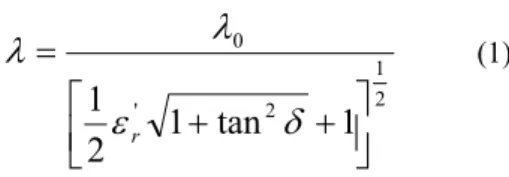
r (1)The wavelength in dielectrics is a decreasing function of dielectric constant (εr′) and dielectric loss tangent (tanδ=εr″/εr′) as expressed in Eq. (1), the absorber thickness can be greatly reduced by employing high-permittivity composite materials as the λ/4 spacer. Where, λo is wavelength in free space
Fig. 1 shows the wavelength (λ) calculated from the complex permittivity of composites by using Eq. (1). It is 2006 POWDER METALLURGY
World Congress
PC11-W-09
Electromagnetic Properties of Siver Coated Iron based Alloy Powders Prepared by
Chemical Reduction Method
Byoung-Yoon Lee1,a, Jae-Wook Lee2,b, Yeo-Chun Yun2,c, In-Bum Jeong2,d, Jooho Moon1,e 1
Department of Materials Science and Engineering, Yonsei University, Seoul 120-749, Korea 2
Changsung coporation, 11-9 Namdong industrial area, Namdong-gu, Incheon 405-100, Korea a
[email protected], b [email protected], c [email protected] d
[email protected], e [email protected] Abstract
The synthesis of silver coated iron base alloy (Sendust : Fe-Si-Al) powder having the both effects of shielding and suppressing of electromagnetic wave was studied. Depending on thickness of silver coating layer, the electromagnetic properties of the dispersed particles complexed with organic binder were examined. It is proposed that the silver coated sendust flake powders with controlled electrical properties and thickness can be used as thin microwave absorbers in quasi-microwave frequency band.
© Korean Powder Metallurgy Institute 1214 -shown that the optimum matching frequences are change as a variable thickness of composites. For instance, if the thick is 1.0mm, matching frequences are, raw composite : 1.8 GHz, silver 5% : 1.0 GHz, silver 10% : 700 MHz, respectively. The value of the wavelength decreases with increasing of frequency and the silver cotaining composites have a small value due to their high permittivity.
Fig. 1. The λ/4 values calculated from the complex permittivity of the composite
The reflection loss was measured in the composites with 1.0mm thickness. The maximum value of reflection loss in silver containing composites are lower (-6.5 dB for silver 1%, -6.0 dB for silver 5% and -5.5dB for silver 10%) than raw composite(-7dB), which is due to increasing the surface reflectivity of composites as silver concentration. But reflection loss of silver containing composites is higher than raw composite at below 1.0GHz frequence.
Fig. 2. The reflection loss of the composites with the variation thickness. : silver 5wt%.
Fig. 2 shows the change of reflection loss of the 5% silver containing composites associated with the variation thickness (thick is 0.2- 1.0mm). The composite made of 0.2mm thickness shows maximum reflection loss of about -1 dB at 4 GHz. Thereafter, with increasing thickness, reflection loss is enlarged and frequency is decreased, about -6 dB at 1GHz.
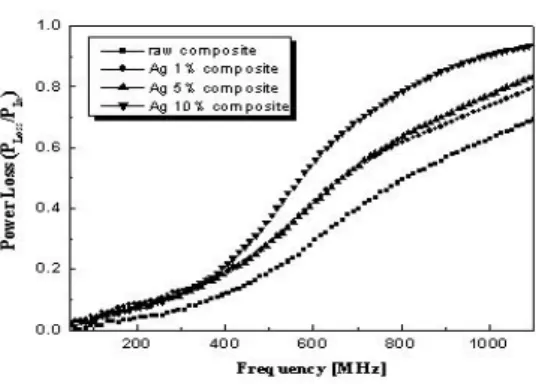
Fig. 3. The power loss of the composites.
The noise suppression effect is evaluated with the ratio of the power loss to the input power, that is, P(loss)/P(in). In terms of reflection coef.(Γ) and transmission coef.(Τ) which are given by Eq. (2),
)
(
1
)
(
/
)
(
loss
P
in
=
−
Γ
2+
Τ
2P
(2)The Γ and Τ were determined by S parameters S11, S21 measured using network analyzer. This evaluation is shown in Fig. 3 where the power loss increases with frequency. The value of power loss in silver containing composite was higher than raw composite (10% silver : 0.9, 5% silver : 0.8, raw composite : 0.6 at 1.0 GHz), which is due to the space charge polarization between the silver coated powders and the conduction loss.
3. Summary
We developed a new design technique of a thin electromagnetic wave absorber for quasi-microwave frequency band utilizing high-permittivity of silver coated sendust flake powders. Thus, we could obtain -5 dB reflection loss at below 0.8 GHz in composites by controlling silver concentration and thickness The increase of reflection loss and power loss at low frequency (below 1.0GHz) were due to a high dielectric constant and dielectric loss of the silver in microwave frequencies. The observed microwave absorbing behavior of the composite is quite well consistent with transmission line theory of λ/4 microwave absorbers.
4. References
1. M. Matsumoto, Y. Miyato : IEEE Magnetics. Vol.33, No 6 (1997), p.4459-4464.
2. Y. Naito : Electromagnetic wave absorber,(ohm, Japan 1987).
3. Y. Shimada : J. Applied physics. Vol.93, No 10 (2003), p.6662-6664.