한국해안․해양공학회 학술발표논문집 (2009) 2009년 11월 5일-11월 6일
제18권, pp. 128-131
Study on the multi-decadal variations of climate change and
typhoon and coastal disasters
수십년주기의 기후변동과 태풍 및 해안재해에 관한 연구
Han Soo Lee1 , Takao Yamashita2 , Tomoaki Komaguchi 3 and Toyoaki Mishima3이한수1
, 야마시타 다카오2, 코마구치 토모아키3, 미시마 토요아키3
1. INTRODUCTION
In the forward future climate described in Intergovernmental Panel on Climate Change (IPCC) Fourth Assessment Report (AR4), the extreme meteorological conditions such as tropical cyclones, draught, heavy rainfall, and so on are concerned to be increased in their intensity and frequency due to global warming under the future climate change. AR4 also confirmed the gradual global temperature increase in exponential trend until the year of 2100 based on the future prediction from climate modeling results by a number of research institutes over the world. Seeking for adaptation and mitigation measures to disasters under the extreme weather conditions in 2100 is already on the way in many research fields.
In the climate change, there are rather short-term fluctuations of climate with several to a few decadal periods in addition to the long-term exponential increase of global temperature. They are El Niño-Southern Oscillation (ENSO) in the equatorial Pacific region, Pacific Decadal Oscillation (PDO)in the Pacific Ocean, Atlantic Multi-decadal Oscillation (AMO) and North Atlantic Oscillation (NAO)in the Atlantic Ocean, and Indian Ocean Dipole (IOD) in the Indian
Ocean, which are known to be highly responsible for regional climates.
Yamashita et al. (2008)showed the relationship between the coastal disasters caused by super typhoons and storm waves and the ENSO and PDO in Japan based on the historical disaster records. They also discussed that the influence of ENSO and PDO with multi-decadal periods should be taken into account for adaptation measures to climate changes not only for long-term increase trend of global temperature but also for multi-decadal variations of climate which is more related to extreme meteorological conditions.
In addition to the typhoons in western Pacific, hurricanes in the Atlantic and eastern Pacific, and cyclones in the Indian Ocean are influenced by such multi-decadal variations of climate in their regions. To clarify the relationship between the tropical cyclones and the multi-decadal variations of climateis one of the important issues for adaption measures in future climate.
In this study, we focus on the typhoons in western Pacific to investigate their relationship with the multi-decadal variation. The hurricanes and cyclones are also studied to find out their relationship with the climate indices such as AMO and IOD in their occurrence regions. 1 발표자: 일본 히로시마대학교 국제협력연구과 특임조교
2 일본 히로시마대학교 국제협력연구과 교수
2. Indices for the multi-decadal fluctuation of climate change
There are several short-term fluctuations of climate which we can consider as multi-decadal variations of climate. They are fore-mentioned ENSO, PDO, AMO, NAO and IOD. Climate indices considered in this study for the multi-decadal variations of climate are Multi-variate ENSO Index (MEI), PDO, AMO, NAO and Dipole Mode Index (DMI).
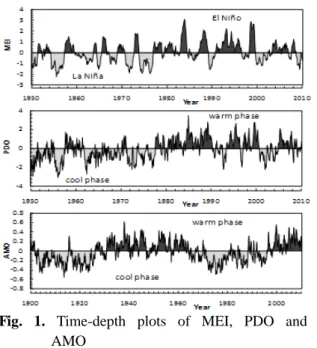
Fig. 1 shows the time-depth plots of MEI, PDO, and AMO since they only revealed certain relationship with tropical cyclones.
Fig. 1. Time-depth plots of MEI, PDO and
AMO
Positive values in MEI indicate El Niño and negative indicate La Niña.Positive in PDO indicates warm phase and negative means cool phase, respectively. As found in Fig.1, the year of 1976 synoptically divides the climate based on MEI and PDO. La Niña dominant or cool phase before 1976 and El Niño or warm phase after 1976. Climate indices data for MEI and PDO are provided by NOAA ESRL HP. AMO is a climate indexof changes in sea surface temperature in the middle of the North Atlantic.
As in the case of the PDO, Positive in AMO indicates warm phase, while negative means cool phase. AMO data is also available at NOAA. It is noticeable that about 40 years periodicity in AMO shows a phase lag compared to the 30
years periodicity in MEI and PDO.
3. Multi-decadal variations of climate change and typhoon
Data for tropical cyclonesare taken from Unisys HP and RSMC Tokyo HP operated by JMA (Unisys Weather HP; JMA RSMC Tokyo HP).
Fig. 2. Tracks of tropical cyclones from 1980
to 1989
Fig. 3. The relationship between MEI and
PDO and the number of typhoon occurrence
Fig. 2shows tracks of tropical cyclones provided by Unisys Weather. By analyzingthe best track data in each ocean, meaningful results in relationship between the multi-decadal variations and typhoons in western Pacific, hurricanes in eastern Pacific and in western Atlantic are obtained. In Fig. 3, it is found that during the La Niña dominant from MEI
or cool phase from PDO from 1950 to 1976, the rate of category 1 to 5 typhoons in total number of typhoons is higher than the El Niño dominant or warm phase from 1977 to 2007. Also the super typhoon in category 5 shows similar trend that it is more likely to occur in La Niña dominant or cool phase.
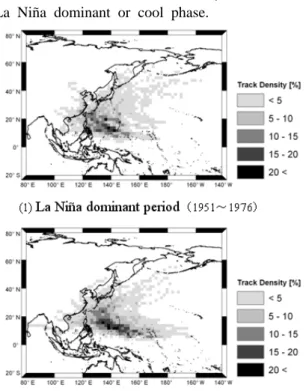
Fig. 4. Track density of category 5 typhoons
Fig. 4 shows track density of category 5 typhoons in different La Niña dominant and El Niño dominant periods. The track density was defined as a rate of the number of typhoons passing through the grid point (2 ° × 2 ° mesh) to the total number of typhoons. In Fig. 4, it is found that the track density of category5 typhoon during the La Niña dominant period is leftward biased and more expanded to northward that El Niño dominant period. It implies that typhoons are generated near south of Korea and Japan, they are more likely to proceed northward moving through Japan and East/Japan Sea. Fig. 5 showsthe frequency of typhoons ranked by the minimum central pressure which made landfall on Japan. During the La Niña dominant period in MEI (cool phase in PDO) from 1950 to 1976, high ranked typhoons up to 30 shows high frequency indicating that higher category typhoons
are more likely to make landfall in this period.
Fig. 5. Frequency of landfall typhoons ranked
in terms of central pressure
Fig. 6. Multi-decadal variation of climate and
hurricanes
4. Multi-decadal fluctuation of climate change and hurricane
Fig. 8 shows relationships between multi-decadal variations of climate and hurricanes in western Atlantic and in eastern Pacific. In Fig. 8(1), the number of hurricanes shows increasing trend of generation during the warm phase of AMO. In particular, the increase in the number of hurricane occurrencessince 1970 follows the increasing AMO well.
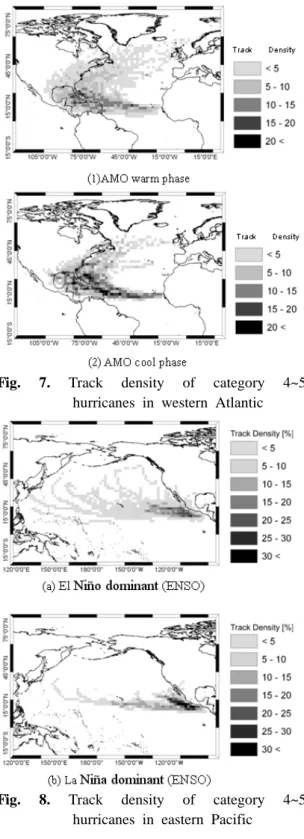
Fig. 7. Track density of category 4~5
hurricanes in western Atlantic
Fig. 8. Track density of category 4~5
hurricanes in eastern Pacific
Meanwhile, Fig. 6(2) shows that the number of hurricane occurrences in eastern Pacific follows the MEI and PDO variations. During El Niño dominant period (warm phase in PDO), the number of hurricanes generated is increased. This relationship is
more clearly depicted in eastern Pacific than that of western Atlantic. The relationship between MEI and PDO and the number of hurricane occurrence in eastern Pacific is much clearly revealed than that of western Pacific implying that MEI and PDO have much influence on the hurricanes in eastern Pacific. It is noticeable that the variation of sea surface temperature in eastern Pacific is most large compared to those in Atlantic and western Pacific.
5. CONCULSION
The relationship between tropical cyclones and the multi-decadal variation of climate in each oceanwas studied using various data.
The typhoons in western Pacific show increase in the number of typhoon occurrence during La Niña dominant period (warm phase in PDO) than El Niño dominant period (cool phase). The tracks of typhoons shows more expanded to northward indicating that higher category typhoons are more likely to make landfall on Korea and Japan.
In addition, the hurricanes in the Atlantic are increasing in the number of occurrence during the warm phase of AMO than in cool phaseand more likely to make landfall. In the eastern Pacific, the number of hurricane occurrence is increasing during the El Niño dominant period (cool phase in PDO) and the spatial region of hurricane occurrence becomes larger than that of La Niña dominant period (warm phase).
The multi-decadal variations of climate shows 30 to 40 periodicity with certain influencesstudied in this paper on tropical cyclones. For the adaptation measures to climate changes in the future, the multi-decadal variations of climate should be taken into account appropriately.
REFERENCES 気象庁RSMC Tokyo HP: http://www.jma.go.jp/ jma/jma-eng/jma-center/rsmc-hp-pub-eg/RSMC_HP.htm. 山下隆男・駒口友章・三島豊秋 (2008):気候変動のゆ らぎを考慮した海岸保全の適応策への一考察,海 岸工学論文集,第55巻,pp. 1341-1345.
NOAA Earth System Research Laboratory (ESRL) HP: http://www.cdc.noaa.gov/data/climateindices/.
Unisys Weather HP: http://www.weather.unisys.com/ hurricane/