Development of the Nuclear Equipment Qualification System
for the LOCA and Seismic Test
a Sung-young Kim, a Chi-sung Song, a Chang-dae Park, a Byung-ju Lim a Hee-beom Roh, a Seok-hwan Kwon, b Woon-kwan Chung a Korea Institute of Machinery and Materials, [email protected] b Department of Nuclear Engineering, Chosun University, [email protected]
1. Introduction
Purpose of EQ (Equipment Qualification) for nuclear equipment qualification is to guaranty functional operability of equipment under all service conditions during design-based life. The design-based life of nuclear power plant is typically about 40 years in the worst condition and the normal condition, which is presented in the IEEE Std. 323 [1]. The presented standardization, however, is only outline for EQ. The detailed procedure of specific EQ varies from institutes to institutes even in foreign institutes. Therefore the detailed procedure should be prepared in each institute according to testing equipment and their environmental conditions. KIMM (Korea Institute of Machinery and Materials) has constructed not only LOCA (Loss of Coolant Accident) test facility and seismic qualification system, but also the systematic procedures for EQ of nuclear equipment.
2. Procedures and Facilities for Equipment Qualification
2.1 Equipment Qualification Process
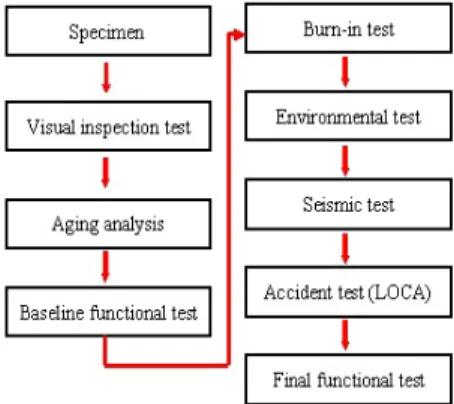
The methods qualifying nuclear equipment include a type test, an operating experience, a qualification analysis, and a combined method [1]. Nuclear equipment qualified by KIMM have been conduct started to from type test and qualification analysis. The procedures of the EQ of nuclear equipment performed in KIMM are shown in Fig. 1.
Figure 1. EQ process of KIMM
2.2 LOCA Test Facilities
LOCA test for EQ stands for qualification of nuclear equipment under the environmental conditions of DBA (Design Basis Accident). Environmental conditions include pressure, temperature, humidity, chemical spray and radiation. Typical test profiles for specific environmental cautious are presented in IEEE Std. 323 [1], which are obtained from accident analysis. LOCA test for EQ have been performed under very severe conditions that are high temperature/pressure and chemical spray. Real-time functional test for the specimen should be performed during the LOCA test whose conditions are controlled by the furnished control unit such as valves, boiler, superheater, pumps.
Testing facilities for DBA were not constructed in Korea by 2001, so that EQ of domestic nuclear equipment was exclusively performed by foreign institutes, resulting in inconvenience of business, expense waste, and failure of localization of nuclear equipments. In order to solve the problems, KIMM has constructed test facilities for DBA, as shown in Fig. 2, under the support of the Korea MOST (Ministry of Science and Technology). Figure 3 shows automatic control system for LOCA test to control the test conditions and to secure operational safety. Figure 4 shows the detailed pressure/temperature profiles for LOCA test performed by KIMM for 26 days, which profiles are conformable to the ones presented IEEE Std. 323 [1].
Figure 2. Diagram of LOCA test system
Figure 3. Automatic control system of LOCA facility
Transactions of the Korean Nuclear Society Autumn Meeting Busan, Korea, October 27-28, 2005
Figure 4. LOCA pressure and temperature profile
2.3 Seismic Test System
The seismic qualification for the nuclear equipment is a process for the equipment to have proven a structural integrity and operability required as the design specification by an analysis and/or a test at the design or manufacturing stage during and after the maximum expected seismic load (Safety Shutdown Earthquake; SSE) [3]. There are essential equipments for the seismic qualification: 1) the test facility and the operation techniques, 2) the analysis tools and dynamic evaluation techniques. Moreover the seismic qualification process with the quality assurance is necessary to improve the reliability of the qualification results.
Figure 5 shows large vibration simulator of 6-DOF (Degree of Freedom), established in 2001 for the seismic qualification test in KIMM. This system with control unit for the simulator is available for the equipment weighing up to 30 tons and has been used to test almost all nuclear equipment as well as building.
Figure 5. Large vibration simulator with 6-DOF
3. EQ Program
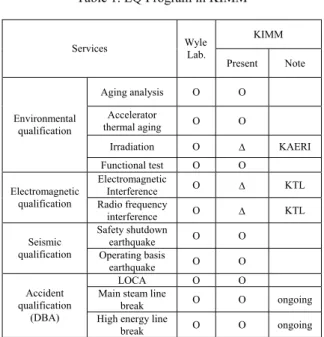
EQ program performed in KIMM is shown in Table 1. Comparing with the Wyle Lab, the popular institute of the nuclear equipment qualification, KIMM has almost equal ability to carry out the EQ except irradiation test among environmental qualifications and tests of the electromagnetic qualifications. KIMM has currently not enough experience in the field of the efficient qualification of nuclear equipment. But well-established facilities and procedures will ensure a good accomplishment for EQ in future.
Table 1. EQ Program in KIMM
KIMM Services Wyle Lab.
Present Note Aging analysis O O Accelerator thermal aging O O Irradiation O ∆ KAERI Environmental qualification Functional test O O Electromagnetic Interference O ∆ KTL Electromagnetic
qualification Radio frequency
interference O ∆ KTL
Safety shutdown
earthquake O O
Seismic
qualification Operating basis
earthquake O O
LOCA O O
Main steam line
break O O ongoing
Accident qualification
(DBA) High energy line
break O O ongoing
4. Conclusions
Almost all test facilities for EQ of nuclear equipment such as seismic qualification, accident qualifications have been constructed in KIMM. We have successful performed not only research and development on EQ program but real EQ test for class 1E cables with detailed procedures. Through this experience and co- work with other institutes, we expect following profits if the relating facilities and research keep improving.
1. Development of production technologies of nuclear equipment by transferring EQ technologies and facilities to domestic corporations.
2. Cost-down of domestic EQ payment by competing with institutes in developed countries in price. 3. Socially elevation affirmative recognition of nuclear
power plant for safety-related problems
Acknowledgement
This work has been carried out under the nuclear research and development program supported by the Korea MOST.
REFERENCES
[1] IEEE 323, “Qualifying class 1E equipment for nuclear power generating station” (1974).
[2] KIMM, “LOCA facility operation and supplementation for technology development in environmental qualification of nuclear equipment,” MOST (2005).
[3] Regulatory Guide 1.110, Revision 01: “Seismic qualification of electric and mechanical equipment for nuclear power digital,” (1988).