Addition of Myofascial Release Therapy to Therapeutic Exercise for
Management of Nonspecific Neck Pain
Yangsun Ha1 Suk-Chan Hahm, PT, Ph.D2ǂ
1Major in Integrative Medicine, Dept. of Medicine, Graduate School of CHA University, Student 2Graduate School of Integrative Medicine, CHA University, Professor
Abstract
Purpose : It is necessary to demonstrate the effect of non-invasive and non-pharmacological interventions such as manual therapy
and therapeutic exercise for the management of nonspecific neck pain. In the present study, we aimed to investigate the efficacy of myofascial release therapy plus therapeutic exercise for disability owing to neck pain and quality of life in individuals with nonspecific neck pain.
Methods : Eighteen participants with nonspecific neck pain were randomly allocated to intervention (n=9) and control groups
(n=9). The intervention group received a myofascial release therapy for 20 min and performed neck stabilization exercises for 30 min twice a week for 4 weeks. The control group performed neck stabilization exercises for 30 min twice a week for 4 weeks at the same time points as the intervention group. Disability owing to neck pain and quality of life were quantified using the neck disability index (NDI) and the Korean version of the World Health Organization Quality of Life Brief Version (WHOQOL-BREF), respectively. NDI and WHOQOL-BREF were assessed before and after intervention.
Results : The disability owing to neck pain significantly changed between the groups over time (total score of NDI, p=.049).
There were significant time and group interactions in pain (pain intensity of NDI, p=.035) and concentration (concentration of NDI, p=.049). Personal care, lifting, reading, headaches, work, driving, sleeping, and recreation did not show significant improvement between the groups over time. Total score, overall quality of life and general health, physical health domain, psychological domain, social relationships domain, and environmental domain quantified by WHOQOL-BREF did not show significant improvements between the groups over time.
Conclusion : These results suggest the clinical use of myofascial release therapy in addition to therapeutic exercise for the
management of nonspecific neck pain. Further studies are needed to generalize the findings of this study.
Key Words : myofascial release therapy, neck disability index, neck stabilization exercise, nonspecific neck pain, quality of life
ǂCorresponding author: Suk-Chan Hahm, [email protected]
1)
Ⅰ
. Introduction
Neck pain is a musculoskeletal disorder that affects people of all ages at some point in their lives (Cohen, 2015). The most common form of neck pain is nonspecific, which makes it challenging to identify a specific cause of pain (Bier et al., 2018). Nonspecific neck pain can be defined as simple neck pain without a specific underlying disease causing pain, resulting from postural and mechanical causes (Bier et al., 2018).
Several exercises and manual therapies can be used for the management of nonspecific neck pain (Bernal-Utrera et al., 2019; Celenay et al., 2016a; Celenay et al., 2016b; Diab et al., 2016; Shin et al., 2020). The results of a previous systematic review suggested the use of therapeutic exercise for nonspecific neck pain (Bertozzi et al., 2013; Vincent et al., 2013). Several clinical trials have demonstrated that neck stabilization exercise is effective in decreasing pain, increasing the range of motion, and increasing functional activity in patients with nonspecific neck pain (Celenay et al., 2016a; Celenay et al., 2016b).
Myofascial release therapy is a manual application for stretching the myofascial complex(Rodríguez-Huguet et al., 2018). Myofascial release therapy improves pain, range of motion, motor function, and quality of life in patients with neck pain (Ajimsha et al., 2014; Rodriguez-Fuentes et al., 2016; Tozzi et al., 2011). A previous study demonstrated that myofascial release therapy is superior to a physical therapy program for the improvement of neck pain (Rodríguez-Huguet et al., 2018). Considering these findings, the application of myofascial release therapy combined with neck stabilization exercise may be more effective than neck stabilization exercise alone for the management of nonspecific neck pain.
To the best of our knowledge, a pilot randomized control trial has not been specifically conducted to investigate the efficacy of myofascial release therapy combined with neck stabilization exercise for nonspecific neck pain. Thus, this
study was aimed at investigating the efficacy of the addition of myofascial release therapy with neck stabilization exercise for disability due to neck pain and for improving quality of life in individuals with nonspecific neck pain.
Ⅱ
. Methods
1. Design and participants
This study was designed as a single-blinded, randomized controlled trial. All the participants provided written informed consent before enrollment in the study. For this study, the inclusion criteria were adults with nonspecific neck pain (visual analog scale > 3/10) for a minimum of 3 months. Patients with neck pain owing to inflammatory, neurological, or structural deformities were excluded.
2. Experimental procedures and interventions
1) Experimental procedures
All participants were randomly assigned to intervention or control groups using a stratified randomization method (Kim & Shin, 2014). Group allocation was concealed to the assessor by blinding the group allocation. Disability owing to neck pain and quality of life were assessed before and after the intervention.
The intervention group received myofascial release therapy for 20 minutes and then performed neck stabilization exercise for 30 minutes, twice a week for 4 weeks, while those in the control group performed neck stabilization exercise alone for 30 minutes.
2) Myofasical release technique
Myofascial release technique was applied as the method used in the previous study (Rodríguez-Huguet et al., 2018). The therapist released the myofascial restrictions of the
suboccipital region by flexing the metacarpophalangeal joints of fingers to raise the atlas to the participant lying in the supine position. The therapist stretched the sternocleidomastoid (SCM) by gently rotating the patient's head with one hand placed in the occipital region and the other was placed on the belly of the SCM with the thumb at the mastoid process. Then, one hand rotated and slightly extended the head, while the other hand performed a transverse sliding movement on the restrictive area of the muscle. To stretch the posterior cervical myofasia, the therapist held the patient's head at the occipital area and slowly bent the cervical spine.
3) Neck Stabilization exercise
The neck stabilization exercise was applied as part of the intervention performed in the previous study (Dusunceli et al., 2009). Intervention began by having the patient look in the front and side mirrors to find a balanced and balanced posture for the lumbar and cervical spine. Stretching exercises (approximately 5 minutes) of the neck, shoulder, chest and scapular muscles were performed in a standing position. After that, in the sitting position, isometric exercises were performed with resistance to the forehead for 10 seconds (cervical flexion, extension, rotation and lateral flexion), a 15-second break between holds with 10 repetitions. The neck stabilization exercise was performed according to the therapist’s instruction.
3. Outcome measures
The neck disability index (NDI) was used to quantify disability owing to neck pain (Song et al., 2010). The NDI is the most widely used tool for quantifying such disability and is recommended for evaluation of the effects of interventions for neck pain control.
The Korean version of the World Health Organization Quality of Life Brief Version (WHOQOL)-BREF was used to quantify the quality of life (Min et al., 2002). It is
commonly used in the assessment of the quality of life in Koreans (Min et al., 2002).
4. Statistical analysis
Data analyses were performed using IBM SPSS Statistics 25.0. (IBM Corp., Armonk, USA). An independent t-test was performed to compare general characteristics between the two groups. Repeated measures analysis of variance was used to analyze the changes in variables between groups over time, and main effect comparisons were performed. A p-value of <.05 was considered statistically significant. and main effect comparisons were performed. A p-value of <.05 was considered statistically significant.
Ⅲ
. Results
1. Participant characteristics
A total of 18 patients completed the study. There were no significant differences of age, sex, height, and weight between the group (Table 1). In addition, there were no significant differences in the pre-values of the outcome variables (NDI and quality of life) between the two groups.
2. Disability owing to neck pain
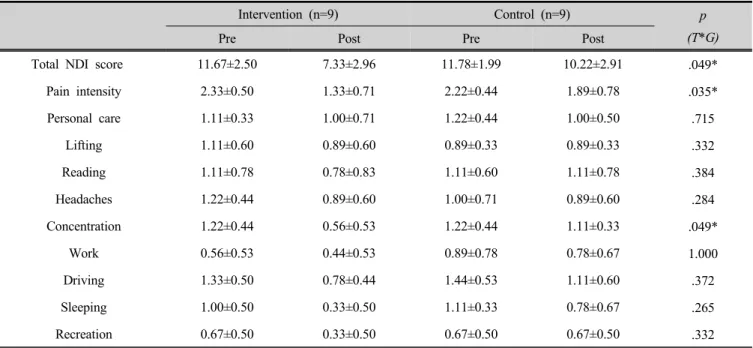
Significant improvement in disability owing to neck pain was observed in the groups over time (p=.049, Table 2). Moreover, myofascial release therapy with neck stabilization exercise yielded significant improvements in neck pain intensity (p=.035) and concentration (p=.049) in comparison with the improvements obtained with neck stability exercise alone over time. However, personal care, lifting, reading, headaches, work, driving, sleeping, and recreation did not show significant time and group interactions.
3. Quality of life
In comparison with the control group, the intervention group did not show significant improvements in the total score of quality of life over time (Table 3). All
subcategories of WHOQOL-BREF (overall quality of life and general health, physical health domain, psychological domain, social relationships domain, and environmental domain) did not show significant time and group interventions. Intervention (n=9) Control (n=9) p Sex (Female/Male)† 9/0 9/0 Age 56.78±5.29 58.11±4.65 .578 Height (㎝) 161.56±4.16 157.89±3.72 .066 Weight (㎏) 57.78±6.85 59.44±4.03 .538 VAS 4.44±1.01 4.33±0.87 .806 NDI 11.67±2.50 11.78±1.99 .918 Quality of life 84.00±6.58 85.11±7.79 .748
Values are expressed as mean±SD and number of participants†. VAS; visual analogue scale, NDI; neck disability index
Table 1. General characteristics of participants by study groups
Intervention (n=9) Control (n=9) p
(T*G)
Pre Post Pre Post
Total NDI score 11.67±2.50 7.33±2.96 11.78±1.99 10.22±2.91 .049*
Pain intensity 2.33±0.50 1.33±0.71 2.22±0.44 1.89±0.78 .035* Personal care 1.11±0.33 1.00±0.71 1.22±0.44 1.00±0.50 .715 Lifting 1.11±0.60 0.89±0.60 0.89±0.33 0.89±0.33 .332 Reading 1.11±0.78 0.78±0.83 1.11±0.60 1.11±0.78 .384 Headaches 1.22±0.44 0.89±0.60 1.00±0.71 0.89±0.60 .284 Concentration 1.22±0.44 0.56±0.53 1.22±0.44 1.11±0.33 .049* Work 0.56±0.53 0.44±0.53 0.89±0.78 0.78±0.67 1.000 Driving 1.33±0.50 0.78±0.44 1.44±0.53 1.11±0.60 .372 Sleeping 1.00±0.50 0.33±0.50 1.11±0.33 0.78±0.67 .265 Recreation 0.67±0.50 0.33±0.50 0.67±0.50 0.67±0.50 .332
Values are expressed as mean±SD.
NDI; neck disability index, T*G; time and group interaction *p<.05
Intervention (n=9) Control (n=9) p (T*G)
Pre Post Pre Post
Total WHOQoL-BREF score 84.00±6.58 93.44±8.71 85.11±7.79 90.33±8.46 .076
Overall quality of life and
general health 6.56±1.24 7.22±1.20 6.89±1.05 7.00±0.87 .172
Physical health
domain 21.11±2.85 25.44±3.47 22.00±2.83 24.33±2.55 .086
Psychological
domain 18.56±2.96 20.44±3.21 19.89±2.32 21.44±3.00 .763
Social relationships domain 10.56±0.73 11.56±0.88 10.00±1.12 10.44±1.51 .310
Environmental
domain 27.22±2.22 28.78±2.77 26.33±3.64 27.11±3.33 .435
Values are expressed as mean±SD.
WHOQoL-BREF; world health organization quality of life brief version, T*G; time and group interaction Table 3. Changes in quality of life between groups
Ⅳ. Discussion
This study was aimed at comparing the effects of myofascial release therapy combined with neck stabilization exercise to those of neck stabilization exercise alone on nonspecific neck pain. Although there were no significant differences in quality of life between groups, this pilot study is the first investigation to demonstrate that myofascial release therapy plus neck stabilization exercise provides benefits that are superior to those of neck stabilization exercise alone on disability owing to neck pain in individuals with nonspecific neck pain. These results may provide evidence for the use of myofascial release therapy and neck stabilization exercise for the management of nonspecific neck pain.
Previous studies have reported the effects of therapeutic exercises, including neck stabilization exercise on nonspecific neck pain and disability (Bertozzi et al., 2013). Our study also demonstrated that myofascial release therapy plus neck stabilization exercise was significantly effective in reducing disability owing to neck pain. Moreover, in
comparison with neck stabilization exercise alone, the intervention group showed a significant decrease in pain intensity. Changes in pain intensity may have resulted in a significantly decreased total score of neck disability. The results of a previous systematic review that reported the reduction of chronic neck pain using manual therapy and exercise treatment combination may support the results of the present study (Hidalgo et al., 2017).
Although not conformed in this study, previous studies have demonstrated that myofascial release therapy improves pain and movement in patients with neck pain (Ajimsha et al., 2014; Pérez-Martínez et al., 2020; Rodríguez-Fuentes et al., 2016; Rodríguez-Huguet et al., 2018; Tozzi et al., 2011). Fascia restriction of the neck area may result in excessive tension in other parts of the body because the fascia is continuous (Ajimsha et al., 2012). Application of myofascial release in the neck area can reduce this excessive tension (Ajimsha et al., 2012) and improve cervical movement and impaired sliding fascial mobility in people with nonspecific neck pain (Rodríguez-Fuentes et al., 2016; Tozzi et al., 2011). Considering these points,
neck stabilization exercise itself helps to improve neck pain (Celenay et al., 2016a; Celenay et al., 2016b; Dusunceli et al., 2009), but it is thought that myofascial release therapy combined with neck stabilization exercise showed superior effect over neck stabilization exercise alone.
This study also examined the changes in quality of life; however, there was no significant time and group intervention of quality of life. All sub-categories (overall quality of life and general health, physical health domain, psychological domain, social relationship domain, and environmental domain) of the WHOQOL-BREF did not show significant time and group interactions. Miller et al. reported that the addition of manual therapy to therapeutic exercise is effective in improving the quality of life in patients with nonspecific neck pain (Hidalgo et al., 2017). This discrepancy between the two studies may be owing to short periods and a small number of interventions (12 sessions applied over 4 weeks) in the present study.
There are some limitations to the present study. First, the small sample size of this pilot study may limit the generalizability of these results. Second, Even though both female and male could participate in this study, all participants were women, which may be a limitation in generalizing the results of this study. Third, deferences (50 minutes vs. 30 minutes) of intervention time between the two groups may have affected the difference in the results of this study. Forth, In order to clearly confirm the synergy effect of myofasical release therapy and neck stabilization exercise, the effect of myofascial release therapy alone should be confirmed, but myofascial release therapy group was not included in this pilot study.
To reach generalizable conclusions regarding the efficacy of myofascial release therapy combined with neck stabilization exercise for nonspecific neck pain, further studies with appropriate sample size, myofascial release technique group and neck stabilization exercise group as control groups, same application time per group, and appropriate sex ratio may be needed.
Ⅴ. Conclusion
Myofascial release therapy plus neck stabilization exercise is effective for nonspecific neck pain control. However, to generalize the clinical use of this intervention for the management of nonspecific neck pain, further studies with an appropriate sample size are needed.
References
Ajimsha MS, Chithra S, Thulasyammal RP(2012). Effectiveness of myofascial release in the management of lateral epicondylitis in computer professionals. Arch Phys Med Rehabil, 93(4), 604–609. https://doi.org/ 10.1016/j.apmr.2011.10.012.
Ajimsha MS, Daniel B, Chithra S(2014). Effectiveness of myofascial release in the management of chronic low back pain in nursing professionals. J Bodyw Mov Ther, 18(2), 273–281. https://doi.org/10.1016/j.jbmt.2013.05.007. Bernal-Utrera C, González-Gerez JJ, Saavedra-Hernandez
M, et al(2019). Manual therapy versus therapeutic exercise in non-specific chronic neck pain: study protocol for a randomized controlled trial. Trials, 20, Printed Online. https://doi.org/10.1186/s13063-019-3598-7. Bertozzi L, Gardenghi I, Turoni F, et al(2013). Effect of
therapeutic exercise on pain and disability in the management of chronic nonspecific neck pain: systematic review and meta-analysis of randomized trials. Phys Ther, 93(8), 1026-1036. https://doi.org/10.2522/ ptj.20120412.
Bier JD, Scholten-Peeters WGM, Staal JB, et al(2018). Clinical practice guideline for physical therapy assessment and treatment in patients with nonspecific neck pain. Phys Ther, 98(3), 162-171. https://doi.org/ 10.1093/ptj/pzx118.
Celenay ST, Akbayrak T, Kaya DO(2016a). A comparison of the effects of stabilization exercises plus manual
therapy to those of stabilization exercises alone in patients with nonspecific mechanical neck pain: a randomized clinical trial. J Orthop Sports Phys Ther, 46(2), 44-55. https://doi.org/10.2519/jospt.2016.5979. Celenay ST, Kaya DO, Akbayrak T(2016b). Cervical and
scapulothoracic stabilization exercises with and without connective tissue massage for chronic mechanical neck pain: A prospective, randomised controlled trial. Man Ther, 21, 144-150. https://doi.org/10.1016/j.math.2015. 07.003.
Cohen SP(2015). Epidemiology, diagnosis, and treatment of neck pain. Mayo Clin Proc, 90(2), 284-299. https://doi.org/10.1016/j.mayocp.2014.09.008.
Diab RH, Hamed RH, Mustafa IM(2016). Efficacy of McKenzie protocol on non-specific neck pain. Int J Physiother Res, 4(5), 1631-1638. https://doi.org/10.16965/ ijpr.2016.140.
Dusunceli Y, Oztrurk C, Atamaz F, et al(2009). Efficacy of neck stabilization exercises for neck pain: a randomized controlled study. J Rehabil Med, 41(8), 626-631. https://doi.org/10.2340/16501977-0392.
Hidalgo B, Hall T, Bossert J, et al(2017). The efficacy of manual therapy and exercise for treating non-specific neck pain: a systematic review. J Back Musculoskelet Rehabil, 30(6), 1149-1169. https://doi.org/10.3233/ BMR-169615.
Kim J, Shin W(2014). How to do random allocation (randomization). Clin Orthop Surg, 6(1), 103-109. https://doi.org/10.4055/cios.2014.6.1.103.
Min SK, Kim KI, Lee CI, et al(2002). Development of the Korean versions of WHO quality of life scale and WHOQOL-BREF. Qual Life Res, 11(6), 593-600. https://doi.org/10.1023/a:1016351406336.
Pérez-Martínez C, Gogorza-Arroitaonandia K, Heredia-Rizo
AM, et al(2020). INYBI: A new tool for self-myofascial release of the suboccipital muscles in patients with chronic non-specific neck pain: a randomized controlled trial. Spine, 45(21), E1367-E1375. https://doi.org/ 10.1097/BRS.0000000000003605.
Rodríguez-Fuentes I, De Toro FJ, Rodriguez-Fuentes G, et al(2016). Myofascial release therapy in the treatment of occupational mechanical neck pain: a randomized parallel group study. Am J Phys Med Rehabil, 95(7), 507–515. https://doi.org/10.1097/PHM.0000000000000425. Rodríguez-Huguet M, Gil-Salú JL, Rodríguez-Huguet P, et
al(2018). Effects of myofascial release on pressure pain thresholds in patients with neck pain: a single-blind randomized controlled trial. Am J Phys Med Rehabil, 97(1), 16-22. https://doi.org/10.1097/PHM. 0000000000000790.
Shin HJ, Kim SH, Hahm SC, et al(2020). Thermotherapy plus neck stabilization exercise for chronic nonspecific neck pain in elderly: a single-blinded randomized controlled trial. Int J Environ Res Public Health, 17(15), Printed Online. https://doi.org/10.3390/ijerph17155572. Song KJ, Choi BW, Choi BR, et al(2010). Cross-cultural
adaptation and validation of the Korean Version of the Neck Disability Index. Spine, 35(20), E1045-1049. https://doi.org/10.1097/BRS.0b013e3181df78e9.
Tozzi P, Bongiorno D, Vitturini C(2011). Fascial release effects on patients with non-specific cervical or lumbar pain. J Bodyw Mov Ther, 15(4), 405–416. https://doi.org/10.1016/j.jbmt.2010.11.003.
Vincent K, Maigne JY, Fischhoff C, et al(2013). Systematic review of manual therapies for nonspecific neck pain. Joint Bone Spine, 80(5), 508-515. https://doi.org/10.1016/ j.jbspin.2012.10.006.