Evaluation of SDS1 Depth for Pressure Tube Rupture in Wolsong-1 NPP
Kim YunHo and Choi HoonKEPRI [email protected]
1. Introduction
In-core LOCA like pressure tube rupture(PTR) can damage in-core structure(such as adjacent guide tubes and fuel channels) and induce positive reactivity into the core. Structural integrity and sufficient negative reactivity for such event should be ensured. In this paper shutdown system 1(SDS1) depth assessment for nominal operating condition is performed using core-tracking data of Wolsong-1 NPP.
2. Analysis Methods
2.1. Event sequence
a) Following channel rupture, coolant discharged into moderator. Jet force of discharging coolant, pipe whip and fuel impact can damage the in-core structures. Also discharged coolant increases moderator pressure and temperature so that the calandria relief duct rupture discs burst within first second of the accident.
b) Discharge of moderator into containment and other indication of in-core LOCA provide operator with unambiguous indication of the accident.
c) Heat transport system (HTS) begin to lose inventory and decrease pressure. Reduced pressure and displacement of moderator by coolant induce positive reactivity due to the increase of void and dilution of poison.
d) The reactor regulating system(RRS) compensate for positive reactivity insertion until trip is initiated.
e) Continued pressure drop of HTS triggers ECC such that subcriticality is kept due to large negative reactivity until operator action.
2.2. Analysis code and model
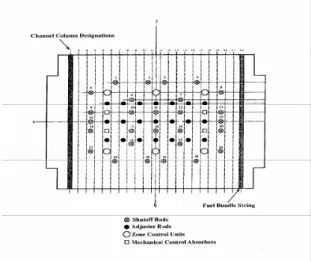
System reactivity calculations are performed with RFSP and CATHENA. RFSP model uses core-tracking model at 5778 EFPD and CATHENA simulation data at 900 second after PTR initiation. Core model including in-core reactivity control device is shown in Fig. 1. 2.3. Analysis assumption
Core simulation is done at hot zero power(HZP) condition on reactor startup after long shutdown to maximize poison(boron) concentration with following assumptions
a) RRS : No credit is taken for RRS and the level of liquid zone contoller(LZC) is frozen at 50%
b) Shutoff rod (SOR) : Damaged SORs are assumed at column 4 in Fig.1 and most reactive SOR 25 is unavailable.
c) Density and temperature of coolant and fuel temperature are generated at 15 minutes after the accident.
d) ECC : No credit is taken for ECC injection for conservatism.
e) Integrated coolant discharged at 15 Min after accident (Mg) : 85.6
f) Other parameters used in this simulation are shown in table 1.
Fig. 1 Layout of reactivity devices Table 1 Calculation conditions
Parameters HFP HZP
Moderator purity (w/o
D2O) 99.90 99.90
Coolant purity (w/o D2O) 99.3 99.3
Moderator temperature(℃ ) 74 67
Coolant density (g/cm3) 0.8122 0.8555
LZC level (%) 50 50
Mass of Moderator(Mg) 264 264
2.4. Dilution of boron in the moderator
Boron dilution in the moderator for in-core LOCA is calculated using “uniform mixing model” as in the following Eq.(1).
B(t) = Bo Exp [ - Md(t) / Mo ] (1) Where
t : time after accident
Bo : boron concentration prior to accident Mo : total mass of moderator
Transactions of the Korean Nuclear Society Autumn Meeting Busan, Korea, October 27-28, 2005
Md : discharged mass of moderator 2.5. Downgrading of the moderator purity
If coolant purity is lower than moderator purity, the discharge of coolant causes downgrading of the moderator D2O purity. The maximum value of coolant purity is used to minimize the reduction in reactivity due to downgrading of the moderator purity. Eq.(2) is used to compute the downgraded moderator purity.
P = Pc + (Po – Pc) Exp [ - Md(t)/ Mc ] (2) Where
Pc : D2O purity in the coolant
Po : initial D2O purity in the moderator Mo : total mass of moderator
Md : discharged mass of moderator
3. Results
Safety analysis for CANDU6 type plant is performed on the conservative assumption that maximum channel power is 7.3MW. And at power less than 100%, linear relationship between core power and permissible maximum channel power is assumed. For example, limiting channel power is 5.84MW, 80% of 7.3MW when core is operating at 80%FP. But there is no specific safety basis for the linear relationship. Operator has difficulty in having confidence for his operation. In this paper, channel power limit at low power is established.
3.1. Baseline calculation
The reactor is assumed to have just been restarted after a long shutdown to maximize the boron poison concentration in the moderator. From the in-core damage assessment, the locations of damaged guide tubes are SOR 5, 9, 14, 16, 21 in Fig.1. Among the remaining SORs, the most effective SOR(25) is also assumed unavailable. The core reactivity with critical boron concentration at HZP, 5778 EFPD, adjuster/SOR out of core with 0 % tilt is shown in table 2.
Table 2 Data in baseline calculation
Power (%) 0.01
Adjuster/SOR Out / Out
Tilt (%) 0 / 5.24
Boron (ppm) 6.403
Reactivity (mk) 2.131
3.2. Depth of SDS1
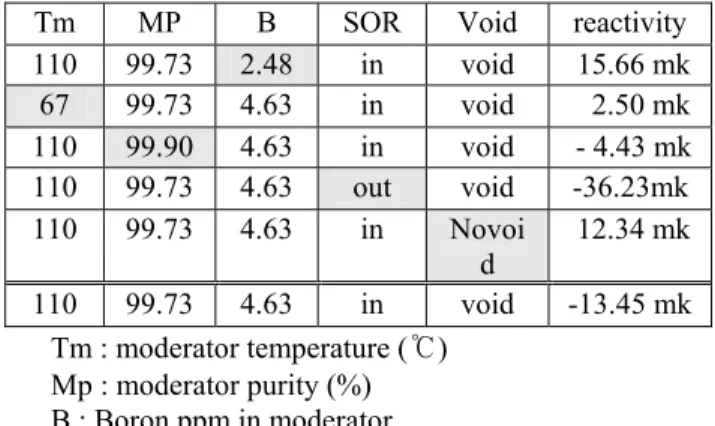
The items that can affect SDS1 depth can be moderator poison replacement, moderator temperature, degrading of moderator purity, and coolant void. The SDS1 depth of Wolsong-1 is 13.45 mk and sub components of SDS1 depth are assessed as shown in Table 3. To assess the relative contribution of each component to SDS1 depth, perturbation calculation is performed. Colored one in Table 3 is the value of
perturbed parameters. Boron dilution in the moderator produces the highest positive reactivity in the core among all the components.
For 5.24% tilt core, same calculation is done. SDS1 depth is 11.25 mk which is slightly less than 0% tilt core. Relative portion of each component is almost similar with 0% tilted core.
Table 3 SDS1 depth and it's components (0% tilt) Tm MP B SOR Void reactivity
110 99.73 2.48 in void 15.66 mk 67 99.73 4.63 in void 2.50 mk 110 99.90 4.63 in void - 4.43 mk 110 99.73 4.63 out void -36.23mk 110 99.73 4.63 in Novoi d 12.34 mk 110 99.73 4.63 in void -13.45 mk Tm : moderator temperature (℃) Mp : moderator purity (%) B : Boron ppm in moderator Void : coolant void
6. Conclusion
The SDS1 depth of Wolsong-1 NPP to keep the reactor subcritical until the operator can act is assessed. Even though plutonium peak core is expected to be most limiting, depth assessment for nominal equilibrium core is practically reasonable because Wolsong-1 NPP will reach the end of life(EOL) and there is no chance to encounter plutonium peak core before EOL of Wolsong-1 NPP. From the assessments of this paper, Wolsong-1 NPP have SDS1 depth more than 13mk. For the tilted core, SDS1 depth is decreased to about 11mk.
REFERENCES
[1] 86-03500-AR-031 Pressure Tube Rupture Analysis Report, 1995, AECL
[2] C-6, Requirements for the Safety Analysis of CANDU NPPs, 1980.
[3] CATHENA Mod-3.5c Input Reference, 1999, AECL [4] TTR-734, RFSP-IST User’s Manual, 2001, AECL [5] 86-03310-DM-000 CANDU6 Generating Station Physics Design Manual, 1995, AECL