54-1 / H.-C.O. Li
• IMID 2009 DIGEST
Abstract
The purpose of the research was to figure out the optimal binocular parallax inducing the least 3D visual fatigue. Subjective 3D visual fatigue was measured while the revolution depth and the average depth of an object were manipulated. The optimal binocular parallax was figured out by using data fitting method.
1. Introduction
Despite the enormous efforts to make 3D displays be widespread over the world, it still needs more effort to remove or at least to reduce 3D visual fatigue. Without developing the technology to remove the 3D visual fatigue, it is still possible to reduce it by figuring out the optimal relevant parameters for 3D displays. Prior to figuring out the optimal parameters, there must be proper tools of measuring 3D visual fatigue. Very recently, several researchers have developed the tools to measure subject 3D visual fatigue[1, 2, 3]. We have employed the tool developed by Li et al. According to Li et al, 3D visual fatigue is comprised of 5 independent factors and it is possible to measure each independent factor.
The most critical parameter in 3D visual fatigue is known as binocular parallax. There are several parameters that are directly related to the amount of binocular parallax; viewing distance, volume of an object, revolution depth, fixation point, average depth of the moving object etc. In order to figure out optimal parameters, it is necessary to examine all the possible combinations of parameters and this takes infinite efforts. In the present research, we have focused on just the parameter of binocular parallax, because it is known to generate the major cause of visual fatigue, the vergence-accommodation conflict.
Usually, as the viewing distance increases the vergence angle becomes small and refractive power of the lens decreases. It is quite natural that both vergence and accommodation works together in
harmony in natural 3D environment, and more importantly visual system has evolved in this way. However, in virtual 3D environment, vergence is set on a position off a display while accommodation is set on a position on the display and there exists some discrepancy between both set positions. This discrepancy is known to affect 3D visual fatigue.
2. Experimental
In the present research, we have manipulated the revolution depth and the average depth of the moving object while keeping the other factors constant. Fig. 1. roughly indicates the stimulus employed in the experiment with relevant parameters. A brief 3D content was produced to make the relevant factors be manipulated easily. The 3D content was comprised of a cube surrounded by random dots. The cube rotated in a 3D space and reversed its rotation direction randomly. We have manipulated the revolution depth of the cube and it’s average depth in 5 levels each (revolution depth: 0.5, 2.075, 5.25, 7.625, 10, average depth: -10, 5, 0, 5, 10). For both depth, the number indicates the amount of binocular parallax and negative value indicates that the cube located behind the monitor while the positive value indicates that it located in front of the monitor. The 3D stimuli were presented on a 32 inch Apple Cinema Display (LCD monitor) as a type of anaglyph. Observers watched the 3D stimulus wearing blue-red goggles at the distance of 120 cm.
All the 15 subjects participated in the experiment and their task was to report the rotation direction reversal as soon as possible. After watching the 3D contents, they reported 3D visual fatigue by filling out scales measuring subjective 3D visual fatigue comprised of 32 questions having 5 separate factors. To compare the 3D visual fatigue with 2D visual fatigue, 2D condition was included. For all the
Determination of The Optimal Binocular Parallax Inducing
The Least 3D Visual Fatigue
Hyung-Chul O. Li
Dept. of Industrial Psychology, Kwangwoon University, Seoul 136-701, Korea Tel.:82-2-940-5425, E-mail: [email protected]
54-1 / H.-C.O. Li
IMID 2009 DIGEST • conditions, the duration of watching displays was
manipulated in 3 levels: 10, 20 and 40 minutes. Finally, we did data fitting to figure out the 3D visual fatigue functions as a function of the parameters we had manipulated.
Fig. 1. Typical stimulus environment and relevant parameters.
3. Results and discussion
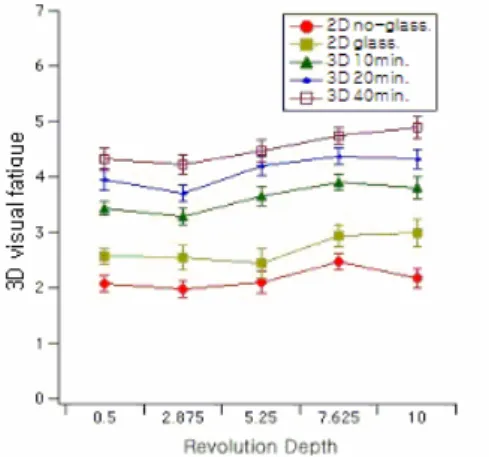
Both Fig. 2 and Fig. 3 indicate the measured 3D visual fatigue in the experiment. As the duration of watching displays increased, the visual fatigue increased in general. Specifically, 3D visual fatigue was much stronger than 2D visual fatigue(see Fig. 2 & 3). As the revolution depth increased, the 3D visual fatigue also increased. The 3D visual fatigue was strongest when the average depth was around the displays. As a result of data fitting, we figured out a pair of functions describing the given data properly.
The 3D visual fatigue was least when the revolution depth was near 0. These results imply that 3D visual fatigue would become very small if binocular parallax is not included. However, this is not what we want. An important issue is what would be the proper binocular parallax while keeping 3D experiences intact. To figure out it, we should know the proper 3D visual fatigue that people can allow. Currently, we do not know the proper 3D visual fatigue that we can allow, and this may be the issue for the future research.
As shown in Fig. 2, the perceived 3D visual fatigue just increased as the revolution depth increased. This result implies that as the 3D contents contain large amount of binocular parallax, the 3D visual fatigue would also increase. This would mean that we should decrease the amount of binocular parallax as much as we can. Then there remains a question: how much binocular parallax do we allow for 3D contents? To answer this question, separate experiments would be required. For the time being, I would suggest that the
revolution depth that does not induce more that 4 levels of 3D visual fatigue would be accepted because the questionnaires were rated using 7 point scale where ‘4’ means “being not certain for having experienced visual fatigue.” It should be noted that 3D visual fatigue varies depending on other relevant parameters. In order to figure out exact optimal parameters, 3D visual fatigue should be measured in the environment to which researchers want to apply the results.
Fig. 2. Total 3D visual fatigue as a function of revolution depth of an object(cube).
Fig. 3. Total 3D visual fatigue as a function of average depth of an object(cube) rotating in depth dimension.
There have been studies showing the effect of binocular parallax on 3D visual fatigue. Most of them measured 3D visual fatigue using one question. Rare studies manipulated the revolution depth and average depth of an object. Although further researches are required to figure out optimal parameters, current research contribute to 3D human factor research by showing a possibility that 3D visual fatigues could be measured with 32 multiple questions having 5
54-1 / H.-C.O. Li
• IMID 2009 DIGEST
separate factors and that revolution depth as well as average depth should be considered to figure out optimal parameters.
4. Summary
The purpose of the present research was to determine the optimal level of the parameter, “binocular parallax” which induces minimum amount of 3D visual fatigue while the impression of 3D being maintained. We have constructed a revolving 3D stimuli(cube) which allows the manipulation of the relevant parameters including revolution depth as well as average depth of the object. We have manipulated either revolution depth or average depth of the 3D stimuli in 5 levels and the subjects watched the stimuli for 10, 20 or 40 minutes. 3D visual fatigue that subjects might have experienced was measured with 32 questionnaires developed by Li et al. The optimal binocular parallax was figured out by using data fitting method. The present research shows the possibility that we can figure out optimal 3D parameter by measuring 3D visual fatigue while manipulating 3D parameters.
Acknowledgement
This work was supported by the IT R&D program of MKE/IITA [2009-F-208-1, Signal processing elements and their SoC developments to realize the integrated service system for interactive digital holograms].
5. References
1. M. Emoto, Y. Nojiri & F. Okano, Displays, 25, pp67~76(2004).
2. H.-C.O. Li, J. Seo, K. Kham & S. Lee, OSA:Digital Holography (2008).