PUBLIC HEALTH WEEKLY REPORT, PHWR
Vol.11 No.16
2018
www.cdc.go.kr
pISSN 2005-811X
eISSN 2586-0860
CONTENTS
CONTENTS
0488
차세대 염기서열 분석법을 이용한 A형 인플루엔자
바이러스 전장 유전자 생산
0497
2018 평창동계올림픽·패럴림픽 검역 대비 대응
0505
주요 감염병 통계
환자감시 : 전수감시, 표본감시
병원체감시 : 인플루엔자 및 호흡기바이러스
급성설사질환, 엔테로바이러스
매개체감시 : 말라리아 매개모기, 일본뇌염 매개모기
차세대 염기서열 분석법을 이용한 A형 인플루엔자
바이러스 전장 유전자 생산
Whole genome sequencing of type A influenza virus by next-generation
sequencing
Kim Heui Man, Lee Namjoo, Kim Mi-Seon, Chung Yoon-Seok, Kang Chun
Division of Viral Diseases, Center for Laboratory Control of Infectious Diseases, KCDC
Background: Since influenza viruses are mutated frequently, the sequencing of their hemagglutinin (HA) antigen helps
researchers to compare newly discovered clinical isolates with existing vaccine strains to characterize their receptor affinity and pathogenicity. Similarly, sequencing of the neuraminidase (NA) antigen is important for estimating anti-influenza drug resistance.
Present condition: Traditional genetic sequencing techniques, such as the Sanger method, have has several limitations.
First, sequencing of a single gene segment of a virus sample involves several laboratory steps that can cause contamination. Second, several polymerase chain reactions (PCRs) need to be performed successively due to the long length of some genes, such as the polymerase genes. Finally, in case of influenza A, frequent mutations make it necessary to redesign the primer sequences because of mismatches with the template sequence. Therefore, next-generation sequencing is employed to prevent contamination of samples and to allow whole genome sequencing regardless of mutations.
Future Perspective: In this study, we performed whole-genome sequencing of influenza isolates obtained from
respiratory specimens of Korean subjects and vaccine strain by multi-segment reverse transcription - PCR and NGS analyses. The continual use of NGS could produce a large amount of information for analysis of genetic characteristics of influenza strains as well as an estimation of the performance of commercial vaccine stocks. It could also be used to construct an effective diagnostic system and assess disease risks to humans by analysis of the mutations of recently evolved influenza A strains.
Keywords: Whole genome sequencing, Influenza A virus, Next generation sequencing, Pathogenicity, Mutation
질병관리본부 감염병분석센터 바이러스분석과 김희만, 이남주, 김미선, 정윤석, 강춘*
www.cdc.go.kr
489
들어가는 말
인플루엔자 바이러스는 A, B, C, D형으로 나뉘며 그 중 A형과
B형은 인체감염 시 임상증상을 일으키므로 3가 및 4가 백신의 주요
항원으로 사용된다[1]. A형 인플루엔자 바이러스에는 계절인플루엔자
A/H1N1과 A/H3N2 뿐만 아니라 모든 조류인플루엔자가 속하며
변이가 빈번하게 발생되어 여러 번의 대유행(Pandemic)을 일으킨
바이러스이다. A형 인플루엔자는 8개의 (-)RNA 분절로 이루어져
있으며 그 중 HA와 NA 유전자는 표면 당단백질(Glycoprotein)을
구성하는 주요 항원이다. 현재까지 HA는 1∼18, NA는 1∼11의
아형이 보고되었으며[2] HA 단백질은 바이러스가 숙주세포에
부착 하 는 부 위로 바 이러스 의 특 성을 결정하 는 주요 항원
부위이다[3]. NA는 숙주세포 내에 감염된 인플루엔자 바이러스가
밖으로 나올 수 있도록 HA 단백질을 끊어주는 가위의 역할을
하며[4] 인플루엔자 치료제로 사용되는 Oseltamivir, Zanamivir
및 Peramivir 등은 이 NA의 가위 기능을 억제시켜 체내에서
바이러스의 증식을 막는다. 그러나 NA 염기서열 중 H275Y 등의
변이를 갖는 인플루엔자 바이러스는 인플루엔자 치료제에 내성[5]을
보이므로 NA 염기서열 분석은 내성주를 감별하는데 필수적이다.
HA와 NA 염기서열뿐만 아니라 전장 유전자 분석을 통하여
인플루엔자의 병원성(Pathogenesis), 전파능력(Transmissibility),
적응성(Adaptation)과 숙주 면역원성 저하와 관련된 변이를
확인함으로써 신종인플루엔자 발생 시 신속한 위해도 평가(Risk
assessment)를 할 수 있다. 기존의 Sanger sequencing 방법을 통한
Figure 1. Classical two step RT-PCR (a), multi-segment RT-PCR to get whole genome sequence of type A influenza (b)[7]
Universal primers for influenza A virus 2281Fig. 2. Schematic representation of the RT-PCR methods. Viral RNA was purified from
virus particles, and the eight negative-sense vRNAs were reverse transcribed with the Uni12 primer, which is complementary to the 12 conserved nucleotides at the 3�-end of the vRNA
(the sequence is in the box on the left; the conserved sequence at the 5�end is in the box on
the right). The single-stranded DNA (ssDNA) was then amplified by PCR using a primer pair complementary to the segment-specific regions. The sizes of the RNA segments range from
890 nucleotide (NS segment) to 2.341 nucleotides (PB1 segment)
Fig. 3. Full length amplification of all eight segments by RT-PCR. RNA from
A/Ck/HK/YU562 (H5N1) was isolated, and reverse transcription was performed with Uni12 primer. Subsequently, PCR reactions for each segment were performed by using the primer pairs presented in Table 1. As a negative control (−) 1 l H2O was added instead of 1 l
of the RT-reaction (+) to the PCR reaction. 10% of the PCR reactions were subjected to electrophoresis on a 1% agarose gel and stained with ethidium bromide
totypical antigenic shift viruses that caused the 1957, 1968, and 1977 pandemics were also amplified (Fig. 1D, lanes 5 to 7). M-RTPCR of A/NY/1469/02(H3N2) illustrates that genomes from contemporary viruses are also amplified (Fig. 1D, lane 8). Genomic amplification of (i) classical swine viruses [e.g., A/Sw/ IN/1726/88(H1N1)], (ii) avian viruses isolated from waterfowl [A/Dk/Alb/35/76(H1N1)] or created by reassortment [A/R26 (turkey/Ontario/7732/1966-WSN/1933(H1N9)],(iii)ahighlypatho-genic avian virus [A/Ty/Ont/7732/66(H5N9)], and (iv) an equine isolate [A/Eq2/Miami/1/63(H3N8)] further demonstrates that M-RTPCR is both subtype and lineage independent (Fig. 1E, lanes 1 to 7). M-RTPCR successfully amplified fatal zoonotic viruses of swine origin (11, 17, 22) (Fig. 1E, lanes 8 to 10) and prototypical avian H5N1 viruses (19) (Fig. 1E, lanes 11 and 12). The vRNA segments for the RNA polymerase subunits often migrate to-gether or are difficult to visualize (Fig. 1D and E): however, they can be consistently differentiated by restriction endonuclease di-gestion, nucleotide sequencing, and/or cloning (data not shown). We have amplified the complete genomes of 450 viruses, comprising nearly all of the known subtypes of human, swine, equine, and avian viruses (data not shown). M-RTPCR ampli-cons are excellent templates for dideoxynucleotide sequencing, and in collaboration with D. Spiro, we have successfully used M-RTPCR amplicons from 30 avian viruses for high-through-put multiplex 454 sequencing (personal communication).
M-RTPCR and reverse genetics of viruses from human na-sopharyngeal (nas) and oropharyngeal (oro) swab specimens.
M-RTPCR of a fraction (1/120) of specimens that were previ-ously identified as positive for influenza A virus by using real-time RT-PCR specific for M vRNA yielded complete genomic amplification of classical H3N2 and H1N1 viruses for all of the primary specimens analyzed (Fig. 2A, lanes 1 to 6), including those with a low level of vRNA (high cycle threshold [CT] value
by quantitative RT-PCR for M vRNA). We are often not able to isolate influenza A viruses by inoculation of primary rhesus monkey cells with swab specimens that have CTvalues of 30.
Therefore, M-RTPCR amplifies the complete genomes of specimens from which isolates may not be recovered by con-ventional virus isolation. M-RTPCR of novel swine origin H1N1 viruses that recently emerged in humans (Fig. 2A, lane 7) is being used to sequence viruses contained in swab specimens (e.g., GenBank accession no. CY039901 to CY039908), thereby avoid-ing inevitable mutations that occur duravoid-ing laboratory isolation/ propagation, which is often required prior to sequencing.
The majority of reverse-genetics plasmids used to engineer influenza A viruses take advantage of host RNA polymerase I promoters at the 5 terminus and RNA polymerase I termina-tors or ribozymes following the 3 terminus to generate exact influenza virus-like vRNAs (5, 6, 14). The strict requirement for precise initiation and termination of the vRNA transcripts
FIG. 1. M-RTPCR designed to exploit the conserved elements of the influenza A virus promoter. (A) Classical panhandle depic-tion of base pairing between the 3 and 5 termini that occurs in each of the genomic RNA segments. (B) Illustration of genomic RNA segments (vRNAs) of influenza A virus. (C) M-RTPCR scheme illustrating the tailed reverse transcription primer P1, which is comple-mentary to the Uni-12 sequence (e.g., MBTuni-12), and the tailed forward primer P2, which is complementary to the Uni-13 sequence (e.g., MBTuni-13). dsDNA, double-stranded DNA. (D) M-RTPCR suc-cessfully amplifies genomes from pandemic human influenza A vi-ruses isolated from 1933 to 2002, regardless of subtype. The influenza A virus strains used were (i) A/WS/1933(H1N1), (ii) A/PR/8/1934(H1N1), (iii) A/Weiss/1947(H1N1), (iv) A/Denver/1/1957(H1N1), (v) A/Japan/305/ 1957(H2N2), (vi) A/HK/8/1968(H3N2), (vii) A/USSR/1977(H1N1), and
(viii) A/NY/1469/2002(H3N2). N, negative control; L DNA ladder (1 kb A/Eq2/Mia/1/1963(H3N8), (viii) A/NJ/8/1976(H1N1), (ix) A/WI/3523/1988(H1N1), (x) A/MD/12/1991(H1N1), (xi) A/HK/156/1997(H5N1),
10310 NOTES J. VIROL.
(a) RT-PCR method
(b) M-RTPCR method
PA)와 같이 상대적으로 길이가 긴 유전자의 경우 분절로 나누어서
PCR을 해야 하는 번거로움이 있다. 더욱이 A형 인플루엔자는
변이가 빈번하기 때문에 프라이머에 mismatch가 있는 경우 이를
다시 디자인해야 하는 번거로움도 있다.
이 글에서는 차세대 염기서열분석법(Next generation
sequencing, NGS)을 이용하여 2009년 인플루엔자 대유행의
원인 바이러스인 국내 분리주 A /Korea/01/2009(H1N1)와
2 015 -2 016절기 A형 인플루엔자 H 3 N2 북반구 백신주인
A/Switzerland/9715293/2013에 대한 전장 유전자를 생산하기 위한
최적의 NGS 실험방법을 확립하였다. 뿐만 아니라 호흡기 검체에서
직접 NGS법을 적용하여 전장 유전자를 확인하고 각 유전자 분절의
변이에 대한 의미를 해석하였으며, NA 유전자의 Quasispecies
sequencing을 통하여 H275Y 변이에 의한 인플루엔자 치료제
내성을 분석하였다.
인플루엔자 유전자 분석은 역전사(Reverse transcription)로 cDNA를
합성하고 8개의 RNA 분절에 대한 각각의 특이 프라이머로 PCR을
수행해야 한다. 또한 DNA 산물을 정제한 후 sequencing을 위한
PCR 반응을 다시 수행해야 한다[6]. 따라서 Polymerase(PB2, PB1,
Table 1. Primers used for multi-segment RT-PCR[7]
Primers Sequence (5′→ 3′)
Uni12/Inf-1 GGGGGGAGCAAAAGCAGG
Uni12/Inf-3 GGGGGGAGCGAAAGCAGG
Uni13/Inf-1 CGGGTTATTAGTAGAAACAAGG
Ref. Bin Zhou et al., 2014.
Table 2. Amplification condition for multi-segment RT-PCR[7]
Steps Temperature Time Cycles
cDNA synthesis 42℃ 60 min 1 cycle
Activate the enzyme 94℃ 2 min
Denature 94℃ 20 sec 5 cycle
Anneal and extend 44℃ 30 sec
Extension 68℃ 3 min
Denature 94℃ 30 sec 31 cycle
Anneal and extend 57℃ 30 sec
Extension 68℃ 7 min
Final extension 68℃ 7 min 1 Cycle
4℃ ∞ Hold
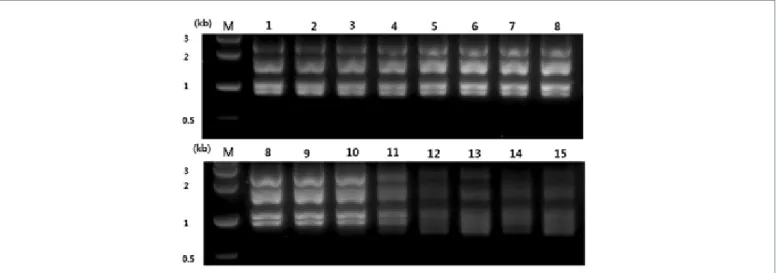
Figure 2. Genomic amplification of type A influenza using
multi-segment RT-PCR
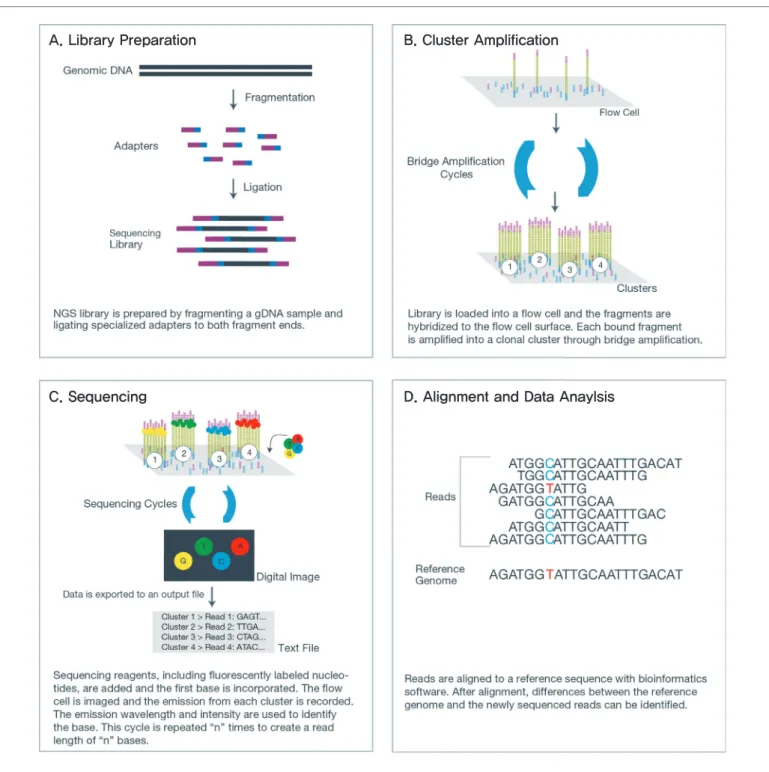
Figure 3. Next generation sequencing chemistry overview
A. Library preparation
- NextraⓇXT DNA Library kit를 사용하여 Multi-segment RT-PCR법으로 생산된 유전자 산물을 단일 가닥의 DNA로 만든 후 조각을 내고 말단에 double stranded linker(adapter)를 붙임.
B. Cluster amplification
- Flow cell 바닥에는 adapter 서열에 상보적인 DNA가 고정되어 있으므로 adapter가 붙어 있는 library는 flow cell에 부착됨. PCR 과정을 통하여 단일가닥의 library를 주형으로 이중의 DNA를 얻음. 주형으로 사용된 library는 제거되고 복제된 단일 가닥 DNA는 flow cell의 adapter와 결합되어 bridge를 형성함. PCR 과정을 통하여 이 단일 가닥의 DNA를 주형으로 이중 가닥의 DNA가 증폭되며 이러한 과정이 반복되어 clonal cluster를 생성함.
C. Sequencing
- 이중 가닥의 DNA 중 한쪽 가닥을 이용하여 염기의 종류에 따라 각각 다른 빛을 내는 형광물질이 결합된 dNTP를 사용하여 DNA polymerase에 의해 한 염기씩 합성될 때 마다 형광물질을 분석하여 염기서열을 생산함.
D. Alignment and data analysis
A. Library Preparation
C. Sequencing
B. Cluster Amplification
Table 3. Alignment metrics
Virus segmentGene length (bps)Reference Mappedreads coverageAverage % GC length (bps)Consensus A/Korea/01/2009 (H1N1) PB2 2,280 169,537 11,253 45 2,280 PB1 2,274 122,211 8,380 42 2,274 PA 2,151 121,465 8,850 44 2,151 HA 1,701 251,160 23,502 41 1,701 NP 1,497 423,175 45,786 46 1,497 NA 1,410 293,011 34,236 42 1,410 MP 982 641,460 106,788 47 982 NS 838 534,804 103,888 44 838 A/Switzerland/9715293/2013 (H3N2) PB2 2,280 172,828 12,472 43 2,280 PB1 2,274 173,969 12,694 42 2,274 PA 2,151 118,452 9,127 42 2,151 HA 1,701 423,590 41,894 42 1,701 NP 1,497 346,293 38,599 45 1,497 NA 1,410 602,720 72,315 43 1,410 MP 983 1,336,229 229,511 47 983 NS 838 400,896 80,251 42 838 ※ %GC: GC ratio
Figure 4. Detection limit of RNA concentration for next generation sequencing
1: 240 ng/㎕, 2: 120 ng/㎕, 3: 60 ng/㎕, 4: 30 ng/㎕, 5: 15 ng/㎕, 6: 7.5 ng/㎕, 7: 3.75 ng/㎕, 8: 1.875 ng/㎕, 9: 1 ng/㎕, 10: 100 pg/㎕, 11: 10 pg/㎕, 12: 1 pg/㎕, 13: 100 fg/㎕, 14: 10 fg/㎕, 15: 1 fg/㎕
몸 말
기존 Sanger sequencing 방법 보다 신속하게 인플루엔자
바이러스의 전장 유전자 정보를 생산하기 위하여 Multi-segment
RT-PCR법[7]과 NGS 방법을 활용하였다. Sanger sequencing
방법에서는 E. Hoffman 등이 제시하였던 RNA 3’ 말단에 상보적인
프라이머(U12)를 이용하여 역전사효소(Reverse transcriptase)로
cDNA를 합성하고, 각 유전자 분절에 특이적 프라이머를 이용하는
RT-PCR 방법으로 각각의 8개 유전자를 합성하였다(Figure 1A).
반면 Bin Zhou 등[7]에 의해 제시된 Multi-segment RT-PCR법은
인플루엔자 바이러스 RNA의 3’ 및 5’ 말단부의 프로모터 부위에
보존적인 염기서열을 이용하여 단 한번의 RT-PCR과정으로 8개
분절에 대한 유전자의 증폭이 가능하며 유전자 산물을 이용하여
이 연구에서는 Bin Zhou 등[7]이 보고한 universal 프라이머(U12,
U13)를 이용하였으며, Multi-segment RT-PCR법을 통해 바이러스
국내 분리주인 A/Korea/01/2009(H1N1)와 2015-2016 절기 백신주인
A/Switzerland/9715293/2013 H3N2를 사용하여 전장 유전자 생산
방법을 확립하였다(Table 1,2).
Multi-segment RT-PCR 산물을 전기영동 한 결과 A형
인플루엔자 바이러스의 8종 유전자(PB2, PB1, PA, NP, HA, NA, M,
NS)로 예상되는 유전자 산물을 확인할 수 있었다(Figure 2).
Multi-segment RT-PCR법을 통해 생산된 유전자 산물은
Miseq(Illumina Inc.) 장비로 library preparation, cluster generation,
sequencing 및 data analysis 단계를 거쳐 A형 인플루엔자에 대한
전장 유전자 정보를 생산하였다(Figure 3).
Miseq를 활용한 NGS 수행 결과 A형 인플루엔자 바이러스의
input RNA (ng) 0 20 40 60 80 100 120 140 160 C t va lu e 20 22 24 26 28 30 32 34 36 38 input RNA (ng) vs Ct value Ct : 32Figure 5. Detection limit of Ct value for next generation sequencing
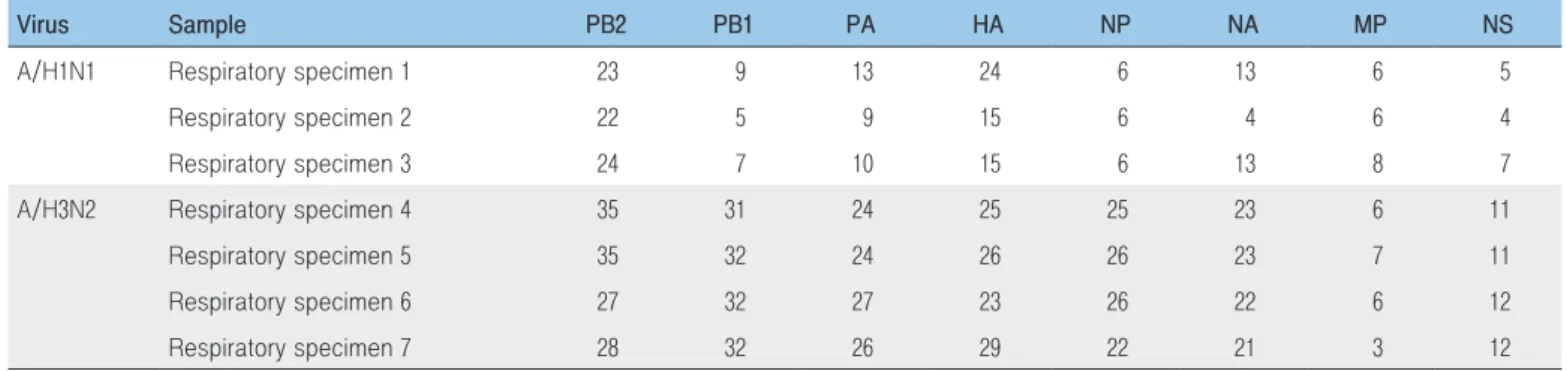
Table 4. Genomic variation between vaccine strains and viruses in respiratory specimens
Virus Sample PB2 PB1 PA HA NP NA MP NS
A/H1N1 Respiratory specimen 1 23 9 13 24 6 13 6 5
Respiratory specimen 2 22 5 9 15 6 4 6 4
Respiratory specimen 3 24 7 10 15 6 13 8 7
A/H3N2 Respiratory specimen 4 35 31 24 25 25 23 6 11
Respiratory specimen 5 35 32 24 26 26 23 7 11
Respiratory specimen 6 27 32 27 23 26 22 6 12
평균적으로 300만 리드를 생산하였으며, 생산된 데이터 중 90.1%의
데이터가 ≥ Q30(Q-score 30, base calling 정확도가 99.9%)으로
확인되었으며 각 시료 당 평균 40,000 적용 범위의 데이터가
생산되었다(Table 3).
전장 유전자 분석을 위한 바이러스의 최소 농도를 확인하기
위하여 국내 분리주(A/Korea/01/2009)에서 RNA를 추출한 후
2진 및 10진으로 희석하여 단계별로 Multi-segment RT-PCR법을
수행한 결과 10 pg/㎕의 RNA 농도까지 NGS 분석이 가능한 농도를
확인하였다(Figure 4).
Real-time RT-PCR을 이용한 A형 인플루엔자 진단법에서
NGS 분석이 가능한 최소 Ct(Threshold cycle) 값을 확인하기
위하여 국내 분리주(A/Korea/01/2009)에서 RNA를 추출한 후
Table 5. Interpretation of genomic variation of influenza A/H1N1
Query Mutation Structural interaction(s)
PB2 P453T Viral oligomerization interfaces, binding small ligand(s) PA T618K Binding other viral protein(s)
HA S91R Viral oligomerization interfaces, binding small ligand(s), antibody recognition sites K226N Viral oligomerization interfaces, antibody recognition sites
I312V Binding small ligand(s)
I341T Viral oligomerization interfaces, binding small ligand(s)
E373K Viral oligomerization interfaces, antibody recognition sites, binding small ligand(s) NA N28X Binding small ligand(s)
S70N Viral oligomerization interfaces, creates a new potential N-glycosylation site at position 70 I108L Viral oligomerization interfaces, binding small ligand(s)
I188T Viral oligomerization interfaces
L412Q Viral oligomerization interfaces, binding small ligand(s)
N449D Viral oligomerization interfaces, binding host protein(s), binding small ligand(s) MP S23N Viral oligomerization interfaces, binding small ligand(s)
I28T Viral oligomerization interfaces, binding small ligand(s) NS M65V Viral oligomerization interfaces
I111V Viral oligomerization interfaces
E153G Binding small ligand(s), viral oligomerization interfaces, binding host protein(s) I156K Binding small ligand(s), viral oligomerization interfaces
V157A Binding small ligand(s), viral oligomerization interfaces L163V Viral oligomerization interfaces
10진 희석하여 농도 별로 Real-time RT-PCR을 수행한 결과 대략
32 Ct 값에서 10 pg/㎕의 RNA 농도가 확인되었으므로 32 이하의
Ct 값을 갖는 호흡기 검체에서도 NGS를 이용한 분석이 가능할
것으로 판단되었다(Figure 5).
2017-2018절기 A/H1N1과 A/H3N2로 진단된 호흡기 검체
중 Ct 값 32 이하 검체로부터 NGS법으로 200만~300만
리드가 생산되었으며 전장 유전자를 확보하였다. 2017-2018절기
백신주 대비 변이 분석을 수행한 결과 유전자 별로 변이가
Table 6. Interpretation of genomic variation of influenza A/H3N2
Query Mutation Structural interaction(s) PB2 K340R Viral oligomerization interfaces
PA F105Y Binding small ligand(s), viral oligomerization interfaces K158R Viral oligomerization interfaces
E165D Viral oligomerization interfaces H713Q Binding other viral protein(s)
HA E78G Viral oligomerization interfaces, binding small ligand(s)
K108R Viral oligomerization interfaces, binding small ligand(s), antibody recognition sites
T151K Binding small ligand(s), antibody recognition sites, viral oligomerization interfaces, removes a potential N-glycosylation site at position 149
K176T Binding small ligand(s), antibody recognition sites, viral oligomerization interfaces, creates a new potential N-glycosylation site at position 174
P210L Host cell receptor binding, binding small ligand(s), antibody recognition sites, a T-cell epitope presented by MHC molecules
T219X Viral oligomerization interfaces, binding small ligand(s)
H327Q Viral oligomerization interfaces, binding small ligand(s), a T-cell epitope presented by MHC molecules, binding host protein(s)
E495G Binding small ligand(s), viral oligomerization interfaces, antibody recognition sites NA R60K Binding small ligand(s), viral oligomerization interfaces
P126L Viral oligomerization interfaces, binding small ligand(s) I212V Viral oligomerization interfaces
K220N Binding small ligand(s), viral oligomerization interfaces, antibody recognition sites
N329S Antibody recognition sites, binding small ligand(s), viral oligomerization interfaces, removes a potential N-glycosylation site at position 329
확인되었다(Table 4).
각 유전자 분절의 변이는
FluSurver(http://flusurver.bii.a-star.edu.sg/)를 이용하여 현재까지 밝혀진 변이에 의한 기능적
분석을 수행할 수 있다(Table 5, 6). 또한 NA의 유전자에 대하여
Quasispecies sequence 분석을 수행한 결과, H1N1과 H3N2의
호흡기 검체에서 생산된 NA 유전자에는 치료제 내성에 관여하는
H275Y 변이가 확인되지 않았다.
맺는 말
이 연구를 통하여 A형 인플루엔자 바이러스 유전자 말단에
universal 프라이머(U12, U13)를 이용한 Multi-segment
RT-PCR법으로 단일 PCR 반응에서 인플루엔자 바이러스의 8개 분절에
대한 전장 유전자 정보를 확보하였다. 뿐만 아니라 국내 분리주와
백신주에 대한 전장 염기서열을 생산함으로써, 차세대 염기서열
분석법을 활용할 경우, 기존의 Sanger sequencing 방식보다
간단하고 신속하게 전장 유전자 분석이 가능함을 확인하였다.
따라서 차세대 염기서열 분석법을 지속적으로 활용한다면 국내
인플루엔자 분리주의 유전적 특성을 분석하고 백신주와의 상동성을
분석할 수 있는 대량의 유전자 정보를 생산할 수 있을 것이다. 또한
신종인플루엔자 발생 시 유전적 특성을 신속하게 분석함으로써
효율적인 진단체계 구축 및 변이 분석을 통한 인체 위해도 평가에
활용할 수 있을 것이다.
이 원고는 질병관리본부 연구과제 (2014-NI43001-00)와 질병조사관리 및 실험실감시망운영 (4851-304) 지원으로 수행된 내용입니다.참고문헌
1. Influenza (Seasonal) Fact sheet N°211". www.who.int. March 2014. Archived from the original on 30 November 2014. Retrieved 25 November 2014.
2. Tong, Suxiang, et al. New world bats harbor diverse influenza A
viruses. PLoS pathogens. 2013;9(10);e1003657.
3. Steinhauer, David A. Role of hemagglutinin cleavage for the pathogenicity of influenza virus. Virology. 1999;258(1):1-20.
4. Nayak, Debi P., Eric Ka-Wai Hui, and Subrata Barman. Assembly and budding of influenza virus. Virus research. 2004:106(2):147-65. 5. Hurt, Aeron C., Hui-Ting Ho, and Ian Barr. Resistance to
anti-influenza drugs: adamantanes and neuraminidase inhibitors. Expert review of anti-infective therapy. 2006;4(5):795-805.
6. Hoffmann, E., et al. Universal primer set for the full-length amplification of all influenza A viruses. Archives of virology. 2001;146(12):2275-89.
7. Zhou, Bin, et al. Single-reaction genomic amplification accelerates sequencing and vaccine production for classical and Swine origin human influenza a viruses. Journal of virology. 2009;83(19):10309-13.
연구단신, Brief report
2018 평창동계올림픽·패럴림픽 검역 대비 대응
질병관리본부 감염병관리센터 검역지원과 황지혜, 손태종, 박기준*
*교신저자 : [email protected], 043-719-7140
Quarantine Preparedness & Responses to 2018 Pyeongchang Winter Olympics
and Paralympics Games
Hwang Ji-Hye, Son Tae-Jong, Park Gi-Jun
Division of Quarantine Support, Center for Control of Infectious Diseases, KCDC
For the 2018 Pyeongchang Winter Olympics and Paralympics Games in Korea from February 9 through March 18, we prepared possible quarantine countermeasures about 6 months prior to the competition in order to prevent the inflow of emerging infectious disease and to respond promptly to the suspected cases with infectious disease in collaboration with relevant institutions for training of quarantine officers, and on-site inspection of quarantine stations. During the two international events, the national quarantine stations performed quarantine inspection for a total of 5,503 passengers from 14 countries: 4,725 persons from ‘quarantinable disease risk areas’, 750 persons from the DPRK, 28 transit passengers from overseas. Among them, although 184 entrants with symptoms such as fever and diarrhea were detected, including 6 athletes for Olympics and Paralympics, there were no suspected cases of quarantinable diseases. To protect the public’s health from emerging infectious diseases, the Korea Centers for Disease Control is striving for establishing more efficient and advanced quarantine system to enable prompt quarantine response to international events at the point of entry to Korea.
Keywords: 2018 Pyeongchang Winter Olympics, Paralympics, Quarantine, Emerging infectious disease
들어가는 말
1988년 서울 하계올림픽 이후 30년 만에 겨울 종합 스포츠
대회인 동계올림픽 및 패럴림픽 대회가 올해 우리나라에서 개최됨에
따라 동계올림픽 92개국, 패럴림픽 50개국의 선수단 및 응원단 등
방지를 위한 감염병 관리가 필요할 것으로 예상되었다.
전 세계적으로 중동호흡기증후군(Middle East respiratory
syndrome, MERS), 조류인플루엔자 인체감염증(Avian Influenza virus
to human infection, AI) 등 신·변종 감염병이 지속적으로 출현하고
있으며 교통·통신의 발달과 세계화로 인해 해외감염병의 국내유입
우려가 높아짐에 따라 출입국 단계에서의 검역에 대한 관심과
중요성이 대두되고 있다. 이에 질병관리본부 검역지원과와 13개
국립검역소는 평창동계올림픽 및 패럴림픽 대회전부터 검역대응
계획을 수립하여 해외감염병 국내 유입을 조기에 차단하고, 감염병
의심환자 발생 시 신속한 대응을 통해 성공적인 대회 개최에
기여하고자 하였다. 이 논고를 통해 2018 평창동계올림픽 및
패럴림픽 검역대응 준비과정과 입국자 검역현황, 유증상자 조치 등의
검역 대응 결과를 공유함으로써 향후 국내에서 개최되는 다양한
국제행사의 검역관리
·대응에 활용하고자 한다.
몸 말
질병관리본부는 평창동계올림픽 및 패럴림픽 참가자 중
검역감염병 오염지역 입국자에 대한 검역을 강화하고자 대회 전부터
검역대응 계획을 수립하고, 해외유입 감염병 관리를 위한 검역관
대상의 교육
·훈련, 감염병 예방 주의 안내 홍보 및 유관기관
협조체계 구축 등을 통해 검역대응을 준비하였다. 국립검역소는
평창동계올림픽
·패럴림픽 기간 중 선수단 등 관계자 5,503명에 대한
검역을 실시하였다. 그 중 발열, 설사 등 단순 유증상자가 184명이
있었으나 감염병 의심환자로 분류되지 않아 특이사항 없이 입국자
검역을 성공적으로 완료하였다.
Table 1. Quarantine responses for the 2018 Pyeongchang Winter Olympics and Paralympics
Period Action items Cooperation institutions
Six months before the Olympics
- Establish action plans for quarantine response - Request entry information of entrants
- National Quarantine Stations - Olympics Organizing Committee Three months before the
Olympics
- Develop of Information on quarantine for entrants - Notify any changes to quarantinable diseases risk areas
- Olympics Organizing Committee
One month before the Olympics
- Development of a Quarantine Response Manual
- Establish action plans for quarantine response for DPRK entrants - Conduct training for quarantine response
- Conduct site inspections at the National Quarantine Stations - Production and distribution of banners and other informative
materials
- Establish a coordination system with related organizations (CIQ, etc.)
- National Quarantine Stations - Immigration Office, Customs of major
airports, Public health centers, etc.
Two weeks before the Olympics / During the Olympics and Paralympics
- Establish quarantine plans for transfer passengers - Consult with related organizations to implement quarantine
measures for transit passengers
- Conduct on-site training for suspected Emerging infectious disease patients
- Strengthen quarantine capacity for athletes and Olympic staff and keep the public updated
- Ready teams(the National Quarantine Station officers) on stand-by to perform emergency work when needed
- Conduct daily quarantine reports
- Conduct monitoring of symptomatic athletes during quarantine process
- Incheon International Airport Corporation - Korean Air
- National Quarantine stations - Donghae National Quarantine station - Olympics Organizing Committee
1) 대회 전 검역대응 준비
(가) 대회 6개월 전 : 검역계획 수립 및 조직위원회와
협조체계 구축
질병관리본부는 평창동계올림픽 및 패럴림픽 참가국 선수단 등
입국자 검역을 위해 2017년 7월부터 검역대응 계획을 수립하였다.
또한, 평창동계올림픽 및 패럴림픽 선수단 등 관계자 중 검역단계
의심환자 발생 시 검역, 역학조사, 정보공유, 이송 등 신속하고
원활한 검역업무 수행을 위해 세관, 출입국사무소, 조직위원회
등 유관기관과의 지속적인 업무협의를 실시하여 협조체계를
구축하였다. 그 중 검역강화를 위한 검역감염병 오염지역 선수단
등 관계자의 개별 입국정보 사전 제공, 검역단계 유증상자 발생 시
신속한 정보공유 및 입국 후 건강상태 모니터링 등을 위해 대회
6개월 이전부터 조직위원회와 협조체계를 구축하여 감염병 확산
예방을 위해 노력하였다.
(나) 대회 3개월 전 : 국내 검역절차 안내문 개발, 검역
감염병 오염지역 안내
각국 체육회에 배포하는 「PyeongChang 2018 Olympic Games
Health Care Guide」에 국내 검역절차 안내문을 게재하여 검역감염병
오염지역 선수단 등 관계자와 모든 입국자에게 입국 전 우리나라
검역 절차를 인지할 수 있도록 하였다(Figure 1). 또한, 2018년 1월
1일에 검역감염병 오염지역이 변경(62개국→59개국)됨에 따라
조직위원회에 변경사항을 안내하였다.
(다) 대회 1개월 전 : 매뉴얼 개발, 교육·훈련 실시,
검역소 시설·장비 점검, 홍보 실시
검 역 관 이 효 율 적 인 검 역 업 무 를 수 행 할 수 있 도 록
평창동계올림픽·패럴림픽 입국자 검역 절차를 수록한 「2018
평창동계올림픽·패럴림픽 감염병 검역대응 세부 매뉴얼」을
개발하였다. 아울러 검역소별 매뉴얼 자체 교육, 생물테러 대응
훈련 등을 통해 올림픽 대비 검역관들의 대응역량을 강화하였다.
평창동계올림픽 및 패럴림픽 관련 입국자들이 주로 이용 예정인
공항의 검역 관련 장비와 진단 실험실, 격리시설(실) 등의 장비
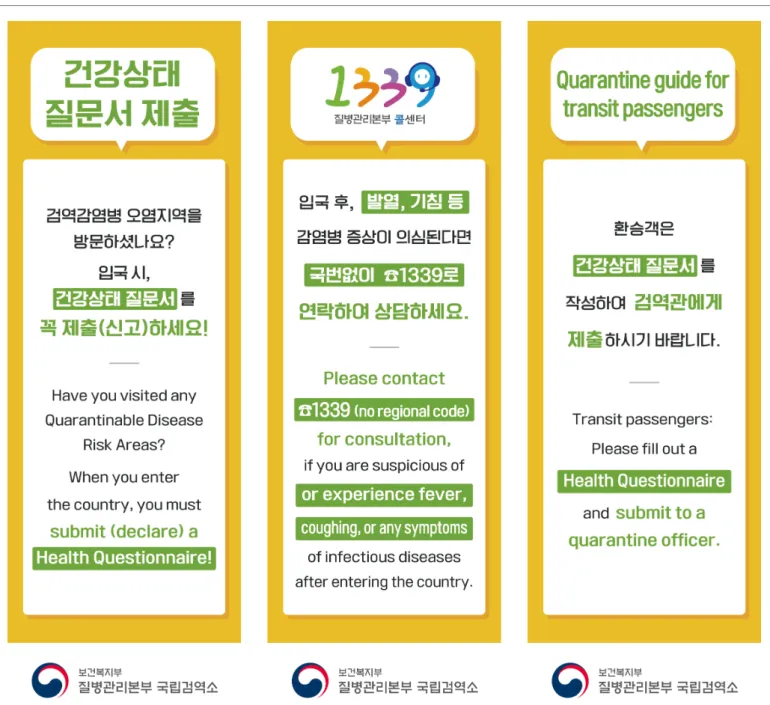
및 시설을 점검하였으며, 건강상태질문서 제출 안내 및 감염병
증상시 신고 안내 등의 배너를 제작
·설치하고 입국자들에게 감염병
예방
·주의·신고 관련 홍보를 지속 실시하였다. 또한, 북한에서
선수단이 대회에 참가하고 예술단 및 응원단의 파견에 대한 논의가
있음에 따라 북한으로부터의 국내 입경자에 대한 입경경로별
검역계획을 마련하였으며, 주요 입경예정 경로인 도라산 및 고성
남북출입사무소의 발열감시카메라 등의 검역 장비, 격리실, 감염병
예방주의 안내 홍보물품 등을 점검하였다.
(라) 대회 2주 전~대회 기간 중 : 감염병 대응 현장훈련
실시, 입국자 검역실시
질병관리본부는 인천공항의 구조상 입국자 중 환승객 일부가
인천공항 입국장에서 검역조치를 받지 않고 환승통로를 이용하여
국내 도착지(양양공항)까지 이동할 수 있는 검역 사각지대(4곳)를
확인하였다. 이에 인천국제공항공사 및 올림픽 기간 동안 국내
환 승기(인천→양양)를 운영하 는 (주)대한항공과 지속적으 로
업무협의를 실시하여 인천공항 환승기 게이트 내 발열감시카메라를
In relation to the PyeongChang 2018 Olympic and Paralympic Winter Games
Information on Quarantine for Entrants
The National Quarantine Station of Korea Centers for Disease Control & Prevention is conducting quarantine activities on all entrants into the country in order to block the importation of infectious diseases from overseas. First, to ensure swift quarantine processing for entrants, each country must submit a list of athletes participating in the PyeongChang 2018 Olympic and Paralympic Winter Games in advance through the Olympic Organizing Committee. All entrants to the Republic of Korea shall be checked for fever using thermal cameras and, in particular, for those from countries where MERS is widespread, an individual body temperature assessment will be measured. In addition, entrants from countries where the six infectious diseases (cholera, yellow fever, plague, MERS, AI, polio) designated as infectious diseases subject to quarantine in Korea must accurately fill out a Health Questionnaire and submit it to quarantine officers upon entry. Entrants who are experiencing such symptoms as fever and coughing at the time of quarantine may be transported to a designated hospital during the quarantine inspection and receive treatment in isolation. Your patience with this inconvenience and cooperation with the quarantine procedures of the Republic of Korea is requested.
* For a list of countries with infectious diseases subject to quarantine and details of the Health Questionnaire, please refer to the Attachments.
수거 등을 통해 효율적인 검역 관리를 할 수 있도록 조치하였다.
또한, 올림픽 개막식 2주 전에는 올림픽 개최 도시 강원도 내
국제공항인 양양공항에서 AI인체감염증 의심환자의 입국 상황을
대비한 현장훈련을 실시함으로써 검역관리, 절차를 점검하여
선제적으로 검역대응을 준비하였다(Figure 3).
올림픽 개최 전인 2018년 1월 21일부터 검역감염병 오염지역
선수단 등 관계자들의 입국자 검역 및 강화하였으며, 조직위원회와
상시 협조체계를 운영하여 선수단 중 유증상자 발생 시 입국 후
건강상태 모니터링을 실시하였다. 또한, 감염병 의심환자 발생
등의 비상시를 대비하여 ‘평창올림픽 및 패럴림픽 감염병 대책본부
검역팀(검역지원과)’과 국립검역소는 2018년 2월 1일부터 비상근무
및 검역 일일상황 보고를 실시하였다.
2) 입국자 검역조치
(가) 검역감염병 오염지역 입국자
국제올림픽위원회(International Olympic Committee, IOC)는
선수단 개인정보 노출 등의 우려로 선수단 개별 입국정보 제공을
승인하지 않아 조직위원회로부터 선수단의 일부 입국정보(소속,
도착시간, 편명)만 제공받았다. 그러므로, 중국 등 입국자가 많은
직항노선의 경우 선수단이 탑승한 항공기의 탑승객 전수 게이트
검역을 실시하였으며, 제3국을 경유하여 입국한 검역감염병
오염지역 선수단 등 관계자 는 검역정보 시스템을 활용하여
타깃(target)검역
1)을 실시하였다.
(나) 북한 선수단 등 관계자
북한은 현재 검역감염병 비오염지역 이지만, 이번 올림픽기간
에는 검역조치를 강화하여 선박(만경봉 92호)의 경우 검역관이 직접
선박에 승선하여 승객
·승무원(210명) 발열감시 및 식품 보관상태,
감염병매개체 서식 유무와 번식 상태조사 등 선박 보건위생관리를
실시하였다.
(다) 국내 환승객
이번 대회기간 동안 해외에서 입국한 외국인 환승객 중
인천공항에서 양양 공항으 로 가 는 국내 환 승객을 대상으 로
인천공항 환승기 게이트에서 발열감시를 실시하였다. 또한, 오염지역
입국자 여부와 상관없이 기내에서 모든 환승객을 대상으로
건강상태질문서를 배포하고 작성안내 후 승무원이 일괄 수거하여
검역관에게 제출하도록 하였으며, 양양공항 검역심사대에서 환승객
발열감시를 추가로 실시하였다.
3) 검역조치 결과
평창동계올림픽 참가 92개국 6,500여명과 패럴림픽 참가
50개국 1,500여 명 중 검역감염병 오염지역은 올림픽 참가국 중
13개국, 패럴림픽 참가국 중 3개국이었다. 2018년 1월 21일부터
1) 감염병 유행국가(오염지역 포함) 입국자 명단을 검역정보시스템으로 사전에 파악하여 항공기가 도착하는 주기장게이트에서 해당 입국자 대상 발열감시 및 개별 체온측정, 건강상3월 18일까지 57일 동안 조직위원회에서 사전 입국 정보를 제공한
검역감염병 오염지역 선수단 및 북한 선수단 등 관계자, 그리고 국내
환승객(외국인)을 포함하여 총 5,503명에 대한 검역을 실시하였다.
5,503명 중 검역감염병 오염지역 검역 인원은 4,725명이며
건강상태질문서 징구율
2)은 99.5%이었다. 북한과 관련된 검역
인원은 총 750명이며 이 중 선수단, 예술단, 응원단 등 북한
관계자가 630명이었고, 남한 관계자는 120명이었다. 남한 관계자의
경우 북한 선수단 등 관계자 출경 시 차량지원 등으로 인해 검역을
받은 사례이다. 그리고 인천공항에서 양양공항으로 국내 환승기를
이용한 환승객 28명에 대해서도 검역을 완료하였다(Table 2).
올림픽 및 패럴림픽 관련 검역인원 5,503명 중 발열, 설사 등
유증상자로 확인된 입국자는 총 184명(3.3%)이며, 그 중 선수단
등 관계자가 6명(3.3%), 중국 등 직항노선 탑승객(일반승객)이
178명(96.7%)이었다. 선수단 6명은 보건교육 및 선수촌 내
폴리클리닉 진료 안내 후 질병관리본부 긴급상황실을 통해
조직위원회로 해당 유증상자의 인적사항, 증상 등을 통보하였다.
유증상자의 국내 입국 후에는 질병관리본부와 조직위원회의 상황
정보 공유 등의 유기적 협조를 통하여 해당자에 대한 건강상태를
모니터링 하였으며 선수단 등 관계자 6명 모두 증상이 소실되어
건강상태가 양호한 것으로 확인하였다(Table 3).
맺는 말
질병관리본부는 평창동계올림픽 및 패럴림픽 대회 6개월
이전부터 입국자 검역 계획을 사전에 수립하고 유관기관과
협력체계를 구축하는 등 철저한 대응 준비와 입국자 검역강화
조치를 통해 검역 단계에서 해외감염병 환자가 단 한명도 발생하지
않음으로써 성공적인 대회가 이루어 질수 있도록 기여하였다.
향후 질병관리본부는 국제행사 개최 시 지금보다 체계적인 입국자
검역관리를 수행하기 위해 「국제행사 검역관리 매뉴얼」을 마련하여
행사(대회) 전부터 유관기관과 정보 공유 및 협조체계를 더욱더
Table 2. Entry quarantine status during the 2018 Pyeongchang Winter Olympics and Paralympics, Jan. 21-Mar. 18
Unit: person, (%)
Total
No. of quarantine targets for the Olympics No. of quarantine targets for the Paralympics Subtotal
Quarantinable disease risk
areas
DPRK passengersTransit Subtotal
Quarantinable disease risk
areas
DPRK passengersTransit
5,503 (100.0%)4,690 (84.0%)3,940 (15.4%)722 (0.6%)28 (100.0%)813 (96.6%)785 (3.4%)28 (0.0%)0
※ DPRK: Democratic People’s Republic of Korea
Table 3. Status of people with symptoms during the entry into the 2018 Pyeongchang Winter Olympics and Paralympics,
Jan. 21-Mar. 18
Unit: person, (%)
Total (No. of athletes)
No. of people with symptoms for the Olympics No. of people with symptoms for the Paralympics Subtotal (No. of athletes) Quarantinable disease risk areas (No. of athletes) DPRK (No. of athletes) Transit passengers (No. of athletes) Subtotal (No. of athletes) Quarantinable disease risk areas (No. of athletes) DPRK (No. of athletes) Transit passengers (No. of athletes) 184 (6) 171 (5) 171 (5) 0 (0) 0 (0) 13 (1) 13 (1) 0 (0) 0 (0)
※ DPRK: Democratic People’s Republic of Korea
강화할 수 있도록 할 것이다. 또한, 참가국 입국자 대상으로는 국내
검역 절차를 사전에 인지할 수 있도록 하고, 유증상자 발생 시
주최기관과 협력하여 신속한 대응 및 건강상태 모니터링 수행으로
해외유입 감염병의 확산을 조기에 차단하는 등 선제적인 검역관리
조치를 수행할 것이다. 앞으로도 질병관리본부와 13개 국립검역소는
효율적이고 선진화된 검역체계를 구 축·운영함으 로서 해외
감염병으로부터 국민의 건강과 생명을 지켜내고자 최선을 다할
것이다.
참고문헌
1. 질병관리본부. 2018 검역업무 지침. 2018. 2. 질병관리본부. 2018 평창올림픽·패럴림픽 감염병 검역대응 세부 매뉴얼. 2018. 3. 질병관리본부. 평창올림픽 감염병 대응 종합계획. 2018. 4. 질병관리본부. 해외감염병 검역대응 표준매뉴얼. 2018.Classification of disease‡ Current
week Cum.2018
5-year weekly average
Total no. of cases by year Imported cases of current week : Country (no. of cases) 2017 2016 2015 2014 2013 Category Ⅰ Cholera 0 0 0 5 4 0 0 3 Typhoid fever 12 119 3 128 121 121 251 156 Paratyphoid fever 3 14 1 73 56 44 37 54 Shigellosis 2 105 1 111 113 88 110 294
EHEC 7 24 1 138 104 71 111 61 Vietnam(1), China(1) Viral hepatitis A 58 956 80 4,419 4,679 1,804 1,307 867 Category Ⅱ Pertussis 3 137 2 318 129 205 88 36 Tetanus 0 4 0 34 24 22 23 22 Measles 8 20 4 7 18 7 442 107 Mumps 511 4,330 377 16,924 17,057 23,448 25,286 17,024 Rubella 1 21 0 8 11 11 11 18
Viral hepatitis B (Acute) 7 116 5 391 359 155 173 117 Japanese encephalitis 0 0 0 9 28 40 26 14 Varicella 1,521 18,101 845 80,092 54,060 46,330 44,450 37,361 Streptococcus pneumoniae 18 278 9 523 441 228 36 - Philippines(1) Category Ⅲ Malaria 4 28 4 515 673 699 638 445 Scarlet fever§ 478 6,271 244 22,838 11,911 7,002 5,809 3,678 Meningococcal meningitis 1 7 0 17 6 6 5 6 Legionellosis 11 88 1 198 128 45 30 21 Vibrio vulnificus sepsis 0 0 0 46 56 37 61 56
Murine typhus 1 2 0 18 18 15 9 19 Swaziland(1) Scrub typhus 39 292 10 10,528 11,105 9,513 8,130 10,365 Leptospirosis 4 10 0 103 117 104 58 50 Brucellosis 11 33 0 6 4 5 8 16 Rabies 0 0 0 0 0 0 0 0 HFRS 8 57 3 531 575 384 344 527 Syphilis 39 694 23 2,148 1,569 1,006 1,015 799 CJD/vCJD 6 37 1 36 42 33 65 34 Tuberculosis 626 8,441 681 28,161 30,892 32,181 34,869 36,089 HIV/AIDS 16 261 18 1,005 1,062 1,018 1,081 1,013 Viral hepatitis C 221 3,370 - 6,396 - - - -VRSA 0 0 - 0 - - - -CRE 212 2,922 - 5,714 - - - -Category Ⅳ
Dengue fever 8 49 3 171 313 255 165 252 Vietnam(2), Philippines(2), Malaysia(1), Myanmar(1), Indonesia(1), Thailand(1) Q fever 23 139 1 96 81 27 8 11
West Nile fever 0 0 0 0 0 0 0 0 Lyme Borreliosis 9 26 0 31 27 9 13 11
Melioidosis 0 0 0 2 4 4 2 2
Chikungunya fever 2 5 0 5 10 2 1 2 Malaysia(1), Philippines(1)
SFTS 2 2 0 272 165 79 55 36
MERS 0 0 - 0 0 185 -
-Zika virus infection 0 0 - 11 16 - -
-1.1 환자감시 : 전수감시 감염병 주간 발생 현황
(15th Week)
Table 1. Reported cases of national infectious diseases in Republic of Korea, week ending April 14, 2018 (15th Week)*
Unit: No. of cases†
Abbreviation: EHEC= Enterohemorrhagic Escherichia coli, HFRS= Hemorrhagic fever with renal syndrome, CJD/vCJD= Creutzfeldt-Jacob Disease / variant Creutzfeldt-Jacob Disease, VRSA= Vancomycin-resistant Staphylococcus aureus, CRE= Carbapenem-resistant Enterobacteriaceae, SFTS= Severe fever with thrombocytopenia syndrome, MERS-CoV= Middle East Respiratory Syndrome Coronavirus.
Cum: Cumulative counts from 1st week to current week in a year.
* The reported data for year 2017, 2018 are provisional but the data from 2013 to 2016 are finalized data.
주요 감염병 통계, Statistics of selected infectious diseases
Reporting area
Diseases of Category Ⅰ
Cholera Typhoid fever Paratyphoid fever Shigellosis Current week Cum.2018 Cum. 5-year average§ Current week Cum.2018 Cum. 5-year average§ Current week Cum.2018 Cum. 5-year average§ Current week Cum.2018 Cum. 5-year average§ Overall 0 0 0 12 119 42 3 14 11 2 105 30 Seoul 0 0 0 3 26 7 1 5 3 0 22 5 Busan 0 0 0 3 12 2 0 1 1 0 7 2 Daegu 0 0 0 0 3 1 0 0 0 0 15 1 Incheon 0 0 0 0 10 3 0 0 2 0 8 6 Gwangju 0 0 0 2 3 2 1 1 0 0 3 0 Daejeon 0 0 0 0 5 2 0 0 0 0 2 0 Ulsan 0 0 0 0 5 0 0 0 0 0 0 0 Sejong 0 0 0 0 2 0 0 0 0 0 2 0 Gyonggi 0 0 0 1 20 9 0 3 2 0 13 7 Gangwon 0 0 0 0 9 0 0 0 0 0 3 0 Chungbuk 0 0 0 0 6 1 0 1 1 0 1 1 Chungnam 0 0 0 2 4 3 0 0 0 0 5 1 Jeonbuk 0 0 0 0 0 1 0 0 1 0 1 1 Jeonnam 0 0 0 1 2 2 0 2 0 2 4 3 Gyeongbuk 0 0 0 0 4 1 0 0 1 0 17 1 Gyeongnam 0 0 0 0 8 8 1 1 0 0 2 1 Jeju 0 0 0 0 0 0 0 0 0 0 0 1
Cum: Cumulative counts from 1st week to current week in a year
* The reported data for year 2017, 2018 are provisional but the data from 2013 to 2016 are finalized data.
† According to surveillance data, the reported cases may include all of the cases such as confirmed, suspected, and asymptomatic carrier in the group. § Cum. 5-year average is mean value calculated by cumulative counts from 1st week to current week for 5 preceding years.
Table 2. (Continued) Reported cases of infectious diseases by geography, weeks ending April 14, 2018 (15th Week)*
Unit: No. of cases†
Reporting area
Diseases of Category Ⅰ Diseases of Category Ⅱ Enterohemorrhagic
Escherichia coli Viral hepatitis A Pertussis Tetanus Current week Cum.2018 Cum. 5-year average§ Current week Cum.2018 Cum. 5-year average§ Current week Cum.2018 Cum. 5-year average§ Current week Cum.2018 Cum. 5-year average§ Overall 7 24 7 58 956 826 3 137 26 0 4 3 Seoul 0 3 2 17 202 152 0 30 7 0 0 0 Busan 0 0 0 3 22 41 0 6 1 0 0 1 Daegu 0 3 1 4 32 18 0 3 0 0 1 0 Incheon 1 2 0 0 68 71 0 20 1 0 0 0 Gwangju 1 3 2 0 15 23 1 7 2 0 0 0 Daejeon 1 1 0 2 35 36 0 2 0 0 0 0 Ulsan 1 1 0 0 10 8 0 0 1 0 0 0 Sejong 0 0 0 3 9 5 0 8 0 0 0 0 Gyonggi 1 4 2 17 291 241 0 21 5 0 0 1 Gangwon 1 2 0 0 19 18 0 0 0 0 0 0 Chungbuk 0 0 0 4 34 25 0 4 0 0 0 0 Chungnam 0 1 0 3 90 52 0 3 1 0 0 0 Jeonbuk 0 0 0 0 57 40 0 5 1 0 0 0 Jeonnam 0 1 0 0 15 40 0 7 1 0 2 1 Gyeongbuk 1 1 0 3 29 18 1 7 3 0 0 0 Gyeongnam 0 1 0 2 26 31 0 13 2 0 1 0 Jeju 0 1 0 0 2 7 1 1 1 0 0 0
Cum: Cumulative counts from 1st week to current week in a year
* The reported data for year 2017, 2018 are provisional but the data from 2013 to 2016 are finalized data.
† According to surveillance data, the reported cases may include all of the cases such as confirmed, suspected, and asymptomatic carrier in the group. § Cum. 5-year average is mean value calculated by cumulative counts from 1st week to current week for 5 preceding years.
Reporting area
Measles Mumps Rubella Viral hepatitis B(Acute) Current week Cum.2018 Cum. 5-year average§ Current week Cum.2018 Cum. 5-year average§ Current week Cum.2018 Cum. 5-year average§ Current week Cum.2018 Cum. 5-year average§ Overall 8 20 24 511 4,330 4,088 1 21 3 7 116 61 Seoul 1 2 2 69 526 386 0 1 1 0 19 9 Busan 1 2 0 34 274 299 0 4 0 1 8 5 Daegu 1 1 0 11 170 127 0 1 0 0 5 1 Incheon 0 1 1 23 217 166 0 0 0 1 6 5 Gwangju 0 0 0 12 127 317 0 0 0 0 2 1 Daejeon 0 1 3 12 139 171 0 1 0 0 5 2 Ulsan 0 0 0 19 175 130 0 0 0 0 2 2 Sejong 0 0 0 5 27 12 0 0 0 0 0 0 Gyonggi 1 5 10 142 1,179 876 0 7 2 3 34 16 Gangwon 1 2 0 16 147 152 0 2 0 2 5 2 Chungbuk 1 1 1 13 113 74 0 0 0 0 2 2 Chungnam 1 3 1 22 190 150 0 0 0 0 4 2 Jeonbuk 0 0 0 26 164 399 0 0 0 0 3 5 Jeonnam 0 0 5 24 153 237 0 2 0 0 3 3 Gyeongbuk 1 1 1 29 223 156 0 1 0 0 6 3 Gyeongnam 0 1 0 48 437 377 0 1 0 0 12 3 Jeju 0 0 0 6 69 59 1 1 0 0 0 0
Cum: Cumulative counts from 1st week to current week in a year
* The reported data for year 2017, 2018 are provisional but the data from 2013 to 2016 are finalized data.
† According to surveillance data, the reported cases may include all of the cases such as confirmed, suspected, and asymptomatic carrier in the group. § Cum. 5-year average is mean value calculated by cumulative counts from 1st week to current week for 5 preceding years.
Table 2. (Continued) Reported cases of infectious diseases by geography, week ending April 14, 2018 (15th Week)*
Unit: No. of cases†
Reporting area
Diseases of Category Ⅱ Diseases of Category Ⅲ
Japanese encephalitis Varicella Malaria Scarlet fever¶
Current week Cum.2018 Cum. 5-year average§ Current week Cum.2018 Cum. 5-year average§ Current week Cum.2018 Cum. 5-year average§ Current week Cum.2018 Cum. 5-year average§ Overall 0 0 0 1,521 18,101 12,668 4 28 24 478 6,271 2,637 Seoul 0 0 0 172 2,310 1,267 1 5 6 84 1,013 285 Busan 0 0 0 122 942 909 0 0 1 45 596 196 Daegu 0 0 0 68 953 723 0 0 0 15 184 106 Incheon 0 0 0 58 983 730 1 5 2 27 316 112 Gwangju 0 0 0 42 709 343 0 2 0 23 234 131 Daejeon 0 0 0 40 540 344 0 0 0 12 206 85 Ulsan 0 0 0 47 717 432 0 0 1 37 359 107 Sejong 0 0 0 40 173 67 0 0 0 2 32 8 Gyonggi 0 0 0 417 4,887 3,539 2 12 10 114 1,546 782 Gangwon 0 0 0 42 491 504 0 1 1 5 97 28 Chungbuk 0 0 0 59 592 237 0 1 1 5 137 45 Chungnam 0 0 0 32 738 541 0 0 1 24 224 132 Jeonbuk 0 0 0 97 681 569 0 1 1 22 284 93 Jeonnam 0 0 0 46 678 571 0 0 0 10 269 100 Gyeongbuk 0 0 0 68 794 577 0 0 0 24 275 168 Gyeongnam 0 0 0 115 1,171 992 0 0 0 28 438 224 Jeju 0 0 0 56 742 323 0 1 0 1 61 35
Cum: Cumulative counts from 1st week to current week in a year
* The reported data for year 2017, 2018 are provisional but the data from 2013 to 2016 are finalized data.
† According to surveillance data, the reported cases may include all of the cases such as confirmed, suspected, and asymptomatic carrier in the group. § Cum. 5-year average is mean value calculated by cumulative counts from 1st week to current week for 5 preceding years.
Reporting area
Diseases of Category Ⅲ
Meningococcal meningitis Legionellosis Vibrio vulnificus sepsis Murine typhus Current week Cum.2018 Cum. 5-year average§ Current week Cum.2018 Cum. 5-year average§ Current week Cum.2018 Cum. 5-year average§ Current week Cum.2018 Cum. 5-year average§ Overall 1 7 2 11 88 19 0 0 0 1 2 2 Seoul 0 0 1 5 25 7 0 0 0 0 0 1 Busan 0 0 0 3 10 1 0 0 0 0 0 0 Daegu 0 0 0 0 4 1 0 0 0 0 0 0 Incheon 0 2 0 1 4 2 0 0 0 0 0 0 Gwangju 0 0 0 0 0 0 0 0 0 0 0 0 Daejeon 0 0 0 0 2 0 0 0 0 0 0 0 Ulsan 0 0 0 0 2 1 0 0 0 0 0 0 Sejong 0 0 0 0 0 0 0 0 0 0 0 0 Gyonggi 1 1 1 1 18 3 0 0 0 1 1 1 Gangwon 0 0 0 0 1 1 0 0 0 0 0 0 Chungbuk 0 0 0 0 2 0 0 0 0 0 0 0 Chungnam 0 1 0 1 1 1 0 0 0 0 0 0 Jeonbuk 0 0 0 0 2 1 0 0 0 0 0 0 Jeonnam 0 0 0 0 1 0 0 0 0 0 0 0 Gyeongbuk 0 0 0 0 14 1 0 0 0 0 0 0 Gyeongnam 0 3 0 0 2 0 0 0 0 0 1 0 Jeju 0 0 0 0 0 0 0 0 0 0 0 0
Cum: Cumulative counts from 1st week to current week in a year
* The reported data for year 2017, 2018 are provisional but the data from 2013 to 2016 are finalized data.
† According to surveillance data, the reported cases may include all of the cases such as confirmed, suspected, and asymptomatic carrier in the group. § Cum. 5-year average is mean value calculated by cumulative counts from 1st week to current week for 5 preceding years.
Table 2. (Continued) Reported cases of infectious diseases by geography, week ending April 14, 2018 (15th Week)*
Unit: No. of cases†
Reporting area
Diseases of Category Ⅲ
Scrub typhus Leptospirosis Brucellosis with renal syndromeHemorrhagic fever Current week Cum.2018 Cum. 5-year average§ Current week Cum.2018 Cum. 5-year average§ Current week Cum.2018 Cum. 5-year average§ Current week Cum.2018 Cum. 5-year average§ Overall 39 292 126 4 10 5 11 33 0 8 57 60 Seoul 4 21 6 0 1 0 1 5 0 0 6 3 Busan 2 7 8 0 0 1 1 3 0 0 0 1 Daegu 2 4 1 0 0 0 1 4 0 0 0 0 Incheon 1 7 3 0 1 0 0 0 0 0 1 1 Gwangju 2 6 2 0 0 0 0 0 0 0 0 1 Daejeon 0 3 4 0 0 0 0 1 0 0 1 1 Ulsan 0 8 4 0 1 0 2 2 0 0 0 1 Sejong 0 0 1 0 0 0 0 0 0 0 0 0 Gyonggi 2 25 14 2 3 1 0 3 0 2 11 22 Gangwon 0 2 5 0 0 0 1 1 0 1 3 6 Chungbuk 0 9 1 0 0 0 2 3 0 0 6 3 Chungnam 6 29 8 0 0 0 0 3 0 1 5 4 Jeonbuk 0 20 9 0 1 1 0 2 0 0 4 4 Jeonnam 10 71 25 1 1 1 0 2 0 2 7 4 Gyeongbuk 7 22 9 1 2 0 2 3 0 2 9 6 Gyeongnam 3 52 23 0 0 1 1 1 0 0 4 2 Jeju 0 6 3 0 0 0 0 0 0 0 0 1
Cum: Cumulative counts from 1st week to current week in a year
* The reported data for year 2017, 2018 are provisional but the data from 2013 to 2016 are finalized data.
† According to surveillance data, the reported cases may include all of the cases such as confirmed, suspected, and asymptomatic carrier in the group. § Cum. 5-year average is mean value calculated by cumulative counts from 1st week to current week for 5 preceding years.
Reporting area
Diseases of Category Ⅲ Diseases of Category Ⅳ
Syphilis CJD/vCJD Tuberculosis Dengue fever
Current week Cum.2018 Cum. 5-year average§ Current week Cum.2018 Cum. 5-year average§ Current week Cum.2018 Cum. 5-year average§ Current week Cum.2018 Cum. 5-year average§ Overall 39 694 312 6 37 13 626 8,441 9,251 8 49 51 Seoul 6 158 67 2 9 3 101 1,446 1,820 3 16 17 Busan 2 46 15 0 1 0 49 575 684 1 7 2 Daegu 4 33 14 1 3 1 35 372 460 0 1 3 Incheon 5 54 28 0 0 1 30 433 489 1 4 2 Gwangju 2 27 10 0 0 1 22 211 241 0 1 0 Daejeon 2 20 7 0 0 0 10 191 224 0 0 2 Ulsan 1 8 3 0 0 0 8 177 185 0 0 1 Sejong 0 1 2 0 0 0 6 41 24 0 0 0 Gyonggi 11 198 83 2 11 3 137 1,846 1,907 2 12 14 Gangwon 0 12 11 0 1 0 34 382 385 0 1 1 Chungbuk 0 17 6 0 0 1 18 275 277 1 2 0 Chungnam 1 30 12 0 1 1 38 442 397 0 0 2 Jeonbuk 0 9 8 0 2 0 19 313 357 0 1 1 Jeonnam 1 12 9 0 1 1 32 452 448 0 2 1 Gyeongbuk 2 28 12 0 4 1 41 612 649 0 1 2 Gyeongnam 2 20 15 1 4 0 36 546 600 0 0 3 Jeju 0 21 10 0 0 0 10 127 105 0 1 0
Cum: Cumulative counts from 1st week to current week in a year
* The reported data for year 2017, 2018 are provisional but the data from 2013 to 2016 are finalized data.
† According to surveillance data, the reported cases may include all of the cases such as confirmed, suspected, and asymptomatic carrier in the group. § Cum. 5-year average is mean value calculated by cumulative counts from 1st week to current week for 5 preceding years.
Table 2. (Continued) Reported cases of infectious diseases by geography, week ending April 14, 2018 (15th Week)*
Unit: No. of cases†
Reporting area
Diseases of Category Ⅳ
Q fever Lyme Borreliosis SFTS Zika virus infection Current week Cum.2018 Cum. 5-year average§ Current week Cum.2018 Cum. 5-year average§ Current week Cum.2018 Cum. 3-year average§ Current week Cum.2018 Cum. 3-year average§ Overall 23 139 7 9 26 1 2 2 0 0 0 -Seoul 2 33 1 3 10 1 0 0 0 0 0 -Busan 2 7 0 0 0 0 0 0 0 0 0 -Daegu 1 6 0 0 0 0 0 0 0 0 0 -Incheon 0 1 0 1 1 0 0 0 0 0 0 -Gwangju 0 4 0 0 0 0 0 0 0 0 0 -Daejeon 0 4 0 0 0 0 0 0 0 0 0 -Ulsan 2 7 0 0 2 0 0 0 0 0 0 -Sejong 0 5 0 0 0 0 0 0 0 0 0 -Gyonggi 3 29 1 1 4 0 0 0 0 0 0 -Gangwon 0 1 0 0 0 0 0 0 0 0 0 -Chungbuk 3 12 2 0 1 0 0 0 0 0 0 -Chungnam 5 10 1 2 5 0 0 0 0 0 0 -Jeonbuk 1 1 0 0 0 0 0 0 0 0 0 -Jeonnam 0 1 0 0 0 0 0 0 0 0 0 -Gyeongbuk 3 7 1 0 0 0 0 0 0 0 0 -Gyeongnam 1 11 1 2 2 0 0 0 0 0 0 -Jeju 0 0 0 0 1 0 2 2 0 0 0
-Cum: Cumulative counts from 1st week to current week in a year
* The reported data for year 2017, 2018 are provisional but the data from 2013 to 2016 are finalized data.
† According to surveillance data, the reported cases may include all of the cases such as confirmed, suspected, and asymptomatic carrier in the group. § Cum. 5-year average is mean value calculated by cumulative counts from 1st week to current week for 5 preceding years.
●
2018년도 제15주 인플루엔자 표본감시(전국 200개 표본감시기관) 결과, 의사환자분율은 외래환자 1,000명당 6.8명으로 지난주(6.2명)대비 증가
※ 2017-2018절기 유행기준은 6.6명(/1,000)
Figure 1. Weekly proportion of influenza-like illness per 1,000 outpatients, 2013-2014 to 2017-2018 flu seasons
0 20 10 40 30 60 70 80 90 50 100 36 38 40 42 44 46 48 50 52 2 4 6 8 10 12 14 16 18 20 22 24 26 28 30 32 34 ILI per 1,000 week 2014-2015 2015-2016 2013-2014 2016-2017 2017-2018
2. Hand, Foot and Mouth Disease(HFMD), Republic of Korea, weeks ending April 14, 2018 (15th week)
●
2018년도 제15주차 수족구병 표본감시(전국 95개 의료기관) 결과, 의사환자 분율은 외래환자 1,000명당 0.4명으로 전주(0.6명) 대비 감소
※ 수족구병은 2009년 6월 법정감염병으로 지정되어 표본감시체계로 운영
Figure 2. Weekly proportion of hand, foot and mouth disease per 1,000 outpatients, 2013-2018
1 3 5 7 9 11 13 2017 2018 2016 2015 2014 2013 15 17 19 21 23 25 27 29 31 33 35 37 39 41 43 45 47 49 51 week 0 10.0 5.0 20.0 15.0 30.0 35.0 40.0 45.0 50.0 25.0 55.0 No. of outpatients / 1,000
3. Ophthalmologic infectious disease, Republic of Korea, weeks ending April 14, 2018 (15th week)
●
2018년도 제15주차 유행성각결막염(전국 92개 의료기관) 결과, 외래환자 1,000명당 분율은 17.4명으로 전주 14.9명 대비 증가
●동기간 급성출혈성결막염의 환자 분율은 1.1명으로 전주 0.6명 대비 증가
Figure 3. Weekly proportion of epidemic keratoconjunctivitis per 1,000 outpatients
0 10 20 30 40 50 60 1 3 5 7 9 11 13 15 17 19 21 23 25 27 29 31 33 35 37 39 41 43 45 47 49 51 53 No. of outpatients / 1,000 week 2018 2017 2016 2015 2014
Figure 4. Weekly proportion of acute hemorrhagic conjunctivitis per 1,000 outpatients
0 1 2 3 4 5 1 3 5 7 9 11 13 15 17 19 21 23 25 27 29 31 33 35 37 39 41 43 45 47 49 51 53 No. of outpatients / 1,000 week 2018 2017 2016 2015 2014
▣ Waterborne and foodborne disease outbreaks, Republic of Korea, weeks ending April 14, 2018 (15th week)
●
2018년도 제15주 보고기관(254개 보건소)에서 집단발생이 13건 발생하였으며 누적발생건수는 153건(사례수 2,142명)이 발생함.
1.3 수인성 및 식품매개 감염병 집단발생 주간 현황 (15th week)
▶ 자세히 보기 : 질병관리본부 → 정책/사업 → 감염병감시 → 표본감시주간소식지
Figure 5. Number of waterborne and foodborne disease outbreaks reported by week, 2017-2018
0 5 15 20 25 30 10 1 3 5 7 9 11 13 15 17 19 21 23 25 27 29 31 33 35 37 39 41 43 45 47 49 51 week 2018 2017 Average no. of cases in last 5 years(2012-2016)
35
No. of outbreaks
Unit: No. of cases/sentinels
Cum: Cumulative counts from 1st week to current week in a year
† According to surveillance data, the reported cases may include all of the cases such as confirmed, suspected, and asymptomatic carrier in the group. § Cum. 5-year average is mean value calculated by cumulative counts from 1st week to current week for 5 preceding years.
※ 문의: (043)719-7118, 7132
※ 제15주차 신고의료기관 수 : 임질 24개, 클라미디아 62개, 성기단순포진 62개, 첨규콘딜롬 43개
Gonorrhea Chlamydia Genital herpes Condyloma acuminata Current week Cum.2018 Cum. 5-year average§ Current week Cum.2018 Cum. 5-year average§ Current week Cum.2018 Cum. 5-year average§ Current week Cum.2018 Cum. 5-year average§ 1.3 4.0 4.8 2.2 12.0 9.9 2.6 15.2 11.2 2.4 9.4 7.1
2.1 병원체감시 : 인플루엔자 및 호흡기바이러스 주간 감시 현황
(15th week)
2. Respiratory viruses, Republic of Korea, Weeks ending April 14, 2018 (15th week)
● 2018년도 제15주 호흡기 검체(264개)에 대한 유전자 검사(17개 시·도 보건환경연구원 및 52개 참여기관) 결과, 70.1%의 호흡기 바이러스가
검출되었음.
(최근 4주 평균 261개의 호흡기 검체에 대한 유전자 검사결과를 나타내고 있음)
※ 주별통계는 잠정통계이므로 변동가능
- HAdV : human Adenovirus, HPIV : human Parainfluenza virus, HRSV : human Respiratory syncytial virus, IFV : Influenza virus, HCoV : human Coronavirus, HRV : human Rhinovirus, HBoV : human Bocavirus, HMPV : human Metapneumovirus
※ the rate of detected cases between March.18. 2018. – April. 14. 2018, (Average No. of detected cases is 261 in last 4 weeks) ∀ 2017 Cum. : the rate of detected cases between January 01. 2017. - December 30. 2017.
Figure 6. Number of specimens positive for influenza by subtype, 2016-2017 to 2017-2018 flu season
0 100 120 140 160 80 60 40 20 0 20.0 10.0 40.0 30.0 60.0 70.0 80.0 90.0 50.0 100.0 110.0
1. Influenza viruses, Republic of Korea, weeks ending April 14, 2018 (15th week)
●
2018년도 제15주에 전국 52개 감시사업 참여의료기관에서 의뢰된 호흡기검체 264건 중 7건 양성(A/H1N1pdm09 2건, A(H3N2) 3건, B형 2건)
180 200 No. of positives Percent positives (%) weekA(H3N2) A(not subtyped) A(H1N1)pdm09 B Percent positive 34 36373839404142434445464748495051 521 2 3 4 5 6 7 8 9101112131415161718192021222324252627282930313233 35
2018 (week)
Weekly total Detection rate (%)
No. of samples Detection rate (%) HAdV HPIV HRSV IFV HCoV HRV HBoV HMPV 12 256 62.1 2.0 3.1 5.9 7.8 10.2 23.0 0.0 10.2 13 268 61.9 3.7 5.2 1.5 7.5 3.7 30.6 0.0 9.7 14 256 72.3 5.1 7.0 1.2 5.1 5.5 29.3 0.0 19.1 15 264 70.1 3.8 7.2 0.8 2.7 6.4 32.2 1.1 15.9 Cum.※ 1,044 66.6 3.6 5.7 2.3 5.7 6.4 28.8 0.3 13.7 2017 Cum.∀ 11,915 56.6 3.7 6.3 4.6 10.9 4.4 19.4 2.0 5.3
◆ Acute gastroenteritis-causing viruses
Week No. of sample
No. of detection (Detection rate, %)
Group A Rotavirus Norovirus Enteric Adenovirus Astrovirus Total
2018 11 64 13 (20.3) 6 (9.4) 1 (1.6) 0 (0.0) 20 (31.3)
12 49 5 (10.2) 4 (8.2) 1 (2.0) 0 (0.0) 10 (20.4)
13 78 16 (20.5) 13 (16.7) 3 (3.8) 0 (0.0) 32 (41.0)
14 56 7 (12.5) 7 (12.5) 1 (1.8) 1 (1.8) 16 (28.6)
Cum. 892 148 (16.6) 167 (18.7) 19 (2.1) 9 (1.0) 343 (38.5)
* The samples were collected from children ≤5 years of sporadic acute gastroenteritis in Korea.
◆ Acute gastroenteritis-causing bacteria
Week sampleNo. of
No. of isolation (Isolation rate, %) Salmonella spp. Pathogenic E.coli Shigella spp. V.parahaem olyticus V. cholerae Campylobacter
spp. C.perfringens S. aureus B. cereus Total
2018 11 153 0 (0) 2 (1.3) 0 (0) 0 (0) 0 (0) 0 (0) 1 (0.7) 6 (3.9) 0 (0) 9 (5.9) 12 161 2 (1.2) 1 (0.6) 0 (0) 0 (0) 0 (0) 0 (0) 1 (0.6) 3 (1.9) 2 (1.2) 9 (5.6) 13 186 1 (0.5) 4 (2.2) 0 (0) 0 (0) 0 (0) 0 (0) 0 (0) 3 (1.6) 2 (1.1) 10 (5.4) 14 203 9 (4.4) 6 (3.0) 0 (0) 0 (0) 0 (0) 0 (0) 2 (1.0) 0 (0) 0 (0) 17 (8.4) Cum. 2,487 39 (1.6) 46 (1.8) 2 (0.1) 0 (0) 0 (0) 10 (0.4) 38 (1.5) 32 (1.3) 20 (0.8) 188 (7.6) * Bacterial Pathogens ; Salmonella spp., E. coli (EHEC, ETEC, EPEC, EIEC), Shigella spp., Vibrio parahaemolyticus, Vibrio cholerae, Campylobacter spp.,
Clostridium perfringens, Staphylococcus aureus, Bacillus cereus, Listeria monocytogenes, Yersinia enterocolitica. * Hospital participating in laboratory surveillance in 2018 (70 hospitals)
▶ 자세히 보기 : 질병관리본부 → 알림 → 주간 질병감시정보
week)
● 2018년도 제14주 실험실 표본감시(17개 시·도 보건환경연구원 및 70개 의료기관) 급성설사질환 유발 바이러스 검출 건수는 16건(28.6%), 세균
0 20 40 60 80 1 5 9 13 17 21 25 29 33 37 41 45 49 53 No. of cases week
2.3 병원체감시 : 엔테로바이러스 실험실 주간 감시 현황
(14th week)
▣ Enterovirus, Republic of Korea, weeks ending April 7, 2018 (14th week)
● 2018년도 제14주 실험실 표본감시(8개 시·도 보건환경연구원, 전국 63개 참여병원) 결과, 엔테로바이러스 검출률 6.3%(1건 양성/16검체),
2018년 누적 양성률 4.0%(10건 양성/251 검체)임.
- 무균성수막염 0건(2018년 누적 2건), 수족구병 및 포진성구협염 0건(2018년 누적 2건), 합병증 동반 수족구 0건(2018년 누적 0건), 기타 1건(2018년 누적 6건)임.
◆ Aseptic meningitis
◆ HFMD and Herpangina
Figure 8. Detection cases of enterovirus in HFMD and herpangina patients from 2017 to 2018
◆ HFMD with Complications
0 5 10 20 15 25 1 5 9 13 17 21 25 29 33 37 41 45 49 53 0 4 3 2 1 5 6 7 8 9 10 1 5 9 13 17 21 25 29 33 37 41 45 49 532018 Enterovirus detection cases 2017 Enterovirus detection cases
Figure 7. Detection cases of enterovirus in aseptic meningitis patients from 2017 to 2018
2017 Enterovirus detection cases 2018 Enterovirus detection cases
2017 Enterovirus detection cases 2018 Enterovirus detection cases
No. of cases
No. of cases
week
![Figure 1. Classical two step RT-PCR (a), multi-segment RT-PCR to get whole genome sequence of type A influenza (b)[7]Universal primers for influenza A virus2281](https://thumb-ap.123doks.com/thumbv2/123dokinfo/5050693.67247/3.892.58.837.549.1110/figure-classical-segment-sequence-influenza-universal-primers-influenza.webp)
![Table 1. Primers used for multi-segment RT-PCR[7]](https://thumb-ap.123doks.com/thumbv2/123dokinfo/5050693.67247/4.892.53.842.175.269/table-primers-used-for-multi-segment-rt-pcr.webp)