Progress on Developing an Interface Program between WIMSD-5B and RFSP
Guk Jong You, Won Young Kim and Joo Hwan ParkKorea Atomic Energy Research Institute, 150 Dukjin-Dong, Yousong-Gu, Daejourn, Korea 1. Introduction
WIMS (Winfrith Improved Multigroup Scheme) code is a multi-group transport code for the reactor lattice calculations which includes a fuel depletion or burn-up routine. The code, created at the United Kingdom Atomic Energy Authority Establishment, Winfrith (AEEW), was intended to perform the lattice calculations with an acceptable accuracy for the analysis of the experiments in a wide range of geometries. As one of its branches, WIMSD-5B is a code which was released from OECD/NEA Data Bank in 1998 and now has been used widely for thermal research and power reactor calculation. Also one of WIMS codes, WIMS-AECL, has been developed by AECL in Canada as an independent version of the original AEEW code. While WIMS-AECL produces a data file which can generate the information required by other code such as RFSP, WIMSD-5B does not. The data file is used for the reactor analysis by WIMS-AECL in connection with RFSP.
This study is to develop an interface data file (Tape 16) of WIMSD-5B with RFSP and to develop a process utility to provide the group collapsing and cell average cross-section generation for a CANDU-6 core analysis on the WINDOW system. With this utility, the physics analysis of a CANDU-6 reactor will be performed by RFSP code using the lattice parameters generated by WIMSD-5B.
2. Tape16 and cross-section generation For the physics analysis on reactors, WIMSD-5B should produce an interface file, Tape 16 as well as the lattice parameters for RFSP.
Interface data file, Tape16: Tape16 in WIMSD-5B is the interface data file to generate the cross-section table for RFSP as in WIMS-AECL. This file is written in an unformatted binary form and generated on the WINDOW system. Tape16 begins with a word of ‘PROCESSING’ and is composed of several recodes. Each record shows the following form:
KEY1, KEY2, N, (DATA (I), I=1, N).
The first two elements of each record contain ten alphanumeric characters. Usually the first element, KEY1, represents the input option to specify the followed record to be written in next, and the second element, KEY 2, represents the type of data on the record. The third element, N, is given by an integer value equal to the number of data followed by the record. Tape16 has several groups of records identified by the input option and the first record which represents
the general information is always produced. And the record followed by the first record indicates MTR, CELLav and REGIon. When we are considering the multiple cases, the appearance of record of TAPE16XXXX at the end of each case indicates that the process of one case ends. Then, ‘PROCESSING’ record will be given for starting the next process for the other case.
read16: “read16” is an execution file to read some necessary information for using Tape 16. Since the structure of Tape 16 is very complicated, “read16” is developed to list the specific contents of Tape 16. A sample form of “read16” is given as follows:
OPEN(16, file=‘tape16’, form=‘unformatted’) READ(16) KEY1, KEY2
IF(KEY1.EQ. ‘MTR ’ ) THEN IF(KEY2.EQ.‘FEWGROUPS’ ) THEN READ(16) DUMC,DUMC,NN,(IG(I),I=1,NN) PRINT DUMC,DUMC,NN,(IG(I),I=1,NN) END IF END IF
At next, WIMS-RFSP, which is an interface code between WIMSD-5B and RFSP, is developed to generate a cross-section table for RFSP by using Tape 16.
Generation of cross-section table: WIMS-RFSP code generates the neutron cross-section data for RFSP by using Tape 16 which is one of results of WIMSD-5B. It is a standard form of FORTRAN program independent of the computing platform. And WIMS-RFSP needs free format for input data. Once the keyword input of WIMS-RFSP and Tape 16 are given, WIMS-RFSP generates a neutron cross-section table for RFSP.
The output for the core code is written in a block of two neutron energy group data. Among the records in Tape 16, the CELLAV records are used to generate the data collapsing multi-group neutron form into the two-group format, usually splitting neutron two-groups at the thermal energy boundary 0.625eV. That is, in order to get the transport cross-section data, “CELLAV TOTAL-X” record of Tape 16 for an infinite reactor is taken.
For a finite reactor, “CELLAV DIFFUSION” of Tape 16 if the input buckling is requested or “CRITICALB” of Tape 16 if buckling resulting from a critical buckling search is requested is taken for the transport cross-section. The absorption, yield and scattering cross-section are taken from “CELLAV ABSORPTION”, “NU-FISSION” and “SCATTER” records of Tape 16. The flux distribution used to
Transactions of the Korean Nuclear Society Autumn Meeting Busan, Korea, October 27-28, 2005
collapse the cross-section is taken from “CELLAV FLUX” record of Tape 16 for an infinite reactor and “CELLAV DIFFUSION” record of Tape 16 for a finite reactor.
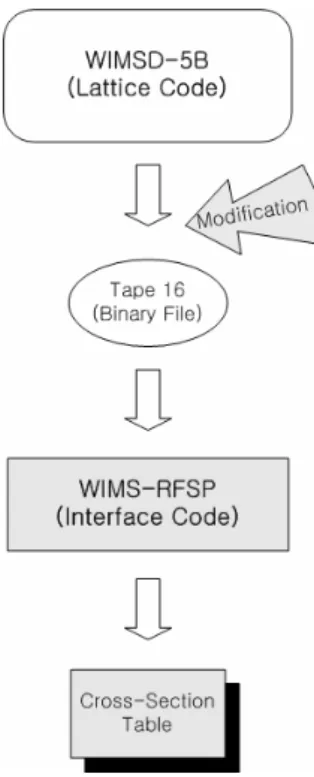
In the same way of WIMS-AECL, WIMSD-5B also generates an appropriate interface data file, Tape 16, and then WIMS-RFSP using Tape 16 produces the cross-section table for RFSP.
Figure 1. Flow chart of the cross-section production. 3. Conclusions and Further Study
In this study, Tape 16 was generated from WIMSD-5B as a first step and then WIMS-RFSP which is interface code between WIMSD-5B and RFSP is developed to generate the cross-section table for RFSP to perform the physics analysis of CANDU-6 with lattice parameters generated by WIMSD-5B,
In the future, it is necessary to compare the results of WIMS-AECL/RFSP with WIMSD-5B/RFSP code as well as with the experimental data on ZED-2 and DCA to verify WIMS-RFSP code. In addition, the package program will be developed to control both WIMD-5B and WIM-CANDU.
Acknowledgements
This work has been carried out under the Nuclear Research and Development Program of the Korea Ministry of Science and Technology.
REFERENCES
[1] E. E. Lewis and W. F. Miller, “Computational Methods of Neutron Transport”, A Wiley-Interscience Publication, New York.
[2] Cochran, Robert G., Tsoulfanidis and Nicholas, “The nuclear fuel cycle : analysis and management”, American Nuclear Society, 1999, Illinois.
[3] J. V. Donnelly, “WIMS-CRNL: A User’s Manual for the Chalk River Version of WIMS”, Atomic Energy of Canada Limited Report, AECL-8955, 1986.
[4] R. J. J. Stamm’ler and M. J. Abbate, “Method of Steady-State Reactor Physics in Nuclear Design”, Academic Press, London.
[5] G. I. Bell and S. Glasstone, Nuclear Reactor Theory, Van Nostrand Reinhold Company, New York, 1070.
[6] Karl O.Ott and Robert J.Neuhold, “Nuclear Reactor Dynamics”, American Nuclear Society, La Grange Park, Illinois, USA.