Removal of radioactive cesium
from an aqueous solution via
bioaccumulation by microalgae and
magnetic separation
Ilgook Kim
1, Hee-Man Yang
1, Chan Woo park
1, In-Ho Yoon
1, Bum-Kyoung seo
1,
eun-Kyung Kim
2& Byung-Gon Ryu
3We evaluated the potential sequestration of cesium (Cs+) by microalgae under heterotrophic growth
conditions in an attempt to ultimately develop a system for treatment of radioactive wastewater. thus, we examined the effects of initial Cs+ concentration (100–500 μM), pH (5–9), K+ and Na+ concentrations
(0–20 mg/L), and different organic carbon sources (acetate, glycerol, glucose) on Cs+ removal. our
initial comparison of nine microalgae indicated that Desmodesmus armatus sCK had removed the most Cs+ under various environmental conditions. Addition of organic substrates significantly enhanced
Cs+ uptake by D. armatus, even in the presence of a competitive cation (K+). We also applied magnetic
nanoparticles coated with a cationic polymer (polyethylenimine) to separate 137Cs-containing
microalgal biomass under a magnetic field. Our technique of combining bioaccumulation and magnetic separation successfully removed more than 90% of the radioactive 137Cs from an aqueous medium.
these results clearly demonstrate that the method described here is a promising bioremediation technique for treatment of radioactive liquid waste.
The Fukushima Daiichi Nuclear Power Plant accident of 2011 released large amounts of radioactive nuclides into the environment. In particular, the release of radioactive cesium (137Cs) was a major concern because of its long
half-life (30.2 years), high water solubility, and rapid uptake by terrestrial and aquatic organisms due to its chem-ical similarity to potassium (K+)1,2. This accident has thus led to the search for new methods that can prevent the adverse effects of pollution by radioactive nuclides, especially 137Cs.
Researchers have previously examined the effects of many chemical and biological techniques for removal of Cs+ and/or 137Cs from wastewater effluents. Biological technologies have attracted intense interest because they
appear to be less expensive and more ecologically friendly than non-biological methods3. The uptake of radioac-tive compounds by microorganisms can be a metabolism-independent process (biosorption, a physiochemical process that does not require cellular energy) or a metabolism-dependent process (bioaccumulation, uptake into the cytoplasm by use of cellular energy). Previous research indicated that energy-independent processes play a minor role in Cs+ accumulation by microbes, because Cs+ is a very weak Lewis acid and only has limited
interaction with ligands4. However, microorganisms can actively take up Cs+ via endogenous K+ transport
sys-tems5 because of the chemical similarity of Cs+ and K+. To the best of our knowledge, only a limited number of
reports examined the use of microalgae for the bioaccumulation of environmental Cs+. Conventional separation
techniques, such as chemical precipitation and ion exchange, are well-developed, but are expensive and ineffi-cient when the environmental concentration of Cs+ is low. In general, contaminated environments have much
lower concentrations of Cs+ than other co-occurring and competing cations. Thus, a biological method that uses
microalgae, which can efficiently accumulate low levels of Cs+ in the presence of competing ions, is considered a
promising approach2.
1Decommissioning Technology Research Division, Korea Atomic Energy Research Institute (KAERI), Daejeon, 34057,
Republic of Korea. 2Advanced Biomass R&D center, Korea Advanced institute of Science and technology (KAiSt),
291, Daehak-ro, Yuseong-gu, Daejeon, Republic of Korea. 3Microbial Research Department, Nakdonggang National
Institute of Biological Resources (NNIBR), 137, Donam 2-gil, Sangju-si, 37242, Republic of Korea. Correspondence and requests for materials should be addressed to B.-G.R. (email: [email protected])
Received: 21 December 2018 Accepted: 26 June 2019 Published: xx xx xxxx
www.nature.com/scientificreports
www.nature.com/scientificreports/
In this study, we examined the feasibility of using microalgae with a magnetic separation system to remove Cs+ and 137Cs from aqueous solutions. Thus, we initially examined the Cs+-uptake capabilities of nine microalgae,
including several newly isolated strains, under constant illumination to select the strain that best accumulates Cs+. We then selected the best of these nine microalgae and examined the effect of different environmental factors
on Cs+ uptake and sequestration6, including pH, initial concentrations of different ions (Cs+, K+, and Na+), and
different organic carbon sources (acetate, glycerol, and glucose). We also used polyethyleneimine (PEI)-coated magnetic nanoparticles (MNPs) to simultaneously recover the microalgae and 137Cs from solution. As a cationic
surfactant, polyethlylenimine (PEI), which is known for its high density of positive charge, was introduced onto the surface of Fe3O4 nanoparticles to synthesize PEI-coated magnetic nanocomposites7. The proposed overall
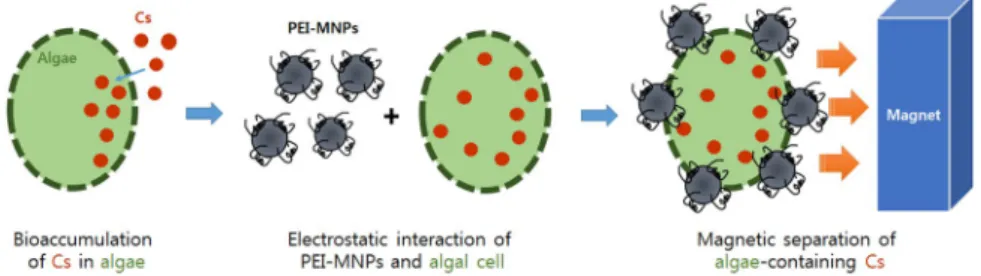
approach is summarized in Fig. 1.
Results and Discussion
screening of Cs
+-accumulating microalgae.
We initially grew the nine different microalgae under constant illumination in Cs+-containing TAP medium, following 3 days of growth in K+-starved TAP medium(Fig. 2a). Measurements of OD680nm indicated Chlorella sp. Arm 0029B had the highest cell density, followed by M. inermum F014, C. vulgaris, and then D. armatus SCK. Measurements of Cs+ uptake by these microalgae
indi-cated that D. armatus SCK removed the greatest amount of Cs+ (63.9 μmol/g DCW), followed by Ettlia sp. YC001
(28.6 μmol/g DCW), Chlorella sp. Arm 0029B (22.2 μmol/g DCW), and M. inermum F014 (16.7 μmol/g DCWM)
Figure 1. Overall process for removal of radioactive Cs via bioaccumulation by microalgae and magnetic
separation.
Figure 2. (a) Relationship of Cs+ uptake (bars) and algal growth (circles) and (b) relationship of the Cs+/K+
(Fig. 2a). We also examined the cellular uptake of K+ from TAP medium without Cs+ (Fig. 2b). It is well known
that cells take up Cs+ using their K+ transport systems, such as the K+/K+ and K+/H+ exchanger5,8,9.
However, our results indicated the uptake of K+ was not always proportional to uptake of Cs+. Based on
uptake of K+, D. armatus SCK had the greatest Cs+ uptake at a Cs+/K+ molar ratio of 0.33. This indicated that
uptake of Cs+ does not necessarily correlate with uptake of K+ or cell growth. Trans-membrane movement of
monovalent cations like Cs generally occurs against a concentration gradient and thus energy is consumed to drive it. Additionally, it likely has to do with the plasma membrane-bound H+-ATPase, which acts to generate a
transmembrane electrochemical proton gradient4,5. It is therefore possible that cation transports are coupled with H+ movements by either symport or antiport. Besides, the monovalent cation uptake may be mediated rather
directly by K+-ATPase4,5. All this led to a mechanistic hypothesis that an apparent Cs+ uptake capacity is could be
different for each cell type whose monovalent cation transport system has varied affinities toward Cs.
Previous studies reported that Chlorella salina and Synechocystis PCC 6803 accumulated Cs+ in the range of
0.8 to 0.49 nmol per 106 cells when grown in BG-11 medium under constant illumination10,11. We found that D.
armatus SCK sequestrated 2.08 nmol Cs+ per 106 cells under our growth conditions, so this microalga appears
to be a promising option for the removal of environmental Cs+. Thus, all of our subsequent experiments focused
on this species.
Effects of initial Cs
+concentration and pH on Cs
+removal.
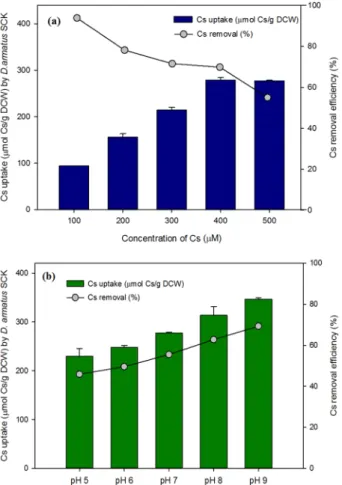
Cs+ is a hard metal that is generallynon-toxic to microorganisms because of its weak coordinating ability. Moreover, several hard metals are essential nutrients for microbial growth, and so they are readily accumulated4. Thus, we examined the effect of the initial Cs+ concentration and pH on Cs+ uptake by D. armatus SCK (Fig. 3). The results show that Cs+ uptake increased
with an increasing initial Cs+ concentration, with an apparent saturation near 400 to 500 μM. The maximum
equilibrium uptake of Cs+ was 280 μmol/g DCW and the removal efficiency was 70% at 400 μM. Tomioka et al.12 reported that several strains of Rhodococcus accumulated Cs+ in the range of 98.3 to 395 μmol/g cells weight for
initial Cs+ concentrations of 0.01 to 1 mM, but that the Cs+ uptake did not increase when the extracellular Cs+
concentration was greater than 100 μM12.
The pH of the growth medium can impact the bioaccumulation or adsorption of Cs+. Our results show that
the bioaccumulation of Cs+ by D. armatus SCK was efficient at pH values between 5 and 9, and the greatest uptake
and removal efficiency were at pH 9. This result is similar to those reported for cyanobacterial removal of Cs+. In
Figure 3. (a) Effect of initial Cs+ concentration on Cs+ uptake (bars) and removal efficiency (circles) at pH 7,
and (b) effect of pH on Cs+ uptake (bars) and removal efficiency (circles) at 400 μM Cs+ by D. armatus SCK cells
www.nature.com/scientificreports
www.nature.com/scientificreports/
particular, optimal Cs+ accumulation by Synechocystis PCC 6803 and Rhodococcus strain occurred under alkaline
conditions (pH 9)1,10, probably because plasma membrane depolarization at low pH inhibits Cs+ uptake10.
effects of K
+and Na
+on Cs
+removal.
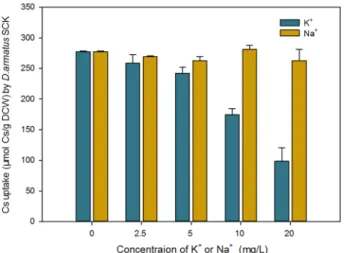
Cs+ is an alkali monovalent cation that cells can transportbecause of its similarity to K+. Thus, we examined the effects of K+ and Na+ concentration on Cs+ uptake by D. armatus SCK (Fig. 4). The results show that the Na+ concentration had little or no effect on Cs+ uptake in the
concentration range tested, but that Cs+ uptake declined as the K+ concentration was above 10 mg/L. Similar
to other microbes, our results show that Cs+ accumulation may occur through sharing K+-transport channel,
not Na+-migration route5. Similarly, Cs+ accumulation by Synechocystis sp. Strain PCC 6803 and C. emersonii
declined as the concentration of K+ increased5,10. These results also suggest that the K+-transport system(s) of
phototrophic microalgae, which are not specific to K+, play an important role in accumulation of Cs+12. The K+
concentrations in natural fresh water and ground water systems typically range from 0.5 to 3 mg/L, levels that have no apparent impact on Cs+ uptake by D. armatus SCK2. However, our results indicate that when this strain is used in laboratory or bioengineering studies, the K+ concentration should be 10 mg/L or less.
Effects of different organic carbon sources on Cs
+removal.
We investigated the effects of three organic carbon sources (acetate, glycerol, and glucose; concentration: 1 g-Carbon/L) on Cs+ uptake by D. arma-tus SCK with or without 500 μM K+ (Fig. 5). The results show that each carbon source notably increased Cs+uptake in the presence or absence of K+, and that glucose had the greatest effect. In agreement, a previous study
also reported increased net K+ uptake by heterotrophic Rhodococcus cells when glucose was added to the growth
medium13.
Glucose-induced net uptake of K+ and Cs+ is likely due to stimulation of an electro-neutral ATP-dependent
K+/H+ exchange, because glucose metabolism acidifies the cell interior. Ohunki et al.14 also found that glucose stimulated the accumulation of Cs+ in a fungal strain14. Our results also indicate that glucose and other carbon sources can act as energy sources that increase Cs+ accumulation by microalgae under heterotrophic conditions.
In contrast, other research indicated that Chlorella accumulated 2-fold less Cs+ in chemoheterotrophic conditions
Figure 4. Effect of K+ and Na+ concentration on Cs+ uptake by D. armatus SCK grown in TAP medium
containing 400 μM Cs+.
Figure 5. Effect of 500 μM K+ and three different carbon sources on uptake of Cs+ by D. armatus SCK when
relative to photoautotrophic conditions5. Few previous studies have examined the effects of other organic sub-strates, such as acetate and glycerol, on the uptake of Cs+ by phototrophic microalgae. Our results (Fig. 5) indicate
that acetate and glycerol significantly increased the uptake of Cs+, although glucose had a stronger effect. Acetate
is a volatile fatty acid that microalgae can directly convert into acetyl-CoA (an intermediate in the synthesis of cellular fatty acids) via the pyruvate pathway in the absence of glucose15, so this may explain its effect (Fig. 5). Although glycerol was not as effective as glucose, it can be considered as an alternative to improve the accumu-lation of Cs+ by D. armatus SCK. Therefore, from an economic perspective, these two low-cost organic carbon
sources (acetate and glycerol) have potential for enhancing the accumulation of Cs+ during the heterotrophic
growth of D. armatus SCK.
Removal of
137Cs using bioaccumulation and magnetic separation.
We measured the separation of microalgae containing Cs+ from liquid medium by use of PEI-MNPs. In an aqueous solution, the surface of metaloxide nanoparticles contains hydroxyl groups, which undergo pH-dependent protonation/deprotonation. Fe3O4
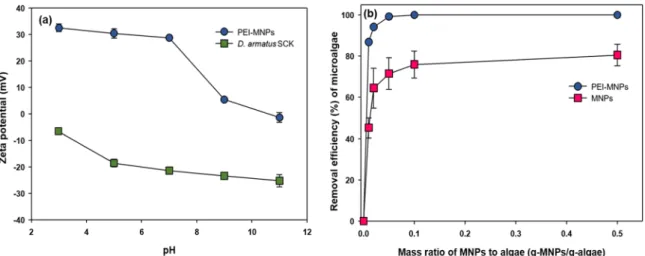
nanoparticles are generally negatively charged at pH 716,17. Therefore, the negative surface potential of algal cells (D. armatus SCK: −21.4 ± 0.92 mV at pH 7) makes them strongly attracted to Fe3O4 nanoparticles that are coated
with PEI, which have a high-density cationic charge (+28.7 ± 0.64 mV at pH 7) (Fig. 6a). As reported in previous studies, the addition of cationic functional groups, such as PEI, to the surface of coated particles increases the effectiveness of separation18–20. As shown in Fig. 6b, the maximum recovery efficiency (~100%) was achieved when the mass ratio exceeds 0.05 g-PEI-MNPs/g-algae, which showed the improved magnetic separation than that of naked Fe3O4 particles. We also found that the complex of magnetic nanocomposites and microalgal cells
were easily separated within 3 min in a magnetic field (Fig. 7). Thus, this magnetic harvesting method has poten-tial for the efficient separation of microalgae containing 137Cs because it is simple, rapid, and consumes very little
energy.
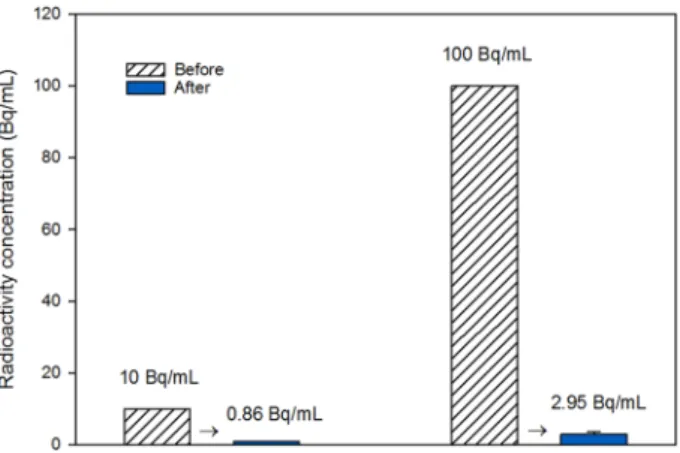
We also examined the use of D. armatus SCK cells followed by magnetic separation for removal of 137Cs from
a medium with glucose (1 g/L) and 10 Bq/mL or 100 Bq/mL of 137Cs (Fig. 8). Measurement of radioactivity in the
liquid medium before and after treatment indicated these cells sequestered 91.4% and 97.1% of 137Cs at 10 and
100 Bq/mL of 137Cs, respectively (Fig. 8). These data are meaningful because low levels of 137Cs are often difficult
to remove using conventional methods in aqueous systems.
Figure 6. (a) Zeta potentials of PEI-MNPs and D. armatus SCK at different pHs, (b) Recovery efficiency of D.
armatus SCK according to the mass ratio of MNPs to algae.
www.nature.com/scientificreports
www.nature.com/scientificreports/
Materials and Methods
screening of Cs-accumulating microalgae.
Four microalgae that accumulate Cs+ were isolated from alocal sewage treatment plant (Desmodesmus armatus SCK) and a lake (Scenedesmus pectinatus CSS-12, Chlorella sp. fE-04, and Chlorella sp. fE-07) in Daejeon, Republic of Korea. An additional five microalgae from the culture collections of the Korea Research Institute of Bioscience and Biotechnology (KRIBB) in Dajeon, Korea (Chlorella sp. ArM0029B, Ettlia sp. YC001, and Chlamydomonas reinhardtii CC124), Pusan National University in Pusan, Korea (Micractinium inermum F014), and University of Texas (UTEX), Austin, TX, USA (Chlorella vulgaris UTEX265). For screening of Cs-accumulating microalgae, each strain was grown in 1 L vessel in Tris-acetate phosphate (TAP) medium (pH = 7) with 100-μmol/L of CsCl and the following additional components: 25 mL of TAP salts, 0.375 mL of phosphate solution, 1 mL of Hunter’s trace elements, 1 mL of glacial acetic acid, and 2.42 g of Tris15. The initial cell concentration was adjusted to an optical density of 0.2 at 680 nm. These algal strains were cultivated for 7 days in baffled hybrid flasks on a shaker (120 rpm) at 25 °C.
Effects of various parameters on Cs removal by microalgae.
To evaluate the maximum uptake capa-bility of Cs+ by microalgae, cultivated cells were transferred to K+-depleted TAP medium and maintained for 3days (Supplementary Fig. S1). Then, cells in the early stationary growth phase were collected by centrifugation at 7000 rpm for 10 min, and the bio-pellets were suspended in a 20-mM Tris buffer solution containing CsCl, with the biomass adjusted to 1 g/L dry cell weight (DCW). Cell suspensions were then incubated at 25 °C for 24 h with rotary shaking (120 rpm) under continuous illumination. The effects of the initial concentrations of Cs+, K+ and
Na+, and various organic carbon sources (acetate, glycerol, and glucose) were examined at 25 °C under
continu-ous illumination. The removal efficiency of non-radioactive Cs+ was calculated as:
= C −C C ×
Removal efficiency (%) ( i f)/ i 100 (1)
where Ci and Cf are the initial (i) and final (f) concentrations of Cs+.
synthesis of peI-Fe
3o
4nanoparticles and magnetic separation.
PEI (polyethyleneimine)-coated magnetic nanoparticles (MNPs) were synthesized according to a previously reported procedure7. First, iron salts (0.99 g FeCl2∙4H2O and 2.7 g FeCl3∙6H2O) were dissolved in 100 mL of deionized water, and deoxygenated withnitrogen gas at 80 °C. Subsequently, 10 mL of NH4OH (25% by wt.) was added and stirred for 0.5 h. After cooling
to room temperature, the precipitated nanoparticles were separated with a magnet and washed four times with deionized water. Then, the Fe3O4 nanoparticles were added to a PEI solution (MW = 2 kDa) in phosphate buffer
at pH 7.3 (10% by vol.). Finally, the PEI-MNPs were collected using a magnetic field and washed three times with deionized water. After synthesis of the nanoparticles, the zeta potentials of PEI-MNPs and prepared microalgae were measured by a Zetasizer instrument (Nano-ZS, Malvern, UK).
For the magnetic separation and removal of radioactive 137Cs, D. armatus SCK cells were cultivated in a Tris
buffer solution containing 10 or 100 Bq/mL of 137Cs, and the PEI-MNPs were mixed with the cultures for 1 min.
Then, the microalga-nanoparticle aggregates containing 137Cs were separated from the medium using an external
permanent magnet within 3 min. After separation, the radioactivity concentration of the solution was measured to calculate the removal efficiency, as described above.
Analytical methods.
To quantify cell growth, the optical density of each sample was measured at 680 nm using a UV-visible spectrophotometer (UV-1800; Shimadzu, Japan). Cell counts were performed using an optical microscope (DM2500; Leica, Switzerland) with a hemocytometer.After the Cs removal experiments, the supernatant was filtered through a PVDF membrane filter (0.2 μm), and the amount of non-radioactive Cs+ remaining in the filtrate was quantified using inductively coupled
plasma-mass spectrometry (ICP-MS; ELAN DRC II, Perkin-Elmer). Thus, the cellular uptake of Cs+ was
deter-mined by measuring the change in Cs+ concentration of the growth medium. The levels of K+ and Na+ were
determined by ion chromatography (883 Basic IC plus; Metrohm AG, Switzerland) using an anionic column
Figure 8. Change of 137Cs concentration in the liquid medium following bioaccumulation by D. armatus SCK
PEI-MNPs for magnetic separation of cells led to highly effective removal of 137Cs from aqueous solutions. The
use of microalgae-magnetic particles with an inexpensive organic substrate appears to have great potential for bioremediation of 137Cs-polluted environments.
References
1. Tomioka, N., Tanaka, K., Uchiyama, H., Yagi, O. & Kokufuta, E. Recovery of 137Cs by a bioaccumulation system using Rhodococcus
erythropolis CS98. J. Ferment. Bioeng. 85, 604–608 (1998).
2. Fukuda, S. et al. Global searches for microalgae and aquatic plants that can eliminate radioactive cesium, iodine and strontium from the radio-polluted aquatic environment: a bioremediation strategy. J. Plant. Res. 127, 79–89 (2014).
3. Jalali-Rad, R. et al. Biosorption of cesium by native and chemically modified biomass of marine algae: introduce the new biosorbents for biotechnology applications. J. Hazard. Mater. 116, 125–134 (2004).
4. Avery, S. V. Caesium accumulation by microorganisms: uptake mechanisms, cation competition, compartmentalization and toxicity.
J. Ind. Microbiol. 14, 76–84 (1995).
5. Avery, S. V., Codd, G. A. & Gadd, G. M. Replacement of cellular potassium by caesium in Chlorella emersonii: differential sensitivity of photoautotrophic and chemoheterotrophic growth. J. Gen. Microbiol. 138, 69–76 (1992).
6. Samadani, M., Perreault, F., Oukarroum, A. & Dewez, D. Effect of cadmium accumulation on green algae Chlamydomonas reingardtii and acid-tolerant Chlamydomonas CPCC 121. Chemosphere 191, 174–182 (2018).
7. Hu, Y. R., Guo, C., Wang, S. K., Pan, F. & Liu, C. Z. Improvement of microalgae harvesting by magnetic nanocomposites coated with polyethylenimine. Chem. Eng. J. 242, 341–347 (2014).
8. Kannan, S. Plasmalemma: the seat of dual mechanisms of ion absorption in Chlorella pyrenoidosa. Science. 173, 927–929 (1971). 9. Raven, J. A. Nutrient transport in microalgae. Adv. Microb. Physiol. 21, 47–226 (1981).
10. Avery, S. V., Codd, G. A. & Gadd, G. M. Caesium accumulation and interactions with other monovalent cations in the
cyanobacterium Synechocystis PCC 6803. J. Gen. Microbiol. 137, 405–413 (1991).
11. Avery, S. V., Codd, G. A. & Gadd, G. M. Salt-stimulation of caesium accumulation in the euryhaline green microalga Chlorella
salina: potential relevance to the development of a biological Cs-removal process. Microbiology. 139, 2239–2244 (1993).
12. Tomioka, N., Uchiyama, H. & Yagi, O. Cesium accumulation and growth characteristics of Rhodococcus erythropolis CS98 and Rhodococcus sp. Strain CS402. Appl. Environ. Microbiol. 60, 2227–2231 (1994).
13. Tromballa, H. W. The effect of glucose on potassium transport by Chlorella fusca. Z. Pflanzenphysiol. 105, 1–10 (1981).
14. Ohnuki, T. et al. Effect of minerals on accumulation of Cs by fungus Saccaromyces cerevisiae. J. Environ. Radioact 144, 127–133 (2015).
15. Ryu, B. G. et al. Advanced treatment of residual nitrogen from biologically treated coke effluent by a microalga-mediated process using volatile fatty acids (VFAs) under stepwise mixotrophic conditions. Bioresour. Technol. 191, 488–495 (2015).
16. Nassar, N. N. Rapid removal and recovery of Pb(II) from wastewater by magnetic nanoadsorbents. J. Hazard. Mater. 184, 538–546 (2010).
17. Xu, L., Guo, C., Wang, F., Zheng, S. & Liu, C. Z. A simple and rapid harvesting method for microalgae by in situ magnetic separation.
Bioresour. Technol. 102, 10047–100513 (2011).
18. Wang, S. K., Stiles, A. R., Guo, C. & Liu, C. Z. Harvesting microalgae by magnetic separation: A review. Algal Res. 9, 178–185 (2015). 19. Hu, Y. R., Wang, F., Wang, S. K., Liu, C. Z. & Guo, C. Efficient harvesting of marine microalgae Nannochloropsis maritima using
magnetic nanoparticles. Bioresour. Technol. 138, 387–390 (2013).
20. Prochazkova, G., Podolova, N., Safarik, I., Zachleder, V. & Branyik, T. Physicochemical approach to freshwater microalgae harvesting with magnetic particles. Colloids Surf. B 112, 213–218 (2013).
Acknowledgements
This work was supported by the National Research Foundation of Korea (NRF) grant funded by the Korean government, Ministry of Science and ICT (No. 2017M2A8A5015148). Also, this work was also supported by a grant of the Nakkonggang National Institute of Biological Resources (NNIBR), funded by the Ministry of Environment (NNIBR201902102), Republic of Korea.
Author Contributions
B.G. Ryu designed the research and supervised the experiments. I. Kim conducted the most of experiments and wrote the manuscript. H.M. Yang synthesized the PEI-Fe3O4 nanoparticles and assisted Ilgook Kim in performing
magnetic separation tests. C.W. Park prepared radioactive cesium solution and assisted in analyzing data. I.H. Yoon, B.K. Seo and E.K. Kim gave B.G. Ryu a number of critical ideas and suggestions for the study.
Additional Information
Supplementary information accompanies this paper at https://doi.org/10.1038/s41598-019-46586-x.
www.nature.com/scientificreports
www.nature.com/scientificreports/
Publisher’s note: Springer Nature remains neutral with regard to jurisdictional claims in published maps and
institutional affiliations.
Open Access This article is licensed under a Creative Commons Attribution 4.0 International
License, which permits use, sharing, adaptation, distribution and reproduction in any medium or format, as long as you give appropriate credit to the original author(s) and the source, provide a link to the Cre-ative Commons license, and indicate if changes were made. The images or other third party material in this article are included in the article’s Creative Commons license, unless indicated otherwise in a credit line to the material. If material is not included in the article’s Creative Commons license and your intended use is not per-mitted by statutory regulation or exceeds the perper-mitted use, you will need to obtain permission directly from the copyright holder. To view a copy of this license, visit http://creativecommons.org/licenses/by/4.0/.