Background and Purpose Korean-speaking patients with a brain injury may show agraphia that differs from that of English-speaking patients due to the unique features of Hangul syllabic writing. Each grapheme in Hangul must be arranged from left to right and/or top to bottom within a square space to form a syllable, which requires greater visuospatial abilities than when writing the letters constituting an alphabetic writing system. Among the Hangul grapheme po-sitions within a syllable, the position of a vowel is important because it determines the writing direction and the whole configuration in Korean syllabic writing. Due to the visuospatial char-acteristics of the Hangul vowel, individuals with early-onset Alzheimer’s disease (EOAD) may experiences differences between the difficulties of writing Hangul vowels and consonants due to prominent visuospatial dysfunctions caused by parietal lesions.
Methods Eighteen patients with EOAD and 18 age-and-education-matched healthy adults participated in this study. The participants were requested to listen to and write 30 monosyllabic characters that consisted of an initial consonant, medial vowel, and final consonant with a one-to-one phoneme-to-grapheme correspondence. We measured the writing time for each graph-eme, the pause time between writing the initial consonant and the medial vowel (P1), and the pause time between writing the medial vowel and the final consonant (P2).
Results All grapheme writing and pause times were significantly longer in the EOAD group than in the controls. P1 was also significantly longer than P2 in the EOAD group.
Conclusions Patients with EOAD might require a higher judgment ability and longer processing time for determining the visuospatial grapheme position before writing medial vowels. This finding suggests that a longer pause time before writing medial vowels is an early marker of visuospatial dysfunction in patients with EOAD.
Key Words Hangul, writing, vowel, agraphia, early-onset Alzheimer’s disease.
Medial-Vowel Writing Difficulty in Korean Syllabic Writing:
A Characteristic Sign of Alzheimer’s Disease
INTRODUCTION
The Korean writing system, Hangul (Hangeul), consists of 24 characters with 10 vowels (known as “/mo-eum/”; ㅏ, ㅑ, ㅓ, ㅕ, ㅗ, ㅛ, ㅜ, ㅠ, ㅡ, ㅣ) and 14 consonants (known as “/ja-eum/”; ㄱ, ㄴ, ㄷ, ㄹ, ㅁ, ㅂ, ㅅ, ㅇ, ㅈ, ㅊ, ㅋ, ㅌ, ㅍ, ㅎ). All Hangul graphemes cor-respond to a single phoneme. Korean syllables typically include an onset, which is a conso-nant (/cho-seong/), followed by a vowel (/jung-seong/), which may be followed by another consonant (/jong-seong/). Therefore, each syllable contains at least one consonant graph-eme and one vowel, plus the optional additional of a final consonant.
In terms of the arrangement of graphemes within a syllable, Hangul has unique visuo-spatial/constructional features. Unlike how graphemes are written horizontally and in tan-dem in alphabetic writing systems, each grapheme in Hangul must be arranged from left to right and/or top to bottom within a square space to form a syllable. Among the graph-Ji Hye Yoona
Yong Jeongb
Duk L. Nac,d
a Division of Speech Pathology and Audiology, Research Institute of Audiology and Speech Pathology, College of Natural Sciences, Hallym University, Chuncheon, Korea b Department of Bio and
Brain Engineering,
KI for Health Science and Technology, Korea Advanced Institute of Science and Technology, Daejeon, Korea
c Department of Neurology, Neuroscience Center, Stem Cell & Regenerative Medicine Institute, Samsung Medical Center, Sungkyunkwan University School of Medicine, Seoul, Korea d Department of Health Sciences and
Technology, SAIHST, Sungkyunkwan University, Seoul, Korea
pISSN 1738-6586 / eISSN 2005-5013 / J Clin Neurol 2018;14(2):179-185 / https://doi.org/10.3988/jcn.2018.14.2.179
Received August 28, 2017 Revised October 29, 2017 Accepted October 31, 2017 Correspondence Duk L. Na, MD, PhD Department of Neurology, Samsung Medical Center, Sungkyunkwan University School of Medicine, 81 Irwon-ro, Gangnam-gu, Seoul 06351, Korea Tel +82-2-3410-3591
Fax +82-2-3410-0052 E-mail [email protected]
cc This is an Open Access article distributed under the terms of the Creative Commons Attribution Non-Com-mercial License (http://creativecommons.org/licenses/by-nc/4.0) which permits unrestricted non-comNon-Com-mercial use, distribution, and reproduction in any medium, provided the original work is properly cited.
Medial Vowel Writing
JCN
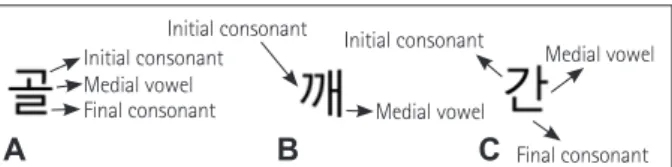
eme positions within a syllable, the position of a vowel is particularly important because it determines the writing di-rection and the whole configuration in Korean syllabic writing (Fig. 1).1 The writing is oriented vertically (i.e., top to bottom)
if the vowel is positioned at the bottom of the initial conso-nant, while the writing is oriented horizontally (left to right) or has a mixed orientation (left to right and top to bottom) if the vowel is positioned on the right side of the initial conso-nant within a syllable. Therefore, determining the vowel po-sition in Hangul syllabic writing might be more closely related to visuoconstructional functions compared to determining the positions of other graphemes in a syllable.
In general, the function of visuospatial construction is processed by the biparietal lobes.2 Patients with Alzheimer’s
disease (AD) present with symptoms associated with tem-poroparietal damage in the early stage that are driven by the deposition of beta-amyloid plaques and neurofibrillary tan-gles in the brain. In particular, hypometabolism in the pari-etal area is more severe in patients with early-onset Alzheim-er’s disease (EOAD) than in those with late-onset AlzheimAlzheim-er’s disease (LOAD).3 A previous study of agraphia in Korean
patients with EOAD found that these patients showed visuo-constructional writing errors (i.e., stroke omission, addition, and misconfiguration) as well as linguistic errors (i.e., graph-eme substitution, addition, and omission) even in the early stages of the disease.4 Because of this visuospatial
characteris-tic of Hangul vowels, patients with AD (and especially those with EOAD) who have parietal lesions may show difficulties in differentiating between vowels and consonants.
The main aim of the present study was to delineate the vi-suoconstructional value of Hangul writing and the vowel grapheme positions within a Hangul syllable. This was achieved by asking patients with EOAD to write 30 dictated monosyl-labic stimuli (vertical and mixed orientations including the initial consonant, medial vowel, and final consonant) and measuring the elapsed time for writing. Due to the unique characteristics of the vowel grapheme positional value and the disease entity of EOAD, we hypothesized that the time delay before writing the vowel grapheme would be longer than that for the other graphemes within a syllable.
METHODS
Participants
Eighteen patients diagnosed with EOAD were recruited from the Memory Disorder Clinic at the Department of Neurology, Samsung Medical Center, Seoul, Korea. The pa-tients were aged 57.44±6.47 years mean±standard deviation) and comprised 5 men and 13 women. They had 11.61±3.53 years of formal education, and their score on the Clinical De-mentia Rating scale was 1.08±0.46, while that for the Mini Mental State Examination was 17.00±4.08. The following inclusion criteria were applied: 1) >6 years of education, to ensure that they had no difficulty writing Hangul in the premorbid state; 2) right-handed speakers of the standard Korean language who reported no history of writing distur-bances before the diagnosis; 3) no history of neurological motor impairments such as weakness, rigidity, or tremor; and 4) language abilities confirmed using the Korean ver-sion of the Western Aphasia Battery,5 with an aphasia
quo-tient of 75.17±17.75 and a language quoquo-tient of 70.77±18.42. In order to compare the writing performance, we recruited 18 age- and education-matched healthy adults (5 men and 13 women) who were caregivers from the same memory disor-der clinics at our hospital. The age of these normal controls (NC) was 56.33±6.42 years and they had 12.17±3.73 years of formal education. None of the NC had a history of neurolog-ical, language, or psychiatric disorders.
Materials for Korean syllabic writing
The writing-to-dictation task consisted of 30 single-syllable characters that had a one-to-one phoneme-to-grapheme cor-respondence (Table 1). Korean syllabic characters comprise either the combination of an initial consonant, a medial vowel, and a final consonant or the combination of an ini-tial consonant and a medial vowel; this study only employed the first type of characters. The stimuli were selected based on their configuration, frequency, and imageability. Partici-pants with EOAD who have temporoparietal lesions may ex-perience writing difficulty not only due to a linguistic disabil-ity but also cognitive deficits. We minimized the contribution of cognitive deficits to agraphia by selecting easier single-syl-lables. In accordance with previous studies of AD,4,6 words
appearing in the Learner’s Dictionary of Korean7 at
frequen-cies above 30% were selected in order to make the task less
Fig. 1. Examples of vertical (A), horizontal (B), and mixed (C) orienta-tions of Hangul syllabic writing.
Table 1. Thirty single-syllable characters used as writing stimuli
Orientation Stimuli Vertical 귤 순 춥 불 중 목 등 콩 쑥 똥 Mixed 길 언 병 칸 집 남 학 색 짹 밴 왁 월 권 꿩 광 환 휠 쉽 괜 된 Initial consonant Final consonant Medial vowel Initial consonant Medial vowel Initial consonant Final consonant Medial vowel A B C
Yoon JH et al.
JCN
complicated and thereby reduce the cognitive load. In terms ofconfiguration, characters with up to four graphemes were se-lected in order to further reduce the complexity of the task. In terms of imageability, the same proportion of concrete (80%) and abstract (20%) words were included in each category.7
Experimental procedures
Participants were asked to write each character on the screen of a tablet PC (IBM ThinkPad X220T) using a stylus pen. A program using ‘Quarsar’ was devised to measure the total writing time, which consists of the grapheme writing times plus the pause times while writing. Before the Hangul writ-ing test, the patients were instructed to trace simple horizon-tal and vertical lines (both 4 cm long) at right angles to each other on the computer screen, and the elapsed time for gen-eral hand movement for drawing was measured. After draw-ing these two simple lines, the patients were instructed to write each character as meticulously as possible on an 8×8 cm2
space, the margin of which was framed on the screen by a black 1-mm-thick line. Each of the Hangul stimuli was verbal-ly presented to the participants with a word cue [e.g., “please write the syllable ‘남’ (/nam/) of ‘남자’ (/nam-ja/ means ‘man’)”], and they were asked to repeat the target stimuli verbally be-fore writing it to ensure that there was no deficit in auditory input ability. No time limit was imposed. The study was ap-proved by the Institutional Review Board of Samsung Med-ical Center (IRB 2006-03-011).
Data analysis
To investigate the general performance of Hangul writing, we first counted the number of erroneous responses accord-ing to the each grapheme position (i.e., initial consonant, me-dial vowel, and final consonant). The minimum and maxi-mum numbers of erroneous responses within each position were 0 and 30, respectively. We inspected these errors from both linguistic and visuoconstructional points of view. The criteria used for the inspection from the linguistic and visuo-constructional aspects were based on previous studies:4,6 the
linguistic errors consisted of the omission, substitution, and addition of graphemes, and the visuoconstructional errors consisted of stroke omission, stroke addition, and miscon-figuration. Two speech-language pathologists analyzed the writing performance of each participant based on these cri-teria. To determine the interobserver agreement, we ran-domly chose two participants (constituting about 10% of the total number) from the patient group. The rate of agreement between the two raters was 98%, and consensus was used to resolve cases of discrepancy.
We also measured the elapsed time for each writing re-sponse. Considering the mean response/reaction time across all responses (i.e., including errors) would mean that the esti-mated times would have included processes that are unlikely to be of interest, and so using response/reaction times only from correct responses is a more-representative measure of time because it eliminates the erroneous responses.8
Accord-ingly, we measured the elapsed time only for correct
respons-Total writing time
Writing time of
initial consonant Writing time of medial vowel final consonantWriting time of
Pause time 1 Pause time 2
Medial Vowel Writing
JCN
es. As illustrated in Fig. 2, the total writing time was defined as the time that had elapsed from the moment the participant touched the screen to write the character to the moment the participant released the pen from the touchscreen when the character had been written. Subsequently, the total writing time consisted of three grapheme writing times (G1, G2, and G3 for the initial consonant, medial vowel, and final consonant, respectively) plus two pause times (P1 and P2). The grapheme writing time was the elapsed writing time for each grapheme, which was defined as the duration from the moment when the screen was first pressed to the moment when the pen was released from the touchscreen. The pause time corresponded to the duration between the end of writ-ing one grapheme and beginnwrit-ing writwrit-ing the next graph-eme: P1 was the pause time between writing the initial con-sonant and the medial vowel, and P2 was the pause time between writing the medial vowel and the final consonant.
RESULTS
Erroneous responses for the position of each
grapheme
Two-way analysis of variance (ANOVA) was employed to evaluate the effect of the group (NC and EOAD), the num-ber of erroneous responses according to grapheme position (initial consonant, medial vowel, and final consonant), and interactions between the group and the number of errone-ous responses. The between-group analysis revealed that the number of errors in all grapheme positions (initial conso-nant, medial vowel, and final consonant) was significantly higher in the EOAD group than in the NC group (p<0.001) (Table 2). There were significantly interactions between the group and the number of erroneous responses (p<0.01).
Within each group, multiple-comparisons analysis with Bonferroni adjustment was performed to compare the per-formance according to the grapheme position in the Hangul syllable. In terms of the number of errors among the graph-eme positions in the Hangul syllable, the performance dif-fered significantly in the patient group (p<0.001), with the number of errors being significantly higher for the medial vowel than for the initial or final consonant (p<0.05, with Bonferroni adjustment). Based on the criteria using in a
pre-vious study,4 the error patterns in the patient group were
distributed as follows: 38.8% linguistic errors, 23.6% visuo-constructional errors, 18.8% mixed (linguistic plus visuocon-structional) errors, and 18.8% undetermined errors.
Elapsed time for writing
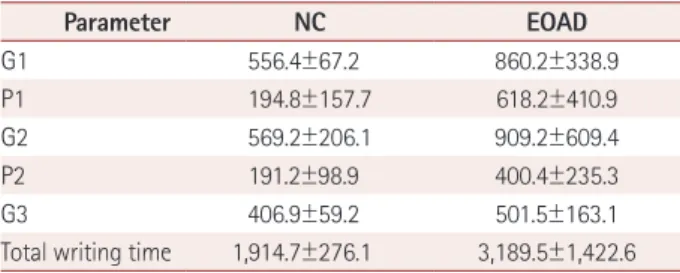
The elapsed time for drawing simple lines served as the con-trol for motor speed, and this did not differ significantly be-tween the NC and EOAD groups (p>0.05). In terms of the writing time, two-way ANOVA was employed to evaluate the effect of group (NC and EOAD), total writing time, and in-teractions between the group and the total writing time. The between-group analysis showed that all grapheme writing and pause times were significantly longer in the EOAD group than in the NC group (p<0.001) (Table 3). There were also significantly interactions between the group and the graph-eme writing time (p<0.01).
Within each group, multiple-comparisons analyses with Bonferroni adjustment were performed to compare the per-formance according to the grapheme position in the Hangul syllable. The grapheme writing times (G1, G2, and G3) and pause times (P1 and P2) were analyzed separately. G1, G2, and G3 differed significantly in both the NC and EOAD groups (p<0.001). The multiple-comparisons analysis revealed that the grapheme writing time was significantly shorter for G3 than for G1 or G2 (p<0.05, with Bonferroni adjustment). Pause times P1 and P2 differed in the EOAD group, with P1 being significantly longer than P2 (p<0.01, with Bonferroni adjustment). No significant difference between P1 and P2 was detected in the NC group.
DISCUSSION
The first major finding of this study was that the difficulties experienced by the patients differed between writing vowels and consonants. Previous case studies of Italian and Turkish
Table 2. Number of erroneous responses
Grapheme position NC EOAD
Initial consonant 0.2±1.0 5.2±4.4
Medial vowel 1.1±1.9 10.5±7.4
Final consonant 1.0±2.2 6.0±8.3
Data are mean±standard-deviation values.
EOAD: early-onset Alzheimer’s disease, NC: normal controls.
Table 3. Writing and pause times (in milliseconds)
Parameter NC EOAD G1 556.4±67.2 860.2±338.9 P1 194.8±157.7 618.2±410.9 G2 569.2±206.1 909.2±609.4 P2 191.2±98.9 400.4±235.3 G3 406.9±59.2 501.5±163.1
Total writing time 1,914.7±276.1 3,189.5±1,422.6 Data are mean±standard-deviation values.
G1: writing time for the initial consonant, G2: writing time for the medial vowel, G3: writing time for the final consonant, P1: pause time between writing the initial consonant and the medial vowel, P2: pause time between writing the medial vowel and the final consonant. EOAD: early-onset Alzheimer’s disease, NC: normal controls.
Yoon JH et al.
JCN
patients using alphabetic writing systems found thatinfor-mation about consonant and vowel representations might be separately handled.9-11 One of these studies found a
selec-tive vowel deficit in writing in two patients,9 while the two
other case studies found a writing disorder for consonants.10,11
From a linguistic point of view, our results support the notion that the consonant and vowel status of graphemes might dif-ferentially affect the spelling process.
The mechanism underlying why the frequency of errors was higher for vowels than for consonants in our patients remains to be elucidated. Linguistically, consonants and vowels represent two different qualities of sounds: conso-nants are defined as sounds articulated by the temporary ob-struction in the airstream that passes through the mouth, with distinctive contributions from each articulator structure such as the lip, alveolar, tongue, or velum; in contrast, vowels are produced without any obstruction of the air passage, with the tongue being the only articulator structure involved in their production. Distinctive features of vowels might be subtle, and the phonetic information may not be sufficient for discriminating them from other vowel sounds,12 which
might result in patients being easily confused about the pho-netic aspects of vowel writing. One of the possible explana-tions is related to the invention theory on the visuocon-structional shape of Hangul single characters. When Hangul was invented, the consonants were modeled after pictorial vocal representations; for example, ‘ㄱ /g/’ depicts the root of the tongue blocking the throat. On the other hand, the vowel graphemes are based on three geometric concepts; for exam-ple, ‘·’ is based on heaven, ‘ㅡ’ is based on earth, and ‘ㅣ’ is based on humanity. Therefore, the visuospatial image of vow-el graphemes might be far more abstract than the consonant graphemes, and the abstract representation of vowel graph-emes might be more difficult to recall. In addition, in terms of generating a Hangul grapheme, the 10 basic vowels were derived from the 3 basic geometric shapes. Each vowel is created by combining any or all of these three basic shapes, and any slight change to a stroke of the vowel grapheme could transform it into another vowel grapheme (e.g., ‘ㅏ/a/’→ ‘ㅓ/Λ/’).
In terms of the error pattern, our patients produced vi-suoconstructional errors as well as linguistic errors, which corroborates results from a previous study.4,6 The left
tem-poral lobe involves the linguistic function and the right pari-etal lobe controls the visuospatial function.13 Korean stroke
patients with unilateral lesions in the left hemisphere were found to exhibit linguistic errors, while those with lesions in the right hemisphere exhibited visuoconstructional errors.14,15
Similarly, patients with left-hemisphere lesions showed only linguistic errors; that is, substitution and omitting errors.9-11,16
Based on these findings, the linguistic and visuospatial errors in the medial vowel are one of the characteristic signs of EOAD because these patients may have degeneration in both tem-poroparietal lobes.
The second major finding of this study was that the Hangul writing time was slower in the patient group than in the NC group (Table 3). The speed of simple line drawing did not differ significantly between the NC and EOAD groups, and so we attributed the slow writing time in EOAD patients to the slowness of factors other than motor movements, such as the cognitive processing time. Cognitive psychology stud-ies have used the elapsed time to measure the amount of time that it takes an individual to process information. A longer processing time in patients with AD has been report-ed to be associatreport-ed with rreport-educreport-ed cerebral blood flow in the temporoparietal lobe.17 Indeed, many studies have found
el-derly AD patients to exhibit slower operational functioning compared to their healthy counterparts.18-20 A study of slow
processing speed in naming found that the articulation and pause times in a naming task were longer in patients with AD than in NC.17 Naming and writing tasks are not identical,
but they do exhibit the following similarities: 1) patients need to integrate cognitive functions such as linguistic and motor components in order to perform these tasks, and 2) these tasks can be assessed using both moving times (e.g., articula-tion for naming and drawing for writing) and pause times. Thus, the slow writing time of patients with EOAD might reflect a decreased cognitive processing speed in writing.
G3 for the Hangul syllable was significantly shorter in both the NC and EOAD groups. According to the cognitive infor-mation-processing model of writing to dictation, the sound of a phoneme verbally presented by an examiner will be mapped onto an auditory engram after it has been analyzed acousti-cally. The phoneme is subsequently converted into a graph-eme based on the correspondence between the sound and a letter. In the final stage, the grapheme is drawn by executing motor movements. When writing Hangul syllables, the ini-tial consonant is written first and the final consonant is writ-ten last. While writing the initial consonant and the medial vowel, the patient might convert the process between the phoneme and grapheme of the target syllable. However, at the point of writing the final consonant, this converting pro-cess might have already finished. Therefore, since all pho-nemes of target syllables might be converted into the corre-sponding graphemes before writing the final consonant, only the last stage (e.g., the execution of motor movements) might be processed during the writing of the final consonant.
An alternative explanation is related to the numbers of strokes required to produce the initial consonant, medial vow-el, and final consonant. When designing the writing task in
Medial Vowel Writing
JCN
this study we used only single-syllable characters with a one-to-one grapheme-to-phoneme correspondence. According to a rule of pronunciation on the seven final consonants, the mean number of strokes of the selected final consonants (e.g., ‘ㄱ’ and ‘ㄴ’) was often smaller than that of the other grapheme positions (e.g., ‘ㅊ’ and ‘ㄸ’ for initial consonants, and ‘ㅟ’ for medial vowels). The total numbers of strokes in the initial consonants, medial vowels, and final consonants were 68, 80, and 51, respectively, and so the smaller number of strokes for the final consonant may explain the shorter G3.
A particularly interesting finding was P1 being signifi-cantly longer than P2 only in the patient group (i.e., not in the NC group), which might be attributable to certain char-acteristics of Hangul syllabic writing. Linguistically, the vowels form the peak or nucleus of the syllables in the Kore-an phonological system.21 In addition, Kim et al.22 suggested
that the medial vowel ‘jung-seong’ is a cardinal component of the Korean syllabic system. This is similar to alphabetic lan-guage systems; for example, the vowel is the nucleus of sylla-bles in the English phonological system.23 However, Hangul
has distinctive features from a visuospatial point of view. Thus, we primarily attributed the delayed P1 in EOAD to visuospa-tial factors other than the phonological aspects, such as the unique appearance of the Korean syllabic structure. For ex-ample, English uses an alphabetic system in which all of the letters within a syllable are always arranged horizontally. This means that English writers do not have to judge the vi-suospatial position within a syllable, especially in vowel graphemes; instead, they simply have to write the vowel next to the following graphemes. However, as mentioned above, the vowel determines and guides the writing direction in the Korean syllabic writing. While the initial consonant always appears on the upper left-hand side of the syllable and the fi-nal consonant is always placed at the bottom of the syllable, the medial vowel can be written on the right side or at the bot-tom of the initial consonant. Compared to the initial and final consonants, patients with EOAD might need a greater judg-ment ability and longer processing time for determining the visuospatial grapheme position immediately before writing the medial vowels. This would explain why P1 (the time be-tween writing the initial consonant and the medial vowel) was significantly longer due to the visuospatial dysfunction in our patients with EOAD.
In addition, writing is not a unitary process, instead re-quiring the coordination of linguistic, visuospatial, and mo-tor parameters.24,25 Another possible explanation for the
lon-ger P1 is disturbance in the stages of phoneme-to-grapheme conversion and/or motor execution before writing vowels. Together these observations indicate that a longer pause time before writing the medial vowel would be another
impor-tant sign of EOAD. In the future we would like to investigate whether the longer P1 is restricted to dysfunction of visuo-spatial judgment/planning, or whether it is also affected by other writing processes.
In conclusion, the brain changes in EOAD patients may be linked to impaired writing when they are performing the tasks of daily living and social behaviors such as signing doc-uments, proficiency at work, and writing documents. The present results have important clinical implications, in that a vowel writing deficit could be a manifestation of brain chang-es as well as other signs of cognitive deterioration,26-29 and
thus writing ability should be constantly monitored from the early stage of this disease. In addition, the present findings offer specific insights into the role of the vowel in Hangul syl-labic writing. While the visuospatial position of vowels might not be important in English syllables, in the Hangul writing system this might be the basis of the shape of the Korean syl-lable and writing direction. We therefore suggest that Korean medial vowels are a cornerstone of both the linguistic and visuospatial aspects of the Korean syllabic writing system.
One limitation of this study is that we could not measure the pause time before writing the initial consonant, which we intentionally did not include in order to rule out any impair-ment at the auditory input level: the participants were in-structed to repeat the target syllable first and to write it sub-sequently from dictation. Some patients repeated the target syllable several times, and thus the examiner could not control the duration before writing an initial grapheme. Advancing the present findings and overcoming this limitation will re-quire the development of duration-measuring software. An-other limitation was our inability to determine the exact lo-cation of the lesions responsible for the writing deficits that we found in our patients with EOAD. We assumed that brain areas—such as the right superior temporal gyrus, right inferior parietal lobule, right middle occipital gyrus, and right precu-neus—that show more-severe hypometabolism in patients with EOAD than in patients with LOAD (based on a previous study3) are associated with the writing errors in the EOAD
pa-tients. Further studies are needed to clarify the brain-behavior relationship, since we expect that lesions at diverse loci (as typi-cally seen in patients with EOAD) would produce lesion-spe-cific features of writing disorders. In addition, future studies should explore the specific characteristics of Hangul writing re-lated to both EOAD and LOAD in large numbers of patients. Conflicts of Interest
The authors have no financial conflicts of interest. Acknowledgements
This material is based upon work supported by the Ministry of Trade, Industry & Energy (MOTIE, Korea) under Industrial Technology
Inno-Yoon JH et al.
JCN
vation Program (10063384).This research was supported by Hallym University Research Fund, 2017 (HRF-201707-009).
REFERENCES
1. Kim MK, Kwon OS, Kwon YB. Hangul character type clustering based on the structural shapes and the combination rules of vowels. J KIISE Softw Appl 1998;25:685-695.
2. Papagno C. Progressive impairment of constructional abilities: a vi-suospatial sketchpad deficit? Neuropsychologia 2002;40:1858-1867. 3. Kim EJ, Cho SS, Jeong Y, Park KC, Kang SJ, Kang E, et al. Glucose
metabolism in early onset versus late onset Alzheimer’s disease: an SPM analysis of 120 patients. Brain 2005;128:1790-1801.
4. Yoon JH, Suh MK, Jeong Y, Ahn HJ, Moon SY, Chin J, et al. Agraphia in Korean patients with early onset Alzheimer’s disease. Int Psychoge-riatr 2011;23:1317-1326.
5. Kim H, Na DL. Normative data on the Korean version of the West-ern Aphasia Battery. J Clin Exp Neuropsychol 2004;26:1011-1020. 6. Yoon JH, Kim H, Seo SW, Chin J, Kim JH, Lee KH, et al. Dysgraphia
in Korean patients with Alzheimer’s disease as a manifestation of bi-lateral hemispheric dysfunction. J Neurol Sci 2012;320:72-78. 7. Seo SK. Learner’s Dictionary of Korean. Seoul: Shinwon Prime, 2006. 8. Glickman ME, Gray JR, Morales CJ. Combining speed and accuracy
to assess error-free cognitive processes. Psychometrika 2005;70:405-425.
9. Cubelli R. A selective deficit for writing vowels in acquired dysgraph-ia. Nature 1991;353:258-260.
10. Miceli G, Capasso R, Benvegnù B, Caramazza A. The categorical dis-tinction of vowel and consonant representations: evidence from dys-graphia. Neurocase 2004;10:109-121.
11. Demirci S. A selective ideational apraxic agraphia for consonants. Turk J Med Sci 2006;36:243-246.
12. Shin JY, Cha JE. Korean Sound System. Seoul: Hankookmoonhwasa, 2003.
13. Lezak MD. Neuropsychological Assessment. 3rd ed. New York: Oxford University Press, 1995
14. Yoon JH, Suh MK, Kim H. Language-specific dysgraphia in Korean stroke patients. Cogn Behav Neurol 2010;23:247-255.
15. Yoon JH, Shin JC, Kim DY, Suh MK, Kim H. Korean agraphia subse-quent to right hemispheric lesion. Speech Sci 2006;13:121-132. 16. Cotelli M, Abutalebi J, Zorzi M, Cappa SF. Vowels in the buffer: a case
study of acquired dysgraphia with selective vowel substitutions. Cogn Neuropsychol 2003;20:99-114.
17. Warkentin S, Erikson C, Janciauskiene S. rCBF pathology in Al-zheimer’s disease is associated with slow processing speed. Neuropsy-chologia 2008;46:1193-1200.
18. Pirozzolo FJ, Christensen KJ, Ogle KM, Hansch EC, Thompson WG. Simple and choice reaction time in dementia: clinical implications. Neurobiol Aging 1981;2:113-117.
19. Storandt M, Beaudreau S. Do reaction time measures enhance diag-nosis of early-stage dementia of the Alzheimer type. Arch Clin Neuro-psychol 2004;19:119-124.
20. Gorus E, De Raedt R, Lambert M, Lemper JC, Mets T. Reaction times and performance variability in normal aging, mild cognitive impair-ment, and Alzheimer’s disease. J Geriatr Psychiatry Neurol 2008;21: 204-218.
21. Ahn SC. An Introduction to Korean Phonology. Seoul: Hanshin, 1998. 22. Kim H, Na DL, Park ES. Intransigent vowel-consonant position in
Korean dysgraphia: evidence of spatial-constructive representation. Behav Neurol 2007;18:91-97.
23. Greenberg S. Speaking in shorthand–a syllable-centric perspective for understanding pronunciation variation. Speech Commun 1999;29: 159-176.
24. Ellis AW. Normality and Pathology in Cognitive Functions. London: Academic Press, 1982.
25. Heilman KM, Valenstein E. Clinical Neuropsychology. 4th ed. New York: Oxford University Press, 2003.
26. Altamura C, Scrascia F, Quattrocchi CC, Errante Y, Gangemi E, Cur-cio G, et al. Regional MRI diffusion, white-matter hyperintensities, and cognitive function in Alzheimer’s disease and vascular dementia. J Clin Neurol 2016;12:201-208.
27. Xu S, Jin X, Liu C, Jin Y, Xu Y, Chen L, et al. Investigating the preva-lence of dementia and its associated risk factors in a Chinese nursing home. J Clin Neurol 2017;13:10-14.
28. Lee P, Ryoo H, Park J, Jeong Y; Alzheimer’s Disease Neuroimaging Initiative. Morphological and microstructural changes of the hippo-campus in early MCI: a study utilizing the Alzheimer’s disease neu-roimaging initiative database. J Clin Neurol 2017;13:144-154. 29. Jiménez-Huete A, Del Barrio A, Riva E, Campo P, Toledano R, Franch
O. Subjective evaluation of mood and cognitive functions in a general neurology clinic: patients versus informants. J Clin Neurol 2017;13: 259-264.