저작자표시-비영리-변경금지 2.0 대한민국 이용자는 아래의 조건을 따르는 경우에 한하여 자유롭게 l 이 저작물을 복제, 배포, 전송, 전시, 공연 및 방송할 수 있습니다. 다음과 같은 조건을 따라야 합니다: l 귀하는, 이 저작물의 재이용이나 배포의 경우, 이 저작물에 적용된 이용허락조건 을 명확하게 나타내어야 합니다. l 저작권자로부터 별도의 허가를 받으면 이러한 조건들은 적용되지 않습니다. 저작권법에 따른 이용자의 권리는 위의 내용에 의하여 영향을 받지 않습니다. 이것은 이용허락규약(Legal Code)을 이해하기 쉽게 요약한 것입니다. Disclaimer 저작자표시. 귀하는 원저작자를 표시하여야 합니다. 비영리. 귀하는 이 저작물을 영리 목적으로 이용할 수 없습니다. 변경금지. 귀하는 이 저작물을 개작, 변형 또는 가공할 수 없습니다.
경제학 석사 학위논문
How to Undertake Architectural
Innovation in Food Industry
: The Case of South Korean
New Food Product Market
식품 산업에서의 아키텍처 혁신 활용 방안 고찰
: 한국 식품 신제품 시장을 중심으로
2017년 8월
서울대학교 대학원
농경제사회학부 지역정보전공
김 진 형
i
Abstract
How to undertake Architectural Innovation in food industry
: The case of South Korean new food product market
Jin Hyeung Kim
Program in Regional Information
Department of Agricultural Economics and Rural Development Seoul National University
New food products market in South Korea shows characteristics of bandwagon effect, hunger marketing, and viral marketing. Some products have shown explosive consumer responses after launching in the market. After a few months, some products are discontinued where others are still attracting consumers.
This study tries to explain the different diffusion results of new food products, based on their innovativeness. Consumers respond differently to new food products based on its innovation types,
architectural and modular. This study evaluates market
performance of several new food products which have drawn explosive responses after launching in South Korea food market. Binary logistic regression model and Cox-proportional hazards model are applied to explain market performances of the new food products by consumer innovativeness and innovation types of new food products, modular and architectural. The result identifies consumer innovativeness as a significant determinant at the initial period of both innovation types in new food product consumption. However, the consumer innovativeness only affects purchase of
ii
new food products with modular innovation in the long term, but does not on products with architectural innovation. The results explain the diffusion of purchase increase to all consumers in the new food products market with architectural innovation. They also explain the short term purchase expansion of new food products with modular innovation, but the purchase disappearance in the long term with launching.
Keyword: New Food Product, Innovation Diffusion, Consumer Innovativeness, Innovation type, Architectural Innovation, R&D Investment, Cox-Proportional Hazards Model
iii
Contents
Ⅰ. Introduction ... 1
Ⅱ.
Background of Study
... 4
1.
New food product market in Korea... 4
2.
Type of consumers to respond innovative product... 7
3.
Type of production innovation... 11
4.
Shaping Hypotheses... 14
Ⅲ.
Research Design
... 16
1.
Research procedure... 16
2.
Entering the field... 21
Ⅳ.
Analysis
... 24
1.
Data Collection... 24
2.
Impact of consumer innovativeness on new food product purchase... 26
3.
Impact of consumer innovativeness on purchase diffusion of new food product... 27
Ⅴ.
Research Results
... 29
1.
Impact of Consumer Innovativeness on new food products29
2.
Consumer Innovativeness Impact on purchase diffusion of new food products... 32
Ⅵ.
Conclusion
... 35
1
Ⅰ. Introduction
Launching the new product in the market is important to meet consumer needs and to increase the company profit (Benedetto, 1999). It it very important for each industry’s development to understand issues rising from the new product launching (Hultink et al., 1997). Successful launching of the new product can ensure sustainable advantage in extreme competition (Li and Calantone, 1998). Success and failure of new product may affect the survival of company (Cooper, 1979).
Although there are various factors that affect the success of new products, this study focuses on their innovativeness. Product innovation is important to satisfy needs of customers and create unique and differentiated products in the market. (Atuahene-Gima, 2005). Many studies have evaluated consumer’s reaction considering product innovation (Mahajan et al., 1990). Consumer responses depends on the launch cycle of new products, and they also differ depending on the characteristics of product innovation (Cooper et al., 1999).
In recent years, innovation in new products has also become important in the food market (Van der Valk et al., 2005). New food product launching and diversification can create differentiation and
2
competitiveness for food companies (Stewart-Knox et al., 2003). Consumers' reactions are very important for the food products. Their quality and characteristics are largely influenced by the consumer's evaluation (Costa et al., 2006). Food companies want to introduce distinctive and innovative products to satisfy consumers. However, only few studies are available on product innovation and consumer responses for food industry.
This study tries to explain consumer responses to new food products by diffusion characteristics of new food product and consumer innovativeness based on the Innovation Diffusion Theory. Binary logistic regression model and Cox-proportional hazards model are applied to verify the relations between consumer responses, innovation type and consumer innovativeness. And type of Innovation shows how innovation diffusion appears according to new product development environment.
It confirms which consumers should be considered as a priority for spreading new products, and how the responses of consumers in the early stages play a role in the spread of new products. In particular, it will be a first study to understand the characteristics of consumer diffusion in products of architectural innovation or not. This will provide various implications for product development and
3
product adoption strategies depending on the type of innovation of new food products.
4
Ⅱ. Background of study
1. New food product market in KoreaKorea food market is steadily growing. The food consumption trends also change rapidly as the population structure changes with low birth rate and aging population (Dragone & Savorelli, 2012). The desire to pursue a healthy and better life is manifest in food consumption in Korea, too. The HMR (Home Meal Replacement) and the convenience food consumption are expanding as the number of single-person households increase (Costa et al., 2001).
Consumption trend of food products does not affect existing products but new products (Fuller, 2016). As the consumer's information transfer accelerates, the consumer's response to the new product market also expands fast (Arndt, 1967). A variety of new food products reflecting food consumption trends have been launched, and have been received explosive responses. The explosive responses of new food product consumption are explained by Viral Marketing, Word of Mouth (EW Anderson, 1998), Bandwagon effect, or Hunger Marketing (Harvey Leibenstein, 1950).
In August 2011, a comedian of South Korea introduced new style ramen, the white noodle ramen, to the market through the TV
5
program. The white noodle ramen differentiated from existing colored noodle ramen, the consumers are rapidly responding through online. As the new style ramen launches, SNS (Social Network Service) response are exploded. Over the next five months, it has posted a revenue of $ 10.85 million and reached to second rank in ramen market share. Competitors have created a new ramen by introducing me-too products. At the end of 2011, the market shares of white soup ramen reached to 17.1% of the total ramen sold in the market.
However, after six months, white soup ramen consumption dropped rapidly. Consumers who have tasted once or twice have returned to the traditional ramen familiar to them. Manufacturers that added factories to match the expanded demand of white soup ramen suffered enormous damages later. The white soup ramen lost consumers, and their production were discontinued. Since then, various new food products etc. have been launched in the market including snack and beverages.
These new food products are innovative as it differentiates characteristics from existing food products. However, the new food products which differentiate only taste and ingredients used, could not hold increased consumers for long time (Fuller, 2016).
6
Competitors can easily make Me-too products, so they are easily withdrawn from the market (Arts et al., 2011). This is known that consumers react differently to the new products depending on product innovation type (Venkatraman, 1991). Consumers also move to new products with more innovative values in them.
The innovation types of new food products can be represented by a variety of innovations, including product processing, product category innovation, and product resource innovations (Del Giudice et al., 2010). Among the innovation types, food product processing is at the top of the innovation level. The processing innovation based on R&D affect me-too product appearance into the market (Lukas et al., 2000).
For successful launching of new food product in the market, producers should understand the diffusion characteristics of new food products (Arndt et al., 1967). In particular, they must know which consumers are responding to new products at first. They also need to know what drives consumers to new product purchases and leads to actions that encourage consistent buying (Birch, Gunder, Grimm-Thomas & Laing, 1998). However, they need to know which consumers are important for new product purchases and what should be the launching strategy for them (Guiltinan, 1999).
7
2. Type of consumers to respond innovative product
The beginning of diffusion theory has been made since 1940s when agricultural technology had grown rapidly (Ryan & Gross, 1943). The diffusion process of new products could also be explained by the diffusion theory. Innovation is defined as "ideas, practices or things that are perceived as new". Innovation diffusion theory focuses on identifying the reasons for the difference in spreading speed and adoption timing of innovation (Rogers, 1995).
Contents related to innovation diffusion have been developed through the characteristics of perceived innovation, consumer innovation propensity and communication channel. It suggests Innovativeness as psychological characteristics. Innovation propensities, defined as "the degree to which new ideas are adopted relatively quickly". Therefore, it can be evaluated on a relative time basis.
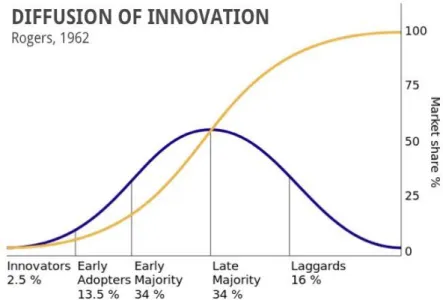
Innovation diffusion theory differentiate adoptions into five different categories based on the innovation tendency. They are the innovators, the early adopters, the early majority, the late majority, and the laggards (figure 1). Innovators are courageous people who bring changes, and very important communication channel (Rogers, 1976). Early adopters represent groups who lead opinions and
8
carefully try new ones. Until now diffusion studies have focused only on successful cases and have overlooked failed innovations. There was no interest in why potential adopters refused or stopped adopting innovation (Rogers, 1995; Ram, 1987; Sheth, 1981).
Figure 1. Diffusion of Innovation Theory (Rogers, 1962)
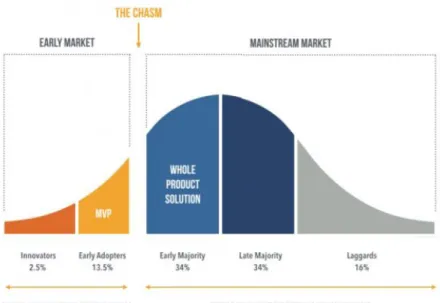
However, there are new failure in new product launching than successful ones. No matter how good the product is, it could be explained in a downturn until it is used by the majority of public. This is called the chasm. Initial adopters and mainstream consumers purchase the product for different reasons at different points. A small number of consumers show the innovative reacts in the early days of product launches, but then the market moves to practical consumers. High-tech firms sometimes experience a sharp decline
9
in sales between early and mainstream markets (Linowes, 1999). In transitional period, disconnection phenomenon in which demand temporarily stagnates or retreats is called chasm (Moore, 1991).
In launching new product, suppliers can be assured of product stability in the mainstream market beyond the level of the chaos. It is important at the initial period to inform the market through early market adopters and then to be recognized by mainstream market adopters. To overcome the chasm and enter the mainstream market, they must strive for a niche market. To do that, product leadership and customer intimacy are important. Consumer innovativeness can be the most important role in this stage.
10
Consumer Innovativeness can be an indicator to distinguish consumers who are innovative in the process of contacting new products (Steenkamp, 1999). Innovative consumers lead opinions and provide ratings for new products to other consumers. Innovative consumers often have a higher social status. Education and income. Young people are more open to new product purchases because they are self-orientated (Mowen & Minor, 1995). As the number of innovative consumers in upper society increases, the influence of online network media such as SNS will also increase.
Consumer characteristics that favor new and differentiated experiences can be commonly reflected in adaption behavior to various new product and industry characteristics. Innovative behaviors react at first in adoption stage of new and differentiated products at first (Goldsmith & Hofacker., 1991). Consumer innovation indicators can tell who is first consumer to launch a new product. The early adaption’s behavior influences the diffusion of new products. This study investigates innovative consumers at first who should pay attention to overcome chasm in the diffusion stages.
11 3. Type of production innovation
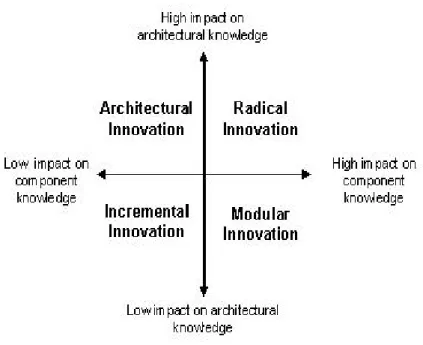
There are many different types of innovation phenomena. Henderson & Clark (1990) presents four types of innovation based on diversity and originality in product, service and process. The framework to distinguish innovation types can be classified by knowledge types and knowledge levels (Venkatraman, 1991). Types of knowledge include component knowledge and system knowledge. Component knowledge refers to the element knowledge having a subject and field of innovation (Venkatraman, 1991). System Knowledge is knowledge of how to associate component knowledge. Component knowledge can be categorized into reinforced and overturned levels in detail. System knowledge is divided by unchanged level and changed level.
Considering knowledge types and levels, four types of innovation appear radical innovation, modular innovation, architectural innovation. Radical Innovation is the center of change in systematic knowledge, and Incremental Innovation emphasized reinforcement of elemental knowledge (Venkatraman, 1991). Radical Innovation is an innovation that replaces existing elements and creates new systems (Walker, 2006). It is a different set of scientific or engineering principals (Popadiuk & Choo, 2006). This type is
12
relatively rare and accounts for about 10% of innovation. Incremental Innovation is an innovation that refines existing designs through the enhancement of elements. It has relatively minor changes to an existing product. Modular Innovation replaces a core component, but leaves the architecture untouched (Magnusson et al., 2003). And Architectural Innovation leaves the existing component, but changes the ways in which the components are linked.
In the case of new food products, it can be divided into Modular Innovation, which changes some concept of product, and architectural innovation, which changes product processing architecture (Galunic et al., 2001). In the innovation of product due to the improvement of food processing, architectural innovation has an important meaning (Bozdogan, 1998). R & D on new food products is mostly focused on changes in the food processing process.
It is easy for competitors to imitate products in the case of new products with little change in the product process (Magnusson, 2003). It is called Me-too product that a competitor makes a popular product as a similar product. Me-too phenomenon is serious in the Korean food market. It is advantageous in that it expands the market size through common marketing among
13
companies, but it has the disadvantage of weakening profitability by increasing supply of similar products in the same market.
Me-too product strategy is a typical phenomenon in the food market and the pharmaceutical market (Oke, 2007). Me-too products can limit the monopoly power in the market, and reduce damage caused by it. Even new markets can be formed through me-too product. Consumers also benefit from improved product selection and quality.
However, it is accused of being immoral in that it invests little in R&D costs, easily makes new products and intercepts popularity (Lukas & Ferrell, 2000). Excessive commodities can confuse consumers' choices and weaken their own identity. In the food market, there is a tendency to reduce the motivation for product launching strategy through R & D and to make a market sick (Oke, 2007).
Therefore, continuous R & D is needed to secure competitiveness in the food market. In the food market, the product processing changes important subject for R & D (Alexander, 1995). The need for R&D means the need for product process innovation, which can be explained through Architectural Innovation. This study pays attention to the difference in consumer behavior to new products
14
with architectural and modular innovation.
Figure 3. Type of Innovation (Henderson & Clark, 1990)
4. Shaping Hypotheses
This paper compares adoption process of new food products with different type of innovation, Modular and Architectural Innovation. Consumer innovativeness and diffusion theory plays important role to explain the difference. Especially, it confirms how the characteristic of Architectural Innovation differs from that of food product with Modular Innovation, which affects product diffusion. The proliferation of new products is explained by the Innovation
15
Diffusion Theory and consumer innovativeness. As they explain other innovative products diffusion in the market, they could also explain consumer innovativeness impact on the new food product diffusion. They can help to decide whether and what type of new food product to develop considering consumers. In addition, it can confirm whether consumer innovativeness plays a key role in adapting to the new food product, and whether they have same impacts on different type of innovation. This research tries to confirm that consumers with consumer innovativeness actually lead to food market adaptation. And if also tries to confirm whether the consumers with different level of innovativeness purchase the new food products with different type of innovativeness. Following research hypothesis are raised to satisfy the issues raised above.
H1: Innovative consumers purchase the new food products initially after their launching, regardless of innovation type (Architectural or Modular)
H2: The purchase of the new food products expands to all consumers in the long term (diffusion), regardless of product innovation type
16
Ⅲ. Research Design
1. Research procedure
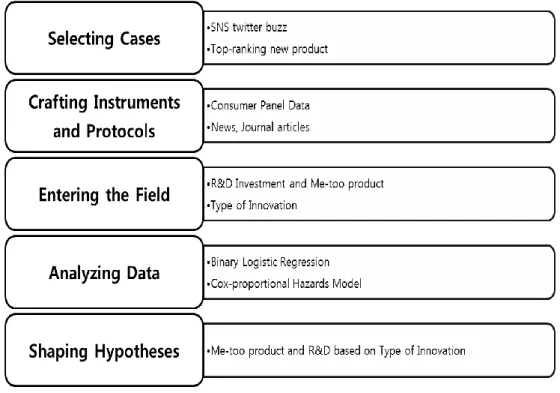
For research, we will utilize the research process for case study research by Eisenhardt (1988). He argues that to construct a theory, it must be able to explain the situation through specific representative organizations or phenomena. The research approach is particularly appropriate for designing new topics or perspectives. This process are composed by getting started, selecting cases, crafting instruments and protocols, entering the field, analyzing data, shaping hypotheses, and enfolding literature and reaching closure. According to select cases, back up sample through multiple data, and classify cases by situation, we perform pre-analysis process. Then we verify hypothesis and problem through actual data analysis, and draw a conclusion according to research direction.
17
Figure 4. The research procedure for this study
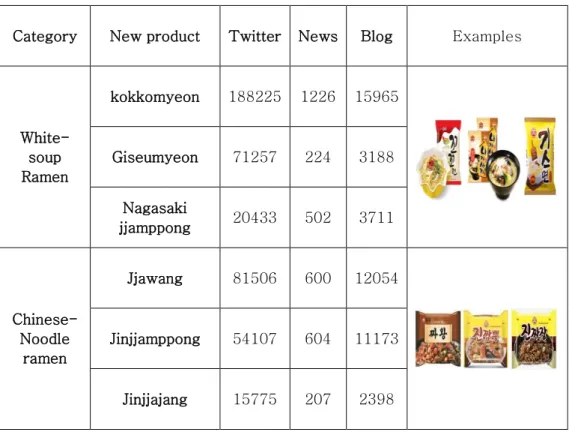
To approach research problem, we have listed representative food products in South Korea for the past 5 years. There are many ramen noodles in Korea every year. However, only certain ramen products gain popularity and most of the rest disappear. In this study, two new product groups selected according to the SNS buzz amount considering the popularity of new products and SNS twitter buzz amount for the past 5 years. White-soup ramen and Chinese noodle ramen are examples of success in the Korean ramen market.
18
Table 1. The case of ramen noodles SNS buzz
Category New product Twitter News Blog Examples
White-soup Ramen kokkomyeon 188225 1226 15965 Giseumyeon 71257 224 3188 Nagasaki jjamppong 20433 502 3711 Chinese-Noodle ramen Jjawang 81506 600 12054 Jinjjamppong 54107 604 11173 Jinjjajang 15775 207 2398
Case1: While-soup Ramen
Kokomyeon was first announced by one entertainer of South Korea in August 2011. Compared with most of the existing red soup ramen, it differentiates color of the soup and clean and spicy chicken broth are the key points. Kokomyeon spread rapidly through broadcasting and SNS media, and accounted for 20% of the market share in 3 months. If realized popularity in the online and offline markets, especially to super markets and large scale stores, competitors released similar white soup ramen, Giseumyeon and Nagasaki jjamppong. Those market had grown to the second position in
19
ramen market share. However, market share fell to 1% within next 8 months. This indicates that consumers are interested in a new style of ramen, but they tend to return to their familiar taste after 6 months. Five years later, many of them have been discontinued.
It was innovative where white soup differs from the conventional red one. Consumers felt innovation through different taste and concept. However, it represents change of a part of product, especially elements of the ramen rather than a whole product configuration or system process. Consumers feel novelty through products that break the perception that ramen is red. There is no particular change in the product process. It is a product that changes taste and ingredients of soup. This is close to Modular Innovation in the innovation type.
Case2: Chinese Noodles Ramen
Jjawang is a new type of ramen product that are launched through long-term R&D by a famous ramen company in Korea. They released the premium Chinese style ramen through the thick noodles which are different from existing soft noodle ramen. In the first year, they developed a chopped noodle. They have developed a noodle that does not easily spread over time while realizing the
20
chewiness of the surface. New technology that increases the heat transfer rate inside the noodle surface and slows the penetration of moisture in applied in the process. It is an upgrades such as putting kelp powder on 3mm noodles and making curved surface. Although traditional Chinese style, such as jjapagatei, were existed, the cause of new style product is the innovative noodle stripes created through R&D.
In October 2015, other ramen maker launched Jin jjamppong using the principle of Chinese cuisine “Wok”. Wok is a method in which the surface moisture is evaporated instantaneously when the vegetables are roasted in oil, and the incense generated by grinding is cooked on the dish. In addition, in order to produce deep soup, they also developed broth by consultation with Japanese experts.
Competitors have launched similar products with thick noodles and Chinese-style soup. However, it has not been easy to follow on quality manufacturing method made through long-term R&D. As a result, Jjawang and Jin jjamppong are still popular.
Jjawang and Jinjjamppong were not simply pursuing changes in product composition, but pursued innovation in product process. They have introduced new process differentiated from existing process of ramen product and naturally combined with existing
21
product structure. They have maintained the traditional concept of Chinese style ramen and changed the structure of the product architecture. The case fits for the product with architectural innovation.
2. Entering the field
The two new ramen noodle products have been popular in South Korea for the last 5 years. They have attracted attention by Me-too products and encouraged R&D for new food products. All two ramen noodles have enjoyed short-term popularity, but their stability in the long-term market is much different. White-Soup Ramen became popular after launching because of the explosive SNS response. However, competitors have also launched me-too product and they together have lost competitiveness in the market one by one. They focused on marketing rather than product development. For existing ramen consumers, white soup ramen was instantly innovative and new, but for long time.
On the other hand, Chinese-Noodle is new food products developed by long-term effort through R & D investment over two years. Innovation in product processing made them to have technical and competitive power as a new product. Even after the launch of competitive products, it has not been easy to imitate still enjoys
22 popularity.
In terms of product innovation, White-soup Ramen is characterized by Modular Innovation and Chinese-noodle ramen is characterized by Architectural innovation. Both information and product innovation type affects the consumers and diffusion of the product in the short term. However, in the long term, the product innovation type makes different results for long term success.
The characteristics of product innovation and the product launching process affects initial purchase of new products and long term spread of the market. This study tries to explain the consumer purchasing behavior of new food product by innovation type and consumer innovativeness, including short and long term purchase of the products. The two different new food products cases, white soup ramen and Chinese noodle ramen are used for analysis (Table 2)
23
White Soup Ramen Chinese Noodle Ramen
Figure 5. Purchase Time Series of each case
Table 2. Category of new food product case by type of Innovation
New food product case Innovation Type Characteristics
Case1: White Soup Ramen Modular Innovation Short period R&D
Me-too Product
Case2: Chinese Noodle Ramen
Architectural
24
Ⅳ. Analysis
1. Data Collection
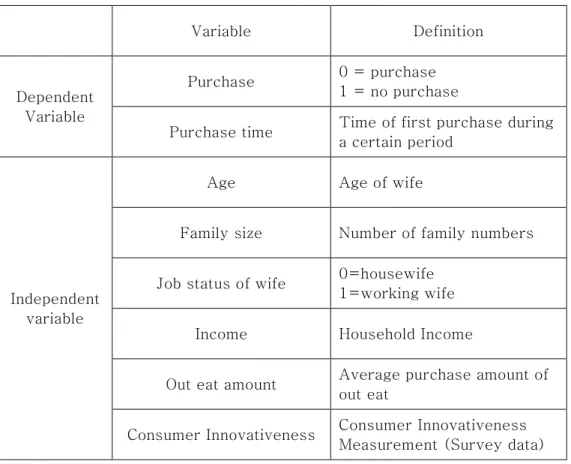
We use agri-food consumer panel data of the Rural Development Administration(RDA). Data is based on grocery purchase records from actual household panels. RDA have collected and accumulated 1,000 household weekly food consumption data of since December 2010. Most households are housewives who live in Seoul of South Korea. This study used food consumption data of 586 households who have been continuously participate in the data collection since then. The household purchase data for white soup and Chinese noodle ramen from their market launching to November 2015 are used for analysis. As a demographic variable of each household, including family size, income, age and job status of wife are for independent variables. Total eat out expenses and consumer innovativeness are also used for independent variable. The purchase (buy amount) and its time (when to buy) are dependent variables (Table3).
25
Table 3. Variable Constructs and Descriptions
Variable Definition
Dependent Variable
Purchase 0 = purchase
1 = no purchase
Purchase time Time of first purchase during
a certain period
Independent variable
Age Age of wife
Family size Number of family numbers
Job status of wife 0=housewife
1=working wife
Income Household Income
Out eat amount Average purchase amount of
out eat
Consumer Innovativeness Consumer Innovativeness
Measurement (Survey data)
To measure the consumer innovativeness a questionnaire survey (Table 4) were conducted for all panel households following Goldsmith et al., (1991). Consumers who selected higher level in the questionnaire are more innovative than ones with lower level.
26
Table 4. Consumer Innovativeness Questionnaire
Scale Item (Goldsmith et al., 1991)
Level 1. In general, I am among the last in my circle of friends to buy new food products when it appears
Level 2. If I heard that new food products were available in the store, I would be interested enough to buy it
Level 3. Compared to my friends, I own few new food products Level 4. I will buy new food products, even if I haven’t heard it yet
Level 5. In general, I am the last in my circle of friends to know the names of the latest food products
Level 6. I know about new food products before other people do
2. Impact of consumer innovativeness on new food product purchase To find consumer innovativeness impact on the new food product purchase, the Binary Logistic Regression is applied. The dependent variable has value 1 for purchase of the new food product and 0 for not. Consumer innovativeness, age, family size, income, dining out expenses, and job status of wife are used as independent variables.
27
3. Impact of consumer innovativeness on purchase diffusion of new food product
Cox-proportional Hazard model are used to identify the effect of consumer innovativeness on the whole market after the new food product launching. Cox-proportional hazard model is also a kind of Hazard Model based on the Bass Diffusion Model. Cox-proportional hazard model is a method to process censored data and time series data using logistic regression. Regression analysis is performed considering many factors that affect survival (Age, Family Size, Job Status of wife, Income, out eat amount, Consumer Innovativeness) Survival analysis is an area that deals with data related to the life of an original individual.
However, to explain new food product and innovation, various studies based on Bass Diffusion Model have been conducted. Bass Diffusion Model is used to describe the process by which new product adapt to the actual market. It may understand the behavior of current adopters and potential adopters. It explains how consumers are gradually adapting to the market and helps to distinguish between innovators and imitators in the new food product adopters. To identify innovators, we use diffusion of innovations and consumer innovativeness to identify members of
28 those category.
According to the innovation type in this study, it can be confirmed that the adopters with high consumer innovativeness in each case actually lead to market adaptation of new food products. The existing demographic variables are used as independent variables, and the actual purchase and purchase timing of each panel are set as dependent variables. It can be confirmed that adopters with high consumer innovativeness actually lead to market adaptation of new food products considering Innovation type. Existing demographic and variables are used as independent variables, with actual purchase and purchase timing of each panel set as dependent variables.
29
Ⅴ. Research Results
1. Impact of Consumer Innovativeness on new food products
To compare the impact of consumer innovativeness on different types of new food products, the Binary logistic regressions are applied. For white Soup Ramen, the new food product with modular innovation, consumer innovativeness variable has a significant impact on the first and second months after launching. Chinese Noodle Ramen has a significant effect on first, second, and third period. In summary, consumer innovativeness plays important role on purchase of new food products regardless of the innovation type in the initial period after launching. Those result indicates that consumers with consumer innovativeness influence the initial purchase of new food products and confirm hypothesis, (H1). Innovators and Early adopters plays key role in the new food product market in initial periods after launching. For the case of new ramen, it affects 2~3months after launching.
30 Si g n if ica n ce lev e ls : * * * : p < 0 .0 1 , * * : p <0 .0 5 , * : p <0 .1 R sq ua re C o n su mer In n o v ativ e n es s O ut eat su m In c o me H o use W if e F a mil y N u mber A g e (In ter cep t) Ta b le 5 . Wh ile S o u p R am e n ( M o d u la r In n o v a tio n ) 0 .5 1 0 .1 1 8 (0 .0 4 0 9 )* * -9 .7 2 E -06 (2 .6 9 E -0 6 )* 2 .9 8 E -04 (2 .0 6 E -0 4 ) 0 .5 1 2 ( 0 .2 8 9 ) 0 .2 4 1 ( 0 .1 4 ) 0 .0 3 7 5 ( 0 .0 2 1 ) -7 .3 8 0 (1 .5 7 )* * * 1 p er io d 0 .3 4 0 .0 6 5 (0 .0 3 3 4 )* -5 .6 7 E -06 (3 .5 5 E -0 6 ) 2 .4 8 E -04 (2 .0 5 E -0 4 ) 0 .6 6 1 (0 .2 3 6 )* * 0 .0 6 8 3 ( 0 .1 2 5 ) -0 .0 1 1 4 (0 .0 1 7 9 ) -2 .9 9 0 (1 .3 1 )* * 2 p er io d 0 .3 5 0 .0 1 9 4 (0 .0 2 6 7 ) -7 .1 9 E -07 (2 .0 8 E -0 6 ) 6 .9 2 E -05 (3 .2 0 E -0 4 ) 0 .0 4 3 5 (0 .0 1 8 5 ) -0 .0 1 5 1 (0 .0 9 8 3 ) -0. 0 2 6 9 (0 .0 1 3 9 )* -0 .2 3 5 ( 1 .0 4 ) 3 p er io d 0 .4 6 0 .0 3 9 5 (0 .0 1 5 8 ) -2 .6 8 E -06 (1 .1 5 E -0 6 ) 1 .2 8 E -04 (1 .5 5 E -0 4 ) 0 .1 7 4 ( 0 .1 1 ) 0 .2 2 7 (0 .0 5 8 )* * 0 .0 0 1 1 ( 0 .0 0 8 ) -2 .5 8 0 (0 .6 1 2 )* * 4 p er io d 0 .5 4 0 .0 0 0 9 1 4 (0 .0 2 6 2 ) -3 .3 1 E -07 (2 .0 7 E -0 6 ) -5 .2 2 E -05 (1 .9 1 E -0 4 ) 0 .0 4 3 3 ( 0 .1 8 4 ) 0 .0 9 1 ( 0 .0 9 8 ) -0 .0 3 0 3 (0 .0 1 4 )* * 0 .4 0 7 ( 1 .0 5 ) 5 p er io d 0 .3 4 -0 .0 3 3 2 (0 .0 2 8 6 ) 2 .6 6 E -06 (2 .0 7 E -0 6 ) 1 .3 7 E -04 (2 .1 2 E -0 4 ) -0 .0 5 7 4 (0 .2 0 0 ) -0 .0 5 5 2 (0 .1 0 4 ) -0 .0 2 1 4 (0 .0 1 4 8 ) 0 .6 9 2 ( 1 .1 2 ) 6 p er io d
31 Si g n if ica n ce lev e ls : * * * : p< 0 .0 1 , * * : p< 0 .0 5 , * : p< 0 .1 R sq uar e C o n su mer In n o v ativ e n es s O ut eat su m In c o me H o use W if e F a mil y N u mber A g e (In ter cep t) Ta b le 6 . C h in e s e No o d le Ra m e n ( Arc h itec tu ral I n n o v at io n ) 0 .3 4 0 .1 2 0 4 (0 .0 3 8 8 )* * * 1 .4 1 E -06 (2 .7 7 E -0 6 ) 1 .8 0 E -04 (2 .5 7 E -0 4 ) 0 .3 5 3 ( 0 .2 7 5 ) 0 .1 5 0 ( 0 .1 3 9 ) -0 .0 6 5 (0 .0 2 0 )* * * -1 .7 4 0 (1 .5 0 6 ) 1 perio d 0 .3 0 0 .0 0 0 7 (0 .0 3 1 0 )* * * 7 .1 6 E -07 (2 .2 4 E -0 6 ) -5 .8 7 E -04 (5 .1 9 E -0 4 ) 0 .0 9 5 ( 0 .2 1 8 ) 0 .0 9 6 ( 0 .1 1 4 ) -0 .0 3 3 (0 .0 1 6 )* * 0 .0 3 1 ( 1 .2 1 2 ) 2 perio d 0 .2 5 0 .0 8 5 1 (0 .0 3 1 8 )* * * 2 .3 2 E -06 (2 .1 2 E -0 6 ) 1 .5 7 E -05 (2 .5 9 E -0 4 ) 0 .0 2 5 ( 0 .2 2 1 ) 0 .0 9 6 ( 0 .1 1 4 ) -0 .0 1 5 (0 .0 1 6 ) -2 .6 7 1 (1 .2 3 1 )* * 3 p er io d 0 .2 1 0 .0 3 3 9 (0 .0 3 3 5 ) -3 .7 2 E -08 (2 .4 8 E -0 6 ) -4 .7 1 E -04 (5 .4 6 E -0 4 ) -0 .0 1 5 (0 .2 3 4 ) 0 .1 6 5 ( 0 .1 2 1 ) -0 .0 0 3 (0 .0 1 7 ) -2 .4 9 0 (1 .2 9 3 )* 4 p er io d 0 .1 9 0 .0 0 0 3 (0 .0 3 1 2 ) -2 .2 3 E -06 (2 .6 4 E -0 6 ) -1 .7 0 E -04 (3 .7 8 E -0 4 ) -0 .2 9 8 (0 .2 2 0 ) 0 .1 9 5 ( 0 .1 1 4 )* -0 .0 3 8 (0 .0 1 6 )* * 0 .0 7 6 ( 1 .2 1 8 ) 5 p er io d 0 .2 4 0 .0 3 2 4 (0 .0 3 1 6 ) -6 .9 2 E -07 (2 .4 3 E -0 6 ) 5 .1 0 E -05 (2 .3 4 E -0 4 ) -0 .0 3 5 (0 .2 2 3 ) -0 .0 3 3 (0 .1 1 8 ) -0 .0 4 0 (0 .0 1 6 )* * 0 .1 1 4 ( 1 .2 5 2 ) 6 p er io d
32
2. Consumer Innovativeness Impact on purchase diffusion of new food products
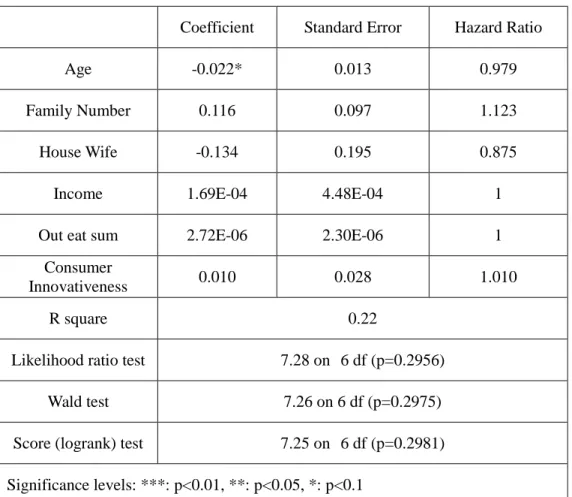
Cox-proportional hazards model is applied to find consumer innovativeness does have significant impact on purchase and purchase time of white soup ramen. On the other hand, It has no significant impact on the purchase and purchase time of Chinese noodle soup ramen. The results explain the diffusion of purchase increase to all consumers in the new food products market with architectural innovation. They also explain the short term purchase expansion of new food products with modular innovation, but the purchase disappearance in the long term with launching. In the case of a new product with Modular Innovation, which has changed part of the composition innovative consumer purchase the food product initially, but the purchase behavior is not diffused to less innovative consumers. However, in the case of a new product of Architectural Innovation, innovative consumers do not only buy the products, but also drive purchase behavior differenced to other consumer. In other words, the proliferation of new architectural innovations takes place through the entire consumer regardless of consumer innovativeness. Consumer Innovativeness, therefore, selectively drives the proliferation of new products by type of innovation.
33
In addition, for each demographic variable, White Soup Ramen had higher purchasing power at large family numbers. Also, Chinese Noodle Ramen had higher purchasing power at lower age. Generally, it shows the purchasing characteristics of each item. The results show that the implications of market adaptation and product launching strategy according to Innovation type presented can be derived.
Table 7. While Soup Ramen (Modular Innovation)
Coefficient Standard Error Hazard Ratio
Age -0.003 0.008 0.997
Family Number 0.074*** 0.055 1.077
House Wife 0.112 0.104 1.119
Income 8.15E-06 7.37E-05 1
Out eat sum -1.39E-06 1.17E-06 1
Consumer
Innovativeness 0.021*** 0.016 1.021
R square 0.17
Likelihood ratio test 8.44 on 6 df (p=0.2075)
Wald test 8.33 on 6 df (p=0.215)
Score (logrank) test 8.34 on 6 df (p=0.2143)
34
Table 8. Chinese Noodle Ramen (Architectural Innovation) Coefficient Standard Error Hazard Ratio
Age -0.022* 0.013 0.979
Family Number 0.116 0.097 1.123
House Wife -0.134 0.195 0.875
Income 1.69E-04 4.48E-04 1
Out eat sum 2.72E-06 2.30E-06 1
Consumer
Innovativeness 0.010 0.028 1.010
R square 0.22
Likelihood ratio test 7.28 on 6 df (p=0.2956)
Wald test 7.26 on 6 df (p=0.2975)
Score (logrank) test 7.25 on 6 df (p=0.2981)
35
Ⅵ. Conclusion
New food products market in South Korea shows characteristics of bandwagon effect, hunger marketing, and viral marketing. Launching the various food products is getting popular and the development of new food products is becoming diverse. Some products have shown explosive consumer responses after launching in the market. After a few months, some products are discontinued where others are still attracting consumers.
Innovative consumers are more likely to change to another product right after new product launching. And hence the producers of the new food products could enjoy the sales expansion in the market. But not every new food product can get attention and enjoy the sales expansion. Manufacturers and marketers in these markets need to understand the characteristics of consumer response and diffusion for successful launches for their products. The consumer adoption may be different depending on the characteristics of new food products, especially their innovation type.
This study tries to explain the different diffusion results of new food products, based on their innovativeness. Consumers respond differently to new food products based on its innovation types,
36
performance of several new food products which have drawn explosive responses after launching in South Korea food market.
Binary logistic regression model and Cox-proportional hazards model are applied to explain market performances of the new food products by consumer innovativeness and innovation type of new food products. Various problems arising in the process of new food products launching are explained.
The result identifies consumer innovativeness as a significant determinant at the initial period of both innovation types in new food product consumption. However, the consumer innovativeness only affects purchase of new food products with modular innovation in the long term, but does not on products with architectural innovation. The results explain the diffusion of purchase increase to all consumers in the new food products market with architectural innovation. They also explain the short term purchase expansion of new food products with modular innovation, but the purchase disappearance in the long term with launching.
Therefore, the new food developers should not be overly optimistic to innovative consumers. Rather, it should focus on the innovation of product development than the innovation that consumers perceive. The success of the new food products highly depends on
37
level of innovation on the new products. Introducing the new food products with architectural innovation has higher probability of success rather than new products with modular innovation. The more innovative product could be diffused to the more consumers.
Temporary and partial product innovations in the fast-paced food markets can attract consumer interest in the short term, but they cannot hold consumers' hearts in the long run. R & D investment to pursue architectural innovation for the new food products can increase the success rate for the new products in the long run. A product developed through Architectural Innovation can prevent launches of the Me-Too products to copy.
This study provides the adoption model for new food products using consumer innovativeness and product innovation type based on innovation diffusion model. It is first attempt to estimate the consumer adoption and diffusion for the new food products using the Cox-proportional hazards model. It provides methods to understand the proliferation of new food products using innovation diffusion theory, and therefore the new food product development strategy for producers.
The lack of cases and data to apply the model limits to extend the findings on other food products. Further research should be
38
conducted through additional cases and enough data. And it will help the producers to the develop new food products.
39
Reference
Alexander, D. L., Flynn, J. E., & Linkins, L. A. (1995). Innovation, R&D productivity, and global market share in the pharmaceutical industry. Review of Industrial Organization, 10(2), 197-207. Anderson, E. W. (1998). Customer satisfaction and word of
mouth. Journal of service research, 1(1), 5-17.
Arndt, J. (1967). Role of product-related conversations in the diffusion of a new product. Journal of marketing Research, 291-295.
Atuahene-Gima, K. (2005). Resolving the capability—rigidity
paradox in new product innovation. Journal of marketing, 69(4), 61-83.
Benedetto, C. A. (1999). Identifying the key success factors in new product launch. Journal of product innovation management, 16(6), 530-544.
Bozdogan, K., Deyst, J., Hoult, D., & Lucas, M. (1998). Architectural innovation in product development through early supplier integration. R&D Management, 28(3), 163-173.
Cooper, R. G. (1979). The dimensions of industrial new product success and failure. The Journal of Marketing, 93-103.
Cooper, R. G., Edgett, S. J., & Kleinschmidt, E. J. (1999). New
product portfolio management: practices and
performance. Journal of product innovation management, 16(4), 333-351.
Costa, A. I. A., Dekker, M., Beumer, R. R., Rombouts, F. M., & Jongen, W. M. F. (2001). A consumer-oriented classification system for home meal replacements. Food Quality and Preference, 12(4), 229-242.
Costa, A. I., & Jongen, W. M. F. (2006). New insights into consumer-led food product development. Trends in Food Science & Technology, 17(8), 457-465.
Del Giudice, T., & Pascucci, S. (2010). The role of consumer acceptance in the food innovation process: Young consumer perception of functional foods in Italy. International Journal on
40
Food System Dynamics, 1(2), 111-122.
Dragone, D., & Savorelli, L. (2012). Thinness and obesity: A model
of food consumption, health concerns, and social
pressure. Journal of health economics, 31(1), 243-256.
Eisenhardt, K. M. (1989). Building theories from case study research. Academy of management review, 14(4), 532-550. Eisenhardt, K. M. (1991). Better stories and better constructs: The
case for rigor and comparative logic. Academy of Management review, 16(3), 620-627.
Fuller, G. W. (2016). New food product development: from concept to marketplace. CRC Press.
Galunic, D. C., & Eisenhardt, K. M. (2001). Architectural innovation and modular corporate forms. Academy of Management journal, 44(6), 1229-1249.
Goldsmith, R. E., & Hofacker, C. F. (1991). Measuring consumer
innovativeness. Journal of the academy of marketing
science, 19(3), 209-221.
Guiltinan, J. P. (1999). Launch strategy, launch tactics, and demand outcomes. Journal of Product Innovation Management, 16(6), 509-529.
Henderson, R. M., & Clark, K. B. (1990). Architectural innovation: The reconfiguration of existing product technologies and the failure of established firms. Administrative science quarterly, 9-30.
Hultink, E. J., Griffin, A., Hart, S., & Robben, H. S. (1997). Industrial new product launch strategies and product development performance. Journal of Product Innovation Management, 14(4), 243-257.
Leibenstein, H. (1950). Bandwagon, snob, and Veblen effects in the theory of consumers' demand. The quarterly journal of economics, 64(2), 183-207.
Li, T., & Calantone, R. J. (1998). The impact of market knowledge competence on new product advantage: conceptualization and empirical examination. The Journal of Marketing, 13-29.
41
Linowes, J. S. (1999). A Summary of “Crossing the Chasm”. Parker
Hill Technology.
Lukas, B. A., & Ferrell, O. C. (2000). The effect of market orientation on product innovation. Journal of the academy of marketing science, 28(2), 239-247.
Magnusson, T., Lindström, G., & Berggren, C. (2003). Architectural or modular innovation? Managing discontinuous product
development in response to challenging environmental
performance targets. International Journal of Innovation Management, 7(01), 1-26.
Mahajan, V., Muller, E., & Bass, F. M. (1990). New product diffusion models in marketing: A review and directions for research. The journal of marketing, 1-26.
Moore, G. A. (1991). Crossing the Chasm: Marketing and selling high-tech goods to mainstream customers.
Mowen, J. C., & Minor, M. (1995). Customer Behavior.
Oke, A. (2007). Innovation types and innovation management practices in service companies. International Journal of Operations & Production Management, 27(6), 564-587.
Popadiuk, S., & Choo, C. W. (2006). Innovation and knowledge creation: How are these concepts related?. International journal of information management, 26(4), 302-312.
Ram, S. (1987). A model of innovation resistance. NA-Advances in Consumer Research Volume 14.
Rogers Everett, M. (1995). Diffusion of innovations. New York, 12. Rogers, E. M. (1976). New product adoption and diffusion. Journal of
consumer Research, 2(4), 290-301.
Ryan, B., & Gross, N. C. (1943). The diffusion of hybrid seed corn in two Iowa communities. Rural sociology, 8(1), 15.
Sheth, J. N. (1981). An integrative theory of patronage preference and behavior (pp. 9-28). College of Commerce and Business Administration, Bureau of Economic and Business Research, University of Illinois, Urbana-Champaign.
42
Steenkamp, J. B. E., Hofstede, F. T., & Wedel, M. (1999). A cross-national investigation into the individual and cross-national cultural antecedents of consumer innovativeness. The Journal of Marketing, 55-69.
Stewart-Knox, B., & Mitchell, P. (2003). What separates the
winners from the losers in new food product
development?. Trends in Food Science & Technology, 14(1), 58-64.
Van der Valk, W., & Wynstra, F. (2005). Supplier involvement in new product development in the food industry. Industrial Marketing Management, 34(7), 681-694.
Venkatraman, M. P. (1991). The impact of innovativeness and innovation type on adoption. Journal of Retailing, 67(1), 51.
Walker, R. M. (2006). Innovation type and diffusion: An empirical analysis of local government. Public administration, 84(2), 311-335.