ORIGINAL ARTICLE
내시경 생검 후 서면 교육자료 제공의 불안 수준 완화: 전향적
무작위 대조연구
김혜원, 정다현, 윤영훈, 김지현, 김재진
1, 박효진
연세대학교 의과대학 강남세브란스병원 내과학교실, 정신과학교실1
Written Educational Material Relieves Anxiety after Endoscopic Biopsy: A Prospective
Randomized Controlled Study
Hae Won Kim, Da Hyun Jung, Young Hoon Youn, Jie-Hyun Kim, Jae Jin Kim1, and Hyojin Park
Departments of Internal Medicine and Psychiatry1, Gangnam Severance Hospital, Yonsei University College of Medicine, Seoul, Korea
Background/Aims: Patients who undergo endoscopic biopsy suffer anxiety until results are confirmed. This study assesses the effects of written educational material on the anxiety level of patients following endoscopic biopsy.
Methods: This study was a randomized controlled study trial with 83 patients divided into the following three groups: a biopsy group given written educational material prepared by our institution following the biopsy (intervention group, n=28), a biopsy group without written material (biopsy only group, n=25), and a control group without biopsy (control group, n=30). The anxiety level of each patient was evaluated three times using Spielberger’s State-Trait Anxiety Inventory (STAI): for baseline at the first visit to our institution, at the day of endoscopy, one day later, and one week after the procedure. We compared baseline characteristics, STAI scores at each visit, and differences in STAI scores among the three groups.
Results: No difference was found in STAI score among groups at baseline and before and after the endoscopic procedure. However, the STAI-state score of the intervention group was slightly lower than biopsy only group one day post-procedure (40.3±7.7 vs. 43.9±7.1, p=0.135). The STAI-state score significantly decreased from pre- to post-procedure only in the intervention group (–2.75±6.1 vs. 0.92±4.0, p<0.027).
Conclusions: Use of written educational material for patients having biopsy might lessen their anxiety level. (Korean J Gastroenterol 2016;67:92-97)
Key Words: Patient education handout; Biopsy; Test anxiety scale
Received November 5, 2015. Revised January 20, 2016. Accepted February 5, 2016.
CC This is an open access article distributed under the terms of the Creative Commons Attribution Non-Commercial License (http://creativecommons.org/licenses/ by-nc/4.0) which permits unrestricted non-commercial use, distribution, and reproduction in any medium, provided the original work is properly cited.
Copyright © 2016. Korean Society of Gastroenterology.
교신저자: 박효진, 06273, 서울시 강남구 언주로 211, 강남세브란스병원 소화기내과
Correspondence to: Hyojin Park, Department of Gastroenterology, Gangnam Severance Hospital, 211 Eonjuro, Gangnam-gu, Seoul 06273, Korea. Tel: +82-2-2019- 3318, Fax: +82-2-3463-3882, E-mail: [email protected]
Financial support: None. Conflict of interest: None.
INTRODUCTION
Endoscopic procedures are commonly performed be-cause they afford an exact diagnosis and guidance regarding proper therapeutic intervention. However, they often give rise to anxiety and stress in patients.1 Diagnostic gastroscopy and colonoscopy are strongly associated with increases in
anxiety.2 Maguire et al.3 reported the following reasons for
in-creases in anxiety in patients before endoscopy: (1) fear of procedure-related pain, (2) fear of disease which may be di-agnosed, (3) fear of the procedure itself because of in-sufficient sedation and information, and (4) fear of doctors and other people watching the operation. Many approaches have been tried to lessen patients’ anxiety during
gastro-Fig. 1. Flow chart of the study design. Enrolled patients were measured Spielberger’s State-Trait Anxiety Inven-tory (STAI; state, trait) at reservation day for endoscopy, procedure day and follow up day. Only intervention group patients were provided written educa-tional materials after endoscopic biopsy.
OPD, out-patient department.
scopy or colonoscopy, including therapeutic conversation and touch, aromatherapy and music.4,5 In our experience,
pa-tients who underwent biopsy during their gastroscopy or colo-noscopy felt more anxiety until they knew the exact diagnosis than patients who did not have a biopsy during the diagnostic procedure. Educating patients about gastroscopy or colono-scopy in advance of the procedure, with written educational material or oral explanation, reduces patients’ anxiety.6
However, there is a lack of research about the effects on pa-tients’ anxiety of providing written educational material after biopsy during gastroscopy or colonoscopy.
There are several methods for evaluating the anxiety of pa-tients who undergo endoscopic procedure, including the Spielberger’s State-Trait Anxiety Inventory (STAI), Hospital Anxiety and Depression Scale, and the Visual Analog Scale.7
In this study, we used the Korean version of STAI8 to examine
the effects of providing written educational material on the anxiety level of patients who underwent biopsy during gastro-scopy or colonogastro-scopy.
SUBJECTS AND METHODS
1. SubjectsWe conducted a randomized controlled trial to evaluate the effects of written educational materials on patients’ anxiety. This study included patients who were scheduled for elective gastroscopy or colonoscopy at Gangnam Severance
Hospital, Seoul, Korea, between January 2011 and December 2012. The inclusion criteria for this study were as follows: age between 18 and 75 years, no history of any overt or borderline psychiatric disease, not using psychotropic drugs, able to read and comprehend the details of the study in the patient information sheet, and agreed to participate in this study. Written informed consent was obtained from each partici-pant. This study was approved by the Ethics Committee of the Gangnam Severance Hospital, Yonsei University College of Medicine (IRB number: 3-2011-0087).
2. Randomization and study design
A single study physician performed the randomization process, using a computer-generated randomization table. One hundred thirty-six patients were randomly assigned to one of following three groups: the control group, comprised of patients who underwent diagnostic gastroscopy or colono-scopy; the biopsy only group, comprised of patients who un-derwent biopsy during gastroscopy or colonoscopy and were not provided written educational material; and the inter-vention group, comprised of patients who underwent biopsy during gastroscopy or colonoscopy and were provided written educational material. Thirty-one patients (22.8%) were ex-cluded from the study because of incomplete questionnaires and lost records, and 22 patients (16.2%) did not participate after the procedure. Eighty-three patients completed the en-tire study protocol as randomized to the three groups: the
control group (n=30), the biopsy only group (n=25) and the intervention group (n=28) (Fig. 1). When patients came to schedule an endoscopic procedure, they were asked to com-plete questionnaires that recorded demographic character-istics and to complete the Korean version of the STAI to eval-uate their baseline anxiety level scores. It was translated from STAI, a scale used extensively in research and clinical practice, including Korean populations.8 STAI scores were
al-so measured on the day of their procedure and one day after. Enrolled patients received oral information about the diag-nostic endoscopy and of the probability of biopsy, in some cases before the endoscopic procedure. The patients in the intervention group were provided with written educational material in a handout form prepared by our institution. The oral information content was the same as the written infor-mation. The written educational material for the intervention group included information about the procedure, reasons for biopsy, complications that the patient might encounter, and a scheme of what would take place after the procedure (Supplementary Fig. 1, 2, available online only).
3. Measure
1) Spielberger’s State-Trait Anxiety Inventory (STAI) The STAI, a validated test that quantifies the state of anxi-ety in a patient9 is simple, generally takes less than five
mi-nutes to finish, and is convenient to score. The STAI consists of two parts (20+20 items), with short statements that can be evaluated individually. The two parts are the State portion, an immediate emotional status caused by concern or tension that could be changeable depending on the patient’s current status, and the Trait portion, an acquired personality of feel-ing fear about a safe situation. Each inventory is measured on a four-point scale. Each of the items is rated from ‘not at all’ (coded as 1) to ‘very much so’ (coded as 4). An overall score varies between 20 and 80, and higher scores indicate a higher anxiety level. A normative mean STAI score is 35 for adults of varying ages. Some reports define a high anxiety state as one standard deviation above the normative mean, which is a score ≥45.10,11
4. Statistical analysis
Associations among various categorical variables were evaluated with chi-square and Fisher’s exact tests, and the t-test was used for non-categorical variables. ANOVA
as-sessed the anxiety level of patients among the three groups. Null hypotheses of no difference were rejected if p-values were less than 0.05. All analyses were performed using IBM SPSS Statistics software version 20.0 (IBM Co., Armonk, NY, USA).
RESULTS
1. Demographic and other characteristics of patients There were no significant differences among the three groups in terms of age, sex, socio-demographic variables, co-morbid conditions, and previous experience of endoscopy (Table 1).
2. Anxiety levels
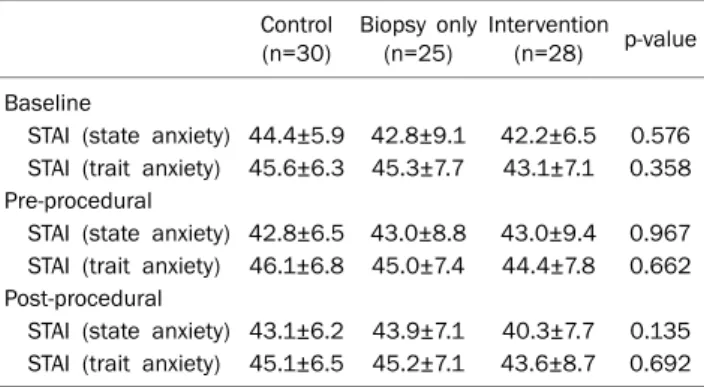
Comparisons of STAI-state and STAI-trait scores at base-line, pre-procedure, and post-procedure are shown in Table 2. There were no significant differences in mean STAI-state and STAI-trait scores among the three groups. However, the mean STAI-state score after the procedure decreased mod-estly compared with baseline and pre-procedure in the biop-sy only group and intervention group. Defining a high anxiety STAI score as ≥45,10 the proportion of patients with high
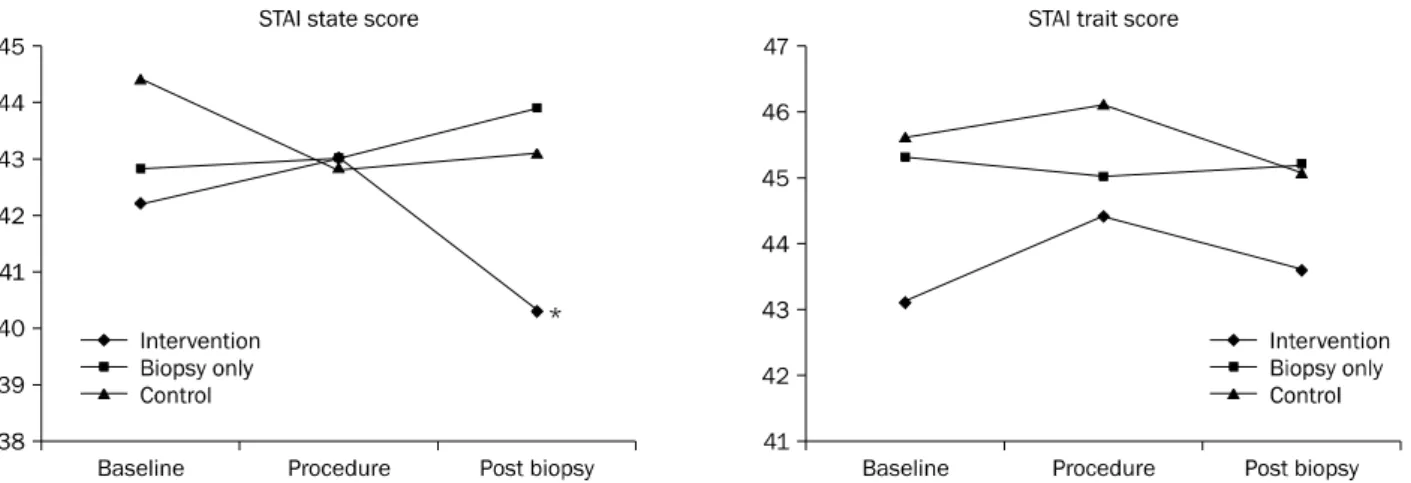
state anxiety STAI scores after the procedure was less than that at baseline and pre-procedure (Table 3). In addition, we analyzed the difference in STAI anxiety scores (STAI-state and STAI- trait) between pre- and post-procedure among the three groups (Table 4). The mean STAI-state scores decreased sig-nificantly in the group that had biopsies and received written educational material (Fig. 2).
DISCUSSION
Anxiety levels are significantly higher in patients prior to gastroscopy and colonoscopy compared to baseline anxiety level.12-14 The anxiety of patients who were given written
edu-cation material before gastroscopy was lower than that of pa-tients not so provided.15 In our study, we focused on the
rela-tion between anxiety and the written educarela-tional material for patients who underwent biopsies during gastroscopy and/or colonoscopy. We showed for the first time that written educa-tional material could lessen the anxiety of patients who re-ceived biopsies. Drossman et al.16 explained the reasons for
Table 1. Demographic Characteristics by Group
Variable Control (n=30) Biopsy only (n=25) Intervention (n=28) p-value
Age (yr) 44.0±12.0 47.4±13.6 51.1±13.8 0.131
Gender 0.814
Male 12 (40.0) 12 (48.0) 13 (46.4)
Female 18 (60.0) 13 (52.0) 15 (53.6)
Educational level 0.762
Primary school graduate 1 (3.3) 2 (8.0) 2 (7.1)
High school graduate 5 (16.7) 5 (20.0) 5 (17.9)
University graduate 21 (70.0) 14 (56.0) 20 (71.4) Not checked 3 (10.0) 4 (16.0) 1 (3.6) Existing conditions 0.223 None 24 (80.0) 10 (40.0) 18 (64.3) Diabetes mellitus 0 (0.0) 1 (4.0) 1 (3.6) Hypertension 2 (6.7) 3 (12.0) 2 (7.1) Thyroid disease 0 (0.0) 2 (8.0) 1 (3.6) Gastric ulcer 0 (0.0) 0 (0.0) 2 (7.1) Duodenal ulcer 0 (0.0) 1 (4.0) 1 (3.6) Gastric cancer 0 (0.0) 1 (4.0) 0 (0.0) Liver disease 1 (3.3) 1 (4.0) 0 (0.0) Others 3 (10.0) 6 (24.0) 4 (14.3) Endoscopy history 0.451 Done 18 (60.0) 19 (76.0) 19 (67.9) Not done 12 (40.0) 6 (24.0) 9 (32.1) Current endoscopy 0.375 Gastroscopy 9 (30.0) 7 (28.0) 3 (10.7) Colonoscopy 8 (26.7) 5 (20.0) 7 (25.0)
Gastroscopy and colonoscopy 13 (43.3) 13 (52.0) 18 (64.3)
Type of biopsya 0.394
Gastroscopy 7 (28.0) 6 (21.4)
Colonoscopy - 5 (20.0) 14 (50.0)
Gastroscopy and colonoscopy 13 (52.0) 8 (28.6)
Values are presented as mean±SD or n (%). aControl group: biopsy was not done.
Table 2. State and Trait Anxiety Scores at Baseline, prior to Gastro-scopy and ColonoGastro-scopy, and One Day Post-procedure by Group
Control (n=30) Biopsy only (n=25) Intervention (n=28) p-value Baseline
STAI (state anxiety) 44.4±5.9 42.8±9.1 42.2±6.5 0.576 STAI (trait anxiety) 45.6±6.3 45.3±7.7 43.1±7.1 0.358 Pre-procedural
STAI (state anxiety) 42.8±6.5 43.0±8.8 43.0±9.4 0.967 STAI (trait anxiety) 46.1±6.8 45.0±7.4 44.4±7.8 0.662 Post-procedural
STAI (state anxiety) 43.1±6.2 43.9±7.1 40.3±7.7 0.135 STAI (trait anxiety) 45.1±6.5 45.2±7.1 43.6±8.7 0.692 Values are presented as mean±SD.
STAI, Spielberger’s State-Trait Anxiety Inventory.
Table 4. Comparisons of Differential in STAI Scores between Pre- and Post-procedure by Group
Control
(n=30) Biopsy only (n=25) Intervention (n=28) p-value STAI (state anxiety)a 0.29±5.3 0.92±4.0 −2.75±6.1 0.029 STAI (trait anxiety) −1.06±7.2 0.25±3.8 −0.71±5.2 0.707 Values are presented as mean±SD.
STAI, Spielberger’s State-Trait Anxiety Inventory. a
p<0.05.
Table 3. Number of Patients with High State Anxiety Scores at Baseline, prior to Gastroscopy and Colonoscopy, and One Day Post-procedure by Group
Control
(n=30) Biopsy only (n=25) Intervention (n=28) p-value STAI (state anxiety) ≥45
Baseline 17 (56.7) 15 (60.0) 9 (32.1) 0.048 Pre-procedural 14 (46.7) 11 (44.0) 12 (42.9) 0.918 Post-procedural 15 (50.0) 12 (48.0) 7 (25.0) 0.099 Values are presented as n (%).
STAI, Spielberger’s State-Trait Anxiety Inventory.
(1) sensory discomfort (e.g., pain, gagging and needles), (2) adverse outcomes (e.g., fear of finding cancer), (3) in-competence/inconvenience (not enough sedation, insuffi-cient knowledge of the procedure), and (4) miscellaneous
Fig. 2. Comparison of mean state and trait anxiety levels after using of written educational material. *The Spielberger’s State-Trait Anxiety Inventory (STAI)-state score was significantly decreased in the intervention group (control, biopsy only, and intervention group; 0.29±5.3, 0.92±4.0, and –2.75±6.1, respectively; p=0.029).
(fear of doctors, concern about others watching the proce-dure). Furthermore, patients are often fearful of cancer diag-nosis after biopsies during gastroscopy and colonoscopy. Anxiety after biopsies might cause unnecessary concern. Morgan et al.17 reported that a detailed explanation reduced anxiety in patients who usually wanted doctors to talk to them about medical decisions. Additionally, a report in Norway even showed that patients were more interested in poten-tially alarming information such as complications than in technical aspects of the endoscopic procedures.18
There-fore, our study team prepared written educational material for patients that includes information about the process of endoscopic biopsy procedure and complication.
The written educational material that we provided effec-tively lessened the anxiety of patients with biopsy because it included sufficient information about the procedure, the rea-sons for the biopsy, complications that the patients might en-counter, and the plan for after the operation. Informing the patient about the procedure in this manner is very important to decrease the anxiety level of the patient before endoscopy and carry out the procedure smoothly. This written educa-tional material was especially critical to reduce the anxiety level in patients who underwent endoscopic biopsy and were more likely to have fear about a diagnosis of uncertain disease.6
The method and timing of providing information to patients prior to endoscopic procedures are most important. If the in-formation is offered to the patients in an inadequate way, the patients’ anxiety may increase. However, some studies found
that the methods of presenting information to patients prior to endoscopy were not significantly associated with the level of anxiety.19,20 In contrast, there are also studies indicating that written or oral educational materials provided to pa-tients had an effect on the level of anxiety.15,21 Our results support the premise that written educational materials alle-viate patients’ anxiety after endoscopic biopsy, especially the STAI-state domain.
The primary limitation of this study is the small number of patients. With this small sample size, we could not evaluate the influence of other factors on anxiety levels, such as gen-der, socioeconomic status, education, and types of proce-dures. Secondly, our study was performed in a well-educated populace, but in areas where the literacy rate is low, the sight of a printed document would surely increase anxiety. Third, although our study was designed as a prospective random-ized controlled trial, the high STAI state-anxiety scored pa-tients in the intervention group were fewer than other two groups. This might significantly lessen the mean anxiety level in the intervention group. However, providing detailed in-formation to patients with high anxiety may increase their anxiety by increasing their awareness of the risks and the in-sertion process.22
Nevertheless, this study has several clinical implications. Our study analyzed the use of written educational material to alleviate patients’ anxiety after endoscopic biopsy. As we ob-served that written educational material effectively reduced anxiety, we recommend that clinicians offer such material to patients undergoing biopsy during endoscopy.
REFERENCES
1. Rollbusch N, Mikocka-Walus AA, Andrews JM. The experience of anxiety in colonoscopy outpatients: a mixed-method study. Gastroenterol Nurs 2014;37:166-175.
2. Ersöz F, Toros AB, Aydoğan G, Bektaş H, Ozcan O, Arikan S. Assessment of anxiety levels in patients during elective upper gastrointestinal endoscopy and colonoscopy. Turk J Gastroen-terol 2010;21:29-33.
3. Maguire D, Walsh JC, Little CL. The effect of information and be-havioural training on endoscopy patients' clinical outcomes. Patient Educ Couns 2004;54:61-65.
4. Rudin D. Frequently overlooked and rarely listened to: music therapy in gastrointestinal endoscopic procedures. World J Gastroenterol 2007;13:4533.
5. Salmore RG, Nelson JP. The effect of preprocedure teaching, re-laxation instruction, and music on anxiety as measured by blood pressures in an outpatient gastrointestinal endoscopy labora-tory. Gastroenterol Nurs 2000;23:102-110.
6. Luo YY. Effects of written plus oral information vs. oral informa-tion alone on precolonoscopy anxiety. J Clin Nurs 2013;22:817- 827.
7. Zigmond AS, Snaith RP. The hospital anxiety and depression scale. Acta Psychiatr Scand 1983;67:361-370.
8. Hahn DW, Lee CH, Chon KK. Korean adaptation of Spielberger's STAI (K-STAI). Korean J Health Psychol 1996;1:1-14.
9. Spielberger CD, Gorsuch RL, Lushene PR, Vagg PR, Jacobs AG. State-Trait anxiety inventory (Form Y). Palo Alto, CA: Mind Garden, 1983.
10. Millar K, Jelicic M, Bonke B, Asbury AJ. Assessment of pre-operative anxiety: comparison of measures in patients awaiting surgery for breast cancer. Br J Anaesth 1995;74:180-183. 11. Kain ZN, Mayes LC, Cicchetti DV, Bagnall AL, Finley JD, Hofstadter
MB. The Yale Preoperative Anxiety Scale: how does it compare with a "gold standard"? Anesth Analg 1997;85:783-788.
12. Jones MP, Ebert CC, Sloan T, et al. Patient anxiety and elective gastrointestinal endoscopy. J Clin Gastroenterol 2004;38:35- 40.
13. Campo R, Brullet E, Montserrat A, et al. Identification of factors that influence tolerance of upper gastrointestinal endoscopy. Eur J Gastroenterol Hepatol 1999;11:201-204.
14. Trevisani L, Sartori S, Putinati S, et al. Assessment of anxiety lev-els in patients during diagnostic endoscopy. Recenti Prog Med 2002;93:240-244.
15. van Zuuren FJ, Grypdonck M, Crevits E, Vande Walle C, Defloor T. The effect of an information brochure on patients undergoing gastrointestinal endoscopy: a randomized controlled study. Patient Educ Couns 2006;64:173-182.
16. Drossman DA, Brandt LJ, Sears C, Li Z, Nat J, Bozymski EM. A pre-liminary study of patients' concerns related to GI endoscopy. Am J Gastroenterol 1996;91:287-291.
17. Morgan J, Roufeil L, Kaushik S, Bassett M. Influence of coping style and precolonoscopy information on pain and anxiety of colonoscopy. Gastrointest Endosc 1998;48:119-127.
18. Aabakken L, Baasland I, Lygren I, Osnes M. Development and evaluation of written patient information for endoscopic proce-dures. Endoscopy 1997;29:23-26.
19. Callaghan P, Chan HC. The effect of videotaped or written in-formation on Chinese gastroscopy patients' clinical outcomes. Patient Educ Couns 2001;42:225-230.
20. Bytzer P, Lindeberg B. Impact of an information video before colo-noscopy on patient satisfaction and anxiety: a randomized trial. Endoscopy 2007;39:710-714.
21. Felley C, Perneger TV, Goulet I, et al. Combined written and oral information prior to gastrointestinal endoscopy compared with oral information alone: a randomized trial. BMC Gastroenterol 2008;8:22.
22. Brandt LJ. Patients' attitudes and apprehensions about endos-copy: how to calm troubled waters. Am J Gastroenterol 2001;96: 280-284.