© Korean Powder Metallurgy Institute 1057
-1. Introduction
Recently, many techniques have been used successfully adopted to prepare Ti-based bulk metallic glasses (BMG), but most of the research efforts and industrial interests have been focused on the different implementations of the rapid solidification [1]. An alternative method is using solid-state amorphization processing, for instance mechanical alloying (MA), to prepare amorphous powders that are suitable for further compaction and densification. Meanwhile, reinforced particles can be introduced easily into the glassy matrix.
In the present study, the preparation of amorphous Ti50Cu28Ni15Sn7 powders with or without CNT additions will
be discussed by MA. Subsequent consolidation of as-milled powders will be investigated and the mechanical property of compacts will be evaluated by Vickers microhardness tests.
2. Experimental Procedure
The mixture of the elemental metallic powders with the nominal composition of Ti50Cu28Ni15Sn7 (in at. %) was
mechanically alloyed with and without the addition of CNT powders. The as-milled composite powders were consolida-ted in a vacuum hot pressing machine to prepare bulk samples with a diameter of 10 mm and thickness of 2 mm. Characterization of the as-milled and bulk samples were analyzed using an X-ray diffractometer, SEM and DSC.
3. Results and Discussion
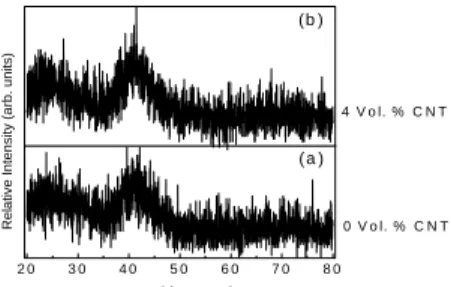
The XRD patterns of the elemental powder mixture with a composition Ti50Cu28Ni15Sn7 after milling for 8h are
shown in Fig. 1 (a). Only a broad diffraction peak appears around 2θ = 42 deg, indicating that fully amorphous powders have formed. In the case of the composite powders, as seen in Figs. 1(b), no diffraction peaks of crystalline CNT can be detected in the XRD patterns for the composite powders of Ti50Cu28Ni15Sn7 alloy mixed with 4 vol. % CNT
after 8h of milling.
The DSC scans of the 8h as-milled Ti50Cu28Ni15Sn7
monolithic glass and the composites with CNT particles are shown in Fig. 2. The Tg and Tx are 719 and 765 K for the Ti50Cu28Ni15Sn7 without CNT particles, 731 and 778 K for
the Ti50Cu28Ni15Sn7 with CNT particles, respectively. The Tg and Tx of the composite powders are higher than those
of the single-phase amorphous Ti50Cu28Ni15Sn7 alloy. This
suggests that a small amount of CNT might be alloyed into the matrix upon milling, thus changing the overall composition of the glassy phase. However, the supercooled liquid region (∆Tx = Tx - Tg) for composite powder remain
almost unchanged.
Figure 3 shows the consolidated sample of the bulk metallic glass composite that exhibited a smooth outer surface and metallic luster. X-ray diffraction and differential scanning calorimeter were performed to confirm the amorphization status of the consolidated samples.
2006 POWDER METALLURGY World Congress
PC03-W-06
Effect of Carbon-Nanotube Addition on Thermal Stability of
Ti-based Metallic Glass Composites
Chih-Feng Hsu and Pee-Yew Lee*
Institute of Materials Engineering, National Taiwan Ocean University, Keelung, Taiwan * [email protected]
Abstract
The preparation of Ti50Cu28Ni15Sn7 metallic glass composite powders was accomplished by the mechanical alloying of a pure
Ti, Cu, Ni, Sn and carbon nanotube (CNT) powder mixture after 8 h milling. In the ball-milled composites, the initial CNT particles were dissolved in the Ti-based alloy glassy matrix. The bulk metallic glass composite was successfully prepared by
vacuum hot pressing the as-milled CNT/ Ti50Cu28Ni15Sn7 metallic glass composite powders. A significant hardness increase
with the CNT additions was observed for the consolidated composite compacts.
Keywords : mechanical alloying; bulk metallic glass composite; supercooled liquid region; vacuum hot pressing; carbon nanotube
© Korean Powder Metallurgy Institute 1058 -2 0 3 0 4 0 5 0 6 0 7 0 8 0 ( a ) (b ) 4 V o l. % C N T 0 V o l. % C N T R e la tiv e In te n s it y ( a rb . u n its ) 2 θ (d e g re e s )
Fig. 1. X-ray diffraction patterns for mechanically alloyed Ti50Cu28Ni15Sn7 and composite powders after 8h
milling. 6 0 0 6 5 0 7 0 0 7 5 0 8 0 0 8 5 0 7 6 5 K 7 7 8 K 7 1 9 K 7 3 1 K 0 V o l. % C N T Tx Tx Tg Tg 4 V o l. % C N T Exot hermi c Heat F low (ar b .uni ts ) T e m p e r a t u r e ( K )
Fig. 2. DSC scans of mechanically alloyed Ti50Cu28Ni15Sn7 and composite powders after 8h milling.
The mechanical property of the BMG composite samples was evaluated using the Vickers microhardness tests. The Vickers microhardness for Ti50Cu28Ni15Sn7 BMG disc was
6.85GPa, which is higher than that (ranged from 6.02 to 6.56 GPa) of the Ti-based amorphous ribbons prepared by melt spinning [2], mechanically alloyed Zr55Al10Cu30Ni5
BMG composites (5.6 to 6.1 GPa) and Zr65Al7.5Cu17.5Ni10
composites (4.9 to 5.7 GPa) [3]. The microhardness increased from 6.85 GPa for Ti50Cu28Ni15Sn7 BMG to 9.34
GPa for the composites with the 12 vol. % CNT additions. The normalized Vickers hardness for various BMG composites produced by consolidating the mechanically alloyed powders were illustrated in Fig. 4 where the influence of hardness increase by adding nanoparticles into the glassy matrix is indicated by the slopes of the linear regression fits (three different fits can be seen in Fig. 4). It is also noteworthy that Zr55Al10Cu30Ni5-based composites
with Y2O3 or W nanoparticles exhibited limited hardness
increase (~5 % for Vf= 10 %) [3]. While Mg55Y15Cu30 BMG
showed a moderate hardness increase (~15 % for Vf = 10 %)
by adding Y2O3. Significant increase (~30 % for Vf = 10 %)
can be noticed for Ti50Cu28Ni15Sn7 BMG investigated in the
present study. Assuming no special interaction between the nanoparticles and the amorphous matrix except the force and energy balances, recent results of finite element analysis of the unit-cell model [4] suggests that the overall hardness of a nanocomposite can be described by a rule of mixtures based on the volume fraction and the hardness of each phase
Hv=Hv,am×Vf,am+Hv,p×Vp,m
where H and V refer to hardness and volume fraction of each phase. The subscripts am and p denote the amorphous matrix phase and nanoparticle phase, respectively. The linear increase of normalized Vickers hardness as shown in Fig.4 agrees well with the results, which was naturally expected from such a rule of mixtures.
Fig. 3. The outer morphology of the Ti50Cu28Ni15Sn7 with 4
vol.% CNT additions after vacuum hot pressing at 723K under a pressure of 1.2GPa. 0 24 6 8 10 12 14 16 18 20 22 24 26 28 30 32 0.95 1.00 1.05 1.10 1.15 1.20 1.25 1.30 1.35 1.40 1.45 1.50 Ti50Cu28Ni15Sn7 + CNT M g55Y15Cu30 + Y2O3 Zr55Al10Cu30Ni5 + W + Y2O3 Nor m ai ze d V icke rs Hardn e ss Volume Fraction Vf(%)
Fig. 4. Normalized Vickers hardness for various mechanically alloyed BMG composites.
4. Conclusion
In the present study, amorphous Ti50Cu28Ni15Sn7 and its
composite powders were successfully synthesized by the mechanical alloying of powder mixtures of pure Ti, Cu, Ni, Sn and CNT after 8 h milling. The metallic glass composite powders were found to exhibit a large supercooled liquid region before crystallization. The thermal stability of the amorphous matrix was affected by the presence of the CNT particles. BMG composite compact discs were obtained by consolidating the 8h as-milled composite powders by vacuum hot pressing process. A significant increase in hardness(~30%) was achieved for Ti50Cu28Ni15Sn7 BMG
composites comprising 10 vol% CNT. 5. References
1 Inoue A. Mater Sci Forum; 312–314, 307(1999). 2 Zhang T, Inoue A. Mater Trans JIM 1998; 39: 1001. 3 J. Eckert, A. Reger-Leonhard, B. Weiß, M. Heilmaier
and L. Schultz: Advanced Engineering Materials; 3 41(2001).
4 H.S. Kim, C. Suryanarayana, S-J. Kim and B.S. Chun: Powder Metall.; 41, 217(1998).