INTRODUCTION
The arrangement of cells at the desired regions of an poly-mer substrate has attracted enormous interest since it is of great important for the biological applications aiming at the fundamental study of cell biology, tissue engineering, cell-based bioassays, and cell-cell-based drug screening (Robertus et al. 2010; Thery 2010; Guillotin et al. 2011; Versaevel et al. 2012). To control the cell adhesion, the formation of micro-patterns on substrates providing both the cell-favorable and -unfavorable regions has been typically performed by means of lithographic methods based on electron beams and UV light (Dalby et al. 2008; Arnold et al. 2009; Gong et al. 2013). However, these methods require multiple fabrication steps
and a necessity of biologically unfavorable chemicals, even though they produce well-defined micropatterns on the sub-strate (Nakanishi et al. 2008; Chien et al. 2009). Accordingly, a more convenient and biologically desirable micropatterning method is necessary for the establishment of well-defined cell patterns on the substrate amenable to such biological applications.
An ion beam-based method is quite attractive for the gen-eration of micropatterns on the polymer substrate because the liner energy transfer (LET) and straighter penetration trajec-tory of the ion beams compared to the other methods using electron beams and UV light (Dong and Bell 1999; Hasebe et al. 2012; Park et al. 2012). This method provides manifold benefits including simplicity, precise controllability, relia-bility, temperature-independence, and green chemistry with-out the use of harsh chemicals (Suzuki and Kusakabe 1993; Kondyurin et al. 2008). Thus, the ion beam-based
micropat-─ ─ 149 ──
Simple Formation of Poly(sodium 4-styrenesulfonate)
Pattern on the Hydrophobic Substrate for the Control of
Cell Adhesion via a Selective Ion Irradiation
Soo-Jung Kim, In-Tae Hwang, Jin-Mook Jung and Chan-Hee Jung* Research Division for Industry and Environment,Advanced Radiation Technology Institute,Korea Atomic Energy Research Institute, Jeongeup 580-185, Korea
Abstract -- In this study, the simple preparation of poly(sodium 4-styrenesulfonate) (PSS)-patterned
substrate via a selective ion irradiation was investigated to manipulate cell adhesion. PSS thin films spin-coated onto the hydrophobic polystyrene (PS) was patterned through masked 150 keV proton irradiation followed by developing with deionized water. The characteristics of the resulting PSS-patterned surfaces were investigated by using microscope, surface profiler, FT-IR, XPS, and con-tact angle analyzer. These analytical results revealed that the resolved 100μμm PSS patterns were formed on the hydrophobic PS surface above the fluence of 1××1015ions cm--2and the chemical
structure, composition, and wettability of the PSS patterns were dependant on a fluence. More-over, the results of the in-vitro cell culture and proliferation assay exhibited that H1299 cells pref-erentially adhered and proliferated onto the more hydrophilic PSS part of the PSS-patterned PS and the well-aligned cell patterns was formed on the PSS-patterned PS particularly at the fluence of 1××1015 ions cm--2.
Key words : Ion irradiation, Poly(sodium 4-styrenesulfonate), Cell micropatterns
* Corresponding author: Chan-Hee Jung, Tel. +82-63-570-3064, Fax. +82-63-570-3090, E-mail. [email protected]
terned substrates have been widely explored to control the adhesion and proliferation of cells with or without extracel-lular matrix molecules (ECM) (Hwang et al. 2010; Jung et al. 2010; Sommani et al. 2011).
Poly(sodium 4-styrenesulfonate) (PSS) is a polyelectrolyte possessing biocompatibility and good capability of thin film formation (Garg et al. 2005; Chiang et al. 2011). It has been widely used in diverse pharmaceutical fields. To our best knowledge, it is first to report the formation of negative PSS patterns on the hydrophobic substrate via a simple selective ion irradiation to regulate the cell behavior.
In this study, the fabrication of PSS-patterned polystyrene (PS) substrate for cell patterning was performed via the sim-ple and biocompatible ion beam-based methods without any toxic chemicals. The condition for the formation of negative PSS patterns on the PS and the surface properties of the result-ing PSS-patterned substrates were investigated. Moreover, the PSS-patterned PS substrates were estimated for their ability to form micropatterns of cell through an in-vitro cell culture.
MATERIALS AND METHODS
1. Materials
Poly(sodium 4-styrenesulfonate) (PSS, M.W. 200,000) and Non-biological PS petri dishes were purchased from Aldrich Chemical Company and SPL Life Science Company, respectively. All materials were used without any further puri-fication. A customized metal mask (100μm spaces and 300 μm pitches) was provided from Youngjin Astech Co., Ltd.
2. Formation of PSS patterns on NPS substrates To form thin PSS films on PS substrates, the aqueous solution of PSS was prepared by dissolving 1.6 g of PSS in 19.6 g of distilled water, spin-coated on PS substrates at 4,000 rpm, and finally dried in a vacuum oven for 24 h. The resulting substrate was selectively irradiated by 200 keV H++ ions through a 100μm line-patterned mask at room tempera-ture on a 300-keV ion implanter at the Advanced Radiation Technology Institute (ARTI, Republic of Korea) (Hwang et al. 2010). The fluence ranged from 5×10¹⁴to 1×10¹⁶ions cm-2and the 1.0μA cm-2of the beam current density was
kept to avoid the thermal effect of the ion irradiation. After
that, to form the negative patterns of PSS, the selectively irradiated substrates were developed with deionized water, and then dried in an N2stream.
3. Characterization
The PSS-patterned PS substrate was observed with an opti-cal microscope (Type 020-519, Leica, Germany) and using a 3D optical surface profiler (NanoSystem, Korea). The static contact angles based on the sessile drop method were perform-ed on a Phoenix 300 contact angle analyzer (Surface Electro Optical Company, Korea). The analysis of surface chemical structure was carried out on an attenuated total reflectance Fourier transform infrared spectroscope (ATR-FT-IR, Varian 640, Australia) equipped with an ATR PIKE MIRacle acces-sory containing a ZnSe crystal. The surface chemical com-position was measured using an X-ray photoelectron spec-trometer (XPS, MultiLab 2000, ThermoElectron Co., Eng-land) with a monochromatic Mg-Kα radiation.
4. In-vitro cell culture on PSS-patterned PS substrate
Pre-confluent H1299 (human lung carcinoma cell) cells were detached through a trypsin-EDTA treatment, and then dispersed them into single cells. Before the cell culture, PSS-patterned PS substrates were sterilized with 70% ethanol solution. For the cell growth on PSS-patterned surfaces, cells with a density of 2.5×10⁴cells well-1were plated in a RPMI
1640 medium (Gibco) containing 10% fetal bovine serum (FBS) and 1% penicillin-streptomycin, and incubated in a humidified incubator at 37�C and 5% CO2. For the duration of 3 days, the adhesion and patterned-growth of the cells were observed with an optical microscope (Type 020-519, Leica, Germany).
5. Cell proliferation assay
Cell proliferation was measured using a Cell Counting Kit-8 (CCK-Kit-8) assay (Dojindo Laboratories, Kumamoto, Japan) according to the manufacturer’s protocol (Wang et al. 2011). Briefly, H1299 cells were plated at a density of 1×10⁴cells well-1onto a PS and PSS surfaces irradiated at different
flu-ences. After the certain incubation periods, the culturing media were daily exchanged with 1 ml of culture medium containing a 10% CCK-8 solution. After storing for 1 h under
the same condition, the absorbance of the CCK-8 solution was measured at 450 nm with a UV-Vis spectrophotometer (MQX 200 model, Bio-Tek Instruments, USA). The absor-bance value for the respective sample at the certain incuba-tion period stands for the relative proliferaincuba-tion rate of cells. All experiments were performed in triplicate.
RESULTS AND DISCUSSION
The PSS-patterned PS substrate formed at various fluen-cies was observed using an optical microscope and the results are shown in Fig. 1. Well-defined negative stripe patterns of PSS patterns spaces were formed at the given fluences. On the other hand, PSS patterns were not generated at the fluence less than 1×10¹⁵ions cm-2(data not shown),
indicat-ing that the PSS was not properly crosslinked. Therefore, the fluences more than 1×10¹⁵ions cm-2are required to pro-duce the PSS patterns in this system.
To measure the remaining thickness of the PSS patterns, the surface profiles of PSS-patterned PS substrates was inves-tigated using a surface profiler. As presented in Fig. 2, the remaining thicknesses of the PSS patterns were increased from 92 nm to 129 nm with the increase in the fluence. This result can be ascribed to the fact that the PSS was more effec-tively crosslinked at higher fluence, and thus less removed by the developing process dissolving the uncrosslinked PSS (Ahn et al. 2010; Hwang et al. 2013).
To investigate the ion irradiation-induced changes in the chemical structure of PSS surfaces taking place under ion irradiation, ATR-FTIR analysis was performed, and the re-sults are shown in Fig. 3. In the spectrum of non-irradiated
Fig. 1. Optical microscopic images of PSS patterns on PS substrates formed at fluences of 1×10¹⁵(a), 5×10¹⁵(b), and 1×10¹⁶ions cm-2(c).
(a) 1×10¹⁵ions cm-2 (b) 5×10¹⁵ions cm-2
(c) 1×10¹⁶ions cm-2
Fig. 2. 3D optical surface profiles of PSS-patterned PS substrates prepared at various fluences.
205 154 102 51 0 (nm) (nm) (nm) 205 154 102 51 0 205 154 102 51 0
PSS in Fig. 3(a) and (b), the respective OH stretching and scissor vibration of H2O were observed at 3452 and 1636 cm-1and the peaks corresponding to the asymmetric and symmetric vibration of SO3group were identified at 1184 and 1130 cm-1, respectively, meaning the existence of PSS on the PS. As shown in Fig. 3(c-e), the irradiated PSS spectra was almost similar to that these of non-irradiated PSS, but the intensities of SO3peaks was gradually decreased with an increase in the fluence (Yang et al. 2002). This result indi-cates that the chemical structure of PSS was changed by ion irradiation.
The surface elemental ratio of the irradiated PSS at various fluences obtained from an XPS analysis is shown in Fig. 4. As shown in Fig. 4(a) and (b), both [O]/[C] and [S]/[C] ele-mental ratios of the irradiated PSS were both gradually dec-reased with the increase in the fluence in comparison to these of the non-irradiated PSS. Thus, this result implies that the PSS surface was converted to more hydrophobic carbon-abundant surface because of the occurrence of crosslinking and chain scission during the ion irradiation.
To investigate the ion irradiation effect on the wettability of PSS, the water contact angles of irradiated PSS surfaces at various fluences were measured, and the results are shown in Fig. 5. The contact angle of the PS substrate was around 86�. In the cases of the irradiated PSS, the contact angels were increased up to 73�with the increase in the fluence, which was smaller than that of the PS. This result indicates that the wettability of PSS surface was reduced due to the
ion beam-induced formation of the carbon-abundant chemi-cal environment, and yet is better than PS.
Fig. 4. [O]/[C] (a) and [S]/[C] atomic ratios (b) of non-irradiated and
irradiated PSS films at various fluences.
Absorbance (arb. units) 4000 3500 3000 2500 2000 1500 1000 Wavenumbers (cm-1) 3452 2922 (e) (d) (c) (b) (a) 1636 1184 1130
Fig. 3. ATR-FTIR spectra of the PS (a), non-irradiated PSS (b), and
irradiated PSS films at fluences of 1×10¹⁵(c), 5×10¹⁵(d), and 1×10¹⁶ions cm-2(e).
Water contact angle
(� ) 0 1×10¹⁵ 5×10¹⁵ 1×10¹⁶ Fluence (ions cm-2) 100 80 60 40 20 0 86� 65� 16� PS 73�
Fig. 5. The variation of water contact angles at various fluences.
0 1×10¹⁵ 5×10¹⁵ 1×10¹⁶ Fluence (ions cm-2) 0 1×10¹⁵ 5×10¹⁵ 1×10¹⁶ Fluence (ions cm-2) 0.42 0.36 0.30 0.24 0.18 0.15 0.12 0.09 0.06 0.03 [O]/[C] [S]/[C] (a) (b)
Human cancer cell line (H1299) was used as a model sys-tem to investigate the cellular response to PSS-patterned PS substrate. As shown in Fig. 6, the cells were dominantly adhered and proliferated onto the more hydrophilic PSS regions, resulting in the formation of well-defined 100μm patterns of the cells on the PSS-patterned PS substrates. Par-ticularly, the most resolved cell patterns were formed on PSS-patterned PS surface prepared at the fluence of 1×10¹⁵ion cm-2. This different cellular response could be ascribed to the difference in the hydrophilicity between the irradiated PSS.
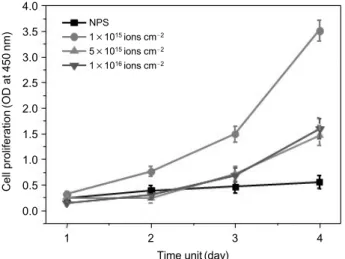
To elucidate the difference in the cellular response between the PSS-patterned surfaces, the proliferation of H1299 cells on the wholly irradiated PSS surfaces at the same condition as the formation of PSS patterns was examined using a CCK-8 assay. As shown in Fig. 6, the proliferation rates of cells cultured on all the irradiated PSS were higher than that on the PS and the cell proliferation rate on the PSS irradiated
at a fluence of 1×10¹⁵ion cm-2was highest, indicating that the more hydrophilic PSS surface provided a better growing environment for the cells. Therefore, the well-defined cell patterns was formed on the more hydrophilic PSS-patterned PS substrate.
CONCLUSION
The formation of hydrophilic PSS patterns on the PS sur-face to control cell adhesive behavior was successfully per-formed by selective ion irradiation. It was clearly seen from the optical microscopic images and surface profiles that the 100μm PSS patterns were successfully formed on the PS substrate at the fluence above 1×10¹⁵ions cm-2and their remaining thickness was dependent on the fluence. Based on the results of ATR-FTIR, XPS, and contact angle measure-ment, it was confirmed that hydrophilic PSS thin layer was effectively formed on the PS surface by ion irradiation-in-duced crosslinking and the changes in their chemical struc-tures and wettability was dependent on the ion fluence. More-over, the results of the in-vitro cell culture and proliferation assay clearly demonstrated that the cells are found to be preferentially adhered onto adhere more hydrophilic PSS compared to PS surface, resulting in the formation of well-defined 100μm cell micropatterns. This facile and biocom-patible method can be helpful to enhancing our understand-ing of cell responses to cellular microenvironment.
ACKNOWLEDGEMENTS
This work was supported by Radiation Technology R&D program through the National Research Foundation of Korea funded by the Ministry of Science, ICT & Future Planning.
Cell proliferation
(OD at 450
nm)
1 2 3 4
Time unit (day) 4.0 3.5 3.0 2.5 2.0 1.5 1.0 0.5 0.0 NPS 1×10¹⁵ ions cm-2 5×10¹⁵ ions cm-2 1×10¹⁶ ions cm-2
Fig. 7. Proliferation of H1299 cells cultured on PSS-coated PS
substrates prepared at various fluences.
REFERENCES
Ahn MY, Hwang IT, Jung CH, Nho YC, Choi JH and Huh KM. 2010. Cell patterning on a poly(N-vinyl pyrrolidone)-pat-terned polystyrene substrate by using ion implantation. J. Ind. Eng. Chem. 16:87-90.
Arnold M, Schwieder M, Blummel J, Cavalcanti-Adam EA, López-Garcia M, Kessler H, Geiger B and Spatz JP. 2009. Cell interactions with hierarchically structured nano-pattern-ed adhesive surfaces. Soft Matte. 5:72-77.
Chiang CC, Wei MT, Chen YQ, Yen PW, Huang YC, Chen JY, Lavastre O, Guillaume H, Guillaume D and Chiou A. 2011. Optical tweezers based active microrheology of sodium polystyrene sulfonate (NaPSS). Opt. Express. 19:8847-8854. Chien HW, Chang TY and Tsai WB. 2009. Spatial control of cellular adhesion using photo-crosslinked micropatterned polyelectrolyte multilayer films. Biomaterials 30:2209-2218.
Dalby MJ, Gadegaard N and Wilkinson CDW. 2008. The res-ponse of fibroblasts to hexagonal nanotopography fabricated by electron beam lithography. J. Biomed. Mater. Res. A. 84A:973-979.
Dong H and Bell T. 1999. State-of-the-art overview: ion beam surface modification of polymers towards improving tribo-logical properties. Surf. Coat. Technol. 111:29-40. Garg S, Vermani K, Garg A, Anderson RA, Rencher WB and
Zaneveld LJD. 2005. Development and characterization of bioadhesive vaginal films of sodium polystyrene sulfonate (PSS), a novel contraceptive antimicrobial agent. Pharm. Res. 22:584-595.
Gong YH, Yang J, Cao FY, Zhang J, Cheng H, Zhuo RX and Zhang XZ. 2013. Photoresponsive smart template for rever-sible cell micropatterning. J. Mater. Chem. B. 1:2013-2017. Guillotin B and Guillemot F. 2011. Cell patterning technologies
for organotypic tissue fabrication. Trends Biotechnol. 29: 183-190.
Hasebe T, Nagashima S, Yoshimoto Y, Hotta A and Suzuki T. 2012. Tailoring surface topographies of polymers by using ion beam: Recent advances and the potential applications in biomedical and tissue engineering. Nucl. Instrum. Meth. B. 282:134-136.
Hwang IT, Ahn MY, Jung CH, Choi JH and Shin K. 2013. Micropatterning of mammalian cells on indium tin oxide substrates using ion implantation. J. Biomed. Nanotechnol. 9:819-824.
Hwang IT, Jung CH, Choi JH and Noh YC. 2010. Simple and biocompatible micropatterning of multiple cell types on a polymer substrate by using ion implantation. Langmuir 26:18437-18441.
Jung CH, Hwang IT, Kwon HJ, Nho YC and Choi JH. 2010. Patterning of cells on a PVC film surface functionalized by ion irradiation. Polym. Adv. Technol. 21:135-138.
Kondyurin A, Gan BK, Bilek MMM, McKanzie DR, Mizuno K and Wuhrer R. 2008. Argon plasma immersion in implanta-tion of polystyrene films. Nucl. Instrum. Meth. B. 266:1074-1084.
Nakanishi J, Takarada T, Yamaguchi K and Maeda M. 2008. Recent advances in cell micropatterning techniques for bioanalytical and biomedical sciences. Anal. Sci. 24:67-72. Park JW, Lee EH, Lee JS, Lee BH, Kim MK, Lee CY, Kim HJ
and Choi BH. 2012. Dual ion beam irradiation of polymeric materials for the modification of optical properties with improved adhesion. Nucl. Instrum. Meth. B. 281:51-55. Robertus J, Browne WR and Feringa BL. 2010. Dynamic
con-trol over cell adhesive properties using molecular-based surface engineering strategies. Chem. Soc. Rev. 39:354-378. Sommani P, Tsuji H, Kojima H, Sato H, Gotoh Y, Ishikawa J and Takaoka G. 2011. Line-width of ion beam-modified polystyrene by negative carbon ions for fine adhesion pat-tern of mesenchymal stem cells. Surf. Coat. Technol. 206: 897-899.
Suzuki Y and Kusakabe M. 1993. Surface modification of poly-styrene for improving wettability by ion implantation. Nucl. Instrum. Meth. B. 80/81:1067-1071.
Thery M. 2010. Micropatterning as a tool to decipher cell mor-phogenesis and functions. J. Cell Sci. 123:4201-4213. Versaevel M, Grevesse T and Gabriele S. 2012. Spatial
coordi-nation between cell and nuclear shape within micropatterned endothelial cells. Nat. Commun. 3:671.
Wang YY, Lü LX, Shi JC, Wang HF, Xiao ZD and Huang NP. 2011. Introducing RGD peptides on PHBV films through PEG-containing cross-linkers to improve the biocompati-bility. Biomacromolecules 12:551-559.
Yang JC, Jablonsky MJ and Mays JW. 2002. NMR and FT-IR studies of sulfonated styrene-based homopolymers and copolymers. Polymer 43:5125-5132.
Manuscript Received: October 24, 2013 Revised: October 29, 2013 Revision Accepted: November 20, 2013