방사선
·
알칼리 전처리 볏짚 당화액 및 당밀 활용
Desmodesmus sp.
KAERI-NJ5
의 지질 생산성 비교 평가
조 민 호1· 김 동 호2· 배 석3,*
1한국원자력연구원 첨단방사선연구소 방사선이용·운영부, 2한국원자력연구원 첨단방사선연구소 방사선연구부, 3전남대학교 생물학과
Evaluation of Lipid Productivity of Desmodesmus sp.
KAERI-NJ5 using Radiation and Alkali Pretreated
Rice Straw Hydrolysate and Molasses
Min-Ho Joe
1, Dong-Ho Kim
2and Suk Bai
3,*
1Radiation Utilization and Facilities Management Division, Korea Atomic Energy Research Institute, Jeongeup 56212, Republic of Korea
2Radiation Research Division, Korea Atomic Energy Research Institute, Jeongeup 56212, Republic of Korea
3Department of Biological Sciences, College of Natural Sciences, Chonnam National University, Gwangju 61186, Republic of Korea
Abstract - Depending on species, microalgae can produce fatty acids more efficiently by using organic carbon sources than by using the phototrophic cultivation mode. In this study,
Desmodesmus sp. KAERI-NJ5 was grown in heterotrophic(HT) and mixotrophic(MT) modes
using enzymatic hydrolysate of rice straw pretreated with radiation and alkali solution to enhance biodiesel feedstock productivity. In addition, biomass and lipid productivities were compared with the results from molasses based medium. Firstly, carbon source preference of the microalga was determined. Although the presence of light caused a slight difference in the carbon source preference, glucose was the most preferred carbon source in both types of cultivation. The rice straw hydrolysate(RSH) was used as a carbon source and successfully utilized by the microalga. The biomass and lipid yield was higher in the HT cultivation mode than those from the MT cultivation mode. The final biomass and lipid yield of 6.0 and 3.4g·l-1 was achieved, respectively,
in HT cultivation. In addition, the conversion yield of consumed sugars to lipid and fatty acid methyl esters(FAMEs) were 34.2 and 31.4%, respectively, which is even higher than that grown with corresponding pure sugars. Analysis of the FAMEs composition revealed that palmitic, oleic, and stearic acids were the main FAMEs, and the FAMEs content was 52.19% in the HT cultivation mode corresponding to a 1.51-fold higher content than with MT cultivation. In addition, 92.52% of FAMEs consisted of saturated and monounsaturated fatty acids indicating good quality biodiesel feedstock. In addition, the productivities of biomass, total lipid and FAMEs were also
─ 257 ─ Technical Paper
* Corresponding author: Suk Bai, Tel. +82-62-530-3412, Fax. +82-62-530-3419, E-mail. [email protected]
서 론
미세조류는 다른 에너지 작물들보다 빠르게 성장하고 높 은 광전환효율과 생체 생산성으로 인해 우수한 바이오디젤 원료로 알려져 있다. 또한 미세조류 배양은 다른 육상 유지 작물들과 달리 대규모의 경작지와 수분 공급이 요구되지 않 고 식량고갈에 대한 윤리적 우려로부터 자유롭다(Scott et al. 2010). 현재 미세조류로부터 지질을 추출한 후 바이오디 젤로 전환하는 공정은 이미 잘 확립되어 있으므로 미세조류 를 활용한 바이오디젤 연구는 대부분 미세조류의 배양 방법 과 지질 생산성 증대에 초점이 맞춰져 있다. 미세조류는 광합성능은 바이오에너지 생산에 있어서 가 장 큰 장점 중 하나이다. 일반적으로 미세조류의 대량배양 은 광영양배양을 통해 이루어지지만 유기물을 탄소원과 에 너지원으로 활용 가능한 미세조류의 경우 종속영양배양 및 혼합영양배양을 통하여 생체와 오메가-3 지방산, 색소, 항산 화물질과 같은 고부가 대사산물의 생산성을 증대시킬 수 있 다(Liu et al. 2016; Morales-Sanchez et al. 2017). 그러나 비 용 효율성을 고려할 경우 통상적인 탄소원인 포도당, 에세 트산 그리고 글리세롤과 같은 탄소원들은 바이오디젤 원 료 생산을 위한 미세조류 배양 탄소원으로 적합하지 않다 (Liang 2013). 따라서 농림 폐자원, 바이오산업 부산물 그 리고 폐수와 같은 저가의 재료를 활용한 미세조류의 종속 영양 및 혼합영양배양법 연구들이 많이 이루어지고 있다. 고가의 탄소원을 대체하기 위하여 폐글리세롤(Leoneti etal. 2012), 당밀 가수분해물(Andrade and Costa 2007; Yan
et al. 2011; Zheng et al. 2015; Gaurav et al. 2016; Piasecka et al. 2017), 돼지감자(Cheng et al. 2009), 사탕수수즙(Gao
et al. 2010), cassava 전분(Wei et al. 2009) 그리고 목질섬 유소(Liang 2013; `Miazek et al. 2014; Joe et al. 2015)와 같 은 다양한 탄소원들을 활용한 미세조류 생체 및 지방산 생 산 연구가 진행된 바 있다. 당밀의 경우 미세조류 배양 탄 소원으로서 성공적 배양 사례가 많이 보고되었다(Andrade and costa 2007; Xiong et al. 2008; Yan et al. 2011; Zheng et
al. 2015; Gaurav et al. 2016; Piasecka et al. 2017). 일반적
으로 당밀의 주성분이 자당의 가수분해 후 활용되었으며,
Chlorella protothecoides의 경우 최적배양조건에서의 생체
와 지질 생산량은 각각 70.9 and 40.8g·l-1이었다(Yan et al. 2011). 그리고 생산된 지질의 품질은 포도당을 탄소원으로 배양한 결과와 유사하였다. 목질섬유소는 셀룰로스, 헤미셀 룰로스 그리고 리그닌 등이 주성분이며, 대부분의 식물체 의 구성성분이다(Miazek et al. 2014). 그러나 목질섬유소의 난분해성으로 인해 다른 미생물을 포함하여 이들의 직접적 인 탄소원으로서의 활용은 극히 제한적이며, 미세조류의 경 우에도 목질섬유소를 활용한 배양 연구 역시 소수의 보고 만 되어 있다. 밀기울 당화액을 C. vulgaris와 Scenedesmus obliquus의 종속영양 그리고 혼합영양배양 탄소원으로 활 용한 결과 미세조류 생체 생산량을 향상시켰다(EL-Sheekh
et al. 2012). Chlamydomonas reinhardtii의 경우 셀룰로스
분해효소를 분비하여 셀룰로스를 셀로비오스로 분해하여 이를 탄소원으로 성장 가능하였다(Blifernez-Klassen et al. 2012). 볏짚 효소 당화액을 C. pyrenoidosa 배양에 탄소원으 로 활용한 결과 동량의 정제 포도당보다 3배 증가된 미세 조류 생체를 생산하였다(Li et al. 2011). 본 보고에 앞서 우 리 연구진도 효소의 볏짚 당화능을 증진시키기 위하여 방사 선과 알칼리 전처리된 볏짚의 당화액을 탄소원으로 활용하 여 C. protothecoides를 배양한 결과 높은 수율의 생체와 지 질 생산성을 보고한 바 있다(Joe et al. 2015). 그리고 광배양 을 통한 Desmodesmus sp. KAERI-NJ5의 생체와 지질 생산 성 연구를 통하여 바이오디젤 원료 생산 잠재력을 보고하였 다(Joe et al. 2018). 본 연구논문은 주저자의 박사학위 논문1을 바탕으로 작성 한 논문으로 바이오디젤 원료생산 용도로 분리된 토착 미세 조류인 Desmodesmus sp. KAERI-NJ5(Joe et al. 2018) 활용 종속영양 및 혼합영양 성장 가능성을 확인하였다. 또한 생 체와 지질 생산성을 향상을 위한 당밀과 방사선·알칼리 전 처리 볏짚 당화액의 탄소원으로서의 활용 가능성을 비교 분 석하였다.
evaluated when the microalga was grown with molasses, a representative low-cost carbon source, in both cultivation modes. The highest total lipid yield was 3.9g·l-1 in the HT cultivation mode
corresponding to 1.15-fold higher than that of the RSH grown microalga. However, the lipid productivity was negligible considering the quality as a biodiesel feedstock, regional availability and sustainability of carbon sources. Thus, the RSH could be used as a carbon source for biodiesel feedstock production by Desmodesmus sp. KAERI-NJ5.
Key words : Desmodesmus sp. KAERI-NJ5, Heterotrophic cultivation, Rice straw hydrolysate, Biodiesel feedstock
재료 및 방법
1. 미세조류, 배지, 시약 및 생장조건
본 연구에서 활용된 미세조류 균주는 전라북도 정읍시에 서 분리된 Desmodesmus sp. KAERI-NJ5(KCTC18331P)이 다. 변형된 Khul 배지(Joe et al. 2018)를 기본배지로 활용하 였고, 모든 배지는 121°C에서 20분 동안 멸균한 후 사용하 였다. 일반적인 미세조류 전 배양은 25°C에서 7일 동안 진 탕 배양(150rpm)하여 준비하였다. 조명은 발광다이오드를 이용하여 200μmolm-2s-1 조도를 12시간 단위로 제공하였 다. 이렇게 제조된 전 배양액은 본 배양액 부피의 10%를 접 종량으로 사용하였다. 배양에 사용된 포도당, 과당, 자당, 갈락토스, 글리세롤, 목당은 Sigma-Aldrich에서 구입하여 10g·l-1의 농도로 배양에 사용하였다. 당밀(AL & C, Kyungkido, Republic of Korea)의 주요 당 성분은 자당(210g·l-1), 포도당(125 g·l-1) 그리고 과당(165g·l-1)으로 이루어져 있으며, 10g 당 (자당+포도당+과당)·l-1의 농도로 첨가하였다. 볏짚 당화 액은 본 연구진에 의해 보고된 논문에 기술한 방법으로 제 조하였고(Joe et al. 2015) 10g 당(포도당+목당)·l-1의 농 도로 첨가하였다. 발효조(FMT DS-D; Fermentec, Daejeon, Republic of Korea) 액상 배양은 29°C에서 200rpm의 속 도로 교반하였고, 여과(0.22μm)된 공기를 급기(1vvm, volume air/volume media/minute) 하였다. 실험 조건에 따라 발광다이오드를 이용하여 200μmolm-2s-1 조도를 12시간 단위로 제공하였다. 2. 생체 및 지질 함량 측정 미세조류의 성장은 UV-vis 분광 광도계(Biochrome, Cambridge, UK)를 통한 흡광도(680nm) 측정을 통하 여 결정하였다. 미세조류의 생체량 측정은 회귀방정식: y=0.3605x-0.4843(R2=0.9994, p<0.05)을 통하여 결정 하였다. y는 세포 건조중량(g·l-1)이고 x는 배양액의 흡광 도(680nm)이다. 미세조류 생체의 건조중량은 흡광도를 측 정한 배양액을 GF/C 유리섬유필터(GE Healthcare, Little Chalfont, UK)에 여과한 후 송풍대류 오븐(JEIO TECH, Daejeon, Republic of Korea)에서 70°C로 가온하여 무게에 변화가 없을 때까지 건조하여 결정하였다.
지질 함량 측정은 본 연구진에 의해 보고된 논문에 기술 한 방법으로 측정하였다(Joe et al. 2015; Joe et al. 2018). 원 심분리(4,000rpm, 15분)를 통하여 미세조류를 회수한 후 2 일 동안 동결건조하였다. 0.2g의 건조된 미세조류에 0.5ml 의 증류수와 3ml의 chloroform/methanol(2 : 1, v/v)을 첨가 하여 그 혼합액을 20분 동안 혼합하였다. 상기 현탁액을 10 분 동안 원심분리(10,000rpm)하여 chloroform 층을 회수하 였고 이 과정을 5회 반복하였다. 회수된 시료는 60°C로 예 열된 건식 농축기(MG-2000, EYELA, Japan)에서 질소가스 를 배기하면서 유기용매를 제거하였다. 지질 함량은 백분율 (지질 중량/건조 생체 중량×100%)로 표기하였다. 3. 당 함량 측정 배양액 내 잔존 당의 측정은 굴절률 검출기(refractive index detector)와 Bio-Rad Aminex HPX-87P 컬럼(Bio-Rad Laboratories, Hercules, CA, USA)이 장착된 액상 크로마 토그라프 Agilent 1200(Agilent Technologies, Santa Clara, CA, USA)를 활용하여 본 연구진에 의해 보고된 논문에 기 술한 방법으로 측정하였다(Joe et al. 2015; Joe et al. 2018). 이동상 용매는 크로마토그라프 등급 물을 사용했으며, 유 속은 60°C에서 1.0ml·min-1으로 설정하였다. 배양액을 5 분 동안 원심분리(10,000rpm)하여 상등액을 회수하고 여과 (0.2mm)하여 시료를 준비하였고, 주입 전에 적절히 희석하 였다. 다양한 농도의 정제당을 이용하여 표준 검정선을 설 정하였고 이를 이용하여 당 함량을 정량하였다. 4. 지방산 분석 지방산 분석은 본 연구진에 의해 보고된 논문에 기술한 방법으로 측정하였다(Joe et al. 2015; Joe et al. 2018). 지방 산은 건조 미세조류 50mg에 1ml의 NaOH-CH3OH 첨가하
여 추출하였다. 모든 지방산 시료에 클로로포름에 용해시킨 tridecanoicacid(10g·l-1) 0.1ml을 표준 지방산으로 첨가하
여 지방산 함량을 측정에 활용하였다. 상기 혼합물은 75°C 에서 10분 동안 열수 중탕시킨 후 상온에 정치하였다. 그리 고 2ml의 boron trifluoride-methanol solution(1 : 2, v/v) 첨 가하고 10분 동안 75°C에서 혼합 후 다시 상온에 정치하 여 온도를 낮춰주었다. 상기 혼합액에 0.3ml의 포화 염 용 액을 첨가하여 층 분리를 시킨 후 2ml의 hexane을 첨가하 여 혼합 후 10분 동안 원심분리(12,000rpm)하였다. 상층의 지방산 층을 회수하여 분석 시료로 사용하였다. 지방산 분 석은 5975 inert mass selective detector가 장착된 GC-linked mass spectrometry Agilent HP 6890N(Agilent Technologies, Santa Clara, CA, USA)를 활용하였다. 분석에 사용된 컬럼 은 DB-5MS(Length 30m, I.D. 0.25mm, Thickness 0.25μm, Agilent Technologies), 이동상 가스는 헬륨, 그리고 1μl의 시료를 사용하였다. 이동상 가스의 유속은 1.0ml·분-1, 용매 지연 시간은 5분, 그리고 주입 온도는 250°C로 설정하였다. 지방산은 mass spectral pattern과 retention index(NIST 05 mass spectral database)의 직접적인 비료를 통하여 동정하였 다. 결과치는 3반복 실험의 평균으로 표기하였다.
결과 및 고찰
1. Desmodesmus sp. KAERI-NJ5의 탄소원 선호도 분석 일부 미세조류들은 유기 탄소원을 이용하여 광영양배양 보다 높은 생체 생산성을 갖는다(Miazek et al. 2014). 현재 유기 당류, 알코올류 또는 유기산 등을 탄소원으로 이용한 미세조류의 종속영양배양은 오메가-3 지방산, 천연색소, 항 상화물질 등과 같은 고부가 산물이 목적 물질인 경우에만 경제적으로 유효하다 할 수 있다. 목질섬유계 자원은 미생물 이 활용할 수 있는 지구상에서 가장 풍부하고 지속 가능한 식물계 비용 효율적 탄소원이다. 다수의 보고에 따르면 미세 조류 역시 목질섬유계 자원을 탄소원으로 성장 가능함이 밝 혀졌다(Miazek et al. 2014; Joe et al. 2015; Rios et al. 2018). 본 연구에서는 광영양배양을 통하여 바이오디젤 원료 생 산 목적으로 분리된 미세조류인 Demodesmus sp. KAERI-NJ5의 생체와 지질 생산성을 증가시키기 위하여 종속영양 배양과 혼합영양배양 가능성을 검토하였다(Joe et al. 2018). 우선 미세조류의 탄소원 이용 가능성과 선호도를 분석하기 위하여 포도당, 과당, 자당, 목당, 갈락토오스, 그리고 글리세 롤의 단일 탄소원으로서 활용 가능성을 종속영양배양 및 혼 합영양배양 조건에서 조사하였다. Fig. 1은 Demodesmus sp. KAERI-NJ5의 유기 탄소원 이용능과 선호도를 확실히 보 여주고 있다. 우선 Demodesmus sp. KAERI-NJ5는 포도당을 두 배양 조건에서 가장 선호하는 탄소원으로 나타났으며, 배양 5일 후 첨가한 포도당을 모두 이용하였다. 그리고 두 배양 조건에서 탄소원 소모량은 비교할 경우 탄소원의 선호 도가 광원의 유무에 따라 차이가 있음을 확인할 수 있었다. 혼합영양배양 조건에서는 갈락토오스, 자당, 목당, 과당 순 서의 탄소원 선호도(Fig. 1A)를 보인 반면에 종속영양배양 조건에서는 자당, 갈락토오스, 목당, 과당 순서의 선호도를 보였다(Fig. 1B). 그리고 글리세롤은 두 조건에서 모두 단 일 탄소원으로 활용될 수 없음을 확인하였다. 추가로 실험 에 사용된 탄소원을 모두 첨가하였을 경우 탄소원 선호도를 조사하였다(Fig. 2). 포도당이 두 배양 조건에서 모두 가장 먼저 소모되었으며, 다른 탄소원들의 소모율이 약간 상승하 였다. 배양 7일 후 혼합영양배양의 경우 목당이 65% 그리고 종속영양배양의 경우 자당이 84%가 소모되었다. 흥미롭게 도 두 배양조건에서 모두 글리세롤 또한 소모되었다. 이는 아마도 배지 내 당 함량이 5배 증가하였고 이로 인해 삼투Fig. 1. Consumption of the sugars and glycerol as a single carbon
source by Desmodesmus sp. KAERI-NJ5 on mixotrophic(A) and heterotrophic(B) cultivation. Average values obtained from triplicate experiments were represented.
Fig. 2. Consumption of the sugars and glycerol as a mixed carbon
source by Desmodesmus sp. KAERI-NJ5 on mixotrophic(A) and heterotrophic(B) cultivation. Average values obtained from triplicate experiments were represented.
(A)
(B)
(A)
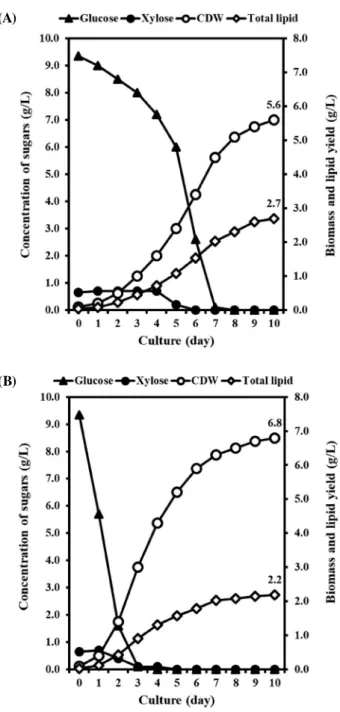
압이 증가하여 글리세롤의 단순확산 또는 글리세롤 수송 시 스템 활성화가 그 원인으로 판단된다. 탄소원의 이용능은 세포 내 수송 시스템과 중심탄소대사 에 필요한 효소의 존재 그리고 수동 또는 촉진 확산 등에 의해 일반적으로 결정된다(Morales-Sanchez et al. 2017). 포도당은 전통적인 미생물 발효에 사용되는 탄소원이며, Demodesmus sp. KAERI-NJ5 역시 가장 높은 선호도를 보였 다(Fig. 1 및 2). 그러나 포도당은 바이오디젤 원료 생산을 위한 미세조류 배양 탄소원으로는 경제적이지 못하다는 것 이 일반적인 인식이다. 따라서 포도당을 다량 함유한 저가 의 탄소원이 비용 효율적인 측면에서 이상적이라 할 수 있 다. Demodesmus sp. KAERI-NJ5의 탄소원 선호도와 단가를 고려할 경우 설탕 정제산업 부산물인 당밀과 포도당과 목당 이 주성분을 이루고 있는 볏짚 당화액이 탄소원으로 활용 가능하다 볼 수 있다. 당밀의 경우 당뿐만 아니라 식물 유 래 다양한 비타민을 함유하고 있어 미생물 발효에도 적극 활용되고 있으며, 볏짚 당화액의 경우 지속 가능하고 가장 풍부한 탄소원이라 할 수 있다. 따라서 이후 연구에서는 당 밀과 볏짚 당화액을 탄소원으로 활용하여 Demodesmus sp. KAERI-NJ5의 혼합영양배양 및 종속영양배양 조건에서 생 체와 지질 생산성에 대하여 조사하였다. 2. 방사선·알칼리 전처리 볏짚 당화액 활용 Demodesmus sp. KAERI-NJ5 생체 및 지질 생산성 분석 목질섬유계 자원은 다양하고 풍부한 탄소원을 포함하고 있으며, 이들 탄소원은 미세조류 배양에 활용 가능하다. 본 연구진의 연구결과에 따르면 C. protothecoides의 경우 방사 선과 알칼리 전처리를 통해 제조된 볏짚 당화액을 탄소원으 로 활용할 경우 생체와 지질 생산성이 증가하였다(Joe et al. 2015). Demodesmus sp. KAERI-NJ5의 경우 C. protothecoides 와는 달리 볏짚 당화액의 주요 구성성분인 목당 역시 탄소 원으로 활용 가능하다(Figs. 1, 2). 따라서 볏짚 당화액을 탄 소원으로 활용할 경우 Demodesmus sp. KAERI-NJ5의 생체 및 지질 생산성을 평가하였다. 혼합영양배양의 경우 볏짚 당화액 당 함량의 소모율은 정 제당보다 낮게 나타났으며, 배양 7일 후 모든 당을 소모하 였다(Fig. 3). 최종 생체와 지질 생산량은 각각 5.6 그리고 2.7g·l-1로 나타났다. 생체 생산량은 정제당을 사용한 대조 군의 82.4%로 나타났으며, 이는 아마도 볏짚 당화액 속에 존재하는 furfural, hydroxymethylfurfural, 증금속 그리고 용 해성 리그닌과 같은 미량의 생장저해 불순물들로 인한 것으 로 판단된다(Silva et al. 2013). 생체 생산량과는 달리 볏짚 당화액을 탄소원으로 활용할 경우 지질 생산성은 정제당 대 조군보다 1.23배 증가하였다. 광량, 온도, 염도, 그리고 질소 량과 같은 일반적인 스트레스 요인에 의한 미세조류의 지질 생산성 증가와 관련된 다수의 보고가 있으며, Demodesmus sp. KAERI-NJ5의 경우에도 볏짚 당화액에 존재하는 미량의 불순물이 미세조류의 성장을 저해한 반면 지질 생산성을 증 가시킨 원인으로 판단된다(Minhas et al. 2016). 종속영양배 양의 경우 당 소모율은 혼합영양배양보다 높게 나타났으며, 생체와 지질 생산량은 유사한 양상을 보였다(Fig. 4). 최종 생체 생산량은 6.0g·l-1으로 정제당 대조군보다 17.8% 낮게
Fig. 3. Consumption of carbon sources and yield of biomass and
lipid by mixotrophically grown Desmodesmus sp.
KAERI-NJ5 with the rice straw hydrolysate(A) and equal amount of corresponding glucose and xylose mixture(B). Average val-ues obtained from triplicate experiments were represented. (A)
나왔으나, 지질 생산량은 1.36배 증가하였다. 결론적으로 볏 짚 당화액을 탄소원으로 활용할 경우 종속영양배양이 혼합 영양배양보다 높은 생체와 지질 생산성을 나타냈다.
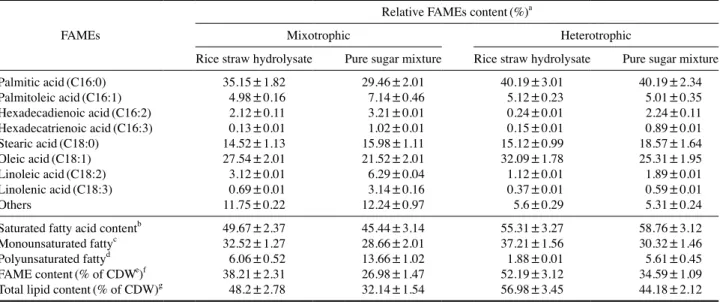
볏짚 당화액을 탄소원으로 Demodesmus sp. KAERI-NJ5 을 배양 후 지방산(fatty acid methyl esters) 조성 분석 결과 팔미틱(palmitic), 올레익(oleic), 그리고 스테아릭(stearic) 산이 주요 지방산으로 나타났다(Table 1). 최대 지질 및 지 방산 함량은 종속영양배양 조건에서 각각 56.98% 그리고 52.19%로 나타났다. 종속영양배양의 경우 혼합영양배양 결 과보다 지방산 함량이 1.51배 높게 나타났다. 또한 포화 지 방산과 단일 포화 지방산 비율이 92.52%로 나타났으며, 이 는 좋은 품질의 바이오디젤 원료를 의미한다. 또한 소모된 당의 생체, 지질 그리고 지방산으로의 전환율 모두 종속영 양배양조건에서 혼합영양배양보다 높게 나타났다(Fig. 5). 따라서 지방산 함량과 조성을 고려할 경우 광원의 공급이 없는 Demodesmus sp. KAERI-NJ5의 종속영양배양 방법이 바이오디젤 원료 생산에 보다 바람직하다 할 수 있다. 방사선과 알칼리 전처리 후 제조된 동일한 볏짚 당화액을 활용한 Demodesmus sp. KAERI-NJ5와 C. protothecoides의 생체, 지질 그리고 지방산 생산 수율을 비교하였다(Joe et al. 2018). 혼합영양배양 조건에서는 모든 Demodesmus sp. KAERI-NJ5의 생산지표가 C. protothecoides보다 높게 나타 났다(Fig. 6). 그리고 종속영양배양 조건에서는 생체와 지질 생산성은 C. protothecoides보다 낮게 나타났지만 지방산 생 산 수율은 높게 나타났다. 따라서 볏짚 당화액을 탄소원으 로 활용할 경우 Demodesmus sp. KAERI-NJ5 미세조류 균주 가 C. protothecoides보다 바이오디젤 원료 생산에 적합하다 할 수 있다. 상기 결과들을 종합한 결과 방사선과 알칼리 전처리 후 제 조된 볏짚 당화액은 고가의 탄소원을 대체하여 Demodesmus sp. KAERI-NJ5의 종속영양 및 혼합영양 배양에 비용 효율적 인 탄소원으로 활용될 수 있다. 그리고 지방산 생산성과 조 성을 고려할 경우 바이오디젤 원료 생산을 위해서는 종속영 양배양 방법이 보다 바람직함을 확인하였다. 3. 당밀 활용 Demodesmus sp. KAERI-NJ5 생체 및 지질 생산성 분석 Demodesmus sp. KAERI-NJ5의 혼합영양 및 종속영양배 양에 있어 저가의 탄소원인 당밀의 단일 탄소원으로서의 가 능성을 생체와 지질 생산성 토대로 평가하였다. 당밀을 탄 소원으로 이용한 Demodesmus sp. KAERI-NJ5의 혼합영양 배양 결과 포도당을 가장 먼저 소비하였으며, 과당 역시 6일 배양 후 모두 소모하였다(Fig. 7A). 그러나 정제당을 활용할 경우 포도당은 모두 소모되었으나, 과당과 자당은 각각 36.4 그리고 28.5% 사용되었다(Fig. 7B). 결론적으로 당밀의 경 우 첨가된 당 량의 73.9%를 이용한 반면 정제당 대조군의 경우 49%만이 소모되었다. 생체와 지질 생산량에는 뚜렷한
Table 1. Composition of fatty acids produced from mixotrophic and heterotrophic cultivations of the microalga with the rice straw
hydroly-sate and corresponding sugar mixture as carbon sources FAMEs
Relative FAMEs content(%)a
Mixotrophic Heterotrophic
Rice straw hydrolysate Pure sugar mixture Rice straw hydrolysate Pure sugar mixture
Palmitic acid(C16:0) 35.15±1.82 29.46±2.01 40.19±3.01 40.19±2.34 Palmitoleic acid(C16:1) 4.98±0.16 7.14±0.46 5.12±0.23 5.01±0.35 Hexadecadienoic acid(C16:2) 2.12±0.11 3.21±0.01 0.24±0.01 2.24±0.11 Hexadecatrienoic acid(C16:3) 0.13±0.01 1.02±0.01 0.15±0.01 0.89±0.01 Stearic acid(C18:0) 14.52±1.13 15.98±1.11 15.12±0.99 18.57±1.64 Oleic acid(C18:1) 27.54±2.01 21.52±2.01 32.09±1.78 25.31±1.95 Linoleic acid(C18:2) 3.12±0.01 6.29±0.04 1.12±0.01 1.89±0.01 Linolenic acid(C18:3) 0.69±0.01 3.14±0.16 0.37±0.01 0.59±0.01 Others 11.75±0.22 12.24±0.97 5.6±0.29 5.31±0.24
Saturated fatty acid contentb 49.67±2.37 45.44±3.14 55.31±3.27 58.76±3.12
Monounsaturated fattyc 32.52±1.27 28.66±2.01 37.21±1.56 30.32±1.46
Polyunsaturated fattyd 6.06±0.52 13.66±1.02 1.88±0.01 5.61±0.45
FAME content(% of CDWe)f 38.21±2.31 26.98±1.47 52.19±3.12 34.59±1.09 Total lipid content(% of CDW)g 48.2±2.78 32.14±1.54 56.98±3.45 44.18±2.12
aComposition of FAMEs is reported as weight percent of all FAMEs content. bSaturated fatty acid/total FAMEs content×100%
cMonounsaturated fatty acid/total FAMEs content×100% dMonounsaturated fatty acid/total FAMEs content×100%
eCells were harvested at stationary phase before loss of cell mass, lyophillized and used for lipid analysis fTotal fatty acids/CDW×100%
gTotal lipids/CDW×100%
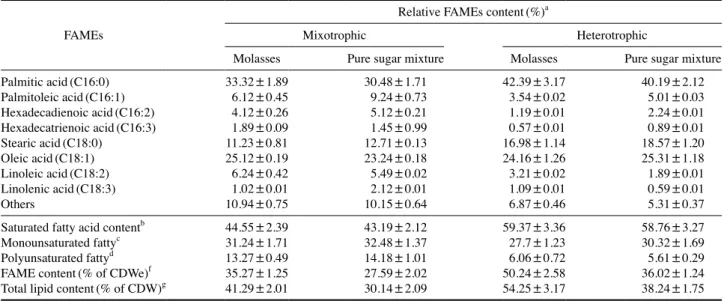
차이를 보였다. 당밀을 탄소원으로 사용할 경우 정제당 사 용 대조군보다 생체와 지질 생산량이 각각 1.36 그리고 1.9 배 높게 나타났다. 이러한 결과는 당밀 역시 Demodesmus sp. KAERI-NJ5의 혼합영양배양에 매우 유용한 탄소원임을 의미한다 볼 수 있다. 당밀을 탄소원으로 활용한 종속영양 배양의 첨가된 모든 당이 소진되었으며, 시간이 지남에 따 라 생체와 지질 생산량이 지속적으로 증가하는 양상을 보 였다(Fig. 8A). 그러나 정제당 대조군의 경우 과당과 자당 의 소모율은 50% 미만으로 나타났다(Fig. 8B). 혼합영양배 양 결과와 마찬가지로 최종 생체와 지질 생산량 역시 당밀 을 사용한 경우 정제당보다 각각 1.4배 그리고 2.0배 높게 나타났다. 당밀은 포도당, 과당, 그리고 자당이 주 성분으로 이루어져 있지만 식물 유래 다양한 비타민과 아미노산 등이 포함되어 있어 미세조류를 포함한 미생물의 생장을 촉진시 킨다고 알려져 있다(Zeng et al. 2015). 당밀의 이러한 성장 촉진 성분들이 아마도 정제당 대조군보다 생체와 지질 생산 량이 높게 나온 것으로 판단된다. 지방산 조성 분석결과 당밀 역시 Demodesmus sp. KAERI-NJ5를 배양을 통한 바이오디젤 원료 생산에 적합한 탄소 원으로 밝혀졌다(Table 2). 모든 배양 조건에서 주요 지방 산 성분은 팔미틱, 올레익, 그리고 스테아릭산 순서로 나타 났다. 종속영양배양 조건이 혼합영양배양보다 높은 지질
Fig. 5. Conversion yield of sugars to biomass, lipid, and FAMEs
after mixotrophic and heterotrophic cultivations. Biomass, Lipid, and FAMEs are depicted as % yield based on sugar consumed after 10 days of cultivation, respectively. Average values obtained from triplicate experiments were represented.
Fig. 6. Comparison of biomass, total lipid and total fatty acids
yields between Chlorella protothecoides and Desmodesmus sp. KAERI-NJ5 after cultivation with the rice straw hydro-lysate as carbon sources. Average values obtained from triplicate experiments were represented.
Fig. 4. Consumption of carbon sources and yield of biomass and
lipid by heterotrophically grown Desmodesmus sp.
KAERI-NJ5 with the rice straw hydrolysate(A) and equal amount of corresponding glucose and xylose mixture(B). Average val-ues obtained from triplicate experiments were represented. (A)
과 지방산 생산성을 보였으며, 지방산의 80%가 포화지방산 과 단일 포화지방산으로 이루어져 있었다. 그리고 고도 불 포화지방산의 경우 혼합영양배양 결과보다 매우 낮게 나타 났다. 종속영양배양 결과만 비교하면 지질과 지방산 생산량 은 당밀을 탄소원으로 이용했을 경우 정제당 대조군보다 각 각 1.42배 그리고 1.4배 높게 나타났다. Fig. 9은 각 배양 결 과에서 나온 수치를 토대로 소모된 당의 생체, 지질, 그리고 지방산으로의 전환율을 보여준다. 혼합영양배양과 종속영 양배양 조건을 비교할 경우 혼합영양배양 결과가 당의 생체 로의 전환율이 보다 높았다. 그러나 지질과 지방산 전환율 은 종속영양배양 조건이 더 높게 나왔다. 따라서 당밀을 이 용한 Demodesmus sp. KAERI-NJ5의 종속영양배양 방법이 고품질의 바이오디젤 원료를 가장 효과적으로 생산할 수 있 다 볼 수 있다.
당밀은 Spirulina platensis(Andrade and Costa 2007),
Parachlorella kessleri(Piasecka et al. 2017), Chlorella species
(Yan et al. 2011; Zeng et al. 2015; Gaurav et al. 2016; Mohammad et al. 2016)와 같은 미세조류 배양 탄소원으로 성공적으로 활용되어왔다. 현재까지 보고에 따르면 당밀을 β-invertase를 처리하여 C. protothecoides의 종속영양배양에
Fig. 7. Consumption of carbon sources, biomass and lipid yield of
mixotrophically grown Desmodesmus sp. KAERI-NJ5 with molasses(A) and equal amount of corresponding sugar mixture(B). Average values obtained from triplicate experi-ments were represented.
Fig. 8. Consumption of carbon sources, biomass and lipid yield
of heterotrophically grown Desmodesmus sp. KAERI-NJ5 with molasses(A) and equal amount of corresponding sugar mixture(B). Average values obtained from triplicate experi-ments were represented.
(A)
(B)
(A)
탄소원으로 활용할 경우 가장 높은 생체와 지질 생산량을 보 였다(Yan et al. 2011). 그러나 이 경우 당밀 전처리에 필요한 시간과 비용이 추가로 필요하고 본 보고보다 높은 양의 당밀 (30g·l-1)를 첨가하였다. 따라서, 당밀을 탄소원으로 활용한 Demodesmus sp. KAERI-NJ5의 종속영양배양 방법 또한 고품 질 바이오디젤 원료생산에 매우 효과적이라 할 수 있다.
결 론
본 연구에서는 방사선·알칼리 병용 전처리 볏짚 당화액 과 당밀을 탄소원으로 활용한 Demodesmus sp. KAERI-NJ5 의 생체 및 바이오디젤 원료 생산성을 평가하였다. 연구결 과 광원의 요구 없이 종속영양배양 조건에서 두 탄소원을 활용하여 고품질 바이오디젤 원료를 성공적으로 생산할 수 있음을 확인하였다. Demodesmus sp. KAERI-NJ5는 볏짚 당 화액에 포함된 탄소원의 31.4%를 지방산 생산(1.07g·l-1) 에 활용하였다. 그리고 당밀을 탄소원으로 종속영양배양 조 건에서 볏짚 당화액을 탄소원으로 활용한 조건보다 1.15배 높은 지방산 생산성을 보였다. 결론적으로 지방산 생산성 은 당밀을 이용할 경우 더 높았으나 지리적 자원 활용도와 지속성을 고려할 경우 볏짚 당화액 역시 Demodesmus sp. KAERI-NJ5 종속영양배양 탄소원으로 활용하여 효과적으로 바이오디젤 원료 생산에 이용될 수 있음을 확인하였다.사 사
본 연구는 과학기술정통부의 재원으로 한국원자력연구원 주요사업(523140-19)에 의해 수행되었다.Fig. 9. Conversion yield of sugars to biomass, lipid, and FAMEs
after mixotrophic and heterotrophic cultivations. Biomass, Lipid, and FAMEs are depicted as % yield based on sugar consumed after 10 days of cultivation, respectively. Aver-age values obtained from triplicate experiments were repre-sented.
Table 2. Composition of fatty acids produced from mixotrophic and heterotrophic cultivations of the microalga with molasses and
corre-sponding sugar mixture as carbon sources FAMEs
Relative FAMEs content(%)a
Mixotrophic Heterotrophic
Molasses Pure sugar mixture Molasses Pure sugar mixture
Palmitic acid(C16:0) 33.32±1.89 30.48±1.71 42.39±3.17 40.19±2.12 Palmitoleic acid(C16:1) 6.12±0.45 9.24±0.73 3.54±0.02 5.01±0.03 Hexadecadienoic acid(C16:2) 4.12±0.26 5.12±0.21 1.19±0.01 2.24±0.01 Hexadecatrienoic acid(C16:3) 1.89±0.09 1.45±0.99 0.57±0.01 0.89±0.01 Stearic acid(C18:0) 11.23±0.81 12.71±0.13 16.98±1.14 18.57±1.20 Oleic acid(C18:1) 25.12±0.19 23.24±0.18 24.16±1.26 25.31±1.18 Linoleic acid(C18:2) 6.24±0.42 5.49±0.02 3.21±0.02 1.89±0.01 Linolenic acid(C18:3) 1.02±0.01 2.12±0.01 1.09±0.01 0.59±0.01 Others 10.94±0.75 10.15±0.64 6.87±0.46 5.31±0.37
Saturated fatty acid contentb 44.55±2.39 43.19±2.12 59.37±3.36 58.76±3.27
Monounsaturated fattyc 31.24±1.71 32.48±1.37 27.7±1.23 30.32±1.69
Polyunsaturated fattyd 13.27±0.49 14.18±1.01 6.06±0.72 5.61±0.29
FAME content(% of CDWe)f 35.27±1.25 27.59±2.02 50.24±2.58 36.02±1.24 Total lipid content(% of CDW)g 41.29±2.01 30.14±2.09 54.25±3.17 38.24±1.75
aComposition of FAMEs is reported as weight percent of all FAMEs content. bSaturated fatty acid/total FAMEs content×100%
cMonounsaturated fatty acid/total FAMEs content×100% dMonounsaturated fatty acid/total FAMEs content×100%
eCells were harvested at stationary phase before loss of cell mass, lyophillized and used for lipid analysis fTotal fatty acids/CDW×100%
gTotal lipids/CDW×100%
참 고 문 헌
Andrade MR and Costa JAV. 2007. Mixotrophic cultivation of microalga Spirulina platensis using molasses as organic substrate. Aquaculture 264:130-134.
Blifernez-Klassen O, Klassen V, Doebbe A, Kersting K, Grimm P, Wobbe L and Kruse O. 2012. Cellulose degradation and assimilation by the unicellular phototrophic eukaryote
Chlamydomonas reinhardtii. Nat. Commun. 3:1214.
Cheng Y, Zhou W, Gao C, Lan K, Gao Y and Wu Q. 2009. Biodiesel production from Jerusalem artichoke(Helianthus
Tuberosus L.) tuber by heterotrophic microalgae Chlorella protothecoides. J. Chem. Technol. Biotechnol. 84:777-781.
Chisti, Y. 2008. Biodiesel from microalgae beats bio ethanol.
Trends Biotechnol. 26:126-131.
EL-Sheekh MM, Bedaiwy MY, Osman ME and Ismail MM. 2012. Mixotrophic and heterotrophic growth of some mi-croalgae using extract of fungal-treated wheat bran. Int. J.
Recycl. Org. Waste Agric. 1:12.
Gao C, Zhai Y, Ding Y and Wu Q. 2010. Application of sweet sorghum for biodiesel production by heterotrophic microal-ga Chlorella protothecoides. Appl. Energy 87:756-761. Gaurav K, Srivastava R, Sharma JG, Singh R and Singh V.
2016. Molasses-based growth and lipid production by
Chlorella pyrenoidosa: A potential feedstock for biodiesel. Int. J. Green Energy 13:320-327.
Joe MH, Kim DH, Choi DS and Bai S. 2018. Optimization of phototrophic growth and lipid production of a newly iso-lated microalga, Desmodesmus sp. KAERI-NJ5. Microbiol.
Biotechnol. Lett. 46:377-389.
Joe MH, Kim JY, Lim S, Kim DH, Bai S, Park H, Lee SG, Han SJ and Choi J. 2015. Microalgal lipid production using the hydrolysates of rice straw pretreated with gamma irradia-tion and alkali soluirradia-tion. Biotechnol. Biofuels 8:125. Leoneti AB, Aragao-Leoneti V and de Oliveira SVWB. 2012.
Glycerol as a by-product of biodiesel production in Brazil: Alternatives for the use of unrefined glycerol. Renew.
En-ergy 45:138-145.
Li P, Miao X, Li R and Zhong J. 2011. In situ biodiesel pro-duction from fast-growing and high oil content Chlorella
pyrenoidosa in rice straw hydrolysate. J. Biomed. Biotech-nol. 2011:141207.
Liang Y. 2013. Producing liquid transportation fuels from het-erotrophic microalgae. Appl. Energy 104:860-868.
Liu L, Pohnert G and Wei D. 2016. Extracellular metabolites from industrial microalgae and their biotechnological poten-tial. Mar. Drugs 14:191.
Miazek K, Remacle C, Richel A and Goffin D. 2014. Effect of Lignocellulose related compounds on microalgae growth and product biosynthesis: A Review. Energies. 7:4446-4481.
Minhas AK, Hodgson P, Barrow CJ and Adholeya A. 2016. A review on the assessment of stress conditions for simul-taneous production of microalgal lipids and carotenoids.
Front. Microbiol. 7:546.
Mohammad MMA, Kalbasi M, Mousavi SM and Ghobadian B. 2016. Investigation of mixotrophic, hetero trophic, and autotrophic growth of Chlorella vulgaris under agricultural waste medium. Prep. Biochem. Biotechnol. 46:150-156. Morales-Sanchez D, Martinez-Rodriguez OA and Martinez A.
2017. Heterotrophic cultivation of microalgae: production of metabolites of commercial interest. J. Chem. Technol.
Biotechnol. 92:925-936.
Piasecka A, Krzemiska I and Tys J. 2017. Enrichment of
Pa-rachlorella kessleri biomass with bioproducts: oil and
pro-tein by utilization of beet molasses. J. Appl. Phycol. 29: 1735-1743.
Rios LF, Martinez A, Klein BC, Maciel MRW and Filho RM. 2018. Comparison of Growth and Lipid Accumulation at Three Different Growth Regimes with Desmodesmus sp.
Waste and Biomass Valorization 9:421-427.
Scott SA, Davey MP, Dennis JS, Horst I, Howe CJ, Lea-Smith DJ and Smith AG. 2010. Biodiesel from algae: challenges and prospects. Curr. Opin. Biotechnol. 21:277-286. Silva JPA, Carneiro LM and Roberto IC. 2013. Treatment
of rice straw hemicellulosic hydrolysates with advanced oxidative processes: a new and promising detoxification method to improve the bioconversion process. Biotechnol.
Biofuels 6:23.
Wei A, Zhang X, Wei D, Chen G, Wu Q and Yang ST. 2009. Effects of cassava starch hydrolysate on cell growth and lipid accumulation of the heterotrophic microalgae
Chlorel-la protothecoides. J. Ind. Microbiol. Biotechnol.
36:1383-1389.
Xiong W, Li X, Xiang J and Wu Q. 2008. High-density fer-mentation of microalga Chlorella protothecoides in biore-actor for microbio-diesel production. Appl. Microbiol.
Bio-technol. 78:29-36.
Yan D, Lu Y, Chen YF and Wu Q. 2011. Waste molasses alone displaces glucose-based media for microalgal fermentation towards cost-saving biodiesel production. Bioresour.
Tech-nol. 102:6487-6493.
Zheng H, Ma X, Gao Z, Wan Y, Min M, Zhou W, Li Y, Liu Y, Huang H, Chen P and Ruan R. 2015. Lipid production of heterotrophic Chlorella sp. from hydrolysate mixtures of lipid-extracted microalgal biomass residues and molasses.
Appl. Biochem. Biotechnol. 177:662-674.
Received: 8 July 2019 Revised: 10 August 2019 Revision accepted: 27 August 2019