An alarming increase in bacteria with resistance to various antibiotics has been
Increase of Ceftazidime- and Fluoroquinolone-Resistant
Klebsiella pneumoniae and Imipenem-Resistant
Acinetobacter spp. in Korea: Analysis of KONSAR Study
Data from 2005 and 2007
Kyungwon Lee,
1Mi Ae Lee,
2Chae Hoon Lee,
3Jongwook Lee,
4Kyoung Ho Roh,
4Sunjoo Kim,
5Jin Ju Kim,
6Eunmi Koh,
1Dongeun Yong,
1Yunsop Chong,
1and the KONSAR group
Departments of Laboratory Medicine, 1Yonsei University College of Medicine, Seoul; 2Ewha Womans University Mokdong Hospital, Seoul; 3Yeungnam University Hospital, Daegu; 4Konyang University Hospital, Daejeon; 5Gyeongsang National University Hospital, Jinju;
6Inha University Hospital, Incheon, Korea.
Purpose:Antimicrobial resistance monitoring could be a useful source of infor-mation for treating and controlling nosocomial infections. We analyzed antimi-crobial resistance data generated by Korean Hospitals and by a commercial laboratory in 2005 and 2007. Materials and Methods:Susceptibility data for 2005 and 2007 were collected from 37 and 41 hospitals, respectively, and from one commercial laboratory. Intermediate susceptibility was not included in the calculation of resistance rates. Results:Methicillin-resistant Staphylococcus aureus (MRSA) (64%), third-generation cephalosporin-resistant Klebsiella pneumoniae (29%), fluoroquinolone-resistant Escherichia coli (27%), Pseu-domonas aeruginosa (33%), and Acinetobacter spp. (48%), and amikacin-resistant P. aeruginosa (19%) and Acinetobacter spp. (37%) were prevalent in hospitals in
2007. A gradual increase of vancomycin-resistant Enterococcus faecium and imipenem-resistant Acinetobacter spp. was observed. Higher incidences of third-generation cephalosporin-resistant E. coli and K. pneumoniae and imipenem-resistant P. aeruginosa were found in the commercial laboratory than in the hospitals. Conclusion:Methicillin-resistant S. aureus, third-generation cephalo-sporin-resistant K. pneumoniae, and fluoroquinolone-resistant E. coli, P.
aeru-ginosa and Acinetobacter spp. remain prevalent in Korea, while the incidence of
vancomycin-resistant E. faecium and imipenem-resistant Acinetobacter spp. has increased gradually. The higher prevalences of third-generation cephalosporin-resistant E. coli and K. pneumoniae, and imipenem-cephalosporin-resistant P. aeruginosa in the commercial laboratory are a new concern.
Key Words: Antimicrobial resistance surveillance, Korea, vancomycin resistance, fluoroquinolone resistance, imipenem resistance, MRSA, P. aerugi-nosa, Acinetobacter spp.
Received: January 27, 2010 Revised: March 5, 2010 Accepted: March 9, 2010
Corresponding author: Dr. Yunsop Chong, Department of Laboratory Medicine and Research Institute of Bacterial Resistance, Yonsei University College of Medicine, 250 Seongsan-ro, Seodaemun-gu, Seoul 120-752, Korea.
Tel: 82-2-2228-2446, Fax: 82-2-313-0908 E-mail: [email protected]
∙The authors have no financial conflicts of interest.
© Copyright:
Yonsei University College of Medicine 2010 This is an Open Access article distributed under the terms of the Creative Commons Attribution Non-Commercial License (http://creativecommons.org/ licenses/by-nc/3.0) which permits unrestricted non-commercial use, distribution, and reproduction in any medium, provided the original work is properly cited.
reported in many parts of the world. However, the pre-valence of antibiotic-resistant bacteria varies greatly from country to country, because it is influenced by antimi-crobial usage and the spread of antibiotic resistance. With the increased incidence of antibiotic-resistant bacteria, optimal treatment of infected patients is often possible only by detection of the etiologic organism and determination of its susceptibility to various antibiotics. However, isolation of the infecting organism is not always feasible, and even if it is possible, results are not promptly accessible. Con-sequently, initial antibiotic therapy is generally empirical. The appropriate antibiotics can be empirically selected only with the full knowledge of the current regional resistance pattern.1Antimicrobial resistance surveillance serves as a
fundamental basis for appreciating trends in resistance, de-veloping accurate treatment guidelines, and evaluating the efficacy of interventions (www.who.int/drugresistance/en/). Monitoring the temporal patterns of resistance is an essential element in the detection of subtle variations in antimi-crobial resistance.2
Trends in antimicrobial resistance are most accurately predicted by collecting clinical isolates and testing their susceptibilities at a reference laboratory. This approach has some drawbacks, however: the number of characterized isolates is limited, and is costly. One example of this ap-proach is the SENTRY program.1Another frequently used
surveillance method is the analysis of routine susceptibility test data from clinical laboratories. This approach has inherent inaccuracies, because not all laboratories use the same methods, but it has the advantage of not requiring extensive resources.3,4Based on a WHO recommendation,
the KONSAR program was initiated in 1997.5Two
surveil-lance methods are employed in the KONSAR program: annual analysis of test data generated by the participant laboratories6and the testing of problematic organisms
col-lected by the coordinating laboratory.7
Some of the most disturbing resistance trends found in the first program were high incidences of methicillin-resistant
Staphylococcus aureus (MRSA) and vancomycin-resistant Enterococcus faecium, and increases in the prevalence of
third-generation cephalosporin-resistant Klebsiella
pneumo-niae and imipenem-resistant Pseudomonas aeruginosa and Acinetobacter spp. Some of these particular
antibiotic-resistant organisms were also found to be prevalent by a commercial laboratory (ComLab).6The second program
revealed wide dissemination of metallo-β-lactamase (MBL)-producing Pseudomonas spp. and Acinetobacter spp.,8,9
and a rapid increase in OXA carbapenemase-producing
Acinetobacter baumannii,9as well as plasmid-mediated
AmpC enzyme-producing Escherichia coli and K.
pneumo-niae.10For this study, we compared the rank order of
orga-nisms and resistance rates in hospitals and in a ComLab.
Susceptibility data for 2005 and 2007 were collected from 37 and 41 hospitals, respectively, and from one ComLab. The KONSAR program participating hospitals have their own laboratories, whereas the ComLab in Seoul mostly tests specimens from smaller hospitals or clinics without in-house microbiology service. Of these, data from 18 and 23 hospitals, respectively, were excluded from the analysis because the data contained multiple isolates from a single patient.
In previous surveillance studies, dividing the hospitals into three groups according to location and bed capacity did not result in a significant difference in resistance rates. Therefore, all hospitals were grouped together in the present analysis. The test data obtained at the ComLab were analyzed separately. Intermediate susceptibility was not included in the calculation of resistance rates as was in the previous studies. For Streptococcus pneumoniae, the penicillin G breakpoint of meningitis was used, although most of the isolates were from other sites. If less than ten isolates of an organism in a hospital were reported, the orga-nism was not included in the calculation of mean rates to avoid biasing these rates.11,12Statistical significance of
resis-tance rates was not analyzed in this surveillance, as it was considered difficult,13and as it was the common practice in
the large scale and continuous surveillance program.14,15
Rank order of organisms and antimicrobial agents used for testing
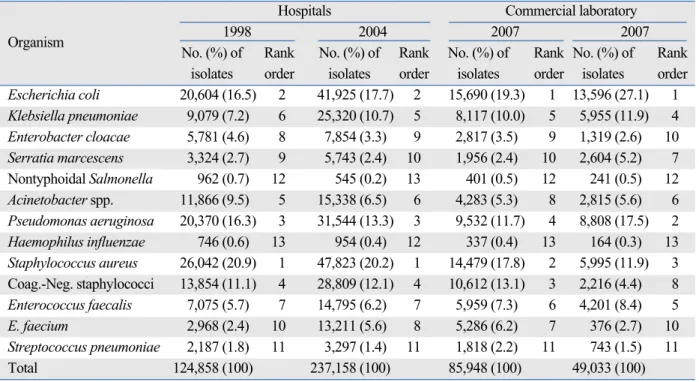
In 2007, E. coli ranked No. 1 in terms of the most prevalent organism isolated in both hospitals and the ComLab (19.3% and 27.1%)(Table 1). The second most prevalent organism was S. aureus in hospitals (17.8%) and P. aeruginosa in the ComLab (17.5%). The organisms ranked No. 3 thro-ugh No. 5 in hospitals were coagulase-negative staphylo-cocci (CNS)(13.1%), P. aeruginosa (11.7%), and K.
pneu-moniae (10.0%), whereas in the ComLab, these organisms
were S. aureus (11.9%), K. pneumoniae (11.9%), and E.
faecalis (8.4%). Changes in the rank of prevalent organisms
in hospitals since 1998 were as follows: E. faecium from No. 10 (2.4%) to No. 7 (6.2%), and Acineto-bacter spp. from No. 5 (9.5%) to No. 8 (5.3%).
The appropriateness of antimicrobial agents used to test susceptibility was analyzed for E. coli and S. aureus as representatives of Gram-negative bacilli and Gram-positive cocci, respectively. Overall, more hospitals followed the CLSI guidelines in 2007 than in 2002. However, the
pro-MATERIALS AND METHODS
portions of hospitals that used cephalothin, cefoxitin, ampicillin-sulbactam or amoxicillin-clavulanic acid, and cotrimoxazole to test the susceptibility of E. coli were only 86%, 81%, 65%, and 51%, respectively (data not shown). All hospitals used penicillin G, oxacillin (or cefoxitin to screen MRSA), erythromycin, and clindamycin to test the susceptibilities of S. aureus, but only 61% of hospitals used cotrimoxazole.
Resistances in the hospitals and in the ComLab Surveillance results for both 2005 and 2007 (Tables 2-5) were analyzed in this study, but for simplicity, only the
results for 2007 are described. Of the S. aureus hospital isolates, 64% and 8% were resistant to oxacillin (or to cefox-itin for MRSA detection) and to cotrimoxazole, respectively (Table 2). In the ComLab, 63% and 56% of S. aureus isola-tes were resistant to oxacillin and clindamycin, respectively. The resistance rates of CNS in hospitals to oxacillin and clindamycin were 64% and 29%, respectively, whereas the respective rates in the ComLab were 70% and 30%.
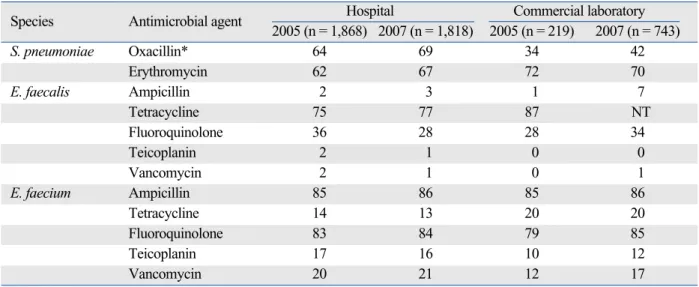
In the hospitals, when the meningitis breakpoint was applied, 69% of S. pneumoniae were nonsusceptible to oxacillin, suggesting penicillin nonsusceptibility (Table 3). The resistance of E. faecalis isolates to ampicillin and Table 1. Comparison of the Number, Proportion, and Rank Order of Organisms Detected in Surveillance Programs in 1998, 2004, and 2007
Hospitals Commercial laboratory
Organism 1998 2004 2007 2007
No. (%) of Rank No. (%) of Rank No. (%) of Rank No. (%) of Rank
isolates order isolates order isolates order isolates order
Escherichia coli 20,604 (16.5) 2 41,925 (17.7) 2 15,690 (19.3) 1 13,596 (27.1) 1 Klebsiella pneumoniae 9,079 (7.2) 6 25,320 (10.7) 5 8,117 (10.0) 5 5,955 (11.9) 4 Enterobacter cloacae 5,781 (4.6) 8 7,854 (3.3) 9 2,817 (3.5) 9 1,319 (2.6) 10 Serratia marcescens 3,324 (2.7) 9 5,743 (2.4) 10 1,956 (2.4) 10 2,604 (5.2) 7 Nontyphoidal Salmonella 962 (0.7) 12 545 (0.2) 13 401 (0.5) 12 241 (0.5) 12 Acinetobacter spp. 11,866 (9.5) 5 15,338 (6.5) 6 4,283 (5.3) 8 2,815 (5.6) 6 Pseudomonas aeruginosa 20,370 (16.3) 3 31,544 (13.3) 3 9,532 (11.7) 4 8,808 (17.5) 2 Haemophilus influenzae 746 (0.6) 13 954 (0.4) 12 337 (0.4) 13 164 (0.3) 13 Staphylococcus aureus 26,042 (20.9) 1 47,823 (20.2) 1 14,479 (17.8) 2 5,995 (11.9) 3 Coag.-Neg. staphylococci 13,854 (11.1) 4 28,809 (12.1) 4 10,612 (13.1) 3 2,216 (4.4) 8 Enterococcus faecalis 7,075 (5.7) 7 14,795 (6.2) 7 5,959 (7.3) 6 4,201 (8.4) 5 E. faecium 2,968 (2.4) 10 13,211 (5.6) 8 5,286 (6.2) 7 376 (2.7) 10 Streptococcus pneumoniae 2,187 (1.8) 11 3,297 (1.4) 11 1,818 (2.2) 11 743 (1.5) 11 Total 124,858 (100) 237,158 (100) 85,948 (100) 49,033 (100)
Table 2. Antimicrobial Resistant Rates (%) of S. aureus and Coagulase-Negative Staphylococcus Isolated in 2005 and in 2007
S. aureus* Coagulase-negative Staphylococcus�
Antimicrobial Hospital Commercial laboratory Hospital Commercial laboratory
agent 2005 2007 2005 2007 2005 2007 2005 2007 (n = 15,699) (n = 14,479) (n = 2,387) (n = 5,995) (n = 11,039) (n = 10,612) (n = 1,721) (n = 2,216) Oxacillin 59 64 53 63 70 64 53 70 Penicillin 90 88 95 99 89 86 88 99 Clindamycin 52 52 43 56 34 29 22 30 Erythromycin 62 62 55 58 55 51 53 51 Cotrimoxazole 12 8 NT NT 31 27 NT NT Tetracycline 45 47 45 47 34 28 33 31 Gentamicin 54 51 50 52 48 28 25 36 Fluoroquinolone 51 52 44 48 36 32 23 34 NT, not tested.
*None of the isolates were resistant to teicoplanin or to vancomycin.
vancomycin were very low, but those of E. faecium were 86% and 21%, respectively. In the ComLab, 42% of S.
pneumoniae were nonsusceptible to oxacillin, 86% of E. faecium were resistant to ampicillin, and 17% of E.
faeci-um were resistant to vancomycin.
The resistance rates of E. coli in the hospitals to ampicil-lin, cefotaxime, amikacin, and fluoroquinolone were 60%, 11%, 2%, and 27%, respectively (Table 4). In the ComLab,
Table 4. Antimicrobial Resistance Rates (%) of E. coli and K. pneumoniae Isolated in 2005 and in 2007
E. coli K. pneumoniae
Antimicrobial Hospital Commercial laboratory Hospital Commercial laboratory
agent 2005 2007 2005 2007 2005 2007 2005 2007 (n = 16,075) (n = 15,690) (n = 5,609)(n = 13,596)(n = 8,936)(n = 8,117) (n = 2,086) (n = 5,955) Ampicillin 65 60 69 70 -* - - -Ampicillin-sulbactam 32 29 - 31 34 30 NT 47 Piperacillin 54 35 28 38 50 45 49 99 Piperacillin-tazobactam 3 2 1 1 14 12 5 7 Ticarcillin-clavulanate 11 12 14 5 28 23 39 22 Cephalothin 27 22 31 54 42 37 50 54 Cefotaxime 12 11 12 45 25 25 38 45 Ceftazidime 12 8 12 47 32 29 41 47 Aztreonam 10 11 NT 21 30 27 NT 44 Cefepime 10 8 11 20 19 22 31 44 Cefoperazone-sulbactam 4 3 NT NT 11 5 NT NT Cefoxitin 8 6 8 11 24 21 33 35 Cefotetan 3 1 NT NT 12 9 NT NT Imipenem 0.2 0 0 0 0.3 0 0 0 Meropenem 0.4 0 NT 0 0.8 0 NT 0 Amikacin 4 2 3 4 24 18 30 31 Gentamicin 25 25 27 32 26 22 33 31 Tobramycin 17 15 16 18 36 29 49 44 Fluoroquinolone 32 27 35 42 30 27 34 42 Cotrimoxazole 33 32 NT NT 25 21 NT NT Tetracycline 53 45 54 53 27 22 20 19 NT, not tested.
*Antimicrobial agent not recommended for susceptibility testing of that particular organism.
Table 3. Antimicrobial Resistant Rates (%) of S. pneumoniae, E. faecalis, and E. faecium Isolated in 2005 and in 2007
Species Antimicrobial agent Hospital Commercial laboratory
2005 (n = 1,868) 2007 (n = 1,818) 2005 (n = 219) 2007 (n = 743) S. pneumoniae Oxacillin* 64 69 34 42 Erythromycin 62 67 72 70 E. faecalis Ampicillin 2 3 1 7 Tetracycline 75 77 87 NT Fluoroquinolone 36 28 28 34 Teicoplanin 2 1 0 0 Vancomycin 2 1 0 1 E. faecium Ampicillin 85 86 85 86 Tetracycline 14 13 20 20 Fluoroquinolone 83 84 79 85 Teicoplanin 17 16 10 12 Vancomycin 20 21 12 17 NT, not tested.
the resistance rates of E. coli to ampicillin and amikacin were similar to those in the hospitals, but the rates of resis-tance to cefotaxime and to fluoroquinolone were higher: 45% and 42%, respectively. Of K. pneumoniae hospital isolates, 29% were resistant to ceftazidime, 21% to cefoxi-tin, 18% to amikacin, and 27% to fluoroquinolone (Table 4). In the ComLab, the resistance rates to ceftazidime, cefoxitin, amikacin, and fluoroquinolone were higher than those in the hospitals. ESBL-producing E. coli and K.
pneumoniae were tested by 21 and 20 hospitals,
respecti-vely. The mean proportion of ESBL-producing E. coli and
K. pneumoniae isolates was 12% and 29% in 2007,
res-pectively (data not shown).
Of the Enterobacter cloacae hospital isolates, 30% were resistant to ceftazidime, 8% to cefepime, 6% to amikacin, and 10% to fluoroquinolone (Table 5). The resistance rates of this organism in the ComLab to ceftazidime and cefe-pime were slightly lower, whereas the rates of resistance to amikacin and fluoroquinolone were similar between the ComLab and hospitals. Of the Serratia marcescens isolates, 17% were ceftazidime-resistant, 10% were cefepime-resistant, 12% were amikacin-cefepime-resistant, and 10% were fluoroquinolone-resistant (Table 5). In the ComLab, 7% of
S. marcescens isolates were resistant to ceftazidime, but
15% were resistant to cefotaxime. The rates of resistance to amikacin and fluoroquinolone were similar, but resis-tance to cefepime was lower in the ComLab isolates than
in the hospital isolates.
Of P. aeruginosa hospitals isolates, 18% were resistant to piperacillin-tazobactam, 19% to ceftazidime, 21% to imipenem, 19% to amikacin, and 33% to fluoroquinolone (Table 6). The resistance rates of the ComLab P. aeruginosa isolates to piperacillin-tazobactam were similar to those of the hospital isolates, but those to ceftazidime, imipenem, amikacin, and fluoroquinolone were higher than those in the hospitals. Of the Acinetobacter spp. hospitals isolates, 26% were resistant to ampicillin-sulbactam, 19% to cefo-perazone-sulbactam, and 50% to ceftazidime. The imipe-nem resistance rate was 22%, which was an increase from 16% in 2005. The resistance rates to amikacin and fluoro-quinolone were 37% and 48%, respectively (Table 6). In the ComLab, the resistance rates to ampicillin-sulbactam, ceftazidime, and imipenem were similar, but that to amika-cin was slightly lower and that to fluoroquinolone was slightly higher than those in the hospitals.
The numbers of hospitals that tested the susceptibility of non-typhoidal Salmonella were 29 in 2005 and 33 in 2007. The resistance rate of hospital isolates of this organism to ampicillin, cotrimoxazole, and fluoroquinolone was 38%, 8%, and 0%, respectively. In the ComLab, the incidence of isolates resistant to ampicillin was slightly lower (data not shown). The susceptibility of Haemophilus influenzae was tested by 18 hospitals in 2005 and 23 in 2007. Among these hospitals 19 tested both ampicillin susceptibility and Table 5. Antimicrobial Resistance Rates (%) of E. cloacae and S. marcescens Isolated in 2005 and in 2007
E. cloacae S. marcescens
Antimicrobial Hospitals Commercial laboratory Hospitals Commercial laboratory
agent 2005 2007 2005 2007 2005 2007 2005 2007 (n = 2,914) (n = 2,817) (n = 478) (n = 1,319) (n = 1,694)(n = 1,956) (n = 795) (n = 2,604) Piperacillin 40 30 26 24 34 38 27 37 Piperacillin-tazobactam 13 9 4 3 10 8 2 1 Ticarcillin-clavulanate 31 27 23 17 24 22 24 NT Cefotaxime 33 29 19 21 20 21 11 15 Ceftazidime 33 30 23 19 16 17 6 7 Aztreonam 29 27 NT 17 16 22 NT 9 Cefepime 9 8 1 4 10 10 NT 2 Cefoperazone-sulbactam 10 5 NT NT 7 10 NT NT Imipenem 0.3 0 0 0 1 1 0 0 Meropenem 0.8 1 NT 0 3 1 NT 0 Amikacin 9 6 4 6 15 12 14 11 Gentamicin 20 17 20 18 30 34 40 40 Tobramycin 28 21 33 23 38 38 57 51 Fluoroquinolone 9 10 6 14 8 10 13 13 Cotrimoxazole 26 24 NT NT 18 19 NT NT Tetracycline 26 20 22 21 78 52 58 40 NT, not tested.
β-lactamase production, 19 tested ampicillin susceptibility only, and 12 tested β-lactamase production only (data not shown). Among the 2007 isolates, 56% were resistant to ampicillin and 41% were β-lactamase positive (data not shown). The resistance rate of this organism to cotrimox-azole was 42%, which was lower than that the 56% ob-served in 2005.
Significant resistance trends
Temporal trends of important antimicrobial agent-organism combinations in hospitals are shown in Figs. 1-4. In 2005, the proportion of MRSA, penicillin-nonsusceptible S.
pneumoniae, and ampicillin-resistant E. faecium decreased
slightly relative to 2003, but in 2007, the proportion of these organisms returned to the 2003 levels (Fig. 1). The propor-tion of vancomycin-resistant E. faecium remained unchang-ed from 2003 to 2005, while in 2007, the proportion was approximately five-fold higher than that ten years prior.
The rates of resistance of K. pneumoniae to ceftazidime, fluoroquinolone, and amikacin increased significantly in 2005 compared to those of previous years and then decreas-ed slightly in 2007 (Fig. 2). Cefoxitin resistance rates of this organism remained largely unchanged since 1999. Over the last decade, fluoroquinolone resistance increased approximately four-fold, while amikacin resistance increas-ed over two-fold.
Fewer P. aeruginosa isolates were resistant to fluoroqui-nolone and amikacin in 2007, but the rates of resistance to these antibiotics remained high: 33% and 19%, respecti-vely (Fig. 3). Ceftazidime and imipenem resistance incre-ased gradually, reaching proportions of 19% and 21%, respectively. Acinetobacter spp. showed decreased resis-tance to ceftazidime, fluoroquinolone, and amikacin, but the rates were still very high in 2007; 50%, 48%, and 37%, Table 6. Antimicrobial Resistance Rates (%) of Acinetobacter spp. and P. aeruginosa Isolated in 2005 and in 2007
P. aeruginosa Acinetobacter spp.
Antimicrobial Hospitals Commercial laboratory Hospitals Commercial laboratory
agent 2005 2007 2005 2007 2005 2007 2005 2007 (n = 10,728) (n = 9,532) (n = 2,817) (n = 8,808) (n = 4,882)(n = 4,283) (n = 933) (n = 2,815) Ampicillin-sulbactam -* - - - 29 26 NT 24 Piperacillin 29 24 30 34 52 46 58 56 Piperacillin-tazobactam 18 18 16 23 33 27 16 20 Ticarcillin-clavulanate 36 22 47 29 36 62 45 78 Cefotaxime 46 68 70 97 57 59 63 98 Ceftazidime 20 19 19 28 56 50 61 58 Aztreonam 23 22 21 29 67 62 75 78 Cefepime 20 22 19 29 45 44 30 43 Cefoperazone-sulbactam 23 26 NT NT 24 19 NT NT Imipenem 19 21 19 29 16 22 9 20 Meropenem 19 16 20 25 29 24 16 23 Amikacin 22 19 29 30 43 37 32 25 Gentamicin 33 29 43 42 54 51 61 58 Tobramycin 30 26 43 40 54 43 60 51 Fluoroquinolone 34 33 49 51 51 48 66 64 Cotrimoxazole - - - - 52 52 NT NT Tetracycline - - - - 62 70 51 98 NT, not tested.
*Antimicrobial agent not recommended for susceptibility testing of that particular organism.
OXA-R SAU Resistance (%) 1997 70 4 72 75 69 15 78 84 70 16 72 88 68 20 70 88 59 20 64 85 64 21 69 86 0 20 40 60 80 PEN-NS SPN AMP-R EFM VAN-R EFM 1999 2001 2003 2005 2007
Fig. 1. The resistance trends of gram-positive cocci in the hospitals.
Oxacillin-resistant S. aureus, penicillin-nonsusceptible S. pneumoniae, and ampicillin-resistant E. faecium continued to have high prevalence rates, and a gradual increase in vancomycin-resistant E. faecium strains was observed. OXA, oxacillin; PEN, penicillin; AMP, ampicillin; VAN, vancomycin; R, resistant; NS, nonsusceptible; SAU, S. aureus; SPN, S. pneumoniae; EFM, E. faecium.
respectively. Imipenem resistance increased 22-fold over the past decade from 1% in 1997 to 22% in 2007 (Fig. 4).
Comparison of the resistance rates of antibiotic-organism combinations of concern between hospitals and the ComLab showed similar prevalences of MRSA (64% vs. 63%) and ampicillin-resistant E. faecium (86% each). Penicillin-nonsusceptible S. pneumoniae isolates were more preval-ent in hospitals than in the ComLab (69% vs. 42%), vanco-mycin-resistant E. faecium were slightly more prevalent (21% vs. 17%), and proportions of imipenem-resistant
Acinetobacter spp. were similar (22% vs. 20%). More
cefo-taxime-resistant E. coli (45% vs. 11%), K. pneumoniae (45% vs. 25%), and imipenem-resistant P. aeruginosa (29% vs. 21%) were detected in the isolates analyzed by the ComLab than were found in the hospital isolates.
Antimicrobial resistance rates can vary greatly among
coun-tries,16hospitals, and even wards. For example, the European
Antimicrobial Resistance Surveillance System (EARSS) Annual Report in 2008 (www.escmid.org) revealed that the proportion of MRSA was only 1% in Sweden whereas it was 53% in Portugal. In Portugal, the rate varied from 0% to 89% depending on the laboratory. This highlights the importance of a national surveillance program. To guide clinicians in the empirical selection of an appropriate antimi-crobial agents, use of the first patient isolate has been recommended by the CLSI.17However, a study showed that
not all participating U.S. hospitals followed this guidel-ine.18Resistance selection occurring within the observation
period cannot be detected when only the first isolates are included.3In contrast to previous surveillance studies,
hospitals with duplicate isolates were excluded in the pre-sent study. Inclusion of only the first isolate may result in slightly lower resistance rates, particularly for certain noso-comial pathogens.19
We found that E. coli, S. aureus, CNS, P. aeruginosa, and K. pneumoniae, in rank order, were the five most pre-valent organisms in hospitals in Korea in 2007, indicating that these organisms were as important in 2007 as they were in 2004 (Table 1). In Germany, hospitals with an onsite microbiology laboratory reported higher frequencies of health care-associated infections than did hospitals without in-house laboratory services.4This suggests that the
rank order of organisms in the ComLab may not be accurate. The most prevalent organisms isolated from ICU pati-ents in 2000-2002 were S. aureus in the US, Canada, and France, P. aeruginosa in Italy, and CNS in Germany.16A
2006-2007 National Healthcare Safety Network (NHSN, which includes the former National Nosocomial Infections Surveillance) reported that the three most prevalent organi-sms isolated from healthcare-associated infections (HAI) were CNS (15%), S. aureus (15%), and Enterococcus sp. (12%).20This suggests that our isolates were mostly from
DISCUSSION
CAZ-R Resistance (%) 1997 8 7 26 16 22 6 10 24 12 10 20 27 19 13 23 25 24 30 32 21 18 27 29 0 5 10 25 20 15 30 35 FOX-R FQN-R AMK-R 1999 2001 2003 2005 2007 Fig. 2. The resistance trends of K. pneumoniae in the hospitals. The cefoxitinresistance rate remained high but stable, whereas ceftazidime, fluoroquinolone, and amikacin resistance rates increased in 2005 compared to those of previous years. CAZ, ceftazidime; FOX, cefoxitin; FQN, fluoroquinolone; AMK, amikacin.
FQN-R Resistance (%) 1997 1 64 50 6 65 68 5 65 61 54 13 55 58 16 56 43 51 37 22 45 50 0 20 40 60 AMK-R CAZ-R IPM-R 1999 2001 2003 2005 2007 Fig. 4. The resistance trends of Acinetobacter spp. isolates in hospitals. The
resistance rates to ceftazidime, fluoroquinolone, and amikacin decreased slightly, but that to imipenem increased steadily. FQN, fluoroquinolone; AMK, amikacin; CAZ, ceftazidime; IPM, imipenem.
FQN-R Resistance (%) 1997 17 16 42 33 28 19 20 39 21 17 26 40 20 19 25 40 19 34 22 20 19 21 33 0 10 30 20 40 AMK-R CAZ-R IPM-R 1999 2001 2003 2005 2007 Fig. 3. The resistance trends of P. aeruginosa isolates from hospitals. The
resistance rates to fluoroquinolone and amikacin declined slightly, but those to ceftazidime and imipenem remained stable. FQN, fluoroquinolone; AMK, amikacin; CAZ, ceftazidime; IPM, imipenem.
inpatients and hence had high resistance rates. A.
bauman-nii can easily acquire antibiotic resistance determinants.21
We therefore predicted that this organism would become more prevalent, but it became less prevalent in the hospi-tals, with a change in rank from the sixth position in 2004 to the eighth position in 2007. In the ComLab data, the typical nosocomial nonfermentative pathogen P.
aerugi-nosa ranked second in 2007, as in 2004.6
The CLSI document17recommends groups of
antimi-crobial agents for susceptibility testing. Group A agents are recommended for primary testing and reporting, while Group B contains agents that may warrant primary testing, however, they should be reported only selectively, such as when the organism is resistant to agents of the same family. However, these recommendations are difficult to follow in practice when resistant organisms are very prevalent. When a laboratory tests only a few classes of antimicrobial agents, information on other agents of interest to clinicians is not available, resulting in potential misselection of antimi-crobial agents. More laboratories used cephalothin, pipera-cillin-tazobactam, and cefoxitin to test E. coli in 2007 than in 2002, but still the laboratories using ampicillin-sulbactam (or amoxicillin-clavulanic acid) and cefoxitin were only 65% and 81%, respectively. Only 51% and 61% of labora-tories used cotrimoxazole to test for E. coli and S. aureus, respectively.
Certain antibiotic-organism combinations are relatively more prevalent in Korea and other Asian countries than in the rest of the world. The results of the present surveillance study highlight the fact that MRSA continues to be preval-ent in Korea, with an occurrence rate of 64% (Fig. 1). In a nationwide surveillance study in Japan in 2007, 59.7% of respiratory isolates of S. aureus were methicillin-resistant.22
Analysis of data from the Surveillance Network-USA (TSN), an electronic surveillance network that collected microbiology data from 300 clinical microbiology labora-tories across the US, revealed that the proportions of MRSA in 2005 in non-ICU inpatients, ICU patients, and outpati-ents were 59.2%, 55%, and 47.9%, respectively.23All of
the reports discussed above indicate that MRSA has also become a serious problem in non-Asian countries.
The CLSI document17defined two different penicillin G
susceptibility breakpoints for S. pneumoniae depending on the site of isolation. The vast majority of S. pneumoniae isolates are from non-meningitis patients. Therefore, apply-ing menapply-ingitis breakpoint to all S. pneumoniae appears illogical, but in epidemiologic surveillance studies, it was suggested that continued reporting based on meningitis (≤ 0.06 µg/mL) breakpoint might also be useful to allow for continuity in the reporting of long-term resistance occurrence data.24 These investigators reported that the
MIC range of penicillin for a large number of worldwide isolates in 2006 was ≤ 0.03-32 µg/mL, but 68% of the isolates were inhibited by ≤ 0.06 µg/mL, 93% by 2 µg/mL meningitis susceptible), and 99% by 4 µg/mL (non-meningitis intermediate). In our previous surveillance study, penicillin susceptibility testing was performed mostly using the oxacillin disk test to screen nonsusceptible isola-tes based on the meningitis breakpoint. In the current study, penicillin-nonsusceptible S. pneumoniae remained very prevalent (69%) in hospitals in 2007 (Fig. 5), but the rate in the ComLab was much lower (42%) (Table 3). A high prevalence of penicillin-nonsusceptible S.
pneu-moniae has also been reported in other Asian countries.25
The resistance rates of E. faecalis to ampicillin and vancomycin are very low. However, since 2003, the
van-Hospital Resistance (%) OXA-R SAU 64 63 0 20 40 60 80 100 ComLab PEN-NS SPN 69 42 AMP-R EFM 86 86 VAN-R EFM 21 17 CTX-R ECO 11 45 CTX-R KPN 25 45 IPM-R ACI 22 20 IPM-R PAE 21 29
Fig. 5. Comparison of the prevalence of antimicrobial-organism combinations in the hospitals and the commercial laboratory (ComLab) in 2007.
Penicillin-nonsusceptible S. pneumoniae and vancomycin-resistant E. faecium were more prevalent in the hospitals. Cefotaxime-resistant E. coli and
K. pneumoniae and imipenem-resistant P. aeruginosa were more prevalent among isolates in the commercial laboratory. OXA, oxacillin; R, resistant;
SAU, S. aureus; PEN, penicillin; NS, nonsusceptible; SPN, S. pneumoniae; AMP, ampicillin; EFM, E. faecium; VAN, vancomycin; CTX, cefotaxime; ECO,
comycin resistance rate of E. faecium has been reported to be 20% or higher in the hospitals (Fig. 5). The ComLab rates of E. faecium vancomycin-resistance were 12% in 2005 and 17% in 2007 (Table 3); a significant increase compared to 7% in 2003.26 Vancomycin-resistant E.
fae-cium has also become more prevalent in the United States.
In a Chicago Hospital, the prevalence of vancomycin-resis-tant E. faecium increased from 28.9% in 1993 to 72.4% in 2002, based on one isolate per patient per month.27The
NHSN report20stated that among the isolates from
catheter-associated urinary tract infections and central line-associ-ated bloodstream infections in 2006 and 2007, 90.4% and 80% of E. faecium were resistant to ampicillin and to van-comycin, respectively. This indicates that vancomycin-resistant enterococci are difficult to control. The rates of E.
faecium resistance to ampicillin were similar in the current
study and in the NHSN report, but vancomycin-resistance was lower in our study than in the NHSN report.
The prevalence of ampicillin-resistant E. coli in hospitals was 60% in 2007, a slight decrease compared to the 2004 rate, but in the ComLab it was 70%. This finding indicates that empirical selection for ampicillin is difficult, but that a significant proportion of E. coli infections can be treated using ampicillin after laboratory testing. E. coli and K.
pneumoniae often acquire ESBL genes. In 2007, 11% of E. coli and 29% of K. pneumoniae hospital isolates were
resistant to cefotaxime or ceftazidime, respectively, sugge-sting ESBL production. Some hospitals tested E. coli and
K. pneumoniae for both susceptibility to third-generation
cephalosporins and the production of β-lactamases. The resistance rates to third-generation cephalosporins and ESBL positive rates in 2007 were E. coli 12% and 12%, res-pectively, and K. pneumoniae 32% and 27%, respectively. It is of concern that in the ComLab in 2007, the ceftazi-dime-resistance rates of both E. coli and K. pneumoniae were much higher (47%) than those documented for hos-pitals. An outbreak of SHV-12 type ESBL-producing K.
pneumoniae was recently reported in a Korean hospital.28
In the hospitals, 6% of E. coli and 21% of K.
pneu-moniae were resistant to cefoxitin, suggesting
plasmid-mediated AmpC production. A previous study showed that the high prevalence of cefoxitin-resistant K. pneumoniae isolates was due to the plasmid-mediated AmpC enzymes, DHA-1 and CMY-1.10It was reported that among the
isolates from the Asia-Pacific region in 1998-2004, 8.9% of E. coli and 20.3% of K. pneumoniae isolates were ESBL screen-positive, but significant proportions of them were confirmation test negative.29 Among these nonconfirming
isolates, 62% of E. coli and 75% of K. pneumoniae har-bored a plasmid-borne AmpC enzyme of the CIT or DHA type. The high cefoxitin resistance rates of E. coli and K.
pneumoniae in our present study, 6% and 21%,
respecti-vely, indicate that ESBL detection could be difficult, result-ing in underestimation of the prevalence.
The percentages of ceftazidime-resistant E. cloacae and
S. marcescens isolates from the hospitals in 2007 were
30% and 17%, respectively; these values were slightly lower than those reported in 2004, namely 35% and 23%, respectively. The resistance rates to cefepime remained low, and imipenem-resistant Enterobacteriaceae remained very rare, but KPC type class A carbapenemase may emerge in the near future in Korea. K. pneumoniae isolates produc-ing KPC carbapenemase are commonly isolated in health care institutions located in the Northeast US, but the resis-tance has also spread to other parts of the country,30as well
as to other counties, including China.31
The rates of ampicillin resistance and β-lactamase pro-duction in H. influenzae were similar in 2004 (47% and 51%, respectively), but in 2007, the rates were 51% and 41%, respectively. It is necessary to determine whether this difference is indeed due to the emergence of β-lactamase-negative ampicillin-resistant (BNAR) H. influenzae, which have become prevalent in Japan.32The resistance rates of
non-typhoidal Salmonella to cotrimoxazole (8%) and fluo-roquinolone (0%) in hospitals were similar to those in 2004, but the ampicillin resistance rate decreased slightly from 44% to 38%. Fluoroquinolone resistance rate, despite being as low as 0%, probably fails to indicate clinical effi-cacy in the treatment of extraintestinal infections. This is because low-level quinolone resistance cannot be detected using fluoroquinolones.17
P. aeruginosa and Acinetobacter spp. are important
nosocomial pathogens. With the emergence of multidrug-resistant isolates, few drugs are now available to treat
Acinetobacter infections. Polymyxins are the only
thera-peutic option in many cases,33 but the emergence of A.
baumannii isolates resistant to all tested antimicrobials,
including polymyxin B, have been reported in Korea.34
Fewer isolates of P. aeruginosa and Acinetobacter spp. were resistant to fluoroquinolone and amikacin in our study than has been documented previously. The rates of imipenem resistance in P. aeruginosa remained stable, but more Acinetobacter spp. isolates were impenem-resistant than has been reported previously. It was shown that in P.
aeruginosa, only 10.8% of imipenem resistance was due to
metallo-β-lactamase production,8but the majority of
resis-tance in Acinetobacter spp. was due to OXA-type carba-penemase production.9Outbreak of imipenem-resistant A.
baumannii with OXA-23 carbapenemase was recently
reported in a Korean tertiary care hospital.35Increasing
car-bapenem resistance is a serious problem, because this is the only class of β-lactam agents active against isolates producing ESBLs or derepressed AmpC enzymes.36
cephalo-sporin-resistant E. coli and K. pneumoniae strains and imipenem-resistant P. aeruginosa strains were more pre-valent in isolates analyzed by the ComLab (Fig. 5) than in isolates examined by the hospital laboratory, suggesting that antimicrobial-resistant nosocomial pathogens are also a serious problem at smaller hospitals and clinics that have no in-house microbiology laboratory service.
In conclusion, MRSA, third-generation cephalosporin-resistant K. pneumoniae, and fluoroquinolone-cephalosporin-resistant E.
coli, P. aeruginosa and Acinetobacter spp. are still
pre-valent in the hospitals, and the smaller hospitals and clinics in Korea, and vancomycin-resistant E. faecium, and imipe-nem-resistant Acinetobacter spp. have gradually increased in Korean hospitals over the last decade. The higher pre-valences of third-generation cephalosporin-resistant E. coli and K. pneumoniae and imipenem-resistant P. aeruginosa in ComLab isolates are of concern.
Other KONSAR program participants
Nam Hee Ryoo, Keimyong University Dong San Medical Center, Daegu; Seok Hoon Jeong, Kosin University Gospel Hospital, Busan; Gyoung Yim Ha, Dongguk University Kyongju Hospital, Gyeongju; Mi-Na Kim, University of Ulsan College of Medicine, Seoul; Wee Gyo Lee, Ajou University Hospital, Suwon; Young Ae Hong, Ulsan Dong-Kang General Hospital, Ulsan; Sung Eun Cho, Ewha Womans University College of Medicine, Seoul; Young Uh, Yonsei University Wonju Christian Hospital, Wonju; Sook Jin Jang, Chosun University Hospital, Gwangju; Myung Hee Lee, Korea Veterans Hospital, Seoul; Wonkeun Song, Hallym University College of Medicine, Seoul; Tae Yeal Choi, Hanyang University Medical College, Seoul; Jong-Hee Shin, Chonnam National University Hospital, Gwangju; Seong Geun Hong, Pochon CHA University Hospital, Seongnam; Young Ah Kim, National Health Insurance Corporation Ilsan Hospital, Goyang; Dong-Hee Cho, Samsung Cheil Hospital, Seoul; Dong Hee Whang, Inje University College of Medicine, Seoul; Seungok Lee, Seoul Clinical Laboratory, Seoul; Seong Hee Lee, Han-maeum Hospital, Jeju.
1. Jones RN, Masterton R. Determining the value of antimicrobial surveillance programs. Diagn Microbiol Infect Dis 2001;41:171-5. 2. Morris AK, Masterton RG. Antibiotic resistance surveillance:
action for international studies. J Antimicrob Chemother 2002;49: 7-10.
3. Cornaglia G, Hryniewicz W, Jarlier V, Kahlmeter G, Mitter-mayer H, Stratchounski L, et al. European recommendations for antimicrobial resistance surveillance. Clin Microbiol Infect 2004; 10:349-83.
4. Llata E, Gaynes RP, Fridkin S. Measuring the scope and magni-tude of hospital-associated infection in the United States: the value of prevalence surveys. Clin Infect Dis 2009;48:1434-40. 5. Chong Y, Lee K, Park YJ, Jeon DS, Lee MH, Kim MY, et al.
Korean Nationwide Surveillance of Antimicrobial Resistance of bacteria in 1997. Yonsei Med J 1998;39:569-77.
6. Lee K, Lim CH, Cho JH, Lee WG, Uh Y, Kim HJ, et al. High prevalence of ceftazidime-resistant Klebsiella pneumoniae and increase of imipenem-resistant Pseudomonas aeruginosa and Acinetobacter spp. in Korea: a KONSAR program in 2004. Yonsei Med J 2006;47:634-45.
7. Lee K, Lee WG, Uh Y, Ha GY, Cho J, Chong Y; Korean Nation-wide Surveillance of Antimicrobial Resistance Group. VIM- and IMP-type metallo-beta-lactamase-producing Pseudomonas spp. and Acinetobacter spp. in Korean hospitals. Emerg Infect Dis 2003;9:868-71.
8. Lee K, Park AJ, Kim MY, Lee HJ, Cho JH, Kang JO, et al. Metallo-beta-lactamase-producing Pseudomonas spp. in Korea: high prevalence of isolates with VIM-2 type and emergence of isolates with IMP-1 type. Yonsei Med J 2009;50:335-9. 9. Lee K, Kim MN, Choi TY, Cho SE, Lee S, Whang DH, et al.
Wide dissemination of OXA-type carbapenemases in clinical
Acinetobacter spp. isolates from South Korea. Int J Antimicrob
Agents 2009;33:520-4
10. Lee K, Lee M, Shin JH, Lee MH, Kang SH, Park AJ, et al. Pre-valence of plasmid-mediated AmpC beta-lactamases in
Escher-ichia coli and Klebsiella pneumoniae in Korea. Microb Drug
Resist 2006;12:44-9.
11. Fridkin SK, Hill HA, Volova NV, Edwards JR, Lawton RM, Gaynes RP, et al. Temporal changes in prevalence of antimicrobial resistance in 23 US hospitals. Emerg Infect Dis 2002;8:697-701. 12. Van Beneden CA, Lexau C, Baughman W, Barnes B, Bennett N,
Cassidy PM, et al. Aggregated antibiograms and monitoring of drug-resistant Streptococcus pneumoniae. Emerg Infect Dis 2003;9:1089-95.
13. Bax R, Bywater R, Cornaglia G, Goosens H, Hunter P, Isham V, et al. Surveillance of antimicrobial resistance-what, how and whither? Clin Microbiol Infect 2001;7:316-25.
14. Sahm DF, Marsilio MK, Piazza G. Antimicrobial resistance in key bloodstream bacterial isolates: electronic surveillance with the Surveillance Network Database-USA. Clin Infect Dis 1999; 29:259-63.
15. Felmingham D, Grüeneberg RN. The Alexander project 1996-1997: latest susceptibility data from this international study of bacterial pathogens from community-acquired lower respiratory tract infections. J Antimicrob Chemother 2000;45:191-203. 16. Jones ME, Draghi DC, Thornsberry C, Karlowsky JA, Sahm DF,
Wenzel RP. Emerging resistance among bacterial pathogens in the intensive care unit - a European and North American Surveil-lance study (2000-2002). Ann Clin Microbiol Antimicrob 2004; 3:14.
17. Clinical and Laboratory Standards Institute. Performance stan-dards for antimicrobial susceptibility testing; nineteenth informa-tional supplement, M100-S19. Wayne, PA:CLSI; 2009. 18. Halstead DC, Gomez N, McCarter YS. Reality of developing a
community-wide antibiogram. J Clin Microbiol 2004;42:1-6.
ACKNOWLEDGEMENTS
19. Lee SO, Cho YK, Kim SY, Lee ES, Park SY, Seo YH. Compari-son of trends of resistance rates over 3 years calculated from results for all isolates and for the first isolate of a given species from a patient. J Clin Microbiol 2004;42:4776-9.
20. Hidron AI, Edwards JR, Patel J, Horan TC, Sievert DM, Pollock DA, et al. NHSN annual update: antimicrobial-resistant patho-gens associated with healthcare-associated infections: annual summary of data reported to the National Healthcare Safety Net-work at the Centers for Disease Control and Prevention, 2006-2007. Infect Control Hosp Epidemiol 2008;29:996-1011. 21. Peleg AY, Seifert H, Paterson DL. Acinetobacter baumannii:
emergence of a successful pathogen. Clin Microbiol Rev 2008; 21:538-82.
22. Niki Y, Hanaki H, Matsumoto T, Yagisawa M, Kohno S, Aoki N, et al. Nationwide surveillance of bacterial respiratory patho-gens conducted by the Japanese Society of Chemotherapy in 2007: general view of the pathogens’ antibacterial susceptibility. J Infect Chemother 2009;15:156-67.
23. Styers D, Sheehan DJ, Hogan P, Sahm DF. Laboratory-based surveillance of current antimicrobial resistance patterns and trends among Staphylococcus aureus: 2005 status in the United States. Ann Clin Microbiol Antimicrob 2006;5:2.
24. Weinstein MP, Klugman KP, Jones RN. Rationale for revised penicillin susceptibility breakpoints versus Streptococcus
pneu-moniae: coping with antimicrobial susceptibility in an era of
resis-tance. Clin Infect Dis 2009;48:1596-600.
25. Song JH, Jung SI, Ko KS, Kim NY, Son JS, Chang HH, et al. High prevalence of antimicrobial resistance among clinical
Strep-tococcus pneumoniae isolates in Asia (an ANSORP study).
Anti-microb Agents Chemother 2004;48:2101-7.
26. Lee K, Park KH, Jeong SH, Lim HS, Shin JH, Yong D, et al. Further increase of vancomycin-resistant Enterococcus faecium, amikacin- and fluoroquinolone-resistant Klebsiella pneumoniae, and imipenem-resistant Acinetobacter spp. in Korea: 2003 KONSAR surveillance. Yonsei Med J 2006;47:43-54.
27. Treitman AN, Yarnold PR, Warren J, Noskin GA. Emerging incidence of Enterococcus faecium among hospital isolates (1993 to 2002). J Clin Microbiol 2005;43:462-3.
28. Roh KH, Uh Y, Kim JS, Kim HS, Shin DH, Song W. First
out-break of multidrug-resistant Klebsiella pneumoniae producing both SHV-12-type extended-spectrum beta-lactamase and DHA-1-type AmpC beta-lactamase at a Korean hospital. Yonsei Med J 2008;49:53-7.
29. Bell JM, Chitsaz M, Turnidge JD, Barton M, Walters LJ, Jones RN. Prevalence and significance of a negative extended-spectrum beta-lactamase (ESBL) confirmation test result after a positive ESBL screening test result for isolates of Escherichia coli and
Klebsiella pneumoniae: results from the SENTRY Asia-Pacific
Surveillance Program. J Clin Microbiol 2007;45:1478-82. 30. Kitchel B, Sundin DR, Patel JB. Regional dissemination of
KPC-producing Klebsiella pneumoniae. Antimicrob Agents Chemo-ther 2009;53:4511-3.
31. Cai JC, Zhou HW, Zhang R, Chen GX. Emergence of Serratia
marcescens, Klebsiella pneumoniae, and Escherichia coli isolates
possessing the plasmid-mediated carbapenem-hydrolyzing beta-lactamase KPC-2 in intensive care units of a Chinese hospital. Antimicrob Agents Chemother 2008;52:2014-8.
32. Hasegawa K, Chiba N, Kobayashi R, Murayama Y, Iwata S, Suna-kawa K, et al. Rapidly increasing prevalence of beta-lactamase-nonproducing, ampicillin-resistant Haemophilus influenzae type b in patients with meningitis. Antimicrob Agents Chemother 2004; 48:1509-14.
33. Walkty A, DeCorby M, Nichol K, Karlowsky JA, Hoban DJ, Zhanel GG. In vitro activity of colistin (polymyxin E) against 3,480 isolates of gram-negative bacilli obtained from patients in Canadian hospitals in the CANWARD Study, 2007-2008. Antimicrob Agents Chemother 2009;53:4924-6.
34. Park YK, Peck KR, Cheong HS, Chung DR, Song JH, Ko KS. Extreme drug resistance in Acinetobacter baumannii infections in intensive care units, South Korea. Emerg Infect Dis 2009;15: 1325-7.
35. Yang HY, Lee HJ, Suh JT, Lee KM. Outbreaks of imipenem resistant Acinetobacter baumannii producing OXA-23 beta-lactamase in a tertiary care hospital in Korea. Yonsei Med J 2009; 50:764-70.
36. Livermore DM, Woodford N. Carbapenemases: a problem in waiting? Curr Opin Microbiol 2000;3:489-95.