FUTURE REFORM STRATEGIES
OF THE HEALTH INSURANCE
PROGRAM IN KOREA
*
1by
Hacheong Yeon**
2KOREA INSTITUTE FOR HEALTH AND
SOCIAL AFFAIRS
* This paper was presented at the International Symposium on "Future Prospect of Health Insurance Program in Developing and Developed Countries" hosted by United Nations University and Tokai University Tokyo, on August 16~23, 1996.
** President, Korea Institute for Health and Social Affairs
A Biographical Note on the Author
Hacheong Yeon, president of the Korea Institute for Health & Social Affairs, and served as the director of the Center for North Korean Economic Studies from 1991 to 1994 and vice president of the Korea Development Institute (KDI) from 1988 to 1990. He received his Ph.D. in 1977 from the City University of New York, where he specialized in welfare economics and comparative economic systems. Currently, he is a co-chairperson of the Reforming Committee for the Health and Welfare System under the Ministry of Health and Welfare. Dr. Yeon was a member of the Presidential Commission on the 21st Century, the Advisory Council on Democratic and Peaceful Unification under the ministry of reunification, and a standing member of the Executive Committee of the Korean Economic Association.
Among his many books and articles are: Social development in Korea: An overview(1995); Practical Means to Improve Intra-Korean Trade and Economic Cooperation (1993); Bridging the Chasm: Cooperative Economic Relation between North & South Korea (1992); An Analysis of the Middle Class in Korea and Policy Issues (1990); and Current Policy Issues and the Future Development of Social Security in Korea (1988); Extension and Reform Program of Medical Insurance Program (1986); Economic Growth and National Welfare Pension Program in Korea (1982).
㏅August 1996
Korea Institute Health and Social Affairs San 42-14, Bulkwang-dong, Eunpyung-ku, Seoul 122-040, Korea
CONTENTS
I. INTRODUCTION /4II. DEVELOPMENT AND PRESENT STATUS / 6
1. Development of the Health Insurance / 6 2. Present Status of Health Insurance / 8
III. GOALS AND ISSUES OF HEALTH INSURANCE REFORM / 13 1. Goals of Reform / 13
2. Reform Issues / 14 3. Reform Strategies / 18
IV. FUTURE PROSPECTS / 24 Reference / 26
I. Introduction
Along with Korea's remarkable economic growth during the past three decades, much progress has been made in social development, particularly with respect to the health insurance program.
Korea initiated a compulsory health insurance program with a limited coverage of less than 10 per cent of its people in 1977. The national health insurance program was then gradually expanded until it finally covered the whole population by 1989. The establishment of universal coverage within 12 years was unprecedented worldwide. Undoubtedly, the development of a health insurance plan in Korea has made significant contributions to increased accessibility to health care services. The Korean experience might be of interest to developing countries that want to achieve universal health insurance coverage under a health care delivery system dominated by the private sector and combined with a social insurance type of health care financing system.
Korea's health insurance program could not, notwithstanding its noteworthy rapid expansion record, avoid including some flaws such as a low reimbursement schedule, high copayments and the exclusion of many health care benefits from reimbursement. Thus reform was planned for the further development of Korea's health insurance program.
The first reform proposals were produced by the Health Care Reform Committee, in which scholars, experts, and government officials participated, in 1994. The main proposal included an expansion of benefits, a
reformulation of the fee schedule and the introduction of DRG (DiagnosisRelated Groups) system, as well as equitable and efficient financing and management. In 1995, the National Welfare Planning Board proposed acting programs for the above reforms. This year the longterm plan of the health care system is under discussion by the Longrange Economic Planning Committee Toward the 21st Century (1996).
In this paper, the current status of Korea's health insurance program will be briefly introduced, and the goals and issues of Korea's health insurance reform will be discussed. Furthermore some reform strategies are introduced and recommended. Finally, there will be a brief discussion of what we expect to gain from the reforms.
II. DEVELOPMENT AND PRESENT STATUS
1. DEVELOPMENT OF THE HEALTH INSURANCE
Until the mid 1970s, an individual's medical care was his or her own responsibility, with the exception of those insured under pilot health insurance programs and the indigent, who were cared for by government and/or private charity hospitals.13 In 1976, the Korean government
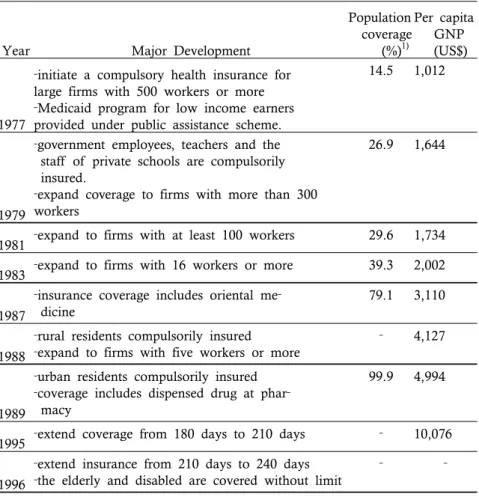
introduced a health insurance law to provide its citizens with compulsory medical care. There was considerable discussion concerning who should be covered first. Those who are in great need, such as poor farmers and the selfemployed, were considered first. However, it would be very difficult to collect premiums, and it would also be necessary to provide a large amount of government subsidies. In addition, there was concern about the lack of health resources in rural areas. As a result, the government made a decision to begin with large firms with 500 workers or more in July, 1977. At the same time the governmentsponsored Medicaid program for those under the poverty line was introduced. Since 1977 the coverage has been extended gradually to smaller firms (see Table 1).
1. In 1963, a law was enacted which permitted voluntary insurance plans to organize health insurance programs for workers. However, the voluntary health insurance was not successful in terms of both participation and financial viability. More details regarding the expansion of health care coverage in Korea can be found in Anderson(1989), Yeon(1989), and Yu and Anderson(1992).
Table 1. Major Development of the Health Insurance in Korea
Year Major Development
Population coverage (%)1) Per capita GNP (US$) 1977
‐initiate a compulsory health insurance for
large firms with 500 workers or more
‐Medicaid program for low income earners
provided under public assistance scheme.
14.5 1,012
1979
‐government employees, teachers and the
staff of private schools are compulsorily insured.
‐expand coverage to firms with more than 300
workers
26.9 1,644
1981 ‐expand to firms with at least 100 workers 29.6 1,734
1983 ‐expand to firms with 16 workers or more 39.3 2,002
1987
‐insurance coverage includes oriental me‐
dicine
79.1 3,110
1988
‐rural residents compulsorily insured
‐expand to firms with five workers or more
‐ 4,127
1989
‐urban residents compulsorily insured
‐coverage includes dispensed drug at phar‐
macy
99.9 4,994
1995 ‐extend coverage from 180 days to 210 days ‐ 10,076
1996
‐extend insurance from 210 days to 240 days
‐the elderly and disabled are covered without limit
‐ ‐
Note: 1) includes population under Medicaid
Sources: Ministry of Health and Welfare; Bank of Korea; Federation of Korean Medical Insurance Societies
On the other hand, there was a growing need to cover rural residents. After completing demonstration projects and considerable discussion, the government expanded the coverage to include rural residents in 1988 and urban residents in July, 1989, wherein the government subsidizes
a half of total expenditures. Thus, Korea had achieved universal health insurance coverage in twelve years.
2. PRESENT STATUS OF HEALTH INSURANCE
General Features of the Health Care System
The general features of health care system in Korea can be summarized as follows. First, most of the health care resources are privately owned. Only 23.8 per cent of hospital beds were public and 14 per cent of doctors were working in the public sector in 1993. Second, a severe disparity in the health resources distribution exists between urban and rural areas. Third, the Korean health care system features the coexistence of Western and Oriental medicine. Fourth, patients are first supposed to visit a primary care doctor, or a hospital, from which they are then referred, if necessary, to a general or University hospital. aim of this referral system is to discourage patients from going directly to expensive medical facilities for minor ailments. This system was introduced in 1989.
Total national health expenditures as a proportion of the GAP have increased from 2.7 per cent in 1975 to 4.5 per cent in 1985, and it is estimated to be around 4.7 per cent since 1990(see Figure 1).24 It is generally
acknowledged that direct patient payments nowadays account for approximately 57 per cent of the total expenditure(see Table 2).35
2. However, the expenditures under health insurance have increased 25.7 per cent in 1995, compared with 13.6 per cent on the average between 1990-94.
Year Health insurance Private se sector Public sector 1980 1985 1990 1993 9.75 16.21 21.65 23.11 71.25 68.63 57.31 56.70 19.01 15.17 21.04 20.18 Figure 1. Ratio of the National Health Expenditures to GAP
Table 2. Components of the National Health Expenditure
Source: Hong(1995)
The current status of the health insurance program is summarized in Table 3 and below are some additional details.
health expenditure is reported 11.6 per cent in Japan(1993) and 21 per cent in U.S.(1988). Source: Japan Ministry of Health and Welfare, and W. De Geyndt(1991).
Types Universal social insurance system with 373 funds nationwide.
a. industrial workers (145 occupational funds) b. civil servants and private school teachers (1 fund) c. self‐employed (227 regional funds)
11Population Coverage
a. employees of firms with 5 or more
b. civil servants, private school teachers, and de‐ pendents of military personnel
c. employees of firms with less than 5, the self‐ employed, and pensioners
Financing Contribution plus government subsidy
a. 3%(total), 1.5% employee, 1.5% employer; no ceiling
b. 3.8%(total), 1.65% employee, 1.65% govern‐ ment; no ceiling
c. premiums according to income, property, and family size, plus government subsidy (half of expenditure) Risk adjustment among 373 funds nationwide
Benefits Statutory benefits: (mainly in‐kind) medical examination, drugs, surgery, nursing, ambulance,
and check‐ups, Duration: 240 days/year (no limit for the disables and the elderly)
Patients copayment: 20% of hospitalization fees, and certain rates of copayment of outpatient fees (30% clinic, 40% hospital, 55% general hospital) Reimbursement: fee‐for‐service, fees under control of government, additional fees allowed (10% clinic, 15% hospital, 23% general hospital, 30% university hospital) and special
consultation fees for specialists at hospitals. Organization a,b,c.‐Ministry of Health and Welfare Affairs
a,c.‐National Federation of Medical Insurance b.‐Korean Medical Insurance Corporation
Organizational Structure
The National Health Insurance program is composed of three different schemes: 'Industrial Health Insurance Funds' for industrial workers(145 funds); a 'government health insurance fund' for government employees and private school teachers, 'Regional Health Insurance Funds' for rural and urban selfemployed workers (227 regions). Most funds are legally independent in terms of both administration and finance. The National Federation of Medical Insurance plays an important role in examining the invoices from medical care institutions and paying them.
Source of Funds
Premiums are imposed at a proportional rate of the insured's monthly earnings for industrial and government insurance funds, while for the regional insurance funds, several factors such as income, value of real estate and family size are taken into account in calculating the premiums. For the financing of the regional funds, the government provides subsidies, most of which are allocated by capitation. Some portion of the subsidies is distributed to the funds in different amounts depending on the amount of taxable income and the elderly's dependency ratio of each fund.
Risksharing Mechanism
There is some disparity in the financing ability among funds. Some funds have accumulated a considerable amount of financial reserves, whereas others are in a weak situation financially. To lessen these disparities, a risksharing mechanism was adopted in 1991
based on the simple idea that the richer insurance funds can subsidize the poorer ones.
Reimbursement
Doctor and hospital reimbursements are largely based on a feeforservice schedule, which is determined by the government. The government allows the scheduled prices for certain medical services to be raised, depending on the type of health care facility, according to the following classifications: raises fees for private clinics by 10 per cent, for small hospitals by 15 per cent, for general hospitals by 23 per cent and for large (university) hospitals by 30 per cent.
III. GOALS AND ISSUES OF HEALTH
INSURANCE REFORM
1. GOALS OF REFORM
Setting Reform Goals
The Korean government identified its strong will to reform the national health insurance system in 1994. The main goals of the reform are to increase the equity among the insured groups of various insurance schemes, to obtain the efficient management of the health care system, and finally to improve the overall quality of health care.
Environments Considered for Setting Reform Goals In accomplishing these goals, it is necessary to consider the many external challenges. The first challenge arises from Korea's rapid economic growth. This economic progress has raised the standard of living and the expectation of quality health services. The second challenge is the development of medical technology. In fact, clinically applicable technologies have proliferated to make medical practice more effective, more precise, and less hazardous than once thought possible. However, this development causes healthrelated expenditures to rise far faster than other sectors of the economy. The third is demographic changes, which will continue to increase the number and proportion of the elderly among the total population. Progress in medical technology has made it possible to treat more diseases and prolong life expectancy, resulting in the increased proportion of elderly people. The fourth is a change in disease patterns,
specifically a shift towards more chronic and multifaceted illnesses. This involves a shift from the more popular and heroic acute services towards the less prestigious and continuous care, such as rehabilitation and services for the chronically ill and disabled. These four properties constitute the main external challenges to the accomplishment of our health insurance reforms.
2.REFORM ISSUES
It has been seven years since Korea accomplished the universal coverage of the national health insurance system in 1989. During the last two decades, the quantitative growth of the Korean national health insurance system has been considerable. But in qualitative terms, many problems remain to be solved, such as the high level of outofpocket payments, the distorted health care market, and the financial disparity among funds. In these aspects, health insurance reform is now underway, and the followings are major reform issues.
High Level of OutofPocket Payment
The Korean national health insurance system initially started with a high level of copayments and limited benefits for the insured. By adopting this restricted national health insurance system, Korea may well have been able to establish universal health insurance system much faster than would otherwise have been possible. However, copayments are actually higher than the official schedules. For example, patients pay the full amount for any treatments beyond the limited period per year, which now stands 240 days. In addition
to high copayments, patients have to pay the treatment fees that are not covered by the feeforservice schedule. These limits have led to financial burdens for patients, especially the poor and the elderly. Thus, low income groups can not easily access medical care, because they are burdened by heavy outofpocket payments. Therefore, this problem of outofpocket payments by patients results in inequities among the people.
SupplierInduced Demand
The feeforservice reimbursement system is connected with the physicianinduced demand problem and the deterioration of health care quality. Primary care doctors and hospitals are paid mainly on a feeforservice schedule covering several thousand items. They, therefore, have an incentive to give each patient as much treatment as possible, including even unnecessary practices such as the duplication of services and the prolongation of visits or stays in hospitals. This may lead to the excessive volume of services beyond those which would be considered optimal on purely medical grounds. Furthermore, volume expansion can lead to malpractice as physicians do not spend sufficient time with their patients.
Long Waiting Lines
Under the present referral system, patients first visit a doctor in clinics or hospitals of their choice in their designated region, but require a referral letter to obtain treatment in a general or university hospital without any regional restriction.
This regulation obviously does not apply to emergencies, and there are exceptions allowed for certain treatments in the referral system. In practice, however, there are several ways for patients to make shortcuts if they want treatment with their preferred provider immediately, rather than via the referral process. "Preferred provider" for patients means the nearest urban medical center, rather than the local hospital. Hospitals, which are paid according to the feeforservice schedule, have no incentive to refuse people, either on an inpatient or an outpatient basis. The feeforservice payment system also encourages medical centers to treat patients who do not really require treatment in a specialized hospital department. Thus, patients are often willing to travel to urban areas in order to receive what they believe to be better treatment than the primary care sector, or the rural care sector, can provide. Consequently, the demand tends to be concentrated in urban medical centers, especially large university hospitals or general hospitals, where waiting times for some services then become unnecessarily long, resulting in a deterioration of the quality of service.
Maldistribution of Health Resources
Another problem is the maldistribution of medical personnel and facilities. The inadequacies and maldistribution of medical personnel and facilities results in even worse imbalances in the quality of health care provision across the country, despite the government's efforts to establish more health care
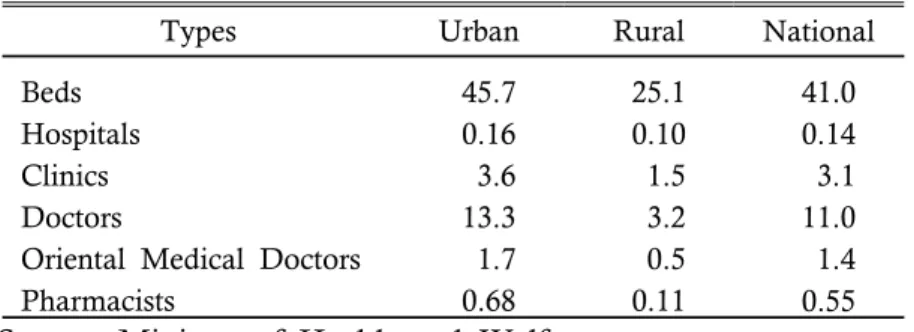
facilities in some rural areas. Table 4 shows that the number of doctors per ten thousand persons in urban and rural areas were 13.3 and 3.2 respectively.46 There are
also regional differences in the number of hospital beds; in 1994, the number of beds per ten thousand persons was 45.7 in urban areas and only 25.1 in rural areas. As a result, patients who reside in rural areas have to pay more traveling costs than urban area residents to access the health care facilities, while the overall quality of medical care is low in their region.
Types Urban Rural National Beds
Hospitals Clinics Doctors
Oriental Medical Doctors Pharmacists 45.7 0.16 3.6 13.3 1.7 0.68 25.1 0.10 1.5 3.2 0.5 0.11 41.0 0.14 3.1 11.0 1.4 0.55
Table 4. Health Resources by Region (1994)
(numbers per ten thousand persons)
Source: Ministry of Health and Welfare.
Financing Disparity among Insurance Funds
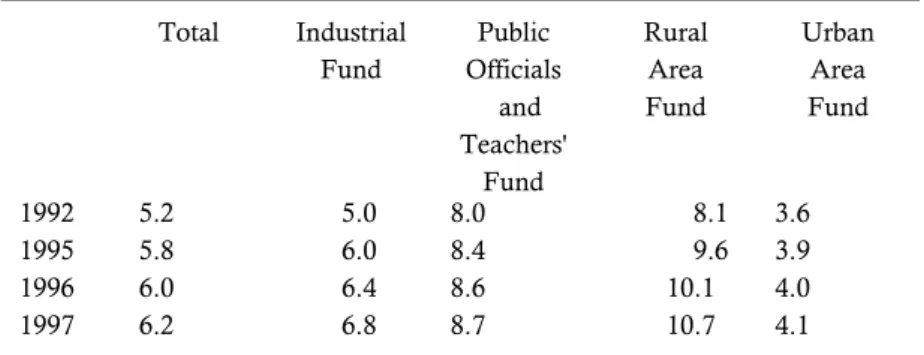
The variations in the affordability of contributions across funds and the differences in the utilization rate have caused financial disparities among funds. Almost all rural insurance funds, whose members have a low income and/or characteristics that lead to high health care costs owing to the large proportion of the elderly, are troubled with budget deficit. Meanwhile, other insurance funds, whose members have aboveaverage incomes and/or low estimated health care costs, such as industrial funds and some urban funds, have budget surpluses.
Total Industrial Fund Public Officials and Teachers' Fund Rural Area Fund Urban Area Fund 1992 1995 1996 1997 5.2 5.8 6.0 6.2 5.0 6.0 6.4 6.8 8.0 8.4 8.6 8.7 8.1 9.6 10.1 10.7 3.6 3.9 4.0 4.1
Table 5. Projections of Proportions of the Elderly Over 65
Source: Health Care Reform Committee(1994).
In addition, administrative cost differences among funds deepen the financial disparity. Rural insurance funds have more administrative costs because they have a wide region compared with the population size.57 Such high
administrative costs in rural insurance funds deteriorates their financial stability and leads to relatively higher premiums compared to other insurance funds. If these problems are not redressed, the disparity among insurance funds will likely be increased and the social solidarity of the insured will be undermined.
3. REFORM STRATEGIES
The issues mentioned above have inspired a wide variety of reform tasks to be performed. The
5. Budget shares of administrative costs were reported as 16.1 per cent in rural insurance funds, 9.6 per cent in urban insurance funds, 8.7 per cent in industrial workers' insurance, and 6.7 per cent in governmental officials and teachers' insurance in 1993.
strategies for reform primarily address the following questions: how to attain efficiency in managing the health insurance system; how to increase the equity among the insured and the insurance funds; and how to improve the quality of health care. At this point I would like to introduce several reform strategies, some of which are currently moving forward and others that are being suggested and discussed.
Reducing OutofPocket Payments and Expanding the Benefits Coverage
To cope with the burdensome outofpocket payments problem, the government has considered expanding the number of reimbursable benefits by insurance funds and reducing the rate of copayments. A more rational use of hospital facilities could be expected if more services were included in the reimbursement schedule. For example, many people are waiting for expensive tests, such as Magnetic Resonance Imaging (MRI), ultra sound testing and other electronic examinations, to be covered by insurance. In addition to this measure, the reimbursable treatment period per year is presently 240 days, and this will gradually be extended every year until it finally reaches 365 days by the year 2000. This extension plan will provide more treatment opportunities for the chronically ill and the elderly, who need more medical care and longer treatment.
These measures would lead to restructuring health care financing. Financing the broader coverage of benefits certainly will bring about raised premiums and also increased government subsidies to regional funds, whereas the pressure of increasing expenditures for
financially weak funds has to be alleviated through a risk sharing mechanism. For the low income earners, some adjustments in the premium schedule should be arranged.
Alleviating Moral Hazard
To solve the physicianinduced demand problem and the deterioration of health care quality, the government is now considering reformulating the feeforservice structure into Resource Based Relative Value Scale (RBRVS) and introducing Diagnosis Related Groups (DRG) system. The former price mechanism is expected to alleviate the behavior distortion of physicians. The latter DRG system is being experimented with to see if it will be successful through a series of demonstration projects continuing until late 1997. Such a system would be phased in, starting perhaps with inpatient treatment which can be readily defined and easily calculated. However, the system might eventually be extended to most services, including some outpatient treatments provided by private clinics. Another strategy we can consider is screening medical bills more carefully. Particularly, it might be possible to give the insurance funds more leeway when it comes to screening, including the review of bills and treatment process.68
Another view towards making the systems efficient suggest that Korea could develop health insurance system toward competition. This development could eventually move, as in several European countries,
6. NERA(1994) also recommended the introduction of a medical audit for the Korean health care system. NERA suggests that insurance funds should become the principal enforcement agencies, while physicians would have the right of appeal.
towards giving individuals a choice among insurance funds, thus introducing an element of competition among the funds.
Enhancing Referral System
In order to reduce the long waiting lines in urban medical centers, the following remedies are suggested. To improve the efficiency of the current referral system, we can enforce patients and hospitals to present a treatment referral letter from doctors of primary or secondary facilities when visiting general or university hospitals. The referral letter should include the details of treatment from doctors of the previous facilities.
Another measure is to improve the level of service quality in the primary health care facilities. The collective opening of clinics that jointly utilize personnel and facilities is one method to improve the health care level and to reduce investment expense at the same time. Tax alleviation and financial assistance will be needed to support group openings.
Other method being considered is to encourage the patients to utilize primary care for ordinary occasions, resulting in a decreased the utilization rate of the tertiary care facilities.
Supporting Health Care Resources in Rural Areas
So as to mitigate the maldistribution of physicians and health care facilities, government subsidizes local private hospitals and public 'Health Centers' through long term loans with low interest rates. In order to finance the fund, the government recently established a special tax, called "Special Tax for Agricultural
Industry". Another measure is to strengthen the function and structure of the 'Health Center' for chronic disease control for the elderly. Also being considered is the development of the 'Health Center' as a central organization taking charge of the comprehensive health promotion program including health education. Meanwhile in rural areas, two or three 'Health Posts' could be integrated into larger one to heighten the level of treatment facilities. Furthermore, it is necessary to reshape the role of Health Post according to geographic characteristics and population size and to strengthen the clinical test facility in the Health Post.
Reducing Financial Disparity Among Funds
To decrease the financial disparity between insurance funds, it will be necessary to strengthen and incorporate two kinds of financial adjustment mechanisms. The first one is an adjustment of the government's subsidy to the rural funds according to the level of taxable income and the proportion of elderly persons of each fund. The second one is to strengthen the risk sharing mechanism among overall funds. The government will increase the current risk sharing funds, which will be used to compensate the medical costs of insurance funds accruing from elderly patients over 65 years old and highly expensive treatments. In order to make the distribution effect efficient, it will be important to measure the financial status of each fund in order to assign the amount of contributions from each fund into the risk sharing funds.
Besides these measures, it will be necessary to reduce administrative costs and to realize
1994 1996 Change Total Industrial Funds Regional Funds KMIC1) 417 150 266 1 373 145 227 1 ▼ 44 ▼ 5 ▼ 39 ‐
"economies of scale" by making appropriate size of funds. One way might be to integrate a few closely located regional funds into a bigger one. The government has already tried this and reduced total number of funds from 417 in 1994 to 373 in 1996 (see Table 6).
Table 6. The Number of Insurance Fund
Note: 1) KMIC is Korea Medical Insurance Cooperation. Source: Korea Medical Insurance Cooperation.
IV. FUTURE PROSPECTS
So far I introduced ongoing reforms and some suggestions for further improvement of the Korea's health insurance system in the previous chapter. In this final chapter, I would like to speculate about the possible effects from the suggested reform strategies. With the completion of health insurance reform, the Korean health insurance scheme would enter a more mature phase and contribute to the health security of the people by facilitating access to health care and by using health resources more efficiently. From this perspective, both equity and efficiency, two goals of health care, could be improved.
With the integration of and competition among insurance funds, administrative costs could be reduced and better services would be provided to the insured. In addition, more efficient risk pooling with larger size of fund can bring about a cheaper premiums than what, otherwise, would have been expected.
As a result of the risk sharing mechanisms, the financial disparities and premium differences among funds will be alleviated. In the long run, it will be desirable that direct government subsidies are phased out gradually and replaced by the crosssubsidization among insurance funds. Furthermore, the medical aid program, currently paid for by the government, could be merged into the National Health Insurance Program through the risk sharing mechanism. Consequently, this would increase the independence and flexibility of insurance funds and strengthen the social solidarity
across the nation.
Finally I would like to note some limitations in performing reforms as well. In implementing various reform policies at the same time, every intended effect of policy measures might not be attainable because the goal of one policy could be conflict with that of the other. Moreover, the historical experience tells us that we often fail to have the expected outcomes of some reform policies. Therefore it would be the better way in implementing policies that individual reform policy must be evaluated in the comprehensive perspective at a certain point of time during the reforming schedule and the evaluation result should be fed back into the policy through the revision of the policies.
REFERENCES
Anderson, G. F., "Universal Health Care Coverage in Korea",Health Affairs, Summer 1989, pp. 2434. De Geyndt W., Managing Health Expenditures under National Health Insurance: The Case of Korea, World Bank Technical Paper No. 156, The World Bank, 1991. Health Care Reform Committee, Tasks and Policy Directions of Health Security Reform, June 1994 (in Korean).
Hong, J. K., Projections and Implicit Costs of the National Health Care Expenditures, Korea Institute for Health and Social Affairs, 1995 (in Korean). Longrange Economic Planning Committee Toward 21 Century, Planning for the Korean Social Welfare System (working paper), 1996 (in Korean).
Ministry of Health and Welfare(MOHW), Yearbook of Health and Welfare Statistics, Each Year.
National Economic Research Associates, The Health Care System in Korea, (Financing Health Care with Particular Reference to Medicines, Vol. 17), July 1994.
National Welfare Planning Board, Blue Print of National Welfare for Improvement of the Quality of Life, 1995 (in Korean).
Yeon, H. C., Social Development in the Republic of Korea: Considerations of Equity versus Efficiency Issue in Policy Making, Korea Development Institute Working Paper No. 8906, 1989, Seoul.
, Who Gains and Who Loses: An Overview of Equity and Efficiency in Korea's Health Insurance System, School of Public Health Discussion Paper, Harvard University, May 1985.
Yu, S. H. and G. F. Anderson, "Achieving Universal Health Insurance in Korea: A Model for Other Developing Countries?", Health Policy, 20, 1992, pp. 289299.