© Korean Powder Metallurgy Institute 706 -1. Introduction
The development of new and higher performance PM applications often requires the utilization of finer and finer additives of all kinds in premixes. However, very fine additives are more prone to dusting and segregation during powder handling and they deteriorate the flowability of the premix and its die cavity filling capability. This may result in lower production rates, higher variability in weight, larger density gradients within parts and less dimensional consistency after sintering. These drawbacks highly motivated the development of the FLOMET process, a binder treatment technology, in which a polymeric solid binder is used to bond the fine additives to the iron particles. The most remarkable effects are a reduced dusting (cleaner environment), reduced segregation and improved flow [1]. In this paper, the characteristics of bonded premixes are described and performances quantified. The merits of a binder treatment to achieve better consistency in part weight or high dimensional stability in sintered parts are also described.
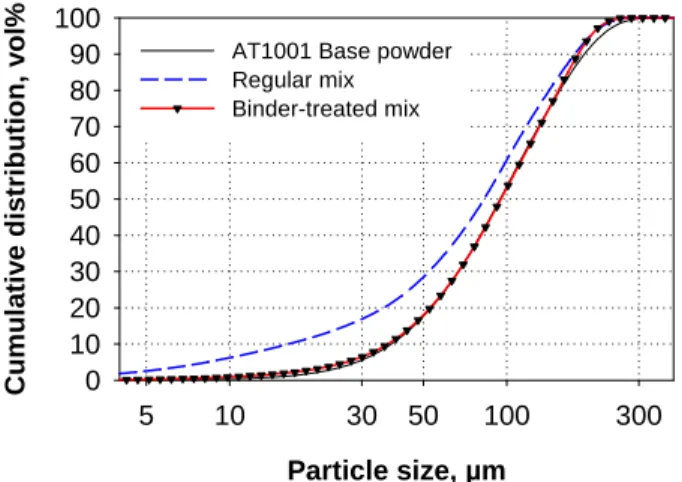
2. Characteristics of binder-treated premixes The efficiency of bonding fine particles in binder-treated mixes can be appreciated by measuring the particle size distribution using a laser diffractometer. As shown in Fig. 1 for a FC0208-type mix containing 0.50% MnS, the proportion of fine particles in the regular premix is much higher than in the binder-treated mix which is very similar to that of the base iron powder. This shows that the binder treatment is very efficient in bonding particles below about 60 µm to the larger ones or form larger size agglomerates.
Particle size, µm 5 10 30 50 100 300 Cum u la ti v e dist ri b u ti on, v o l% 0 10 20 30 40 50 60 70 80 90 100
AT1001 Base powder Regular mix Binder-treated mix
Fig. 1. Particle size distribution (laser analyzer) of a FC0208-type mix containing 0.50% MnS: ATOMET 1001 base powder, regular and binder-treated mixes. The bonding film must be strong enough to retain the fine particles when handling the mix. A laboratory test in which a sample of the powder premix is poured into a cylindrical tube and subjected to a flow of air in order to partially fluidize the powder was developed to qualify and quantify the strength of the bonding film. A qualitative appreciation of the bonding effect is shown in Fig. 2 for a regular and a binder-treated FC0208-type mix fluidized with an airflow of 6 l/min.
Quantitatively, this dusting resistance test consists in measuring the proportion of a given additive retained inside the tube after this severe fluidization. The dusting resistance values for binder-treated mixes are typically twice those of regular mixes, as reported in Table 1 for Cu, Ni and C (this latter includes graphite and lubricants). 2006 POWDER METALLURGY
World Congress
A01-07-3
Use of Binder Treatment to Enhance Properties of Premixes
Claude Gélinas and Sylvain St-LaurentQuebec Metal Powders, 1655 Marie-Victorin, Sorel-Tracy (Quebec) Canada [email protected], [email protected]
Abstract
Premixes treated with a binder, such as in the FLOMET process, exhibit better flow, reduced dusting and segregation and improved productivity and part consistency compared to conventional premixes. The binder treatment is highly suitable for high performance P/M applications which often require premixes containing very fine alloying additives and excellent die filling characteristics. With this process, various binders and lubricants can be utilized in order to make premixes with unique properties. In this paper, the characteristics and performances of bonded premixes are reported.
© Korean Powder Metallurgy Institute 707
-Fig. 2. Dust produced by the fine particles expelled out of the apparatus used to measure resistance to dusting (FC0208-type mixes containing 0.35% MnS).
Table 1. Typical C, Cu and Ni dust resistance of mixes. Type of mix C, % Cu, % Ni, %
Regular 50-65 20 25
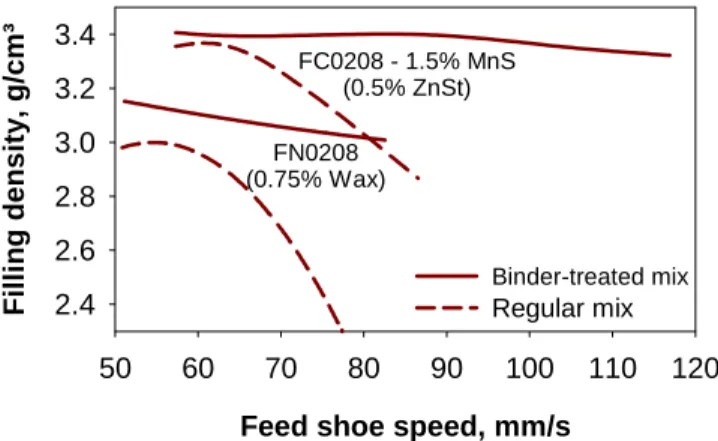
Binder-treated (FLOMET) 85-95 50 60 The bonding of fine particles improves the Hall flow rate of the mixes by 4 to 10 s/50 g depending on the mix formulation. Generally, worse the flow of a given mix and larger the gain in flow rate after binder treatment. One of the most important objectives of such a binder treatment is to improve the behavior of the mix during compaction and this is difficult to measure in laboratory. A variant of the Arnold test method was used in order to measure the mix die fill capability. The test consists in filling a small cylindrical cavity (8 mm dia by 30 mm deep) by sliding at different speeds over the cavity a shoe containing the mix. The typical die filling behavior of a regular and binder-treated mix is illustrated in Fig. 3 for a FC0208-type mix containing 1.5% MnS and a FN0208-type mix. The binder-treated mixes fill the cavity more consistently than the regular mixes and at higher speeds (shorter filling times).
Feed shoe speed, mm/s
50 60 70 80 90 100 110 120 F il li ng de ns it y , g /cm ³ 2.4 2.6 2.8 3.0 3.2 3.4 Binder-treated mix Regular mix FC0208 - 1.5% MnS (0.5% ZnSt) FN0208 (0.75% Wax)
Fig. 3. Filling density as a function of feed shoe speed for regular and binder-treated mixes (laboratory test).
3. Better consistency and dimensional stability
These results obtained in laboratory are often indicative of the mix behavior on a production press. For instance, a regular and a binder-treated FC0208-type mix based on a free-machining ATOMET 29M iron powder were pressed into small drive nuts under actual industrial compaction conditions [1]. Series of ~1500 parts were produced at 21 and 27 SPM with the part weight variations reported in Table 2. The regular mix could not be run at a rate higher than 21 SPM due to excessive variations in weight and pressure. Increasing the compaction rate to 27 SPM, which is the upper limit of the press, did not affect the part weight stability of the binder-treated mix. The production rate could thus be increased by 28% with a 20% reduction in weight variability versus the regular mix.
Table 2. Part weight variation obtained during production of drive nuts at 2 compaction rates.
Strokes Per Minute Type of mix
21 27
Regular 0.82% Not run
Binder-treated (FLOMET) 0.65% 0.67%
Finally, for applications in which dimensional stability is crucial, fine additives are preferred and then a binder treatment is often required in order to make the premix free flowing. The benefit of using both fine additives and the binder treatment on the dimensional stability was demonstrated for thin rings pressed and sintered from a pre-alloyed Mo steel powder admixed with 4% Ni, 2.6% Cu and 0.6% graphite [2]. Different grades of Cu and graphite were used. The dimensional variation, defined as the difference in dimensional change between the top and the bottom of the ring, was found to be much lower with the very fine Cu and graphite additives: 0.013% versus 0.077% for regular graphite and copper. This resulted from a better chemical homogeneity within parts and from part-to-part.
4. Summary
The characteristics and performances of bonded mixes were described. Two examples were given to show how the improvements in physical properties of mixes treated with a binder transposed into a better consistency in part weight or high dimensional stability in sintered parts.
5. References
1. S. St-Laurent & al., Advances in Powder Metallurgy & Particulate Materials - 2005, MPIF, Part 3, pp 110-123. 2. C. Gélinas & S. St-Laurent, SAE 2002 World Congress,
Detroit, Paper 2002-01-0668.