2019 ⦽ǎႊᔍᖒ⠱ʑྜྷ⦺⫭ ⇹ĥ⦺ᚁݡ⫭ םྙ᧞Ḳ
149
Buffer Retardation Experiment for Radionuclides Under the Elevated Temperature
Conditions: In-situ Synchrotron X-ray Powder Diffraction Study for the Korean
Bentonite Under the KURT Groundwater Saturated Conditions
Donghoon Seoung1,* and Tae-Jin Park2,** 1
Chonnam National University, 77, Yongbong-ro, Buk-gu, Gwangju, Republic of Korea 2
Korea Atomic Energy Research Institute, 111, Daedeok-daero 989beon-gil, Yuseong-gu, Daejeon, Republic of Korea *
[email protected] , **[email protected]
1. Introduction
Bentonites are to be used as buffer materials in a geological repository designed to host high-level radioactive wastes. The radioactive wastes including the spent nuclear fuels generate decay heats for a very long time. Although, most of the criteria is set to below 100oC for the bentonites, some efforts have been started to reconsider the thermal criteria for the buffer [1]. Thus, the hydration and dehydration reactions under the elevated temperatures of the bentonite, especially the montmorillonite as the main mineral component responsible for the performance of the buffer system, are of crucial importance in geological processes and the radioactive wastes disposal [2, 3].
The hydration and dehydration procedures concomitant with volume expansion and contraction of clay inside bentonite provide important information related with interstratified layers configuration, since the hydration and dehydration process depend on the composition of metal cations and water layers in interstratified layers [4]. We have conducted in-situ X-ray powder diffraction experiments as a function of increasing temperature for the Korean bentonite (e.g., the Gyeongju bentonite) under the dry as well as the KURT groundwater saturated conditions. Here, we report the results obtained under the KURT groundwater saturated conditions.
2. In-situ Synchrotron X-ray Powder
Diffraction
2.1 Method
In-situ synchrotron X-ray powder diffraction on montmorillonite was performed at beamline 3D at Pohang light source (PLS-II) at Pohang accelerator laboratory (PAL). At beamline 3D, approximate
100 ໃ beam of monochromatized X-rays with a wavelength of 0.6888 Å and MAR345 image plate detector was used to collect powder diffraction data.
For the in-situ sample heating environments, a sealed capillary with a diameter of 700 ໃ surrounded by nickel-chrome resistance heating coils was heated from RT to 250ଇ as a function of temperature. The temperature was raised for 30 minutes to each targeted steps, and was stabilized for 30 minutes.
2.2 Montmorillonite under the KURT Groundwater Saturated Condition
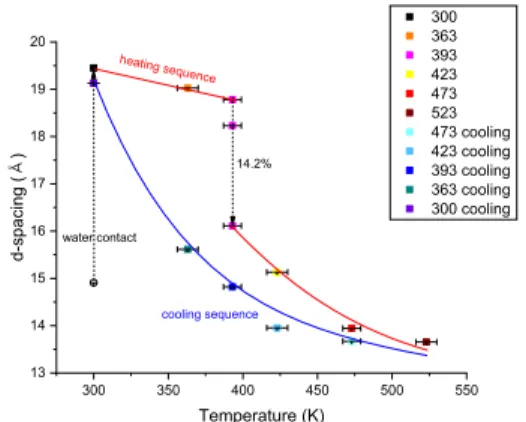
At heating sequence, (001) d-spacing gradually decreases. At 120ଇ it was drastically decreases from 19.02 ଈ to 16.11 ଈ concomitant with 14.2% of volume contraction. As temperature increases, it shows gradual decrease until the final step of experiment, 225ଇ. At cooling sequence with water saturated condition, it shows complete recovery to 19.12ଈ of d-spacing (Fig. 1). 300 350 400 450 500 550 13 14 15 16 17 18 19 20 14.2% cooling sequence water contact heating sequence 300 363 393 423 473 523 473 cooling 423 cooling 393 cooling 363 cooling 300 cooling d-spacing ( ) Temperature (K)
Fig. 1. Changes in the d-spacing (Å) of montmorillonite (001) reflections under water saturated condition as a
function of temperature. Black line shows superhydration at initial water contact, red line shows heating sequence, and blue line shows cooling sequence.
150
2019 ⦽ǎႊᔍᖒ⠱ʑྜྷ⦺⫭⇹ĥ⦺ᚁݡ⫭םྙ᧞Ḳ2.3 Pretreated-Montmorillonite under the KURT Groundwater Saturated Condition
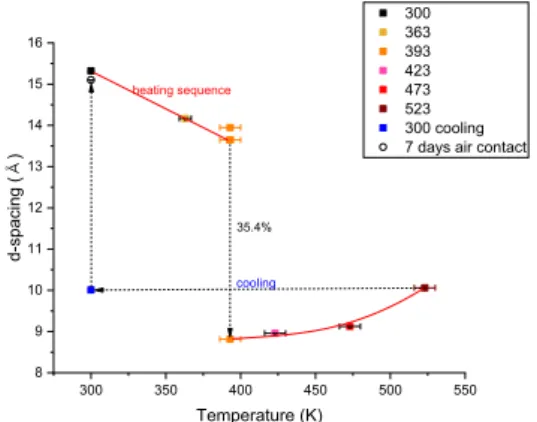
The Korean bentonite pretreated for longer than 365 days with LAB-TH setup under the elevated temperature conditions was prepared for the comparison. 300 350 400 450 500 550 8 9 10 11 12 13 14 15 16 cooling heating sequence 35.4% 300 363 393 423 473 523 300 cooling 7 days air contact
d-spacing (
)
Temperature (K)
Fig. 2. Changes in the d-spacing (Å) of montmorillonite (001) reflections under dry condition as a function of
temperature.
At 120ଇ, drastic d-spacing decrease from 19.04ଈ to 15.36ଈ concomitant with about 19.3% of volume contraction was observed. Particularly, it shows additional d-spacing decrease at 200ଇ from 13.79ଈ to 8.53ଈ with ~38.1% volume contraction. After air contact for a week, d-spacing showed minor recovery to 15.75ଈ (Fig. 2).
3. Conclusions
We experimentally established that montmorillonite (001) d-spacing changes under the elevated temperature conditions including both hydrothermal and dry conditions show particular contraction at 120ଇ with dehydration sequence. Gradual volume contraction of montmorillonite up to 250ଇ under water saturated condition implies its second dehydration temperature is anticipated over final stage.
ACKNOWLEDGEMENT
This work was supported by the Korean government, Ministry of Science and ICT, for support No. 2017M2A8A5014859 and NRF-2017R1D1A1B03035418.
REFERENCES
[1] Park, T.-J., Ryu, J.-H., Cho, W. H., and Lee, J.-K., "Buffer retardation experiments for radionuclides under the elevated temperature conditions: Strategy and methodology development for the Korean bentonite," Proc. Kor. Rad. Waste Soc., 16(2), 203-204 (2018).
[2] Ewing, R.C., "Long-term storage of spent nuclear fuel," Nature Materials, 14(3): p. 252-257 (2015). [3] Sellin, P. and O.X. Leupin, "The use of caly as an
engineered barrier in radioactive-waste management - A review," Clays and Clay Minerals, 61(6): p. 477-498 (2013).
[4] Park, T.-J., Ryu, J.-H., Cho, W. H., and Lee, J.-K., "Buffer retardation experiments for radionuclides under the elevated temperature conditions: Strategy and methodology development for the Korean bentonite," Proc. Kor. Rad. Waste Soc., 16(2), 203-204 (2018).