INTRODUCTION
The problem of biological action of high-LET radiation is now very important not only for radiation industry but also for radiation therapy, sterilization, aerospace flights and ecology problems newly arisen after Chernobyl and Fukushima reactor accidents. Actually, densely ionizing radiations are responsible for a half of natural radiation dose(Hall and Giaccia 2012). Secondly, it is promising to use densely ionizing radiation in the cancer treatment
be-cause of high values of the relative biological effectiveness (RBE), as well as due to the suppression of the cell ability to recover from sub-lethal and potentially lethal damage (Dasu and Toma-Dasu 2008; Dale et al. 2009; Jones et al. 2011). While considerable knowledge about repair process-es in cells exposed to ionizing radiations has been gained during past decades, the situation is far less clear for the combined action of ionizing radiations of different linear energy transfer(LET) with medical drugs applied for in-hibition of cell ability to recover from radiation damage (Raleigh and Haas-Kogan 2013). It is known that the chem-ical inhibition of this process is related with inhibition of cell recovery, which is displayed by decreased repair rates at molecular and cellular levels(Kim et al. 2005, 2007). It
Chemical Inhibition of Cell Recovery after Irradiation with
Sparsely and Densely Ionizing Radiation
Ekaterina S. Evstratova1, Jin-Hong Kim2,3, Young-Khi Lim4, Jin Kyu Kim2,3,* and Vladislav G. Petin1,*
1A. Tsyb Medical Radiological Research Centre-branch of the National Medical Research Radiological Centre of the Ministry of Health of the Russian Federation, Obninsk, Kaluga Region, Russia
2Korea Atomic Energy Research Institute, Advanced Radiation Technology Institute(ARTI), 29, Geumgu-gil, Jeongeup-si, Jeollabuk-do 56212, Republic of Korea
3Department of Radiation Biotechnology and Applied Radioisotope Science, University of Science and Technology(UST), 217, Gajeong-ro, Yuseong-gu, Daejeon 34113, Republic of Korea
4Department of Radiological Science, Gachon University, 191, Hambangmoe-ro, Yeonsu-gu, Incheon 21936, Republic of Korea
Abstract - The dependence of cell survival on exposure dose and the duration of the liquid-holding recovery(LHR) was obtained for diploid yeast cells irradiated with ionizing radiation of different linear energy transfer(LET) and recovering from radiation damage without and with various concentrations of cisplatin-the most widely used anticancer drug. The ability of yeast cells to recover from radiation damage was less effective after cell exposure to high-LET radiation, when cells were irradiated without drug. The increase in cisplatin concentration resulted in the disappearance of this difference whereas the fraction of irreversible damage was permanently enlarged independently of radiation quality. The probability of cell recovery was shown to be constant for various conditions of irradiation and recovery. A new mechanism of cisplatin action was suggested according with which the inhibition of cell recovery after exposure to ionizing radiations was completely explained by the production of irreversible damage.
Key words : Yeast cells, Gamma-rays, Alpha-particles, Chemical inhibitor, Cell recovery
─ 199 ─ Technical Paper
* Co-corresponding authors: Jin Kyu Kim, Tel. +82-63-570-3130, Fax. +82-63-570-3139, E-mail. [email protected]
Vladislav G. Petin, Tel. +7-08439-74743, Fax. +7-095-9561440, E-mail. [email protected]
may be inferred that the mechanism of cell recovery inhibi-tion by drugs can be attributed to either the damage of the recovery process itself or to the increase in the portion of irreversible damage that could not be repairable at all and reduces or prevents further recovery to occur. In the last case, the process of recovery may be either also damaged or stayed unchanged. However, the data distinguishing these possibilities are lacking in literature. It would be of interest to estimate quantitatively the role each of these possibili-ties. Although the combination of ionizing radiation with drugs is of considerable current interest, there have been no reports in the literature on a quantitative estimation of each of these reasons after exposure to high-LET radiation(Hall and Giaccia 2012). Moreover, there are little comparative investigations of cell recovery inhibition after exposure to low- and high-LET radiation(Petin and Kim 2005; Petin et al. 2014; Evstratova et al. 2016). Cisplatin is used in this paper as an example of chemical compound that inhibits the recovery process. This drug is one of the most widely used anticancer drugs(Dasari and Tchounwou 2014). DNA dam-aged by the drug has proved to be a valuable tool for ex-ploring the details of the nucleotide excision repair pathway (Zamble and Lippard 1995; Modig et al. 2013).
Yeast cells were chosen as a test object in this study be-cause of some reasons. First, radiobiological responses of yeast cells are qualitatively identical to those of cultured mammalian cells(Petin and Kapultcevich 2014). Second, their recovery has been well studied both on cellular and molecular levels(Petin and Kim 2016). Furthermore, the ability of eukaryotic cells to recover from radiation damage was first discovered in experiments with yeasts (Korogo-din 1958; Patrick et al. 1964). And at last, a quantitative approach describing the liquid holding recovery(LHR) of yeast cells was successfully applied for combined action of ionizing radiation with various chemical agents on cultured mammalian cells(Petin et al. 2013; Petin and Kim 2016). This approach enables the estimation of the probability of recovery per unit time and the fraction of irreversible dam-age. Therefore, we studied the anticancer drug cisplatin and their impact on the ability of yeast cells to recover after cell exposure to radiations with different LET. The LHR is often considered to be an indicator of other dark repairs. Getting a better insight into the relationship between radiation qual-ity and cell recovery from potential lethal radiation damage is of interest both from a fundamental standpoint and with respect to practical applications of densely ionizing
radia-tion in tumour therapy.
Thus, the purposes of this study were as follows: (1) to compare the effectiveness of yeast cell recovery inhibition by cisplatin after cell exposure to radiations with different LET; (2) to evaluate whether the change in the extent and the rate of recovery is proceeding through the alteration re-pairable and irreversible portions of the damage inflicted; and (3) to answer the question whether or not high-LET radiation affects the recovery capacity per se or it only pro-duces a higher level of severe irreversible damage that can-not be repaired at all.
MATERIALS AND METHODS
The yeast Saccharomyces cerevisiae(wild-type diploid strain XS800), in stationary phase of growth was used for these experiments. Cells from the same stock solutions were irradiated with 60Co γ-rays(23Gy min-1) and with 239Pu α-particles(20Gy min-1). The LET of the particles reach-ing the cell monolayer was estimated to be about 120keV μm-1. Just at this LET value the maximum in RBE-LET relationship was observed for most eukaryotic and some prokaryotic unicellular organisms. The small range of the α-particles necessitated the use of a monolayer of the yeast cells for α-irradiation: 0.02ml of the cell suspension was placed on the surface of a non-nutrient agar, and the water from this drop of suspension was evaporated. Immediately after irradiation, a part of the samples was plated on nutrient agar plates for the assay of colony-forming ability. Other parts of the irradiated cell suspension with and without var-ious concentration of cisplatin were placed into conditions suitable for the LHR(nonnutriet media, 30℃) and their col-ony-forming ability was determined as a function of the in-cubation time in recovery conditions. The survival response was determined by colony counts at the end of 5-7 days of incubation at 30℃. Each data point represents average survival for three to six Petri dishes, each containing 50-200 clones. Experimental points at all figures have errors of 2% or less, that is, approximately the size of the points. Dose-effect curves have been drawn by visually fitting the experimental points. Dosimetry, irradiation and other details have been already published(Petin and Kim 2005, 2016).
Procedure of quantitative estimation of the recovery pa-rameters have been described in detail(Kim et al. 2005, 2007). It is worth to mention here the basic steps. The
pro-cess of LHR may be considered as a reduction of the initial dose D1 to a certain effective dose Deff (t) after a recovery during t hours. The decrease in the effective dose Deff (t) with the recovery time t may be fitted by an equation of the form
Deff (t)=D1[K+(1-K)·e-β·t], (1)
where β is the recovery constant that characterizes the pro-bability of the recovery per unit time. The fraction of radi-ation damage K is an irreversible component of radiradi-ation damage, which can be determined as
K=Deff(∞)/D1, (2)
where Deff(∞) is the effective dose corresponding to the plateau of the recovery curve. Then the function
K(t)=Deff (t)/D1 (3)
reflects the relative part of unrepaired damage, both repair-able and irreversible, which has not been repaired during t hours. Combining equations(1) and (2), one can deduce Deff (t)-Deff(∞)
A(t)=e-β·t=--- . (4) D1-Deff(∞)
In biological terms, A(t) reflects the relative part of the rep-arable damage that has not been repaired after t hours of recovery. It follows from this equation that the recovery constant β may be presented as
β=-[lnA(t)]/t (5)
Thus, knowing the survival and recovery curves after cell exposure to low- and high-LET radiation, one can calculate the corresponding values of Deff (t), Deff(∞), K, A(t), and β.
RESULTS
Fig. 1A shows the survival curves of diploid yeast cells of Saccharomyces cerevisiae(strain XS800) irradiated with graded doses of γ-rays without cisplatin. The recovery ki-netic patterns we observed are shown in Fig. 1B. A compar-ison in the ability of yeast cells to undergo LHR carried out at equal levels of survival(i.e. at equal amounts of lethal lesions). When samples were plated at different times after treatment, the number of viable cells increased as a function of time, reaching a plateau after about 3 days. Cells were recovered during postirradiation period at various cisplatin
concentrations. The presented data suggest that both the rate and the extent of recovery decreased with increase in cisplatin concentration at which the recovery occurred. The cisplatin concentration of 0.02mg ml-1 completely inhibit-ed the LHR.
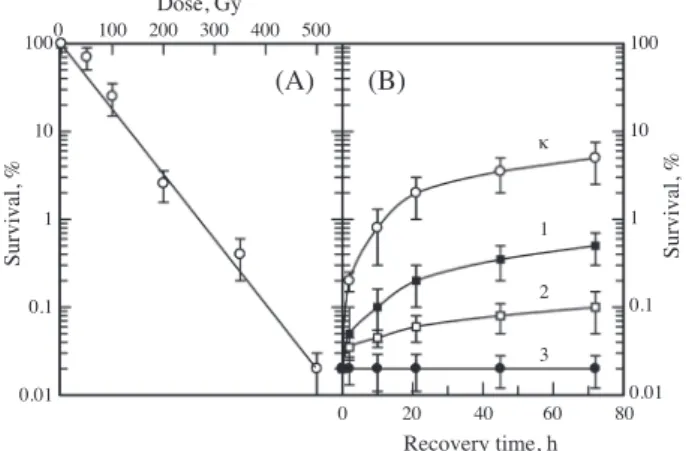
Fig. 2 exhibits the results of experiments with the same diploid yeast cells exposed to α-particles(densely ionizing radiation). The dependence of cell survival on dose and the duration of recovery presents in Fig. 2A and 2B corre-spondingly. One can see that the volume of recovery is pro-gressively decreased with increase in the concentration of cisplatin. Again, the cisplatin concentration of 0.02mg ml-1 completely inhibits LHR. Fig. 3 presents the decrement of the relative part of the recovered radiation damage A(t) as a
100 10 1 0.1 0.01 Dose, Gy 0 200 400 600 800 1000 1200 0 20 40 60 80 Recovery time, h 100 10 1 0.1 0.01 Survival, % Survival, % κ 1 2 3 (A) (B)
Fig. 1. Survival (A) and recovery (B) curves after irradiation with
60Co γ-rays. Irradiated cells recovered without cisplatin (K)
and in the presence of 0.0002 (curve 1), 0.002 (curve 2) and
0.02 (curve 3) mg ml-1 of cisplatin. 100 10 1 0.1 0.01 Dose, Gy 0 100 200 300 400 500 0 20 40 60 80 Recovery time, h 100 10 1 0.1 0.01 Survival, % Survival, % κ 1 2 3 (A) (B)
Fig. 2. Survival(A) and recovery(B) curves after irradiation with
239Pu α-particles. Irradiated cells were recovered without
cisplatin(K) and in the presence of 0.0002(curve 1), 0.002
function of recovery time after irradiation with 239Pu α-par-ticles(panel A) and with 60Co γ-rays(panel B): open circles -recovery without cisplatin, closed squares, open squares and closed circles-recovery in the presence of 0.0002, 0.002 and 0.02mg ml-1 of cisplatin correspondingly.
Using the experimental results represented in Figs. 1-3 we elucidated the irreversible component(Eq. 2) and the probability of recovery per unit time(constant of recov-ery)(Eq. 5). The results of our computation are totalized in Table 1. From these data we can draw the following import-ant conclusions. First of all, the irreversible component was greater for exposure to high-LET radiation in comparison with that produced by low-LET radiation when the cells were irradiated without drug whereas the increase in cis-platin concentration resulted in the disappearance of this difference for any condition of irradiation. Further, the in-crease in cisplatin concentration results in constant inin-crease in the part of irreversible damage independently of radia-tion quality and the cisplatin concentraradia-tion of 0.02mg ml-1 practically completely inhibited the LHR.
One can see from the data presented in Table 1 that the
recovery constant was the same after alpha- and gamma-ir-radiation independently of exposure conditions. The ob-served difference between constant recovery values was sta-tistically insignificant after gamma- and alpha-irradiation.
DISCUSSION
Inhibitors of cell recovery from radiation damage are attaining considerable interest for the treatment of cancer (Dasari and Tchounwou 2014). From a general point of view (Hall and Giaccia 2012), the effect of high-LET radiation may be modified before or during irradiation in a lesser ex-tent in comparison with that for low-LET radiation. In our paper, the dependence of cell survival on exposure dose and the duration of the LHR have been obtained for diploid yeast cells irradiated with ionizing radiation of different LET and recovering during postirradiation period without and with various concentration of cisplatin, widely used in clinical practice as an inhibitor of cell recovery. The major point to be inferred from the data described here is that the postirradiation inhibition of cell recovery by cisplatin may be revealed equally both after action of sparsely and dense-ly ionizing radiation on diploid yeast cells, the simplest model of eukaryotic cells. The probability of cell recovery was shown to be constant for various conditions of recovery after irradiation with ionizing radiation of different LET. This last assertion corresponds our previous publication (Petin and Kim 2005; Evstratova et al. 2016), where LHR kinetics in wild-type and radiosensitive mutants of Saccha-romyces yeast have been studied after exposure to low- and high-LET radiation. The increase in cisplatin concentra-tion was shown to result in constant increase in the porconcentra-tion of irreversible damage independently of radiation quality and the cisplatin concentration of 0.02mg ml-1 practically completely inhibited the LHR. Then one may believe that cisplatin inhibition of cell recovery after exposure to low- 1 0.1 0.01 0 10 20 30 40 50 Recovery time, h 0 10 20 30 40 50 Recovery time, h 1 0.1 0.01 A(t) A(t)
Fig. 3. The decrement of the relative part of the recovered radia tion
damage A(t) as a function of recovery time after irradiation
with 239Pu α-particles(A) and 60Co γ-rays(B): open circles-
recovery without cisplatin, closed squares, open squares and
closed circles-recovery in the presence of 0.0002, 0.002 and
0.02 mg ml-1 of cisplatin correspondingly.
(A) (B)
Table 1. LHR parameters of diploid Saccharomyces cerevisiae yeast cells recovered after gamma and alpha irradiation without and with
vari-ous concentration of cysplatin Concentration of
cisplatin(mg ml-1) Irreversible component The probability of recovery(h
-1)
After gamma irradiation After alpha irradiation After gamma irradiation After alpha irradiation
0 0.25±0.01 0.33±0.01 0.076±0.005 0.078±0.007
0.0002 0.66±0.02 0.62±0.01 0.084±0.006 0.080±0.005
0.002 0.80±0.02 0.80±0.02 0.089±0.008 0.081±0.009
-and high-LET radiations may be completely explained by the production of irreversible damage from which cells are incapable to recover. Very similar results were published for cultured mammalian cells irradiated with ionizing radia-tion and treated by various chemical compounds before and during postirradiation LHR(Kim et al. 2003, 2005; Petin et al. 2004, 2013). On this basis one may conclude that the mechanism of inhibition of cell recovery may be general both for the simplest and the highest eukaryotes.
The new data presented in this paper have a number of fundamental and practical implications. A fundamental sig-nificance of the data described is that the results of this and other papers(Kim et al. 2005; Petin et al. 2013) ensure an opportunity for searching agents, selectively or simultane-ously influence on the probability of recovery and the yield of irreversible radiation damage. The recognition that spe-cific inhibitors of recovery may exist, such as suppressor of the recovery process itself and that resulting in the increased yield of irreversible damage, would provide both a possibil-ity to analyze of the drugs and ionizing radiation interaction from this theoretical point of view and an expectation that useful regimens in cancer research may be devised to make use of these inhibitors. The main practical important of the results described is that there may exists effective drug sup-pressing cell recovery after densely ionizing radiation, and its effectiveness is comparable to its effect after applying the sparsely ionizing radiation. An important implication is also contained in the assertion that one can consider the recovery inhibition effect of cisplatin after cell exposure to α-particles as an additional advantage of densely ionizing radiation application in oncology therapy.
CONCLUSION
1. The ability of yeast cells to recover from radiation dam-age was less effective after cell exposure to high-LET radiation, when cells were irradiated without drug, the increase in cisplatin concentration resulted in the disap-pearance of this difference.
2. The increase of cisplatin concentration results in progres-sive increase in the fraction of irreversible damage inde-pendently of radiation quality.
3. The probability of cell recovery was shown to be con-stant for various conditions of recovery independently of radiation quality.
4. A new mechanism of chemical inhibitor action was sug-gested according with which the inhibition of cell recov-ery after exposure to ionizing radiations was completely explained by the production of irreversible damage.
ACKNOWLEDGMENT
This study has been supported by Russian Fund of Fun-damental Research and Administration of Kaluga Region (grant No. 16-34-00770), and also by the Brain Pool Pro-gram and National Research ProPro-gram by the Ministry of Science, ICT and Future Planning(MSIP) of Korea.
REFERENCES
Dale RG, Jones B and Carabe-Fernandez A. 2009. Why more needs to be known about RBE effects in modern radiother-apy. Appl. Radiat. Isot. 67:387-392.
Dasari S. and Tchounwou PB. 2014. Cisplatin in cancer ther-apy: molecular mechanisms of action. Eur. J. Pharmacol. 740:364-378.
Dasu A and Toma-Dasu I. 2008. What is the clinically relevant relative biological effectiveness? A warning for fractionat-ed treatments with high linear energy transfer. Int. J.
Radi-at. Oncol. Biol. Phys. 70:867-874.
Evstratova ES, Kim JK, Kim J-H and Petin VG. 2016. Influ-ence of chemical inhibitors on cell recovery after exposure to different LET radiation. 2016 Autumn Meeting of the Korean Association for Radiation Protection, Phoenix Is-land, Nov.30~Dec.2, 2016, Jeju.
Hall EJ and Giaccia AJ. 2012. Radiobiology for the Radiolo-gist. Lippimcott, Williams and Wilkins. 576 p.
Jones B, Underwood TSA and Dale RG. 2011. The potential impact of relative biological effectiveness uncertainty on charged particle treatment prescriptions. Br. J. Radiol. 84 (Spec. Iss. 1): S061-S069.
Kim JK, Komarova LN, Kim SH and Petin VG. 2007. Inhibi-tion of DNA repair from radiaInhibi-tion damage by hyperthermia is mainly realized through the production of irreversible damage. Indian J. Rad. Res. 4:188-195.
Kim JK, Komarova LN, Tkhabisimova MD and Petin VG. 2005. Inhibition of recovery from potentially lethal damage by chemicals in Chinese hamster cells is realized through the production of irreversible damage. Korean J. Environ.
Biol. 23:390-397.
Korogodin VI. 1958. Some regularity of the post-irradiation changes in resting yeast cells. Biofizika 3:703-710.
Moding EJ, Kastan MB and Kirsch DG. 2013. Strategies for optimizing the response of cancer and normal tissues to radiation. Nat. Rev. Drug. Discov. 12:526-542.
Patrick MH, Haynes RH and Uretz RB. 1964. Dark recovery phenomenon in yeast. 1. Comparative effects with various inactivating agents. Radiat. Res. 21:144-163.
Petin VG, Evstratova ES and Kim JK. 2014. Radiosensitivity, liquid-holding recovery and relative biological effective-ness of densely-ionizing radiation after repeated irradiation of yeast cells. Mutat. Res. 771:37-42.
Petin VG and Kapultcevich YuG. 2014. Radiation quality and the shape of dose-effect curves at low doses of ionizing radiation for eukaryotic cells. Mathem. Biosci. 252:1-6. Petin VG and Kim JK. 2005. Liquid holding recovery kinetics
in wild-type and radiosensitive mutants of the yeast Sac-charomyces exposed to low and high-LET radiations.
Mu-tat. Res. 570:1-8.
Petin VG, Kim JK, Evstratova ES and Komarova LN. 2013.
Quantitative estimation of recovery parameters after com-bined action of ionizing radiation and chemical agents. Int.
J. Radiat. Res. 11:17-27.
Petin VG and Kim JK. 2016. Synergistic Interaction and Cell Responses to Environmental Factors. New York: Nova Sci-ences Publisher. 337 p.
Raleigh DR and Haas-Kogan DA. 2013. Molecular targets and mechanisms of radiosensitization using DNA damage re-sponse pathways. Future Oncol. 9:219-223.
Takahashi S, Takeda E, Kubota Y and Okayasu R. 2000. Inhi-bition of repair of radiation-induced DNA double-strand breaks by nickel and arsenite. Radiat. Res. 154:686-691. Zamble DB and Lippard SJ. 1995. Cisplatin and DNA repair in
cancer chemotherapy. Trends Biochem. Sci. 20:435-439.
Received: 21 September 2016 Revised: 31 October 2016 Revision accepted: 7 November 2016